AFRICAN AMERICAN RIGHTS MOVEMENT(CIVIL WAR – PRESENT)Legal equality for African Americans was brought about through …Civil Rights ProtestExecutive Branch RulingSupreme Court Decisions
PROTESTS
PROTESTSNational Association for Advancement of Colored People=NAACP  Oldest, largest and most widely recognized civil rights group. Founded Feb. 12 1909.Peaceful protests are one of the largest factors of HOW African American’s received their rights.
BUS BOYCOTTS & SIT INNSDec. 1st 1955 Rosa Parks refused to give up bus seatSaid to be the beginning of modern civil rights movementBus boycott of Montgomery Alabama. Lasted 11 monthsSupreme Court then outlawed segregation on public transportAug. 19, 1958 Mrs. Lupa and her students started the peacful sit-ins at a Oaklahoma City drug storeSit-ins known for the difference they made in greensburro, NCThey were an effort to end segregation in restraunts.The “Blacks” sat peacfully at the “white” counter
PROTEST LEADERSMartin Luther King Jr.Leader of Montgomery Improvement AssociationBelieved in peaceful protestsApril 16th, 1963 “Letter from Birmingham Jail”Aug. 28th, 1963 Lincoln Memorial “I have a dream” speechMalcom“X”A minister for the “islam nation”Believed that non violent protest was pointlessTold his followers to defend themselves “by any means necessary”Constantly spoke against MLK Jr.
BLOODY SUNDAYMarch 7th 1965March to Polls stopped at Pettus Bridge by police blockade50 people were hospitalized by tear gas, whips, and clubsThe event that really made the differenceNot to be mistaken with many other historical events with the same nameFirst of three marches to Montogomery AL from Selma, AL. The only succeeding one was on March 21Not to be mistaken with many other historical events with the same name
EXECUTIVE BRANCH
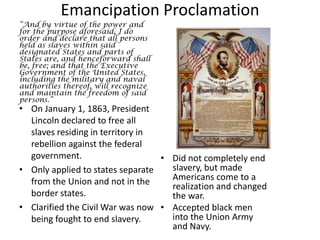
Emancipation Proclamation“And by virtue of the power and for the purpose aforesaid, I do order and declare that all persons held as slaves within said designated States and parts of States are, and henceforward shall be, free; and that the Executive Government of the United States, including the military and naval authorities thereof, will recognize and maintain the freedom of said persons.”On January 1, 1863, President Lincoln declared to free all slaves residing in territory in rebellion against the federal government. Only applied to states separate from the Union and not in the border states.Clarified the Civil War was now being fought to end slavery. Did not completely end slavery, but made Americans come to a realization and changed the war.Accepted black men into the Union Army and Navy.
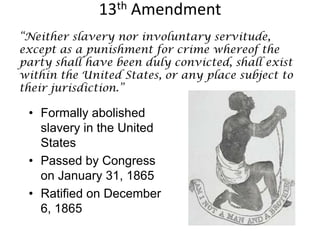
13th Amendment“Neither slavery nor involuntary servitude, except as a punishment for crime whereof the party shall have been duly convicted, shall exist within the United States, or any place subject to their jurisdiction.”Formally abolished slavery in the United StatesPassed by Congress on January 31, 1865 Ratified on December 6, 1865
14th Amendment"[A foreigner in the United States] has a right to the protection of the laws; but he is not a citizen in the ordinary acceptance of the word...""Every person born within the limits of the United States, and subject to their jurisdiction, is by virtue of natural law and national law a citizen of the United States.”Granted citizenship to “All persons born or naturalized in the United States,” thereby allowing citizenship to former slaves.Tried reconstructing between the struggle of black and white citizens to enforce the 14th amendment.Executive branch attempted to enforce measures that would guard all citizens’ rights.  Passed by Congress June 13, 1866. Ratified July 9, 1868.Designed to grant citizenship to and protect the civil liberties of recently freed slaves.Prohibited states from denying or abridging the privileges or immunities of citizens of the United States, depriving any person of his life, liberty, or property without due process of law, or denying to any person within their jurisdiction the equal protection of the laws.
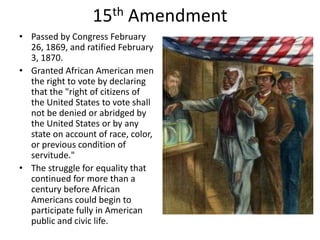
15th AmendmentPassed by Congress February 26, 1869, and ratified February 3, 1870.Granted African American men the right to vote by declaring that the "right of citizens of the United States to vote shall not be denied or abridged by the United States or by any state on account of race, color, or previous condition of servitude." The struggle for equality that continued for more than a century before African Americans could begin to participate fully in American public and civic life.
President Truman Appoints Committee on Civil Rights Orders Desegregation of MilitaryDecember 5, 1946Created the President’s Committee on Civil RightsCommittee would “inquire into and determine whether and in what respect current law enforcement measures…may be strengthened and improved to safeguard the civil rights of the people.”Also authorized it to make “recommendations with respect to…more adequate and effective means and procedures for the protection of civil rights.”Helped arouse public awareness of racism as a national problem. Provided more than 25,000 copies of To Secure These Rights to the press.  President called To Secure These Rights “an American charter of human freedom…[and] a guide for action.”July 26, 1948Established President's Committee on Equality of Treatment and Opportunity in the Armed ServicesDetermined to end military segregationExecutive Order No. 9981 stated, "It is hereby declared to be the policy of the President that there shall be equality of treatment and opportunity for all persons in the armed services without regard to race, color, religion, or national origin."
SUPREME COURT
Supreme Court cases Civil war-1950s1857: Dred Scott vs. SanfordDred Scott was a slave taken from a slave state to a free territoryScott filed a lawsuit claiming that because he lived on free soil he was entitled to his freedomAllowed slavery in the territoriesIntensified the national debate over slaveryThe Chief Justice, Roger B. Taney, ruled that blacks were not citizens and could not sue in federal court(he said that Congress had no right to ban slavery from U.S. territories) The declared opinion of the Supreme Court fanned the flames of slavery controversy leading up to the Civil War 4 years later1873: slaughterhouse cases (undermine the Civil Rights Act of 1866)Originally had nothing to do with the rights of freed slaves although it was on the interpretation of the 14th Amendment Brought to court by a group of white business menThey were arguing the constitutionality of a 1869 Louisiana statute that granted exclusive rights to the Crescent City Livestock Landing & Slaughterhouse Company to do business (because it had bribed the State Legislature)“No State shall make or enforce any law which shall abridge the privileges or immunities of citizens of the United States.”
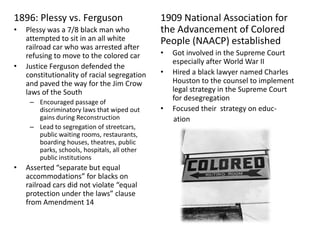
1909 National Association for the Advancement of Colored People (NAACP) establishedGot involved in the Supreme Court especially after World War II Hired a black lawyer named Charles Houston to the counsel to implement legal strategy in the Supreme Court for desegregationFocused their  strategy on educ-      ation1896: Plessy vs. FergusonPlessy was a 7/8 black man who attempted to sit in an all white railroad car who was arrested after refusing to move to the colored car Justice Ferguson defended the constitutionality of racial segregation and paved the way for the Jim Crow laws of the SouthEncouraged passage of discriminatory laws that wiped out gains during ReconstructionLead to segregation of streetcars, public waiting rooms, restaurants, boarding houses, theatres, public parks, schools, hospitals, all other public institutionsAsserted “separate but equal accommodations” for blacks on railroad cars did not violate “equal protection under the laws” clause from Amendment 14
1938 Missouri ex rel Gaines vs. CanadaIn 1929 Houston became the dean of Howard University Law School and transformed his idea to school policyHe trained students in the use of the 14th Amendment to fight racial discriminationJustice James McReynolds turned in his chair and kept his back to Houston during his whole presentationThe decision held that states providing education for white people must provide it for blacks as well which allowed Lloyd Gaines into the University of MissouriAs a result of the case, the University of Law School was opened to black applicantsWorld War II (1939-1945/Vday or 1951/Treat of peace with Japan signed)During WWII the drive to end discrimination was put on the back burner
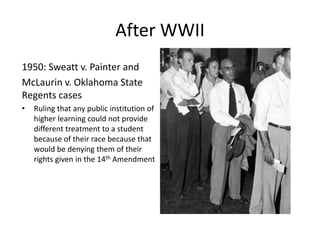
When WWII ended blacks were even more determined to get equality especially because they had just gone and fought in a war for a country in which they did not even have the freedom to use public facilities or obtain the best schooling the country had to offerAfter WWII1950: Sweatt v. Painter and McLaurinv. Oklahoma State Regents casesRuling that any public institution of higher learning could not provide different treatment to a student because of their race because that would be denying them of their rights given in the 14th Amendment
SUPREME COURT CONT…
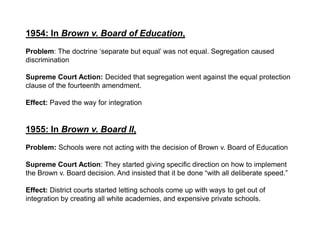
1954: In Brown v. Board of Education,Problem: The doctrine ‘separate but equal’ was not equal. Segregation caused discriminationSupreme Court Action: Decided that segregation went against the equal protection clause of the fourteenth amendment. Effect: Paved the way for integration1955: In Brown v. Board II, Problem: Schools were not acting with the decision of Brown v. Board of EducationSupreme Court Action: They started giving specific direction on how to implement the Brown v. Board decision. And insisted that it be done “with all deliberate speed.”Effect: District courts started letting schools come up with ways to get out of integration by creating all white academies, and expensive private schools.
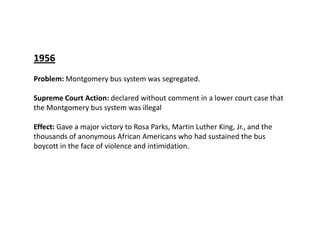
1956Problem: Montgomery bus system was segregated.Supreme Court Action:declared without comment in a lower court case thattheMontgomery bus system was illegalEffect: Gave a major victory to Rosa Parks, Martin Luther King, Jr., and the thousands of anonymous African Americans who had sustained the bus boycott in the face of violence and intimidation.
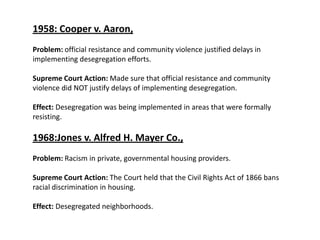
1958: Cooper v. Aaron, Problem: official resistance and community violence justified delays in implementing desegregation efforts. Supreme Court Action: Made sure that official resistance and community violence did NOT justify delays of implementing desegregation. Effect: Desegregation was being implemented in areas that were formally resisting. 1968:Jones v. Alfred H. Mayer Co.,Problem: Racism in private, governmental housing providers. Supreme Court Action: The Court held that the Civil Rights Act of 1866 bans racial discrimination in housing.Effect: Desegregated neighborhoods.
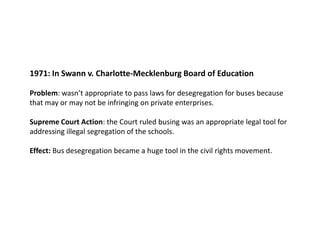
1971: In Swann v. Charlotte-Mecklenburg Board of EducationProblem: wasn’t appropriate to pass laws for desegregation for buses because that may or may not be infringing on private enterprises.  Supreme Court Action: the Court ruled busing was an appropriate legal tool for addressing illegal segregation of the schools. Effect: Bus desegregation became a huge tool in the civil rights movement.
1971: In Griggs v. Duke Power Co.PROBLEM: African American applicants for jobs at the Duke Power Company were prohibited when the tests were not shown to be job-related. Supreme Court Action: the Supreme Court ruled that Title VII of the 1964 Civil Rights Act prohibits not only intentional job discrimination, but also employer practices that have a discriminatory effect on minorities and womenEffect: Desegregation in the workplace began to become more common.
ConclusionCivil rights and eqaulity is a continuing endeavor and we have the obligation to support to integration of all of God’s children.he ainviteth them ball to ccome unto him and partake of his goodness; and he ddenieth none that come unto him, black and white, ebond and free, male and female; and he remembereth the fheathen; and all are alike unto God, both Jew and Gentile.

No danny

  • 2.
    AFRICAN AMERICAN RIGHTSMOVEMENT(CIVIL WAR – PRESENT)Legal equality for African Americans was brought about through …Civil Rights ProtestExecutive Branch RulingSupreme Court Decisions
  • 3.
  • 4.
    PROTESTSNational Association forAdvancement of Colored People=NAACP Oldest, largest and most widely recognized civil rights group. Founded Feb. 12 1909.Peaceful protests are one of the largest factors of HOW African American’s received their rights.
  • 5.
    BUS BOYCOTTS &SIT INNSDec. 1st 1955 Rosa Parks refused to give up bus seatSaid to be the beginning of modern civil rights movementBus boycott of Montgomery Alabama. Lasted 11 monthsSupreme Court then outlawed segregation on public transportAug. 19, 1958 Mrs. Lupa and her students started the peacful sit-ins at a Oaklahoma City drug storeSit-ins known for the difference they made in greensburro, NCThey were an effort to end segregation in restraunts.The “Blacks” sat peacfully at the “white” counter
  • 6.
    PROTEST LEADERSMartin LutherKing Jr.Leader of Montgomery Improvement AssociationBelieved in peaceful protestsApril 16th, 1963 “Letter from Birmingham Jail”Aug. 28th, 1963 Lincoln Memorial “I have a dream” speechMalcom“X”A minister for the “islam nation”Believed that non violent protest was pointlessTold his followers to defend themselves “by any means necessary”Constantly spoke against MLK Jr.
  • 7.
    BLOODY SUNDAYMarch 7th1965March to Polls stopped at Pettus Bridge by police blockade50 people were hospitalized by tear gas, whips, and clubsThe event that really made the differenceNot to be mistaken with many other historical events with the same nameFirst of three marches to Montogomery AL from Selma, AL. The only succeeding one was on March 21Not to be mistaken with many other historical events with the same name
  • 8.
  • 9.
    Emancipation Proclamation“And byvirtue of the power and for the purpose aforesaid, I do order and declare that all persons held as slaves within said designated States and parts of States are, and henceforward shall be, free; and that the Executive Government of the United States, including the military and naval authorities thereof, will recognize and maintain the freedom of said persons.”On January 1, 1863, President Lincoln declared to free all slaves residing in territory in rebellion against the federal government. Only applied to states separate from the Union and not in the border states.Clarified the Civil War was now being fought to end slavery. Did not completely end slavery, but made Americans come to a realization and changed the war.Accepted black men into the Union Army and Navy.
  • 10.
    13th Amendment“Neither slaverynor involuntary servitude, except as a punishment for crime whereof the party shall have been duly convicted, shall exist within the United States, or any place subject to their jurisdiction.”Formally abolished slavery in the United StatesPassed by Congress on January 31, 1865 Ratified on December 6, 1865
  • 11.
    14th Amendment"[A foreignerin the United States] has a right to the protection of the laws; but he is not a citizen in the ordinary acceptance of the word...""Every person born within the limits of the United States, and subject to their jurisdiction, is by virtue of natural law and national law a citizen of the United States.”Granted citizenship to “All persons born or naturalized in the United States,” thereby allowing citizenship to former slaves.Tried reconstructing between the struggle of black and white citizens to enforce the 14th amendment.Executive branch attempted to enforce measures that would guard all citizens’ rights. Passed by Congress June 13, 1866. Ratified July 9, 1868.Designed to grant citizenship to and protect the civil liberties of recently freed slaves.Prohibited states from denying or abridging the privileges or immunities of citizens of the United States, depriving any person of his life, liberty, or property without due process of law, or denying to any person within their jurisdiction the equal protection of the laws.
  • 12.
    15th AmendmentPassed byCongress February 26, 1869, and ratified February 3, 1870.Granted African American men the right to vote by declaring that the "right of citizens of the United States to vote shall not be denied or abridged by the United States or by any state on account of race, color, or previous condition of servitude." The struggle for equality that continued for more than a century before African Americans could begin to participate fully in American public and civic life.
  • 13.
    President Truman AppointsCommittee on Civil Rights Orders Desegregation of MilitaryDecember 5, 1946Created the President’s Committee on Civil RightsCommittee would “inquire into and determine whether and in what respect current law enforcement measures…may be strengthened and improved to safeguard the civil rights of the people.”Also authorized it to make “recommendations with respect to…more adequate and effective means and procedures for the protection of civil rights.”Helped arouse public awareness of racism as a national problem. Provided more than 25,000 copies of To Secure These Rights to the press. President called To Secure These Rights “an American charter of human freedom…[and] a guide for action.”July 26, 1948Established President's Committee on Equality of Treatment and Opportunity in the Armed ServicesDetermined to end military segregationExecutive Order No. 9981 stated, "It is hereby declared to be the policy of the President that there shall be equality of treatment and opportunity for all persons in the armed services without regard to race, color, religion, or national origin."
  • 14.
  • 15.
    Supreme Court casesCivil war-1950s1857: Dred Scott vs. SanfordDred Scott was a slave taken from a slave state to a free territoryScott filed a lawsuit claiming that because he lived on free soil he was entitled to his freedomAllowed slavery in the territoriesIntensified the national debate over slaveryThe Chief Justice, Roger B. Taney, ruled that blacks were not citizens and could not sue in federal court(he said that Congress had no right to ban slavery from U.S. territories) The declared opinion of the Supreme Court fanned the flames of slavery controversy leading up to the Civil War 4 years later1873: slaughterhouse cases (undermine the Civil Rights Act of 1866)Originally had nothing to do with the rights of freed slaves although it was on the interpretation of the 14th Amendment Brought to court by a group of white business menThey were arguing the constitutionality of a 1869 Louisiana statute that granted exclusive rights to the Crescent City Livestock Landing & Slaughterhouse Company to do business (because it had bribed the State Legislature)“No State shall make or enforce any law which shall abridge the privileges or immunities of citizens of the United States.”
  • 16.
    1909 National Associationfor the Advancement of Colored People (NAACP) establishedGot involved in the Supreme Court especially after World War II Hired a black lawyer named Charles Houston to the counsel to implement legal strategy in the Supreme Court for desegregationFocused their strategy on educ- ation1896: Plessy vs. FergusonPlessy was a 7/8 black man who attempted to sit in an all white railroad car who was arrested after refusing to move to the colored car Justice Ferguson defended the constitutionality of racial segregation and paved the way for the Jim Crow laws of the SouthEncouraged passage of discriminatory laws that wiped out gains during ReconstructionLead to segregation of streetcars, public waiting rooms, restaurants, boarding houses, theatres, public parks, schools, hospitals, all other public institutionsAsserted “separate but equal accommodations” for blacks on railroad cars did not violate “equal protection under the laws” clause from Amendment 14
  • 17.
    1938 Missouri exrel Gaines vs. CanadaIn 1929 Houston became the dean of Howard University Law School and transformed his idea to school policyHe trained students in the use of the 14th Amendment to fight racial discriminationJustice James McReynolds turned in his chair and kept his back to Houston during his whole presentationThe decision held that states providing education for white people must provide it for blacks as well which allowed Lloyd Gaines into the University of MissouriAs a result of the case, the University of Law School was opened to black applicantsWorld War II (1939-1945/Vday or 1951/Treat of peace with Japan signed)During WWII the drive to end discrimination was put on the back burner
  • 18.
    When WWII endedblacks were even more determined to get equality especially because they had just gone and fought in a war for a country in which they did not even have the freedom to use public facilities or obtain the best schooling the country had to offerAfter WWII1950: Sweatt v. Painter and McLaurinv. Oklahoma State Regents casesRuling that any public institution of higher learning could not provide different treatment to a student because of their race because that would be denying them of their rights given in the 14th Amendment
  • 19.
  • 20.
    1954: In Brownv. Board of Education,Problem: The doctrine ‘separate but equal’ was not equal. Segregation caused discriminationSupreme Court Action: Decided that segregation went against the equal protection clause of the fourteenth amendment. Effect: Paved the way for integration1955: In Brown v. Board II, Problem: Schools were not acting with the decision of Brown v. Board of EducationSupreme Court Action: They started giving specific direction on how to implement the Brown v. Board decision. And insisted that it be done “with all deliberate speed.”Effect: District courts started letting schools come up with ways to get out of integration by creating all white academies, and expensive private schools.
  • 21.
    1956Problem: Montgomery bussystem was segregated.Supreme Court Action:declared without comment in a lower court case thattheMontgomery bus system was illegalEffect: Gave a major victory to Rosa Parks, Martin Luther King, Jr., and the thousands of anonymous African Americans who had sustained the bus boycott in the face of violence and intimidation.
  • 22.
    1958: Cooper v.Aaron, Problem: official resistance and community violence justified delays in implementing desegregation efforts. Supreme Court Action: Made sure that official resistance and community violence did NOT justify delays of implementing desegregation. Effect: Desegregation was being implemented in areas that were formally resisting. 1968:Jones v. Alfred H. Mayer Co.,Problem: Racism in private, governmental housing providers. Supreme Court Action: The Court held that the Civil Rights Act of 1866 bans racial discrimination in housing.Effect: Desegregated neighborhoods.
  • 23.
    1971: In Swannv. Charlotte-Mecklenburg Board of EducationProblem: wasn’t appropriate to pass laws for desegregation for buses because that may or may not be infringing on private enterprises. Supreme Court Action: the Court ruled busing was an appropriate legal tool for addressing illegal segregation of the schools. Effect: Bus desegregation became a huge tool in the civil rights movement.
  • 24.
    1971: In Griggsv. Duke Power Co.PROBLEM: African American applicants for jobs at the Duke Power Company were prohibited when the tests were not shown to be job-related. Supreme Court Action: the Supreme Court ruled that Title VII of the 1964 Civil Rights Act prohibits not only intentional job discrimination, but also employer practices that have a discriminatory effect on minorities and womenEffect: Desegregation in the workplace began to become more common.
  • 25.
    ConclusionCivil rights andeqaulity is a continuing endeavor and we have the obligation to support to integration of all of God’s children.he ainviteth them ball to ccome unto him and partake of his goodness; and he ddenieth none that come unto him, black and white, ebond and free, male and female; and he remembereth the fheathen; and all are alike unto God, both Jew and Gentile.

Editor's Notes

  • #10 http://libertyonline.hypermall.com/Lincoln/emancipate.htmlhttp://www.archives.gov/exhibits/featured_documents/emancipation_proclamation/
  • #12 http://www.ourdocuments.gov/doc.php?flash=true&doc=43http://www.14thamendment.us/index.html
  • #13 http://www.loc.gov/rr/program/bib/ourdocs/15thamendment.htmlhttp://www.ourdocuments.gov/doc.php?doc=44
  • #14 PRESIDENT TRUMAN'S COMMITTEE ON CIVIL RIGHTShttp://www.trumanlibrary.org/anniversaries/desegblurb.htmhttp://theomahaproject.org/module_display.php?mod_id=48&review=yes