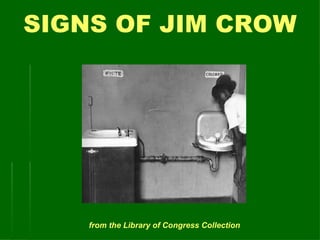
SIGNS OF JIM CROW   from the Library of Congress Collection
      What were Jim Crow laws? From the 1880s into the 1960s, most American states enforced segregation through " Jim Crow " laws (so called after a black character in minstrel shows). From Delaware to California, and from North Dakota to Texas, many states (and cities, too) could impose legal punishments on people for mingling with members of another race. The most common types of laws forbade intermarriage and ordered business owners and public institutions to keep blacks and whites separated.
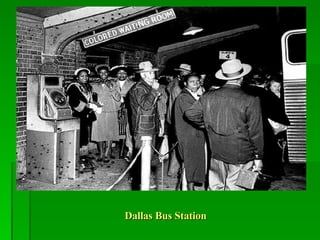
Some Facilities that Were Separate:  Bus station waiting rooms and ticket windows Railroad cars or coaches Restaurants and lunch counters Schools and public parks Restrooms and water fountains Sections of movie theaters There were even separate cemeteries
JUST IMAGINE… You are Black.  You must address all whites as Yes Sir, Yes Ma’am. You must not look a white person in the eye – always head down You must walk in the street to yield to Whites on sidewalks
Dallas Bus Station
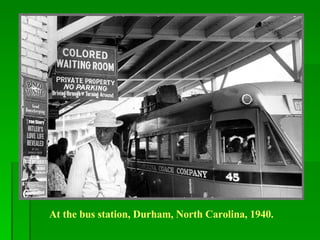
At the bus station, Durham, North Carolina, 1940.
Greyhound bus terminal, Memphis, Tennessee. 1943.
A rest stop for bus passengers on the way from Louisville, Kentucky to Nashville, Tennessee, with separate entrance for Blacks. 1943.
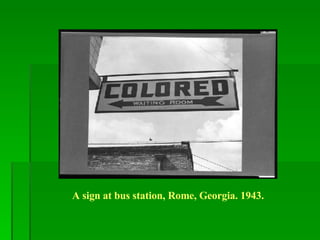
A sign at bus station, Rome, Georgia. 1943.
A highway sign advertising tourist cabins for Blacks, South Carolina. 1939.
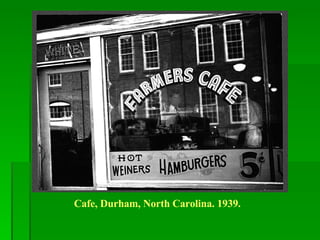
Cafe, Durham, North Carolina. 1939.
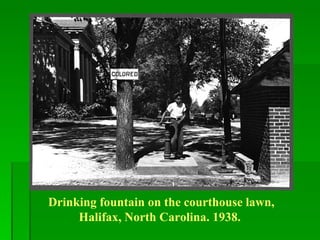
Drinking fountain on the courthouse lawn, Halifax, North Carolina. 1938.
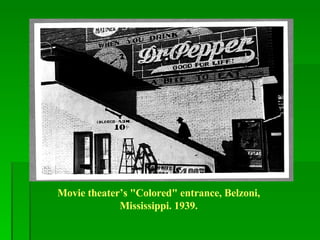
Movie theater’s "Colored" entrance, Belzoni, Mississippi. 1939.
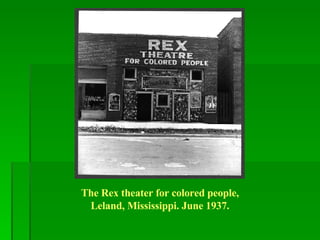
The Rex theater for colored people, Leland, Mississippi. June 1937.
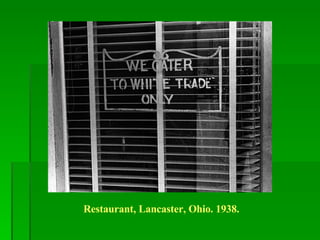
Restaurant, Lancaster, Ohio. 1938.
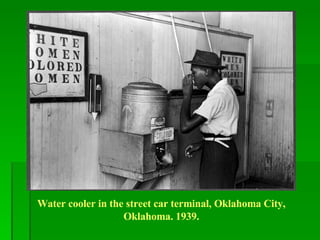
Water cooler in the street car terminal, Oklahoma City, Oklahoma. 1939.
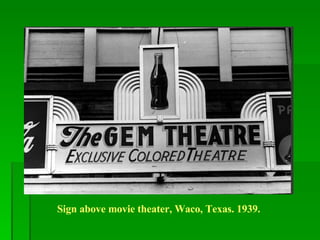
Sign above movie theater, Waco, Texas. 1939.
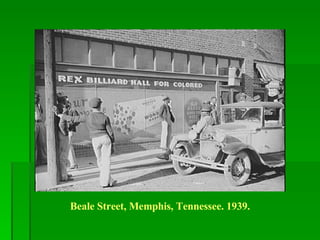
Beale Street, Memphis, Tennessee. 1939.
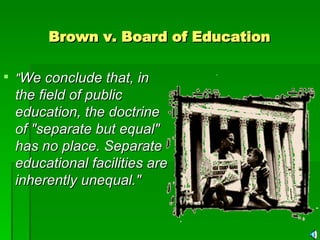
Brown v. Board of Education   " We conclude that, in the field of public education, the doctrine of "separate but equal" has no place. Separate educational facilities are inherently unequal."
What Happened? On May 17, 1954, the U.S. Supreme Court ruled unanimously that racial segregation in public schools violated the Fourteenth Amendment to the Constitution, which says that no state may deny equal protection of the laws to any person within its jurisdiction. The 1954 decision declared that separate educational facilities were inherently unequal.
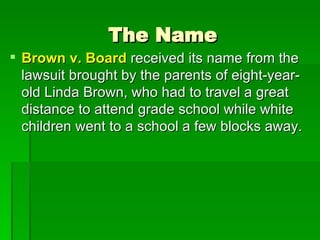
The Name Brown v. Board  received its name from the lawsuit brought by the parents of eight-year-old Linda Brown, who had to travel a great distance to attend grade school while white children went to a school a few blocks away.
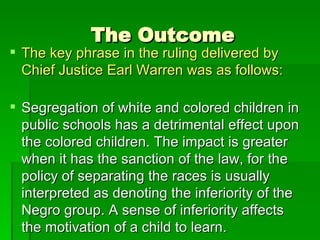
The Outcome The key phrase in the ruling delivered by Chief Justice Earl Warren was as follows:  Segregation of white and colored children in public schools has a detrimental effect upon the colored children. The impact is greater when it has the sanction of the law, for the policy of separating the races is usually interpreted as denoting the inferiority of the Negro group. A sense of inferiority affects the motivation of a child to learn.
Continued… Segregation with the sanction of law, therefore, has a tendency to [retard] the educational and mental development of Negro children and to deprive them of some of the benefits they would receive in a racially integrated school system. ...  We conclude that, in the field of public education, the doctrine of "separate but equal" has no place. Separate educational facilities are inherently unequal."

Jim Crow Signs Powerpoint

  • 1.
    SIGNS OF JIMCROW   from the Library of Congress Collection
  • 2.
          What wereJim Crow laws? From the 1880s into the 1960s, most American states enforced segregation through " Jim Crow " laws (so called after a black character in minstrel shows). From Delaware to California, and from North Dakota to Texas, many states (and cities, too) could impose legal punishments on people for mingling with members of another race. The most common types of laws forbade intermarriage and ordered business owners and public institutions to keep blacks and whites separated.
  • 3.
    Some Facilities thatWere Separate: Bus station waiting rooms and ticket windows Railroad cars or coaches Restaurants and lunch counters Schools and public parks Restrooms and water fountains Sections of movie theaters There were even separate cemeteries
  • 4.
    JUST IMAGINE… Youare Black. You must address all whites as Yes Sir, Yes Ma’am. You must not look a white person in the eye – always head down You must walk in the street to yield to Whites on sidewalks
  • 5.
  • 6.
    At the busstation, Durham, North Carolina, 1940.
  • 7.
    Greyhound bus terminal,Memphis, Tennessee. 1943.
  • 8.
    A rest stopfor bus passengers on the way from Louisville, Kentucky to Nashville, Tennessee, with separate entrance for Blacks. 1943.
  • 9.
    A sign atbus station, Rome, Georgia. 1943.
  • 10.
    A highway signadvertising tourist cabins for Blacks, South Carolina. 1939.
  • 11.
    Cafe, Durham, NorthCarolina. 1939.
  • 12.
    Drinking fountain onthe courthouse lawn, Halifax, North Carolina. 1938.
  • 13.
    Movie theater’s "Colored"entrance, Belzoni, Mississippi. 1939.
  • 14.
    The Rex theaterfor colored people, Leland, Mississippi. June 1937.
  • 15.
  • 16.
    Water cooler inthe street car terminal, Oklahoma City, Oklahoma. 1939.
  • 17.
    Sign above movietheater, Waco, Texas. 1939.
  • 18.
    Beale Street, Memphis,Tennessee. 1939.
  • 19.
    Brown v. Boardof Education " We conclude that, in the field of public education, the doctrine of "separate but equal" has no place. Separate educational facilities are inherently unequal."
  • 20.
    What Happened? OnMay 17, 1954, the U.S. Supreme Court ruled unanimously that racial segregation in public schools violated the Fourteenth Amendment to the Constitution, which says that no state may deny equal protection of the laws to any person within its jurisdiction. The 1954 decision declared that separate educational facilities were inherently unequal.
  • 21.
    The Name Brownv. Board received its name from the lawsuit brought by the parents of eight-year-old Linda Brown, who had to travel a great distance to attend grade school while white children went to a school a few blocks away.
  • 22.
    The Outcome Thekey phrase in the ruling delivered by Chief Justice Earl Warren was as follows: Segregation of white and colored children in public schools has a detrimental effect upon the colored children. The impact is greater when it has the sanction of the law, for the policy of separating the races is usually interpreted as denoting the inferiority of the Negro group. A sense of inferiority affects the motivation of a child to learn.
  • 23.
    Continued… Segregation withthe sanction of law, therefore, has a tendency to [retard] the educational and mental development of Negro children and to deprive them of some of the benefits they would receive in a racially integrated school system. ... We conclude that, in the field of public education, the doctrine of "separate but equal" has no place. Separate educational facilities are inherently unequal."