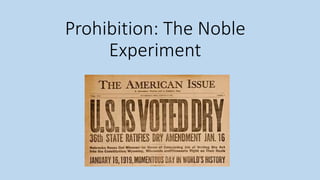
Prohibition: The Noble
Experiment
Prohibition Lesson Introduction
California Content Standard 11.5.3: Examine the passage of the Eighteenth
Amendment to the Constitution and the Volstead Act (Prohibition).
Big Ideas & Overall Lesson Goals:
• Understand what the 18th Amendment and Volstead Act are.
• Know the causes for the Prohibition and the effects it had on American
Society.
Student Learning Objectives:
• Students will be able to explain what the 18th Amendment and Volstead Act
are.
• They will be able to analyze the causes and effects of the Prohibition.
The 18th Amendment
• The 18th Amendment made the production, transportation, and sale of
alcohol illegal.
• Also made illegal importation and exportation of alcohol.
• Did not specifically state that the consumption of alcohol was illegal.
• It was ratified in January of 1919, thereby taking effect in January of
1920.
• The text itself called for this to begin a year after ratification.
• This was considered a Progressive Amendment.
• Only two state rejected this amendment: Connecticut and Rhode Island.
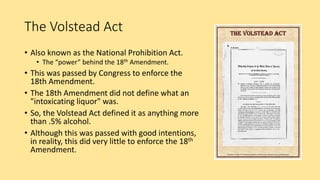
The Volstead Act
• Also known as the National Prohibition Act.
• The “power” behind the 18th Amendment.
• This was passed by Congress to enforce the 18th
Amendment.
• The 18th Amendment did not define what an
"intoxicating liquor" was.
• So, the Volstead Act defined it as anything more
than .5% alcohol.
• President Wilson vetoed the Volstead Act on
constitutional grounds.
• His veto was overridden by Congress.
• Although this was passed with good intentions, in
reality, this did very little to enforce the 18th
Amendment.
Clarification Question:
1. What is the difference between the 18th Amendment
and the Volstead Act? Explain this difference in a
comment on the very first slide of the Voice Thread
below this presentation.
Movement for Prohibition
• 1820s & 30s wave of religious revivalism swept the U.S.
• This led to an increase call for temperance, which was to stop the
consumption of alcohol.
• Women's Christian Temperance Movement
• Women played strong roles.
• They felt that alcohol was a driving force in the destruction of marriage and families.
• Also believed that it was a leading cause of domestic abuse and child neglect.
• Carrie Nation- major influential woman in this movement. (View a short clip about her
on the next slide.)
• Anti-Saloon League (1893-1933)
• They influenced politics through lobbying and the written word.
• Turned into a moral crusade against alcohol.
Supporters of Prohibition
• The supporters of Prohibition were called "drys.“
• Mostly middle class Americans.
• Also Progressives.
• Women (for the reasons discussed earlier).
• Even as this "noble experiment" loses support throughout
time, rural Protestant Americans (especially from the
South and West) will still defend it.
• To them, drinking symbolized a "new culture" and they wanted
to protect their traditional views of morality.
• Factory Owners
• Did not like the fact that their employees were coming to work
drunk or hungover.
• This caused many accidents at work and decreased workers’
productivity.
(The "wets" opposed Prohibition.)
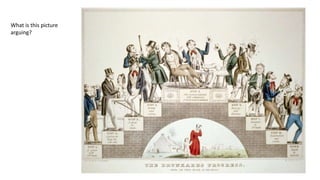
Source Questions:
1. What is this
picture portraying?
What is the idea
that this image is
trying to argue?
2. Of all of the
advocates of
Prohibition we
discussed earlier,
who would likely
use this image as a
tool to persuade
others?
Answer these questions in the second slide of the Voice Thread below this
presentation.
How WWI Influenced Prohibition
• Fed off of Anti-German Sentiment
• Most breweries owned by German Americans
• Anti-Saloon league called beer “Kaiser’s Brew”
• Need to Conserve Wheat
• Jan 1917 - Wilson instituted a partial prohibition in effort to conserve grain
• Sept 1917 – banned a wartime production of beer
• “Grain should be made into bread for fighting men and not for making liquor.”
• It was considered unpatriotic to consume beer
The Argument: Drys vs Wets
Drys argued that banning alcohol would:
• Improve individuals wellbeing
• Strengthen families
• Create a better society
• Help to stop disease
Wets argued that banning alcohol:
• Didn’t stop Americans from drinking
anyways
• Turned law abiding citizens into
criminals
• Created and strengthened illegal
networks
• Led to an increase in crime, violence,
and corruption
Viewpoint/ Perspective Question:
1.If you were alive during this time period, would
you have been a “dry” or a “wet?” Answer this
question on the third part of the Voice Thread.
What Effects did this Have on American
Society?
• There were a few positive effects:
• This did reduce drinking in most parts of the country, especially because
bootlegging was so expensive.
• Before Prohibition, “nice” women were not allowed in saloons. During the
Prohibition, women were allowed to engage in and enjoy the new, emerging
social gatherings.
• The money being saved by some households who weren’t buying alcohol
were now able to buy consumer items (like appliances) and possibly even
start their own small businesses.
• However, there were many negative effects of the Prohibition.
Negative Economic Effects
• The closing of breweries, distilleries and saloons led to the loss of an enormous
number of jobs.
• There was also loss of jobs among truckers, barrel makers, glass workers,
hospitality workers and many others.
• Before Prohibition, many states relied heavily on alcohol excise taxes for their
budgets.
• In New York, almost 75% of the state’s revenue was from such taxes.
• With Prohibition, that revenue was lost.
• Prohibition cost the federal government $11 billion in lost tax revenue.
• And it cost over $300 million to enforce.
• From then on, most states and the federal government would increasingly rely
on income taxes.
Negative Political Effects
• Prohibition led to the growth of widespread corruption of public officials by
organized crime.
• This enabled gangsters to conduct their illegal operations.
• The extent of the corruption was a national scandal.
• Prohibition led to widespread hypocrisy that reached the highest levels of
government.
• Congress had its own bootleggers.
• There were many reports of cocktails enjoyed in the halls of Congress
between sessions- sessions discussing Prohibition and its enforcement.
• Prohibition led to an increase in people having no respect for the law.
• Breaking the law, even flaunting it, became exciting and popular, especially
amongst young people.
Negative Social Effects
• Prohibition led to the rapid rise of speakeasies.
• Speakeasies owned by gangsters replaced neighborhood
bars. They promoted heavy drinking, gambling and
prostitution.
• Secret saloon bars opened up in cellars and back rooms.
• They had names like the ‘Dizzy Club’ and drinkers had to
give a password or knock at the door in code to be let in.
• Speakeasies sold ‘bootleg’ alcohol, smuggled into America
from abroad.
• Before Prohibition there were 15,000 bars in New York.
• By 1926 there were 30,000 speakeasies.
• This example shows that Prohibition did not actually prevent
people from drinking if they wanted to.
• It just drove it underground.
Enjoy a music clip of a popular song played in Speakeasies on the next
slide!
Negative Social Effects Continued
• Prohibition promoted the rapid growth of organized crime.
• It created a demand for illegal alcohol that criminals could sell at
high prices.
• The price of spirits rose 24%. That of beer jumped 700% .
• The profits of organized crime were enormous. This gave
gangsters great political power.
• One notorious gangster, Al Capone, is featured in the video on the next
slide.
• Bootleggers- people who smuggled alcohol illegally
Negative Cultural Effects
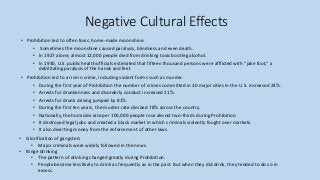
• Prohibition led to often toxic, home-made moonshine.
• Sometimes the moonshine caused paralysis, blindness and even death.
• In 1927 alone, almost 12,000 people died from drinking toxic bootleg alcohol.
• In 1930, U.S. public health officials estimated that fifteen thousand persons were afflicted with “jake foot,” a
debilitating paralysis of the hands and feet
• Prohibition led to a rise in crime, including violent forms such as murder.
• During the first year of Prohibition the number of crimes committed in 30 major cities in the U.S. increased 24%.
• Arrests for drunkenness and disorderly conduct increased 21%.
• Arrests for drunk driving jumped by 81%.
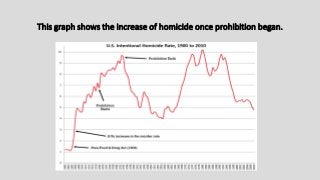
• During the first ten years, the murder rate climbed 78% across the country.
• Nationally, the homicide rate per 100,000 people rose almost two-thirds during Prohibition.
• It destroyed legal jobs and created a black market in which criminals violently fought over markets.
• It also diverting money from the enforcement of other laws.
• Glorification of gangsters
• Major criminals were widely followed in the news.
• Binge drinking
• The pattern of drinking changed greatly during Prohibition.
• People became less likely to drink as frequently as in the past. But when they did drink, they tended to do so in
excess.
This graph shows the increase of homicide once prohibition began.
How Did This End?
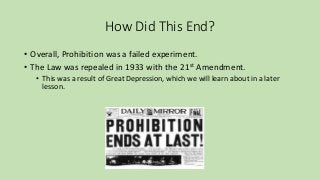
• Overall, Prohibition was a failed experiment.
• The Law was repealed in 1933 with the 21st Amendment.
• This was a result of Great Depression, which we will learn about in a later
lesson.
Hypothetical Question:
1. Pretend you were a politician during this time period. Clearly, we
can see that the Prohibition did not work the way it was
intended to. But, there were still many issues and societal
problems that supporters of the Prohibition were attempting to
solve. What would you have proposed as a better alternative?
Answer this question on the last slide of the Voice Thread.

Prohibition

  • 1.
  • 2.
    Prohibition Lesson Introduction CaliforniaContent Standard 11.5.3: Examine the passage of the Eighteenth Amendment to the Constitution and the Volstead Act (Prohibition). Big Ideas & Overall Lesson Goals: • Understand what the 18th Amendment and Volstead Act are. • Know the causes for the Prohibition and the effects it had on American Society. Student Learning Objectives: • Students will be able to explain what the 18th Amendment and Volstead Act are. • They will be able to analyze the causes and effects of the Prohibition.
  • 3.
    The 18th Amendment •The 18th Amendment made the production, transportation, and sale of alcohol illegal. • Also made illegal importation and exportation of alcohol. • Did not specifically state that the consumption of alcohol was illegal. • It was ratified in January of 1919, thereby taking effect in January of 1920. • The text itself called for this to begin a year after ratification. • This was considered a Progressive Amendment. • Only two state rejected this amendment: Connecticut and Rhode Island.
  • 4.
    The Volstead Act •Also known as the National Prohibition Act. • The “power” behind the 18th Amendment. • This was passed by Congress to enforce the 18th Amendment. • The 18th Amendment did not define what an "intoxicating liquor" was. • So, the Volstead Act defined it as anything more than .5% alcohol. • President Wilson vetoed the Volstead Act on constitutional grounds. • His veto was overridden by Congress. • Although this was passed with good intentions, in reality, this did very little to enforce the 18th Amendment.
  • 5.
    Clarification Question: 1. Whatis the difference between the 18th Amendment and the Volstead Act? Explain this difference in a comment on the very first slide of the Voice Thread below this presentation.
  • 6.
    Movement for Prohibition •1820s & 30s wave of religious revivalism swept the U.S. • This led to an increase call for temperance, which was to stop the consumption of alcohol. • Women's Christian Temperance Movement • Women played strong roles. • They felt that alcohol was a driving force in the destruction of marriage and families. • Also believed that it was a leading cause of domestic abuse and child neglect. • Carrie Nation- major influential woman in this movement. (View a short clip about her on the next slide.) • Anti-Saloon League (1893-1933) • They influenced politics through lobbying and the written word. • Turned into a moral crusade against alcohol.
  • 7.
    Supporters of Prohibition •The supporters of Prohibition were called "drys.“ • Mostly middle class Americans. • Also Progressives. • Women (for the reasons discussed earlier). • Even as this "noble experiment" loses support throughout time, rural Protestant Americans (especially from the South and West) will still defend it. • To them, drinking symbolized a "new culture" and they wanted to protect their traditional views of morality. • Factory Owners • Did not like the fact that their employees were coming to work drunk or hungover. • This caused many accidents at work and decreased workers’ productivity. (The "wets" opposed Prohibition.)
  • 8.
    Source Questions: 1. Whatis this picture portraying? What is the idea that this image is trying to argue? 2. Of all of the advocates of Prohibition we discussed earlier, who would likely use this image as a tool to persuade others? Answer these questions in the second slide of the Voice Thread below this presentation.
  • 9.
    How WWI InfluencedProhibition • Fed off of Anti-German Sentiment • Most breweries owned by German Americans • Anti-Saloon league called beer “Kaiser’s Brew” • Need to Conserve Wheat • Jan 1917 - Wilson instituted a partial prohibition in effort to conserve grain • Sept 1917 – banned a wartime production of beer • “Grain should be made into bread for fighting men and not for making liquor.” • It was considered unpatriotic to consume beer
  • 10.
    The Argument: Drysvs Wets Drys argued that banning alcohol would: • Improve individuals wellbeing • Strengthen families • Create a better society • Help to stop disease Wets argued that banning alcohol: • Didn’t stop Americans from drinking anyways • Turned law abiding citizens into criminals • Created and strengthened illegal networks • Led to an increase in crime, violence, and corruption
  • 11.
    Viewpoint/ Perspective Question: 1.Ifyou were alive during this time period, would you have been a “dry” or a “wet?” Answer this question on the third part of the Voice Thread.
  • 12.
    What Effects didthis Have on American Society? • There were a few positive effects: • This did reduce drinking in most parts of the country, especially because bootlegging was so expensive. • Before Prohibition, “nice” women were not allowed in saloons. During the Prohibition, women were allowed to engage in and enjoy the new, emerging social gatherings. • The money being saved by some households who weren’t buying alcohol were now able to buy consumer items (like appliances) and possibly even start their own small businesses. • However, there were many negative effects of the Prohibition.
  • 13.
    Negative Economic Effects •The closing of breweries, distilleries and saloons led to the loss of an enormous number of jobs. • There was also loss of jobs among truckers, barrel makers, glass workers, hospitality workers and many others. • Before Prohibition, many states relied heavily on alcohol excise taxes for their budgets. • In New York, almost 75% of the state’s revenue was from such taxes. • With Prohibition, that revenue was lost. • Prohibition cost the federal government $11 billion in lost tax revenue. • And it cost over $300 million to enforce. • From then on, most states and the federal government would increasingly rely on income taxes.
  • 14.
    Negative Political Effects •Prohibition led to the growth of widespread corruption of public officials by organized crime. • This enabled gangsters to conduct their illegal operations. • The extent of the corruption was a national scandal. • Prohibition led to widespread hypocrisy that reached the highest levels of government. • Congress had its own bootleggers. • There were many reports of cocktails enjoyed in the halls of Congress between sessions- sessions discussing Prohibition and its enforcement. • Prohibition led to an increase in people having no respect for the law. • Breaking the law, even flaunting it, became exciting and popular, especially amongst young people.
  • 15.
    Negative Social Effects •Prohibition led to the rapid rise of speakeasies. • Speakeasies owned by gangsters replaced neighborhood bars. They promoted heavy drinking, gambling and prostitution. • Secret saloon bars opened up in cellars and back rooms. • They had names like the ‘Dizzy Club’ and drinkers had to give a password or knock at the door in code to be let in. • Speakeasies sold ‘bootleg’ alcohol, smuggled into America from abroad. • Before Prohibition there were 15,000 bars in New York. • By 1926 there were 30,000 speakeasies. • This example shows that Prohibition did not actually prevent people from drinking if they wanted to. • It just drove it underground. Enjoy a music clip of a popular song played in Speakeasies on the next slide!
  • 16.
    Negative Social EffectsContinued • Prohibition promoted the rapid growth of organized crime. • It created a demand for illegal alcohol that criminals could sell at high prices. • The price of spirits rose 24%. That of beer jumped 700% . • The profits of organized crime were enormous. This gave gangsters great political power. • One notorious gangster, Al Capone, is featured in the video on the next slide. • Bootleggers- people who smuggled alcohol illegally
  • 17.
    Negative Cultural Effects •Prohibition led to often toxic, home-made moonshine. • Sometimes the moonshine caused paralysis, blindness and even death. • In 1927 alone, almost 12,000 people died from drinking toxic bootleg alcohol. • In 1930, U.S. public health officials estimated that fifteen thousand persons were afflicted with “jake foot,” a debilitating paralysis of the hands and feet • Prohibition led to a rise in crime, including violent forms such as murder. • During the first year of Prohibition the number of crimes committed in 30 major cities in the U.S. increased 24%. • Arrests for drunkenness and disorderly conduct increased 21%. • Arrests for drunk driving jumped by 81%. • During the first ten years, the murder rate climbed 78% across the country. • Nationally, the homicide rate per 100,000 people rose almost two-thirds during Prohibition. • It destroyed legal jobs and created a black market in which criminals violently fought over markets. • It also diverting money from the enforcement of other laws. • Glorification of gangsters • Major criminals were widely followed in the news. • Binge drinking • The pattern of drinking changed greatly during Prohibition. • People became less likely to drink as frequently as in the past. But when they did drink, they tended to do so in excess.
  • 18.
    This graph showsthe increase of homicide once prohibition began.
  • 19.
    How Did ThisEnd? • Overall, Prohibition was a failed experiment. • The Law was repealed in 1933 with the 21st Amendment. • This was a result of Great Depression, which we will learn about in a later lesson.
  • 20.
    Hypothetical Question: 1. Pretendyou were a politician during this time period. Clearly, we can see that the Prohibition did not work the way it was intended to. But, there were still many issues and societal problems that supporters of the Prohibition were attempting to solve. What would you have proposed as a better alternative? Answer this question on the last slide of the Voice Thread.