BLACK CIVIL RIGHTS
   MOVEMENT


  Jim Crow Laws and background to
        segregation in the USA
Timeline
Pre 1860 –Legalised Slavery
1860-1865 – Civil War
 (end of slavery but many attitudes
remained the same)
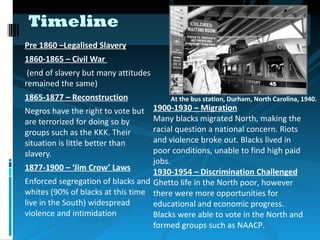
1865-1877 – Reconstruction             At the bus station, Durham, North Carolina, 1940.
Negros have the right to vote but  1900-1930 – Migration
are terrorized for doing so by     Many blacks migrated North, making the
groups such as the KKK. Their      racial question a national concern. Riots
situation is little better than    and violence broke out. Blacks lived in
slavery.                           poor conditions, unable to find high paid
                                   jobs.
1877-1900 – ‘Jim Crow’ Laws        1930-1954 – Discrimination Challenged
Enforced segregation of blacks and Ghetto life in the North poor, however
whites (90% of blacks at this time there were more opportunities for
live in the South) widespread      educational and economic progress.
violence and intimidation          Blacks were able to vote in the North and
                                   formed groups such as NAACP.
Why Did the Civil Rights
Movement Take Off After
         1945?
•Black equality became a significant political issue for the
Democratic Party
•WWII had been fought against racism abroad—hard to
keep harboring it at home
•Black veterans came home dedicated to change
•Increasing number of White Americans condemned
segregation
•Discrimination in the United States hurt our propaganda
battle against the Communists
What were Jim Crow laws?
From the 1880s into the 1960s, most American states
enforced segregation through "Jim Crow" laws (so
called after a black character in minstrel shows).
From Delaware to California, and from North Dakota
to Texas, many states (and cities, too) could impose
legal punishments on people for mingling with
members of another race. The most common types
of laws forbade intermarriage and ordered business
owners and public institutions to keep blacks and
whites separated.
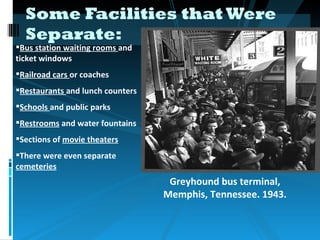
Some Facilities that Were
  Separate:
Bus station waiting rooms and
ticket windows
Railroad cars or coaches
Restaurants and lunch counters
Schools and public parks
Restrooms and water fountains
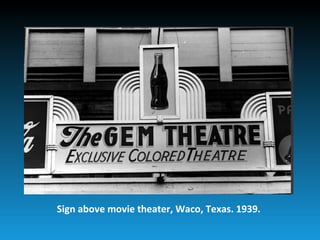
Sections of movie theaters
There were even separate
cemeteries
                                   Greyhound bus terminal,
                                  Memphis, Tennessee. 1943.
In your group answer these
questions in one or two
sentences....
    What are the main areas of segregation? E.g.
    Education, public transport, marriage, etc.

c   Who do the laws target?

t   Do the laws change over time? Can you identify the
    change?

g   Summarize your state’s attitude towards coloured
    races.
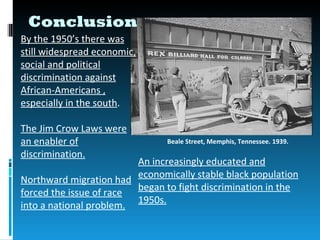
Conclusion
By the 1950’s there was
still widespread economic,
social and political
discrimination against
African-Americans ,
especially in the south.

The Jim Crow Laws were
an enabler of                   Beale Street, Memphis, Tennessee. 1939.
discrimination.
                         An increasingly educated and
                         economically stable black population
Northward migration had
                         began to fight discrimination in the
forced the issue of race
                         1950s.
into a national problem.
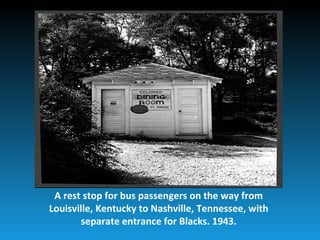
A rest stop for bus passengers on the way from
Louisville, Kentucky to Nashville, Tennessee, with
       separate entrance for Blacks. 1943.
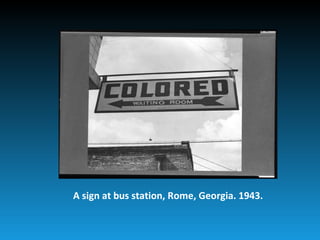
A sign at bus station, Rome, Georgia. 1943.
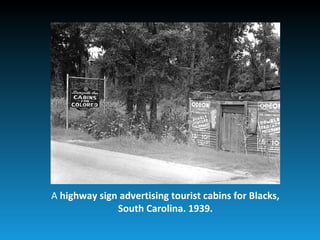
A highway sign advertising tourist cabins for Blacks,
              South Carolina. 1939.
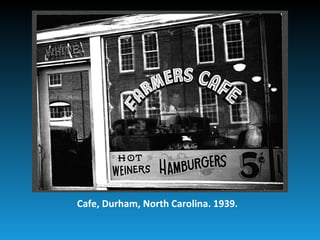
Cafe, Durham, North Carolina. 1939.
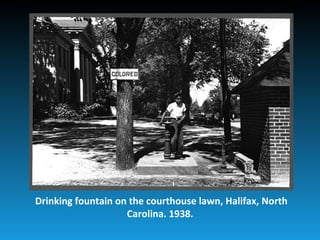
Drinking fountain on the courthouse lawn, Halifax, North
                    Carolina. 1938.
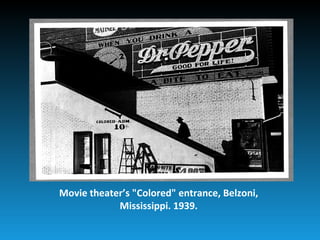
Movie theater’s "Colored" entrance, Belzoni,
            Mississippi. 1939.
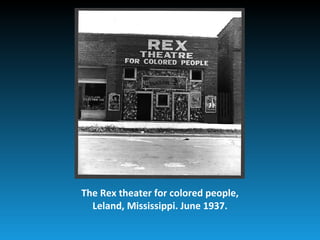
The Rex theater for colored people,
  Leland, Mississippi. June 1937.
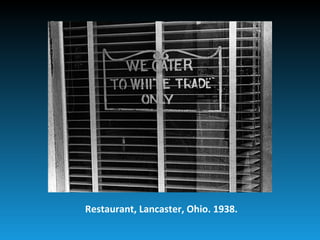
Restaurant, Lancaster, Ohio. 1938.
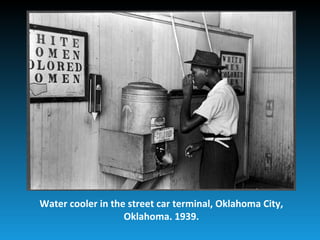
Water cooler in the street car terminal, Oklahoma City,
                   Oklahoma. 1939.
Sign above movie theater, Waco, Texas. 1939.
Bibliography

Johnson, Angela, ill. by Eric Velasquez. A Sweet Smell of Roses. New York:
      Simon & Schuster, 2005.
McKissack, Patrica, ill. by Jerry Pinkney. Goin’ Someplace Special. New York:
     Atheneum, 2001.
Miller, William, ill. by Cedric Lucas. Night Golf. New York: Lee & Low, 1999.
Ringgold, Faith. If a Bus Could Talk: The Story of Rosa Parks. New York:
      Simon & Schuster, 1999.
Weatherford, Carole Boston. A Negro League Scrapbook. Honesdale, PA: Boyds
     Mills Press, 2005.
Weatherford, Carole Boston, ill. by Jerome Lagarrigue. Freedom on the Menu:
     The Greensboro Sit-Ins. New York: Dial, 2005.
Weatherford, Carole Boston. Remember the Bridge: Poems of a People. New
     York: Philomel, 2002.
Wiles, Deborah, ill. by Jerome Lagarrigue. Freedom Summer. New York:
      Atheneum, 2001.
Woodson, Jacqueline, ill. by E. B. Lewis. The Other Side. New York: G. P.
    Putnam’s Sons, 2001.

Jim Crow PowerPoint

  • 1.
    BLACK CIVIL RIGHTS MOVEMENT Jim Crow Laws and background to segregation in the USA
  • 2.
    Timeline Pre 1860 –LegalisedSlavery 1860-1865 – Civil War (end of slavery but many attitudes remained the same) 1865-1877 – Reconstruction At the bus station, Durham, North Carolina, 1940. Negros have the right to vote but 1900-1930 – Migration are terrorized for doing so by Many blacks migrated North, making the groups such as the KKK. Their racial question a national concern. Riots situation is little better than and violence broke out. Blacks lived in slavery. poor conditions, unable to find high paid jobs. 1877-1900 – ‘Jim Crow’ Laws 1930-1954 – Discrimination Challenged Enforced segregation of blacks and Ghetto life in the North poor, however whites (90% of blacks at this time there were more opportunities for live in the South) widespread educational and economic progress. violence and intimidation Blacks were able to vote in the North and formed groups such as NAACP.
  • 3.
    Why Did theCivil Rights Movement Take Off After 1945? •Black equality became a significant political issue for the Democratic Party •WWII had been fought against racism abroad—hard to keep harboring it at home •Black veterans came home dedicated to change •Increasing number of White Americans condemned segregation •Discrimination in the United States hurt our propaganda battle against the Communists
  • 4.
    What were JimCrow laws? From the 1880s into the 1960s, most American states enforced segregation through "Jim Crow" laws (so called after a black character in minstrel shows). From Delaware to California, and from North Dakota to Texas, many states (and cities, too) could impose legal punishments on people for mingling with members of another race. The most common types of laws forbade intermarriage and ordered business owners and public institutions to keep blacks and whites separated.
  • 5.
    Some Facilities thatWere Separate: Bus station waiting rooms and ticket windows Railroad cars or coaches Restaurants and lunch counters Schools and public parks Restrooms and water fountains Sections of movie theaters There were even separate cemeteries Greyhound bus terminal, Memphis, Tennessee. 1943.
  • 6.
    In your groupanswer these questions in one or two sentences.... What are the main areas of segregation? E.g. Education, public transport, marriage, etc. c Who do the laws target? t Do the laws change over time? Can you identify the change? g Summarize your state’s attitude towards coloured races.
  • 7.
    Conclusion By the 1950’sthere was still widespread economic, social and political discrimination against African-Americans , especially in the south. The Jim Crow Laws were an enabler of Beale Street, Memphis, Tennessee. 1939. discrimination. An increasingly educated and economically stable black population Northward migration had began to fight discrimination in the forced the issue of race 1950s. into a national problem.
  • 8.
    A rest stopfor bus passengers on the way from Louisville, Kentucky to Nashville, Tennessee, with separate entrance for Blacks. 1943.
  • 9.
    A sign atbus station, Rome, Georgia. 1943.
  • 10.
    A highway signadvertising tourist cabins for Blacks, South Carolina. 1939.
  • 11.
    Cafe, Durham, NorthCarolina. 1939.
  • 12.
    Drinking fountain onthe courthouse lawn, Halifax, North Carolina. 1938.
  • 13.
    Movie theater’s "Colored"entrance, Belzoni, Mississippi. 1939.
  • 14.
    The Rex theaterfor colored people, Leland, Mississippi. June 1937.
  • 15.
  • 16.
    Water cooler inthe street car terminal, Oklahoma City, Oklahoma. 1939.
  • 17.
    Sign above movietheater, Waco, Texas. 1939.
  • 18.
    Bibliography Johnson, Angela, ill.by Eric Velasquez. A Sweet Smell of Roses. New York: Simon & Schuster, 2005. McKissack, Patrica, ill. by Jerry Pinkney. Goin’ Someplace Special. New York: Atheneum, 2001. Miller, William, ill. by Cedric Lucas. Night Golf. New York: Lee & Low, 1999. Ringgold, Faith. If a Bus Could Talk: The Story of Rosa Parks. New York: Simon & Schuster, 1999. Weatherford, Carole Boston. A Negro League Scrapbook. Honesdale, PA: Boyds Mills Press, 2005. Weatherford, Carole Boston, ill. by Jerome Lagarrigue. Freedom on the Menu: The Greensboro Sit-Ins. New York: Dial, 2005. Weatherford, Carole Boston. Remember the Bridge: Poems of a People. New York: Philomel, 2002. Wiles, Deborah, ill. by Jerome Lagarrigue. Freedom Summer. New York: Atheneum, 2001. Woodson, Jacqueline, ill. by E. B. Lewis. The Other Side. New York: G. P. Putnam’s Sons, 2001.