RECON LIKE A PRO
- Nirmal Thapa (@tnirmalz)
$ WHOAMI
• Nirmal Thapa (mpz)
• Full time Security stuffs @ Cotiviti
• Part time Bug Bounty Hunter and CTF player
• Acknowledged by Apple, Facebook, Google, US DoD, Instacart, Grab, AT&T,
Swisscom, Zomato, Coinbase, etc
TOPICS WE’LL COVER TODAY
• Infra recon (ASN, IP ranges, port scanning)
• Reverse whois
• Domain/Subdomain enumeration
• Shodan Recon
• Content discovery
• VHOST Fuzzing
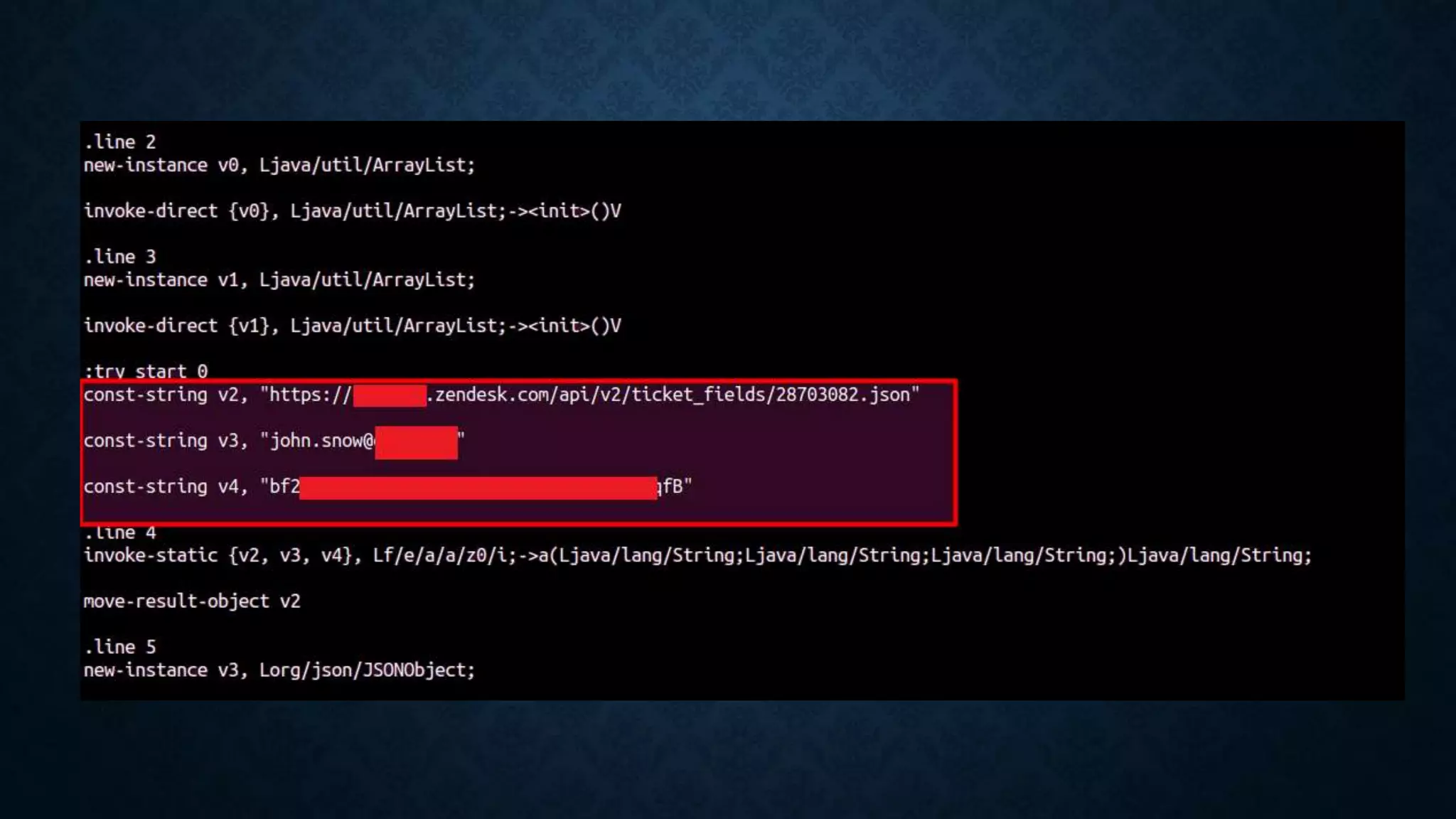
• Hunting for secrets in android apps
• Data leaks in code sharing websites (github, dockerhub, gitlab, codepen, pastebin,
jsfiddle)
WHAT IS RECON?
• Short for “Reconnaissance”
• From google – “military observation of a region to locate an enemy or ascertain
strategic features.
• In pentest & bug bounties – Understanding infra of the target, how things are setup,
how the app works, finding possible entry points and so on.
INFRA RECON
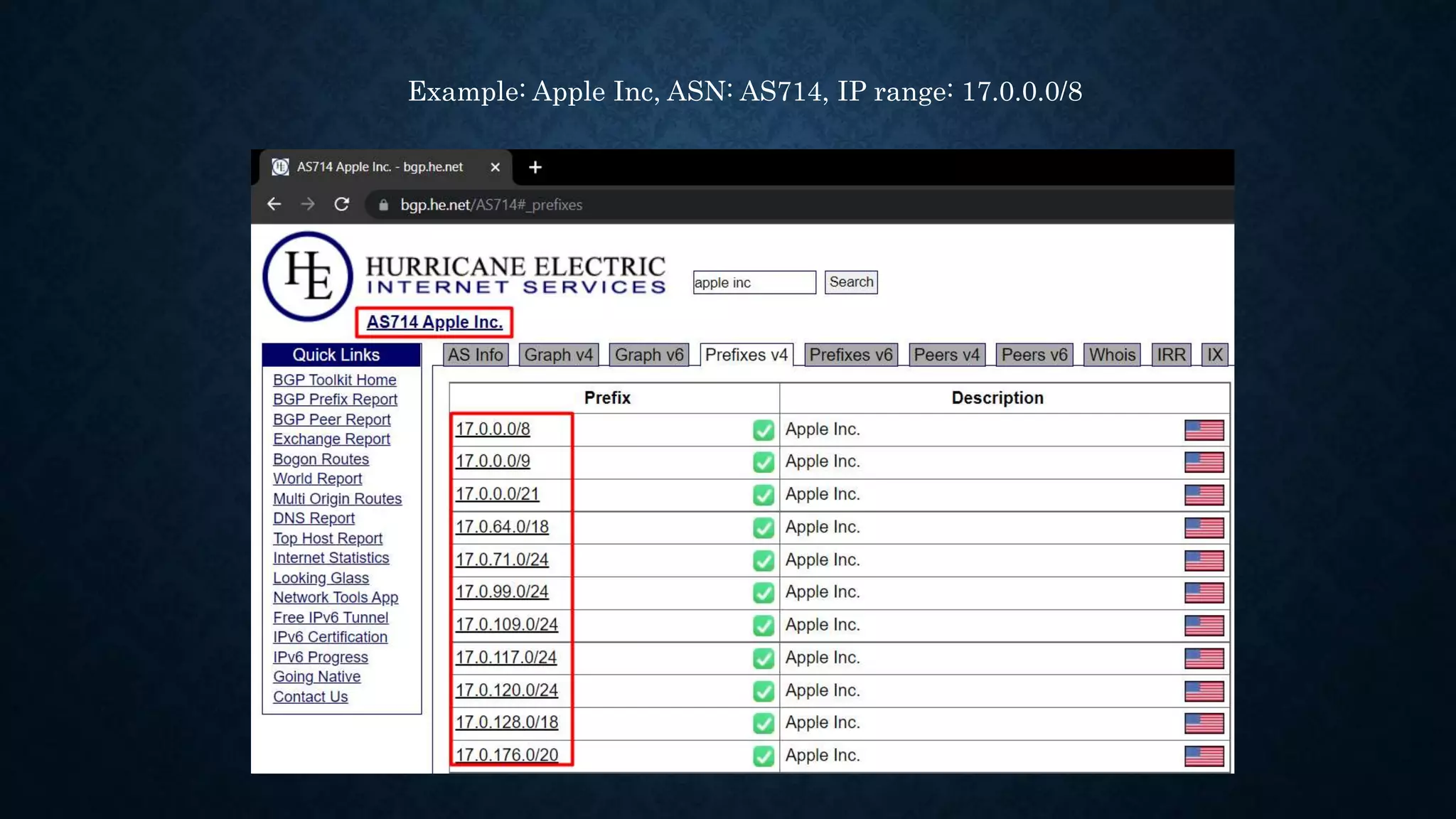
• ASN? Autonomous System Number
• Big orgs like Google, Apple have their own ASN and IP ranges
• Easy for us to map our targets
Example: Apple Inc, ASN: AS714, IP range: 17.0.0.0/8
• /8 of Apple contains 16M+ IP addresses
• We can divide it into smaller /24s and look for potential targets
• For demo - 17.120.252.6/24
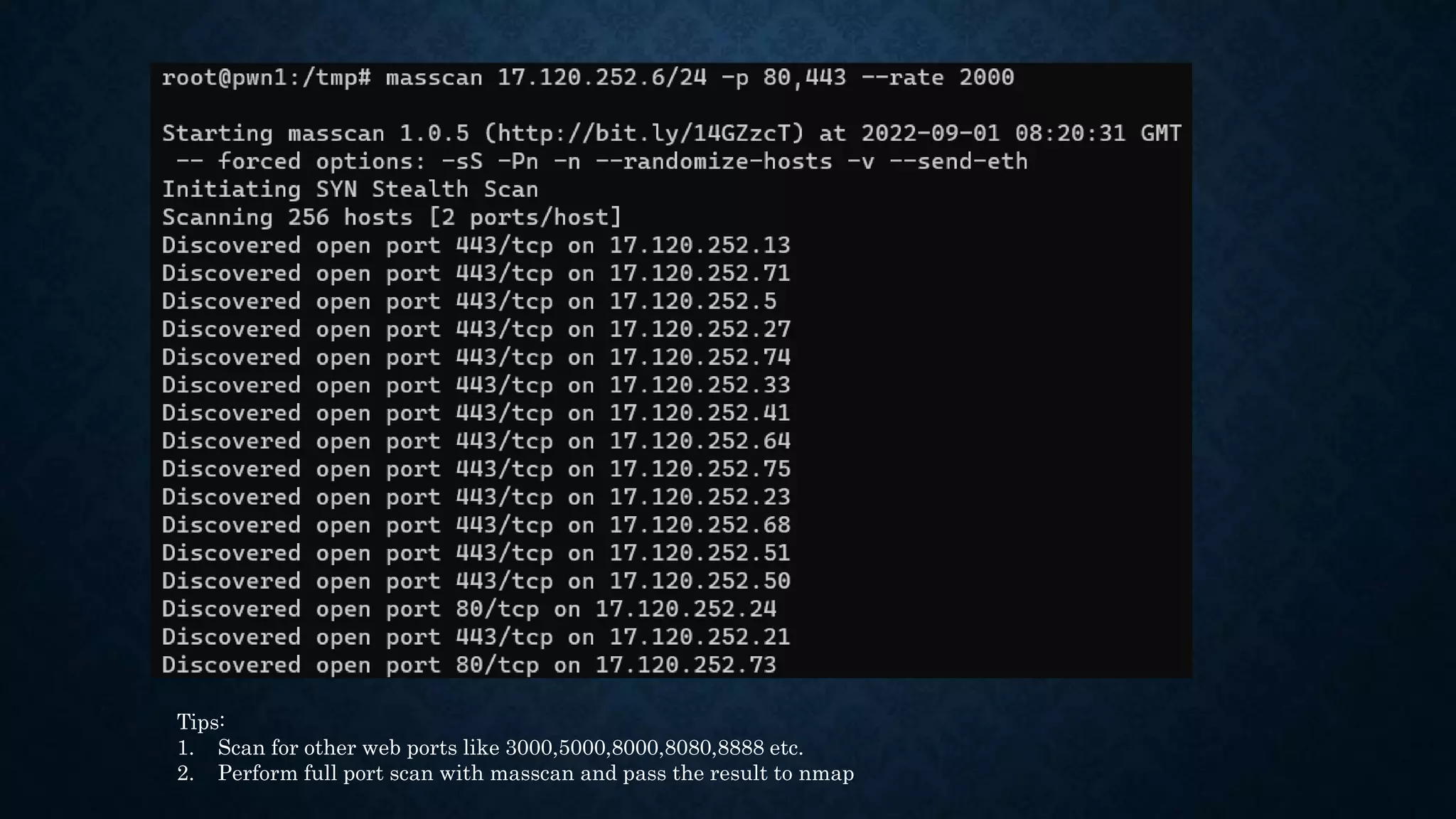
• Masscan can be used for quick port scan
• masscan 17.120.252.6/24 -p 80,443 --rate 2000
Tips:
1. Scan for other web ports like 3000,5000,8000,8080,8888 etc.
2. Perform full port scan with masscan and pass the result to nmap
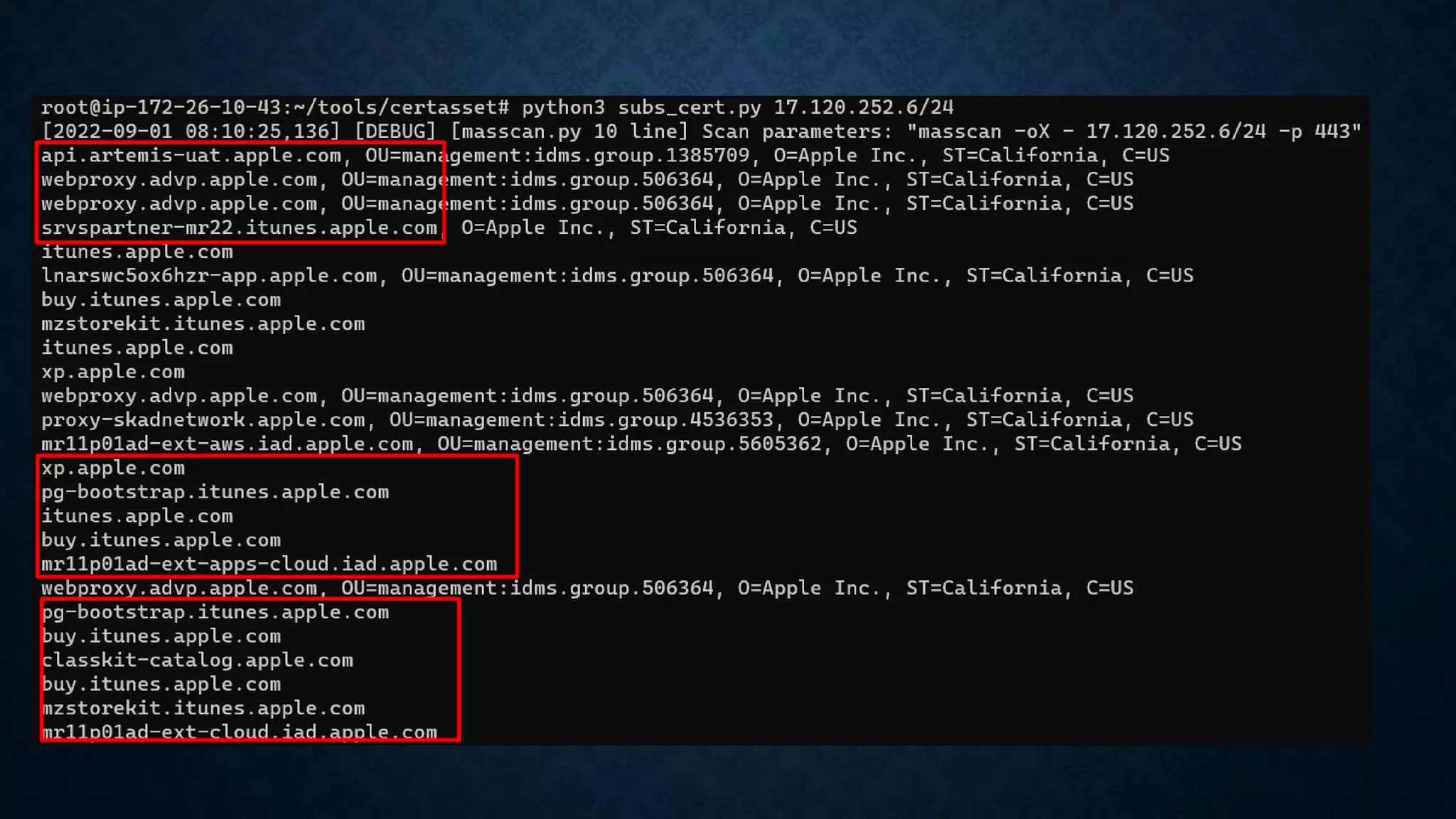
SCANNING SSL CERTS FROM IP RANGES
• https://github.com/arbazkiraak/certasset
• This tool can be used to scan IP ranges to gather more domains/subdomains
• IP range -> masscan port 443 -> if open -> parse SSL certs and output hosts
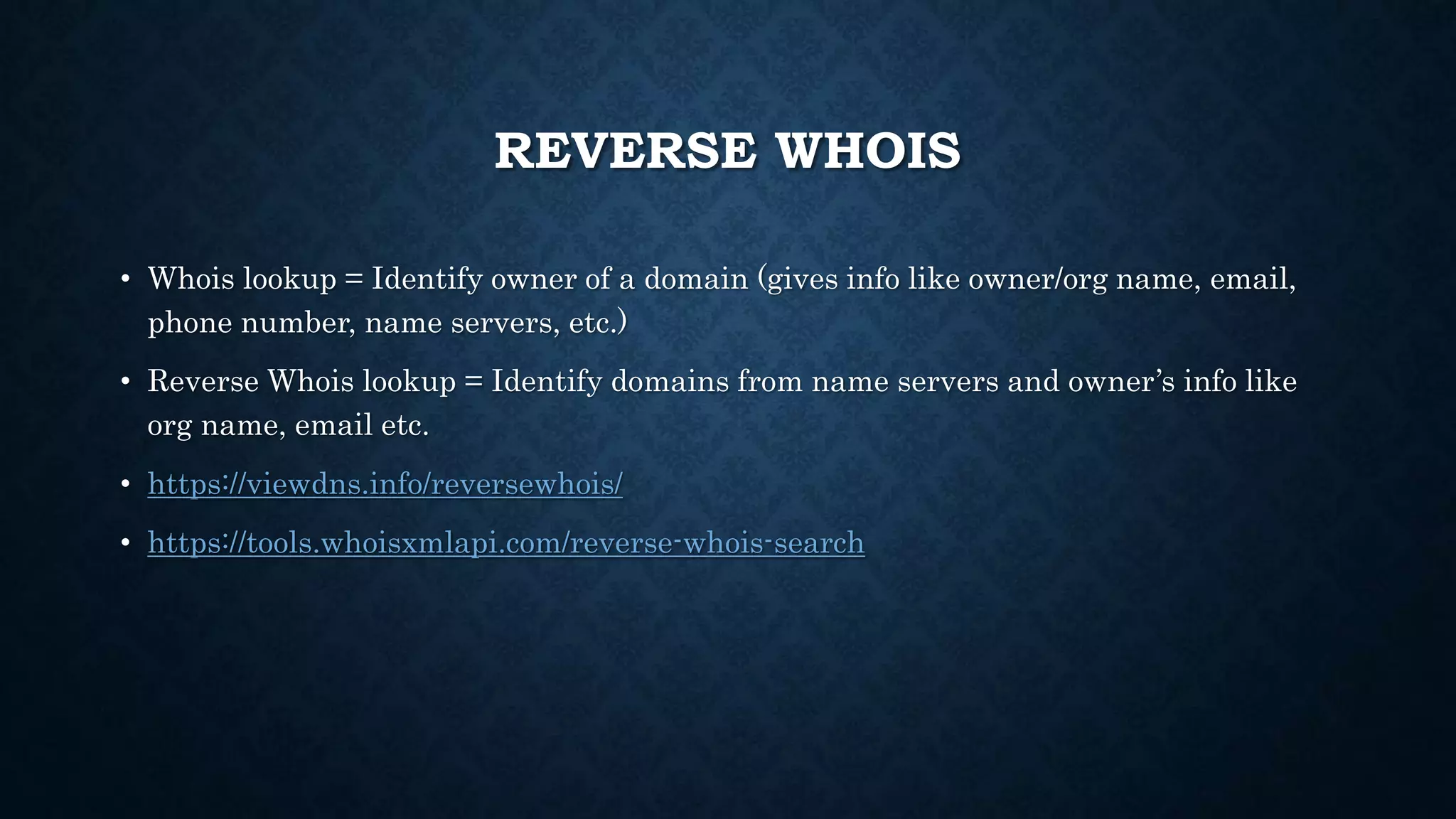
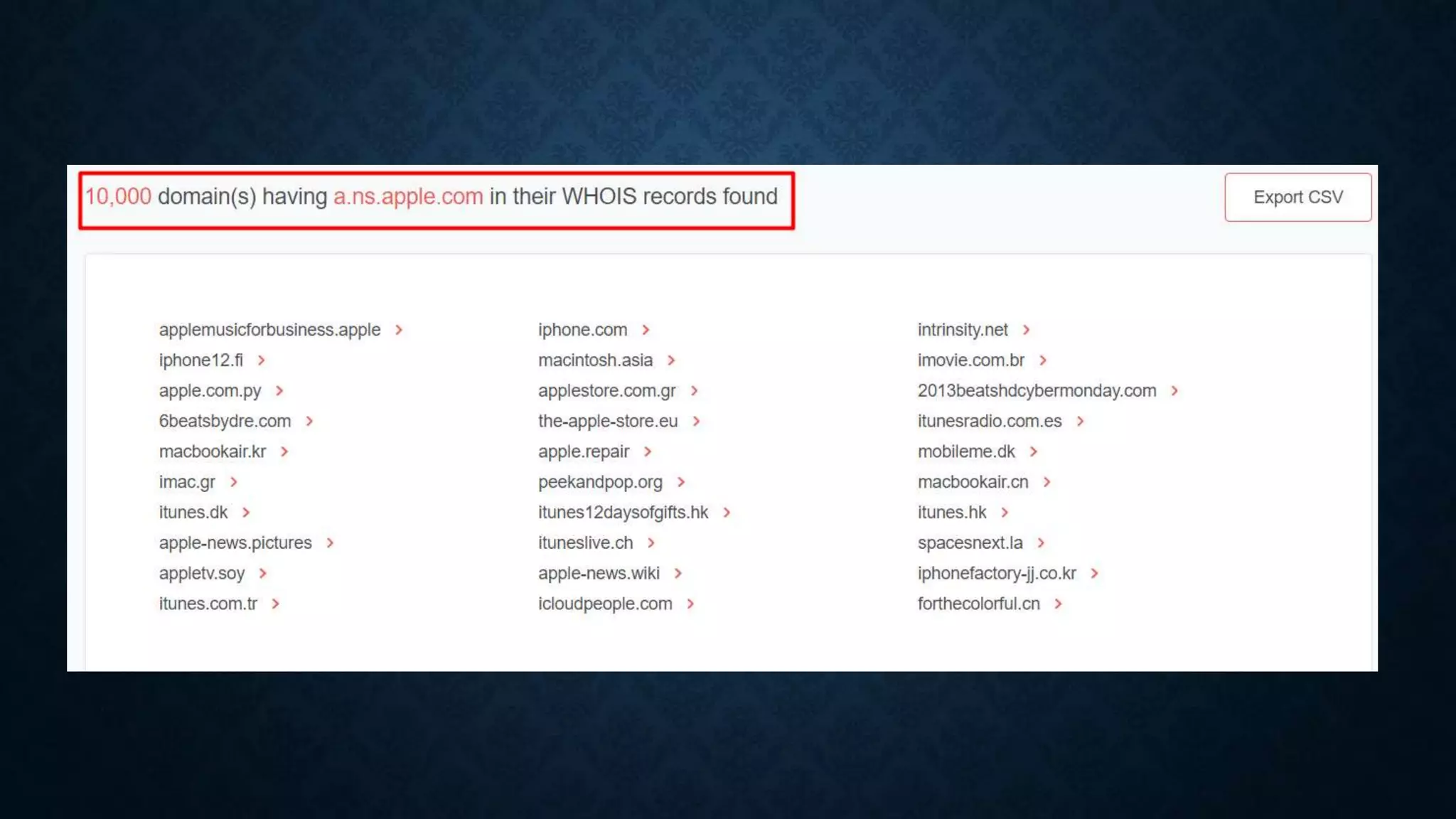
REVERSE WHOIS
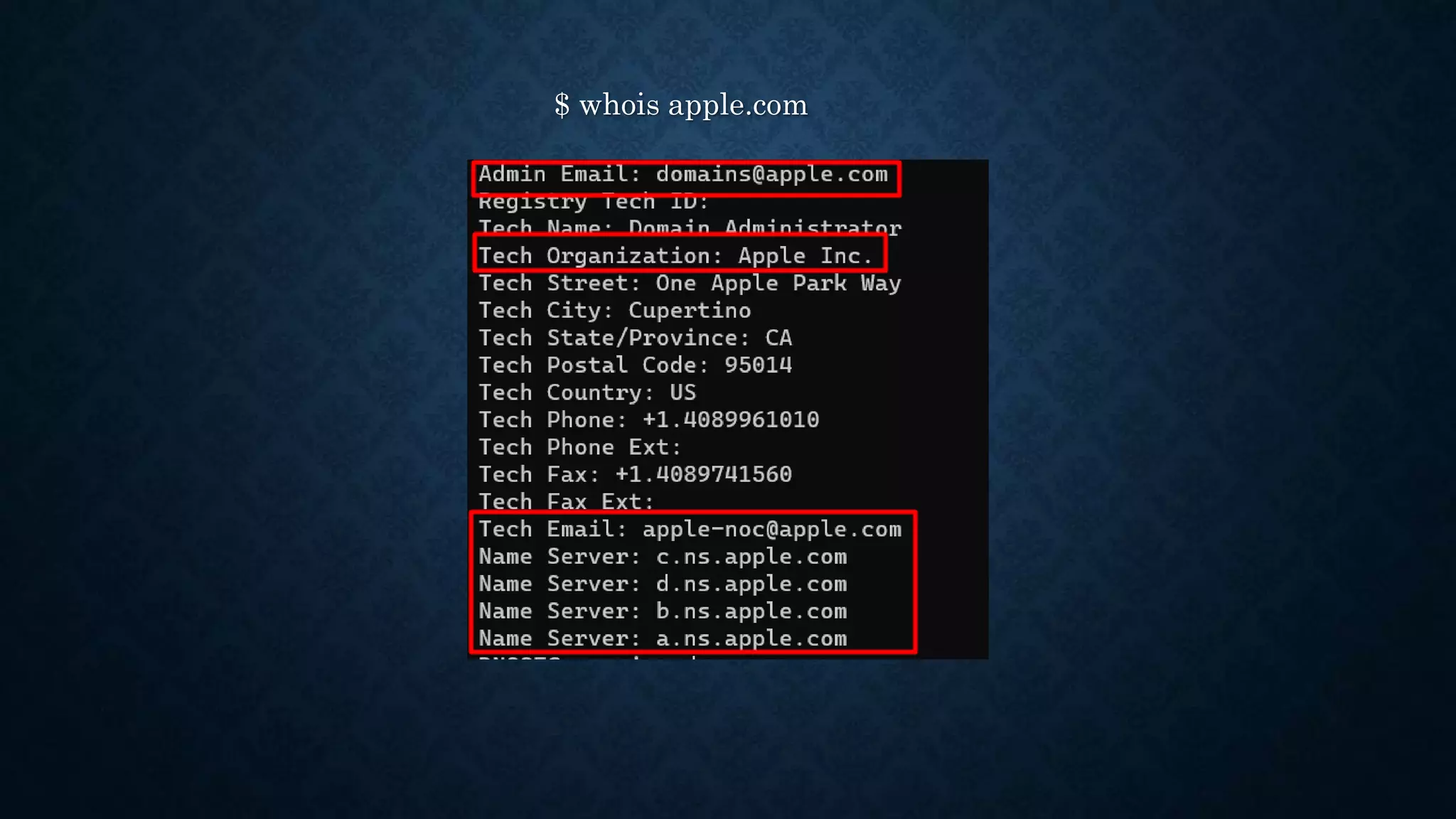
• Whois lookup = Identify owner of a domain (gives info like owner/org name, email,
phone number, name servers, etc.)
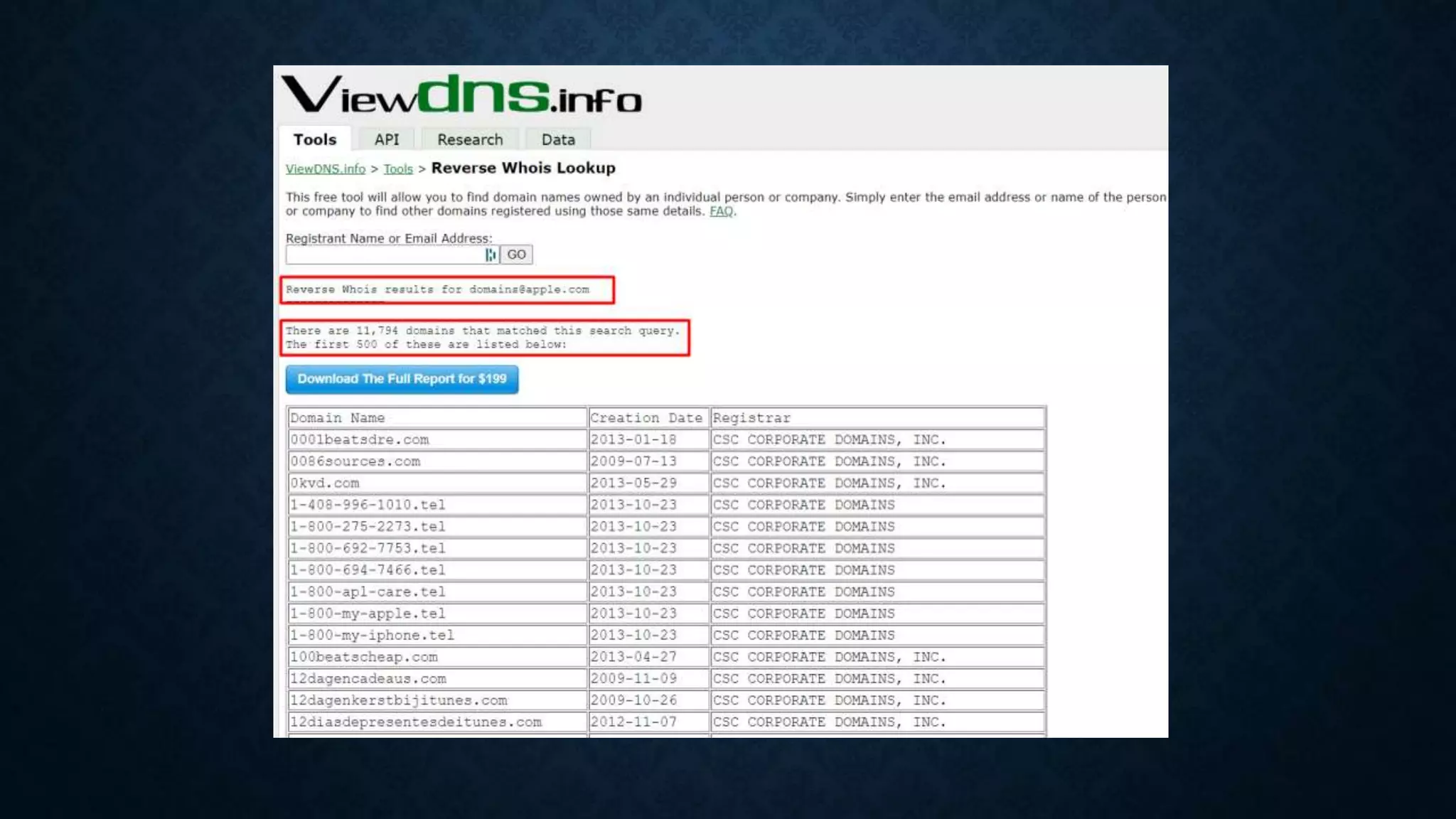
• Reverse Whois lookup = Identify domains from name servers and owner’s info like
org name, email etc.
• https://viewdns.info/reversewhois/
• https://tools.whoisxmlapi.com/reverse-whois-search
$ whois apple.com
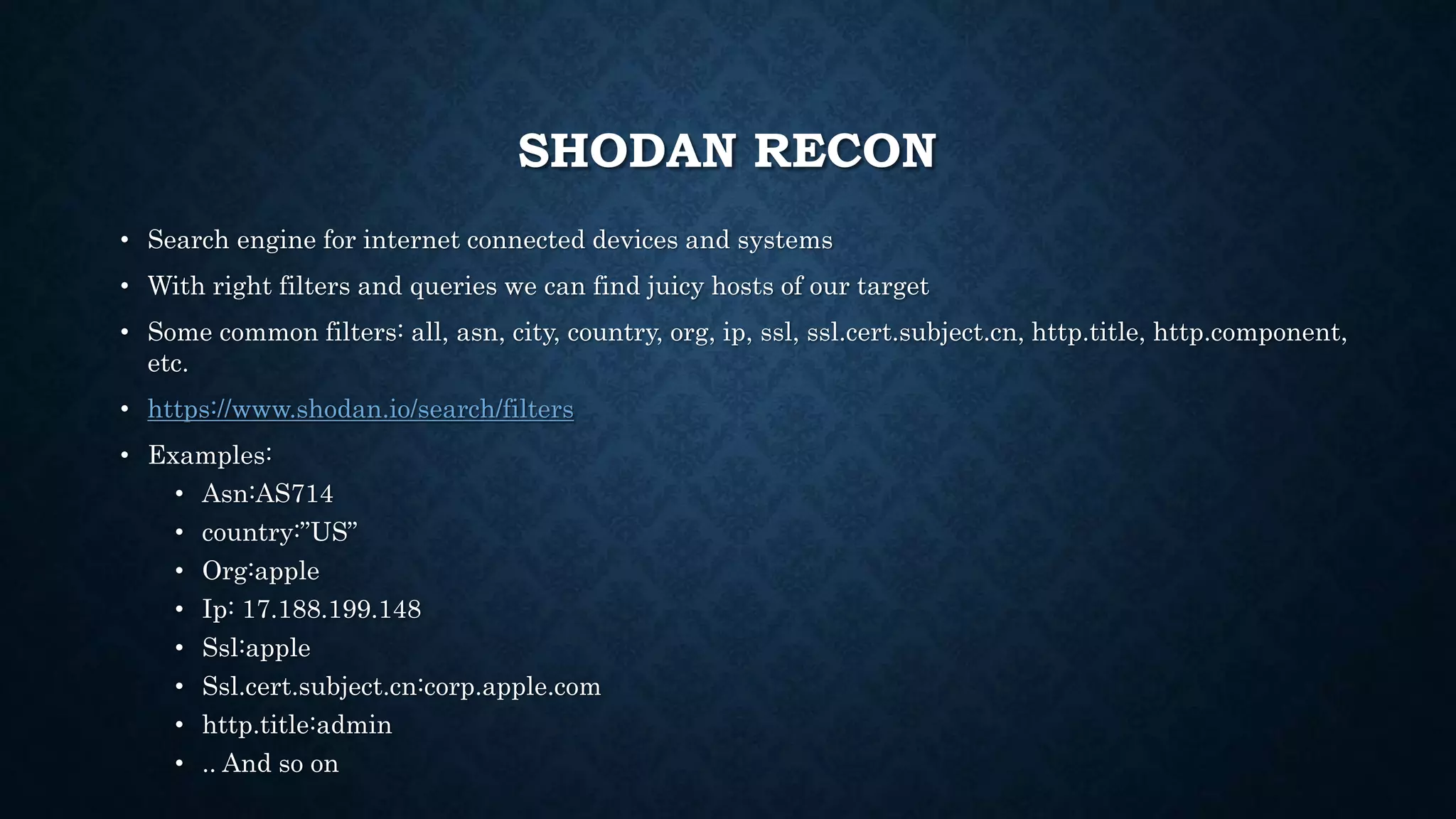
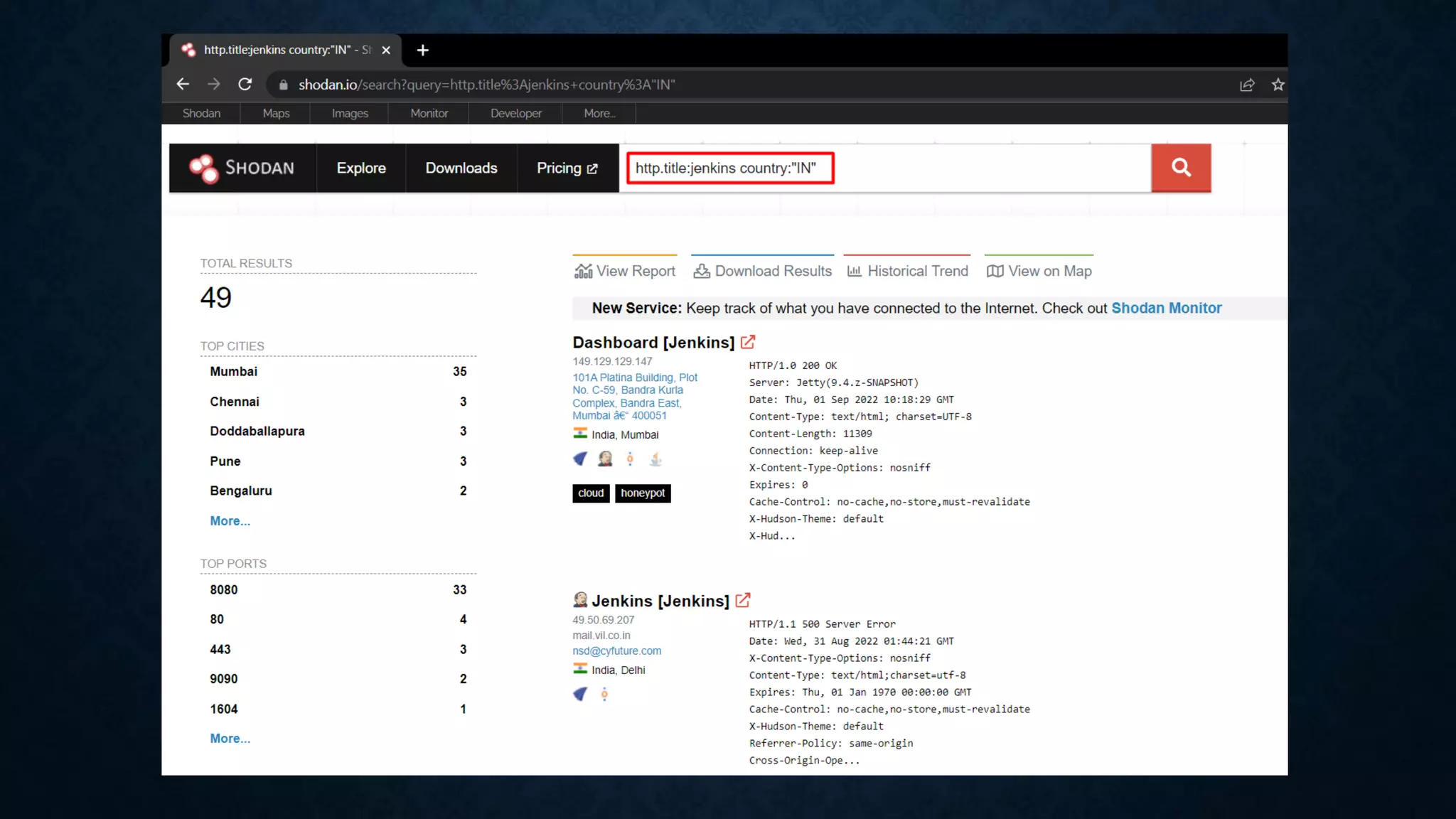
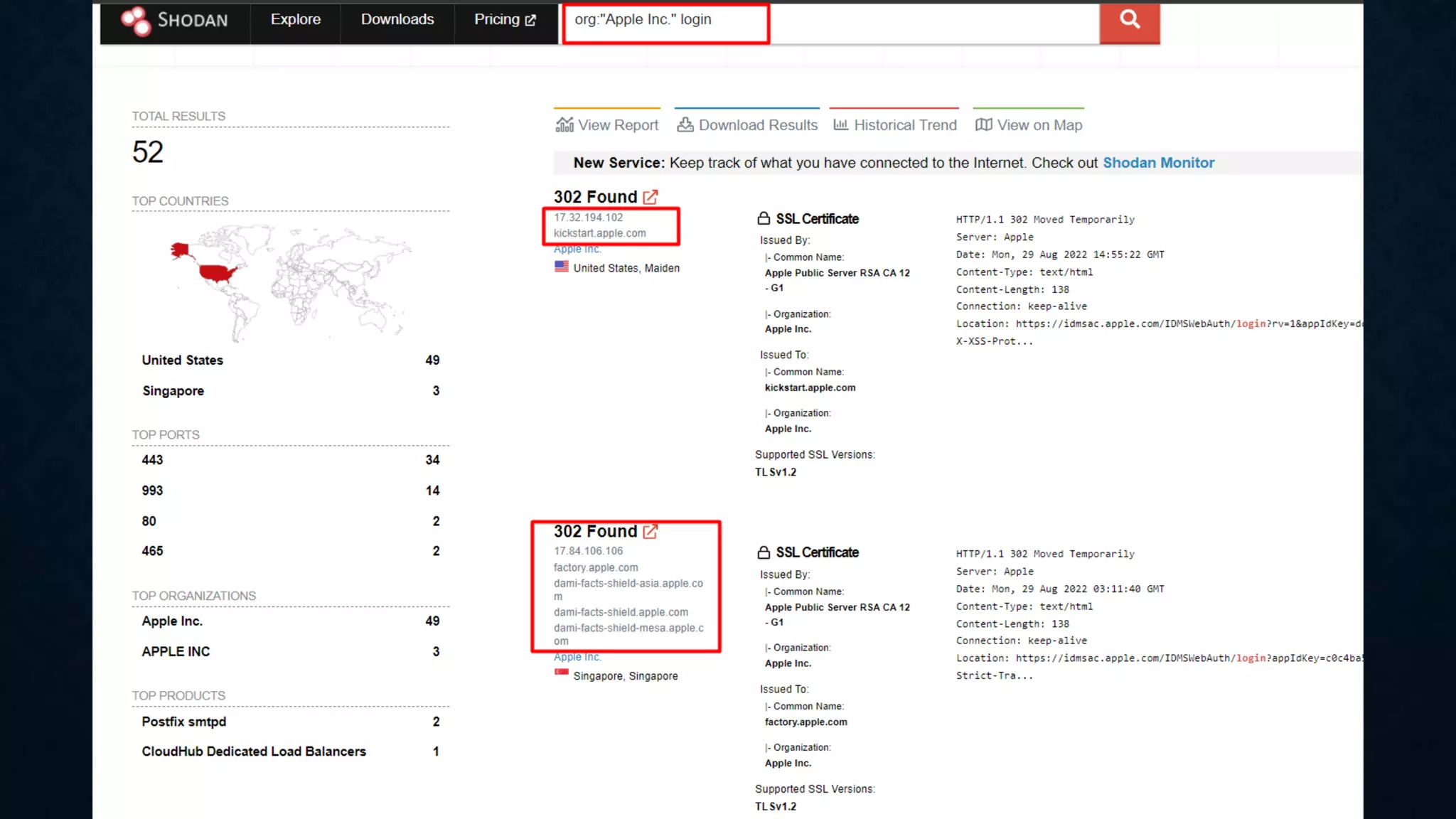
SHODAN RECON
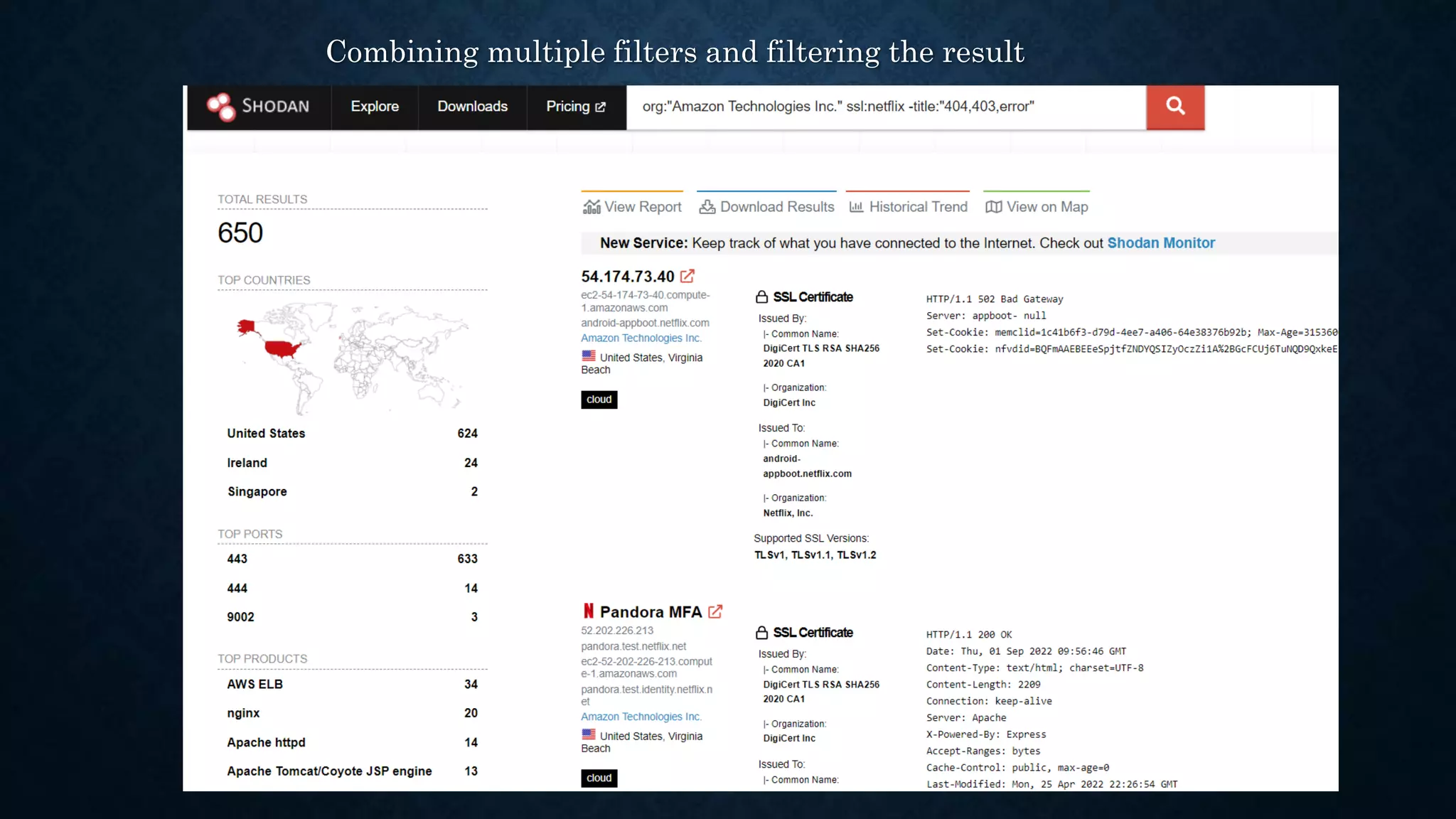
• Search engine for internet connected devices and systems
• With right filters and queries we can find juicy hosts of our target
• Some common filters: all, asn, city, country, org, ip, ssl, ssl.cert.subject.cn, http.title, http.component,
etc.
• https://www.shodan.io/search/filters
• Examples:
• Asn:AS714
• country:”US”
• Org:apple
• Ip: 17.188.199.148
• Ssl:apple
• Ssl.cert.subject.cn:corp.apple.com
• http.title:admin
• .. And so on
Combining multiple filters and filtering the result
• At this point, you should have a bunch of domains and subdomains
• Enumerate more subdomains with tools like amass, subfinder, findomain, knockpy
• Bruteforce/Resolve with massdns/puredns/shuffledns, dnsx, etc.
• When you have a list of resolved or “alive” hosts, probe for web ports 80,443 with
tools like httprobe, httpx
• https://github.com/projectdiscovery/httpx
• https://github.com/tomnomnom/httprobe
CONTENT DISCOVERY
• For effective content discovery, use curated wordlists
• Understand the technology used by your target and use respective wordlist
• No point bruteforcing wordpress wordlists in Django targets
• https://wordlists.assetnote.io/
• https://github.com/ayoubfathi/leaky-paths
HUNTING FOR ENDPOINTS IN JS FILES
• JS files are goldmines for discovering new endpoints for the target
• They often contain API endpoints, URLs, hardcoded secrets, etc.
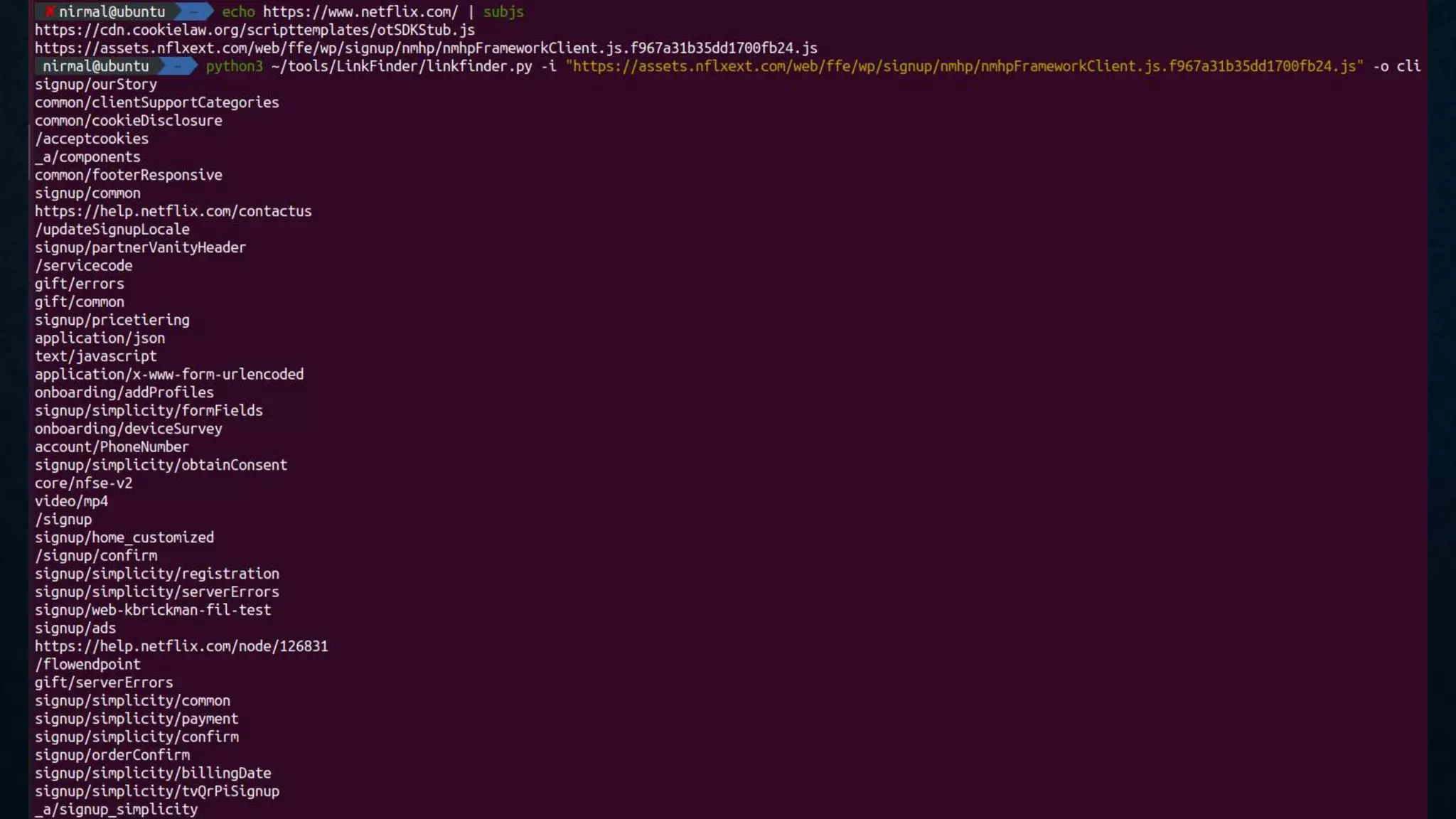
• Subjs tool can be used to fetch javascript files in bulk
(https://github.com/lc/subjs)
• The obtained js files can now be parsed with LinkFinder
(https://github.com/GerbenJavado/LinkFinder)
• Gather js files from multiple subdomains with subjs -> generate wordlist with
linkfinder -> sort and combine them all -> You have a target specific wordlist
now
VHOST FUZZING
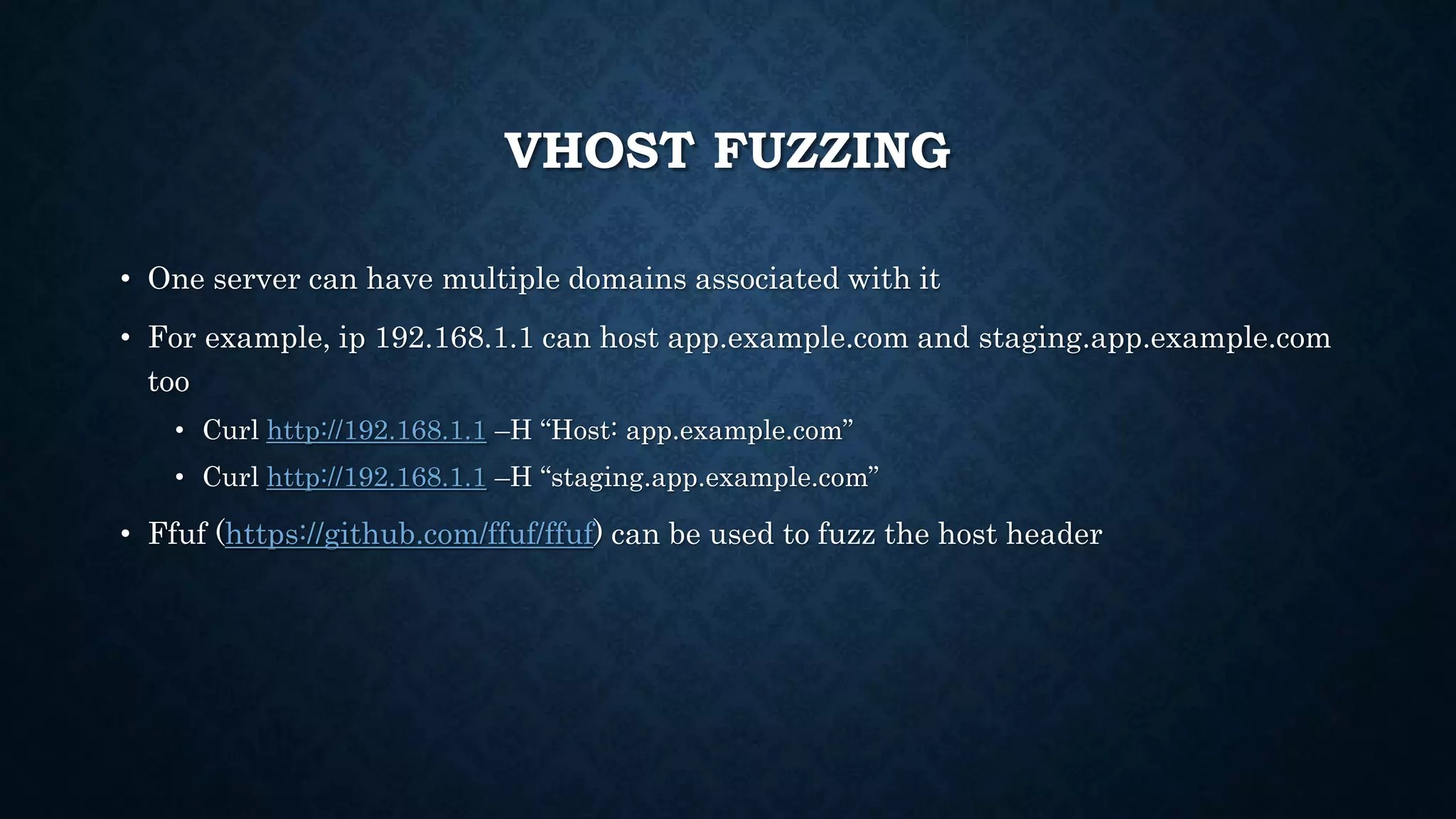
• One server can have multiple domains associated with it
• For example, ip 192.168.1.1 can host app.example.com and staging.app.example.com
too
• Curl http://192.168.1.1 –H “Host: app.example.com”
• Curl http://192.168.1.1 –H “staging.app.example.com”
• Ffuf (https://github.com/ffuf/ffuf) can be used to fuzz the host header
HUNTING FOR SECRETS IN ANDROID APPS
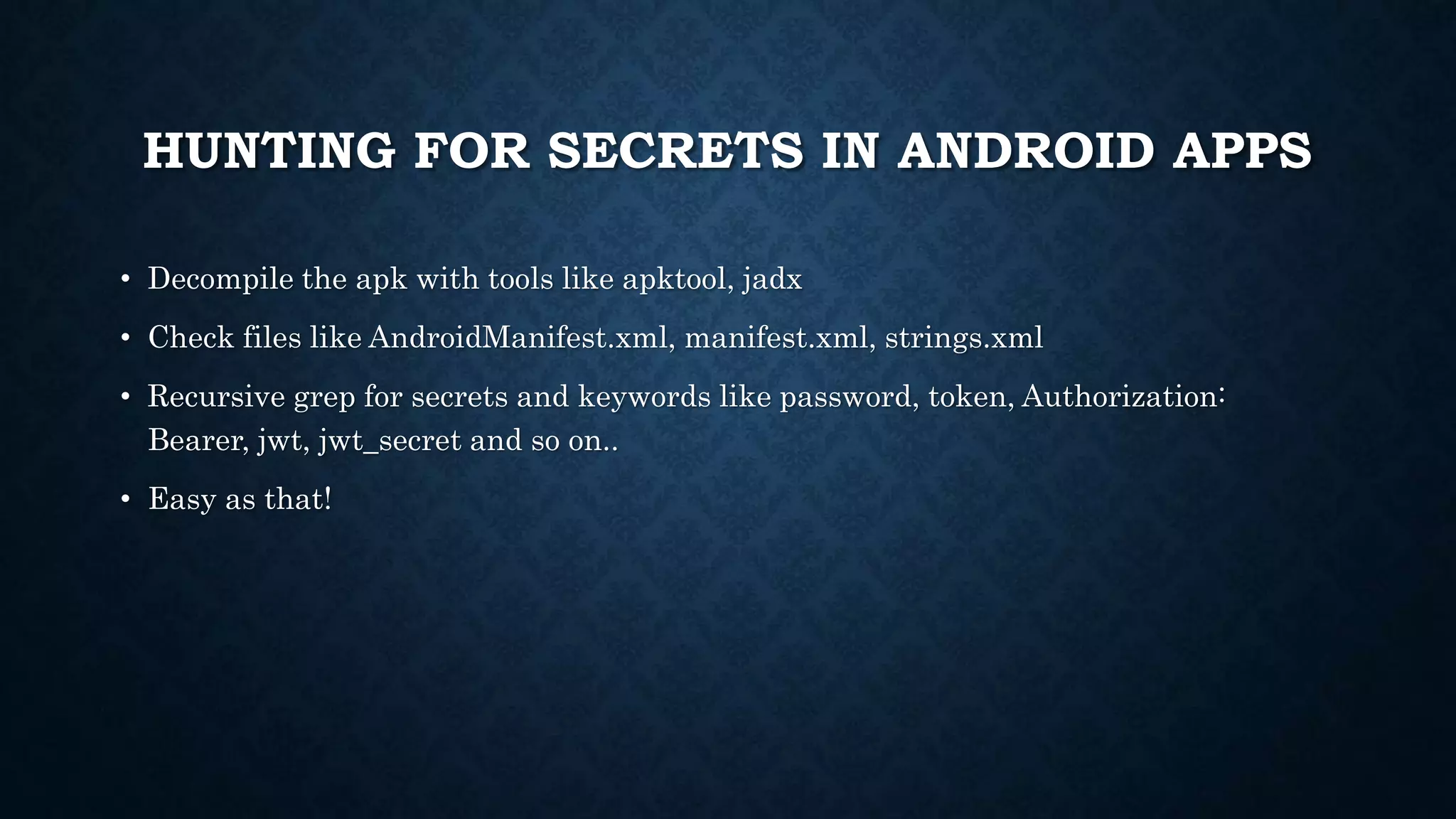
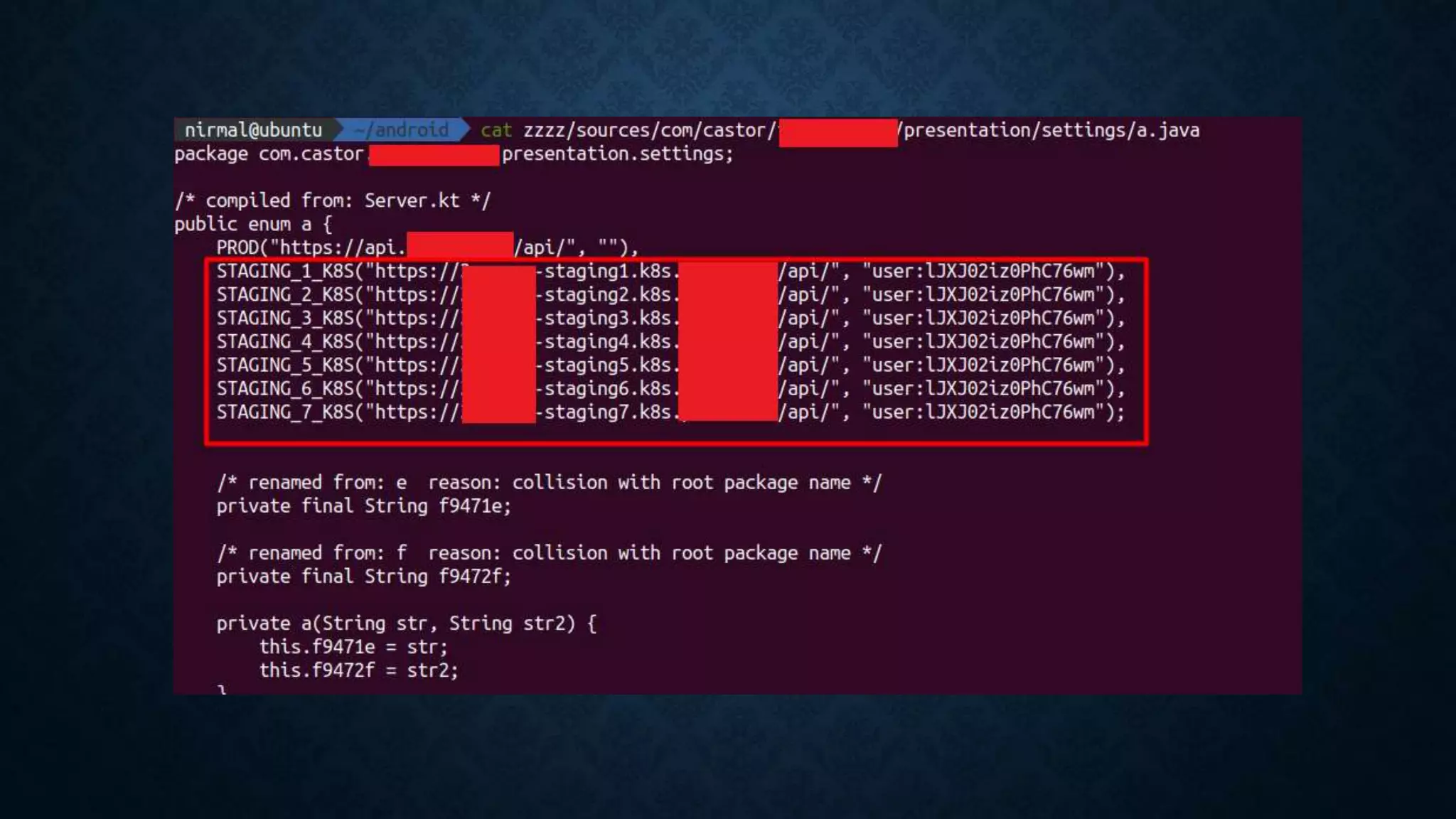
• Decompile the apk with tools like apktool, jadx
• Check files like AndroidManifest.xml, manifest.xml, strings.xml
• Recursive grep for secrets and keywords like password, token, Authorization:
Bearer, jwt, jwt_secret and so on..
• Easy as that!
DATA LEAKS IN CODE SHARING WEBSITES
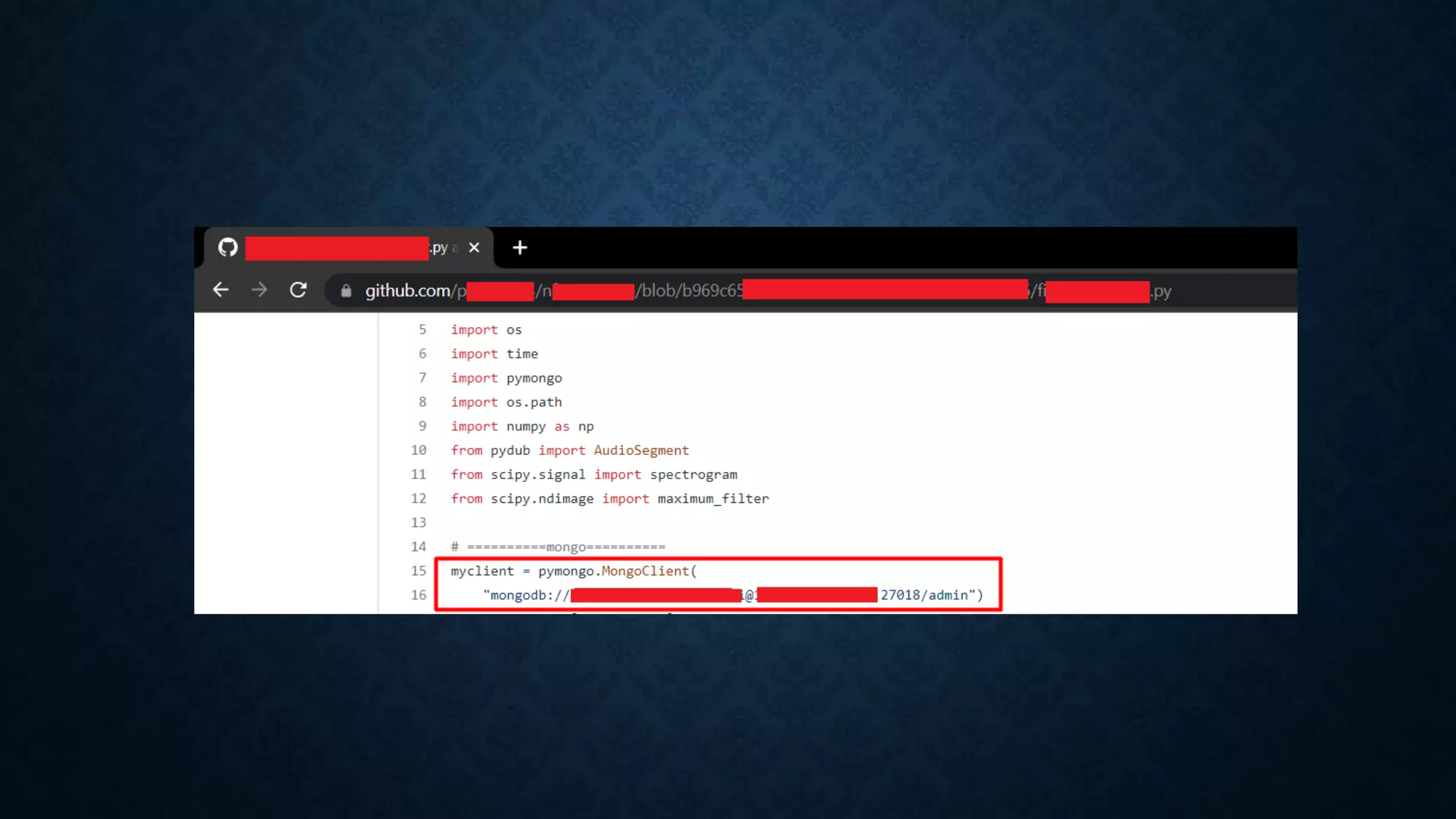
• Many developers push their internal source codes in public code sharing websites
like github, gitlab
• For quick testing they even use public sandbox like jsfiddle, dotnetfiddle, codepen
• We can use google dorks to find these code leaks which often contains hardcoded
secrets or internal URLs
• Site: jsfiddle.net “corp.apple.com”
• Site: dotnetfiddle.net “prod.apple.com”
• Site: codepen.io “internal.apple.com”
GITHUB RECON
• Check the organization page of the target
• Check repos one by one and note all the users who have pushed commits to the org repos
• When you have a list of users, check for keywords like password, username, secret,
secret_key, jwt_key, admin, ssh, ftp, mongodb, postgres_password, docker_password etc.
• More dorks and keywords: https://github.com/techgaun/github-dorks
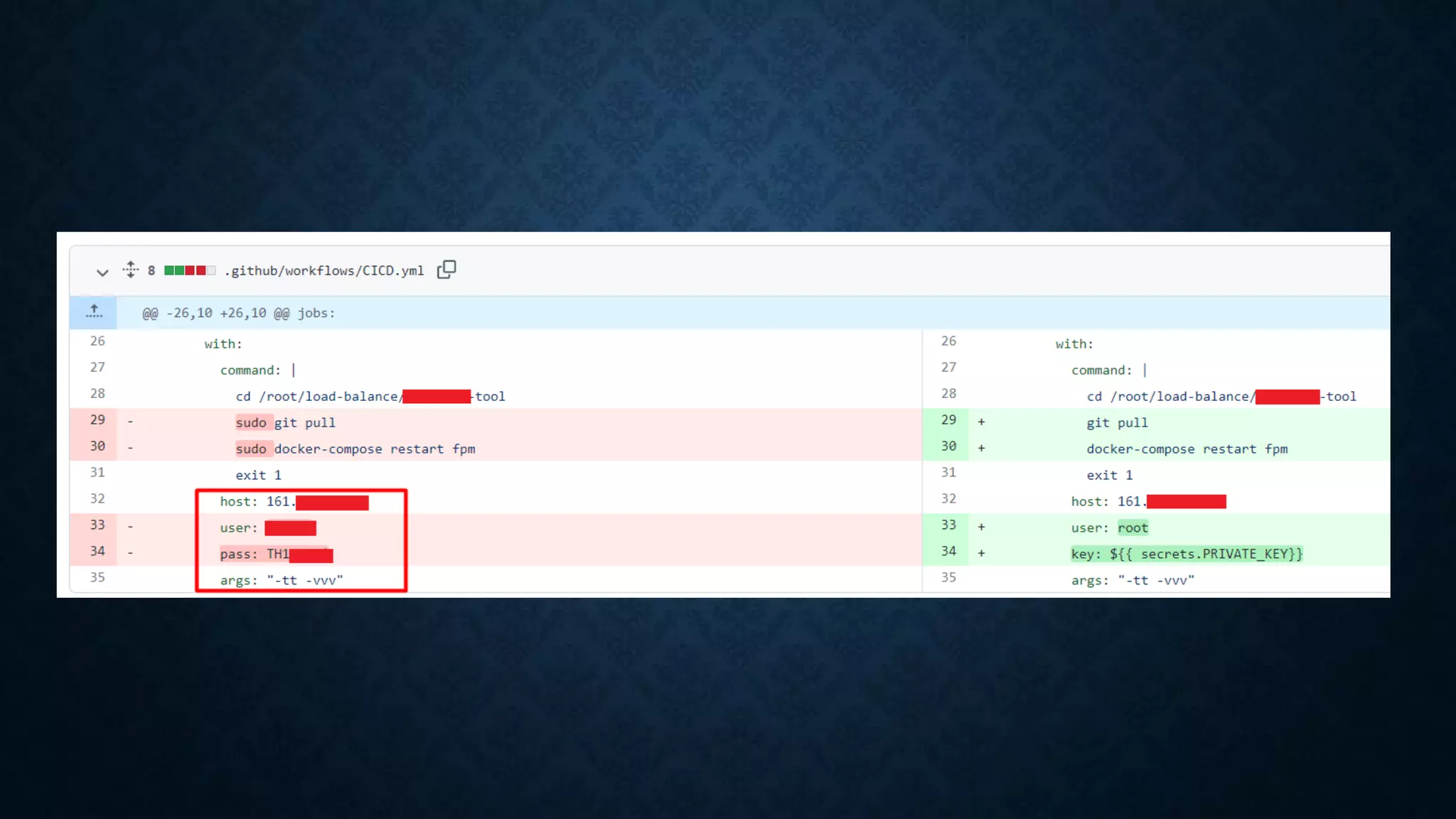
• Also look for branches of the repo and commit history
• Often developers remove password from git but still it can be obtained from git commits.
THANK YOU 

Recon like a pro

  • 1.
    RECON LIKE APRO - Nirmal Thapa (@tnirmalz)
  • 2.
    $ WHOAMI • NirmalThapa (mpz) • Full time Security stuffs @ Cotiviti • Part time Bug Bounty Hunter and CTF player • Acknowledged by Apple, Facebook, Google, US DoD, Instacart, Grab, AT&T, Swisscom, Zomato, Coinbase, etc
  • 3.
    TOPICS WE’LL COVERTODAY • Infra recon (ASN, IP ranges, port scanning) • Reverse whois • Domain/Subdomain enumeration • Shodan Recon • Content discovery • VHOST Fuzzing • Hunting for secrets in android apps • Data leaks in code sharing websites (github, dockerhub, gitlab, codepen, pastebin, jsfiddle)
  • 4.
    WHAT IS RECON? •Short for “Reconnaissance” • From google – “military observation of a region to locate an enemy or ascertain strategic features. • In pentest & bug bounties – Understanding infra of the target, how things are setup, how the app works, finding possible entry points and so on.
  • 5.
    INFRA RECON • ASN?Autonomous System Number • Big orgs like Google, Apple have their own ASN and IP ranges • Easy for us to map our targets
  • 6.
    Example: Apple Inc,ASN: AS714, IP range: 17.0.0.0/8
  • 7.
    • /8 ofApple contains 16M+ IP addresses • We can divide it into smaller /24s and look for potential targets • For demo - 17.120.252.6/24 • Masscan can be used for quick port scan • masscan 17.120.252.6/24 -p 80,443 --rate 2000
  • 8.
    Tips: 1. Scan forother web ports like 3000,5000,8000,8080,8888 etc. 2. Perform full port scan with masscan and pass the result to nmap
  • 9.
    SCANNING SSL CERTSFROM IP RANGES • https://github.com/arbazkiraak/certasset • This tool can be used to scan IP ranges to gather more domains/subdomains • IP range -> masscan port 443 -> if open -> parse SSL certs and output hosts
  • 11.
    REVERSE WHOIS • Whoislookup = Identify owner of a domain (gives info like owner/org name, email, phone number, name servers, etc.) • Reverse Whois lookup = Identify domains from name servers and owner’s info like org name, email etc. • https://viewdns.info/reversewhois/ • https://tools.whoisxmlapi.com/reverse-whois-search
  • 12.
  • 15.
    SHODAN RECON • Searchengine for internet connected devices and systems • With right filters and queries we can find juicy hosts of our target • Some common filters: all, asn, city, country, org, ip, ssl, ssl.cert.subject.cn, http.title, http.component, etc. • https://www.shodan.io/search/filters • Examples: • Asn:AS714 • country:”US” • Org:apple • Ip: 17.188.199.148 • Ssl:apple • Ssl.cert.subject.cn:corp.apple.com • http.title:admin • .. And so on
  • 18.
    Combining multiple filtersand filtering the result
  • 19.
    • At thispoint, you should have a bunch of domains and subdomains • Enumerate more subdomains with tools like amass, subfinder, findomain, knockpy • Bruteforce/Resolve with massdns/puredns/shuffledns, dnsx, etc. • When you have a list of resolved or “alive” hosts, probe for web ports 80,443 with tools like httprobe, httpx • https://github.com/projectdiscovery/httpx • https://github.com/tomnomnom/httprobe
  • 20.
    CONTENT DISCOVERY • Foreffective content discovery, use curated wordlists • Understand the technology used by your target and use respective wordlist • No point bruteforcing wordpress wordlists in Django targets • https://wordlists.assetnote.io/ • https://github.com/ayoubfathi/leaky-paths
  • 21.
    HUNTING FOR ENDPOINTSIN JS FILES • JS files are goldmines for discovering new endpoints for the target • They often contain API endpoints, URLs, hardcoded secrets, etc. • Subjs tool can be used to fetch javascript files in bulk (https://github.com/lc/subjs) • The obtained js files can now be parsed with LinkFinder (https://github.com/GerbenJavado/LinkFinder) • Gather js files from multiple subdomains with subjs -> generate wordlist with linkfinder -> sort and combine them all -> You have a target specific wordlist now
  • 23.
    VHOST FUZZING • Oneserver can have multiple domains associated with it • For example, ip 192.168.1.1 can host app.example.com and staging.app.example.com too • Curl http://192.168.1.1 –H “Host: app.example.com” • Curl http://192.168.1.1 –H “staging.app.example.com” • Ffuf (https://github.com/ffuf/ffuf) can be used to fuzz the host header
  • 24.
    HUNTING FOR SECRETSIN ANDROID APPS • Decompile the apk with tools like apktool, jadx • Check files like AndroidManifest.xml, manifest.xml, strings.xml • Recursive grep for secrets and keywords like password, token, Authorization: Bearer, jwt, jwt_secret and so on.. • Easy as that!
  • 27.
    DATA LEAKS INCODE SHARING WEBSITES • Many developers push their internal source codes in public code sharing websites like github, gitlab • For quick testing they even use public sandbox like jsfiddle, dotnetfiddle, codepen • We can use google dorks to find these code leaks which often contains hardcoded secrets or internal URLs • Site: jsfiddle.net “corp.apple.com” • Site: dotnetfiddle.net “prod.apple.com” • Site: codepen.io “internal.apple.com”
  • 28.
    GITHUB RECON • Checkthe organization page of the target • Check repos one by one and note all the users who have pushed commits to the org repos • When you have a list of users, check for keywords like password, username, secret, secret_key, jwt_key, admin, ssh, ftp, mongodb, postgres_password, docker_password etc. • More dorks and keywords: https://github.com/techgaun/github-dorks • Also look for branches of the repo and commit history • Often developers remove password from git but still it can be obtained from git commits.
  • 32.