Presented by
SUN Jianshan
Information department of college of business
Recommendation techniques
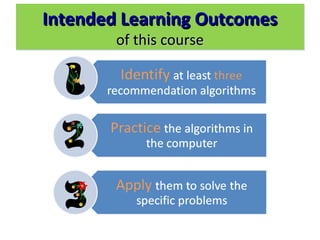
Intended Learning OutcomesIntended Learning Outcomes
of this courseof this course
Intended Learning OutcomesIntended Learning Outcomes
of this courseof this course
Researchers’ troubles
•Every day, a researcher:
– Spend about half of their
working time just searching
for information
– Do not receive timely update
information related to their
research
– Find uneasy to connect with
other researchers for joint
research activities
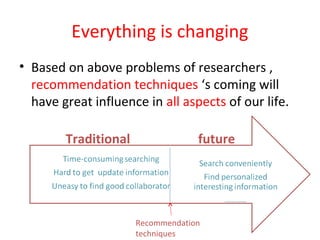
Everything is changing
• Based on above problems of researchers ,
recommendation techniques ‘s coming will
have great influence in all aspects of our life.
Traditional future
Recommendation
techniques
What’s the recommendation
techniques ?
Recommender techniques
are information agents that
attempt to predict which
items out of a large pool a
user may be interested in
and recommend the best
ones to the target user.
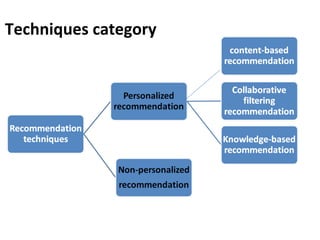
Techniques category
• The techniques can be classified based on the information
sources they use .
• The available sources are the user features (demographics)
(e.g. age, gender, income, location), the item features (e.g.
keywords, genres), the user-item ratings (explicit ratings,
transaction data) and knowledge about user and item(for
reasoning).
Techniques category
An open question
If you want to buy a pair of
trousers in a shop, what
kinds of suggestions will you
get?
non-personalized recommendation
Non-personalized
recommendations are
identical for each user.
The recommendations are
often based on the
popularity of items
(e.g. average ratings,
sales data). Maybe the clerk
advises you to buy
some popular trousers
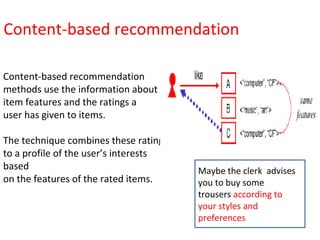
Content-based recommendation
methods use the information about
item features and the ratings a
user has given to items.
The technique combines these ratings
to a profile of the user’s interests
based
on the features of the rated items.
Maybe the clerk advises
you to buy some
trousers according to
your styles and
preferences
Collaborative filtering recommendation
The users are
categorized based on the
attributes of their demographic
profiles or on similar rating
preferences in order to find users
with similar
features.
The technique then recommends
items that are preferred by these
similar users
Maybe you will receive
suggestions from you
like-minded friends
(similar demographic
profiles or similar
preference)
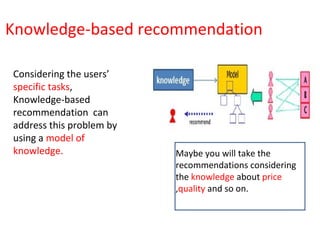
Knowledge-based recommendation
Maybe you will take the
recommendations considering
the knowledge about price
,quality and so on.
Considering the users’
specific tasks,
Knowledge-based
recommendation can
address this problem by
using a model of
knowledge.
Examples
Techniques category
Thank you for your
attention
If you want to know more
about this interesting
techniques , please wait
for next class!

Recommendation techniques

  • 1.
    Presented by SUN Jianshan Informationdepartment of college of business Recommendation techniques
  • 2.
    Intended Learning OutcomesIntendedLearning Outcomes of this courseof this course Intended Learning OutcomesIntended Learning Outcomes of this courseof this course
  • 3.
    Researchers’ troubles •Every day,a researcher: – Spend about half of their working time just searching for information – Do not receive timely update information related to their research – Find uneasy to connect with other researchers for joint research activities
  • 4.
    Everything is changing •Based on above problems of researchers , recommendation techniques ‘s coming will have great influence in all aspects of our life. Traditional future Recommendation techniques
  • 5.
    What’s the recommendation techniques? Recommender techniques are information agents that attempt to predict which items out of a large pool a user may be interested in and recommend the best ones to the target user.
  • 6.
    Techniques category • Thetechniques can be classified based on the information sources they use . • The available sources are the user features (demographics) (e.g. age, gender, income, location), the item features (e.g. keywords, genres), the user-item ratings (explicit ratings, transaction data) and knowledge about user and item(for reasoning).
  • 7.
  • 8.
    An open question Ifyou want to buy a pair of trousers in a shop, what kinds of suggestions will you get?
  • 9.
    non-personalized recommendation Non-personalized recommendations are identicalfor each user. The recommendations are often based on the popularity of items (e.g. average ratings, sales data). Maybe the clerk advises you to buy some popular trousers
  • 10.
    Content-based recommendation Content-based recommendation methodsuse the information about item features and the ratings a user has given to items. The technique combines these ratings to a profile of the user’s interests based on the features of the rated items. Maybe the clerk advises you to buy some trousers according to your styles and preferences
  • 11.
    Collaborative filtering recommendation Theusers are categorized based on the attributes of their demographic profiles or on similar rating preferences in order to find users with similar features. The technique then recommends items that are preferred by these similar users Maybe you will receive suggestions from you like-minded friends (similar demographic profiles or similar preference)
  • 12.
    Knowledge-based recommendation Maybe youwill take the recommendations considering the knowledge about price ,quality and so on. Considering the users’ specific tasks, Knowledge-based recommendation can address this problem by using a model of knowledge.
  • 13.
  • 14.
  • 15.
    Thank you foryour attention If you want to know more about this interesting techniques , please wait for next class!

Editor's Notes

  • #6 These items can be of any type, like movies, music, books, Websites , commodities or collaborators. The user’s interest in an item is expressed through the rating the user gives the item. A recommendation system has to predict the ratings for items that the user has not yet seen.