Download to read offline
![International Research Journal of Engineering and Technology (IRJET) e-ISSN: 2395-0056
Volume: 06 Issue: 06 | June 2019 www.irjet.net p-ISSN: 2395-0072
© 2019, IRJET | Impact Factor value: 7.211 | ISO 9001:2008 Certified Journal | Page 2192
RATING BASED RECOMMEDATION SYSTEM FOR WEB SERVICE
Sagar R. Tatar1, R. B. Wagh2
1PG Student, Dept. of Computer Engineering, RCPIT, Shirpur, Maharashtra, India
2Assistant Professor Dept. of Computer Engineering, RCPIT, Shirpur, Maharashtra, India
---------------------------------------------------------------------***----------------------------------------------------------------------
Abstract - Web services are software frameworksdesigned to
support Interoperable machine-to-machineinteractionovera
network. Web services delivery mode in business is a new
paradigm that shifts the development of monolithic
applications to the dynamic setup of business process. E-
commerce and Service users are not knowledgementaboutall
the different types of web services. Hence, the Web Service
Recommender System (WSRS) is needed to provide quality of
service to the users. In the E-commerce and other Web-based
services Recommendation techniques are very important,
dynamically providing a high-quality recommendation on
sparse data is one of the main difficulty. Exploring latent
relations between ratings is depends on the information
contained in both ratings and profile contents are utilized, in
multiple phases a set of dynamic features are designed to
describe user preferences and finally a recommendation is
made by adaptively weighting the features.
Key Words: Web service Recommendation, User rating,
Diversity.
1. INTRODUCTION
This E-commerce and other Web-based services
Recommendationtechniquesareveryimportant,dynamically
providing a high-quality recommendation on sparse data is
one of the main difficulty.Nowaday,E-commercetechnology
is very famous for the information explosion. Most studies
annoyed to develop the autonomoussystem which identifies
the user's desires. A most popular tool that helps users to
recommend according to their interests is Recommendation
System. The main objective of recommendation systemsisto
help users to deal with the information burden problem by
delivering personalized recommendations, content and
service. Recommendation systems are progressively being
used in E-commerce for recommending books, mobiles or
different types of objects. Recommendation systems help
consumers to find what they really want. So this meets the
desires of consumers in a short time [1]. It helps consumers
to find information, products, or by gathering and exploring
Suggestionsfromotherusersaction.TheInternethasbecome
an indispensable part of our lives, and it provides a platform
for enterprises to deliver information about products and
services to the customers conveniently. This kind of
information is increasing rapidly, one great challenge is
ensuring that proper content can be delivered quickly to the
appropriate customers. The way to improve customer
satisfaction and retention are Personalized
recommendations. web surfing/searching have become a
popular activity for many consumers who not only make
purchases online but also seek relevant information on
products and services before they commit to buying. In
recent years web services have been rapidly developed and
played an increasingly significant role in e-commerce,
enterprise application integration, and other applications.
With the growing of the number of Web services on the
Internet, Web service finding hasbecomeacriticalissuetobe
addressed in service computing community. Since there are
many Web services with similar functionalities and different
non-functional quality, it is important for users to select
desirable high-quality Web services whichsatisfybothusers’
functional and non- functional requirements.
Xiangyu Tang, Jie Zhou have developed on the Dynamic
Personalized Recommendation On Sparse Data. Nowadays
the internet has become an indispensable part of our lives,
and it provides a platform for enterprises to deliver
information about products and services to the customers
conveniently. This kind of information is increasing rapidly,
one great challenge is ensuring that proper content can be
delivered quickly to the appropriate customers. The way to
improvecustomersatisfactionandretentionarePersonalized
recommendations.There are mainly three approaches to
recommendation engines based on different data analysis
methods, i.e., rule-based, content-based and collaborative
filtering.
A novel dynamic personalized recommendation
algorithm for sparse data, in which more rating data is
utilized in one prediction by involving more neighboring
ratings through each attribute in user and item .profiles. To
describe the preference information, a set of dynamic
features are designed on the basis of TSA technique, and
finally a recommendation is made by adaptively weighting
the features using information in multiple phases of interest.
public MovieLens 100k and NetflixCompetitiondataindicate
that the proposed algorithm is effective, and its
computational cost is also acceptable. [2].
Manish Agrawal, Maryam Karimzadehgan, ChengXiang
Zhai have developed on the Online News Recommender
System for Social Networks. The popular social network i.e.
Facebook is online news recommender system as described.
This system provides daily newsletters for communities on
Facebook. The system retrieves the news articles and filters
them based on the community description to prepare the
daily news digest. Most users found the application useful
and easy to use is explicit survey feedback from the users.
Users also indicated that they could get some community-](https://image.slidesharecdn.com/irjet-v6i6470-191126064815/85/IRJET-Rating-based-Recommedation-System-for-Web-Service-1-320.jpg)
![International Research Journal of Engineering and Technology (IRJET) e-ISSN: 2395-0056
Volume: 06 Issue: 06 | June 2019 www.irjet.net p-ISSN: 2395-0072
© 2019, IRJET | Impact Factor value: 7.211 | ISO 9001:2008 Certified Journal | Page 2192
RATING BASED RECOMMEDATION SYSTEM FOR WEB SERVICE
Sagar R. Tatar1, R. B. Wagh2
1PG Student, Dept. of Computer Engineering, RCPIT, Shirpur, Maharashtra, India
2Assistant Professor Dept. of Computer Engineering, RCPIT, Shirpur, Maharashtra, India
---------------------------------------------------------------------***----------------------------------------------------------------------
Abstract - Web services are software frameworksdesigned to
support Interoperable machine-to-machineinteractionovera
network. Web services delivery mode in business is a new
paradigm that shifts the development of monolithic
applications to the dynamic setup of business process. E-
commerce and Service users are not knowledgementaboutall
the different types of web services. Hence, the Web Service
Recommender System (WSRS) is needed to provide quality of
service to the users. In the E-commerce and other Web-based
services Recommendation techniques are very important,
dynamically providing a high-quality recommendation on
sparse data is one of the main difficulty. Exploring latent
relations between ratings is depends on the information
contained in both ratings and profile contents are utilized, in
multiple phases a set of dynamic features are designed to
describe user preferences and finally a recommendation is
made by adaptively weighting the features.
Key Words: Web service Recommendation, User rating,
Diversity.
1. INTRODUCTION
This E-commerce and other Web-based services
Recommendationtechniquesareveryimportant,dynamically
providing a high-quality recommendation on sparse data is
one of the main difficulty.Nowaday,E-commercetechnology
is very famous for the information explosion. Most studies
annoyed to develop the autonomoussystem which identifies
the user's desires. A most popular tool that helps users to
recommend according to their interests is Recommendation
System. The main objective of recommendation systemsisto
help users to deal with the information burden problem by
delivering personalized recommendations, content and
service. Recommendation systems are progressively being
used in E-commerce for recommending books, mobiles or
different types of objects. Recommendation systems help
consumers to find what they really want. So this meets the
desires of consumers in a short time [1]. It helps consumers
to find information, products, or by gathering and exploring
Suggestionsfromotherusersaction.TheInternethasbecome
an indispensable part of our lives, and it provides a platform
for enterprises to deliver information about products and
services to the customers conveniently. This kind of
information is increasing rapidly, one great challenge is
ensuring that proper content can be delivered quickly to the
appropriate customers. The way to improve customer
satisfaction and retention are Personalized
recommendations. web surfing/searching have become a
popular activity for many consumers who not only make
purchases online but also seek relevant information on
products and services before they commit to buying. In
recent years web services have been rapidly developed and
played an increasingly significant role in e-commerce,
enterprise application integration, and other applications.
With the growing of the number of Web services on the
Internet, Web service finding hasbecomeacriticalissuetobe
addressed in service computing community. Since there are
many Web services with similar functionalities and different
non-functional quality, it is important for users to select
desirable high-quality Web services whichsatisfybothusers’
functional and non- functional requirements.
Xiangyu Tang, Jie Zhou have developed on the Dynamic
Personalized Recommendation On Sparse Data. Nowadays
the internet has become an indispensable part of our lives,
and it provides a platform for enterprises to deliver
information about products and services to the customers
conveniently. This kind of information is increasing rapidly,
one great challenge is ensuring that proper content can be
delivered quickly to the appropriate customers. The way to
improvecustomersatisfactionandretentionarePersonalized
recommendations.There are mainly three approaches to
recommendation engines based on different data analysis
methods, i.e., rule-based, content-based and collaborative
filtering.
A novel dynamic personalized recommendation
algorithm for sparse data, in which more rating data is
utilized in one prediction by involving more neighboring
ratings through each attribute in user and item .profiles. To
describe the preference information, a set of dynamic
features are designed on the basis of TSA technique, and
finally a recommendation is made by adaptively weighting
the features using information in multiple phases of interest.
public MovieLens 100k and NetflixCompetitiondataindicate
that the proposed algorithm is effective, and its
computational cost is also acceptable. [2].
Manish Agrawal, Maryam Karimzadehgan, ChengXiang
Zhai have developed on the Online News Recommender
System for Social Networks. The popular social network i.e.
Facebook is online news recommender system as described.
This system provides daily newsletters for communities on
Facebook. The system retrieves the news articles and filters
them based on the community description to prepare the
daily news digest. Most users found the application useful
and easy to use is explicit survey feedback from the users.
Users also indicated that they could get some community-](https://image.slidesharecdn.com/irjet-v6i6470-191126064815/75/IRJET-Rating-based-Recommedation-System-for-Web-Service-1-2048.jpg)
![International Research Journal of Engineering and Technology (IRJET) e-ISSN: 2395-0056
Volume: 06 Issue: 06 | June 2019 www.irjet.net p-ISSN: 2395-0072
© 2019, IRJET | Impact Factor value: 7.211 | ISO 9001:2008 Certified Journal | Page 2193
specific articles that they would not have got otherwise.
Sharing some common interests
In social network communicatesnewsarticlesisbasedon
recommending a novel system. The main contribution is
building a novel news recommender system and integrating
it with Facebook and gathering user feedback.Acombination
of content-based filtering and collaborative filtering is
recommendation approach. Facebook is an application to
explore and extent our knowledge.Foruserparticipation,the
system is automatic, sustainable and scalable to a large
number of communities. User studies indicate that most
users of this application find it useful and efficient,
demonstrating the feasibility of recommending information
through social networks [3].
Gediminas adomavicius, Alexander Tuzhilin, have
developed on the Toward the Next Generation of
Recommender Systems: A Survey of the State of the Art and
Possible Extensions. The current generation of
recommendation methods that are usually classified intothe
following described main categories: content-based,
collaborative, and hybrid recommendation approaches.Also
described limitations of current recommendation methods
and discusses possible extensions that can improve
recommendation capabilities and make recommender
systems applicable to an even broader range of applications.
An improvement of understanding of users and items,
incorporation of the contextual information into the
recommendation process, support for multcriteria ratings,
and a provision of more flexible and less intrusive types of
recommendation.
The current generation of recommender systems
surveyed still requires further improvements to make
recommendation methods more effective in a broader range
of applications. For better recommendation capabilities
Reviewed various limitationsofthecurrentrecommendation
methods and possible extensions
Cai-Nicolas Ziegler, Sean M. McNeehavedevelopedonthe
Improving Recommendation Lists through Topic
Diversification. Though the accuracy of state of the art
collaborative filtering systems, i.e., the probability that the
active user1 will appreciate the products recommended, is
excellent, some implications affecting user satisfaction have
been observed in practice. Thus, on Amazon.com
(http://www.amazon.com),manyrecommendationsseemto
be “similar” with respect to content. Buyers/customers that
have purchased many of same author's prose may happen to
obtain recommendation lists where all top-5 entries contain
books by that respective author only. Active user clearly
appreciates books written by author for all these
recommendations and pure accuracy
On the other hand, assuming that the active user has
several interests other than Hermann Hesse, e.g., historical
novels in general and books about world travel, the
recommended set of items appears poor, owing to its lack of
diversity. A framework to increase thediversityofatop-Klist
of recommended products. In order to show its efficiency in
diversifying. Also introduced new intra-list similaritymetric.
Contrasting precision and recall metrics, computed both for
user-based and item-based CF and featuring different levels
of diversification, with results obtained from a large-scale
user survey, the user’s overall liking of recommendationlists
goes beyond accuracy and involves other factors, e.g., the
users’ perceived list diversity. Able to provide empirical
evidence that lists are more than mere aggregations of single
recommendations, but bear an intrinsic, added value. [5].
Aviv Segev, Jian Yu have developed on the
Recommending Web Services via Combining Collaborative
Filtering With Content-based Features After a decade of
research and development, Web services have become one
of the standard technologies for sharing dataand software
and the number of Web services available on the Internet is
consistentlyincreasing.
According to recent statistics, there are 28,606 Web
services available on the Web, provided by 7,739 different
providers. This increasing adoption and presence of Web
services calls fornovel approaches forefficient Web services
recommendation and selection, which is afundamentalissue
in service oriented computing.
Web services recommendation is the process of
automatically identifying the usefulness of services and
proactively discovering and recommending services to end
users. Can also view service recommendation as the process
of service selection augmented with end user behavior
analysis. Web services recommendation and selection is a
fundamental issue in service oriented computing. Existing
Web services discovery and recommendation approaches
focus on either perishing UDDI registries, or keyword-
dominant, QoS-based Web service search engines. Such
approaches possess many limitations such as insufficient
recommendation performance and heavy reliance on the
input from users (e.g., preparing queries). A novel hybrid
approach for effective Web services recommendation.
Approach exploits a three-way aspect model that
systematically combines classic collaborative filtering and
content-based recommendation. Hybrid approach
simultaneously considers the similarities ofuserratingsand
semantic Web service content. Approach is validated by
conducting several experimental studies using 3,693 real-
world Web services publicly available from the Internet.
That the approach outperforms the conventional
collaborative and content-based methods in terms of
recommendation performance. [6]
2. RELATED WORK
A) Pre-retrieval method: This method predicts the difficulty
of a query without computing its results. These methods
normally use the statistical propertiesofthefactinthe query](https://image.slidesharecdn.com/irjet-v6i6470-191126064815/85/IRJET-Rating-based-Recommedation-System-for-Web-Service-2-320.jpg)
![International Research Journal of Engineering and Technology (IRJET) e-ISSN: 2395-0056
Volume: 06 Issue: 06 | June 2019 www.irjet.net p-ISSN: 2395-0072
© 2019, IRJET | Impact Factor value: 7.211 | ISO 9001:2008 Certified Journal | Page 2195
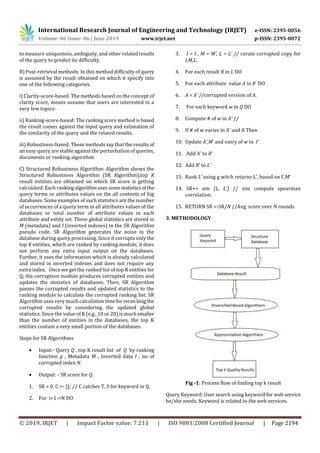
Structure Database: We have database which contains the
data about web services. We havecreatedthisdatabaseusing
structured and unstructured database entries. Is has some
complex database like usage statistics every time user
recommend the webservicethedatabaseentryforrespective
web service will get updated according to usage.
Database Result: As per the user querywewillgetresultofall
web services witch match with user keyword. This result
will contains thousands of entries.
Diversified Based Algorithm: We apply this algorithm on
database result that we get. This algorithm make cluster of
the result. This cluster will crated according to the
similarities between the data of web services. Every cluster
contains web services related to the keyword that user
recommended.
Approximation Algorithm: Approximationalgorithmsortthe
result from the cluster created. We will get the result
according to the user recommendation.
Top K Quality Result: At the end we will get the top K ranked
result as per keyword entered by user.
4. EXPERIMENTAL RESULTS
Website
Name
Total
Users
User
Views
Avg
Server
Avg
Total
Count
User
Rate
User
Rate
Avg
Website1 23 19 5 4 4
Website2 29 13 4 6 3
Website3 25 7 2 5 3
Table -1: Qos Preferances Of Users
Chart -1: Graphical Representation of Top K-Result
In Table -1, According to web service user statistics are
shown in the above table wehave average user views, server
view and total count of user rating according to all statistics
we recommend top K results to users. We have also shown
the graphical representation of recommended services.
5. CONCLUSION
We have recommend web service to user as per our
algorithm based calculation. Using diversified based
algorithm we create clusters of web services. After applying
approximation algorithm on clusters we are getting sorted
result for user query. On sorted resultwearerecommending
top k result to the user. Real world Webservicedatasetshow
that the proposed approach improves the Web service
recommendation performance in terms of diversity, the
combination of functional relevance and QoS utility, and the
diversified ranking evaluation.
REFERENCES
[1] L. Zhang, J. Zhang, H. Cai. Services computing. Tsinghua
University Press, Beijing, 2007.
[2] Xiangyu Tang, Jie Zhou “Dynamic Personalized
Recommendation On Sparse Data”. IEEE Transcationon
knowledge and data engineeringvol:ppno:99year2013
[3] Manish Agrawal, Maryam Karimzadehgan, ChengXiang
Zhai. “An Online News Recommender System for Social
Networks” Proceedings of International Conference on
Web Services. IEEE Computer Society, pp. 444-445,
2013.
[4] Gediminas adomavicius, Alexander Tuzhilin “Toward
the Next GenerationofRecommenderSystems:ASurvey
of the State-of-the-Art and Possible Extensions
”Proceedings of CHI'06 extended abstracts on Human
factors in computing systems. ACM, pp. 1097-1101,
2014.
[5] Cai-Nicolas Ziegler, Sean M. McNee “Improving
Recommendation Lists Through Topic Diversification
”Proceedings of Proceedings of the 14th international
conference on World Wide Web. ACM, pp. 22-32, 2007.
[6] Aviv Segev, Jian Yu “Recommending Web Services via
Combining CollaborativeFiltering With Content-based
Features ". Proceedings of International Conference on
Web Services. IEEE Computer Society, pp. 439-446,
2013.](https://image.slidesharecdn.com/irjet-v6i6470-191126064815/85/IRJET-Rating-based-Recommedation-System-for-Web-Service-4-320.jpg)

This document summarizes several research papers on recommendation systems for web services. It discusses using rating data from users to recommend web services based on quality of service. Approaches include collaborative filtering to find similar users and services. Dynamic features are designed to describe user preferences and recommendations are made by weighting these features. The document also discusses using content-based filtering and social network data to provide recommendations. Improving recommendation diversity and combining collaborative and content-based filtering is addressed. Experimental results on real world datasets show hybrid approaches can improve performance on metrics like diversity, relevance and quality of service.


