RECOGNISING THE CHILD WITH  RESPIRATORY DISTRESS Jamie Ranse :  Critical Care Education Coordinator, Staff Development Unit, ACT Health.
Effort of breathing Efficacy of breathing Effects of respiratory inadequacy Respiratory status assessment Respiratory alterations management overview
Respiratory Rate Recession Mild: sub-costal Severe: sternal Accessory muscle use Grunting Alar nasal flare Child’s position Respiratory noises Stridor / wheeze effort of breathing
effort of breathing:  respiratory rate
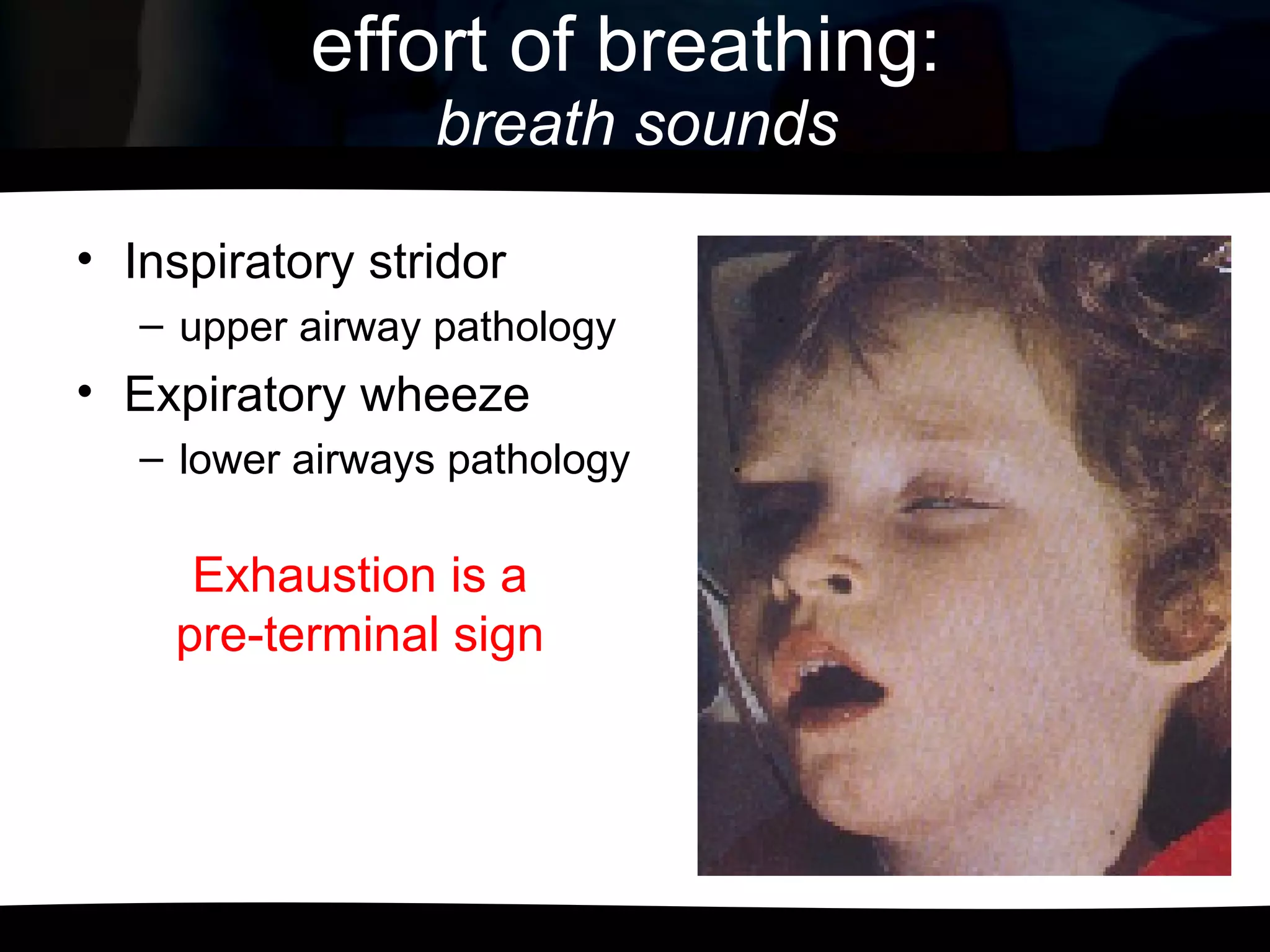
effort of breathing:  breath sounds Inspiratory stridor upper airway pathology Expiratory wheeze lower airways pathology Exhaustion is a pre-terminal sign
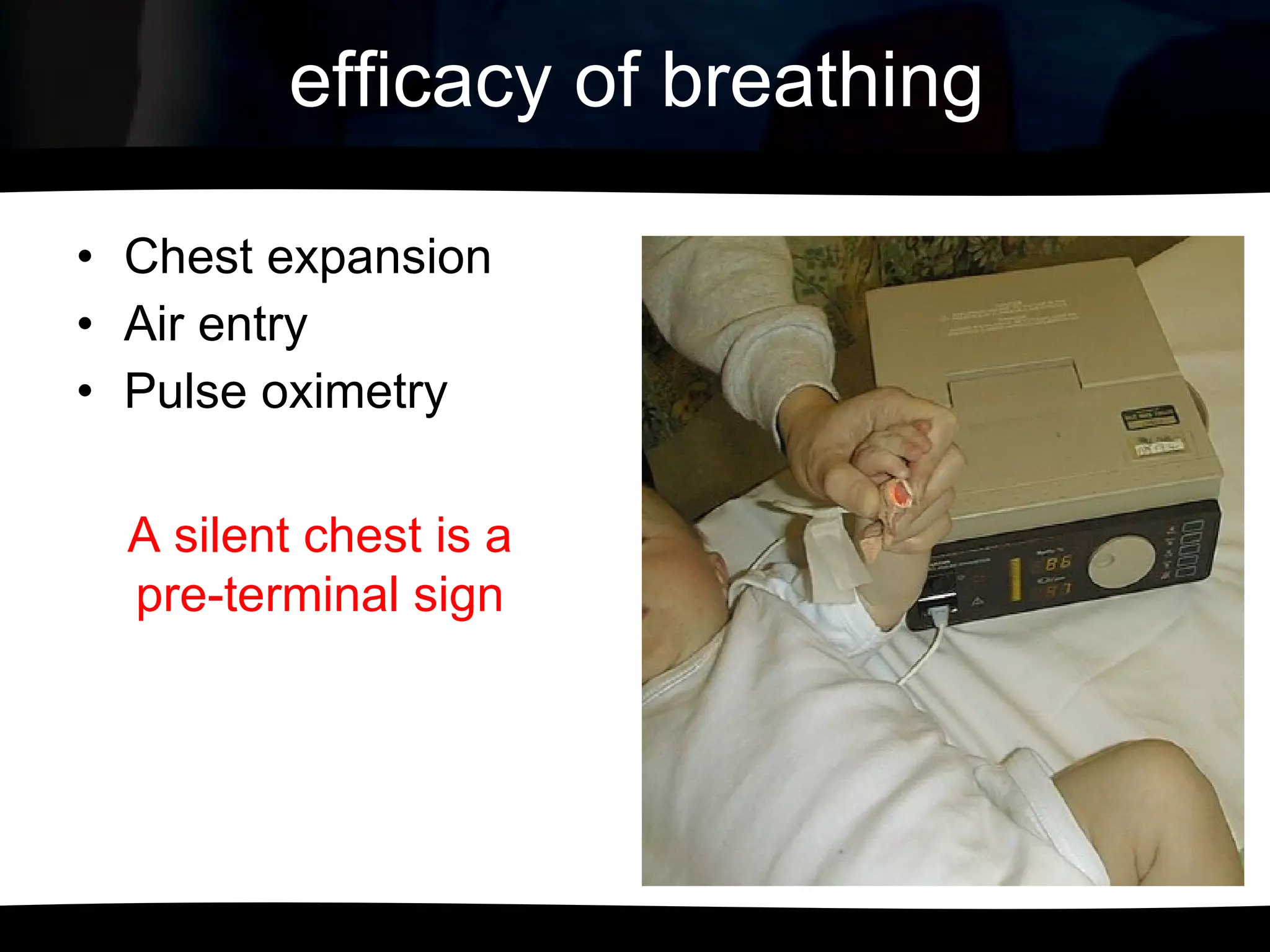
Chest expansion Air entry Pulse oximetry efficacy of breathing A silent chest is a pre-terminal sign
Heart rate Skin colour Level of consciousness Pre-terminal signs: Bradycardia Central cyonosis Unconsciousness effects of respiratory inadequacy
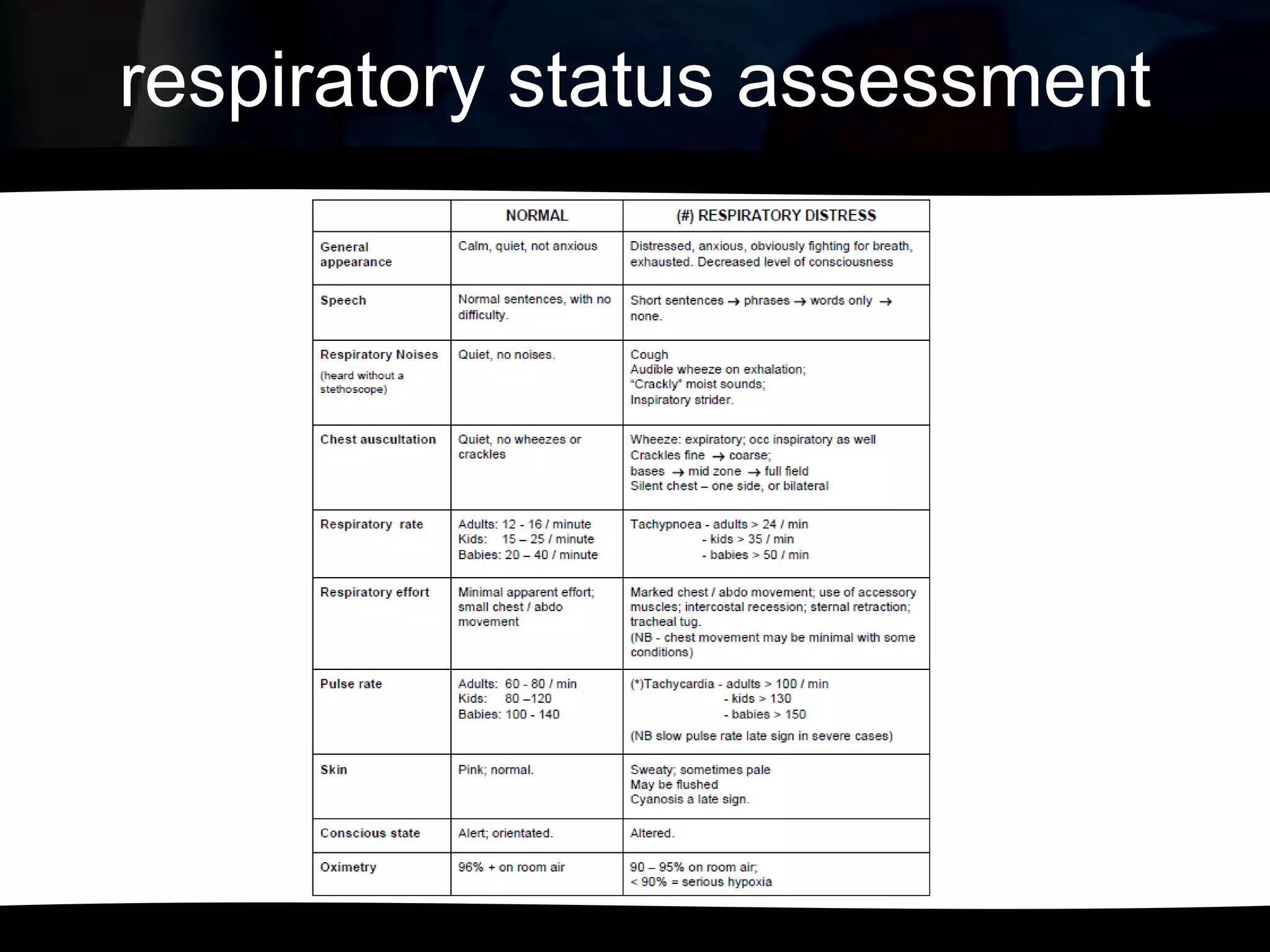
respiratory status assessment
respiratory alterations management Airway obstruction Swelling Bronchospasm Pulmonary oedema Non-specific respiratory disease Hyperventilation due to anxiety

Recognising the child with respiratory distress

  • 1.
    RECOGNISING THE CHILDWITH RESPIRATORY DISTRESS Jamie Ranse : Critical Care Education Coordinator, Staff Development Unit, ACT Health.
  • 2.
    Effort of breathingEfficacy of breathing Effects of respiratory inadequacy Respiratory status assessment Respiratory alterations management overview
  • 3.
    Respiratory Rate RecessionMild: sub-costal Severe: sternal Accessory muscle use Grunting Alar nasal flare Child’s position Respiratory noises Stridor / wheeze effort of breathing
  • 4.
    effort of breathing: respiratory rate
  • 5.
    effort of breathing: breath sounds Inspiratory stridor upper airway pathology Expiratory wheeze lower airways pathology Exhaustion is a pre-terminal sign
  • 6.
    Chest expansion Airentry Pulse oximetry efficacy of breathing A silent chest is a pre-terminal sign
  • 7.
    Heart rate Skincolour Level of consciousness Pre-terminal signs: Bradycardia Central cyonosis Unconsciousness effects of respiratory inadequacy
  • 8.
  • 9.
    respiratory alterations managementAirway obstruction Swelling Bronchospasm Pulmonary oedema Non-specific respiratory disease Hyperventilation due to anxiety

Editor's Notes

  • #4 RR: an increase in respiratory rate indicates possible airway disease or metabolic acidosis. Conversely, a slow respiratory rate can be an ominous sign indicating breathing fatigue, cerebral depression or a pre-terminal state. Reccesion: as paediatric patients have a more compliant chest wall (that is, it is not as rigid as an adults) any increased negative pressures generated in the thorax will result in intercostal, sub-costal or sternal recession. Greater recession = greater respiratory distress. But be careful, as children will tire from an increased effort of breathing much faster than adults, and as they do, these recessions will decrease. Accessory muscles: the child may begin using the sternomastoid muscle to assist with breathing. In infants this may lead to bobbing of the head. Looks cute, but isn’t. Grunting: a grunting child is a bad thing. It is an attempt to keep the distal airways open by generating a grunted positive end-expiratory pressure. It is a sign of severe respiratory distress. Grunting may also be seen in children with raised intercrainial pressure. Alar nasal flare: increase diameter = increased volume
  • #6 Stridor: is usually more pronounced in inspiration but may also occur during expiration. It indicates an upper airway obstruction. Always consider the possibility of an inhaled foreign body if you can hear stridor. Wheeze: Indicates lower airway narrowing and us usually more pronounced during expiration. Increased wheeze does not = increased respiratory distress. And once again, wheeze will subside as the patient becomes exhausted. Rhonchi: course rattling sound, somewhat like snoring, usually caused by secretions in the brhonical airways
  • #7 Efficacy: capacity to produce an effect Chest expansion: symetrical Air entry: equal, no adventious (added) sounds Pulse oximetry: random number generators, they rely on many things to work, such as peripheral circulation, warmth, constant waveform.
  • #10 Everyone gets oxygen, Consider reversible causes Remove from environment Drugs, etc… Airway obstruction: Back blows, Mcgill forceps – for uncouncious Surgical airway Swelling Neb salbutamol 0.5ml/kg adrenaline nebulised (1:1000) (consider IM in bites / stings) Bronchospasm Neb salbutamol (consider atrovent) Severe Asthma: Hydrocortisone (4mg/kg to max of 200mg) Life threatening: 0.01mg/kg IM IPPV slow gental Pulmonary Oedema: IPPV and PEEP Non-specific Neb salbutamol + atrovent –to every second dose anxiety Anxiety due to decreasd O2 or decreased O2 due to anxiety - ?pathological cause Low flow O2 via H/M