DR. SARITA SHARMA
ASSOCIATE PROFESSOR
MMCP, MMDU
INTRODUCTION
 Cell culture refers to the removal of cells from an
animal or plant and their subsequent growth in a
favorable artificial environment.
 The cells may be removed from the tissue directly and
disaggregated by enzymatic or mechanical means
before cultivation, or they may be derived from a cell
line or cell strain that has already been established.
TYPES OF CELL CULTURE
 1.Primary cell culture….1.Adherent cell culture
2.Suspension cell culture
2. Secondary cell culture
3. Cell line….1. Finite cell line
2.Continuous cell line
PRIMARY CELL CULTURE
 Separate cell directly from the parent tissue..kidney ,
liver, heart.
 Seperated by enzymetic and mechanical methods.
 Maintaining the growth of the cell in a culture
medium using glass or plastic container.
 CULTURE MEDIUM..Liquid or gel designed to
maintain the growth of the cells.
 It varies from different types of cells.
 ADHERENT CELL-Those cells which attach to the
surface of the culture flask.
 Forms a monolayer.
 They have to be detached from the surface before they
get sub cultured.
 Growth limited to surface area.
 SUSPENSION CELL-Those cells does not attached to
the surface of culture flask.
 They are free floating
 Cells in blood stream.
SECONDARY CELL CULTURE
 When primary cell is sub cultured, then it is secondary
cell.
 Subculture-transfer of cell from one culture vessel to
another.
 METHOD-Remove growth medium
 Detach adherent cells
Why required-To provide fresh nutrients.
To provide more space
CELL LINE
FINITE CELL LINE CONTINUOUS CELL LINE
 Limited life span
 Go through a limited number
of cell generation
 Less growth rate
 Doubling time-24-92hrs
 Properties-contact inhibition
density limitation
 Grow indefinetly
 Grow either in monolayer or
in suspension.
 High growth rate
 Doubling time-12-24hrs
 Properties-absence contact
inhibition
CELL CULTURE MEDIUM
 Generally, a medium contains –
 inorganic salts Na+, K+, Mg2+, Ca2+, Cl−,SO4
2−, PO4
3−, and
HCO3
 amino acids (EAA & NEAA)
 vitamins (B complex)
 special ingredients like trace elements (Cu, Fe, Zn)
 nucleosides & nucleotides (AMP, ATP, UTP, FAD, Guanine,
guanosine, hypoxanthine)
 TCA cycle intermediates (pyruvate, acetate, acetyl CoA)
 energy metabolites (glucose, galactose)
 lipids & precursors (cholesterol, lipoic acid, linoleic acid).
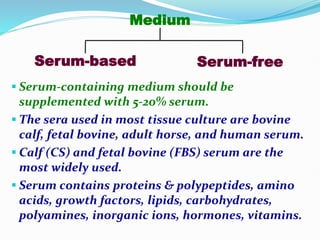
Serum-based
Medium
Serum-free
 Serum-containing medium should be
supplemented with 5-20% serum.
 The sera used in most tissue culture are bovine
calf, fetal bovine, adult horse, and human serum.
 Calf (CS) and fetal bovine (FBS) serum are the
most widely used.
 Serum contains proteins & polypeptides, amino
acids, growth factors, lipids, carbohydrates,
polyamines, inorganic ions, hormones, vitamins.
 Cell culture medium is available either as liquid
(generic-bottled & sterile) or lyophilized powder (non-
sterile).
 Liquid medium can be used directly after addition of
serum (for serum-based medium).
 Lyophilized powder needs to be reconstituted in water
(tissue culture grade), pH adjusted and sterilized by
filtration, and then be used, after addition of serum.
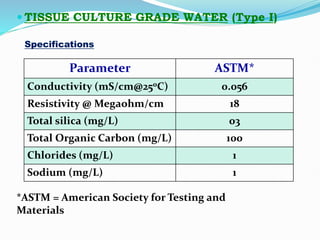
 TISSUE CULTURE GRADE WATER (Type I)
Specifications
Parameter ASTM*
Conductivity (mS/cm@250C) 0.056
Resistivity @ Megaohm/cm 18
Total silica (mg/L) 03
Total Organic Carbon (mg/L) 100
Chlorides (mg/L) 1
Sodium (mg/L) 1
*ASTM = American Society for Testing and
Materials
 Antibiotics may be added to prevent microbial
growth.
 Commonly used antibiotics are –
 - Penicillin G (100 U/ml)
 - Streptomycin (100 µg/ml)
 - Amphotericin B (2.5 µg/ml).
 Others are –
 Ampicillin, Ciprofloxacin, Erythromycin,
Gentamycin, Kanamycin, Neomycin, Nystatin,
Polymixin B, Tetracyclin, Tylosin.
 Also contains NaHCO3 (as a buffer) and phenol red (as
a pH indicator).
 pH 7.2-7.5 is optimum for the growth of most cells.
 Phenol red is red at pH 7.4 → becomes orange at pH
7.0 → yellow at pH 6.5 → lemon yellow below pH 6.5 →
more pink at pH 7.6 → purple at pH 7.8
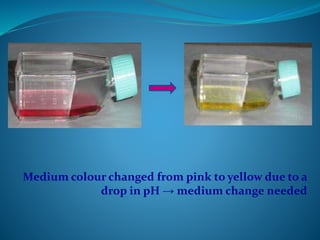
Medium colour changed from pink to yellow due to a
drop in pH → medium change needed
EXAMPLES OF FEW MEDIA
SERUM-BASED
 MEM
 DMEM
 RPMI 1640
 Ham’s F12
 DMEM/F12
 McCoy’s 5A
 M199
 CMRL 1066
SERUM-FREE
 MCDB 110
 MCDB 131
 MCDB 170
 MCDB 202
 MCDB 302
 MCDB 402
 MCDB 153
 WAJC 404
 ISCOVE’s
 LHC-9
CELL CULTURE MEDIA
 Natural Media
 Natural media consist solely of naturally occurring
biological fluids. Natural media are very useful and
convenient for a wide range of animal cell culture.
 The major disadvantage of natural media is its poor
reproducibility due to lack of knowledge of the exact
composition of these natural media.
 Artificial Media
 Artificial or synthetic media are prepared by adding
nutrients (both organic and inorganic), vitamins, salts,
O2 and CO2 gas phases, serum proteins, carbohydrates,
cofactors [1].
 Different artificial media have been devised to serve one
or more of the following purposes:
 1) immediate survival (a balanced salt solution, with
specific pH and osmotic pressure);
 2) prolonged survival (a balanced salt solution
supplemented with various formulation of organic
compounds and/or serum);
 3) indefinite growth; 4) specialized functions.
TYPES OF ARTIFICIAL MEDIA
 1.Serum containing media
 Fetal bovine serum is the most common supplement in animal
cell culture media. It is used as a low-cost supplement to provide
an optimal culture medium.
 2.Serum-free media
 Presence of serum in the media has many drawbacks and can
lead to serious misinterpretations in immunological studies.
 These media are generally specifically formulated to support the
culture of a single cell type and incorporate defined quantities of
purified growth factors, lipoproteins, and other proteins, which
are otherwise usually provided by the serum. These media are
also referred to as ‘defined culture media’ since the components
in these media are known.
 3.Chemically defined media
 These media contain contamination-free ultra pure inorganic and
organic ingredients, and may also contain pure protein additives,
like growth factors. Their constituents are produced in bacteria or
yeast by genetic engineering with the addition of vitamins,
cholesterol, specific amino acids, and fatty acids.
 4.Protein-free media
 Protein-free media do not contain any protein and only contain
non-protein constituents. Compared to serum-supplemented
media, use of protein-free media promotes superior cell growth
and protein expression and facilitates downstream purification of
any expressed product Formulations like MEM, RPMI-1640 are
protein-free and protein supplement is provided when required.
BASIC EQUIPMENTS
 Incubators
 The purpose of the incubator is to provide the appropriate
environment for cell growth. The incubator should be large
enough for your laboratory needs, have forced-air circulation,
and should have temperature control to within ±0.2°C. Stainless
steel incubators allow easy cleaning and provide corrosion
protection, especially if humid air is required for
incubation. Although the requirement for aseptic conditions in
a cell culture incubator is not as stringent as that in a cell culture
hood, frequent cleaning of the incubator is essential to avoid
contamination of cell cultures.
 Storage
 A cell culture laboratory should have storage areas for
liquids such as media and reagents, for chemicals such as
drugs and antibiotics, for consumables such as disposable
pipettes, culture vessels, and gloves, for glassware such as
media bottles and glass pipettes, for specialized
equipment, and for tissues and cells. Glassware, plastics,
and specilized equipment can be stored at ambient
temperature on shelves and in drawers; however, it is
important to store all media, reagents, and chemicals
according to the instructions on the label.
Some media, reagents, and chemicals are sensitive to light;
while their normal laboratory use under lighted conditions
is tolerated, they should be stored in the dark or wrapped
in aluminum foil when not in use.
 Refrigerators
 For small cell culture laboratories, a domestic
refrigerator (preferably one without an autodefrost
freezer) is an adequate and inexpensive piece of
equipment for storing reagents and media at 2–
8°C. For larger laboratories, a cold room restricted to
cell culture is more appropriate. Make sure that the
refrigerator or the cold room is cleaned regularly to
avoid contamination.
 Freezers
 Most cell culture reagents can be stored at –5°C to –
20°C; therefore an ultradeep freezer (i.e., a –80°C
freezer) is optional for storing most reagents. A
domestic freezer is a cheaper alternative to a
laboratory freezer. While most reagents can
withstand temperature oscillations in an autodefrost
(i.e., self-thawing) freezer, some reagents such as
antibiotics and enzymes should be stored in a
freezer that does not autodefrost.
 Cryogenic Storage
 Cell lines in continuous culture are likely to suffer from genetic
instability as their passage number increases; therefore, it is
essential to prepare working stocks of the cells and preserve them
in cryogenic storage . Do not store cells in –20°C or –80°C
freezers, because their viability quickly decreases when they are
stored at these temperatures.
There are two main types of liquid-nitrogen storage systems, vapor
phase and liquid phase, which come as wide-necked or narrow-
necked storage containers. Vapor phase systems minimize the risk
of explosion with cryostorage tubes, and are required for storing
biohazardous materials, while the liquid phase systems usually
have longer static holding times, and are therefore more
economical.
Narrow-necked containers have a slower nitrogen evaporation
rate and are more economical, but wide-neckedcontainers allow
easier access and have a larger storage capacity
ASEPTIC TECHNIQUE
 In the laboratory cells are generally maintained in a suitable
culture medium either solid or liquid, but in either case one
providing an environment suitable for their growth and
multiplication. Furthermore, cultures of cells are normally
supplied as pure cultures, containing only a single strain..
Cultures are usually supplied in conical flasks, universal bottles
or Petri dishes, the cotton wool plugs, screw caps or covers
respectively serving to keep the cultures free of contamination
from airborne bacteria or fungal spores. In order to maintain
pure cultures, all glassware must be sterilised before use
and aseptic techniques (sometimes known as sterile
techniques) should be observed throughout, as described in the
following notes.
 Plugs and caps must be held in the fingers when temporarily
removed from culture vessels and must be set down on the
bench.
 The mouths of culture tubes or bottles should be flamed after
removing plugs and caps and again before they are replaced.
 Work in a laminar flow or close to a Bunsen flame to ensure that
airborne contaminants are carried upwards.
TISSUE CULTURE
 In vitro cultivation of organs, tissues & cells at defined
temperature using an incubator & supplemented with
a medium containing cell nutrients & growth factors is
collectively known as tissue culture.
 Different types of cell grown in culture includes
connective tissue elements such as fibroblasts, skeletal
tissue, cardiac, epithelial tissue (liver, breast, skin,
kidney) and many different types of tumor cells.
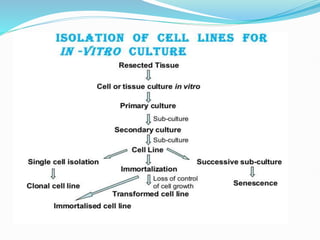
CELL LINES
 Most cell lines grow for a limited number of generations after which
they ceases
 Cell lines which either occur spontaneously or induced virally or
chemically transformed into cell lines
 Characteristics of cell lines
 -smaller, more rounded, less adherent with a higher nucleus
/cytoplasm ratio
 -Fast growth and have aneuploid chromosome number
 -reduced serum and anchorage dependence and grow more in
suspension conditions
 -ability to grow upto higher cell density
 -different in phenotypes from donar tissue
 -stop expressing tissue specific genes
SUBCULTURE
 In biology , a subculture is a new cell or microbiological
culture made by transferring some or all cells from a
previous culture to fresh growth medium. This action is
called subculturing or passaging the cells.
 Subculture is used to prolong the life and/or expand the
number of cells or microorganisms in the culture.
WHY SUBCULTURING
 Once the available substrate surface is covered by cells (a
confluent culture) growth slows & ceases.
 Cells to be kept in healthy & in growing state have to be
sub-cultured or passaged.
 It’s the passage of cells when they reach to 80-90%
confluence in flask/dishes/plates.
 Enzyme such as trypsin, diphase, collagenase in
combination with EDTA breaks the cellular glue that
attached the cells to the surface.
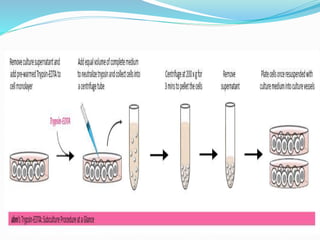
 After they are grown in culture for a few days, cells can
become too crowded for their container and this can
be detrimental to their growth, generally leading to
cell death if left for long periods of time as they will
use up the nutrients over time.
 A common solution to this is to subculture the cells
into another container. What this involves is simply
taking a portion of the cells from one container and
moving them to a new container with fresh media,
thus providing more space and nutrients for both
portions of cell
GENERAL PROCEDURE OF CELL CULTURE
 Sanitize the cabinet using 70% ethanol before
commencing work.
 Sanitize gloves by washing them in 70% ethanol and
allowing to air dry for 30 seconds before commencing
work.
 Put all materials and equipment into the cabinet prior to
starting work after sanitizing the exterior surfaces with
70% ethanol.
 Sanitize the cabinet with 10 – 30 min UV light. Warning –
plastics will crack and become brittle over time with
repeated exposure to UV light. Only some cabinets have
timed UV lights. Ensure they are not left on for extended
periods.
 While working, do not contaminate hands or gloves by
touching anything outside the cabinet (especially face and
hair). If gloves become contaminated re-sanitize with 70%
ethanol as above before proceeding.
 Discard gloves after handling contaminated cultures and at
the end of all cell culture procedures.
 Equipment in the cabinet or that which will be taken into
the cabinet during cell culture procedures (media bottles,
pipette tip boxes, pipette aids) should be wiped with tissue
soaked with 70% ethanol prior to use.
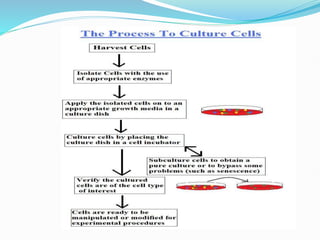
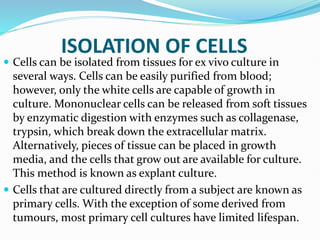
ISOLATION OF CELLS
 Cells can be isolated from tissues for ex vivo culture in
several ways. Cells can be easily purified from blood;
however, only the white cells are capable of growth in
culture. Mononuclear cells can be released from soft tissues
by enzymatic digestion with enzymes such as collagenase,
trypsin, which break down the extracellular matrix.
Alternatively, pieces of tissue can be placed in growth
media, and the cells that grow out are available for culture.
This method is known as explant culture.
 Cells that are cultured directly from a subject are known as
primary cells. With the exception of some derived from
tumours, most primary cell cultures have limited lifespan.
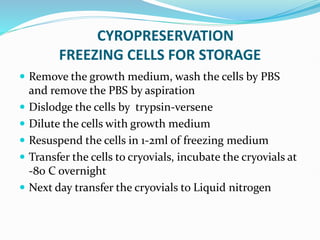
CYROPRESERVATION
FREEZING CELLS FOR STORAGE
 Remove the growth medium, wash the cells by PBS
and remove the PBS by aspiration
 Dislodge the cells by trypsin-versene
 Dilute the cells with growth medium
 Resuspend the cells in 1-2ml of freezing medium
 Transfer the cells to cryovials, incubate the cryovials at
-80 C overnight
 Next day transfer the cryovials to Liquid nitrogen
WORKING
 Vial from liquid nitrogen is placed into 37C water
bath, agitate vial continuously until medium is thawed
 Resuspend the cell pellet in 1 ml of complete medium
with 20% FBS and transfer to properly labeled culture
plate containing the appropriate amount of medium
 Check the cultures after 24 hrs to ensure that they are
attached to the plate
 Change medium as the colour changes, use 20% FBS
until the cells are established
AMPOULES
 Use polypropylene cryovials
 Resistant to cracking
 Some Repositories Prefer Glass
 Better properties for long term storage
 Labeling Is Very Important
 Stored cells can outlive you! Proper labeling is essential
 In your label include
 Cell type, date and cell number
 Use an alcohol resistant marker
APPLICATIONS OF CELL CULTURE
 Areas where cell culture technology is currently playing
major role.
Model systems for-
Studying basic cell biology, interactions between disease
causing agents and cells, effects of drugs on cells, process
and triggering of aging & nutritional studies.
 Toxicity testing
Study the effects of new drugs.
 Cancer research
 Study the function of various chemicals, virus & radiation
to convert normal cultured cells to cancerous cells.
 Virology
 Cultivation of virus for vaccine production, also used
to study there infectious cycle.
 Genetic Engineering
 Production of commercial proteins, large
scale production of viruses for use in vaccine
production e.g. polio, rabies, chicken pox, hepatitis B
& measles.
 Gene therapy
 Cells having a functional gene can be replaced to
cells which are having non-functional gene.
CELL VIABILITY ASSAY
 A viability assay is an assay to determine the ability of
organs , cells or tissues to maintain or recover viability.
 Viability can be distinguished from the all-or-nothing
states of life and death by use of a quantifiable index
between 0 and 1 (or 0% and 100%).Viability can assay
mechanical activity, motility (spermatozoa or
granulocytes), contraction (muscle tissue or cells),
mitotic activity, etc.
METHODS OF CELL VIABILITY
 Indirect viable-cell counting.
 Dilution methods ( solid, liquid media).
 Surface viable count (miles & mizra ).
 Roll tube technique.
 Direct viable-cell counting
 Nalidixic acid method
 Vital fluorogenic dyes
 Trypan blue assay
 Microradioautography
GLUCOSE UPTAKE ASSAY
 Glucose is the primary source of energy for most cells
and its uptake into cells is highly regulated and the
first rate limiting step in glucose metabolism.
 Glucose uptake is facilitated by the GLUT family of
transporter proteins, whose expression and activity are
regulated by multiple mechanisms.
 Glucose uptake is upregulated in many cancer cells,
which exhibit high rates of aerobic glycolysis. Cells
exhibiting insulin resistance show diminished glucose
uptake in response to insulin stimulation.
 The Glucose Uptake Colorimetric Assay kit provides a simple
and direct procedure for measuring glucose uptake in a variety
of cells.
 Glucose uptake is measured using the glucose analog, 2-
deoxyglucose (2-DG), which is taken up by cells and
phosphorylated by hexokinase to 2-DG6P.
 2-DG6P cannot be further metabolized and accumulates in
cells, directly proportional to the glucose uptake by cells.
 In this assay, 2-DG uptake is determined by a coupled
enzymatic assay in which the 2-DG6P is oxidized, resulting in
the generation of NADPH, which is then determined by a
recycling amplification reaction in which the NADPH is utilized
by glutathione reductase in a coupled enzymatic reaction that
produces glutathione.
 Glutathione reacts with DTNB to product TNB, which is
detected at 412 nm.
CALCIUM UPTAKE ASSAY
 Preparation (For 4 samples) Preparation of Jurkat T cells:
 Count cells growing exponentially (1 x 10⁶ per assay).
 Wash cells once with pre-warmed complete RPMI media at 200 x g for
5 min.
 Place 1 x 10⁶ cells/250 μl of fresh complete RPMI media into a 5 ml
FACS tube.
 Preparation of 1x enhancing solution (from Calcium Assay
Kit) (2 ml for 4 assays):
 Mix 200 μl of 10x enhancing solution with 1.8 ml of assay buffer.
 Keep it at room temperature.
 Preparation of indicator (from Calcium Assay Kit):
 Equilibrate a vial of indicator (stored at -20 °C) at room temperature
for 5 min.
 Add 100 μl of 100% DMSO.
 Mix well by pipetting up and down multiple times.
 Store at RT for 10 min to stabilize completely.
 Store unused indicator in a small aliquot at -20 °C until use.
 Cool down tube at RT for 20 min before analysis

Cell Culture.pptx

  • 1.
    DR. SARITA SHARMA ASSOCIATEPROFESSOR MMCP, MMDU
  • 2.
    INTRODUCTION  Cell culturerefers to the removal of cells from an animal or plant and their subsequent growth in a favorable artificial environment.  The cells may be removed from the tissue directly and disaggregated by enzymatic or mechanical means before cultivation, or they may be derived from a cell line or cell strain that has already been established.
  • 3.
    TYPES OF CELLCULTURE  1.Primary cell culture….1.Adherent cell culture 2.Suspension cell culture 2. Secondary cell culture 3. Cell line….1. Finite cell line 2.Continuous cell line
  • 4.
    PRIMARY CELL CULTURE Separate cell directly from the parent tissue..kidney , liver, heart.  Seperated by enzymetic and mechanical methods.  Maintaining the growth of the cell in a culture medium using glass or plastic container.  CULTURE MEDIUM..Liquid or gel designed to maintain the growth of the cells.  It varies from different types of cells.
  • 5.
     ADHERENT CELL-Thosecells which attach to the surface of the culture flask.  Forms a monolayer.  They have to be detached from the surface before they get sub cultured.  Growth limited to surface area.  SUSPENSION CELL-Those cells does not attached to the surface of culture flask.  They are free floating  Cells in blood stream.
  • 6.
    SECONDARY CELL CULTURE When primary cell is sub cultured, then it is secondary cell.  Subculture-transfer of cell from one culture vessel to another.  METHOD-Remove growth medium  Detach adherent cells Why required-To provide fresh nutrients. To provide more space
  • 7.
    CELL LINE FINITE CELLLINE CONTINUOUS CELL LINE  Limited life span  Go through a limited number of cell generation  Less growth rate  Doubling time-24-92hrs  Properties-contact inhibition density limitation  Grow indefinetly  Grow either in monolayer or in suspension.  High growth rate  Doubling time-12-24hrs  Properties-absence contact inhibition
  • 8.
    CELL CULTURE MEDIUM Generally, a medium contains –  inorganic salts Na+, K+, Mg2+, Ca2+, Cl−,SO4 2−, PO4 3−, and HCO3  amino acids (EAA & NEAA)  vitamins (B complex)  special ingredients like trace elements (Cu, Fe, Zn)  nucleosides & nucleotides (AMP, ATP, UTP, FAD, Guanine, guanosine, hypoxanthine)  TCA cycle intermediates (pyruvate, acetate, acetyl CoA)  energy metabolites (glucose, galactose)  lipids & precursors (cholesterol, lipoic acid, linoleic acid).
  • 9.
    Serum-based Medium Serum-free  Serum-containing mediumshould be supplemented with 5-20% serum.  The sera used in most tissue culture are bovine calf, fetal bovine, adult horse, and human serum.  Calf (CS) and fetal bovine (FBS) serum are the most widely used.  Serum contains proteins & polypeptides, amino acids, growth factors, lipids, carbohydrates, polyamines, inorganic ions, hormones, vitamins.
  • 10.
     Cell culturemedium is available either as liquid (generic-bottled & sterile) or lyophilized powder (non- sterile).  Liquid medium can be used directly after addition of serum (for serum-based medium).  Lyophilized powder needs to be reconstituted in water (tissue culture grade), pH adjusted and sterilized by filtration, and then be used, after addition of serum.
  • 11.
     TISSUE CULTUREGRADE WATER (Type I) Specifications Parameter ASTM* Conductivity (mS/cm@250C) 0.056 Resistivity @ Megaohm/cm 18 Total silica (mg/L) 03 Total Organic Carbon (mg/L) 100 Chlorides (mg/L) 1 Sodium (mg/L) 1 *ASTM = American Society for Testing and Materials
  • 12.
     Antibiotics maybe added to prevent microbial growth.  Commonly used antibiotics are –  - Penicillin G (100 U/ml)  - Streptomycin (100 µg/ml)  - Amphotericin B (2.5 µg/ml).  Others are –  Ampicillin, Ciprofloxacin, Erythromycin, Gentamycin, Kanamycin, Neomycin, Nystatin, Polymixin B, Tetracyclin, Tylosin.
  • 13.
     Also containsNaHCO3 (as a buffer) and phenol red (as a pH indicator).  pH 7.2-7.5 is optimum for the growth of most cells.  Phenol red is red at pH 7.4 → becomes orange at pH 7.0 → yellow at pH 6.5 → lemon yellow below pH 6.5 → more pink at pH 7.6 → purple at pH 7.8
  • 14.
    Medium colour changedfrom pink to yellow due to a drop in pH → medium change needed
  • 15.
    EXAMPLES OF FEWMEDIA SERUM-BASED  MEM  DMEM  RPMI 1640  Ham’s F12  DMEM/F12  McCoy’s 5A  M199  CMRL 1066 SERUM-FREE  MCDB 110  MCDB 131  MCDB 170  MCDB 202  MCDB 302  MCDB 402  MCDB 153  WAJC 404  ISCOVE’s  LHC-9
  • 16.
    CELL CULTURE MEDIA Natural Media  Natural media consist solely of naturally occurring biological fluids. Natural media are very useful and convenient for a wide range of animal cell culture.  The major disadvantage of natural media is its poor reproducibility due to lack of knowledge of the exact composition of these natural media.
  • 17.
     Artificial Media Artificial or synthetic media are prepared by adding nutrients (both organic and inorganic), vitamins, salts, O2 and CO2 gas phases, serum proteins, carbohydrates, cofactors [1].  Different artificial media have been devised to serve one or more of the following purposes:  1) immediate survival (a balanced salt solution, with specific pH and osmotic pressure);  2) prolonged survival (a balanced salt solution supplemented with various formulation of organic compounds and/or serum);  3) indefinite growth; 4) specialized functions.
  • 18.
    TYPES OF ARTIFICIALMEDIA  1.Serum containing media  Fetal bovine serum is the most common supplement in animal cell culture media. It is used as a low-cost supplement to provide an optimal culture medium.  2.Serum-free media  Presence of serum in the media has many drawbacks and can lead to serious misinterpretations in immunological studies.  These media are generally specifically formulated to support the culture of a single cell type and incorporate defined quantities of purified growth factors, lipoproteins, and other proteins, which are otherwise usually provided by the serum. These media are also referred to as ‘defined culture media’ since the components in these media are known.
  • 19.
     3.Chemically definedmedia  These media contain contamination-free ultra pure inorganic and organic ingredients, and may also contain pure protein additives, like growth factors. Their constituents are produced in bacteria or yeast by genetic engineering with the addition of vitamins, cholesterol, specific amino acids, and fatty acids.  4.Protein-free media  Protein-free media do not contain any protein and only contain non-protein constituents. Compared to serum-supplemented media, use of protein-free media promotes superior cell growth and protein expression and facilitates downstream purification of any expressed product Formulations like MEM, RPMI-1640 are protein-free and protein supplement is provided when required.
  • 20.
    BASIC EQUIPMENTS  Incubators The purpose of the incubator is to provide the appropriate environment for cell growth. The incubator should be large enough for your laboratory needs, have forced-air circulation, and should have temperature control to within ±0.2°C. Stainless steel incubators allow easy cleaning and provide corrosion protection, especially if humid air is required for incubation. Although the requirement for aseptic conditions in a cell culture incubator is not as stringent as that in a cell culture hood, frequent cleaning of the incubator is essential to avoid contamination of cell cultures.
  • 21.
     Storage  Acell culture laboratory should have storage areas for liquids such as media and reagents, for chemicals such as drugs and antibiotics, for consumables such as disposable pipettes, culture vessels, and gloves, for glassware such as media bottles and glass pipettes, for specialized equipment, and for tissues and cells. Glassware, plastics, and specilized equipment can be stored at ambient temperature on shelves and in drawers; however, it is important to store all media, reagents, and chemicals according to the instructions on the label. Some media, reagents, and chemicals are sensitive to light; while their normal laboratory use under lighted conditions is tolerated, they should be stored in the dark or wrapped in aluminum foil when not in use.
  • 22.
     Refrigerators  Forsmall cell culture laboratories, a domestic refrigerator (preferably one without an autodefrost freezer) is an adequate and inexpensive piece of equipment for storing reagents and media at 2– 8°C. For larger laboratories, a cold room restricted to cell culture is more appropriate. Make sure that the refrigerator or the cold room is cleaned regularly to avoid contamination.
  • 23.
     Freezers  Mostcell culture reagents can be stored at –5°C to – 20°C; therefore an ultradeep freezer (i.e., a –80°C freezer) is optional for storing most reagents. A domestic freezer is a cheaper alternative to a laboratory freezer. While most reagents can withstand temperature oscillations in an autodefrost (i.e., self-thawing) freezer, some reagents such as antibiotics and enzymes should be stored in a freezer that does not autodefrost.
  • 24.
     Cryogenic Storage Cell lines in continuous culture are likely to suffer from genetic instability as their passage number increases; therefore, it is essential to prepare working stocks of the cells and preserve them in cryogenic storage . Do not store cells in –20°C or –80°C freezers, because their viability quickly decreases when they are stored at these temperatures. There are two main types of liquid-nitrogen storage systems, vapor phase and liquid phase, which come as wide-necked or narrow- necked storage containers. Vapor phase systems minimize the risk of explosion with cryostorage tubes, and are required for storing biohazardous materials, while the liquid phase systems usually have longer static holding times, and are therefore more economical. Narrow-necked containers have a slower nitrogen evaporation rate and are more economical, but wide-neckedcontainers allow easier access and have a larger storage capacity
  • 25.
    ASEPTIC TECHNIQUE  Inthe laboratory cells are generally maintained in a suitable culture medium either solid or liquid, but in either case one providing an environment suitable for their growth and multiplication. Furthermore, cultures of cells are normally supplied as pure cultures, containing only a single strain.. Cultures are usually supplied in conical flasks, universal bottles or Petri dishes, the cotton wool plugs, screw caps or covers respectively serving to keep the cultures free of contamination from airborne bacteria or fungal spores. In order to maintain pure cultures, all glassware must be sterilised before use and aseptic techniques (sometimes known as sterile techniques) should be observed throughout, as described in the following notes.  Plugs and caps must be held in the fingers when temporarily removed from culture vessels and must be set down on the bench.  The mouths of culture tubes or bottles should be flamed after removing plugs and caps and again before they are replaced.  Work in a laminar flow or close to a Bunsen flame to ensure that airborne contaminants are carried upwards.
  • 26.
    TISSUE CULTURE  Invitro cultivation of organs, tissues & cells at defined temperature using an incubator & supplemented with a medium containing cell nutrients & growth factors is collectively known as tissue culture.  Different types of cell grown in culture includes connective tissue elements such as fibroblasts, skeletal tissue, cardiac, epithelial tissue (liver, breast, skin, kidney) and many different types of tumor cells.
  • 27.
    CELL LINES  Mostcell lines grow for a limited number of generations after which they ceases  Cell lines which either occur spontaneously or induced virally or chemically transformed into cell lines  Characteristics of cell lines  -smaller, more rounded, less adherent with a higher nucleus /cytoplasm ratio  -Fast growth and have aneuploid chromosome number  -reduced serum and anchorage dependence and grow more in suspension conditions  -ability to grow upto higher cell density  -different in phenotypes from donar tissue  -stop expressing tissue specific genes
  • 28.
    SUBCULTURE  In biology, a subculture is a new cell or microbiological culture made by transferring some or all cells from a previous culture to fresh growth medium. This action is called subculturing or passaging the cells.  Subculture is used to prolong the life and/or expand the number of cells or microorganisms in the culture.
  • 29.
    WHY SUBCULTURING  Oncethe available substrate surface is covered by cells (a confluent culture) growth slows & ceases.  Cells to be kept in healthy & in growing state have to be sub-cultured or passaged.  It’s the passage of cells when they reach to 80-90% confluence in flask/dishes/plates.  Enzyme such as trypsin, diphase, collagenase in combination with EDTA breaks the cellular glue that attached the cells to the surface.
  • 30.
     After theyare grown in culture for a few days, cells can become too crowded for their container and this can be detrimental to their growth, generally leading to cell death if left for long periods of time as they will use up the nutrients over time.  A common solution to this is to subculture the cells into another container. What this involves is simply taking a portion of the cells from one container and moving them to a new container with fresh media, thus providing more space and nutrients for both portions of cell
  • 32.
    GENERAL PROCEDURE OFCELL CULTURE  Sanitize the cabinet using 70% ethanol before commencing work.  Sanitize gloves by washing them in 70% ethanol and allowing to air dry for 30 seconds before commencing work.  Put all materials and equipment into the cabinet prior to starting work after sanitizing the exterior surfaces with 70% ethanol.  Sanitize the cabinet with 10 – 30 min UV light. Warning – plastics will crack and become brittle over time with repeated exposure to UV light. Only some cabinets have timed UV lights. Ensure they are not left on for extended periods.
  • 33.
     While working,do not contaminate hands or gloves by touching anything outside the cabinet (especially face and hair). If gloves become contaminated re-sanitize with 70% ethanol as above before proceeding.  Discard gloves after handling contaminated cultures and at the end of all cell culture procedures.  Equipment in the cabinet or that which will be taken into the cabinet during cell culture procedures (media bottles, pipette tip boxes, pipette aids) should be wiped with tissue soaked with 70% ethanol prior to use.
  • 35.
    ISOLATION OF CELLS Cells can be isolated from tissues for ex vivo culture in several ways. Cells can be easily purified from blood; however, only the white cells are capable of growth in culture. Mononuclear cells can be released from soft tissues by enzymatic digestion with enzymes such as collagenase, trypsin, which break down the extracellular matrix. Alternatively, pieces of tissue can be placed in growth media, and the cells that grow out are available for culture. This method is known as explant culture.  Cells that are cultured directly from a subject are known as primary cells. With the exception of some derived from tumours, most primary cell cultures have limited lifespan.
  • 37.
    CYROPRESERVATION FREEZING CELLS FORSTORAGE  Remove the growth medium, wash the cells by PBS and remove the PBS by aspiration  Dislodge the cells by trypsin-versene  Dilute the cells with growth medium  Resuspend the cells in 1-2ml of freezing medium  Transfer the cells to cryovials, incubate the cryovials at -80 C overnight  Next day transfer the cryovials to Liquid nitrogen
  • 38.
    WORKING  Vial fromliquid nitrogen is placed into 37C water bath, agitate vial continuously until medium is thawed  Resuspend the cell pellet in 1 ml of complete medium with 20% FBS and transfer to properly labeled culture plate containing the appropriate amount of medium  Check the cultures after 24 hrs to ensure that they are attached to the plate  Change medium as the colour changes, use 20% FBS until the cells are established
  • 39.
    AMPOULES  Use polypropylenecryovials  Resistant to cracking  Some Repositories Prefer Glass  Better properties for long term storage  Labeling Is Very Important  Stored cells can outlive you! Proper labeling is essential  In your label include  Cell type, date and cell number  Use an alcohol resistant marker
  • 40.
    APPLICATIONS OF CELLCULTURE  Areas where cell culture technology is currently playing major role. Model systems for- Studying basic cell biology, interactions between disease causing agents and cells, effects of drugs on cells, process and triggering of aging & nutritional studies.  Toxicity testing Study the effects of new drugs.  Cancer research  Study the function of various chemicals, virus & radiation to convert normal cultured cells to cancerous cells.
  • 41.
     Virology  Cultivationof virus for vaccine production, also used to study there infectious cycle.  Genetic Engineering  Production of commercial proteins, large scale production of viruses for use in vaccine production e.g. polio, rabies, chicken pox, hepatitis B & measles.  Gene therapy  Cells having a functional gene can be replaced to cells which are having non-functional gene.
  • 42.
    CELL VIABILITY ASSAY A viability assay is an assay to determine the ability of organs , cells or tissues to maintain or recover viability.  Viability can be distinguished from the all-or-nothing states of life and death by use of a quantifiable index between 0 and 1 (or 0% and 100%).Viability can assay mechanical activity, motility (spermatozoa or granulocytes), contraction (muscle tissue or cells), mitotic activity, etc.
  • 43.
    METHODS OF CELLVIABILITY  Indirect viable-cell counting.  Dilution methods ( solid, liquid media).  Surface viable count (miles & mizra ).  Roll tube technique.  Direct viable-cell counting  Nalidixic acid method  Vital fluorogenic dyes  Trypan blue assay  Microradioautography
  • 44.
    GLUCOSE UPTAKE ASSAY Glucose is the primary source of energy for most cells and its uptake into cells is highly regulated and the first rate limiting step in glucose metabolism.  Glucose uptake is facilitated by the GLUT family of transporter proteins, whose expression and activity are regulated by multiple mechanisms.  Glucose uptake is upregulated in many cancer cells, which exhibit high rates of aerobic glycolysis. Cells exhibiting insulin resistance show diminished glucose uptake in response to insulin stimulation.
  • 45.
     The GlucoseUptake Colorimetric Assay kit provides a simple and direct procedure for measuring glucose uptake in a variety of cells.  Glucose uptake is measured using the glucose analog, 2- deoxyglucose (2-DG), which is taken up by cells and phosphorylated by hexokinase to 2-DG6P.  2-DG6P cannot be further metabolized and accumulates in cells, directly proportional to the glucose uptake by cells.  In this assay, 2-DG uptake is determined by a coupled enzymatic assay in which the 2-DG6P is oxidized, resulting in the generation of NADPH, which is then determined by a recycling amplification reaction in which the NADPH is utilized by glutathione reductase in a coupled enzymatic reaction that produces glutathione.  Glutathione reacts with DTNB to product TNB, which is detected at 412 nm.
  • 46.
    CALCIUM UPTAKE ASSAY Preparation (For 4 samples) Preparation of Jurkat T cells:  Count cells growing exponentially (1 x 10⁶ per assay).  Wash cells once with pre-warmed complete RPMI media at 200 x g for 5 min.  Place 1 x 10⁶ cells/250 μl of fresh complete RPMI media into a 5 ml FACS tube.  Preparation of 1x enhancing solution (from Calcium Assay Kit) (2 ml for 4 assays):  Mix 200 μl of 10x enhancing solution with 1.8 ml of assay buffer.  Keep it at room temperature.
  • 47.
     Preparation ofindicator (from Calcium Assay Kit):  Equilibrate a vial of indicator (stored at -20 °C) at room temperature for 5 min.  Add 100 μl of 100% DMSO.  Mix well by pipetting up and down multiple times.  Store at RT for 10 min to stabilize completely.  Store unused indicator in a small aliquot at -20 °C until use.  Cool down tube at RT for 20 min before analysis