Business Learning Strategy Supporting Business  through  Learning Effectiveness Nick DeNardo David Nichols Robert Flores
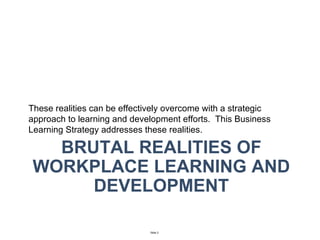
BRUTAL REALITIES OF WORKPLACE LEARNING AND DEVELOPMENT These realities can be effectively overcome with a strategic approach to learning and development efforts.  This Business Learning Strategy addresses these realities.
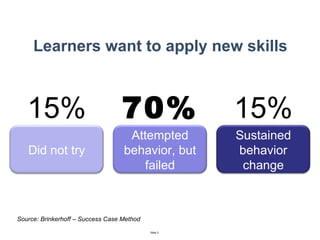
Learners want to apply new skills 15% 70% 15% Source: Brinkerhoff – Success Case Method Did not try Attempted behavior, but failed Sustained behavior change
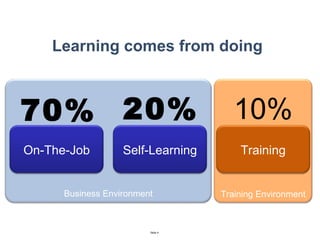
Learning comes from doing 70% 20% 10% Training Environment Business Environment On-The-Job Self-Learning Training
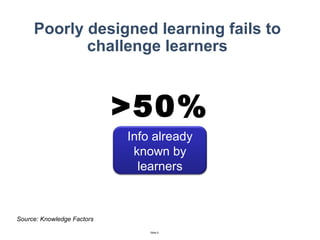
Poorly designed learning fails to challenge learners >50% Source: Knowledge Factors Info already known by learners
BUSINESS ALIGNMENT PROCESS Align learning and development efforts to the business initiative
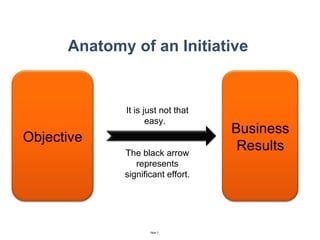
Anatomy of an Initiative It is just not that easy.  The black arrow represents significant effort. Objective Business Results
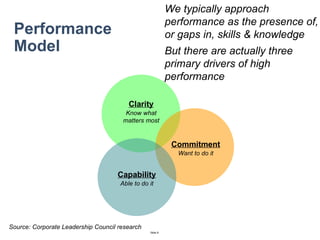
Performance Model But there are actually three primary drivers of high performance We typically approach performance as the presence of, or gaps in, skills & knowledge Source: Corporate Leadership Council research Clarity Know what matters most Commitment Want to do it Capability Able to do it
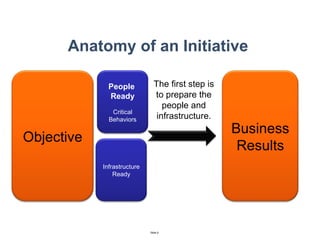
Anatomy of an Initiative The first step is to prepare the people and infrastructure. Business Results People  Ready Critical Behaviors Infrastructure Ready Objective
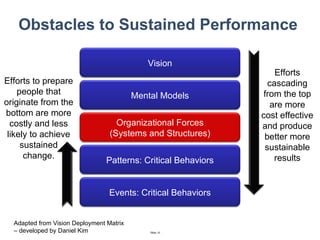
Obstacles to Sustained Performance Adapted from Vision Deployment Matrix  –  developed by Daniel Kim Efforts to prepare people that originate from the bottom are more costly and less likely to achieve sustained change. Efforts cascading from the top are more cost effective and produce better more sustainable results Events: Critical Behaviors Patterns: Critical Behaviors Mental Models Organizational Forces (Systems and Structures) Vision
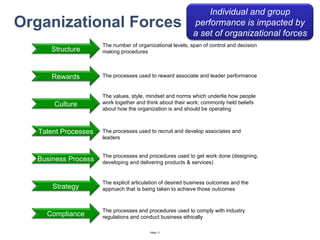
Organizational Forces The processes used to recruit and develop associates and leaders The processes used to reward associate and leader performance The explicit articulation of desired business outcomes and the approach that is being taken to achieve those outcomes The number of organizational levels, span of control and decision making procedures The processes and procedures used to get work done (designing, developing and delivering products & services) The values, style, mindset and norms which underlie how people work together and think about their work; commonly held beliefs about how the organization is and should be operating The processes and procedures used to comply with industry regulations and conduct business ethically Structure Rewards Culture Talent Processes Business Process Strategy Compliance Individual and group performance is impacted by a set of organizational forces
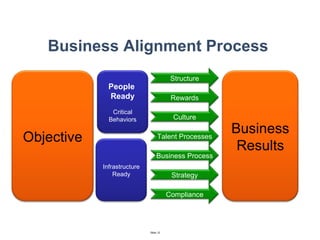
Business Alignment Process Business Results Structure People  Ready Critical Behaviors Infrastructure Ready Rewards Culture Talent Processes Business Process Strategy Compliance Objective
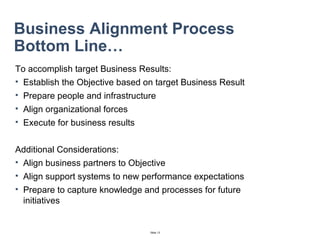
Business Alignment Process Bottom Line… To accomplish target Business Results: Establish the Objective based on target Business Result Prepare people and infrastructure Align organizational forces Execute for business results Additional Considerations: Align business partners to Objective Align support systems to new performance expectations Prepare to capture knowledge and processes for future initiatives
STRATEGIC PROGRAM DESIGN Scarce learning and development resources are maximized when program design is aligned to the target Business Results
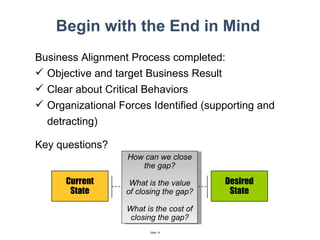
Begin with the End in Mind Business Alignment Process completed: Objective and target Business Result Clear about Critical Behaviors Organizational Forces Identified (supporting and detracting)  Key questions? Current State Desired State How can we close the gap? What is the value of closing the gap? What is the cost of closing the gap?
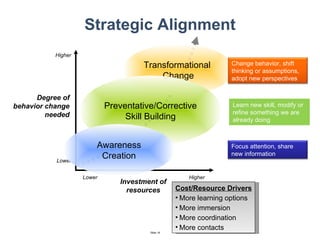
Strategic Alignment Lower Lower Higher Higher Degree of behavior change needed Investment of resources Cost/Resource Drivers More learning options More immersion More coordination More contacts Transformational  Change Change behavior, shift thinking or assumptions, adopt new perspectives Preventative/Corrective Skill Building Learn new skill, modify or refine something we are already doing Awareness Creation Focus attention, share new information
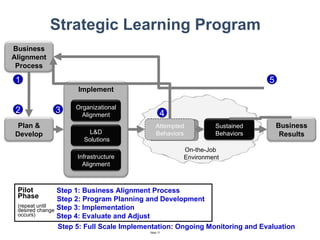
Strategic Learning Program Pilot  Phase (repeat until  desired change  occurs) Step 1: Business Alignment Process Step 2: Program Planning and Development Step 3: Implementation Step 5: Full Scale Implementation: Ongoing Monitoring and Evaluation Step 4: Evaluate and Adjust Attempted Behaviors On-the-Job  Environment 1 2 3 4 5 Business Alignment Process Plan & Develop Implement Organizational Alignment L&D Solutions Infrastructure Alignment Sustained Behaviors Business Results
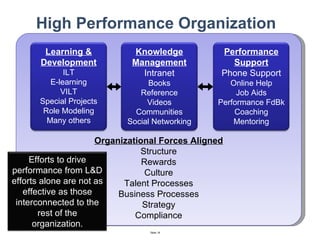
High Performance Organization Organizational Forces Aligned Structure Rewards Culture Talent Processes Business Processes Strategy Compliance Learning & Development ILT E-learning VILT Special Projects Role Modeling Many others Knowledge Management Intranet Books Reference Videos Communities Social Networking Performance Support Phone Support Online Help Job Aids Performance FdBk Coaching Mentoring Efforts to drive performance from L&D efforts alone are not as effective as those interconnected to the rest of the organization.
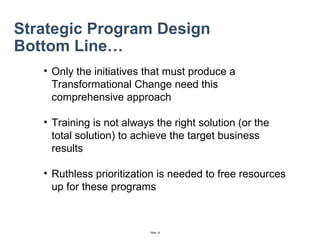
Strategic Program Design Bottom Line… Only the initiatives that must produce a Transformational Change need this comprehensive approach Training is not always the right solution (or the total solution) to achieve the target business results Ruthless prioritization is needed to free resources up for these programs
MEASUREMENT STRATEGY Maximizing the impact of L&D programs while maximizing the ROI of measurement and evaluation resources.
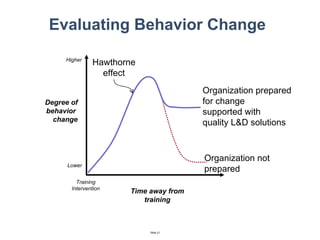
Evaluating Behavior Change Organization prepared  for change  supported with  quality L&D solutions Lower Training  Intervention  Higher Degree of behavior  change Time away from training Hawthorne effect Organization not  prepared
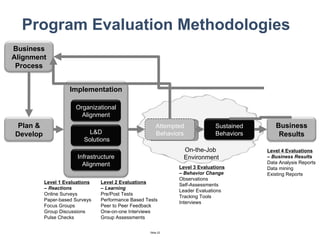
Program Evaluation Methodologies Attempted Behaviors On-the-Job  Environment Level 1 Evaluations –  Reactions Online Surveys Paper-based Surveys Focus Groups Group Discussions Pulse Checks Level 2 Evaluations   –  Learning Pre/Post Tests Performance Based Tests Peer to Peer Feedback One-on-one Interviews Group Assessments Level 3 Evaluations   –  Behavior Change Observations Self-Assessments Leader Evaluations Tracking Tools Interviews Level 4 Evaluations –  Business Results Data Analysis Reports Data mining Existing Reports Business Alignment Process Plan & Develop Implementation Organizational Alignment L&D Solutions Infrastructure Alignment Sustained Behaviors Business Results
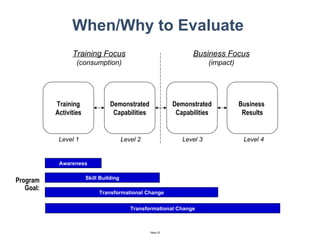
When/Why to Evaluate Demonstrated  Capabilities Training Activities Business  Results Level 1 Level 2 Level 3 Level 4 Training Focus (consumption) Business Focus (impact) Demonstrated  Capabilities Transformational Change Skill Building Awareness Program Goal: Transformational Change
Measurement Strategy Bottom Line… Meaningful action can not be taken without meaningful data Impact and Consumption data have different purposes Even bad programs have short term spikes Measurement of learning is not the same thing as measurement for reporting

Business Learning Strategy

  • 1.
    Business Learning StrategySupporting Business through Learning Effectiveness Nick DeNardo David Nichols Robert Flores
  • 2.
    BRUTAL REALITIES OFWORKPLACE LEARNING AND DEVELOPMENT These realities can be effectively overcome with a strategic approach to learning and development efforts. This Business Learning Strategy addresses these realities.
  • 3.
    Learners want toapply new skills 15% 70% 15% Source: Brinkerhoff – Success Case Method Did not try Attempted behavior, but failed Sustained behavior change
  • 4.
    Learning comes fromdoing 70% 20% 10% Training Environment Business Environment On-The-Job Self-Learning Training
  • 5.
    Poorly designed learningfails to challenge learners >50% Source: Knowledge Factors Info already known by learners
  • 6.
    BUSINESS ALIGNMENT PROCESSAlign learning and development efforts to the business initiative
  • 7.
    Anatomy of anInitiative It is just not that easy. The black arrow represents significant effort. Objective Business Results
  • 8.
    Performance Model Butthere are actually three primary drivers of high performance We typically approach performance as the presence of, or gaps in, skills & knowledge Source: Corporate Leadership Council research Clarity Know what matters most Commitment Want to do it Capability Able to do it
  • 9.
    Anatomy of anInitiative The first step is to prepare the people and infrastructure. Business Results People Ready Critical Behaviors Infrastructure Ready Objective
  • 10.
    Obstacles to SustainedPerformance Adapted from Vision Deployment Matrix – developed by Daniel Kim Efforts to prepare people that originate from the bottom are more costly and less likely to achieve sustained change. Efforts cascading from the top are more cost effective and produce better more sustainable results Events: Critical Behaviors Patterns: Critical Behaviors Mental Models Organizational Forces (Systems and Structures) Vision
  • 11.
    Organizational Forces Theprocesses used to recruit and develop associates and leaders The processes used to reward associate and leader performance The explicit articulation of desired business outcomes and the approach that is being taken to achieve those outcomes The number of organizational levels, span of control and decision making procedures The processes and procedures used to get work done (designing, developing and delivering products & services) The values, style, mindset and norms which underlie how people work together and think about their work; commonly held beliefs about how the organization is and should be operating The processes and procedures used to comply with industry regulations and conduct business ethically Structure Rewards Culture Talent Processes Business Process Strategy Compliance Individual and group performance is impacted by a set of organizational forces
  • 12.
    Business Alignment ProcessBusiness Results Structure People Ready Critical Behaviors Infrastructure Ready Rewards Culture Talent Processes Business Process Strategy Compliance Objective
  • 13.
    Business Alignment ProcessBottom Line… To accomplish target Business Results: Establish the Objective based on target Business Result Prepare people and infrastructure Align organizational forces Execute for business results Additional Considerations: Align business partners to Objective Align support systems to new performance expectations Prepare to capture knowledge and processes for future initiatives
  • 14.
    STRATEGIC PROGRAM DESIGNScarce learning and development resources are maximized when program design is aligned to the target Business Results
  • 15.
    Begin with theEnd in Mind Business Alignment Process completed: Objective and target Business Result Clear about Critical Behaviors Organizational Forces Identified (supporting and detracting) Key questions? Current State Desired State How can we close the gap? What is the value of closing the gap? What is the cost of closing the gap?
  • 16.
    Strategic Alignment LowerLower Higher Higher Degree of behavior change needed Investment of resources Cost/Resource Drivers More learning options More immersion More coordination More contacts Transformational Change Change behavior, shift thinking or assumptions, adopt new perspectives Preventative/Corrective Skill Building Learn new skill, modify or refine something we are already doing Awareness Creation Focus attention, share new information
  • 17.
    Strategic Learning ProgramPilot Phase (repeat until desired change occurs) Step 1: Business Alignment Process Step 2: Program Planning and Development Step 3: Implementation Step 5: Full Scale Implementation: Ongoing Monitoring and Evaluation Step 4: Evaluate and Adjust Attempted Behaviors On-the-Job Environment 1 2 3 4 5 Business Alignment Process Plan & Develop Implement Organizational Alignment L&D Solutions Infrastructure Alignment Sustained Behaviors Business Results
  • 18.
    High Performance OrganizationOrganizational Forces Aligned Structure Rewards Culture Talent Processes Business Processes Strategy Compliance Learning & Development ILT E-learning VILT Special Projects Role Modeling Many others Knowledge Management Intranet Books Reference Videos Communities Social Networking Performance Support Phone Support Online Help Job Aids Performance FdBk Coaching Mentoring Efforts to drive performance from L&D efforts alone are not as effective as those interconnected to the rest of the organization.
  • 19.
    Strategic Program DesignBottom Line… Only the initiatives that must produce a Transformational Change need this comprehensive approach Training is not always the right solution (or the total solution) to achieve the target business results Ruthless prioritization is needed to free resources up for these programs
  • 20.
    MEASUREMENT STRATEGY Maximizingthe impact of L&D programs while maximizing the ROI of measurement and evaluation resources.
  • 21.
    Evaluating Behavior ChangeOrganization prepared for change supported with quality L&D solutions Lower Training Intervention Higher Degree of behavior change Time away from training Hawthorne effect Organization not prepared
  • 22.
    Program Evaluation MethodologiesAttempted Behaviors On-the-Job Environment Level 1 Evaluations – Reactions Online Surveys Paper-based Surveys Focus Groups Group Discussions Pulse Checks Level 2 Evaluations – Learning Pre/Post Tests Performance Based Tests Peer to Peer Feedback One-on-one Interviews Group Assessments Level 3 Evaluations – Behavior Change Observations Self-Assessments Leader Evaluations Tracking Tools Interviews Level 4 Evaluations – Business Results Data Analysis Reports Data mining Existing Reports Business Alignment Process Plan & Develop Implementation Organizational Alignment L&D Solutions Infrastructure Alignment Sustained Behaviors Business Results
  • 23.
    When/Why to EvaluateDemonstrated Capabilities Training Activities Business Results Level 1 Level 2 Level 3 Level 4 Training Focus (consumption) Business Focus (impact) Demonstrated Capabilities Transformational Change Skill Building Awareness Program Goal: Transformational Change
  • 24.
    Measurement Strategy BottomLine… Meaningful action can not be taken without meaningful data Impact and Consumption data have different purposes Even bad programs have short term spikes Measurement of learning is not the same thing as measurement for reporting