




Learning & development (L&D)
by Toronto Training and HR
May 2014
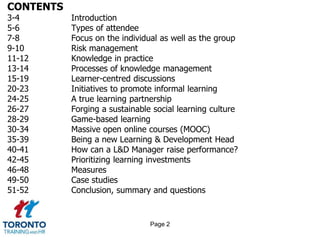
CONTENTS
3-4 Introduction
5-6 Types of attendee
7-8 Focus on the individual as well as the group
9-10 Risk management
11-12 Knowledge in practice
13-14 Processes of knowledge management
15-19 Learner-centred discussions
20-23 Initiatives to promote informal learning
24-25 A true learning partnership
26-27 Forging a sustainable social learning culture
28-29 Game-based learning
30-34 Massive open online courses (MOOC)
35-39 Being a new Learning & Development Head
40-41 How can a L&D Manager raise performance?
42-45 Prioritizing learning investments
46-48 Measures
49-50 Case studies
51-52 Conclusion, summary and questions
Page 2
Page 3
Introduction
Page 4
Introduction to Toronto Training
and HR
Toronto Training and HR is a specialist training and
human resources consultancy headed by Timothy Holden
10 years in banking
15 years in training and human resources
Freelance practitioner since 2006
The core services provided by Toronto Training and HR
are:
Training event design
Training event delivery
HR support with an emphasis on reducing
costs, saving time plus improving employee
engagement and morale
Services for job seekers
Page 5
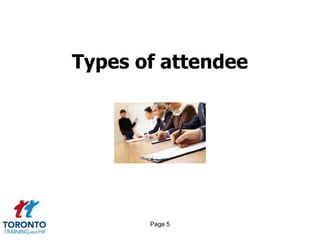
Types of attendee
Types of
attendee
• Political prisoners
• Tourists
• Explorers
Page 6
Page 7
Focus on the individual as
well as the group
Focus on the
individual as
well as the
group
CSAR
• Curiosity
• Study
• Activity
• Reflection
Page 8
Page 9
Risk management
Risk
management
• Artifacts
• Espoused values
• Basic assumptions
Page 10
Page 11
Knowledge in practice
Knowledge in
practice
• Learnability
• Tacitness
Page 12
Page 13
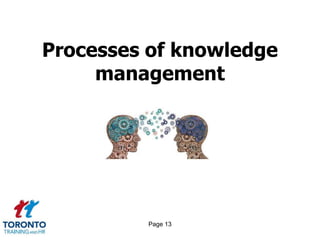
Processes of knowledge
management
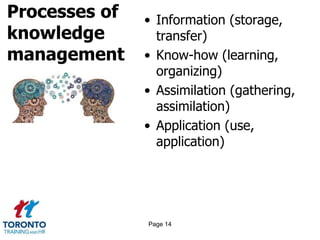
Processes of
knowledge
management
• Information (storage,
transfer)
• Know-how (learning,
organizing)
• Assimilation (gathering,
assimilation)
• Application (use,
application)
Page 14
Page 15
Learner-centred
discussions
Learner-
centred
discussions
1 of 4
DEFINE THE GOALS OF THE
DISCUSSION
• Brainstorming
• Debriefing or reflection on
learning activities
• Applying new skills or
knowledge
• Evaluating the learning
experience
Page 16
Learner-
centred
discussions
2 of 4
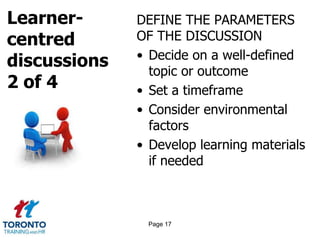
DEFINE THE PARAMETERS
OF THE DISCUSSION
• Decide on a well-defined
topic or outcome
• Set a timeframe
• Consider environmental
factors
• Develop learning materials
if needed
Page 17
Learner-
centred
discussions
3 of 4
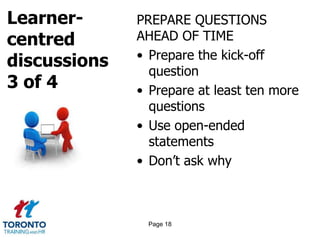
PREPARE QUESTIONS
AHEAD OF TIME
• Prepare the kick-off
question
• Prepare at least ten more
questions
• Use open-ended
statements
• Don’t ask why
Page 18
Learner-
centred
discussions
4 of 4
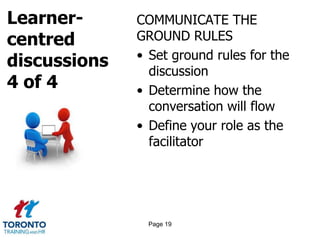
COMMUNICATE THE
GROUND RULES
• Set ground rules for the
discussion
• Determine how the
conversation will flow
• Define your role as the
facilitator
Page 19
Page 20
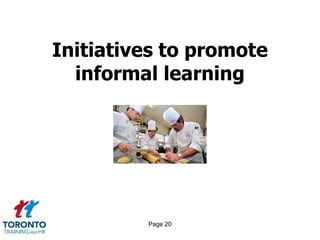
Initiatives to promote
informal learning
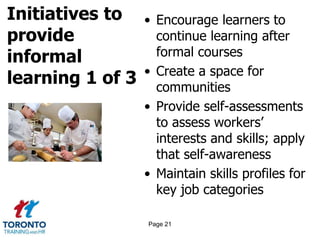
Initiatives to
provide
informal
learning 1 of 3
• Encourage learners to
continue learning after
formal courses
• Create a space for
communities
• Provide self-assessments
to assess workers’
interests and skills; apply
that self-awareness
• Maintain skills profiles for
key job categories
Page 21
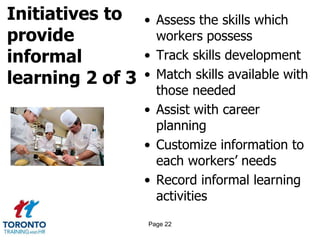
Initiatives to
provide
informal
learning 2 of 3
• Assess the skills which
workers possess
• Track skills development
• Match skills available with
those needed
• Assist with career
planning
• Customize information to
each workers’ needs
• Record informal learning
activities
Page 22
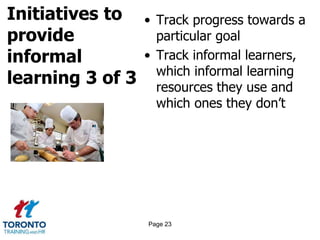
Initiatives to
provide
informal
learning 3 of 3
• Track progress towards a
particular goal
• Track informal learners,
which informal learning
resources they use and
which ones they don’t
Page 23
Page 24
A true learning
partnership
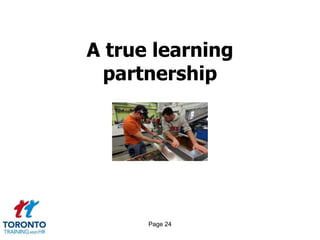
A true
learning
partnership
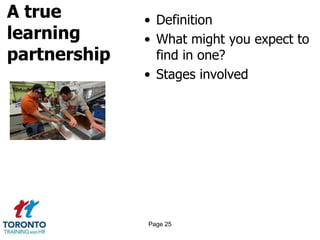
• Definition
• What might you expect to
find in one?
• Stages involved
Page 25
Page 26
Forging a sustainable
social learning culture
Forging a
sustainable
social learning
culture
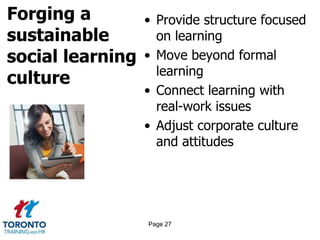
• Provide structure focused
on learning
• Move beyond formal
learning
• Connect learning with
real-work issues
• Adjust corporate culture
and attitudes
Page 27
Page 28
Game-based learning
Game-based
learning
• Principal L&D challenges
• Criteria which must be
fulfilled by quality online
learning
• How can we ensure online
learning will fulfill these
requirements?
• Growth of gamification
Page 29
Page 30
Massive open online
courses (MOOC)
Massive
open online
courses
(MOOC)
1 of 4
TRENDS
• Organizations are creatively
applying today’s higher
education MOOCs to their
specific purposes
• Organizations are developing
specialized MOOCs to
educate customers, clients
and ecosystem partners
Page 31
Massive
open online
courses
(MOOC)
2 of 4
TRENDS (CONT.)
• Organizations are developing
and leveraging MOOCs to
identify, develop and source
scarce talent
• Organizations are building a
variety of “private MOOC”
learning solutions for both
internal and partner
audiences
Page 32
Massive
open online
courses
(MOOC)
3 of 4
LAUNCHING AN EFFECTIVE
MOOC:
• Clearly identify the problem
to be solved
• Develop a plan
• Ensure content is relevant
and modular, with
meaningful opportunities for
practice and application
• Award badges to recognize
learner mastery
Page 33
Massive
open online
courses
(MOOC)
4 of 4
LAUNCHING AN EFFECTIVE
MOOC (CONT.):
• Select technology that
enables an integrated
learning experience
• Prioritize “learner success”
and support services
• Identify partners to help you
get started if needed
Page 34
Page 35
Being a new Learning &
Development Head
Being a new
Learning &
Development
Head 1 of 4
SKILLS OR QUALITIES
NEEDED
• Killer consulting skills
along with insatiable
curiosity
• Courage mixed with
sound judgment
• Visionary leadership,
strategic orientation and
solid business acumen
Page 36
Being a new
Learning &
Development
Head 2 of 4
SKILLS OR QUALITIES
NEEDED (CONT.)
• Being secure enough to
ask simple questions
without the fear of
looking inexperienced or
foolish
• Ability to surf the waves
of change without getting
too far out over the front
of the board and getting
knocked off
Page 37
Being a new
Learning &
Development
Head 3 of 4
CURRENT ISSUES TO
CONSIDER
• Learning revolution
• Content availability
• Changing learning
styles
• Time
Page 38
Being a new
Learning &
Development
Head 4 of 4
HOW SHOULD THE NEW
PERSON START?
• What and who to know
• What to do
• When to do it
Page 39
Page 40
How can a L&D Manager
raise performance?
How can a
L&D Manager
raise
performance?
• Give people good
information
• Treat people as adults
• Encourage learning
• Stress reduction
• Support
• Payoff
Page 41
Page 42
Prioritizing learning
investments
Prioritizing
learning
investments
1 of 3
• Decide which functions
have the greatest impact
on business success
• Prioritize those functions
and start with the most
important
• Determine which roles
within that most important
function drive growth
Page 43
Prioritizing
learning
investments
2 of 3
• Align with the functional
business leader to determine
key measures of success
• Determine what learning
offerings are needed to
successfully perform within
that role
• Choose a learning modality;
What will improve
performance, change
behaviours and reduce costs?
Page 44
Prioritizing
learning
investments
3 of 3
• Examine learning impact pre
and post-learning event,
reinforcement and
sustainability of learning over
time
• Conduct a financial analysis
and employ cost comparison
methodology for staffing,
development, delivery,
production, costs of
classroom space, multimedia,
travel and record keeping
Page 45
Page 46
Measures
Measures
1 of 2
RETURN ON INVESTMENT
• Reaction
• Learning
• Behaviour
• Results
Page 47
Measures
2 of 2
• Metrics
• Analysis
• Outcomes
• Quality
• Volume
• Cost
• Process
• Business priorities
Page 48
Page 49
Case studies
Case studies
Page 50
Page 51
Conclusion, summary and
questions
Page 52
Conclusion, summary and
questions
Conclusion
Summary
Videos
Questions

Learning & development May 2014

  • 1.
    Learning & development(L&D) by Toronto Training and HR May 2014
  • 2.
    CONTENTS 3-4 Introduction 5-6 Typesof attendee 7-8 Focus on the individual as well as the group 9-10 Risk management 11-12 Knowledge in practice 13-14 Processes of knowledge management 15-19 Learner-centred discussions 20-23 Initiatives to promote informal learning 24-25 A true learning partnership 26-27 Forging a sustainable social learning culture 28-29 Game-based learning 30-34 Massive open online courses (MOOC) 35-39 Being a new Learning & Development Head 40-41 How can a L&D Manager raise performance? 42-45 Prioritizing learning investments 46-48 Measures 49-50 Case studies 51-52 Conclusion, summary and questions Page 2
  • 3.
  • 4.
    Page 4 Introduction toToronto Training and HR Toronto Training and HR is a specialist training and human resources consultancy headed by Timothy Holden 10 years in banking 15 years in training and human resources Freelance practitioner since 2006 The core services provided by Toronto Training and HR are: Training event design Training event delivery HR support with an emphasis on reducing costs, saving time plus improving employee engagement and morale Services for job seekers
  • 5.
  • 6.
    Types of attendee • Politicalprisoners • Tourists • Explorers Page 6
  • 7.
    Page 7 Focus onthe individual as well as the group
  • 8.
    Focus on the individualas well as the group CSAR • Curiosity • Study • Activity • Reflection Page 8
  • 9.
  • 10.
    Risk management • Artifacts • Espousedvalues • Basic assumptions Page 10
  • 11.
  • 12.
  • 13.
    Page 13 Processes ofknowledge management
  • 14.
    Processes of knowledge management • Information(storage, transfer) • Know-how (learning, organizing) • Assimilation (gathering, assimilation) • Application (use, application) Page 14
  • 15.
  • 16.
    Learner- centred discussions 1 of 4 DEFINETHE GOALS OF THE DISCUSSION • Brainstorming • Debriefing or reflection on learning activities • Applying new skills or knowledge • Evaluating the learning experience Page 16
  • 17.
    Learner- centred discussions 2 of 4 DEFINETHE PARAMETERS OF THE DISCUSSION • Decide on a well-defined topic or outcome • Set a timeframe • Consider environmental factors • Develop learning materials if needed Page 17
  • 18.
    Learner- centred discussions 3 of 4 PREPAREQUESTIONS AHEAD OF TIME • Prepare the kick-off question • Prepare at least ten more questions • Use open-ended statements • Don’t ask why Page 18
  • 19.
    Learner- centred discussions 4 of 4 COMMUNICATETHE GROUND RULES • Set ground rules for the discussion • Determine how the conversation will flow • Define your role as the facilitator Page 19
  • 20.
    Page 20 Initiatives topromote informal learning
  • 21.
    Initiatives to provide informal learning 1of 3 • Encourage learners to continue learning after formal courses • Create a space for communities • Provide self-assessments to assess workers’ interests and skills; apply that self-awareness • Maintain skills profiles for key job categories Page 21
  • 22.
    Initiatives to provide informal learning 2of 3 • Assess the skills which workers possess • Track skills development • Match skills available with those needed • Assist with career planning • Customize information to each workers’ needs • Record informal learning activities Page 22
  • 23.
    Initiatives to provide informal learning 3of 3 • Track progress towards a particular goal • Track informal learners, which informal learning resources they use and which ones they don’t Page 23
  • 24.
    Page 24 A truelearning partnership
  • 25.
    A true learning partnership • Definition •What might you expect to find in one? • Stages involved Page 25
  • 26.
    Page 26 Forging asustainable social learning culture
  • 27.
    Forging a sustainable social learning culture •Provide structure focused on learning • Move beyond formal learning • Connect learning with real-work issues • Adjust corporate culture and attitudes Page 27
  • 28.
  • 29.
    Game-based learning • Principal L&Dchallenges • Criteria which must be fulfilled by quality online learning • How can we ensure online learning will fulfill these requirements? • Growth of gamification Page 29
  • 30.
    Page 30 Massive openonline courses (MOOC)
  • 31.
    Massive open online courses (MOOC) 1 of4 TRENDS • Organizations are creatively applying today’s higher education MOOCs to their specific purposes • Organizations are developing specialized MOOCs to educate customers, clients and ecosystem partners Page 31
  • 32.
    Massive open online courses (MOOC) 2 of4 TRENDS (CONT.) • Organizations are developing and leveraging MOOCs to identify, develop and source scarce talent • Organizations are building a variety of “private MOOC” learning solutions for both internal and partner audiences Page 32
  • 33.
    Massive open online courses (MOOC) 3 of4 LAUNCHING AN EFFECTIVE MOOC: • Clearly identify the problem to be solved • Develop a plan • Ensure content is relevant and modular, with meaningful opportunities for practice and application • Award badges to recognize learner mastery Page 33
  • 34.
    Massive open online courses (MOOC) 4 of4 LAUNCHING AN EFFECTIVE MOOC (CONT.): • Select technology that enables an integrated learning experience • Prioritize “learner success” and support services • Identify partners to help you get started if needed Page 34
  • 35.
    Page 35 Being anew Learning & Development Head
  • 36.
    Being a new Learning& Development Head 1 of 4 SKILLS OR QUALITIES NEEDED • Killer consulting skills along with insatiable curiosity • Courage mixed with sound judgment • Visionary leadership, strategic orientation and solid business acumen Page 36
  • 37.
    Being a new Learning& Development Head 2 of 4 SKILLS OR QUALITIES NEEDED (CONT.) • Being secure enough to ask simple questions without the fear of looking inexperienced or foolish • Ability to surf the waves of change without getting too far out over the front of the board and getting knocked off Page 37
  • 38.
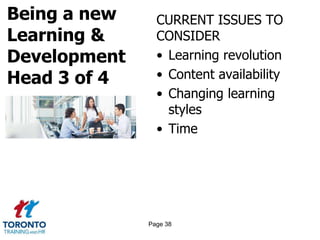
    Being a new Learning& Development Head 3 of 4 CURRENT ISSUES TO CONSIDER • Learning revolution • Content availability • Changing learning styles • Time Page 38
  • 39.
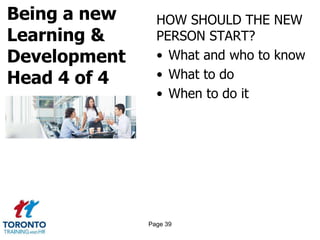
    Being a new Learning& Development Head 4 of 4 HOW SHOULD THE NEW PERSON START? • What and who to know • What to do • When to do it Page 39
  • 40.
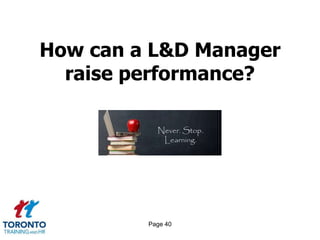
    Page 40 How cana L&D Manager raise performance?
  • 41.
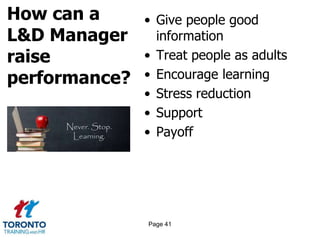
    How can a L&DManager raise performance? • Give people good information • Treat people as adults • Encourage learning • Stress reduction • Support • Payoff Page 41
  • 42.
  • 43.
    Prioritizing learning investments 1 of 3 •Decide which functions have the greatest impact on business success • Prioritize those functions and start with the most important • Determine which roles within that most important function drive growth Page 43
  • 44.
    Prioritizing learning investments 2 of 3 •Align with the functional business leader to determine key measures of success • Determine what learning offerings are needed to successfully perform within that role • Choose a learning modality; What will improve performance, change behaviours and reduce costs? Page 44
  • 45.
    Prioritizing learning investments 3 of 3 •Examine learning impact pre and post-learning event, reinforcement and sustainability of learning over time • Conduct a financial analysis and employ cost comparison methodology for staffing, development, delivery, production, costs of classroom space, multimedia, travel and record keeping Page 45
  • 46.
  • 47.
    Measures 1 of 2 RETURNON INVESTMENT • Reaction • Learning • Behaviour • Results Page 47
  • 48.
    Measures 2 of 2 •Metrics • Analysis • Outcomes • Quality • Volume • Cost • Process • Business priorities Page 48
  • 49.
  • 50.
  • 51.
  • 52.
    Page 52 Conclusion, summaryand questions Conclusion Summary Videos Questions