Organisational contribution of Learning & Development BILD Connect Workshop 14 th  January 2009 David Vachell  MA, FBILD
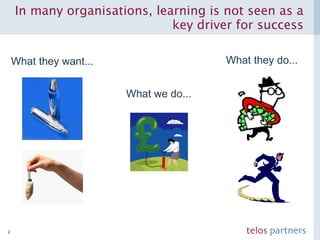
In many organisations, learning is not seen as a key driver for success What they want... What we do... What they do...
Learning & Development is one of the most significantly leveraged investments any organisation can make
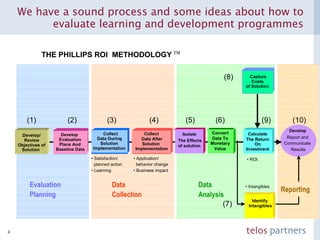
We have a sound process and some ideas about how to evaluate learning and development programmes
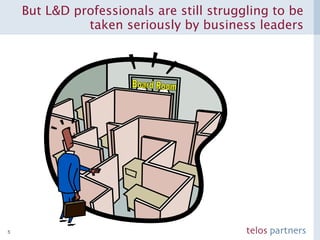
But L&D professionals are still struggling to be taken seriously by business leaders Board Room
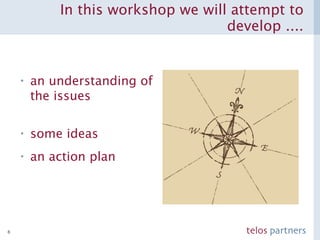
In this workshop we will attempt to develop .... an understanding of the issues some ideas an action plan
WHAT ARE THE GOVERNING FACTORS DRIVING INVESTMENT CHOICES IN ORGANISATIONS?
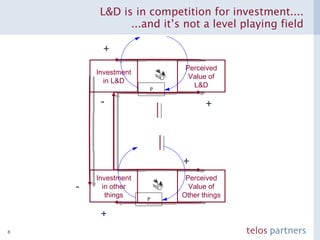
L&D is in competition for investment.... ...and it’s not a level playing field Investment in L&D Investment in other things Perceived Value of L&D Perceived Value of Other things + - + - + +
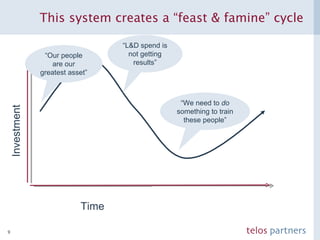
This system creates a “feast & famine” cycle Investment Time “ Our people are our greatest asset” “ L&D spend is not getting results” “ We need to  do  something to train these people”
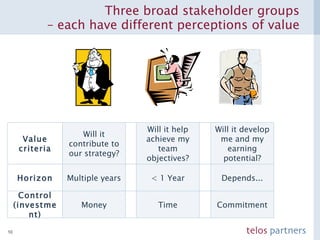
Three broad stakeholder groups  – each have different perceptions of value  Value criteria Will it contribute to our strategy? Will it help achieve my team objectives? Will it develop me and my earning potential? Horizon Multiple years < 1 Year Depends... Control (investment) Money Time Commitment
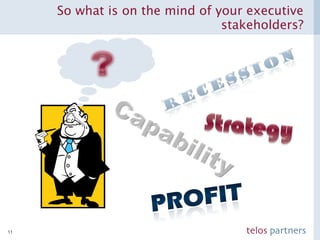
So what is on the mind of your executive stakeholders?
HOW CAN WE BUILD A STRATEGIC BUSINESS CASE FOR L&D?
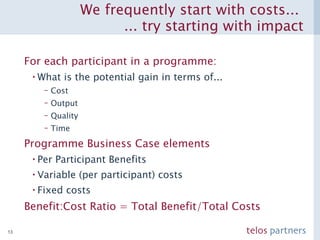
We frequently start with costs...  ... try starting with impact For each participant in a programme: What is the potential gain in terms of... Cost Output Quality Time Programme Business Case elements Per Participant Benefits Variable (per participant) costs Fixed costs Benefit:Cost Ratio = Total Benefit/Total Costs
Get answers to level 4 questions for every intervention before you start What would be the benefit if people did more/less of….? What is the cost of people doing too much/not enough of….? How much/often does this happen?
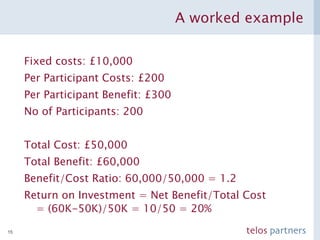
A worked example Fixed costs: £10,000 Per Participant Costs: £200 Per Participant Benefit: £300 No of Participants: 200 Total Cost: £50,000 Total Benefit: £60,000 Benefit/Cost Ratio: 60,000/50,000 = 1.2 Return on Investment = Net Benefit/Total Cost = (60K-50K)/50K = 10/50 = 20%
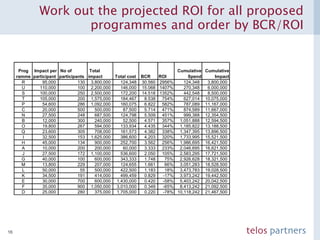
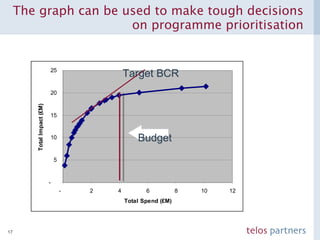
Work out the projected ROI for all proposed programmes and order by BCR/ROI
The graph can be used to make tough decisions on programme prioritisation Target BCR Budget
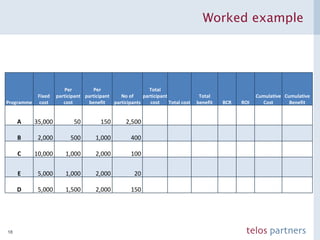
Worked example Programme Fixed cost Per participant cost Per participant benefit No of participants Total participant cost Total cost Total benefit BCR ROI Cumulative Cost Cumulative Benefit A 35,000  50  150  2,500  B 2,000  500  1,000  400  C 10,000  1,000  2,000  100  E 5,000  1,000  2,000  20  D 5,000  1,500  2,000  150
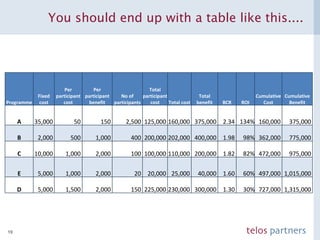
You should end up with a table like this.... Programme Fixed cost Per participant cost Per participant benefit No of participants Total participant cost Total cost Total benefit BCR ROI Cumulative Cost Cumulative Benefit A 35,000  50  150  2,500  125,000  160,000  375,000  2.34  134% 160,000  375,000  B 2,000  500  1,000  400  200,000  202,000  400,000  1.98  98% 362,000  775,000  C 10,000  1,000  2,000  100  100,000  110,000  200,000  1.82  82% 472,000  975,000  E 5,000  1,000  2,000  20  20,000  25,000  40,000  1.60  60% 497,000  1,015,000  D 5,000  1,500  2,000  150  225,000  230,000  300,000  1.30  30% 727,000  1,315,000
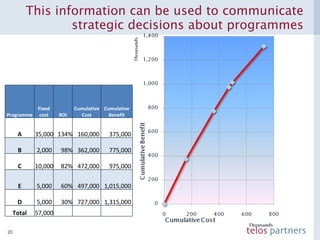
This information can be used to communicate strategic decisions about programmes Programme Fixed cost ROI Cumulative Cost Cumulative Benefit A 35,000  134% 160,000  375,000  B 2,000  98% 362,000  775,000  C 10,000  82% 472,000  975,000  E 5,000  60% 497,000  1,015,000  D 5,000  30% 727,000  1,315,000  Total 57,000
IT IS ESSENTIAL TO COMMUNICATE PERFORMANCE AGAINST PLAN
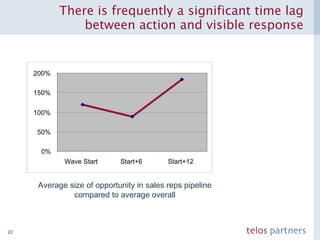
There is frequently a significant time lag between action and visible response Average size of opportunity in sales reps pipeline compared to average overall 0% 50% 100% 150% 200% Wave Start Start+6 Start+12
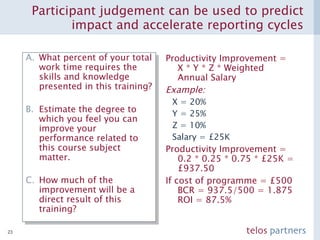
Participant judgement can be used to predict impact and accelerate reporting cycles What percent of your total work time requires the skills and knowledge presented in this training? Estimate the degree to which you feel you can improve your performance related to this course subject matter. How much of the improvement will be a direct result of this training? Productivity Improvement = X * Y * Z * Weighted Annual Salary Example: X = 20% Y = 25% Z = 10% Salary = £25K Productivity Improvement = 0.2 * 0.25 * 0.75 * £25K = £937.50 If cost of programme = £500 BCR = 937.5/500 = 1.875 ROI = 87.5%
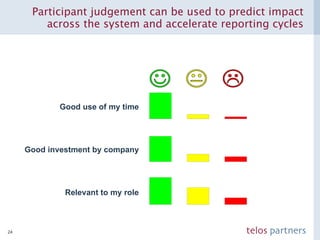
Participant judgement can be used to predict impact across the system and accelerate reporting cycles J K L Good use of my time Good investment by company Relevant to my role
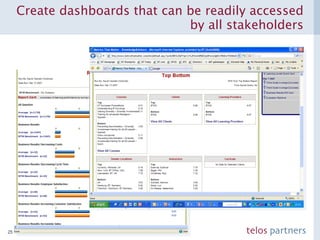
Create dashboards that can be readily accessed by all stakeholders
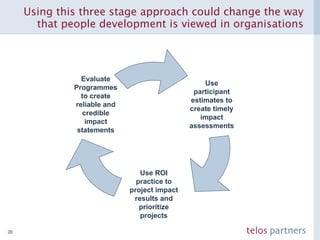
Using this three stage approach could change the way that people development is viewed in organisations Use participant estimates to create timely impact assessments Use ROI practice to project impact results and prioritize projects Evaluate Programmes to create reliable and credible impact statements
Breakout conversations To what extent can we develop the perception of strategic value of learning & development? What specific actions will you take in the next 3 months?

Strategic Value of Learning & Development

  • 1.
    Organisational contribution ofLearning & Development BILD Connect Workshop 14 th January 2009 David Vachell MA, FBILD
  • 2.
    In many organisations,learning is not seen as a key driver for success What they want... What we do... What they do...
  • 3.
    Learning & Developmentis one of the most significantly leveraged investments any organisation can make
  • 4.
    We have asound process and some ideas about how to evaluate learning and development programmes
  • 5.
    But L&D professionalsare still struggling to be taken seriously by business leaders Board Room
  • 6.
    In this workshopwe will attempt to develop .... an understanding of the issues some ideas an action plan
  • 7.
    WHAT ARE THEGOVERNING FACTORS DRIVING INVESTMENT CHOICES IN ORGANISATIONS?
  • 8.
    L&D is incompetition for investment.... ...and it’s not a level playing field Investment in L&D Investment in other things Perceived Value of L&D Perceived Value of Other things + - + - + +
  • 9.
    This system createsa “feast & famine” cycle Investment Time “ Our people are our greatest asset” “ L&D spend is not getting results” “ We need to do something to train these people”
  • 10.
    Three broad stakeholdergroups – each have different perceptions of value Value criteria Will it contribute to our strategy? Will it help achieve my team objectives? Will it develop me and my earning potential? Horizon Multiple years < 1 Year Depends... Control (investment) Money Time Commitment
  • 11.
    So what ison the mind of your executive stakeholders?
  • 12.
    HOW CAN WEBUILD A STRATEGIC BUSINESS CASE FOR L&D?
  • 13.
    We frequently startwith costs... ... try starting with impact For each participant in a programme: What is the potential gain in terms of... Cost Output Quality Time Programme Business Case elements Per Participant Benefits Variable (per participant) costs Fixed costs Benefit:Cost Ratio = Total Benefit/Total Costs
  • 14.
    Get answers tolevel 4 questions for every intervention before you start What would be the benefit if people did more/less of….? What is the cost of people doing too much/not enough of….? How much/often does this happen?
  • 15.
    A worked exampleFixed costs: £10,000 Per Participant Costs: £200 Per Participant Benefit: £300 No of Participants: 200 Total Cost: £50,000 Total Benefit: £60,000 Benefit/Cost Ratio: 60,000/50,000 = 1.2 Return on Investment = Net Benefit/Total Cost = (60K-50K)/50K = 10/50 = 20%
  • 16.
    Work out theprojected ROI for all proposed programmes and order by BCR/ROI
  • 17.
    The graph canbe used to make tough decisions on programme prioritisation Target BCR Budget
  • 18.
    Worked example ProgrammeFixed cost Per participant cost Per participant benefit No of participants Total participant cost Total cost Total benefit BCR ROI Cumulative Cost Cumulative Benefit A 35,000 50 150 2,500 B 2,000 500 1,000 400 C 10,000 1,000 2,000 100 E 5,000 1,000 2,000 20 D 5,000 1,500 2,000 150
  • 19.
    You should endup with a table like this.... Programme Fixed cost Per participant cost Per participant benefit No of participants Total participant cost Total cost Total benefit BCR ROI Cumulative Cost Cumulative Benefit A 35,000 50 150 2,500 125,000 160,000 375,000 2.34 134% 160,000 375,000 B 2,000 500 1,000 400 200,000 202,000 400,000 1.98 98% 362,000 775,000 C 10,000 1,000 2,000 100 100,000 110,000 200,000 1.82 82% 472,000 975,000 E 5,000 1,000 2,000 20 20,000 25,000 40,000 1.60 60% 497,000 1,015,000 D 5,000 1,500 2,000 150 225,000 230,000 300,000 1.30 30% 727,000 1,315,000
  • 20.
    This information canbe used to communicate strategic decisions about programmes Programme Fixed cost ROI Cumulative Cost Cumulative Benefit A 35,000 134% 160,000 375,000 B 2,000 98% 362,000 775,000 C 10,000 82% 472,000 975,000 E 5,000 60% 497,000 1,015,000 D 5,000 30% 727,000 1,315,000 Total 57,000
  • 21.
    IT IS ESSENTIALTO COMMUNICATE PERFORMANCE AGAINST PLAN
  • 22.
    There is frequentlya significant time lag between action and visible response Average size of opportunity in sales reps pipeline compared to average overall 0% 50% 100% 150% 200% Wave Start Start+6 Start+12
  • 23.
    Participant judgement canbe used to predict impact and accelerate reporting cycles What percent of your total work time requires the skills and knowledge presented in this training? Estimate the degree to which you feel you can improve your performance related to this course subject matter. How much of the improvement will be a direct result of this training? Productivity Improvement = X * Y * Z * Weighted Annual Salary Example: X = 20% Y = 25% Z = 10% Salary = £25K Productivity Improvement = 0.2 * 0.25 * 0.75 * £25K = £937.50 If cost of programme = £500 BCR = 937.5/500 = 1.875 ROI = 87.5%
  • 24.
    Participant judgement canbe used to predict impact across the system and accelerate reporting cycles J K L Good use of my time Good investment by company Relevant to my role
  • 25.
    Create dashboards thatcan be readily accessed by all stakeholders
  • 26.
    Using this threestage approach could change the way that people development is viewed in organisations Use participant estimates to create timely impact assessments Use ROI practice to project impact results and prioritize projects Evaluate Programmes to create reliable and credible impact statements
  • 27.
    Breakout conversations Towhat extent can we develop the perception of strategic value of learning & development? What specific actions will you take in the next 3 months?