Uses of NPN compounds in
Ruminants
Dr. Pankaj Kumar Singh
Assistant Professor (Animal Nutrition)
Bihar Veterinary College, Patna
1
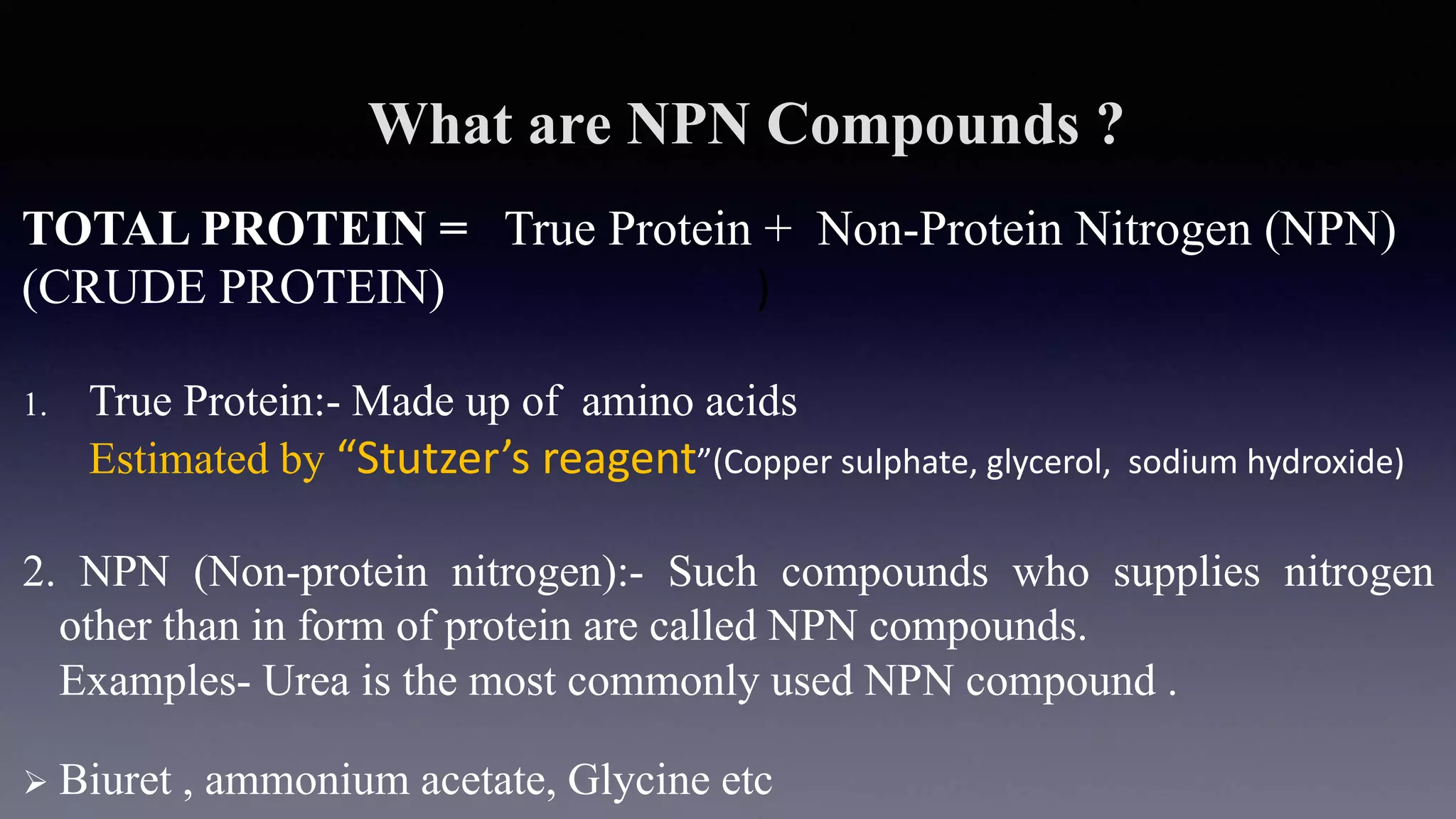
What are NPN Compounds ?
TOTAL PROTEIN = True Protein + Non-Protein Nitrogen (NPN)
(CRUDE PROTEIN) )
1. True Protein:- Made up of amino acids
Estimated by “Stutzer’s reagent”(Copper sulphate, glycerol, sodium hydroxide)
2. NPN (Non-protein nitrogen):- Such compounds who supplies nitrogen
other than in form of protein are called NPN compounds.
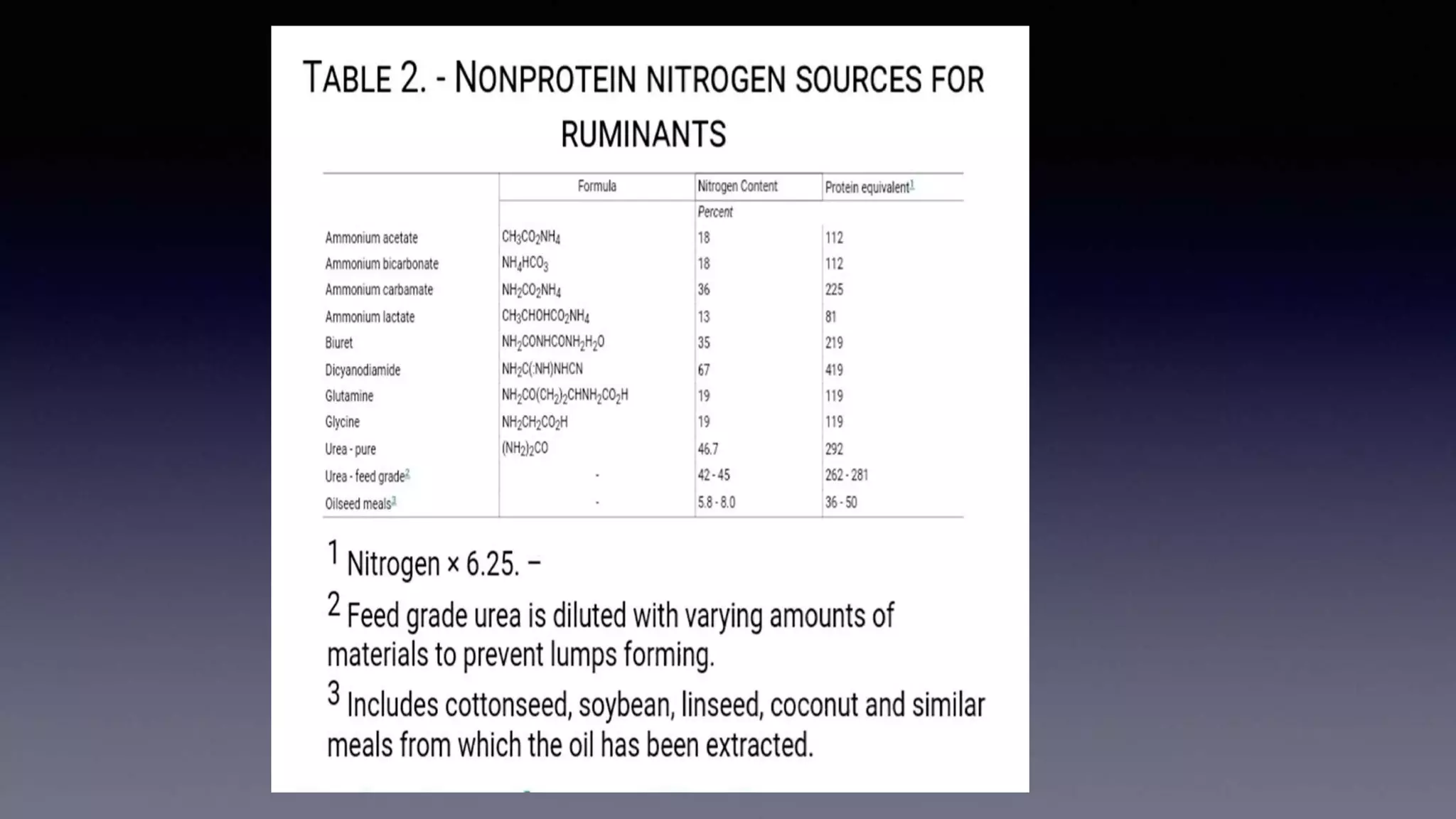
Examples- Urea is the most commonly used NPN compound .
 Biuret , ammonium acetate, Glycine etc
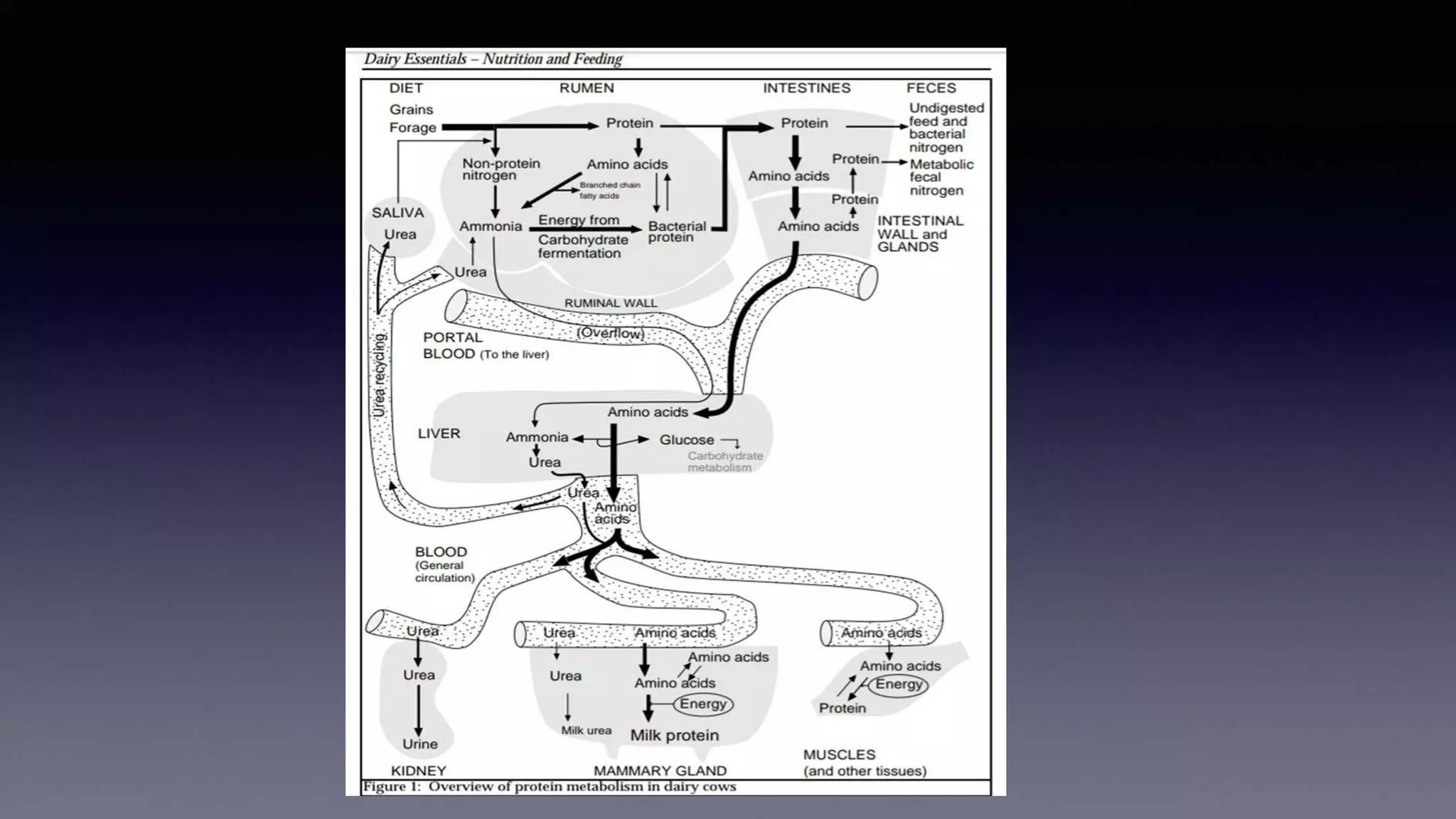
Protein metabolism in Ruminants
Ruminants have this unique ability to metabolise the dietary Nitrogen for
synthesis of protein within the rumen.
Protein provide the amino acids needed for maintenance functions.
Feed Protein are degraded by microorganisms in Rumen via amino acid into ammonia
(NH3) and branched chain fatty acids.
The rumen microbes convert this ammonia along with a carbohydrate source (
energy source) into Microbial Protein .
Microbial protein is further degraded down to free amino acid in small intestine.
This amino acid is available for the use to animal .
Role of NPN in Ruminants nutrition
In ruminants, the central component for the synthesis of
protein is NH3 .
 The ammonia can be derived from metabolism of feed Protein
or directly from NPN compound
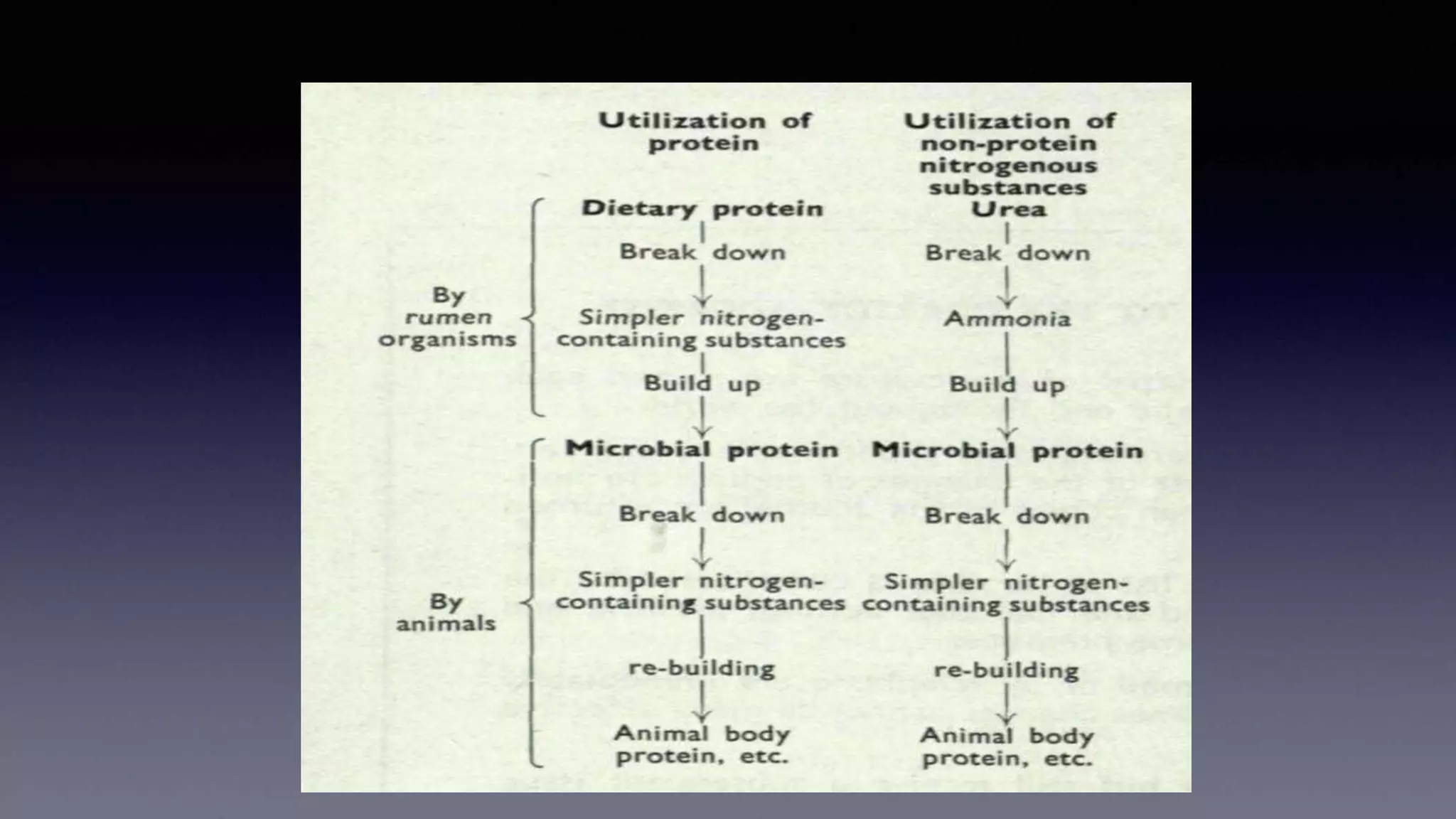
 Urea is the most commonly used NPN .
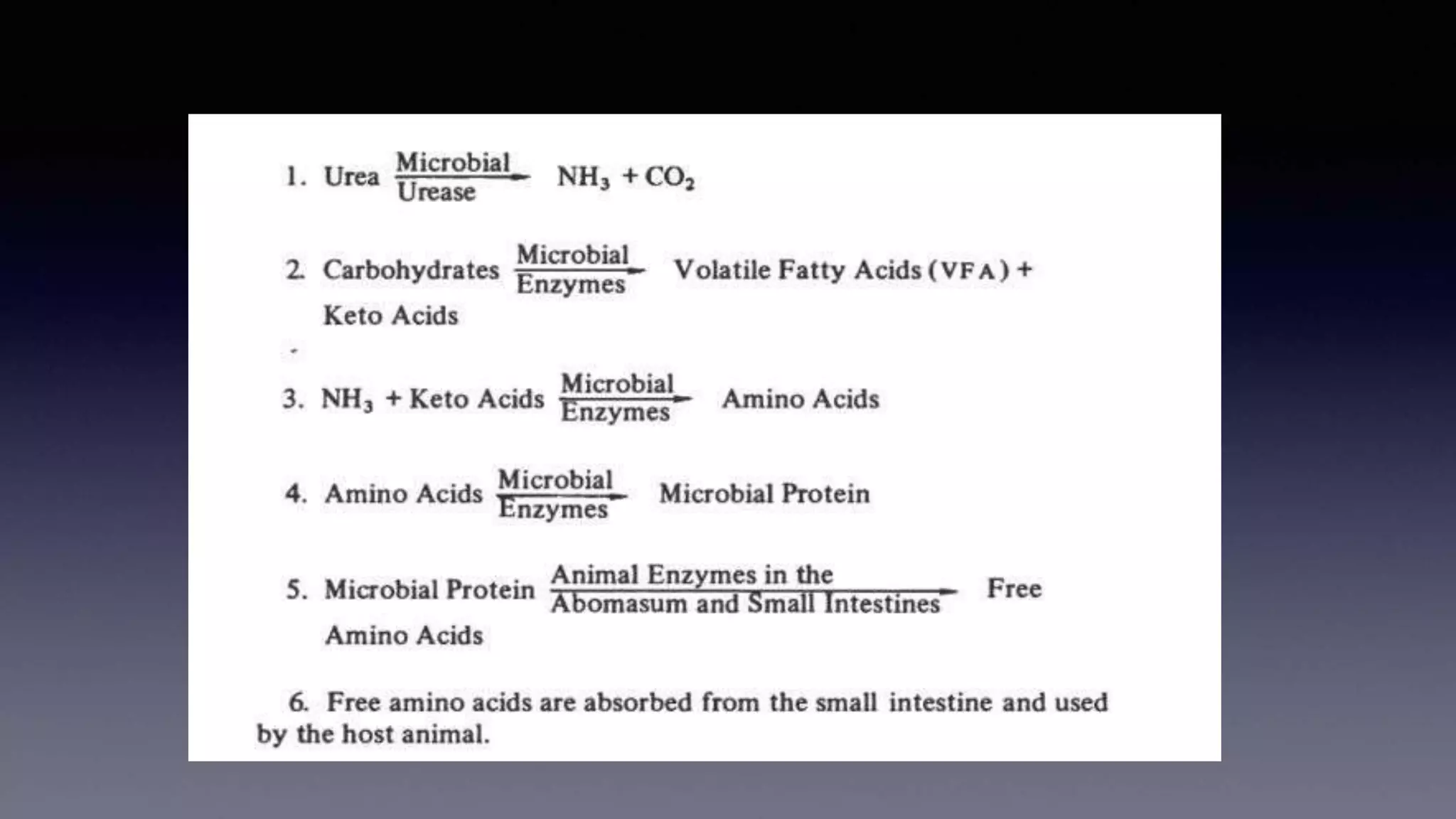
 The role of urea can be best explained as follow -
Feeding guidelines of NPN
 While NPN does serve as a cheaper alternate of protein for
ruminants, it should also be kept in mind that NPN are not true
protein.
 Alone NPN feeding can not replace the whole protein requirement.
 NPN feeding does require some of the guidelines to be followed
strictly.
These are
 Add NPN with high energy feed such as grains/molasses and mix
thoroughly.
 Introduce NPN ration slowly as 2-3 week period is necessary for
rumen bacteria to achieve maximum utilisation of NPN.
 Use NPN only when additional protein is necessary in the ration .
The crude protein should not be more than 12 percent in the ration.
 Add maximum 1% NPN in concentrate mixture.
 Make sure that no more than 1/3rd of the total
ration protein equivalent comes from NPN.
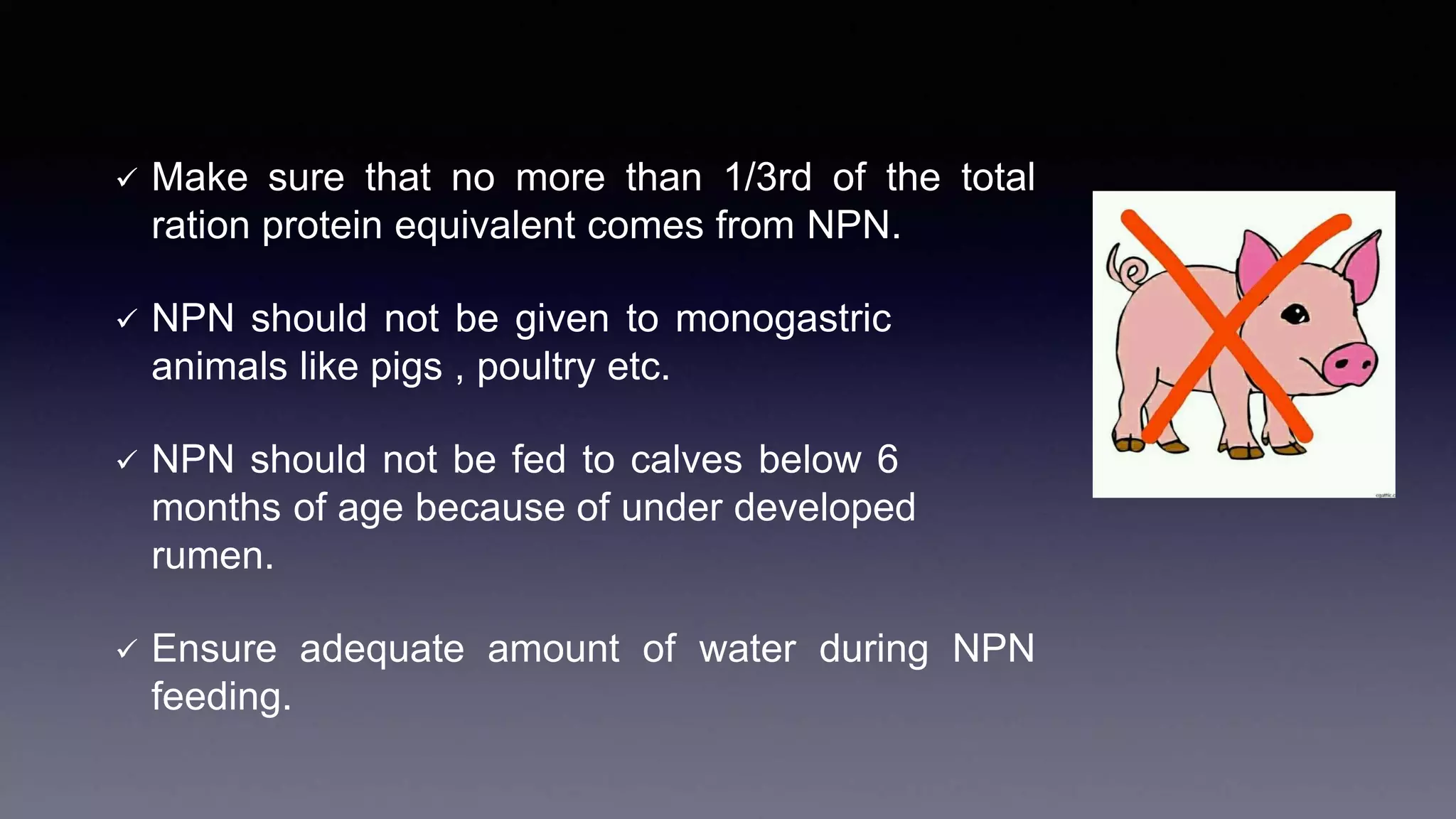
 NPN should not be given to monogastric
animals like pigs , poultry etc.
 NPN should not be fed to calves below 6
months of age because of under developed
rumen.
 Ensure adequate amount of water during NPN
feeding.
UREA
 Urea was discovered in 1773 by Rouelle and it's composition was
established by Prout in 1818.
 It's a white compound with bitter taste for Ruminants.
 Having 46% Nitrogen.
 One kilogram of urea can furnish as much as 2.92kg of protein.
 When Urea enters the rumen it is rapidly dissolved and hydrolyzed
to ammonia by bacterial urease.
 Urea NH3 + CO2
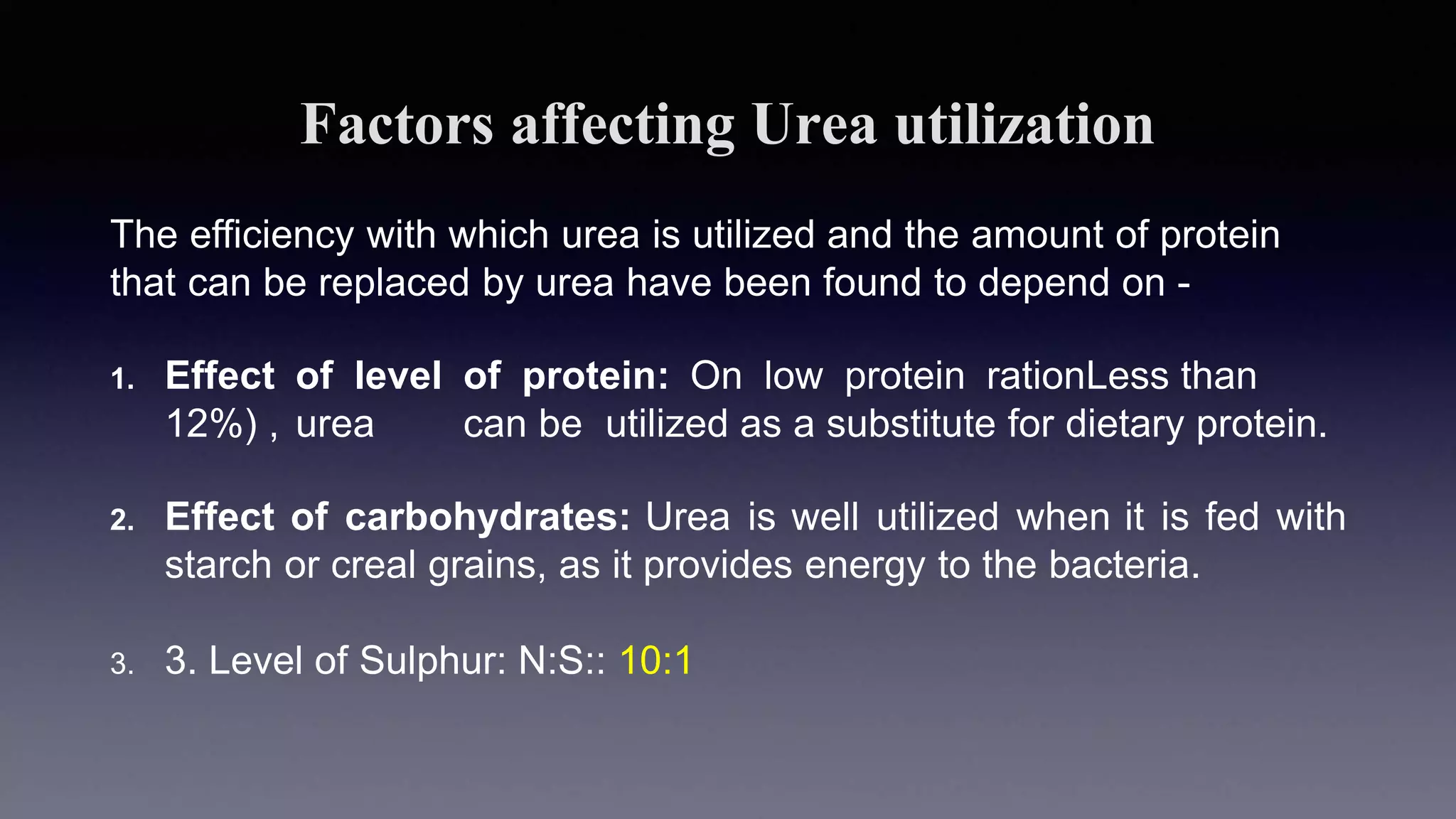
Factors affecting Urea utilization
The efficiency with which urea is utilized and the amount of protein
that can be replaced by urea have been found to depend on -
1. Effect of level of protein: On low protein rationLess than
12%) , urea can be utilized as a substitute for dietary protein.
2. Effect of carbohydrates: Urea is well utilized when it is fed with
starch or creal grains, as it provides energy to the bacteria.
3. 3. Level of Sulphur: N:S:: 10:1
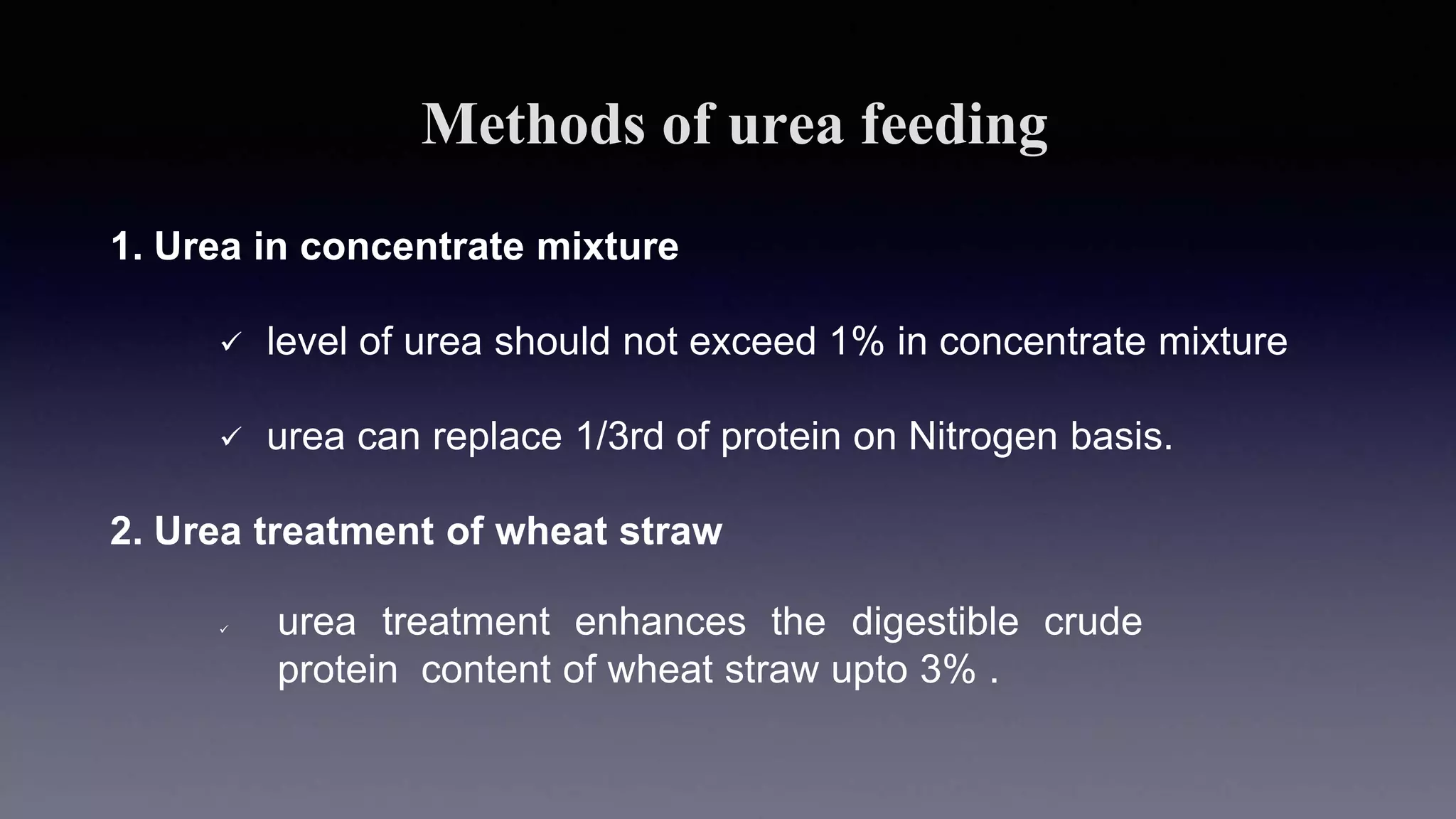
Methods of urea feeding
1. Urea in concentrate mixture
 level of urea should not exceed 1% in concentrate mixture
 urea can replace 1/3rd of protein on Nitrogen basis.
2. Urea treatment of wheat straw
 urea treatment enhances the digestible crude
protein content of wheat straw upto 3% .
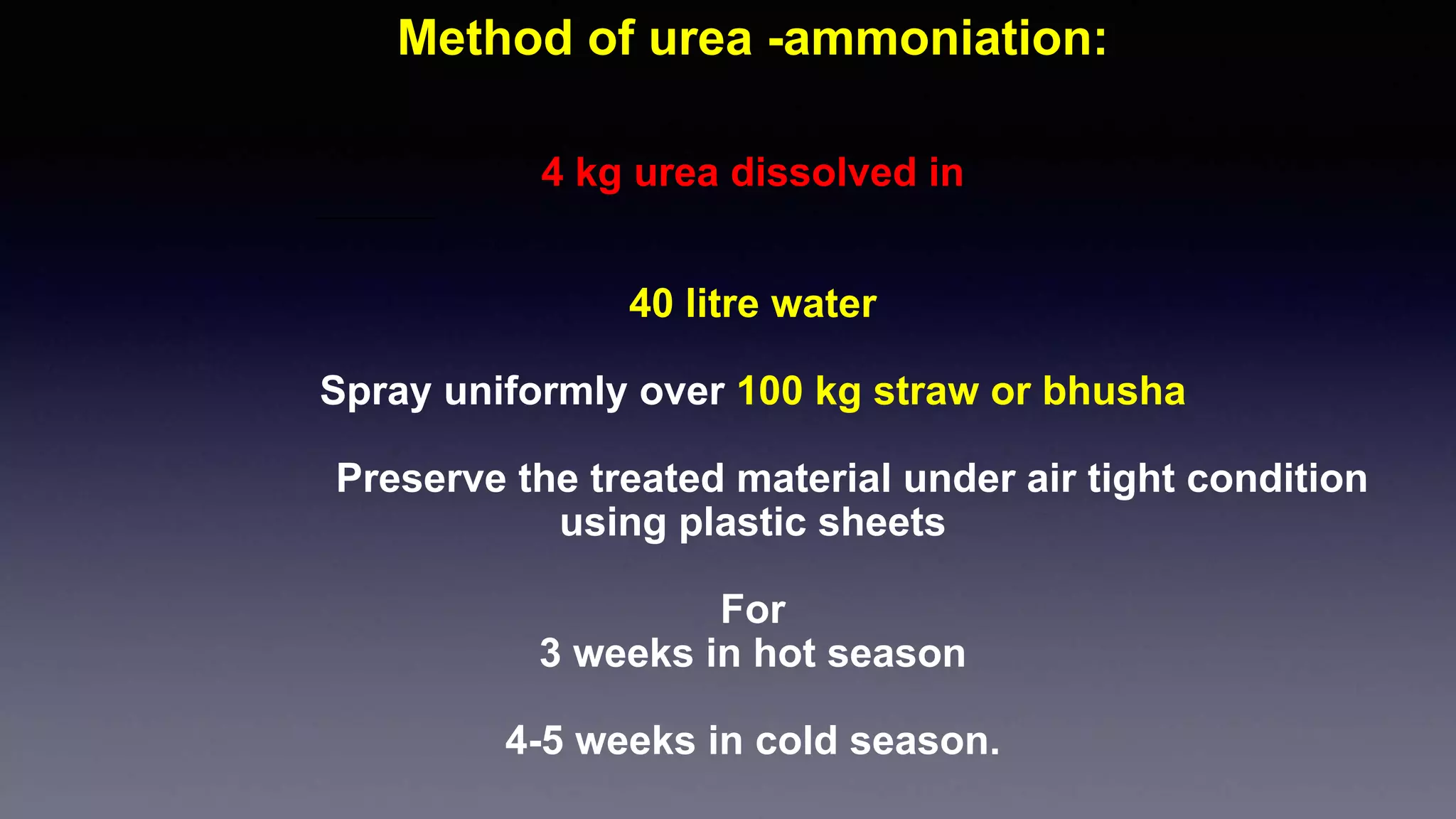
Method of urea -ammoniation:
4 kg urea dissolved in
40 litre water
Spray uniformly over 100 kg straw or bhusha
Preserve the treated material under air tight condition
using plastic sheets
For
3 weeks in hot season
4-5 weeks in cold season.
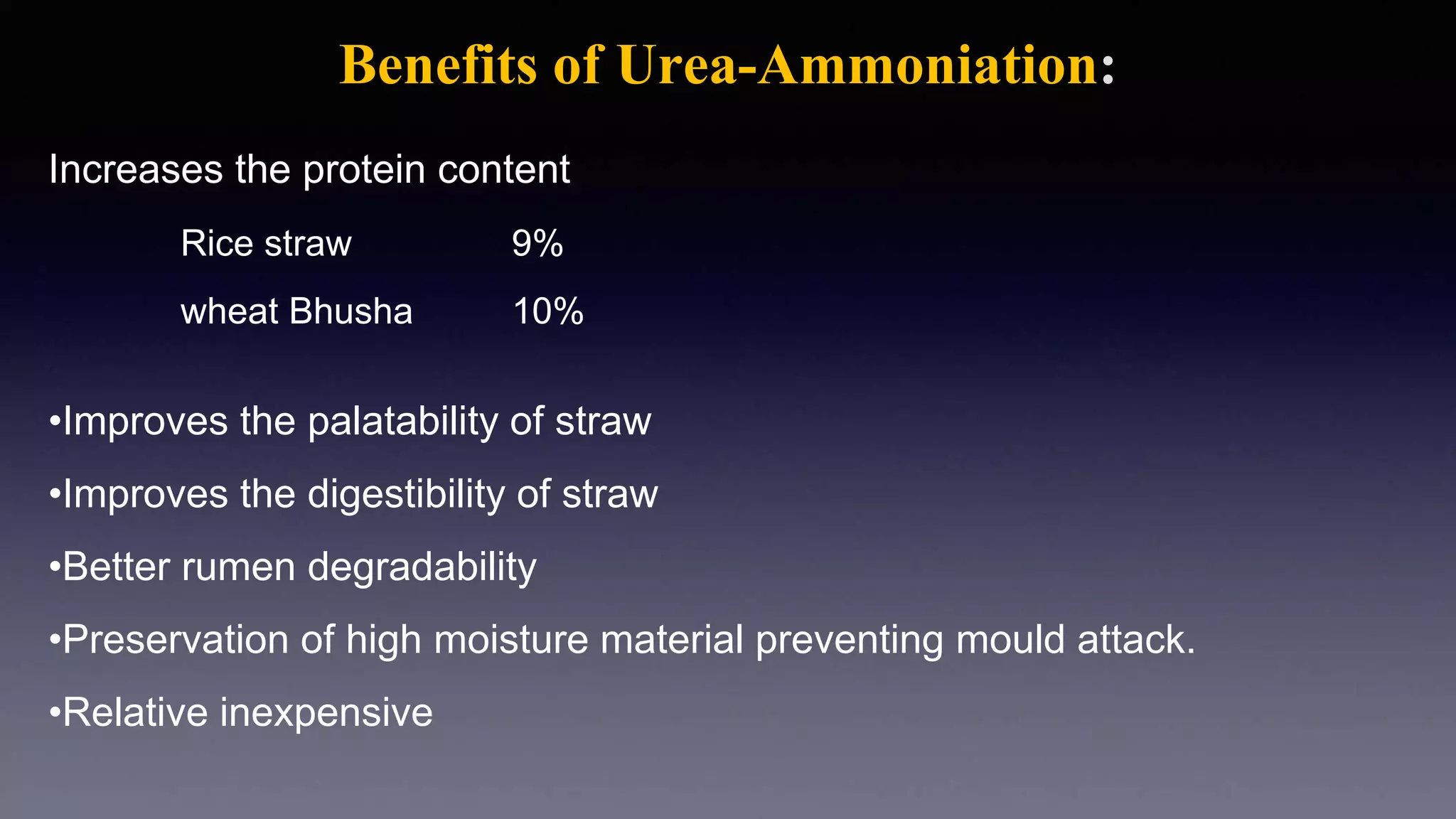
Benefits of Urea-Ammoniation:
Increases the protein content
Rice straw 9%
wheat Bhusha 10%
•Improves the palatability of straw
•Improves the digestibility of straw
•Better rumen degradability
•Preservation of high moisture material preventing mould attack.
•Relative inexpensive
3.Uromol
 It is prepared by boiling urea with Molasses in the ratio of 1:
3 for 30 minutes.
 It contains 36% DCP and 70% TDN .
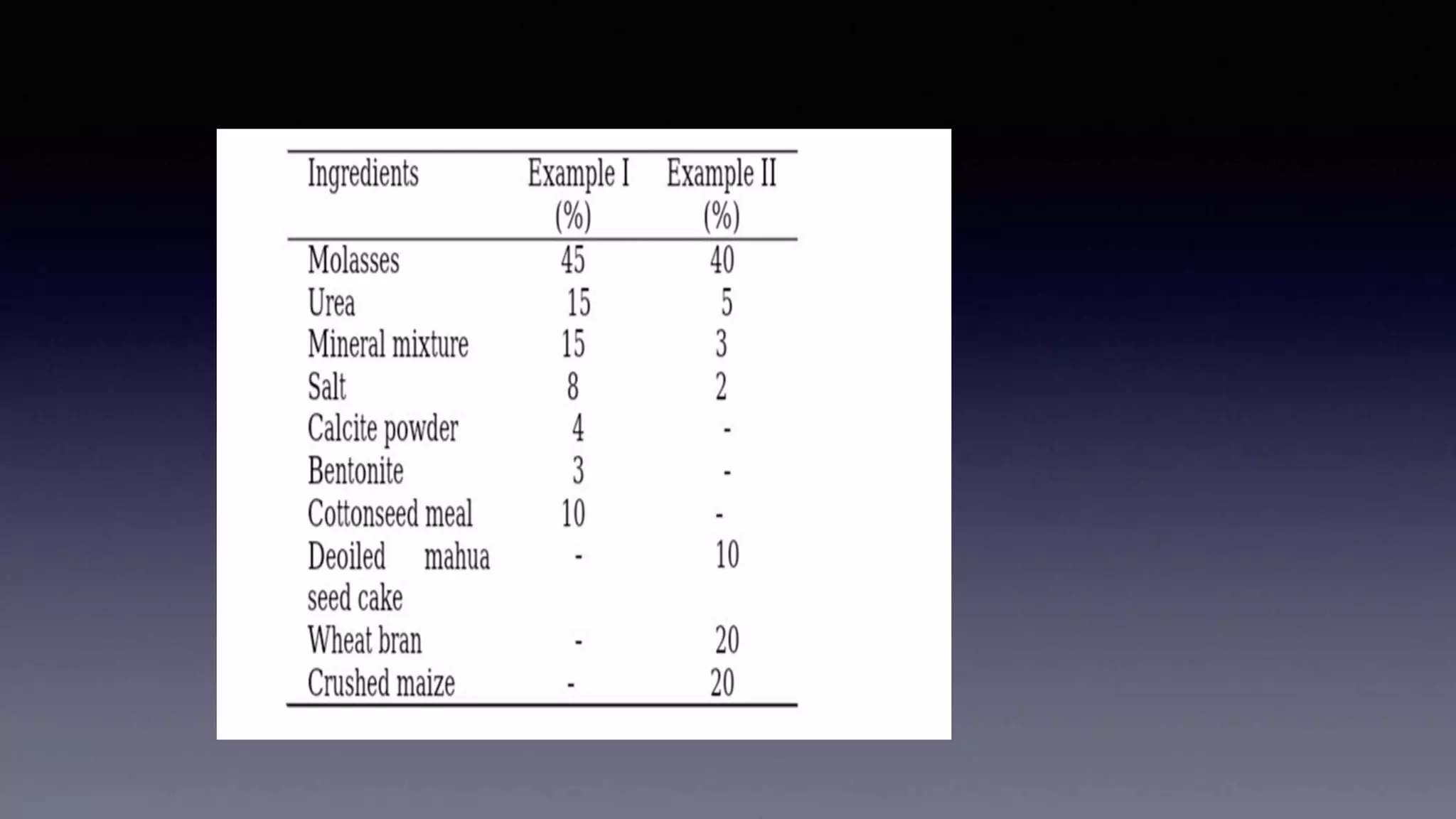
4.UMMB
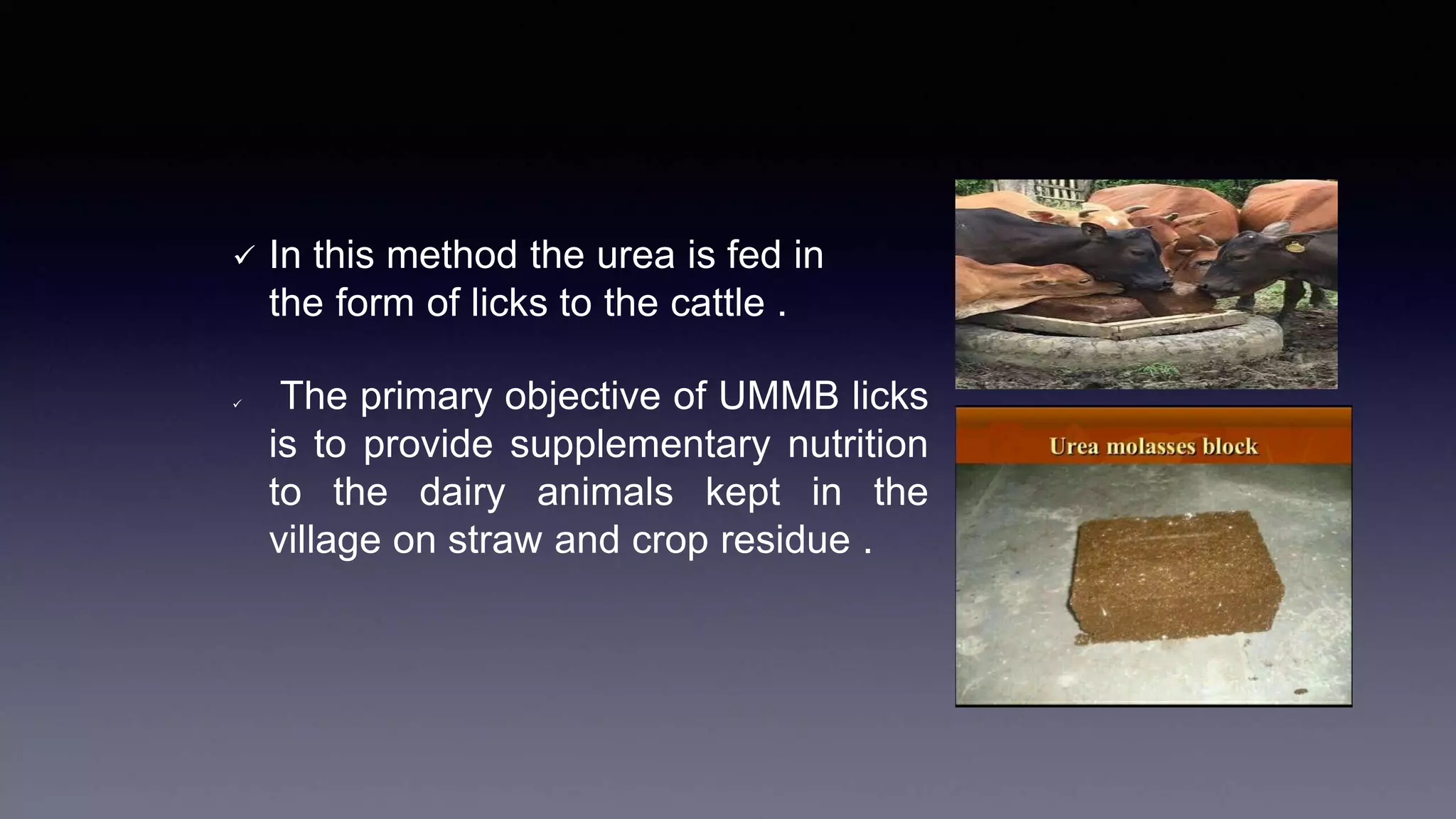
 UMMB stands for Urea Molasses Mineral Block .
 UMMB is a method for slow releasing urea , which checks
the proper amount of urea given per day .
 In this method the urea is fed in
the form of licks to the cattle .
 The primary objective of UMMB licks
is to provide supplementary nutrition
to the dairy animals kept in the
village on straw and crop residue .
Precaution of urea feeding:
•Never feed to young animals below 6 months of age.
•Never cross the limit of 116 gram of urea for adult cattle and 10 g for sheep.
•Provide sufficient drinking water
•Uniform mixing of urea is essential to avoid urea toxicity.
•Avoid dietary inclusion of urea suddenly.
•Provide sufficient amount of soluble carbohydrate for efficient utilization of
urea (e.g Molasses)
20
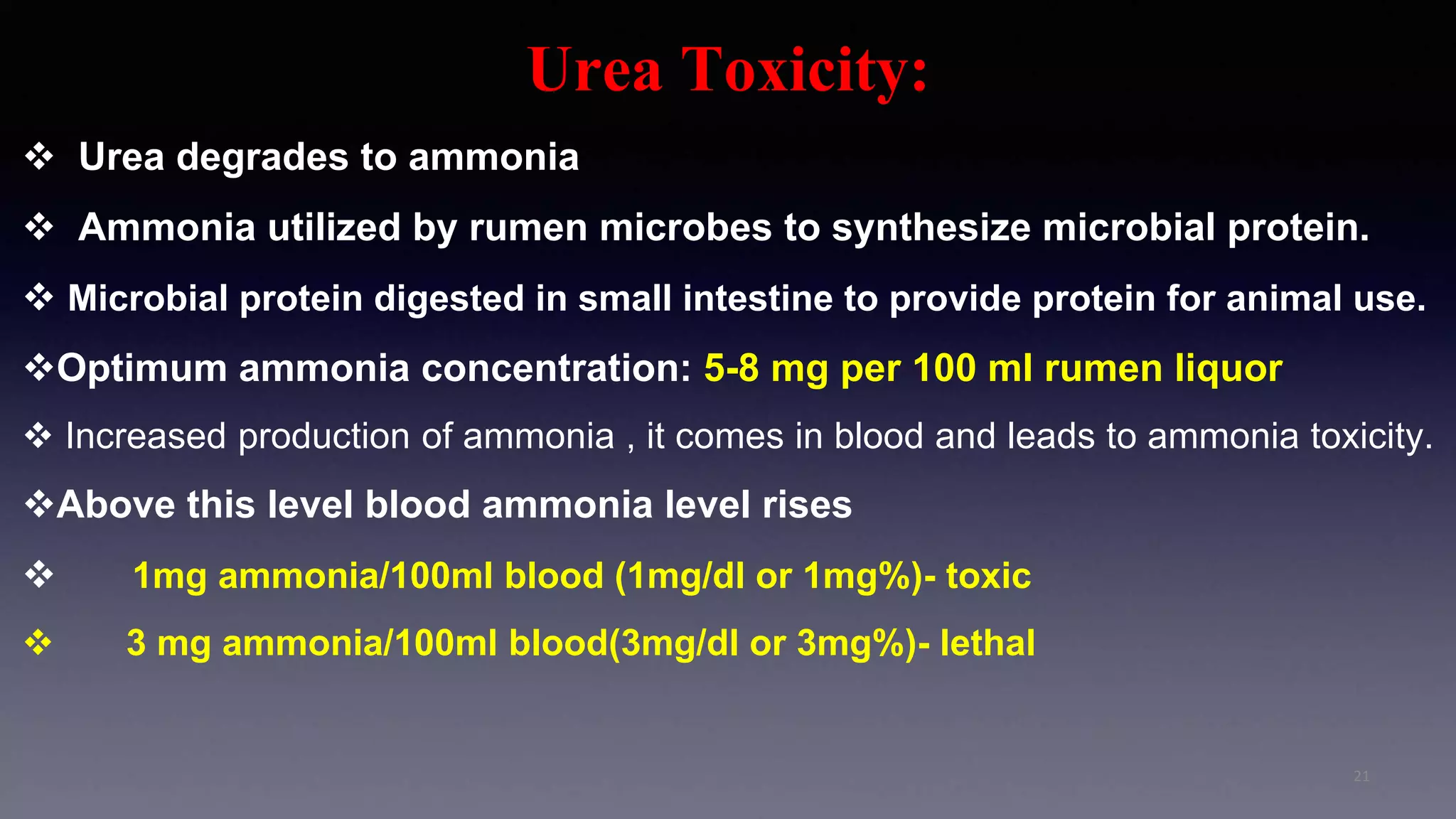
Urea Toxicity:
 Urea degrades to ammonia
 Ammonia utilized by rumen microbes to synthesize microbial protein.
 Microbial protein digested in small intestine to provide protein for animal use.
Optimum ammonia concentration: 5-8 mg per 100 ml rumen liquor
 Increased production of ammonia , it comes in blood and leads to ammonia toxicity.
Above this level blood ammonia level rises
 1mg ammonia/100ml blood (1mg/dl or 1mg%)- toxic
 3 mg ammonia/100ml blood(3mg/dl or 3mg%)- lethal
21
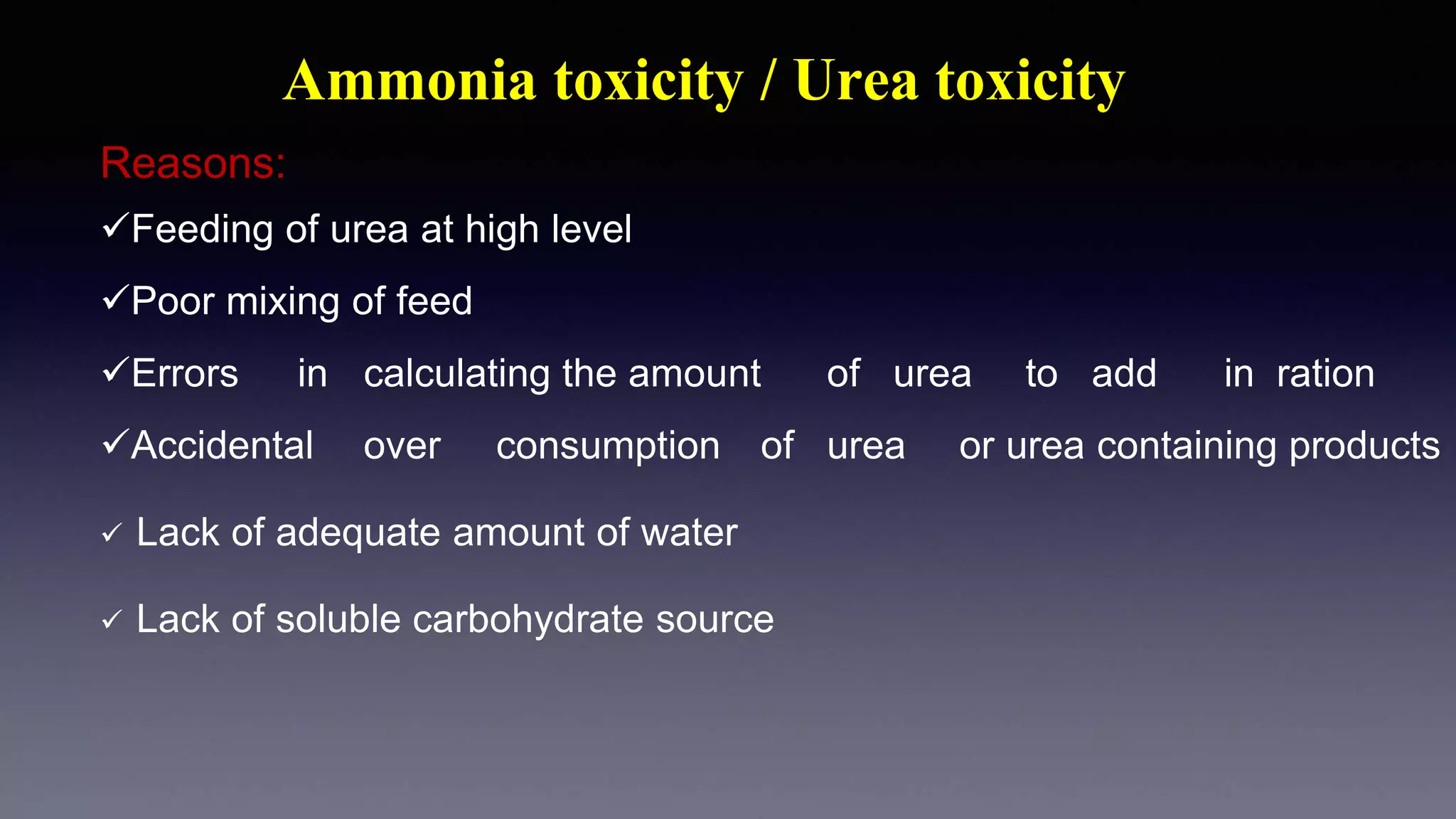
Ammonia toxicity / Urea toxicity
Reasons:
Feeding of urea at high level
Poor mixing of feed
Errors in calculating the amount of urea to add in ration
Accidental over consumption of urea or urea containing products
 Lack of adequate amount of water
 Lack of soluble carbohydrate source
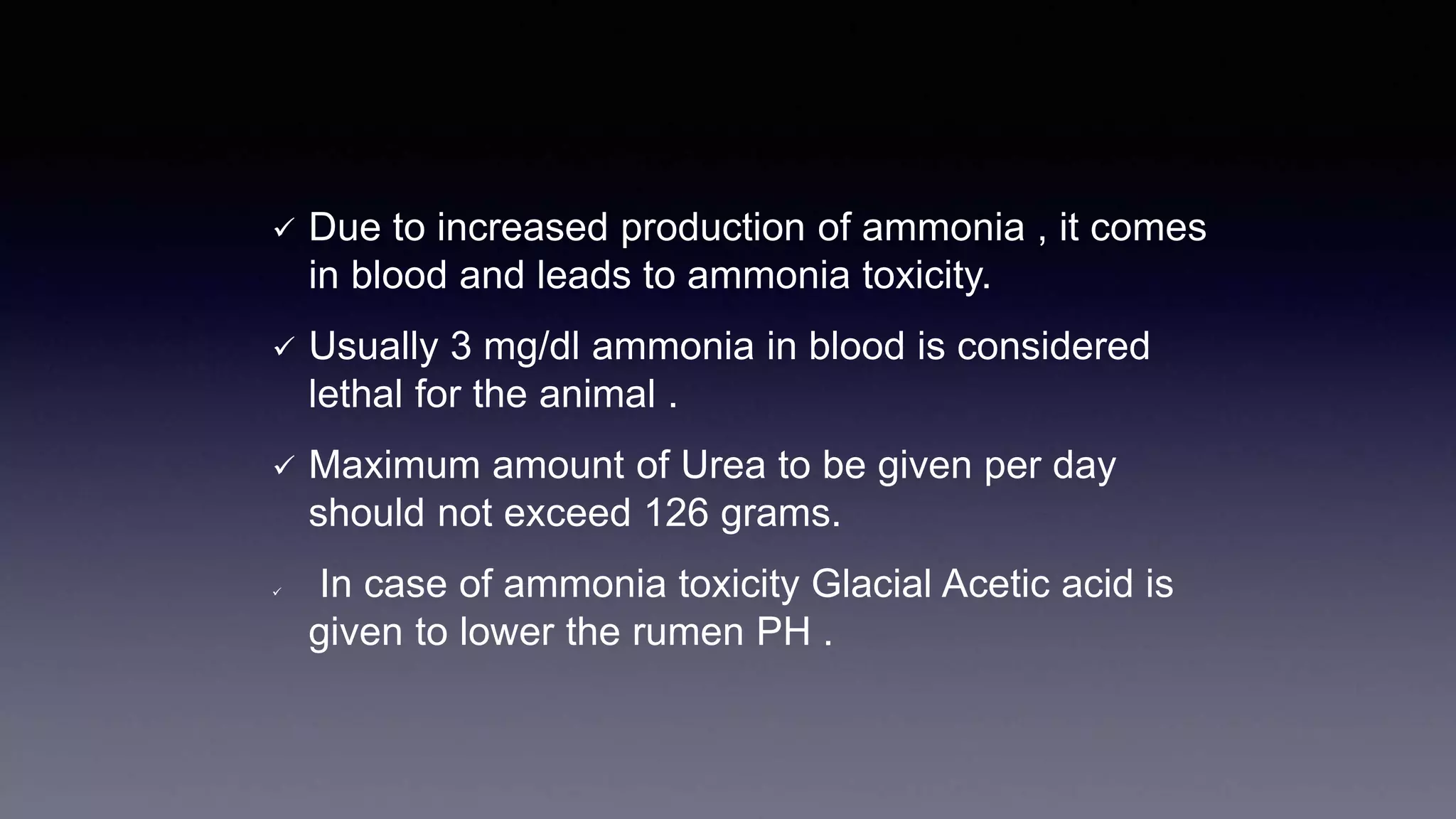
 Due to increased production of ammonia , it comes
in blood and leads to ammonia toxicity.
 Usually 3 mg/dl ammonia in blood is considered
lethal for the animal .
 Maximum amount of Urea to be given per day
should not exceed 126 grams.
 In case of ammonia toxicity Glacial Acetic acid is
given to lower the rumen PH .
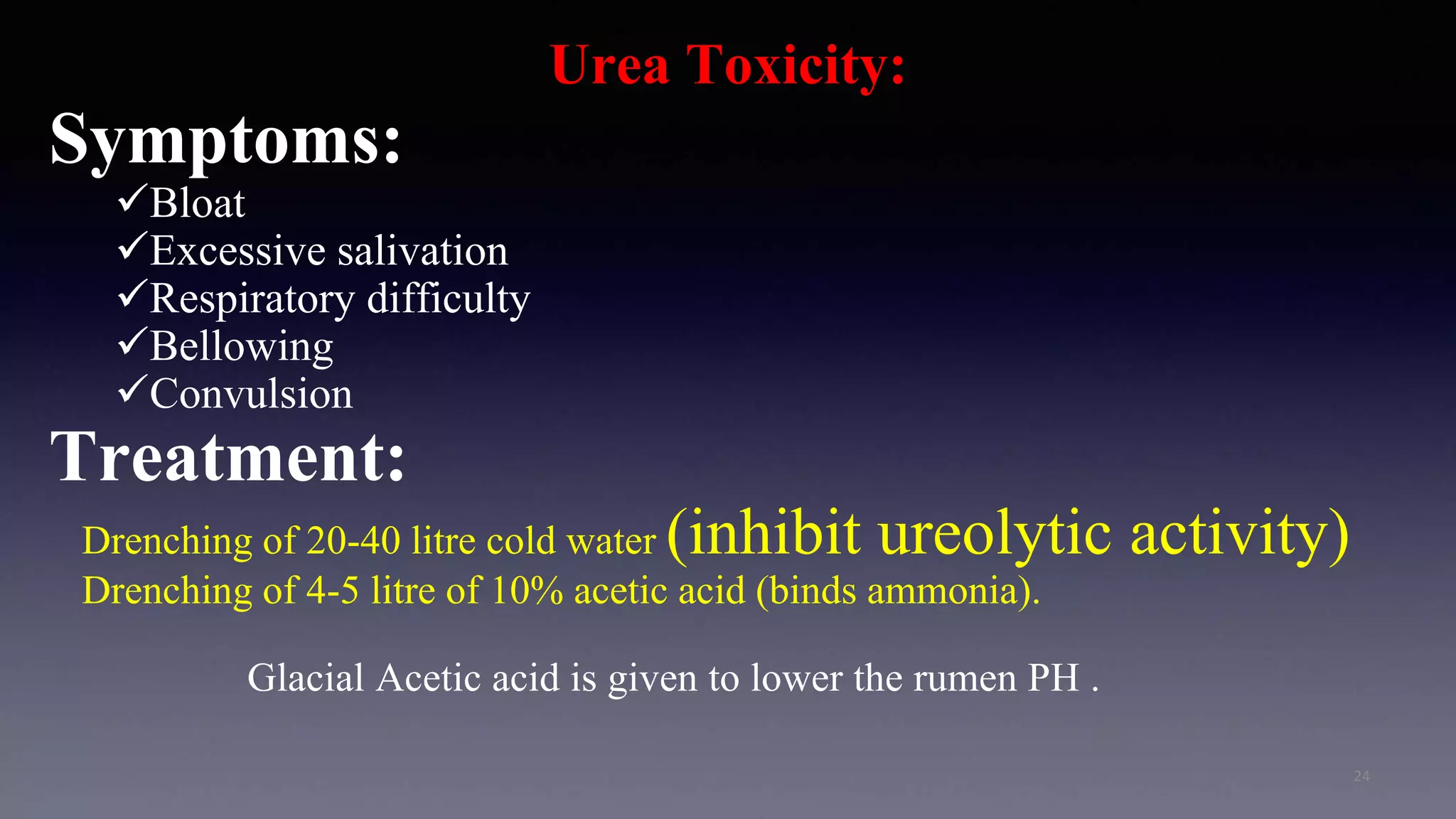
Urea Toxicity:
Symptoms:
Bloat
Excessive salivation
Respiratory difficulty
Bellowing
Convulsion
Treatment:
Drenching of 20-40 litre cold water (inhibit ureolytic activity)
Drenching of 4-5 litre of 10% acetic acid (binds ammonia).
Glacial Acetic acid is given to lower the rumen PH .
24
EXERCISE
A. Fill in the blanks -
.
3)
1) central component for the synthesis of protein is
2) one kg of pure urea furnishes kg of protein.
is the most commonly used NPN compound.
4) Bacterial _ acts on urea to degrade it in rumen.
5) Urea contains % of nitrogen.
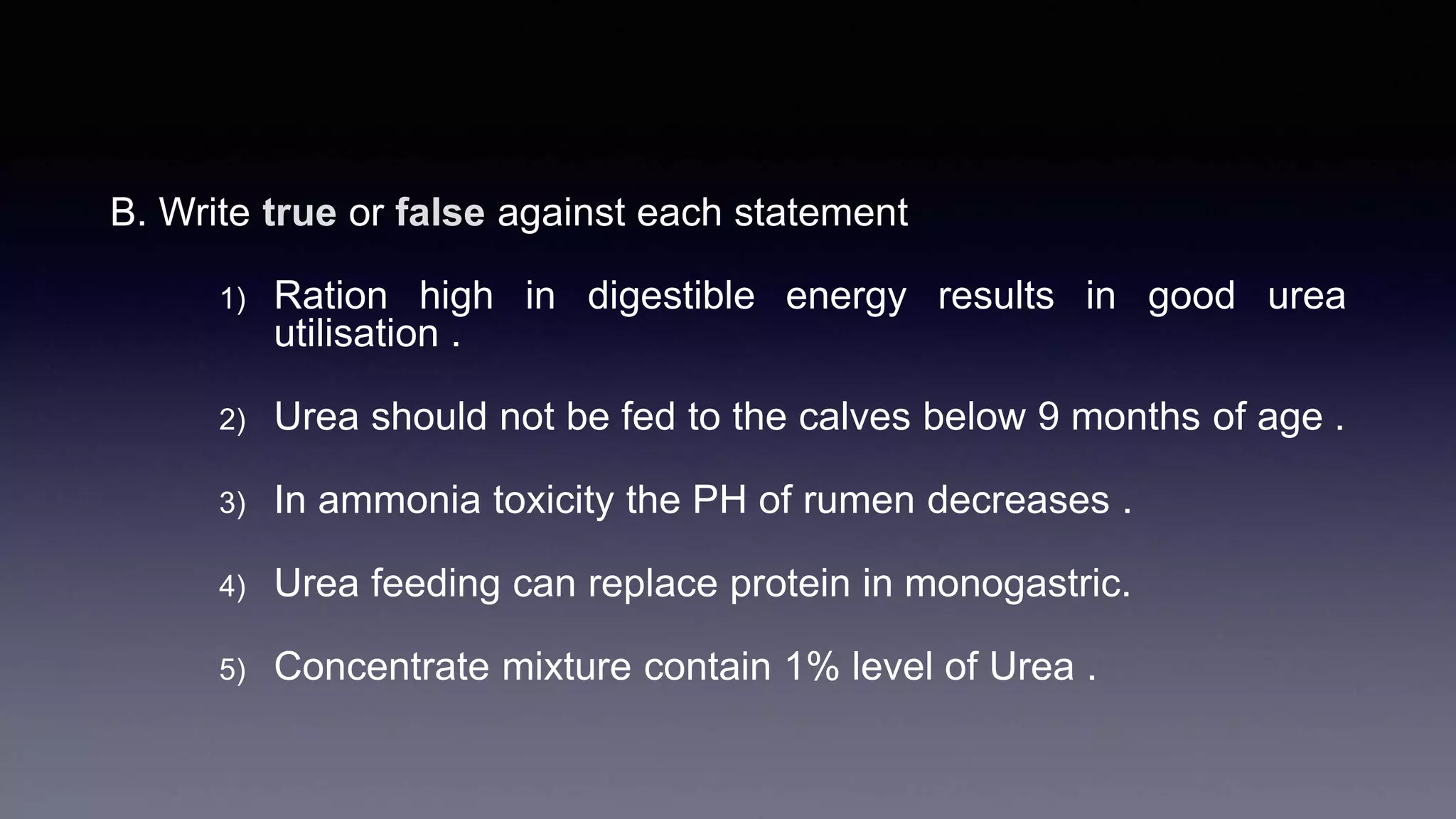
B. Write true or false against each statement
1) Ration high in digestible energy results in good urea
utilisation .
2) Urea should not be fed to the calves below 9 months of age .
3) In ammonia toxicity the PH of rumen decreases .
4) Urea feeding can replace protein in monogastric.
5) Concentrate mixture contain 1% level of Urea .
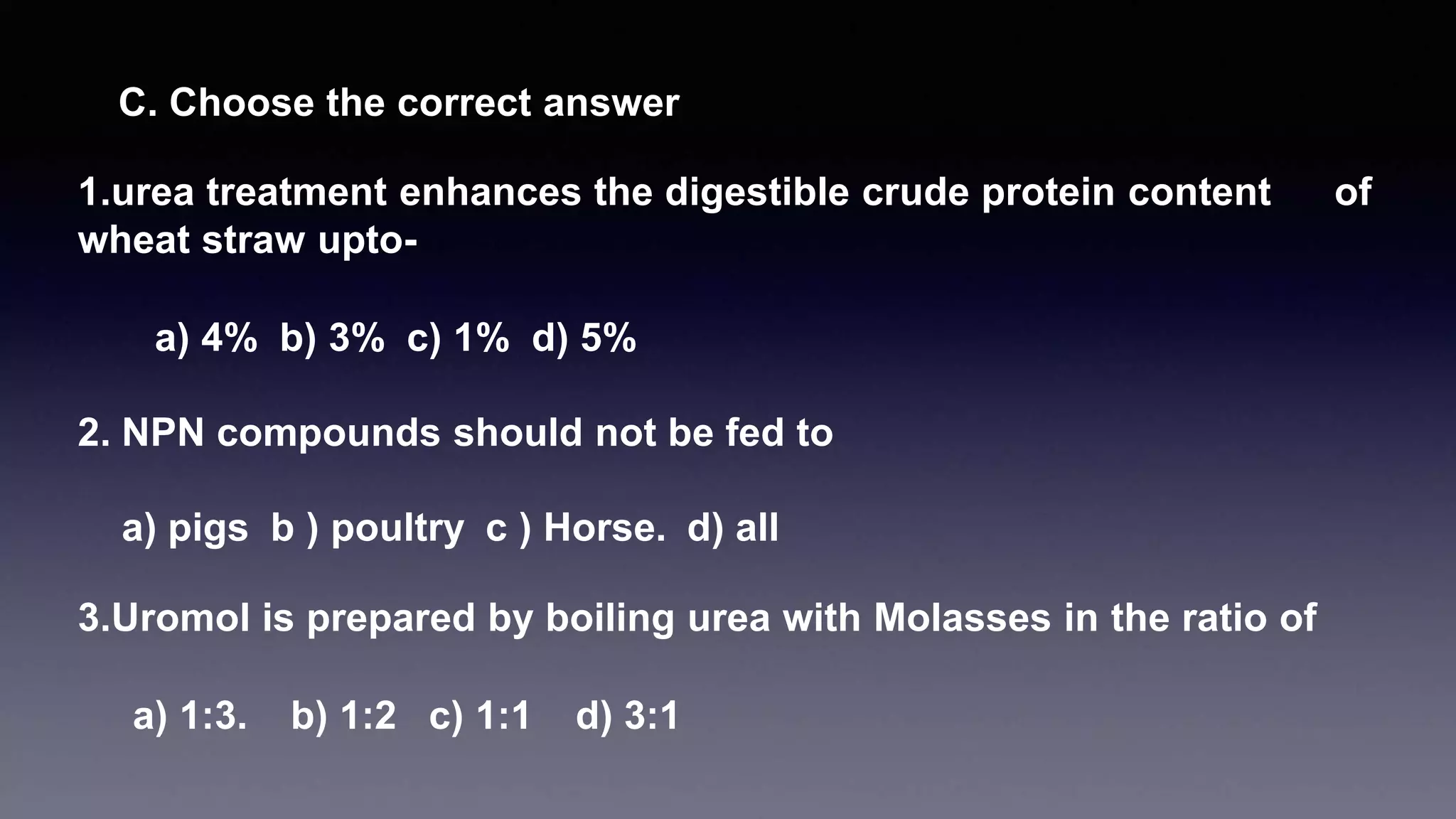
C. Choose the correct answer
1.urea treatment enhances the digestible crude protein content of
wheat straw upto-
a) 4% b) 3% c) 1% d) 5%
2. NPN compounds should not be fed to
a) pigs b ) poultry c ) Horse. d) all
3.Uromol is prepared by boiling urea with Molasses in the ratio of
a) 1:3. b) 1:2 c) 1:1 d) 3:1
4. NPN should be given in ration having crude protein content
a) 30% b) 12 % c) 40 % d) none
5.Total ration protein equivalent coming from NPN should not be
more than
a) 2/3rd b ) 1/3rd c) 1/4th d) none
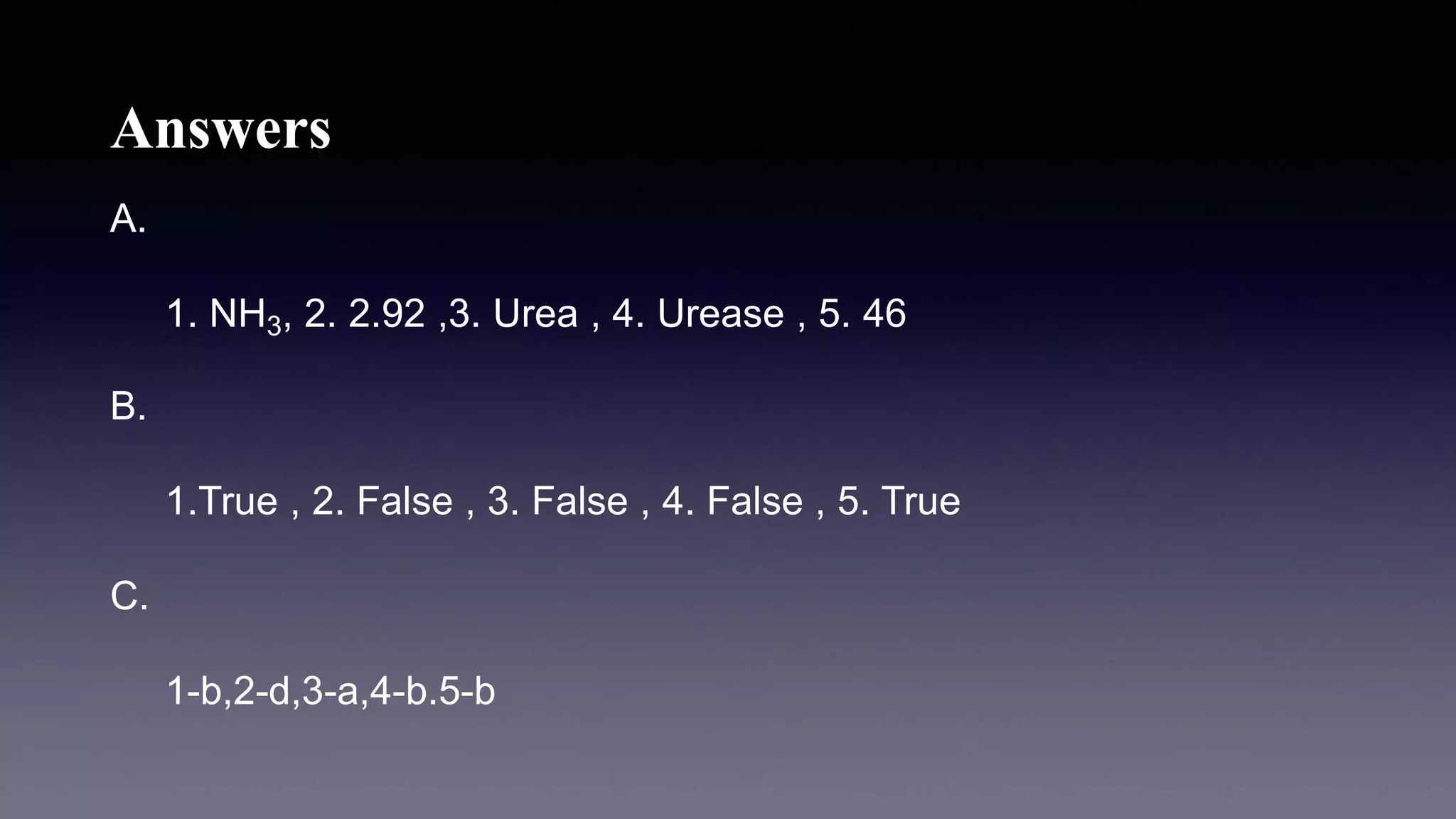
Answers
A.
1. NH3, 2. 2.92 ,3. Urea , 4. Urease , 5. 46
B.
1.True , 2. False , 3. False , 4. False , 5. True
C.
1-b,2-d,3-a,4-b.5-b
Non Protein Nutrogen Utilization in Ruminant

Non Protein Nutrogen Utilization in Ruminant

  • 1.
    Uses of NPNcompounds in Ruminants Dr. Pankaj Kumar Singh Assistant Professor (Animal Nutrition) Bihar Veterinary College, Patna 1
  • 2.
    What are NPNCompounds ? TOTAL PROTEIN = True Protein + Non-Protein Nitrogen (NPN) (CRUDE PROTEIN) ) 1. True Protein:- Made up of amino acids Estimated by “Stutzer’s reagent”(Copper sulphate, glycerol, sodium hydroxide) 2. NPN (Non-protein nitrogen):- Such compounds who supplies nitrogen other than in form of protein are called NPN compounds. Examples- Urea is the most commonly used NPN compound .  Biuret , ammonium acetate, Glycine etc
  • 4.
    Protein metabolism inRuminants Ruminants have this unique ability to metabolise the dietary Nitrogen for synthesis of protein within the rumen. Protein provide the amino acids needed for maintenance functions. Feed Protein are degraded by microorganisms in Rumen via amino acid into ammonia (NH3) and branched chain fatty acids. The rumen microbes convert this ammonia along with a carbohydrate source ( energy source) into Microbial Protein . Microbial protein is further degraded down to free amino acid in small intestine. This amino acid is available for the use to animal .
  • 6.
    Role of NPNin Ruminants nutrition In ruminants, the central component for the synthesis of protein is NH3 .  The ammonia can be derived from metabolism of feed Protein or directly from NPN compound  Urea is the most commonly used NPN .  The role of urea can be best explained as follow -
  • 8.
    Feeding guidelines ofNPN  While NPN does serve as a cheaper alternate of protein for ruminants, it should also be kept in mind that NPN are not true protein.  Alone NPN feeding can not replace the whole protein requirement.  NPN feeding does require some of the guidelines to be followed strictly.
  • 9.
    These are  AddNPN with high energy feed such as grains/molasses and mix thoroughly.  Introduce NPN ration slowly as 2-3 week period is necessary for rumen bacteria to achieve maximum utilisation of NPN.  Use NPN only when additional protein is necessary in the ration . The crude protein should not be more than 12 percent in the ration.  Add maximum 1% NPN in concentrate mixture.
  • 10.
     Make surethat no more than 1/3rd of the total ration protein equivalent comes from NPN.  NPN should not be given to monogastric animals like pigs , poultry etc.  NPN should not be fed to calves below 6 months of age because of under developed rumen.  Ensure adequate amount of water during NPN feeding.
  • 11.
    UREA  Urea wasdiscovered in 1773 by Rouelle and it's composition was established by Prout in 1818.  It's a white compound with bitter taste for Ruminants.  Having 46% Nitrogen.  One kilogram of urea can furnish as much as 2.92kg of protein.  When Urea enters the rumen it is rapidly dissolved and hydrolyzed to ammonia by bacterial urease.  Urea NH3 + CO2
  • 13.
    Factors affecting Ureautilization The efficiency with which urea is utilized and the amount of protein that can be replaced by urea have been found to depend on - 1. Effect of level of protein: On low protein rationLess than 12%) , urea can be utilized as a substitute for dietary protein. 2. Effect of carbohydrates: Urea is well utilized when it is fed with starch or creal grains, as it provides energy to the bacteria. 3. 3. Level of Sulphur: N:S:: 10:1
  • 14.
    Methods of ureafeeding 1. Urea in concentrate mixture  level of urea should not exceed 1% in concentrate mixture  urea can replace 1/3rd of protein on Nitrogen basis. 2. Urea treatment of wheat straw  urea treatment enhances the digestible crude protein content of wheat straw upto 3% .
  • 15.
    Method of urea-ammoniation: 4 kg urea dissolved in 40 litre water Spray uniformly over 100 kg straw or bhusha Preserve the treated material under air tight condition using plastic sheets For 3 weeks in hot season 4-5 weeks in cold season.
  • 16.
    Benefits of Urea-Ammoniation: Increasesthe protein content Rice straw 9% wheat Bhusha 10% •Improves the palatability of straw •Improves the digestibility of straw •Better rumen degradability •Preservation of high moisture material preventing mould attack. •Relative inexpensive
  • 17.
    3.Uromol  It isprepared by boiling urea with Molasses in the ratio of 1: 3 for 30 minutes.  It contains 36% DCP and 70% TDN . 4.UMMB  UMMB stands for Urea Molasses Mineral Block .  UMMB is a method for slow releasing urea , which checks the proper amount of urea given per day .
  • 18.
     In thismethod the urea is fed in the form of licks to the cattle .  The primary objective of UMMB licks is to provide supplementary nutrition to the dairy animals kept in the village on straw and crop residue .
  • 20.
    Precaution of ureafeeding: •Never feed to young animals below 6 months of age. •Never cross the limit of 116 gram of urea for adult cattle and 10 g for sheep. •Provide sufficient drinking water •Uniform mixing of urea is essential to avoid urea toxicity. •Avoid dietary inclusion of urea suddenly. •Provide sufficient amount of soluble carbohydrate for efficient utilization of urea (e.g Molasses) 20
  • 21.
    Urea Toxicity:  Ureadegrades to ammonia  Ammonia utilized by rumen microbes to synthesize microbial protein.  Microbial protein digested in small intestine to provide protein for animal use. Optimum ammonia concentration: 5-8 mg per 100 ml rumen liquor  Increased production of ammonia , it comes in blood and leads to ammonia toxicity. Above this level blood ammonia level rises  1mg ammonia/100ml blood (1mg/dl or 1mg%)- toxic  3 mg ammonia/100ml blood(3mg/dl or 3mg%)- lethal 21
  • 22.
    Ammonia toxicity /Urea toxicity Reasons: Feeding of urea at high level Poor mixing of feed Errors in calculating the amount of urea to add in ration Accidental over consumption of urea or urea containing products  Lack of adequate amount of water  Lack of soluble carbohydrate source
  • 23.
     Due toincreased production of ammonia , it comes in blood and leads to ammonia toxicity.  Usually 3 mg/dl ammonia in blood is considered lethal for the animal .  Maximum amount of Urea to be given per day should not exceed 126 grams.  In case of ammonia toxicity Glacial Acetic acid is given to lower the rumen PH .
  • 24.
    Urea Toxicity: Symptoms: Bloat Excessive salivation Respiratorydifficulty Bellowing Convulsion Treatment: Drenching of 20-40 litre cold water (inhibit ureolytic activity) Drenching of 4-5 litre of 10% acetic acid (binds ammonia). Glacial Acetic acid is given to lower the rumen PH . 24
  • 25.
    EXERCISE A. Fill inthe blanks - . 3) 1) central component for the synthesis of protein is 2) one kg of pure urea furnishes kg of protein. is the most commonly used NPN compound. 4) Bacterial _ acts on urea to degrade it in rumen. 5) Urea contains % of nitrogen.
  • 26.
    B. Write trueor false against each statement 1) Ration high in digestible energy results in good urea utilisation . 2) Urea should not be fed to the calves below 9 months of age . 3) In ammonia toxicity the PH of rumen decreases . 4) Urea feeding can replace protein in monogastric. 5) Concentrate mixture contain 1% level of Urea .
  • 27.
    C. Choose thecorrect answer 1.urea treatment enhances the digestible crude protein content of wheat straw upto- a) 4% b) 3% c) 1% d) 5% 2. NPN compounds should not be fed to a) pigs b ) poultry c ) Horse. d) all 3.Uromol is prepared by boiling urea with Molasses in the ratio of a) 1:3. b) 1:2 c) 1:1 d) 3:1
  • 28.
    4. NPN shouldbe given in ration having crude protein content a) 30% b) 12 % c) 40 % d) none 5.Total ration protein equivalent coming from NPN should not be more than a) 2/3rd b ) 1/3rd c) 1/4th d) none
  • 29.
    Answers A. 1. NH3, 2.2.92 ,3. Urea , 4. Urease , 5. 46 B. 1.True , 2. False , 3. False , 4. False , 5. True C. 1-b,2-d,3-a,4-b.5-b