NCFTE 2009
National Curriculum Framework for Teacher Education
“ONE CHILD, ONE TEACHER, ONE
BOOK, ONE PEN CAN CHANGE THE
WORLD.”
(Malala Yousafzai)
TEACHER
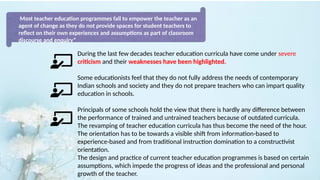
Most teacher education programmes fail to empower the teacher as an
agent of change as they do not provide spaces for student teachers to
reflect on their own experiences and assumptions as part of classroom
discourse and enquiry”
During the last few decades teacher education curricula have come under severe
criticism and their weaknesses have been highlighted.
Some educationists feel that they do not fully address the needs of contemporary
Indian schools and society and they do not prepare teachers who can impart quality
education in schools.
Principals of some schools hold the view that there is hardly any difference between
the performance of trained and untrained teachers because of outdated curricula.
The revamping of teacher education curricula has thus become the need of the hour.
The orientation has to be towards a visible shift from information-based to
experience-based and from traditional instruction domination to a constructivist
orientation.
The design and practice of current teacher education programmes is based on certain
assumptions, which impede the progress of ideas and the professional and personal
growth of the teacher.
• National Curriculum Framework for Teacher Education 2009 is a
draft created by the government of India to propose changes
and updates required in the National Council for Teacher
Education, which is an Indian government body launched under
the National Council for Teacher Education Act, 1993.
• National Curriculum Framework for teacher education (NCFTE) 2009 is an
attempt to improve teacher education in India, and to prepare an ideal,
innovative, humane and affectionate teacher.
• National Curriculum Framework for teacher education (NCFTE) circulated in
March 2009.
TITLE THEME : “TOWARDS PREPARING PROFESSIONAL AND HUMANE TEACHER”.
It is an attempt to improve ‘teacher education’ in India and to prepare ideal, innovative
and affectionate teachers.
Prepared by NCTE ( National Council for Teacher Education )
Based on NCF 2005 AND RTE 2009.
NCF 2005 - National Curriculum Framework
(Provide education to all till the age of 14)
RTE 2009 – Right To Education ( Right of Children to Free and Compulsory Education Act)
OBJECTIVES
 To produce good teacher.
 To improve teachers education qualitatively and quantitatively.
 To develop skills for guidance and counselling.
 To develop among teachers understanding of psychology of their pupils.
 To enable them to make pedagogical analysis.
 To enable them to foster creative thinking among pupils.
Important Dimensions of the Framework
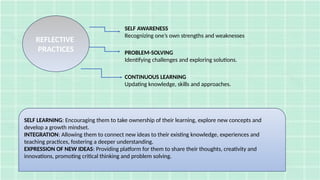
 Reflective practices are considered to be the chief aim of teacher education.
 Pupil-teachers should be provided opportunities for self-learning, reflection, integration and
expression of new ideas.
 Providing adequate opportunities to student-teachers for observing and engaging with
children, communicate with and get linked to children.
 To well execute the curricular operations and assessment related strategies for the various
preliminary teacher education programmes.
REFLECTIVE
PRACTICES
SELF AWARENESS
Recognizing one’s own strengths and weaknesses
PROBLEM-SOLVING
Identifying challenges and exploring solutions.
CONTINUOUS LEARNING
Updating knowledge, skills and approaches.
SELF LEARNING: Encouraging them to take ownership of their learning, explore new concepts and
develop a growth mindset.
INTEGRATION: Allowing them to connect new ideas to their existing knowledge, experiences and
teaching practices, fostering a deeper understanding.
EXPRESSION OF NEW IDEAS: Providing platform for them to share their thoughts, creativity and
innovations, promoting critical thinking and problem solving.
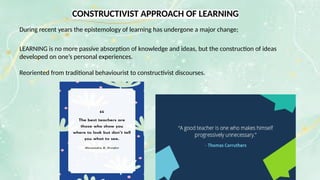
CONSTRUCTIVIST APPROACH OF LEARNING
During recent years the epistemology of learning has undergone a major change;
LEARNING is no more passive absorption of knowledge and ideas, but the construction of ideas
developed on one’s personal experiences.
Reoriented from traditional behaviourist to constructivist discourses.
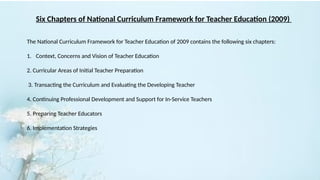
Six Chapters of National Curriculum Framework for Teacher Education (2009)
The National Curriculum Framework for Teacher Education of 2009 contains the following six chapters:
1. Context, Concerns and Vision of Teacher Education
2. Curricular Areas of Initial Teacher Preparation
3. Transacting the Curriculum and Evaluating the Developing Teacher
4. Continuing Professional Development and Support for In-Service Teachers
5. Preparing Teacher Educators
6. Implementation Strategies
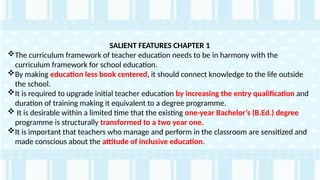
SALIENT FEATURES CHAPTER 1
The curriculum framework of teacher education needs to be in harmony with the
curriculum framework for school education.
By making education less book centered, it should connect knowledge to the life outside
the school.
It is required to upgrade initial teacher education by increasing the entry qualification and
duration of training making it equivalent to a degree programme.
 It is desirable within a limited time that the existing one-year Bachelor’s (B.Ed.) degree
programme is structurally transformed to a two year one.
It is important that teachers who manage and perform in the classroom are sensitized and
made conscious about the attitude of inclusive education.
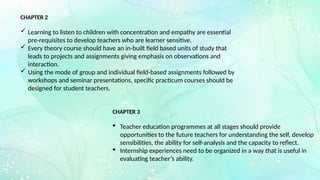
CHAPTER 2
 Learning to listen to children with concentration and empathy are essential
pre-requisites to develop teachers who are learner sensitive.
 Every theory course should have an in-built field based units of study that
leads to projects and assignments giving emphasis on observations and
interaction.
 Using the mode of group and individual field-based assignments followed by
workshops and seminar presentations, specific practicum courses should be
designed for student teachers.
CHAPTER 3
 Teacher education programmes at all stages should provide
opportunities to the future teachers for understanding the self, develop
sensibilities, the ability for self-analysis and the capacity to reflect.
 Internship experiences need to be organized in a way that is useful in
evaluating teacher’s ability.
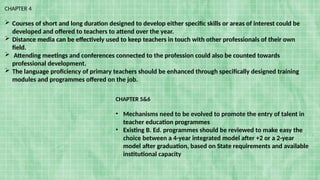
CHAPTER 4
 Courses of short and long duration designed to develop either specific skills or areas of interest could be
developed and offered to teachers to attend over the year.
 Distance media can be effectively used to keep teachers in touch with other professionals of their own
field.
 Attending meetings and conferences connected to the profession could also be counted towards
professional development.
 The language proficiency of primary teachers should be enhanced through specifically designed training
modules and programmes offered on the job.
CHAPTER 5&6
• Mechanisms need to be evolved to promote the entry of talent in
teacher education programmes
• Existing B. Ed. programmes should be reviewed to make easy the
choice between a 4-year integrated model after +2 or a 2-year
model after graduation, based on State requirements and available
institutional capacity
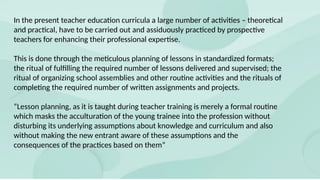
In the present teacher education curricula a large number of activities – theoretical
and practical, have to be carried out and assiduously practiced by prospective
teachers for enhancing their professional expertise.
This is done through the meticulous planning of lessons in standardized formats;
the ritual of fulfilling the required number of lessons delivered and supervised; the
ritual of organizing school assemblies and other routine activities and the rituals of
completing the required number of written assignments and projects.
“Lesson planning, as it is taught during teacher training is merely a formal routine
which masks the acculturation of the young trainee into the profession without
disturbing its underlying assumptions about knowledge and curriculum and also
without making the new entrant aware of these assumptions and the
consequences of the practices based on them”
A teacher’s attitude towards children, their
needs and problems, dispositions of tolerance,
ability to listen with empathy, habits of
punctuality, a seeking mind, habits of reading
and independent learning, a self-questioning
and critical mind are particularly important in
making a reflective practitioner. The present
evaluation protocol has no space for evaluating
qualitative dimensions such as these.
Thankyou