Potential Therapeutic Applications of Stem Cells Dr. Boenjamin Setiawan, Ph.D. Dr.Virgi Saputra
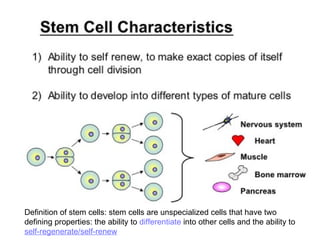
Definition of stem cells: stem cells are unspecialized cells that have two defining properties: the ability to  differentiate  into other cells and the ability to  self-regenerate /self-renew
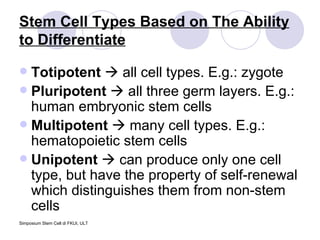
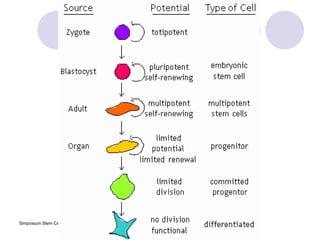
Stem Cell Types Based on The Ability to Differentiate Totipotent    all cell types. E.g.: zygote Pluripotent    all three germ layers. E.g.: human embryonic stem cells Multipotent    many cell types. E.g.: hematopoietic stem cells Unipotent    can produce only one cell type, but have the property of self-renewal which distinguishes them from non-stem cells
 
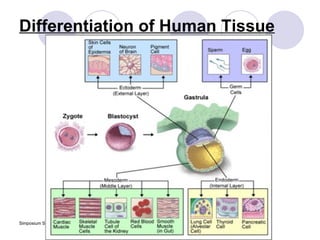
Differentiation of Human Tissue
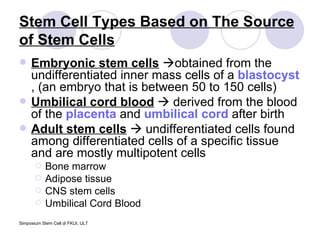
Stem Cell Types Based on The Source of Stem Cells Embryonic stem cells    obtained from the undifferentiated inner mass cells of a  blastocyst , (an embryo that is between 50 to 150 cells)  Umbilical cord blood     derived from the blood of the  placenta  and  umbilical cord  after birth  Adult stem cells     undifferentiated cells found among differentiated cells of a specific tissue and are mostly multipotent cells  Bone marrow Adipose tissue CNS stem cells Umbilical Cord Blood
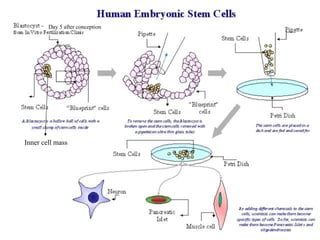
Inner cell mass Day 5 after conception
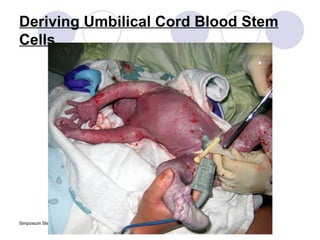
Deriving Umbilical Cord Blood Stem Cells
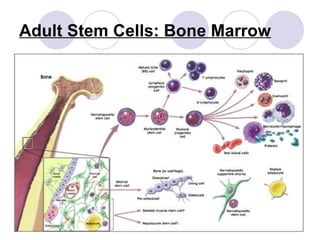
Adult Stem Cells: Bone Marrow
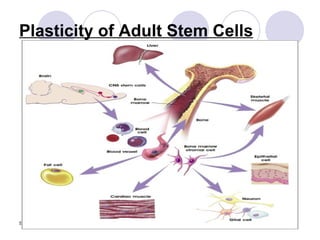
Plasticity of Adult Stem Cells
 
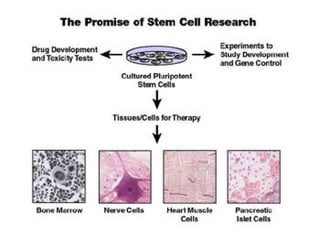
Research & Clinical Applications of Cultured Stem Cells Functional genomic studies     gene therapy Study of biological processes     development of the organism & progress of cancer Drug discovery & development     to see the properties of the drugs to differentiated cells Cell-based regenerative therapy
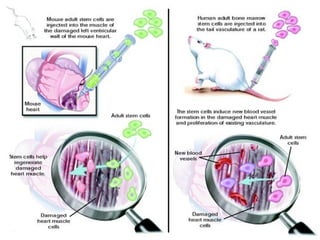
Cell-based Regenerative Therapy
 
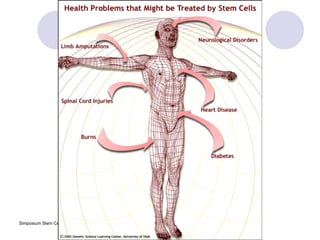
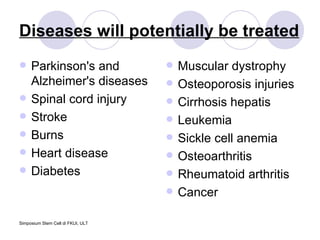
Diseases will potentially be treated Parkinson's and Alzheimer's diseases  Spinal cord injury  Stroke  Burns  Heart disease  Diabetes  Muscular dystrophy Osteoporosis injuries Cirrhosis hepatis Leukemia Sickle cell anemia Osteoarthritis  Rheumatoid arthritis  Cancer
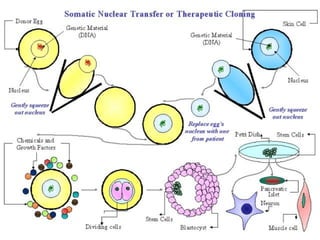
Use of Stem Cell in Transplantation Aims: To encourage the development of new, healthy cells in patients (at first) To make healthy replacements for specific cell types that have become damaged or diseased and to use these for transplantation (later on) Benefits from stem cell transplantation: No match donor is needed Autologous transplantation may be very possible Prevention of tissue rejection    by SCNT (Somatic Cell Nuclear Transfer)/therapeutic cloning
Stem Cell Characteristics Make Them Good Candidates for Cell-based Therapies Potential to be harvested from patients High capacity of  cell proliferation  in culture to obtain large number of cells from a limited source Ease of manipulation to replace existing non functional genes via gene transfer methods Ability to migrate to host's target tissues, e.g. the brain Ability to integrate into host tissue and interact with surrounding tissue


Embryonic Stem Cells for Therapy Advantages: Easily available    from fertility clinics Pluripotent    have ability to differentiate into cells derived from all 3 germ layers but not the embryonic membranes Immortal    proliferate in culture & maintained in culture for several hundred doublings Disadvantages: Tumorigenic    any contaminating undifferentiated cells could give rise to cancer Always allogenic    immune rejection Ethically controversial
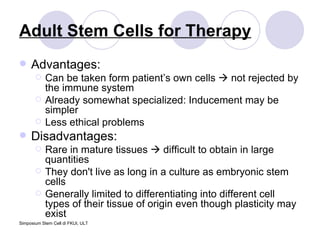
Adult Stem Cells for Therapy Advantages: Can be taken form patient’s own cells    not rejected by the immune system Already somewhat specialized: Inducement may be simpler  Less ethical problems Disadvantages: Rare in mature tissues    difficult to obtain in large quantities They don't live as long in a culture as embryonic stem cells  Generally limited to differentiating into different cell types of their tissue of origin even though plasticity may exist
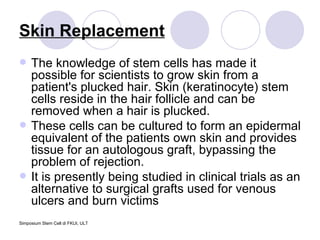
Skin Replacement The knowledge of stem cells has made it possible for scientists to grow skin from a patient's plucked hair. Skin (keratinocyte) stem cells reside in the hair follicle and can be removed when a hair is plucked.  These cells can be cultured to form an epidermal equivalent of the patients own skin and provides tissue for an autologous graft, bypassing the problem of rejection.  It is presently being studied in clinical trials as an alternative to surgical grafts used for venous ulcers and burn victims
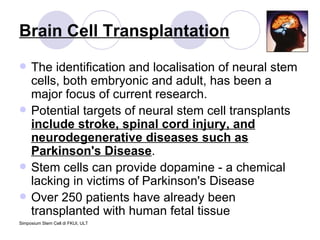
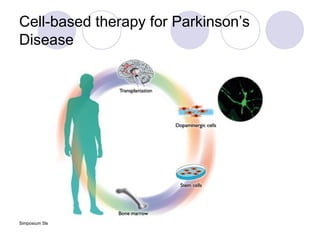
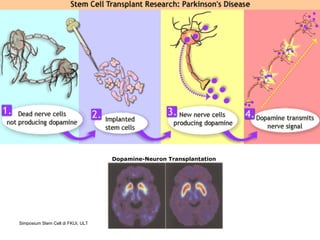
Brain Cell Transplantation The identification and localisation of neural stem cells, both embryonic and adult, has been a major focus of current research.  Potential targets of neural stem cell transplants  include stroke, spinal cord injury, and neurodegenerative diseases such as Parkinson's Disease .  Stem cells can provide dopamine - a chemical lacking in victims of Parkinson's Disease Over 250 patients have already been transplanted with human fetal tissue
Cell-based therapy for Parkinson’s Disease
Dopamine-Neuron Transplantation
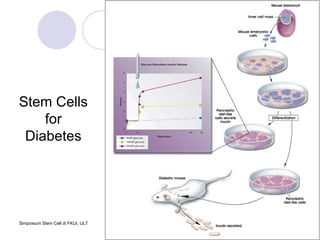
Treatment of Diabetes Recently, insulin expressing cells from mouse stem cells have been generated. In addition, the cells self assemble to form structures, which closely resemble normal pancreatic islets and produce insulin  Future research will need to investigate how to optimize conditions for insulin production with the aim of providing a stem cell-based therapy to treat diabetes to replace the constant need for insulin injections
Stem Cells for Diabetes
Commercialization and Utilization of Stem Cells
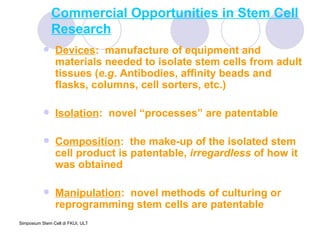
Commercial Opportunities in Stem Cell Research Devices :  manufacture of equipment and materials needed to isolate stem cells from adult tissues ( e.g . Antibodies, affinity beads and flasks, columns, cell sorters, etc.)  Isolation :  novel “processes” are patentable  Composition :  the make-up of the isolated stem cell product is patentable,  irregardless  of how it was obtained Manipulation :  novel methods of culturing or reprogramming stem cells are patentable
Aastrom Advanced Cell Tech.  BresaGen Cryo Cell Curis Diacrin Geron ReNeuron StemCells Incara Nexell NeuroNova Novartis Genzyme Others Biotechnology Companies in the Stem Cell Field
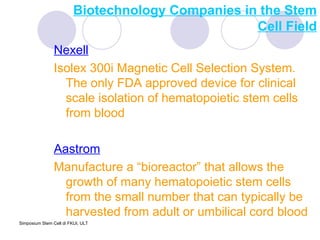
Biotechnology Companies in the Stem Cell Field Nexell Isolex 300i Magnetic Cell Selection System.  The only FDA approved device for clinical scale isolation of hematopoietic stem cells from blood Aastrom Manufacture a “bioreactor” that allows the growth of many hematopoietic stem cells from the small number that can typically be harvested from adult or umbilical cord blood
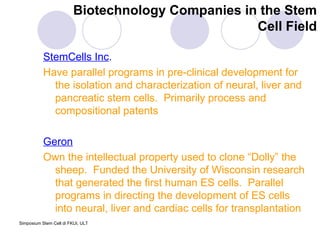
Biotechnology Companies in the Stem Cell Field StemCells Inc . Have parallel programs in pre-clinical development for the isolation and characterization of neural, liver and pancreatic stem cells.  Primarily process and compositional patents Geron Own the intellectual property used to clone “Dolly” the sheep.  Funded the University of Wisconsin research that generated the first human ES cells.  Parallel  programs in directing the development of ES cells into neural, liver and cardiac cells for transplantation
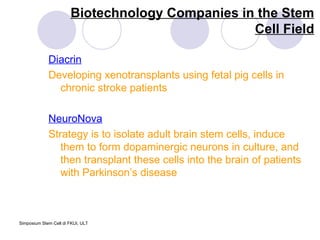
Biotechnology Companies in the Stem Cell Field Diacrin Developing xenotransplants using fetal pig cells in chronic stroke patients NeuroNova Strategy is to isolate adult brain stem cells, induce them to form dopaminergic neurons in culture, and then transplant these cells into the brain of patients with Parkinson’s disease
Biotechnology Companies in the Stem Cell Field ReNeuron Has developed neural stem cell lines from different regions of the human brain.  Can be grown in large numbers for transplantation.  Also examining the genes and proteins expressed in neural stem cells to identify novel targets for drug discovery Novartis Through its acquisition of SyStemix, Inc., now owns the composition patent on human hematopoietic stem cells
Market Analysis Currently HSCs  are the most intensively exploited stem cells, particularly in the treatment of cancer and immune disorders. Apart from bone/cartilage regeneration and skin/wound heling, all clinical applications of adult non-HSCs are at an early stage At least  300 million  people in the US, EU, and Japan could potentially benefit from stem cell therapeutics
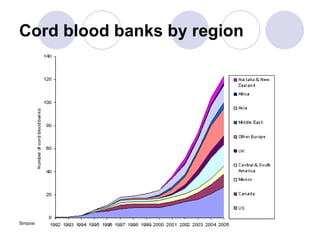
Market Analysis In the last few years, a new industry has evolved for  the collection and storage of cord blood HSCs and the number of cord blood banks has been rapidly increasing The US & EU are, and will remain, the largest world markets for stem cell therapies. Regulatory constraints are expected to affect the US more than Europe, closing the gap between them in relative terms as new stem cell products are developed, but  it is also expected that there will be a significant shift in stem cell R&D towards Asia,  where such constraints are less prominent (China, India, Korea, Singapore, Taiwan, (----Indonesia????)
Bone/Cartilage Regeneration Osteocel 1 st  commercial product in US: bone matrix containing allogeneic human mesenchymal stem cells Launched in 2005 by Osiris Therapeutics Osiris’ ability to supply Osteocel is limited, so it is currently marketed only for use in certain spinal surgeries requiring bone fusion, but more extensive bone-regenerating applications are envisaged At May 2005 report from Swiss investment company New Venturetec, Osiris largest backer, estimated the company could be worth $2m in revenue (all from Osteocel) in that year rising to $10m by 2006 and peaking at about $50m in 2009 because of supply constraints Other brands: Chondrogen, Tissue Repair Cells (TRCs), Prochymal, and Mesoblast
Myocardial & Vascular Regeneration By 2003, 10 int’l trials had enrolled human subjects with end-stage heart disease but results so far have been mixed. It remains to be demonstrated that bone marrow-derived stem cells offer better prospects for heart regeneration than myoblasts A number of companies are now investigating proprietary stem cells, cell combinations, or isolation methods, and stem cell delivery methods for vascular/cardiac regeneration
Skin Replacement and Wound Healing Cellerix’s ex vivo expanded adipose stem cells are currently in phase II clinical trials for perianal fistulas In July 2005 the company received Orphan Status designation by the EMEA for this therapy, the 1 st  time that this status has been granted by the EMEA to a European company for a cell-based medicinal product
Drug Screening Two of the world’s most successful blockbuster biotechnology products – Epogen & Neupogen – were discovered & developed through the use of in vitro assays involving blood stem cell technologies Stem cells which can be expanded ex vivo and differentiated into specialized cell types could enable the development of high-throughput screens for testing the effects and possible toxicity of a range of drugs early in the drug development pipeline
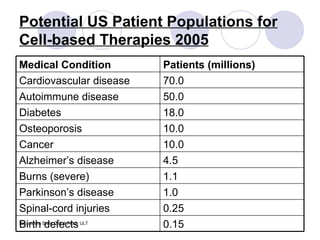
Potential US Patient Populations for Cell-based Therapies 2005 0.15 Birth defects 0.25 Spinal-cord injuries 1.0 Parkinson’s disease 1.1 Burns (severe) 4.5 Alzheimer’s disease 10.0 Cancer 10.0 Osteoporosis 18.0 Diabetes 50.0 Autoimmune disease 70.0 Cardiovascular disease Patients (millions) Medical Condition
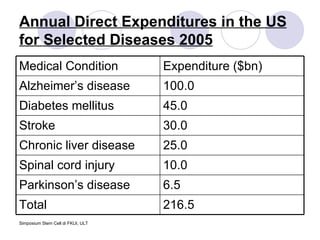
Annual Direct Expenditures in the US for Selected Diseases 2005 216.5 Total 6.5 Parkinson’s disease 10.0 Spinal cord injury 25.0 Chronic liver disease 30.0 Stroke 45.0 Diabetes mellitus 100.0 Alzheimer’s disease Expenditure ($bn) Medical Condition
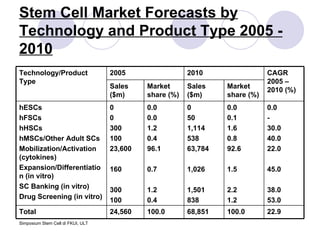
Stem Cell Market Forecasts by Technology and Product Type 2005 - 2010 22.9 100.0 68,851 100.0 24,560 Total 0.0 - 30.0 40.0 22.0 45.0 38.0 53.0 0.0 0.1 1.6 0.8 92.6 1.5 2.2 1.2 0 50 1,114 538 63,784 1,026 1,501 838 0.0 0.0 1.2 0.4 96.1 0.7 1.2 0.4 0 0 300 100 23,600  160 300 100 hESCs hFSCs hHSCs hMSCs/Other Adult SCs Mobilization/Activation (cytokines) Expansion/Differentiation (in vitro) SC Banking (in vitro) Drug Screening (in vitro) Market share (%) Sales ($m) Market share (%) Sales ($m) CAGR 2005 – 2010 (%) 2010 2005 Technology/Product Type
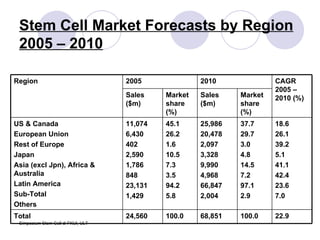
Stem Cell Market Forecasts by Region 2005 – 2010   22.9 100.0 68,851 100.0 24,560 Total 18.6 26.1 39.2 5.1 41.1 42.4 23.6 7.0 37.7 29.7 3.0 4.8 14.5 7.2 97.1 2.9 25,986 20,478 2,097 3,328 9,990 4,968 66,847 2,004 45.1 26.2 1.6 10.5 7.3 3.5 94.2 5.8 11,074 6,430 402 2,590 1,786 848 23,131 1,429 US & Canada European Union Rest of Europe Japan Asia (excl Jpn), Africa & Australia Latin America Sub-Total Others Market share (%) Sales ($m) Market share (%) Sales ($m) CAGR 2005 – 2010 (%) 2010 2005 Region
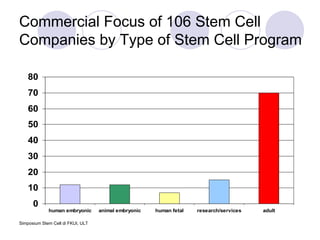
Commercial Focus of 106 Stem Cell Companies by Type of Stem Cell Program
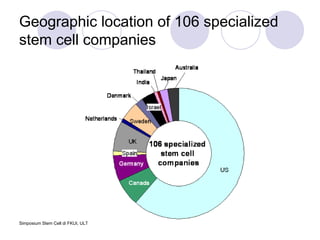
Geographic location of 106 specialized stem cell companies
Cord blood banks by region
Terima kasih

Potential Therapeutic Application Of Stem Cell

  • 1.
    Potential Therapeutic Applicationsof Stem Cells Dr. Boenjamin Setiawan, Ph.D. Dr.Virgi Saputra
  • 2.
    Definition of stemcells: stem cells are unspecialized cells that have two defining properties: the ability to differentiate into other cells and the ability to self-regenerate /self-renew
  • 3.
    Stem Cell TypesBased on The Ability to Differentiate Totipotent  all cell types. E.g.: zygote Pluripotent  all three germ layers. E.g.: human embryonic stem cells Multipotent  many cell types. E.g.: hematopoietic stem cells Unipotent  can produce only one cell type, but have the property of self-renewal which distinguishes them from non-stem cells
  • 4.
  • 5.
  • 6.
    Stem Cell TypesBased on The Source of Stem Cells Embryonic stem cells  obtained from the undifferentiated inner mass cells of a blastocyst , (an embryo that is between 50 to 150 cells) Umbilical cord blood  derived from the blood of the placenta and umbilical cord after birth Adult stem cells  undifferentiated cells found among differentiated cells of a specific tissue and are mostly multipotent cells Bone marrow Adipose tissue CNS stem cells Umbilical Cord Blood
  • 7.
    Inner cell massDay 5 after conception
  • 8.
    Deriving Umbilical CordBlood Stem Cells
  • 9.
    Adult Stem Cells:Bone Marrow
  • 10.
  • 11.
  • 12.
    Research & ClinicalApplications of Cultured Stem Cells Functional genomic studies  gene therapy Study of biological processes  development of the organism & progress of cancer Drug discovery & development  to see the properties of the drugs to differentiated cells Cell-based regenerative therapy
  • 13.
  • 14.
  • 15.
    Diseases will potentiallybe treated Parkinson's and Alzheimer's diseases Spinal cord injury Stroke Burns Heart disease Diabetes Muscular dystrophy Osteoporosis injuries Cirrhosis hepatis Leukemia Sickle cell anemia Osteoarthritis Rheumatoid arthritis Cancer
  • 16.
    Use of StemCell in Transplantation Aims: To encourage the development of new, healthy cells in patients (at first) To make healthy replacements for specific cell types that have become damaged or diseased and to use these for transplantation (later on) Benefits from stem cell transplantation: No match donor is needed Autologous transplantation may be very possible Prevention of tissue rejection  by SCNT (Somatic Cell Nuclear Transfer)/therapeutic cloning
  • 17.
    Stem Cell CharacteristicsMake Them Good Candidates for Cell-based Therapies Potential to be harvested from patients High capacity of cell proliferation in culture to obtain large number of cells from a limited source Ease of manipulation to replace existing non functional genes via gene transfer methods Ability to migrate to host's target tissues, e.g. the brain Ability to integrate into host tissue and interact with surrounding tissue
  • 18.
  • 19.
  • 20.
  • 21.
    Embryonic Stem Cellsfor Therapy Advantages: Easily available  from fertility clinics Pluripotent  have ability to differentiate into cells derived from all 3 germ layers but not the embryonic membranes Immortal  proliferate in culture & maintained in culture for several hundred doublings Disadvantages: Tumorigenic  any contaminating undifferentiated cells could give rise to cancer Always allogenic  immune rejection Ethically controversial
  • 22.
    Adult Stem Cellsfor Therapy Advantages: Can be taken form patient’s own cells  not rejected by the immune system Already somewhat specialized: Inducement may be simpler Less ethical problems Disadvantages: Rare in mature tissues  difficult to obtain in large quantities They don't live as long in a culture as embryonic stem cells Generally limited to differentiating into different cell types of their tissue of origin even though plasticity may exist
  • 23.
    Skin Replacement Theknowledge of stem cells has made it possible for scientists to grow skin from a patient's plucked hair. Skin (keratinocyte) stem cells reside in the hair follicle and can be removed when a hair is plucked. These cells can be cultured to form an epidermal equivalent of the patients own skin and provides tissue for an autologous graft, bypassing the problem of rejection. It is presently being studied in clinical trials as an alternative to surgical grafts used for venous ulcers and burn victims
  • 24.
    Brain Cell TransplantationThe identification and localisation of neural stem cells, both embryonic and adult, has been a major focus of current research. Potential targets of neural stem cell transplants include stroke, spinal cord injury, and neurodegenerative diseases such as Parkinson's Disease .  Stem cells can provide dopamine - a chemical lacking in victims of Parkinson's Disease Over 250 patients have already been transplanted with human fetal tissue
  • 25.
    Cell-based therapy forParkinson’s Disease
  • 26.
  • 27.
    Treatment of DiabetesRecently, insulin expressing cells from mouse stem cells have been generated. In addition, the cells self assemble to form structures, which closely resemble normal pancreatic islets and produce insulin Future research will need to investigate how to optimize conditions for insulin production with the aim of providing a stem cell-based therapy to treat diabetes to replace the constant need for insulin injections
  • 28.
  • 29.
  • 30.
    Commercial Opportunities inStem Cell Research Devices : manufacture of equipment and materials needed to isolate stem cells from adult tissues ( e.g . Antibodies, affinity beads and flasks, columns, cell sorters, etc.) Isolation : novel “processes” are patentable Composition : the make-up of the isolated stem cell product is patentable, irregardless of how it was obtained Manipulation : novel methods of culturing or reprogramming stem cells are patentable
  • 31.
    Aastrom Advanced CellTech. BresaGen Cryo Cell Curis Diacrin Geron ReNeuron StemCells Incara Nexell NeuroNova Novartis Genzyme Others Biotechnology Companies in the Stem Cell Field
  • 32.
    Biotechnology Companies inthe Stem Cell Field Nexell Isolex 300i Magnetic Cell Selection System. The only FDA approved device for clinical scale isolation of hematopoietic stem cells from blood Aastrom Manufacture a “bioreactor” that allows the growth of many hematopoietic stem cells from the small number that can typically be harvested from adult or umbilical cord blood
  • 33.
    Biotechnology Companies inthe Stem Cell Field StemCells Inc . Have parallel programs in pre-clinical development for the isolation and characterization of neural, liver and pancreatic stem cells. Primarily process and compositional patents Geron Own the intellectual property used to clone “Dolly” the sheep. Funded the University of Wisconsin research that generated the first human ES cells. Parallel programs in directing the development of ES cells into neural, liver and cardiac cells for transplantation
  • 34.
    Biotechnology Companies inthe Stem Cell Field Diacrin Developing xenotransplants using fetal pig cells in chronic stroke patients NeuroNova Strategy is to isolate adult brain stem cells, induce them to form dopaminergic neurons in culture, and then transplant these cells into the brain of patients with Parkinson’s disease
  • 35.
    Biotechnology Companies inthe Stem Cell Field ReNeuron Has developed neural stem cell lines from different regions of the human brain. Can be grown in large numbers for transplantation. Also examining the genes and proteins expressed in neural stem cells to identify novel targets for drug discovery Novartis Through its acquisition of SyStemix, Inc., now owns the composition patent on human hematopoietic stem cells
  • 36.
    Market Analysis CurrentlyHSCs are the most intensively exploited stem cells, particularly in the treatment of cancer and immune disorders. Apart from bone/cartilage regeneration and skin/wound heling, all clinical applications of adult non-HSCs are at an early stage At least 300 million people in the US, EU, and Japan could potentially benefit from stem cell therapeutics
  • 37.
    Market Analysis Inthe last few years, a new industry has evolved for the collection and storage of cord blood HSCs and the number of cord blood banks has been rapidly increasing The US & EU are, and will remain, the largest world markets for stem cell therapies. Regulatory constraints are expected to affect the US more than Europe, closing the gap between them in relative terms as new stem cell products are developed, but it is also expected that there will be a significant shift in stem cell R&D towards Asia, where such constraints are less prominent (China, India, Korea, Singapore, Taiwan, (----Indonesia????)
  • 38.
    Bone/Cartilage Regeneration Osteocel1 st commercial product in US: bone matrix containing allogeneic human mesenchymal stem cells Launched in 2005 by Osiris Therapeutics Osiris’ ability to supply Osteocel is limited, so it is currently marketed only for use in certain spinal surgeries requiring bone fusion, but more extensive bone-regenerating applications are envisaged At May 2005 report from Swiss investment company New Venturetec, Osiris largest backer, estimated the company could be worth $2m in revenue (all from Osteocel) in that year rising to $10m by 2006 and peaking at about $50m in 2009 because of supply constraints Other brands: Chondrogen, Tissue Repair Cells (TRCs), Prochymal, and Mesoblast
  • 39.
    Myocardial & VascularRegeneration By 2003, 10 int’l trials had enrolled human subjects with end-stage heart disease but results so far have been mixed. It remains to be demonstrated that bone marrow-derived stem cells offer better prospects for heart regeneration than myoblasts A number of companies are now investigating proprietary stem cells, cell combinations, or isolation methods, and stem cell delivery methods for vascular/cardiac regeneration
  • 40.
    Skin Replacement andWound Healing Cellerix’s ex vivo expanded adipose stem cells are currently in phase II clinical trials for perianal fistulas In July 2005 the company received Orphan Status designation by the EMEA for this therapy, the 1 st time that this status has been granted by the EMEA to a European company for a cell-based medicinal product
  • 41.
    Drug Screening Twoof the world’s most successful blockbuster biotechnology products – Epogen & Neupogen – were discovered & developed through the use of in vitro assays involving blood stem cell technologies Stem cells which can be expanded ex vivo and differentiated into specialized cell types could enable the development of high-throughput screens for testing the effects and possible toxicity of a range of drugs early in the drug development pipeline
  • 42.
    Potential US PatientPopulations for Cell-based Therapies 2005 0.15 Birth defects 0.25 Spinal-cord injuries 1.0 Parkinson’s disease 1.1 Burns (severe) 4.5 Alzheimer’s disease 10.0 Cancer 10.0 Osteoporosis 18.0 Diabetes 50.0 Autoimmune disease 70.0 Cardiovascular disease Patients (millions) Medical Condition
  • 43.
    Annual Direct Expendituresin the US for Selected Diseases 2005 216.5 Total 6.5 Parkinson’s disease 10.0 Spinal cord injury 25.0 Chronic liver disease 30.0 Stroke 45.0 Diabetes mellitus 100.0 Alzheimer’s disease Expenditure ($bn) Medical Condition
  • 44.
    Stem Cell MarketForecasts by Technology and Product Type 2005 - 2010 22.9 100.0 68,851 100.0 24,560 Total 0.0 - 30.0 40.0 22.0 45.0 38.0 53.0 0.0 0.1 1.6 0.8 92.6 1.5 2.2 1.2 0 50 1,114 538 63,784 1,026 1,501 838 0.0 0.0 1.2 0.4 96.1 0.7 1.2 0.4 0 0 300 100 23,600 160 300 100 hESCs hFSCs hHSCs hMSCs/Other Adult SCs Mobilization/Activation (cytokines) Expansion/Differentiation (in vitro) SC Banking (in vitro) Drug Screening (in vitro) Market share (%) Sales ($m) Market share (%) Sales ($m) CAGR 2005 – 2010 (%) 2010 2005 Technology/Product Type
  • 45.
    Stem Cell MarketForecasts by Region 2005 – 2010 22.9 100.0 68,851 100.0 24,560 Total 18.6 26.1 39.2 5.1 41.1 42.4 23.6 7.0 37.7 29.7 3.0 4.8 14.5 7.2 97.1 2.9 25,986 20,478 2,097 3,328 9,990 4,968 66,847 2,004 45.1 26.2 1.6 10.5 7.3 3.5 94.2 5.8 11,074 6,430 402 2,590 1,786 848 23,131 1,429 US & Canada European Union Rest of Europe Japan Asia (excl Jpn), Africa & Australia Latin America Sub-Total Others Market share (%) Sales ($m) Market share (%) Sales ($m) CAGR 2005 – 2010 (%) 2010 2005 Region
  • 46.
    Commercial Focus of106 Stem Cell Companies by Type of Stem Cell Program
  • 47.
    Geographic location of106 specialized stem cell companies
  • 48.
  • 49.