FISCAL PLANNING (BUDGETING)
Introduction
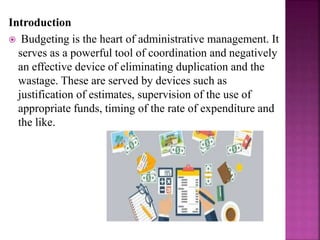
 Budgeting is the heart of administrative management. It
serves as a powerful tool of coordination and negatively
an effective device of eliminating duplication and the
wastage. These are served by devices such as
justification of estimates, supervision of the use of
appropriate funds, timing of the rate of expenditure and
the like.
Definition:
 A budget may be a simple plan of ones personal
finances, or it may be a complex document used by
large organization.
 According to TN Chhabra “a budget is an estimation
of future needs arranged according to orderly basis
covering some or all activities of an enterprise for a
definite period of time”.
 According to Dimock “Budget is a balance estimated
expenditure and receipts for a given period of time. In
the hands of the administrator the budget is the record
of the past performance, a method of current control
and projection of future plans”.
Feature of budget
 Budget should be simple in design and oriented to those who use it
 It should be flexible. It should be adjust various needs and conditions of
the institution
 It should be synthesis of past, present and future
 It should be product of joint venture and co-operation of executives/
department heads at different levels of management.
 Budget is composed of two segment; that are income and expenditure.
Income limits expenditure; hence income should be estimated prior to the
estimation expenditure.
 A budget reflects the goals and aspirations of the faculty
 Budget making involves the whole situation
 Budget is forward planning. Planned activities are vital for efficient and
successful functioning
 A budget gives direction- it is more than the list of the desired and
approved expenditure. It is also the instrument of administration and
management.
 It should have support of top management throughout the period of its
planning and supplementation.
 Budget has a time period usually annual. It is important to secure the
maximum participation of organization in preparation on of budget.
Purposes of budget
 To provide definite targets for income and expenditure
of the department
 To co-ordinate the activities of the different functional
heads in the working of these departmental budget
 To enable a cash flow statement prepared month by
month
 To aid management in formulating future policy
decision to promote the growth and welfare of the
organizations
 To provide useful tool for the control of costs
 To provide a tool for communication and co ordination
within the organization.
 To improve financial planning and decision making.
 To identify controllable and uncontrollable cost area.
Importance of budget
 Budget is a numerical description of expected income and
planned expenditure for an organization for a specified
period of time. It is a concrete, picture of the total operation
of an enterprise/ organization/ institution in monetary term,
i.e., finance
The following point serves the importance of budget:
 Budget is needed for planning for future course of action
and to have a control over all activities in the organization
 Budget facilities co coordinating operation of various
departments and sections for realizing organizational
objectives.
 Budget serves as a guide for action in the organization
 Budget helps one to weigh the values and to make decision
when necessary on whether one is of a greater value in the
programme than the other
Principles of Budget
 Budget is an operational plan for a definite period, usually a
year, expressed in financial terms and based on expected
income and expenditure.
1. Budget should provide sound financial management by
focusing on requirement of the organization
2. Budget should focus on objectives and policies of the
organization. It must flow from objectives and give realistic
expression to the way of realizing such objectives.
3. Budget should ensure the most effective use of scarce
financial and non financial resources.
4. Budget requires that programme activities planned in
advance
5. Budgetary process requires consistent delegation for which
fixed duties and responsibilities are required to be allocated to
managers at different level for framing and executing budget.
6. Budgeting should include coordinating efforts of various
departments establishing frame of reference for managerial
decisions, and providing a criterion for evaluating managerial
performance.
7. Setting budget target requires an adequate checks and
balance against the adoption of too high or too low estimate.
Utmost care is a must for fixing targets.
8. Budget period must be appropriate to the nature of business
or service and to the type of budget.
9. Budget is prepared under the direction and supervision of
the administrator or finance officer.
10. Budget is to be prepared and interpreted consistently
throughout the organization in the communication of planning
process.
11. Budget necessitates a review of the performance of the
previous year and an evaluation of its adequacy both in
quantity and quality.
12. While developing a budget, the provision should be made
for its flexibility.
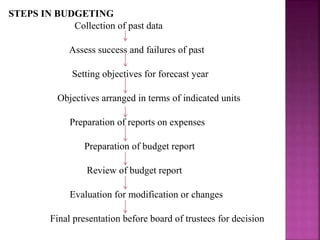
STEPS IN BUDGETING
Collection of past data
Assess success and failures of past
Setting objectives for forecast year
Objectives arranged in terms of indicated units
Preparation of reports on expenses
Preparation of budget report
Review of budget report
Evaluation for modification or changes
Final presentation before board of trustees for decision
GENRAL BUDGET: How to make your self
Step 1 : Determine your monthly income
Step 2: List your “fixed” and “variable” monthly
expenses
Step 3: Find your “discretionary income”
Step 4: List all unsecured debts
Step 5: Determine if you have any remaining
discretionary income
Step 6: To establish short- and long-term goals
Steps in effective budgeting process
 Determine the requirements: inputs from all levels of
hierarchy must be obtained
 Develop plan: Budget for 12months is set. Zero-Based
budget
 Analyze and control the operation: continuous
monitoring is essential
 Review the plan: Periodic revision and modification
Steps in budgeting for college of nursing
 Request for the needs of various departments
 Review the budget appropriation and actual
expenditure for the current year
 Contemplated changes
 Salary fixation
 Requirement estimation
 Summary of new needs
The steps of planning budget for nursing unit
 Assistance of his/her subordinates
 Review of budget
 Ascertain changes
 Preparing requirements
 Summary of new needs
 Submitting to institutional administrator
Roles and Responsibilities of the Nurse
Administrator/Principal in Budgeting
 Participation in planning budget
 Consult an take assistance of his/her subordinates
 Request sufficient finds
 Submit budget request
 Support the budget when it is allotted
 Cover the routine budget control
Introduction:
Audit in nursing management is the professional
evaluation of the quality of the patient care, by
analyzing through all the facilities , services rendered,
measures involved in diagnosis, treatment and other
conditions and activities that affect the patients.
Definition:
“Nursing audit refers to the assessment of the quality of
clinical nursing.”- Elison
“Nursing audit is the means by which nurses themselves
can define standards from their point of view and
describe the actual practice of nursing.” -Goster Walfer
Characteristics:
 It improve the quality of nursing care
 It compares actual practice with agreed standards of
practice.
 It is formal and systemic.
 It involves peer review.
 It requires the identification of variations between
practice and standards followed by the analysis of
causes of such variations.
 It provides feedback for those whose records are
audited.
 It includes follow- up or repeating an audit sometimes
later to find out if the practice is fulfilling the agreed
standards.
Objectives:
 To evaluate the quality of nursing care given.
 To achieve the desired and feasible quality of care.
 To provide a way for better records.
 To focus on care provided and care provider.
 To provide rationalized care thereby maintaining
uniform standards worldwide.
 To contribute to research.
Methods of Audit :
There are mainly two methods;
1. Retrospective view- It refers to the detail quality care
assessment after the patient has been discharged. The
records can be reviewed for completeness of records,
diagnosis, treatment, lab investigations, consultations,
nursing care plan, complications, and end results.
2. Concurrent view- It is achieved by reviewing patient
care during the time of hospital stay by the patient.
 It includes assessing the patient at the bed- side in
relation to predetermined criteria like errors, omissions,
deficiencies, as well as efficiencies and also excess in
the care of patients under them.
 It involves direct and indirect observation, interviewing
the staff responsible for care, and reviewing the
patients‘ records and care plan.
Audit cycle:
According to Payne, the steps in audit or utilization review
include;
 Criteria development
 Selection of cases
 Work sheet preparation
 Case evaluation
 Tabulation of evaluation
 Presentation of reports
The basic audit cycle can be depicted as;
4. implement 1. set standards
change
2.Observe
practice change
3. Compare
with standards
In general, the stages of audit cycle are;
 Identify the need for change
 Setting criteria and standards
 Collecting data on performance
 Assess criteria against criteria and standards
 Identify need for change (re- evaluation)
Advantages:
 Patient is assured of good service.
 Better planning of quality improvement can be done.
 It develops openness to change.
 It provides assurance, by meeting evidence based
practice.
 It increases understanding of client‘s expectations.
 It minimizes error or harm to patients.
 It reduces complaints or claims.
Disadvantages:
 It may be considered as a punishment to
professional group.
 Medico- legal importance- They feel that they will
be used in court of law as any document can be
called for in a court law.
 Many components may make analysis difficult.
 It is time consuming.
 It requires a team of trained auditors.
Introduction:
• Cost effectiveness and cost accounting are important
aspects in the managerial level.
• If these factors are not being monitored properly the profit
of the organization may be drastically affected.
• So each administrator should be aware of this.
• It forms an important aspect in the part of administration.
Origin of cost accounting:
Cost accounting has long been used to help managers
understand the costs of running a business. Modern cost
accounting originated during the industrial revolution, when
the complexities of running a large scale business led to the
development of systems for recording and tracking costs to
help business owners and managers make decisions.
Definition:
Cost accounting is the process that supports the budget
reporting system and the agency efforts for cost containment.
Cost accounting is a set of techniques for associating costs
with the purpose for which obtained.
Classical cost elements are:
1. Raw materials
2. Labor
3. Indirect expenses/overhead
Elements of cost:
1. Material (Material is a very important part of business)
A. Direct material
2. Labor
A. Direct labor
3. Overhead
A. Indirect material B. Indirect labor
Classification of costs:
Classification of cost means, the grouping of costs according to their
common characteristics. The important ways of classification of costs
are:
 By nature or element: materials, labor, expenses
 By functions: production, selling, distribution, administration,
R&D, development,
 As direct and indirect
 By variability: fixed, variable, semi-variable
 By controllability: controllable, uncontrollable
 By normality: normal, abnormal
There are various managerial accounting approaches:
 Standardized or standard cost accounting
 Lean accounting
 Activity-based costing
 Resource consumption accounting
 Throughput accounting
 Marginal costing/cost-volume-profit analysis
 Activity-based costing
Activity-based costing (ABC) is a system for assigning
costs to products based on the activities they require. In
this case, activities are those regular actions performed
inside a company. "Talking with customer regarding
invoice questions" is an example of an activity inside
most companies.
 Lean accounting
Lean accounting has developed in recent years to provide
the accounting, control, and measurement methods
supporting lean manufacturing and other applications of
lean thinking such as healthcare, construction, insurance,
banking, education, government, and other industries
 Marginal costing
This method is used particularly for short-term decision-
making. Its principal tenets are:
 Revenue (per product) − variable costs (per product) =
contribution (per product)
 Total contribution − total fixed costs = (total profit or
total loss)
 Throughput Accounting
Throughput Accounting (TA) is a dynamic, integrated,
principle-based, and comprehensive management
accounting approach that provides managers with
decision support information for enterprise optimization.
Advantages:
 The accumulated data enable a head nurse to
assess the cost
 It enables a nurse manager to identify the
interaction between different expenditure.
 It enables a manager to identify popular services.
Disadvantages:
 It is difficult to associate some costs with
particular programme
 It is the fact that it is difficult for a manager to
justify the cost of a nursing care programme.
2. Cost effectiveness:
Cost-effectiveness analysis:
Cost-effectiveness analysis is a form of economic analysis that
compares the relative costs and outcomes (effects) of two or
more courses of action. Cost-effectiveness analysis is distinct
from cost-benefit analysis, which assigns a monetary value to
the measure of effect.
Cost benefit analysis:
It is a tool with great potential for the decision maker so long
as he or she recognizes the difficulty in determining the true
costs and benefits of various alternatives. This tool can be
especially useful when trying to decide between alternative
expenditure of money.
 A cost benefit ratio (z) is defined as the ratio of the value of
benefits of an alternative to the value of alternative cost.
 Z= Present value of economic benefits/ present value of
economic costs
CRITICAL PATHWAY
Introduction:
 Clinical Pathways were introduced in the early 1990s in
the UK and the USA, and are being increasingly used
throughout the developed world.
 Clinical Pathways are structured, multidisplinary plans
of care designed to support the implementation of
clinical guidelines and protocols.
 They are designed to support clinical management,
clinical and non-clinical resource management, clinical
audit and also financial management.
 They provide detailed guidance for each stage in the
management of a patient (treatments, interventions etc.)
with a specific condition over a given time period, and
include progress and outcomes details.
Clinical Pathways have four main components (Hill,
1994, Hill 1998):
1. A timeline
2. The categories of care or activities and their interventions
3. Inter-mediate and long term outcome criteria
4. The variance record (to allow deviations to be documented
and analysed).
Critical Pathway Development:
 Select a Topic
 Select a Team
 Evaluate the Current Process of Care
 Evaluate Medical Evidence and External Practices
 Determine the Critical Pathway Format
 Document and Analyze Variance
Critical Path Analysis and PERT Charts:
 Critical Path Analysis and PERT are powerful tools that
help to schedule and manage complex projects.
 They were developed in the 1950s to control large defense
projects, and have been used routinely since then.
 As with Gantt Charts, Critical Path Analysis (CPA) or the
Critical Path Method (CPM) helps to plan all tasks that must
be completed as part of a project.
 They act as the basis both for preparation of a schedule, and
of resource planning.
 During management of a project, they allow to monitor
achievement of project goals.
 They help to see where remedial action needs to be taken to
get a project back on course.
 The benefit of Critical Path Analysis is that it helps to
identify the minimum length of time needed to complete a
project.
PERT (Program Evaluation and Review Technique):
 PERT is a variation on Critical Path Analysis that takes
a slightly more skeptical view of time estimates made
for each project stage.
 To use it, estimate the shortest possible time each
activity will take, the most likely length of time, and
the longest time that might be taken if the activity
takes longer than expected.
 Use the formula below to calculate the time to use for
each project stage:
Shortest time + 4 x likely time + longest time
6
Importance
Critical Path Analysis is an effective and powerful
method of assessing:
 What tasks must be carried out.
 Where parallel activity can be performed.
 The shortest time in which you can complete a
project.
 Resources needed to execute a project.
 The sequence of activities, scheduling and timings
involved.
 Task priorities.
 The most efficient way of shortening time on
urgent projects.
CPM - Critical Path Method
 In 1957, DuPont developed a project management method
designed to address the challenge of shutting down
chemical plants for maintenance and then restarting the
plants once the maintenance had been completed. Given the
complexity of the process, they developed the Critical Path
Method (CPM) for managing such projects.
CPM provides the following benefits:
 Provides a graphical view of the project.
 Predicts the time required to complete the project.
 Shows which activities are critical to maintaining the
schedule and which are not.
 CPM models the activities and events of a project as a
network. Activities are depicted as nodes on the network
and events that signify the beginning or ending of activities
are depicted as arcs or lines between the nodes.
The following is an example of a CPM network diagram:
Steps in CPM Project Planning:
1. Specify the individual activities.
2. Determine the sequence of those activities.
3. Draw a network diagram.
4. Estimate the completion time for each activity.
5. Identify the critical path (longest path through the network)
6. Update the CPM diagram as the project progresses.
CPM Limitations:
 CPM was developed for complex but fairly routine projects
with minimal uncertainty in the project completion times.
 For less routine projects there is more uncertainty in the
completion times, and this uncertainty limits the usefulness
of the deterministic CPM model.
 An alternative to CPM is the PERT project planning model,
which allows a range of durations to be specified for each
activity.
Benefits:
o Support the introduction of evidence-based medicine and
use of clinical guidelines
o Support clinical effectiveness, risk management and
clinical audit
o Improve multidisciplinary communication, teamwork and
care planning
o Can support continuity and co-ordination of care across different clinical
disciplines and sectors;
o Provide explicit and well-defined standards for care;
o Help reduce variations in patient care (by promoting standardization);
o Help improve clinical outcomes;
o Help improve and even reduce patient documentation
o Support training;
o Optimise the management of resources;
o Can help ensure quality of care and provide a means of continuous quality
improvement;
o Support the implementation of continuous clinical audit in clinical practice
o Support the use of guidelines in clinical practice;
o Help empower patients;
o Help manage clinical risk;
o Help improve communications between different care sectors;
o Expected to help reduce risk; Expected to help reduce costs by shortening
hospital stays
Issues with Critical Pathways:
 May appear to discourage personalised care
 Risk increasing litigation
 Don't respond well to unexpected changes in a patient's
condition
 Suit standard conditions better than unusual or
unpredictable ones
 Require commitment from staff and establishment of
an adequate organizational structure
 Problems of introduction of new technology
 May take time to be accepted in the workplace
 Need to ensure variance and outcomes are properly
recorded
HEALTH CARE
REFORM
 Health care reform is a general rubric used for discussing
major health policy creation or changes—for the most part,
governmental policy that affects health care delivery in a
given place. Health care reform typically attempts to:
 Broaden the population that receives health care coverage
through either public sector insurance programs or private
sector insurance companies
 Expand the array of health care providers consumers may
choose among
 Improve the access to health care specialists
 Improve the quality of health care
 Give more care to citizens
 Decrease the cost of health care
 We need a different approach to healthcare reforms in India
Goal:
 The goal of healthcare reform is to make healthcare more
accessible and available to all citizens.
The primary objectives of health care reform include:
1. Provide healthcare coverage for all.
2. Decrease the costs of health care services and coverage
Health care reforms in India
The Ministry of Health and Family Welfare is the Indian
government ministry charged with health policy in India. It is
also responsible for all government programs relating to
family planning in India.
The Minister of Health and Family Welfare holds cabinet rank
as a member of the Council of Ministers. The current minister
is Shri. Ghulam Nabi Azad, who is assisted by a Minister of
States for Health and Family Welfare, Shri. Dinesh Trivedi &
Shri. S. Gandhiselvan.
The ministry is composed of three departments:
1 Department of Health
2 Department of Family Welfare
3 Department of AYUSH
1. Department of Health:
The Department of Health deals with health care, including
awareness campaigns, immunization campaigns, preventive
medicine, and public health. Bodies under the administrative
control of this department are:
1) National AIDS Control Programme (AIDS)
2) National Cancer Control Programme (cancer)
3) National Filaria Control Programme (filariasis)
4) National Iodine Deficiency Disorders Control Programme
(iodine deficiency)
5) National Leprosy Eradication Programme (leprosy)
6) National Mental Health Programme (mental health)
7) National Programme for Control of Blindness (blindness)
8) National Programme for Prevention and Control of Deafness
(deafness)
9) National Tobacco Control Programme (tobacco control)
10) National Vector Borne Disease Control Programme (NVBDCP)
(vector-born disease)
11) Pilot Programme on Prevention and Control of Diabetes, CVD
and Stroke (diabetes, cardiovascular disease, stroke)
12) Revised National TB Control Programme (tuberculosis)
13) Universal Immunization Programme
14) Medical Council of India
15) Dental Council of India
16) Pharmacy Council of India
17) Indian Nursing Council
18) All India Institute of Speech and Hearing (AIISH), Mysore
19) All India Institute of Physical Medicine and Rehabilitation
(AIIPMR), Mumbai
20) Hospital Services Consultancy Corporation Limited (HSCC)
2. Department of Family Welfare:
The Department of Family Welfare (FW) is responsible
for aspects relating to family welfare, especially in
reproductive health, maternal health, pediatrics,
information, education and communications; cooperation
with NGOs and international aid groups; and rural health
services. The Department of Family Welfare is
responsible for:
 18 Population Research Centres (PRCs) at six
universities and six other institutions across 17 states
 National Institute of Health and Family Welfare
(NIHFW), South Delhi
 International Institute for Population Sciences (IIPS),
Mumbai
 Central Drug Research Institute (CDRI), Lucknow
 Indian Council of Medical Research (ICMR), New Delhi -
founded in 1991, it is one of the oldest medical research
bodies in the world
3. Department of AYUSH:
 The Department of Ayurveda, Yoga and Naturopathy,
Unani, Siddha and Homoeopathy (AYUSH) deals with
Ayurveda (Indian traditional medicine), and other yoga,
naturopathy, unani, siddha, and homoeopathy, and other
alternative medicine systems.
 The department was established in March 1995 as the
Department of Indian Systems of Medicines and
Homoeopathy (ISM&H).
 The department is charged with upholding educational
standards in the Indian Systems of Medicines and
Homoeopathy colleges, strengthening research, promoting
the cultivation of medicinal plants used, and working on
Pharmacopoeia standards.
 Bodies under the control of the Department of AYUSH are:
Various research councils
1) Central Council for Research in Ayurveda and Siddha (CCRAS)
2) Central Council for Research in Unani Medicine (CCRUM)
3) Central Council for Research in Homoeopathy (CCRH)
4) Central Council for Research in Yoga and Naturopathy (CCRYN)
5) Several educational institutions:
6) National Institute of Ayurveda, Jaipur (NIA)
7) National Institute of Siddha, Chennai (NIS)
8) National Institute of Homoeopathy, Kolkata (NIH)
9) National Institute of Naturopathy, Pune (NIN)
10) National Institute of Unani Medicine, Bangalore (NIUM)
11) Institute of Post Graduate Teaching and Research in Ayurveda,
Jamnagar, Gujarat (IPGTR)
12) Rashtriya Ayurveda Vidyapeeth, New Delhi (RAV)
13) Morarji Desai National Institute of Yoga, New Delhi (MDNIY)
14) Indian Medicine Pharmaceutical Corporation Limited (IMPCL),
Mohan, Uttaranchal (a public sector undertaking)
15) Professional councils
16) Central Council of Homoeopathy (CCH)
17) Central Council of Indian Medicine (CCIM)
Healthcare in India
 India has a universal health care system run by the local (state or
territorial) governments.
 Government hospitals, some of which are among the best
hospitals in India, provide treatment at taxpayer expense.
 Most essential drugs are offered free of charge in these hospitals.
 The fact that the government sector is understaffed,
underfinanced and that these hospitals maintain very poor
standards of hygiene forces many people to visit private medical
practitioners.
 The charges for basic in-hospital treatment and investigations are
much less compared to the private sector.
 The cost for these subsidies comes from annual allocations from
the central and state governments.
 For example, an outpatient card at AIIMS (one of the best
hospitals in India) costs a one-time fee of 10 rupees (around
20 cents U.S.) and thereafter outpatient medical advice is
free.
 In-hospital treatment costs depend on financial condition of
the patient and facilities utilized, but are usually much less
than the private sector.
 Primary health care is provided by city and district hospitals
and rural primary health centres (PHCs). These hospitals
provide treatment free of cost.
 Primary care is focused on immunization, prevention of
malnutrition, pregnancy, child birth, postnatal care, and
treatment of common illnesses.
 Now organizations like Hindustan Latex Family Planning
Promotional Trust and other private organizations have
started creating hospitals and clinics in India, which also
provide free or subsidized health care and subsidized
insurance plans.
Indian healthcare reforms:
 37 percent of Indian population is undernourished. They
have difficulty in meeting even basic needs. 55 percent of
the population have a diet which is calorie sufficient but
nutrient deficient whereas eight percent of the population is
over-nourished.
 Statistics tells us that arthritis, hypertension, diabetes,
CVD, cancer patients and elderly patients are major part of
our disease burden.
 65 percent of Indian population lives in rural areas while
only two percent qualified medical doctors are available in
these areas.
 Indian healthcare system should start from preventive care
through nutrition. Reforms must provide impetus to lift the
population which is at the bottom of the pyramid.
 It’s a branch of economics concerned with issues
related to scarcity in the allocation of health and
health care.
 It’s the application of the theories, concepts and
techniques of economics to the health sector.
Aims:
 Most Beneficial Activities Are Chosen For Health
within the available resource
Concept Of Health Economics:
HEALTH CONCEPT
HEALTH
CONCEPT
 HEALTH SERVICES
 MEDICAL
EDUCATION,TRAINING &
RESEARCH
ECONOMIC
CONCEPT
 COST
 CAPITAL & RECURRING
EXPENDITURE
 DEPRECIATION
 SICKNESS
 HEALTH SERVICES
BENEFIT
PREVENTIVE
HEALTH
SERVICES
ENVIROMENTAL
PUBLIC HEALTH
SERVICES
MEDICAL HEALTH
SERVICES
 Medical , Nursing School & Other Training
Institutions Should Be Included In The Training Of
Health Manpower.
 Research Expenditure Should Be Financed By
Specially Allocated Funds.
 Arises from the fact that goods & manpower are
absorbed for health services.
 The cost is incurred by producers of health
services through staffs, buildings, equipments and
material and by consumers who use transport to
heath centers, drugs and special food.
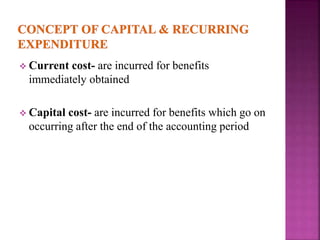
 Current cost- are incurred for benefits
immediately obtained
 Capital cost- are incurred for benefits which go on
occurring after the end of the accounting period
 Capital goods has economic life for more than a
year, their economic value diminishes with passage
of time.
 Depreciation rate- is the rate of diminution in
the value of a fixed asset due to use and/or lapse of
time.
 Direct cost- includes cost of prevention, detection,
treatment, rehabilitation, research, training &
capital investment.
 Indirect cost- include loss of output to the
economy because of illness & premature death.
1. Health problems are influenced by the general
socioeconomic conditions prevailing.
2. Health services depends on their utilization &
maintenance by the population & co-operation of
the patient.
3. Medical specialists & other values are given
health impairment differently.
Alan Williams- Plumbing Diagram-divided the
discipline(8)
1. What influences health?
2. What is health & what its value?
3. The demand for health care.
4. The supply of health care
5. Micro-economics evaluation at treatment level
6. Market equilibrium
7. Evaluation at whole system level
8. Planning, budgeting & monitoring mechanisms
BEYOND HEALTH WITHIN THE HEALTH
ARENA
Pure Economics Health Services Research
Finance & Insurance Medicine
Industrial Organization Medical Ethics
Labor Economics Psychology
Public Policy Public
Health/Epidemiology
Sociology
1. Heath resources are infinite
2. Provides a framework which aims at maximizing
benefits within available resources
3. Equity or fair distribution of resources
4. Economics are concerned with efficiency
Focus on:
 How to extract maximum benefits from health
industry with minimum cost combination
 The use of application of material things like
medicines, surgical instruments, lab equipments,
drugs, vaccination &family planning tools
BIBLIOGRAPHIC DATA
BASE
JOURNALS
VALUE ADDED
INFORMATION
RESEARCH
WORK
STATISTI
CAL
DATA
LITERATURE
INTERNET
SOURCES
HEALTH CARE
FINANCING
EXTERNAL
LOAN
USERS FEE
VOLUNTARY
AGENCIES
HEALTH
INSURANCE
FINANCIAL
FLOW WITHIN
HEALTH SECTOR
HEALTH
ECONOMICS AT
THE FAMILY
LEVEL
HEALTH
INSURANCE
MEDICAL
PRACTIONER
IMMUNIZATION
SERVICES
MAKING THE
USE OF LIMITED
RESOURCES
GOVERNANCE
 It’s a Non profitable organization
 Governed - by board of directors & officers
 Meeting- twice a year
 Members- eminent group of health economics & social
scientists from across India
 Professional organization dedicated to promote health
economic research in India
 Affiliated to International Health Economic
Association(IHEA)
 Established to achieve the multiple objectives of
encouraging & strengthening theoretical and empirical
economic reasoning into academic & policy making
 Health insurance is one definite way towards achieving
‘health for all’ in the world.
 In India, health insurance is gathering momentum, with
many state governments tying up with private
insurance companies to provide decent health cover for
their people.
 Healthcare in India is seeing a gradual shift of focus
from public sector hospitals to private corporate
hospitals.
 However, by and large the common man is still
ignorant about the concepts of Insurance.
 Health Insurance is only a component of different types
of insurance cover.
 Health insurance in a narrow sense would be ‘an
individual or group purchasing health care coverage in
advance by paying a fee called premium.’
 A policy that will pay specified sums for medical expenses
or treatments. Health policies can offer many options and
vary in their approaches to coverage.
 The health insurance market in India is very limited
covering about 10% of the total population.
HEALTH INSURANCE IN INDIA
EMPLOYEE STATE INSURANCE SCHEME (ESI)
CENTRAL GOVERNMENT HEALTH SCHEME(CGHS)
COMMUNITY HEALTH INSURANCE IN INDIA (CHI)
RASHTRIYA SWASTHYA BIMA YOJANA (RSBY)
OTHER AGENCIES
Mission Statement:
To provide for certain benefits to employee in case
of sickness, maternity & employment injury & to
make provisions for related matters
Scope:
1. Shops
2. Hotel & restaurants
3. Cinemas & theaters
4. Road- motor transportation
5. Newspaper establishment
Administration:(OHP)
Finance:
Employer pays – 4.75% of total wages
Employee pays – 1.75% of total wages
State govt shares – 1/8th of total expenditure
Central govt shares – 2/3rd of administration exp
ESI shares – 7/8th of total expenditure
Benefits:
1. Medical Benefits
2. Maternity Benefits
3. Disablement Benefits
4. Dependants Benefits
5. Rajiv Gandhi shramik kalyan yojana
6. Other benefits
Covers:
1. Retired central govt
2. Autonomous, semi autonomous, semi- govt
3. Parliament members
4. Widows receiving family pension
5. Accredited journals
Benefits:
1. Medical care at all levels & home visit
2. Free medicine
3. Free diagnosis
Services Provided:
a) Emergency treatment
b) Natal & pediatric services
c) Family welfare services
d) Domiciliary visit
e) Specialist consultation
f) investigation
Types of CHI:
1. Provider model- NGOs act both as insurer &
provider
2. Insurance model- NGOs act as insurer
3. Intermediary model- NGOs act as an
intermediate between the insurance and the
provider
Objectives:
To provide health security for the BPL workers in the
unorganized sector & their family through an insurance that
cover their hospital expenses.
Provider : Public & private sector
Claims : Through smart cards
Maximum benefits : Rs 30,000/ family
Transportation cost : Rs 100/trip/hospitalization
Implemented by : state govt of India
Implementing agency: Insurance company
Community : All BPL workers & their families
Premium : 75% of premium paid by govt of
India 25% by state govt
DEFENCE
MEDICAL
SERVICES
PRIVATE
AGENCIES
HEALTH CARE
OF RAILWAY
EMPLOYESS
 Hospital Budget
Instructions:-
1. Determine hospital revenue
2. Figure out expenses
3. Know the cost of Personnel, all employees and ancillary
staff, including consultants, outsourced contracts, perhaps
laundry or nurse staffing services.
4. Add all medical equipment costs, ongoing and expected
expansion or replacement of new diagnostic equipment
5. Know the medical costs of each bed
6. What about expansion?
7. Don't forget parking garages, lots, landscaping,
groundskeeping or window washing
8. Include all insurance for the facility and personnel.
9. Write in an emergency expense fund. Disasters occur and
the hospital must be prepared for them when they arrive.
10. To do the budget, use a spreadsheet
 Budget For Educational Institution
The budget is classified into 3 heads as
1. Revenue 2. Expenditure 3. Capital
 Revenue: It includes assets, fixed deposits, investments,
loan, advances and income.
 Expenditure: It includes capital, recurring annual
mandatory and non recurring.
The recurring annual mandatory expenditure includes:
- University Administration Fees – Rs. 50,000/
- Affiliation Fees – Rs.3,00,000/
- and every year Rs 50,000/- per course
- Inspection Fees Rs 25,000/-
- State council – Rs 7000/ every year for recognition.
- INC recognition fees Rs 50,000/ per course.
- INC inspection or affiliation fees is 7,500/
- Reinspection fees 7000/
- Affiliation fees to other institution.
The recurring monthly expenditure also include
- Rent
- Salary
- Stationary items
- Contingency
- Guest relation
- House keeping indent
- Pharmacy indent
- AV aids
- Journals
- Books
- Maintenance: Repair, Replacement, Electricity, Phone,
Drinking Water, Sewage Disposal
Non recurring expenditure includes:
- DME endowment
Endowment Fund (property or income left to someone like
insurance) Rs 20,00,000/- in two installments (before one year
10,00,000/ and second year Rs.10,00,000/) which is paid to the
DME office.
- Security fixed deposit Rs.10,00,000/ with the joint account
of registrar of the university and trustees.
- Solvency certificate(state of having more money than one
owes) for Rs. 30,00,000/ from nationalized bank for a
period of 5 years.
- University endowment
Approximately the Revenue is Rs. 21,24,000/ and where as the
Expenditure is Rs. 20,52,859/
Annual auditing is done to plan for the next year budget and
to evaluate the current year budget.
fiscal planning.pptx

fiscal planning.pptx

  • 2.
  • 3.
    Introduction  Budgeting isthe heart of administrative management. It serves as a powerful tool of coordination and negatively an effective device of eliminating duplication and the wastage. These are served by devices such as justification of estimates, supervision of the use of appropriate funds, timing of the rate of expenditure and the like.
  • 4.
    Definition:  A budgetmay be a simple plan of ones personal finances, or it may be a complex document used by large organization.  According to TN Chhabra “a budget is an estimation of future needs arranged according to orderly basis covering some or all activities of an enterprise for a definite period of time”.  According to Dimock “Budget is a balance estimated expenditure and receipts for a given period of time. In the hands of the administrator the budget is the record of the past performance, a method of current control and projection of future plans”.
  • 5.
    Feature of budget Budget should be simple in design and oriented to those who use it  It should be flexible. It should be adjust various needs and conditions of the institution  It should be synthesis of past, present and future  It should be product of joint venture and co-operation of executives/ department heads at different levels of management.  Budget is composed of two segment; that are income and expenditure. Income limits expenditure; hence income should be estimated prior to the estimation expenditure.  A budget reflects the goals and aspirations of the faculty  Budget making involves the whole situation  Budget is forward planning. Planned activities are vital for efficient and successful functioning  A budget gives direction- it is more than the list of the desired and approved expenditure. It is also the instrument of administration and management.  It should have support of top management throughout the period of its planning and supplementation.  Budget has a time period usually annual. It is important to secure the maximum participation of organization in preparation on of budget.
  • 6.
    Purposes of budget To provide definite targets for income and expenditure of the department  To co-ordinate the activities of the different functional heads in the working of these departmental budget  To enable a cash flow statement prepared month by month  To aid management in formulating future policy decision to promote the growth and welfare of the organizations  To provide useful tool for the control of costs  To provide a tool for communication and co ordination within the organization.  To improve financial planning and decision making.  To identify controllable and uncontrollable cost area.
  • 7.
    Importance of budget Budget is a numerical description of expected income and planned expenditure for an organization for a specified period of time. It is a concrete, picture of the total operation of an enterprise/ organization/ institution in monetary term, i.e., finance The following point serves the importance of budget:  Budget is needed for planning for future course of action and to have a control over all activities in the organization  Budget facilities co coordinating operation of various departments and sections for realizing organizational objectives.  Budget serves as a guide for action in the organization  Budget helps one to weigh the values and to make decision when necessary on whether one is of a greater value in the programme than the other
  • 8.
    Principles of Budget Budget is an operational plan for a definite period, usually a year, expressed in financial terms and based on expected income and expenditure. 1. Budget should provide sound financial management by focusing on requirement of the organization 2. Budget should focus on objectives and policies of the organization. It must flow from objectives and give realistic expression to the way of realizing such objectives. 3. Budget should ensure the most effective use of scarce financial and non financial resources. 4. Budget requires that programme activities planned in advance 5. Budgetary process requires consistent delegation for which fixed duties and responsibilities are required to be allocated to managers at different level for framing and executing budget.
  • 9.
    6. Budgeting shouldinclude coordinating efforts of various departments establishing frame of reference for managerial decisions, and providing a criterion for evaluating managerial performance. 7. Setting budget target requires an adequate checks and balance against the adoption of too high or too low estimate. Utmost care is a must for fixing targets. 8. Budget period must be appropriate to the nature of business or service and to the type of budget. 9. Budget is prepared under the direction and supervision of the administrator or finance officer. 10. Budget is to be prepared and interpreted consistently throughout the organization in the communication of planning process. 11. Budget necessitates a review of the performance of the previous year and an evaluation of its adequacy both in quantity and quality. 12. While developing a budget, the provision should be made for its flexibility.
  • 10.
    STEPS IN BUDGETING Collectionof past data Assess success and failures of past Setting objectives for forecast year Objectives arranged in terms of indicated units Preparation of reports on expenses Preparation of budget report Review of budget report Evaluation for modification or changes Final presentation before board of trustees for decision
  • 11.
    GENRAL BUDGET: Howto make your self Step 1 : Determine your monthly income Step 2: List your “fixed” and “variable” monthly expenses Step 3: Find your “discretionary income” Step 4: List all unsecured debts Step 5: Determine if you have any remaining discretionary income Step 6: To establish short- and long-term goals
  • 12.
    Steps in effectivebudgeting process  Determine the requirements: inputs from all levels of hierarchy must be obtained  Develop plan: Budget for 12months is set. Zero-Based budget  Analyze and control the operation: continuous monitoring is essential  Review the plan: Periodic revision and modification
  • 13.
    Steps in budgetingfor college of nursing  Request for the needs of various departments  Review the budget appropriation and actual expenditure for the current year  Contemplated changes  Salary fixation  Requirement estimation  Summary of new needs
  • 14.
    The steps ofplanning budget for nursing unit  Assistance of his/her subordinates  Review of budget  Ascertain changes  Preparing requirements  Summary of new needs  Submitting to institutional administrator
  • 15.
    Roles and Responsibilitiesof the Nurse Administrator/Principal in Budgeting  Participation in planning budget  Consult an take assistance of his/her subordinates  Request sufficient finds  Submit budget request  Support the budget when it is allotted  Cover the routine budget control
  • 16.
    Introduction: Audit in nursingmanagement is the professional evaluation of the quality of the patient care, by analyzing through all the facilities , services rendered, measures involved in diagnosis, treatment and other conditions and activities that affect the patients. Definition: “Nursing audit refers to the assessment of the quality of clinical nursing.”- Elison “Nursing audit is the means by which nurses themselves can define standards from their point of view and describe the actual practice of nursing.” -Goster Walfer
  • 17.
    Characteristics:  It improvethe quality of nursing care  It compares actual practice with agreed standards of practice.  It is formal and systemic.  It involves peer review.  It requires the identification of variations between practice and standards followed by the analysis of causes of such variations.  It provides feedback for those whose records are audited.  It includes follow- up or repeating an audit sometimes later to find out if the practice is fulfilling the agreed standards.
  • 18.
    Objectives:  To evaluatethe quality of nursing care given.  To achieve the desired and feasible quality of care.  To provide a way for better records.  To focus on care provided and care provider.  To provide rationalized care thereby maintaining uniform standards worldwide.  To contribute to research.
  • 19.
    Methods of Audit: There are mainly two methods; 1. Retrospective view- It refers to the detail quality care assessment after the patient has been discharged. The records can be reviewed for completeness of records, diagnosis, treatment, lab investigations, consultations, nursing care plan, complications, and end results. 2. Concurrent view- It is achieved by reviewing patient care during the time of hospital stay by the patient.  It includes assessing the patient at the bed- side in relation to predetermined criteria like errors, omissions, deficiencies, as well as efficiencies and also excess in the care of patients under them.  It involves direct and indirect observation, interviewing the staff responsible for care, and reviewing the patients‘ records and care plan.
  • 20.
    Audit cycle: According toPayne, the steps in audit or utilization review include;  Criteria development  Selection of cases  Work sheet preparation  Case evaluation  Tabulation of evaluation  Presentation of reports The basic audit cycle can be depicted as; 4. implement 1. set standards change 2.Observe practice change 3. Compare with standards
  • 21.
    In general, thestages of audit cycle are;  Identify the need for change  Setting criteria and standards  Collecting data on performance  Assess criteria against criteria and standards  Identify need for change (re- evaluation) Advantages:  Patient is assured of good service.  Better planning of quality improvement can be done.  It develops openness to change.  It provides assurance, by meeting evidence based practice.  It increases understanding of client‘s expectations.  It minimizes error or harm to patients.  It reduces complaints or claims.
  • 22.
    Disadvantages:  It maybe considered as a punishment to professional group.  Medico- legal importance- They feel that they will be used in court of law as any document can be called for in a court law.  Many components may make analysis difficult.  It is time consuming.  It requires a team of trained auditors.
  • 23.
    Introduction: • Cost effectivenessand cost accounting are important aspects in the managerial level. • If these factors are not being monitored properly the profit of the organization may be drastically affected. • So each administrator should be aware of this. • It forms an important aspect in the part of administration. Origin of cost accounting: Cost accounting has long been used to help managers understand the costs of running a business. Modern cost accounting originated during the industrial revolution, when the complexities of running a large scale business led to the development of systems for recording and tracking costs to help business owners and managers make decisions.
  • 24.
    Definition: Cost accounting isthe process that supports the budget reporting system and the agency efforts for cost containment. Cost accounting is a set of techniques for associating costs with the purpose for which obtained. Classical cost elements are: 1. Raw materials 2. Labor 3. Indirect expenses/overhead Elements of cost: 1. Material (Material is a very important part of business) A. Direct material 2. Labor A. Direct labor 3. Overhead A. Indirect material B. Indirect labor
  • 25.
    Classification of costs: Classificationof cost means, the grouping of costs according to their common characteristics. The important ways of classification of costs are:  By nature or element: materials, labor, expenses  By functions: production, selling, distribution, administration, R&D, development,  As direct and indirect  By variability: fixed, variable, semi-variable  By controllability: controllable, uncontrollable  By normality: normal, abnormal There are various managerial accounting approaches:  Standardized or standard cost accounting  Lean accounting  Activity-based costing  Resource consumption accounting  Throughput accounting  Marginal costing/cost-volume-profit analysis
  • 26.
     Activity-based costing Activity-basedcosting (ABC) is a system for assigning costs to products based on the activities they require. In this case, activities are those regular actions performed inside a company. "Talking with customer regarding invoice questions" is an example of an activity inside most companies.  Lean accounting Lean accounting has developed in recent years to provide the accounting, control, and measurement methods supporting lean manufacturing and other applications of lean thinking such as healthcare, construction, insurance, banking, education, government, and other industries
  • 27.
     Marginal costing Thismethod is used particularly for short-term decision- making. Its principal tenets are:  Revenue (per product) − variable costs (per product) = contribution (per product)  Total contribution − total fixed costs = (total profit or total loss)  Throughput Accounting Throughput Accounting (TA) is a dynamic, integrated, principle-based, and comprehensive management accounting approach that provides managers with decision support information for enterprise optimization.
  • 28.
    Advantages:  The accumulateddata enable a head nurse to assess the cost  It enables a nurse manager to identify the interaction between different expenditure.  It enables a manager to identify popular services. Disadvantages:  It is difficult to associate some costs with particular programme  It is the fact that it is difficult for a manager to justify the cost of a nursing care programme.
  • 29.
    2. Cost effectiveness: Cost-effectivenessanalysis: Cost-effectiveness analysis is a form of economic analysis that compares the relative costs and outcomes (effects) of two or more courses of action. Cost-effectiveness analysis is distinct from cost-benefit analysis, which assigns a monetary value to the measure of effect. Cost benefit analysis: It is a tool with great potential for the decision maker so long as he or she recognizes the difficulty in determining the true costs and benefits of various alternatives. This tool can be especially useful when trying to decide between alternative expenditure of money.  A cost benefit ratio (z) is defined as the ratio of the value of benefits of an alternative to the value of alternative cost.  Z= Present value of economic benefits/ present value of economic costs
  • 30.
  • 31.
    Introduction:  Clinical Pathwayswere introduced in the early 1990s in the UK and the USA, and are being increasingly used throughout the developed world.  Clinical Pathways are structured, multidisplinary plans of care designed to support the implementation of clinical guidelines and protocols.  They are designed to support clinical management, clinical and non-clinical resource management, clinical audit and also financial management.  They provide detailed guidance for each stage in the management of a patient (treatments, interventions etc.) with a specific condition over a given time period, and include progress and outcomes details.
  • 32.
    Clinical Pathways havefour main components (Hill, 1994, Hill 1998): 1. A timeline 2. The categories of care or activities and their interventions 3. Inter-mediate and long term outcome criteria 4. The variance record (to allow deviations to be documented and analysed). Critical Pathway Development:  Select a Topic  Select a Team  Evaluate the Current Process of Care  Evaluate Medical Evidence and External Practices  Determine the Critical Pathway Format  Document and Analyze Variance
  • 33.
    Critical Path Analysisand PERT Charts:  Critical Path Analysis and PERT are powerful tools that help to schedule and manage complex projects.  They were developed in the 1950s to control large defense projects, and have been used routinely since then.  As with Gantt Charts, Critical Path Analysis (CPA) or the Critical Path Method (CPM) helps to plan all tasks that must be completed as part of a project.  They act as the basis both for preparation of a schedule, and of resource planning.  During management of a project, they allow to monitor achievement of project goals.  They help to see where remedial action needs to be taken to get a project back on course.  The benefit of Critical Path Analysis is that it helps to identify the minimum length of time needed to complete a project.
  • 34.
    PERT (Program Evaluationand Review Technique):  PERT is a variation on Critical Path Analysis that takes a slightly more skeptical view of time estimates made for each project stage.  To use it, estimate the shortest possible time each activity will take, the most likely length of time, and the longest time that might be taken if the activity takes longer than expected.  Use the formula below to calculate the time to use for each project stage: Shortest time + 4 x likely time + longest time 6
  • 35.
    Importance Critical Path Analysisis an effective and powerful method of assessing:  What tasks must be carried out.  Where parallel activity can be performed.  The shortest time in which you can complete a project.  Resources needed to execute a project.  The sequence of activities, scheduling and timings involved.  Task priorities.  The most efficient way of shortening time on urgent projects.
  • 36.
    CPM - CriticalPath Method  In 1957, DuPont developed a project management method designed to address the challenge of shutting down chemical plants for maintenance and then restarting the plants once the maintenance had been completed. Given the complexity of the process, they developed the Critical Path Method (CPM) for managing such projects. CPM provides the following benefits:  Provides a graphical view of the project.  Predicts the time required to complete the project.  Shows which activities are critical to maintaining the schedule and which are not.  CPM models the activities and events of a project as a network. Activities are depicted as nodes on the network and events that signify the beginning or ending of activities are depicted as arcs or lines between the nodes.
  • 37.
    The following isan example of a CPM network diagram: Steps in CPM Project Planning: 1. Specify the individual activities. 2. Determine the sequence of those activities. 3. Draw a network diagram. 4. Estimate the completion time for each activity. 5. Identify the critical path (longest path through the network) 6. Update the CPM diagram as the project progresses.
  • 38.
    CPM Limitations:  CPMwas developed for complex but fairly routine projects with minimal uncertainty in the project completion times.  For less routine projects there is more uncertainty in the completion times, and this uncertainty limits the usefulness of the deterministic CPM model.  An alternative to CPM is the PERT project planning model, which allows a range of durations to be specified for each activity. Benefits: o Support the introduction of evidence-based medicine and use of clinical guidelines o Support clinical effectiveness, risk management and clinical audit o Improve multidisciplinary communication, teamwork and care planning
  • 39.
    o Can supportcontinuity and co-ordination of care across different clinical disciplines and sectors; o Provide explicit and well-defined standards for care; o Help reduce variations in patient care (by promoting standardization); o Help improve clinical outcomes; o Help improve and even reduce patient documentation o Support training; o Optimise the management of resources; o Can help ensure quality of care and provide a means of continuous quality improvement; o Support the implementation of continuous clinical audit in clinical practice o Support the use of guidelines in clinical practice; o Help empower patients; o Help manage clinical risk; o Help improve communications between different care sectors; o Expected to help reduce risk; Expected to help reduce costs by shortening hospital stays
  • 40.
    Issues with CriticalPathways:  May appear to discourage personalised care  Risk increasing litigation  Don't respond well to unexpected changes in a patient's condition  Suit standard conditions better than unusual or unpredictable ones  Require commitment from staff and establishment of an adequate organizational structure  Problems of introduction of new technology  May take time to be accepted in the workplace  Need to ensure variance and outcomes are properly recorded
  • 41.
  • 42.
     Health carereform is a general rubric used for discussing major health policy creation or changes—for the most part, governmental policy that affects health care delivery in a given place. Health care reform typically attempts to:  Broaden the population that receives health care coverage through either public sector insurance programs or private sector insurance companies  Expand the array of health care providers consumers may choose among  Improve the access to health care specialists  Improve the quality of health care  Give more care to citizens  Decrease the cost of health care  We need a different approach to healthcare reforms in India
  • 43.
    Goal:  The goalof healthcare reform is to make healthcare more accessible and available to all citizens. The primary objectives of health care reform include: 1. Provide healthcare coverage for all. 2. Decrease the costs of health care services and coverage Health care reforms in India The Ministry of Health and Family Welfare is the Indian government ministry charged with health policy in India. It is also responsible for all government programs relating to family planning in India. The Minister of Health and Family Welfare holds cabinet rank as a member of the Council of Ministers. The current minister is Shri. Ghulam Nabi Azad, who is assisted by a Minister of States for Health and Family Welfare, Shri. Dinesh Trivedi & Shri. S. Gandhiselvan.
  • 44.
    The ministry iscomposed of three departments: 1 Department of Health 2 Department of Family Welfare 3 Department of AYUSH 1. Department of Health: The Department of Health deals with health care, including awareness campaigns, immunization campaigns, preventive medicine, and public health. Bodies under the administrative control of this department are: 1) National AIDS Control Programme (AIDS) 2) National Cancer Control Programme (cancer) 3) National Filaria Control Programme (filariasis) 4) National Iodine Deficiency Disorders Control Programme (iodine deficiency) 5) National Leprosy Eradication Programme (leprosy)
  • 45.
    6) National MentalHealth Programme (mental health) 7) National Programme for Control of Blindness (blindness) 8) National Programme for Prevention and Control of Deafness (deafness) 9) National Tobacco Control Programme (tobacco control) 10) National Vector Borne Disease Control Programme (NVBDCP) (vector-born disease) 11) Pilot Programme on Prevention and Control of Diabetes, CVD and Stroke (diabetes, cardiovascular disease, stroke) 12) Revised National TB Control Programme (tuberculosis) 13) Universal Immunization Programme 14) Medical Council of India 15) Dental Council of India 16) Pharmacy Council of India 17) Indian Nursing Council 18) All India Institute of Speech and Hearing (AIISH), Mysore 19) All India Institute of Physical Medicine and Rehabilitation (AIIPMR), Mumbai 20) Hospital Services Consultancy Corporation Limited (HSCC)
  • 46.
    2. Department ofFamily Welfare: The Department of Family Welfare (FW) is responsible for aspects relating to family welfare, especially in reproductive health, maternal health, pediatrics, information, education and communications; cooperation with NGOs and international aid groups; and rural health services. The Department of Family Welfare is responsible for:  18 Population Research Centres (PRCs) at six universities and six other institutions across 17 states  National Institute of Health and Family Welfare (NIHFW), South Delhi  International Institute for Population Sciences (IIPS), Mumbai  Central Drug Research Institute (CDRI), Lucknow
  • 47.
     Indian Councilof Medical Research (ICMR), New Delhi - founded in 1991, it is one of the oldest medical research bodies in the world 3. Department of AYUSH:  The Department of Ayurveda, Yoga and Naturopathy, Unani, Siddha and Homoeopathy (AYUSH) deals with Ayurveda (Indian traditional medicine), and other yoga, naturopathy, unani, siddha, and homoeopathy, and other alternative medicine systems.  The department was established in March 1995 as the Department of Indian Systems of Medicines and Homoeopathy (ISM&H).  The department is charged with upholding educational standards in the Indian Systems of Medicines and Homoeopathy colleges, strengthening research, promoting the cultivation of medicinal plants used, and working on Pharmacopoeia standards.  Bodies under the control of the Department of AYUSH are:
  • 48.
    Various research councils 1)Central Council for Research in Ayurveda and Siddha (CCRAS) 2) Central Council for Research in Unani Medicine (CCRUM) 3) Central Council for Research in Homoeopathy (CCRH) 4) Central Council for Research in Yoga and Naturopathy (CCRYN) 5) Several educational institutions: 6) National Institute of Ayurveda, Jaipur (NIA) 7) National Institute of Siddha, Chennai (NIS) 8) National Institute of Homoeopathy, Kolkata (NIH) 9) National Institute of Naturopathy, Pune (NIN) 10) National Institute of Unani Medicine, Bangalore (NIUM) 11) Institute of Post Graduate Teaching and Research in Ayurveda, Jamnagar, Gujarat (IPGTR) 12) Rashtriya Ayurveda Vidyapeeth, New Delhi (RAV) 13) Morarji Desai National Institute of Yoga, New Delhi (MDNIY) 14) Indian Medicine Pharmaceutical Corporation Limited (IMPCL), Mohan, Uttaranchal (a public sector undertaking)
  • 49.
    15) Professional councils 16)Central Council of Homoeopathy (CCH) 17) Central Council of Indian Medicine (CCIM) Healthcare in India  India has a universal health care system run by the local (state or territorial) governments.  Government hospitals, some of which are among the best hospitals in India, provide treatment at taxpayer expense.  Most essential drugs are offered free of charge in these hospitals.  The fact that the government sector is understaffed, underfinanced and that these hospitals maintain very poor standards of hygiene forces many people to visit private medical practitioners.  The charges for basic in-hospital treatment and investigations are much less compared to the private sector.  The cost for these subsidies comes from annual allocations from the central and state governments.
  • 50.
     For example,an outpatient card at AIIMS (one of the best hospitals in India) costs a one-time fee of 10 rupees (around 20 cents U.S.) and thereafter outpatient medical advice is free.  In-hospital treatment costs depend on financial condition of the patient and facilities utilized, but are usually much less than the private sector.  Primary health care is provided by city and district hospitals and rural primary health centres (PHCs). These hospitals provide treatment free of cost.  Primary care is focused on immunization, prevention of malnutrition, pregnancy, child birth, postnatal care, and treatment of common illnesses.  Now organizations like Hindustan Latex Family Planning Promotional Trust and other private organizations have started creating hospitals and clinics in India, which also provide free or subsidized health care and subsidized insurance plans.
  • 51.
    Indian healthcare reforms: 37 percent of Indian population is undernourished. They have difficulty in meeting even basic needs. 55 percent of the population have a diet which is calorie sufficient but nutrient deficient whereas eight percent of the population is over-nourished.  Statistics tells us that arthritis, hypertension, diabetes, CVD, cancer patients and elderly patients are major part of our disease burden.  65 percent of Indian population lives in rural areas while only two percent qualified medical doctors are available in these areas.  Indian healthcare system should start from preventive care through nutrition. Reforms must provide impetus to lift the population which is at the bottom of the pyramid.
  • 53.
     It’s abranch of economics concerned with issues related to scarcity in the allocation of health and health care.  It’s the application of the theories, concepts and techniques of economics to the health sector. Aims:  Most Beneficial Activities Are Chosen For Health within the available resource
  • 54.
    Concept Of HealthEconomics: HEALTH CONCEPT HEALTH CONCEPT  HEALTH SERVICES  MEDICAL EDUCATION,TRAINING & RESEARCH ECONOMIC CONCEPT  COST  CAPITAL & RECURRING EXPENDITURE  DEPRECIATION  SICKNESS  HEALTH SERVICES BENEFIT
  • 55.
  • 56.
     Medical ,Nursing School & Other Training Institutions Should Be Included In The Training Of Health Manpower.  Research Expenditure Should Be Financed By Specially Allocated Funds.
  • 57.
     Arises fromthe fact that goods & manpower are absorbed for health services.  The cost is incurred by producers of health services through staffs, buildings, equipments and material and by consumers who use transport to heath centers, drugs and special food.
  • 58.
     Current cost-are incurred for benefits immediately obtained  Capital cost- are incurred for benefits which go on occurring after the end of the accounting period
  • 59.
     Capital goodshas economic life for more than a year, their economic value diminishes with passage of time.  Depreciation rate- is the rate of diminution in the value of a fixed asset due to use and/or lapse of time.
  • 60.
     Direct cost-includes cost of prevention, detection, treatment, rehabilitation, research, training & capital investment.  Indirect cost- include loss of output to the economy because of illness & premature death.
  • 61.
    1. Health problemsare influenced by the general socioeconomic conditions prevailing. 2. Health services depends on their utilization & maintenance by the population & co-operation of the patient. 3. Medical specialists & other values are given health impairment differently.
  • 62.
    Alan Williams- PlumbingDiagram-divided the discipline(8) 1. What influences health? 2. What is health & what its value? 3. The demand for health care. 4. The supply of health care 5. Micro-economics evaluation at treatment level 6. Market equilibrium 7. Evaluation at whole system level 8. Planning, budgeting & monitoring mechanisms
  • 63.
    BEYOND HEALTH WITHINTHE HEALTH ARENA Pure Economics Health Services Research Finance & Insurance Medicine Industrial Organization Medical Ethics Labor Economics Psychology Public Policy Public Health/Epidemiology Sociology
  • 64.
    1. Heath resourcesare infinite 2. Provides a framework which aims at maximizing benefits within available resources 3. Equity or fair distribution of resources 4. Economics are concerned with efficiency
  • 65.
    Focus on:  Howto extract maximum benefits from health industry with minimum cost combination  The use of application of material things like medicines, surgical instruments, lab equipments, drugs, vaccination &family planning tools
  • 66.
  • 67.
    HEALTH CARE FINANCING EXTERNAL LOAN USERS FEE VOLUNTARY AGENCIES HEALTH INSURANCE FINANCIAL FLOWWITHIN HEALTH SECTOR HEALTH ECONOMICS AT THE FAMILY LEVEL HEALTH INSURANCE MEDICAL PRACTIONER IMMUNIZATION SERVICES MAKING THE USE OF LIMITED RESOURCES
  • 68.
    GOVERNANCE  It’s aNon profitable organization  Governed - by board of directors & officers  Meeting- twice a year  Members- eminent group of health economics & social scientists from across India  Professional organization dedicated to promote health economic research in India  Affiliated to International Health Economic Association(IHEA)  Established to achieve the multiple objectives of encouraging & strengthening theoretical and empirical economic reasoning into academic & policy making
  • 70.
     Health insuranceis one definite way towards achieving ‘health for all’ in the world.  In India, health insurance is gathering momentum, with many state governments tying up with private insurance companies to provide decent health cover for their people.  Healthcare in India is seeing a gradual shift of focus from public sector hospitals to private corporate hospitals.  However, by and large the common man is still ignorant about the concepts of Insurance.  Health Insurance is only a component of different types of insurance cover.
  • 71.
     Health insurancein a narrow sense would be ‘an individual or group purchasing health care coverage in advance by paying a fee called premium.’  A policy that will pay specified sums for medical expenses or treatments. Health policies can offer many options and vary in their approaches to coverage.  The health insurance market in India is very limited covering about 10% of the total population.
  • 73.
    HEALTH INSURANCE ININDIA EMPLOYEE STATE INSURANCE SCHEME (ESI) CENTRAL GOVERNMENT HEALTH SCHEME(CGHS) COMMUNITY HEALTH INSURANCE IN INDIA (CHI) RASHTRIYA SWASTHYA BIMA YOJANA (RSBY) OTHER AGENCIES
  • 74.
    Mission Statement: To providefor certain benefits to employee in case of sickness, maternity & employment injury & to make provisions for related matters Scope: 1. Shops 2. Hotel & restaurants 3. Cinemas & theaters 4. Road- motor transportation 5. Newspaper establishment
  • 75.
    Administration:(OHP) Finance: Employer pays –4.75% of total wages Employee pays – 1.75% of total wages State govt shares – 1/8th of total expenditure Central govt shares – 2/3rd of administration exp ESI shares – 7/8th of total expenditure
  • 76.
    Benefits: 1. Medical Benefits 2.Maternity Benefits 3. Disablement Benefits 4. Dependants Benefits 5. Rajiv Gandhi shramik kalyan yojana 6. Other benefits
  • 77.
    Covers: 1. Retired centralgovt 2. Autonomous, semi autonomous, semi- govt 3. Parliament members 4. Widows receiving family pension 5. Accredited journals Benefits: 1. Medical care at all levels & home visit 2. Free medicine 3. Free diagnosis Services Provided: a) Emergency treatment b) Natal & pediatric services c) Family welfare services d) Domiciliary visit e) Specialist consultation f) investigation
  • 78.
    Types of CHI: 1.Provider model- NGOs act both as insurer & provider 2. Insurance model- NGOs act as insurer 3. Intermediary model- NGOs act as an intermediate between the insurance and the provider
  • 79.
    Objectives: To provide healthsecurity for the BPL workers in the unorganized sector & their family through an insurance that cover their hospital expenses. Provider : Public & private sector Claims : Through smart cards Maximum benefits : Rs 30,000/ family Transportation cost : Rs 100/trip/hospitalization Implemented by : state govt of India Implementing agency: Insurance company Community : All BPL workers & their families Premium : 75% of premium paid by govt of India 25% by state govt
  • 80.
  • 81.
     Hospital Budget Instructions:- 1.Determine hospital revenue 2. Figure out expenses 3. Know the cost of Personnel, all employees and ancillary staff, including consultants, outsourced contracts, perhaps laundry or nurse staffing services. 4. Add all medical equipment costs, ongoing and expected expansion or replacement of new diagnostic equipment 5. Know the medical costs of each bed 6. What about expansion? 7. Don't forget parking garages, lots, landscaping, groundskeeping or window washing
  • 82.
    8. Include allinsurance for the facility and personnel. 9. Write in an emergency expense fund. Disasters occur and the hospital must be prepared for them when they arrive. 10. To do the budget, use a spreadsheet  Budget For Educational Institution The budget is classified into 3 heads as 1. Revenue 2. Expenditure 3. Capital  Revenue: It includes assets, fixed deposits, investments, loan, advances and income.  Expenditure: It includes capital, recurring annual mandatory and non recurring.
  • 83.
    The recurring annualmandatory expenditure includes: - University Administration Fees – Rs. 50,000/ - Affiliation Fees – Rs.3,00,000/ - and every year Rs 50,000/- per course - Inspection Fees Rs 25,000/- - State council – Rs 7000/ every year for recognition. - INC recognition fees Rs 50,000/ per course. - INC inspection or affiliation fees is 7,500/ - Reinspection fees 7000/ - Affiliation fees to other institution.
  • 84.
    The recurring monthlyexpenditure also include - Rent - Salary - Stationary items - Contingency - Guest relation - House keeping indent - Pharmacy indent - AV aids - Journals - Books - Maintenance: Repair, Replacement, Electricity, Phone, Drinking Water, Sewage Disposal
  • 85.
    Non recurring expenditureincludes: - DME endowment Endowment Fund (property or income left to someone like insurance) Rs 20,00,000/- in two installments (before one year 10,00,000/ and second year Rs.10,00,000/) which is paid to the DME office. - Security fixed deposit Rs.10,00,000/ with the joint account of registrar of the university and trustees. - Solvency certificate(state of having more money than one owes) for Rs. 30,00,000/ from nationalized bank for a period of 5 years. - University endowment Approximately the Revenue is Rs. 21,24,000/ and where as the Expenditure is Rs. 20,52,859/ Annual auditing is done to plan for the next year budget and to evaluate the current year budget.