Presenter: Leeann Sills
Registration # 10/0532/0169
Lecturer: Ms Tabitha Mallampati
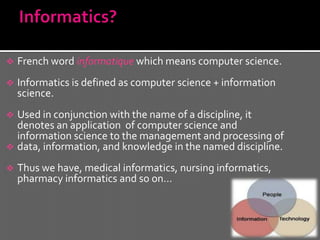
   French word informatique which means computer science.
   Informatics is defined as computer science + information
    science.
 Used in conjunction with the name of a discipline, it
  denotes an application of computer science and
  information science to the management and processing of
 data, information, and knowledge in the named discipline.

   Thus we have, medical informatics, nursing informatics,
    pharmacy informatics and so on…
A way of helping in the management and
processing of nursing information data through
the use of computers.

Involves research and analysis aimed at
supporting nursing education and practice.

Deals specifically with the process of gathering
and acquiring nursing health care data.
   Nurses have worked in informatics roles for over twenty-five years, but
    the phrase “nursing informatics” was not seen in the literature until 1984.
    Nursing informatics has established itself as a specialty in the nursing
    field.
    Nurses have become proficient in utilizing and adapting complex
    technology into caring nursing practice for decades, at least since the
    time of Florence Nightingale in the United Kingdom and even earlier,
    when Jeanne Mance (1606-1673) founded the first hospital in Montreal,
    Canada in 1642.
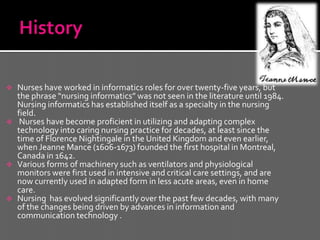
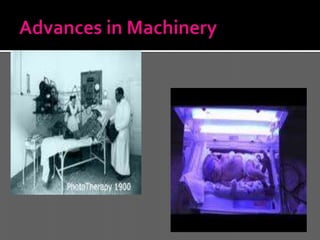
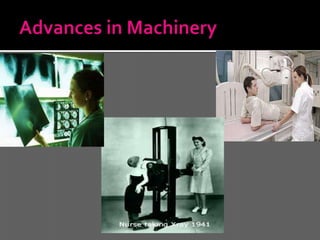
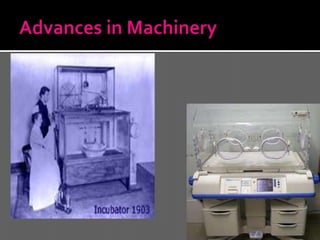
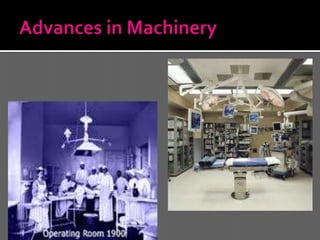
   Various forms of machinery such as ventilators and physiological
    monitors were first used in intensive and critical care settings, and are
    now currently used in adapted form in less acute areas, even in home
    care.
   Nursing has evolved significantly over the past few decades, with many
    of the changes being driven by advances in information and
    communication technology .
Rognehaugh

   “the use of any computer and information
    technologies that support any nursing
    function carried out by nurses in the
    performance of their duties”
Hannah (1985)

    “use of information technologies in relation
    to those functions, within the purview of
    nursing that are carried out by nurses when
    performing their duties”
Graves and Corcoran(1989)

   “a combination of computer science,
    information science and nursing science
    designed to assist in the management and
    processing of nursing data, information and
    knowledge to support the practice of nursing
    and the delivery of nursing care.”
Hebda (1998 )

   Defines nursing informatics as "the use of
    computers technology to support nursing,
    including clinical practice, administration,
    education, and research.
ANA Scope and Standards of Nursing Informatics Practice(
2001, pg vii)

“Nursing Informatics is a specialty that integrates nursing
science, computer science, and information science to
manage and communicate data, information, and
knowledge in nursing practice. Nursing informatics
facilitates the integration of data, information and
knowledge to support patients, nurses and other providers in
their decision-making in all roles and settings. This support is
accomplished through the use of information structures,
information processes, and information technology.”
    The goal of Nursing Informatics is to improve the
    health of populations, communities, families, and
    individuals by optimizing information management
    and communication. This includes the use of
    technology in the direct provision of care, in
    establishing effective administrative systems, in
    managing and delivering education experiences, in
    supporting life-long learning, and in supporting
    nursing research.

(Scope of Standards of Nursing Informatics Practice -
  American Nurses Association 2001)
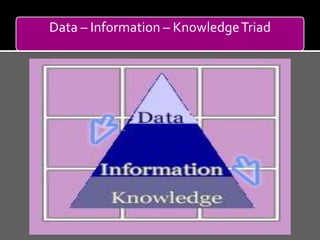
The framework for nursing informatics relies on the central
  concepts of data, information and knowledge:

DATA: is defined as discrete entities that are described
 objectively without interpretation

INFORMATION: as data that is interpreted, organized or
  structured

KNOWLEDGE as information that has been synthesized so that
  interrelationships
are identified and formalized.

Resulting in decisions that guide practice.
Deals with how this data is collected and
processed with an aim to improve various decision-
making levels within the nursing profession.
Is applied to model the human processing of
data, information, and knowledge within a
computer system.
Automates the processing of nursing data to
information and the transformation of nursing
information to nursing knowledge.
Data – Information – Knowledge Triad
Nursing Informatics can be applied to all areas
 of nursing practice which include;

   Clinical Practice,
   Administration
   Education
   Research
Point-of-Care Systems and Clinical Information
  Systems

 Work lists to remind staff of planned nursing
  interventions

 Computer generated client documentation

 Electronic Medical Record (EMR) and Computer-
  Based Patient Record (CPR) Monitoring devices that
  record vital signs and other measurements directly
  into the client record (electronic medical record)
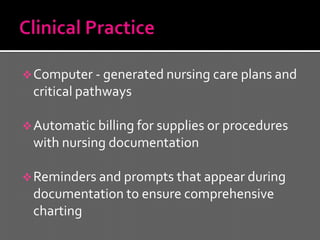
 Computer - generated nursing care plans and
 critical pathways

 Automatic billing for supplies or procedures
 with nursing documentation

 Reminders and prompts that appear during
 documentation to ensure comprehensive
 charting
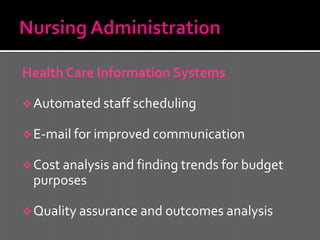
Health Care Information Systems

 Automated staff scheduling

 E-mail for improved communication

 Cost analysis and finding trends for budget
 purposes

 Quality assurance and outcomes analysis
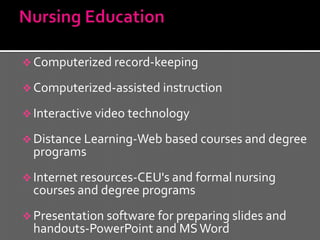
 Computerized record-keeping

 Computerized-assisted instruction

 Interactive video technology

 Distance Learning-Web based courses and degree
  programs
 Internet resources-CEU's and formal nursing
  courses and degree programs
 Presentation software for preparing slides and
  handouts-PowerPoint and MS Word
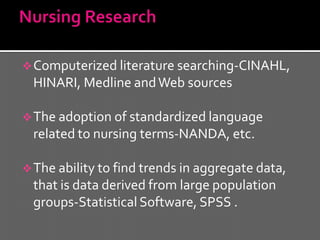
 Computerized literature searching-CINAHL,
 HINARI, Medline and Web sources

 The adoption of standardized language
 related to nursing terms-NANDA, etc.

 The ability to find trends in aggregate data,
 that is data derived from large population
 groups-Statistical Software, SPSS .
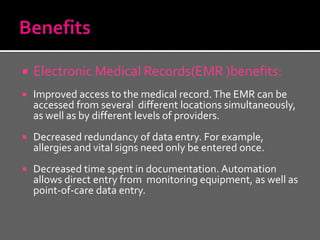
   Electronic Medical Records(EMR )benefits:
   Improved access to the medical record. The EMR can be
    accessed from several different locations simultaneously,
    as well as by different levels of providers.
   Decreased redundancy of data entry. For example,
    allergies and vital signs need only be entered once.
   Decreased time spent in documentation. Automation
    allows direct entry from monitoring equipment, as well as
    point-of-care data entry.
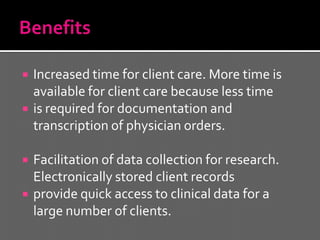
   Increased time for client care. More time is
    available for client care because less time
   is required for documentation and
    transcription of physician orders.

   Facilitation of data collection for research.
    Electronically stored client records
   provide quick access to clinical data for a
    large number of clients.
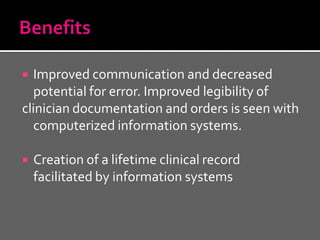
  Improved communication and decreased
   potential for error. Improved legibility of
clinician documentation and orders is seen with
   computerized information systems.

   Creation of a lifetime clinical record
    facilitated by information systems
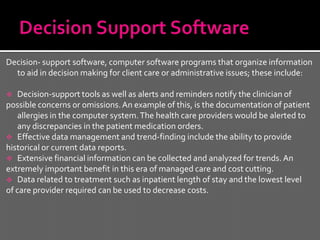
Decision- support software, computer software programs that organize information
  to aid in decision making for client care or administrative issues; these include:

  Decision-support tools as well as alerts and reminders notify the clinician of
possible concerns or omissions. An example of this, is the documentation of patient
   allergies in the computer system. The health care providers would be alerted to
   any discrepancies in the patient medication orders.
 Effective data management and trend-finding include the ability to provide
historical or current data reports.
 Extensive financial information can be collected and analyzed for trends. An
extremely important benefit in this era of managed care and cost cutting.
 Data related to treatment such as inpatient length of stay and the lowest level
of care provider required can be used to decrease costs.
Database advantages

   shared data;
   centralized control;
   disadvantages of redundancy control;
   improved data integrity;
   improved data security, and database
    systems;
   flexible conceptual design.
   More easily archived
   Standardized and customized reporting
   Legible
   More accurate patient data, less chance of
    error
   Document set maintained
   Complex conceptual design process
   Need for multiple external databases
   Need to hire database-related employees
   High DBMS acquisition costs
   A more complex programmer environment
   Potentially catastrophic program failures
   A longer running time for individual
    applications
   Highly dependent DBMS operations
   Increased costs to startup, maintain, train,
    and upgrade Computer literacy required-fear
    of computers
   Confidentiality, privacy and security difficult
    to guarantee
At present, nursing informatics is an emerging
  field of study. National nursing organizations
  support the need for nurses to become
  computer literate and versed in the dynamics of
  nursing informatics. We are at a transition
  period. Becoming educated in nursing
  informatics is, for the most party, a self-directed
  and independent endeavor. Programs that offer
  basic and further education in nursing
  informatics are beginning to spring up around
  the globe, but many more are needed to provide
  easy access for motivated nurses.
Virginia Saba (1992) predicted, "By the turn of
 the century, most health care delivery
 systems will function with computers and will
 be managed by computer literate nurses. I
 believe, that by the turn of the century, "high
 tech and high touch" will be an integral part
 of the health care delivery system,"

Nursing informatics presentation

  • 1.
    Presenter: Leeann Sills Registration# 10/0532/0169 Lecturer: Ms Tabitha Mallampati
  • 2.
    French word informatique which means computer science.  Informatics is defined as computer science + information science.  Used in conjunction with the name of a discipline, it denotes an application of computer science and information science to the management and processing of  data, information, and knowledge in the named discipline.  Thus we have, medical informatics, nursing informatics, pharmacy informatics and so on…
  • 3.
    A way ofhelping in the management and processing of nursing information data through the use of computers. Involves research and analysis aimed at supporting nursing education and practice. Deals specifically with the process of gathering and acquiring nursing health care data.
  • 4.
    Nurses have worked in informatics roles for over twenty-five years, but the phrase “nursing informatics” was not seen in the literature until 1984. Nursing informatics has established itself as a specialty in the nursing field.  Nurses have become proficient in utilizing and adapting complex technology into caring nursing practice for decades, at least since the time of Florence Nightingale in the United Kingdom and even earlier, when Jeanne Mance (1606-1673) founded the first hospital in Montreal, Canada in 1642.  Various forms of machinery such as ventilators and physiological monitors were first used in intensive and critical care settings, and are now currently used in adapted form in less acute areas, even in home care.  Nursing has evolved significantly over the past few decades, with many of the changes being driven by advances in information and communication technology .
  • 9.
    Rognehaugh  “the use of any computer and information technologies that support any nursing function carried out by nurses in the performance of their duties”
  • 10.
    Hannah (1985)  “use of information technologies in relation to those functions, within the purview of nursing that are carried out by nurses when performing their duties”
  • 11.
    Graves and Corcoran(1989)  “a combination of computer science, information science and nursing science designed to assist in the management and processing of nursing data, information and knowledge to support the practice of nursing and the delivery of nursing care.”
  • 12.
    Hebda (1998 )  Defines nursing informatics as "the use of computers technology to support nursing, including clinical practice, administration, education, and research.
  • 13.
    ANA Scope andStandards of Nursing Informatics Practice( 2001, pg vii) “Nursing Informatics is a specialty that integrates nursing science, computer science, and information science to manage and communicate data, information, and knowledge in nursing practice. Nursing informatics facilitates the integration of data, information and knowledge to support patients, nurses and other providers in their decision-making in all roles and settings. This support is accomplished through the use of information structures, information processes, and information technology.”
  • 14.
    The goal of Nursing Informatics is to improve the health of populations, communities, families, and individuals by optimizing information management and communication. This includes the use of technology in the direct provision of care, in establishing effective administrative systems, in managing and delivering education experiences, in supporting life-long learning, and in supporting nursing research. (Scope of Standards of Nursing Informatics Practice - American Nurses Association 2001)
  • 15.
    The framework fornursing informatics relies on the central concepts of data, information and knowledge: DATA: is defined as discrete entities that are described objectively without interpretation INFORMATION: as data that is interpreted, organized or structured KNOWLEDGE as information that has been synthesized so that interrelationships are identified and formalized. Resulting in decisions that guide practice.
  • 16.
    Deals with howthis data is collected and processed with an aim to improve various decision- making levels within the nursing profession. Is applied to model the human processing of data, information, and knowledge within a computer system. Automates the processing of nursing data to information and the transformation of nursing information to nursing knowledge.
  • 17.
    Data – Information– Knowledge Triad
  • 18.
    Nursing Informatics canbe applied to all areas of nursing practice which include;  Clinical Practice,  Administration  Education  Research
  • 19.
    Point-of-Care Systems andClinical Information Systems  Work lists to remind staff of planned nursing interventions  Computer generated client documentation  Electronic Medical Record (EMR) and Computer- Based Patient Record (CPR) Monitoring devices that record vital signs and other measurements directly into the client record (electronic medical record)
  • 20.
     Computer -generated nursing care plans and critical pathways  Automatic billing for supplies or procedures with nursing documentation  Reminders and prompts that appear during documentation to ensure comprehensive charting
  • 21.
    Health Care InformationSystems  Automated staff scheduling  E-mail for improved communication  Cost analysis and finding trends for budget purposes  Quality assurance and outcomes analysis
  • 22.
     Computerized record-keeping Computerized-assisted instruction  Interactive video technology  Distance Learning-Web based courses and degree programs  Internet resources-CEU's and formal nursing courses and degree programs  Presentation software for preparing slides and handouts-PowerPoint and MS Word
  • 23.
     Computerized literaturesearching-CINAHL, HINARI, Medline and Web sources  The adoption of standardized language related to nursing terms-NANDA, etc.  The ability to find trends in aggregate data, that is data derived from large population groups-Statistical Software, SPSS .
  • 24.
    Electronic Medical Records(EMR )benefits:  Improved access to the medical record. The EMR can be accessed from several different locations simultaneously, as well as by different levels of providers.  Decreased redundancy of data entry. For example, allergies and vital signs need only be entered once.  Decreased time spent in documentation. Automation allows direct entry from monitoring equipment, as well as point-of-care data entry.
  • 25.
    Increased time for client care. More time is available for client care because less time  is required for documentation and transcription of physician orders.  Facilitation of data collection for research. Electronically stored client records  provide quick access to clinical data for a large number of clients.
  • 26.
     Improvedcommunication and decreased potential for error. Improved legibility of clinician documentation and orders is seen with computerized information systems.  Creation of a lifetime clinical record facilitated by information systems
  • 27.
    Decision- support software,computer software programs that organize information to aid in decision making for client care or administrative issues; these include:  Decision-support tools as well as alerts and reminders notify the clinician of possible concerns or omissions. An example of this, is the documentation of patient allergies in the computer system. The health care providers would be alerted to any discrepancies in the patient medication orders.  Effective data management and trend-finding include the ability to provide historical or current data reports.  Extensive financial information can be collected and analyzed for trends. An extremely important benefit in this era of managed care and cost cutting.  Data related to treatment such as inpatient length of stay and the lowest level of care provider required can be used to decrease costs.
  • 28.
    Database advantages  shared data;  centralized control;  disadvantages of redundancy control;  improved data integrity;  improved data security, and database systems;  flexible conceptual design.
  • 29.
    More easily archived  Standardized and customized reporting  Legible  More accurate patient data, less chance of error  Document set maintained
  • 30.
    Complex conceptual design process  Need for multiple external databases  Need to hire database-related employees  High DBMS acquisition costs  A more complex programmer environment  Potentially catastrophic program failures  A longer running time for individual applications  Highly dependent DBMS operations
  • 31.
    Increased costs to startup, maintain, train, and upgrade Computer literacy required-fear of computers  Confidentiality, privacy and security difficult to guarantee
  • 32.
    At present, nursinginformatics is an emerging field of study. National nursing organizations support the need for nurses to become computer literate and versed in the dynamics of nursing informatics. We are at a transition period. Becoming educated in nursing informatics is, for the most party, a self-directed and independent endeavor. Programs that offer basic and further education in nursing informatics are beginning to spring up around the globe, but many more are needed to provide easy access for motivated nurses.
  • 33.
    Virginia Saba (1992)predicted, "By the turn of the century, most health care delivery systems will function with computers and will be managed by computer literate nurses. I believe, that by the turn of the century, "high tech and high touch" will be an integral part of the health care delivery system,"

Editor's Notes

  • #10 Definition are meant to cover all aspects of information technology, used by nurses, that related to patient care, health care administration, nursing practice, or nursing education.