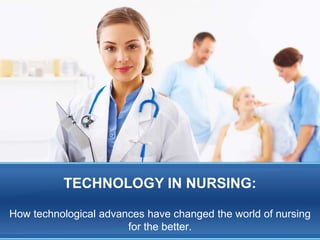
TECHNOLOGY IN NURSING:
How technological advances have changed the world of nursing
for the better.
WHAT IS TECHNOLOGY?
• According to the Merriam-Webster dictionary:
<tech·nol·o·gy> is defined as:
• the practical application of knowledge especially in a
particular area.
• a manner of accomplishing a task especially using
technical processes, methods, or knowledge.
• Some examples of technology include, but are not limited
to: computers, cell phones, PDA’s, internet and much
more!
TECHNOLOGIES THAT
IMPROVE PATIENT CARE:
• Wireless Phone Systems
 Prevents any delay in care which has replaced most pager systems.
• Personal Data Assistants (PDA’s)
 Allows medical staff to be more organized and comes equipped with
many applications that have helped provide greater patient care.
• Handheld Units
 Handheld units are programmed to quickly and efficiently transmit
patient information to electronic medical records (EMR).
• Smart Phones
 Come equipped with an application called “pathways” which has
enabled medical professionals to gather patient information such as
conditions and symptoms.
Programs and Applications
• The Veterans Administration (VA).
 Has designed state of the art program that stores patients in a
nationwide database for more efficient documentation of patient.
• iTunes Applications:
 In 2011, iTunes launched a category of applications called: “iTunes
room for Healthcare”. This consisted of 50 applications for the
healthcare professional.
• Health Information Technology (HIT).
 This system has been put in place by the U.S. government. The goal
of HIT is to reduce cost and create higher standards of care for the
patient.
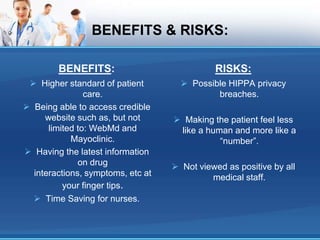
BENEFITS & RISKS:
BENEFITS:
 Higher standard of patient
care.
 Being able to access credible
website such as, but not
limited to: WebMd and
Mayoclinic.
 Having the latest information
on drug
interactions, symptoms, etc at
your finger tips.
 Time Saving for nurses.
RISKS:
 Possible HIPPA privacy
breaches.
 Making the patient feel less
like a human and more like a
“number”.
 Not viewed as positive by all
medical staff.

Technology in nursing

  • 1.
    TECHNOLOGY IN NURSING: Howtechnological advances have changed the world of nursing for the better.
  • 2.
    WHAT IS TECHNOLOGY? •According to the Merriam-Webster dictionary: <tech·nol·o·gy> is defined as: • the practical application of knowledge especially in a particular area. • a manner of accomplishing a task especially using technical processes, methods, or knowledge. • Some examples of technology include, but are not limited to: computers, cell phones, PDA’s, internet and much more!
  • 3.
    TECHNOLOGIES THAT IMPROVE PATIENTCARE: • Wireless Phone Systems  Prevents any delay in care which has replaced most pager systems. • Personal Data Assistants (PDA’s)  Allows medical staff to be more organized and comes equipped with many applications that have helped provide greater patient care. • Handheld Units  Handheld units are programmed to quickly and efficiently transmit patient information to electronic medical records (EMR). • Smart Phones  Come equipped with an application called “pathways” which has enabled medical professionals to gather patient information such as conditions and symptoms.
  • 4.
    Programs and Applications •The Veterans Administration (VA).  Has designed state of the art program that stores patients in a nationwide database for more efficient documentation of patient. • iTunes Applications:  In 2011, iTunes launched a category of applications called: “iTunes room for Healthcare”. This consisted of 50 applications for the healthcare professional. • Health Information Technology (HIT).  This system has been put in place by the U.S. government. The goal of HIT is to reduce cost and create higher standards of care for the patient.
  • 5.
    BENEFITS & RISKS: BENEFITS: Higher standard of patient care.  Being able to access credible website such as, but not limited to: WebMd and Mayoclinic.  Having the latest information on drug interactions, symptoms, etc at your finger tips.  Time Saving for nurses. RISKS:  Possible HIPPA privacy breaches.  Making the patient feel less like a human and more like a “number”.  Not viewed as positive by all medical staff.