Appliesto:Oracle ProjectCosting:E- BusinessSuite andFusionPPM
Simplifying Oracle Project Accounting- Cross charges and inter-
company billing.
These functionalityprovidedbyOracle’sprojectaccountingapplication(InEbiz andFUSION) are
aimedtohelpprojecttransactionsinmulti- org,multi- operatingunit(BusinessUnit) andmulti- legal
entitysetup.There are scenarioswhere aresource isownedfunctionallybyadifferentorganization
and a projectfroma differentorganizationwantstouse the same resource forcompletionof
activities.Hence eitheracross charge isusedto keeptrackof transactionswithinalegal entityandif
the organizationsare indifferentlegal entity,inter- companybillingisused.
Thisarticle wouldkeepthe focusonE- Businesssuite toexplaineachof these transactions.
The organizationthatprovidesthe resourcesiscalledaproviderorganizationandthe one which
ownsthe projectfor whichthe resource isusedcalledareceiverorganization.
There are fourscenarioswhere thiskindof transactionmaytake place.These are as follows:
1. Intra OperatingUnit- Boththe organizationsare underthe same Operatingunit.
2. InterOperatingUnit- Bothorganizationsare indifferentoperatingunitbutunderthe same
legal entity.
3. Inter- company- Bothorganizationsare indifferentlegalentitiesORindifferentOperating
Units.
4. Inter- project:Asthe name suggeststhe transactionoccur betweentwoprojects
Intra and interoperatingunittransactions are calledasborrowedandlent(B& L ) transactions. As
the name suggests,one organizationsborrowsandotherone lendsthe resources.
On the otherhand,Inter- Companybilling,asthe name suggests,isusedtobill the organization
whichusesthe resourcesforitsprojects.ProperARand APinvoicesare generatedinproviderand
receiverorganizationsrespectively.
Borrowed and Lent transactions
For bothintra and interoperatingunittransactions,the processismore orlessthe same withvery
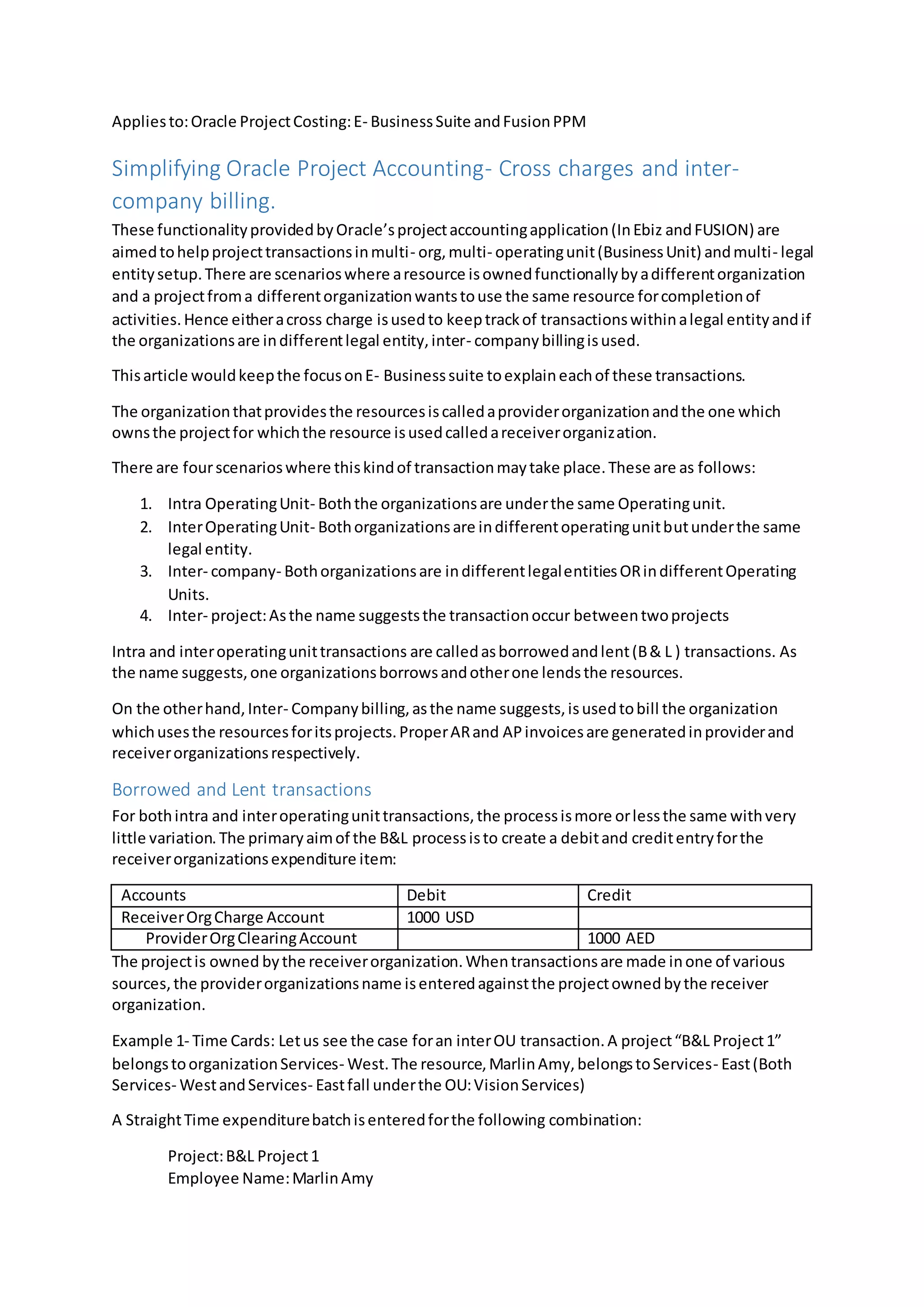
little variation. The primaryaimof the B&L processisto create a debitand creditentryforthe
receiverorganizationsexpenditure item:
Accounts Debit Credit
ReceiverOrgCharge Account 1000 USD
ProviderOrgClearingAccount 1000 AED
The projectis owned bythe receiverorganization.Whentransactionsare made inone of various
sources,the providerorganizationsname isenteredagainstthe projectownedbythe receiver
organization.
Example 1- Time Cards: Letus see the case foran interOU transaction.A project“B&L Project1”
belongstoorganizationServices- West.The resource,MarlinAmy,belongstoServices- East(Both
Services- WestandServices- Eastfall underthe OU:VisionServices)
A StraightTime expenditurebatchisenteredforthe following combination:
Project:B&L Project1
Employee Name:MarlinAmy
Organziation:Services- East.
Example 2- SupplierCost:While enteringthe suppliercost, expenditure type isenteredagainstthe
providerorganization.
Project:B&L Project1
Task: <Name and numberof chargeable task>
Expenditure Type:<Enterexpendituretype name>
Expenditure Organization:Services- East.
Setup
Setupforboth Intra andinteroperatingunitBorrowedandlentare the same exceptforan extra
stepinthe InterOU process.
1. SetupTransferPrice Rule
2. Enable CrossCharge at projectandtask level- settransferprice rule forlaborandnon- labor
resources.
3. ImplementationOption:CrossCharge Tab- SetdefaultvaluesforintraandinterOU cross
charge transactions.
4. Define AutoAccountingFunctions:
a. BorrowedandLent debitaccounts
b. BorrowedandLent debitcreditaccounts
c. Labor Revenue Borrowedaccount
d. Usage Revenue Borrowedaccount
5. Additionallyforinteroperatingunit,processingmethodshouldbe setinthe “Providerand
ReceiverControls”forthe ProviderOperatingunit. The processingmethodshouldbe setto:
BORROWED ANDLENT for inter- operatingunittransactions.
Concurrent Processes
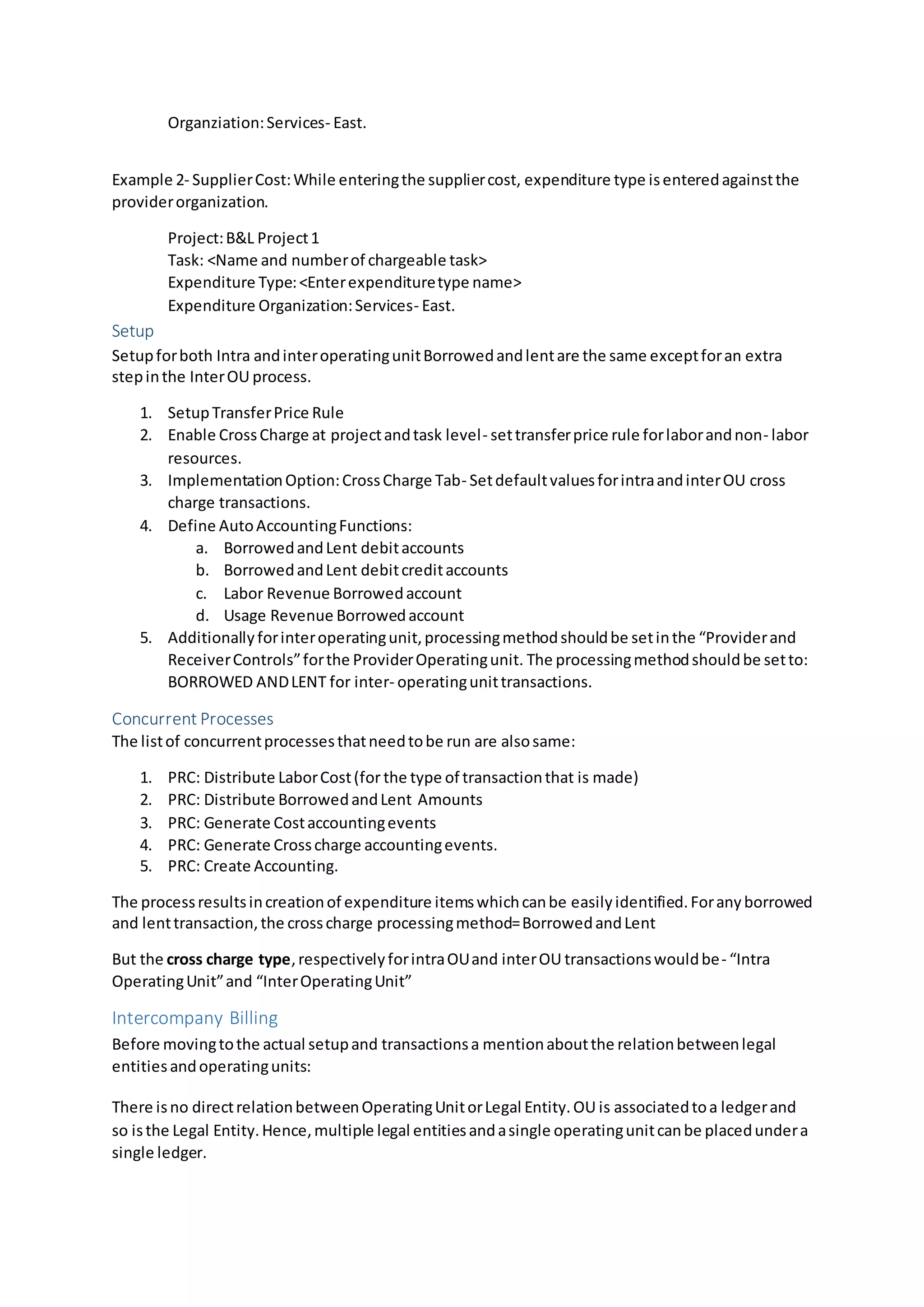
The listof concurrentprocessesthatneedtobe run are alsosame:
1. PRC: Distribute LaborCost(forthe type of transactionthat is made)
2. PRC: Distribute BorrowedandLent Amounts
3. PRC: Generate Costaccountingevents
4. PRC: Generate Crosscharge accountingevents.
5. PRC: Create Accounting.
The processresultsincreationof expenditure itemswhichcanbe easilyidentified.Foranyborrowed
and lenttransaction,the crosscharge processingmethod=BorrowedandLent
But the cross charge type,respectivelyforintraOUand interOU transactionswouldbe- “Intra
OperatingUnit”and “InterOperatingUnit”
Intercompany Billing
Before movingtothe actual setupand transactionsa mentionaboutthe relationbetweenlegal
entitiesandoperatingunits:
There isno directrelationbetweenOperatingUnitorLegal Entity.OU is associatedtoa ledgerand
so isthe Legal Entity.Hence,multiple legal entitiesandasingle operatingunitcanbe placedundera
single ledger.
For inter- companybilling,the providerandreceiveroperatingunitsmustbe indifferentlegal
entities.
As mentionedearlier,the intercompany billingfollowsthe lineof procure topay cycle,i.e,one
projectorganizationprocuresthe servicesof personal/equipmentof otherorganization andthe one
sellingthe servicesbillsthe organizationwhichbuysthe service.Transferprice schedule isthe
governingfactorforrates if the organizationwhichwanttobill the servicessoldwantstomake a
profitonthe transaction. The organizationthatbuysthe services interfacesthe ARinvoicefromthe
organizationthatsellsthe servicesasan APinvoice intoprojectsdirectly,thusaccountingforthe
costs.
Let usbeginbytakingthe example of anoperatingunitXwhichisactuallyexecutingthe project.The
projectinquestionprocuresservicesandmaterialsof contractorstocomplete the actual work and
resultinan outputthat istangible orotherwise.Now,since thisoperatingunitisapart of a bigger
organizationwhichhasotherbusinessinterests,specificservicescanbe procuredor contracted
fromotheroperatingunits.Now,the otheroperatingunitYwhichprovidesthe specialistservices,
maintainsaseparate accountingbookandhas a businessreportingmodeldifferentthanthe
operatingunitXwhichactuallyownsthe project.
Provider OU- Y
- Provides services
- Owns dummy
project
Receiver OU- X
- Receives services
from other Ous
- Invoices clients
Invoicereceiver OU
Nowinthe example statedabove,OperatingUnitXisthe receiverOU andthe OperatingUnitY is
the providerOU. OU X isassociatedtoLE- X and OU Y isassociatedto LE- Y.
Setup and preparation for Intercompany Billing
Before startingthe intercompanytransactions,please complete the following:
1. The receiverOU- X shouldbe markedas ‘ReceiverforInternal Billing’inthe implementation
option’s‘Internal Billing’tab. The providerOU- Y shouldbe markedas‘ProviderforInternal
Billing’inthe implementationoption’s‘Internal Billing’ Tab
2. Settingupof transferprice schedule
3. Define AutoAccountingFunction:IntercompanyInvoice Accounts
4. ReceiverProject:
a. Once the contract project,say‘CustomerBillingProject’iscreatedinthe receiver
OU- X for capturingtransactionandinvoicingexternal clients,enable crosscharge at
projectand tasklevel toreceive the transactionsfromOU- Y.
b. Define the transferprice schedule thatneedstobe usedwhenexecutingthe step
above forlabor andnon- labor transactions.
5. ProviderProject:
a. Create ProjectunderOU- Y to associate to‘ProviderControls’in‘Providerand
ReceiverControls’.The projectshouldbe of ‘Contract’projecttype andenabledfor
intercompanybilling[IntercompanyFlag=Yes,inthe projecttype].Asinformed
earlier,thisisjusta dummyprojectandusedto bill the projectinOU- X.
b. Assignthe internal customerto the projectunderthe ‘CustomerandContacts’
form.The internal customeristhe receivingprojectsoperatingunit- OU- X
c. Thisprojectshouldhave a funding.The fundingisautomaticallybaselinedasthe
flag:Intercompanyissetas yesinprojecttype. The fundinglimitisnotcheckedonce
the invoice generationstarts.
Provider and Receiver Controls for Receiver Operating Unit
Let usstart byunderstandingthe receiverOU- Xand the projectsitowns.Receiveroperatingunit
may ownmultitude of projectsbecauseitisthe organizationthatdoesthe “PROJECTS”business.The
complete setupforOracle project’smodule will be done aroundthe OUX.
For betterunderstanding, letussetupthe providerandreceivercontrol forthe receivingoperating
unit- X, first.
Navigateto Setup>Costing>Providerand Receiver Controls
Select Operating UnitX and click on ‘Receiver Controls’- Itwill be the second tab in the form.
Define the following:
1. ProviderOperating units(Operating UnitXin this case)
2. The legal entity of the (LE of Operating UnitX)
3. SupplierName- the Operating unitshould besetup as an internal supplieras a pre-requisite
beforeintercompany billing is executed.
4. SupplierSite
5. ExpenditureType:Since the costborneby theproviderorganization istreated asa supplier
invoice,there should be a separateexpenditureitemof expenditureitemclass ‘Supplier
Invoice’thatshould beassociated with the inter- company transactions.
6. ExpenditureOrganization:Aswith any projectaccounting transactions,thereshould bea
projectexpenditureorganization fortheexpense.SinceOU Xis set asa projectorganization
the sameshould beused asthe expenditureorganization (orany otherorganization thatis
required by the setup)
Provider and Receiver controls for Provider Operating Unit:
Provideroperatingunitownsthe servicesthatitwantsto sell.The customercanbe an internal
organization,likeOU- Y or external. There will be amark- up inthe transferprice schedule if the
provideroperatingunit( OU- Y) seekstomake profitevenfromthe inter- companytransactions
betweenOUXand OU Y.
Let usnow discussthe setupforthe provideroperatingunit- Y.
Navigateto Setup>Costing>Providerand Receiver Controls
Select Operating UnitY and click on ‘ProviderControls’- Itwill be the first tab in the form.
Define the following:
1. Receiver Operating:Select OU- Y
2. Receiver Legal Entity: Select the LE of OU- Y
3. Allow cross- charge:Setto YES
4. Processing Method:Setto Intercompany Billing.Since we are transacting between two
operating unitsbelonging to differentlegal entities.
5. Inter- company billing project:A projectneedsto be defined in theOU Y which will beused
fortransactionsonly.Thisis a dummy projectand used only foraccounting any
intercompany transactionsbetween OU Xand OU Y. If a second operating unitbelonging to a
differentlegal entityneeds OU Ys services and invoice OU Y for the same,then a second line
should bedefined in the providercontrolsfor thenew operating unit.A new projectshould
be created in OU- Y forcapturing thetransactionsbetween thenew operating unitand OU-
Y.
6. Enter invoice grouping method.
Transactions
ProviderOUincur costsand chargesto receiverprojectdirectly.
1. LoginwithOU- Y responsibilityandcreate anexpenditureitemforthe project:‘Customer
BillingProject’inOU- X.
2. Distribute andaccountthe cost enteredabove.
3. WithOU – Y responsibilityrunPRC: Generate IntercompanyInvoicesforasingle project.
4. Approve andrelease the invoice.
5. Run PRC:Interface InvoicestoReceivables
6. LoginwithreceivablesresponsibilityforOU- Y, and execute AutoInvoice importtocreate
receivablesinvoice.
7. Accountthe receivablesinvoice.
8. Tiebackfromreceivables.
9. LoginwithOU- X payablesresponsibilityandrunthe PayablesOpenInterface import
program
10. LoginwithOU- X projectsresponsibilityandrunthe program:PRC: ImportSupplierCosts.
Thiscompletesthe costingprocessforthe project:CustomBillingProject.
Inter-Project Billing
The main difference betweeninter- companybillingandinter- projectbillingisthatwhencostsare
incurredinthe firstcase,the transactionsare bookedagainstthe receivingoperating unit’sproject
where asin the latter,the costsare bookedagainstthe provideroperatingunit’sprojects.
Inter- projectBilling- isusedif invoicesare neededforworkdone betweentwoprojects.
Unlike intercompanyinvoicing,the projectownedbythe providerorganizationisafull- fledged
projectinitself. Eachprovideroperatingunitshouldcreate a projectandown itcompletely. The
projectshouldhave anagreementandbaselinedfundingtogenerate inter- projectinvoice. Funding
limitischecked forinter- projectbillingasina normal contract project.
User doesnothave to setupthe providerandreceivercontrolsforthe operatingunitthatacts as the
provider.Insteadof settingupproviderandreceivercontrol,userhastoaddthe projectin the
'CustomerandContacts' formin the projects.
Whentransactionsare incurred,the expenditure itemisbookedagainstthe respective provider
project.These costsare distributedagainstthe providerorganization.Eventhoughthe costis
accounted afterdistribution,the external clientassociatedtothe receiverprojectcannotbe billed
unlessthe receivablesinvoice isgeneratedandtransferredasAPinvoice tothe receivablesproject.
The projectinvoice isgeneratedusingthe processPRC:Generate DraftInvoice fora single project.
Thisprocessis same incase whenthe projectcustomerisexternal.The projectinvoiceforinter-
projectinvoicesare treatedasnormal invoice togenerate the ARinvoices.
Once the AR invoicesare generatedandtie backto the ProviderOUsProject,the processtoimport
supplierinvoice fromopeninvoice interfaceisrunfromthe account payablesresponsibilityof the
receivingproject'soperatingunit.
Once thiscost is importedfully,accountedinGLand treatedas a supplierinvoice inthe receiving
operatingunit,the same istransferredtoprojectsasactual costs.
Nowthe receivingprojectcaninvoice the external customerbasedonthe actual cost/ work
incurred.
Transfer Price Schedules (TPS)
Transferprice schedulesare rule basedschedules.Usercanestablishseparate TPSforlaborand
non- labortransactionsor use separate ones.
The transferprice rulescan be set to pickup raw cost,burdenedcostor revenue amountasthe
basisto transferthe cost to the receivingorganization.Additionalmark- upcan be providedtothe
rule if the providerorganizationwantstoincura profit.The rule can use burdenschedule orbill - rate
schedule tocalculate the costthat needstotransferred.
The rulesare thenassociatedtothe transferprice schedule.Additional mark- upordiscountcanbe
enteredinthe TPSfor definingthe crosschargesbetweentwoorganizations.
References
Cross-Charge:Borrowed&Lentand Inter-CompanyProcessinginOracle Projects(DocID
1351653.1):
https://support.oracle.com/epmos/faces/DocumentDisplay?parent=DOCUMENT&sourceId=135165
3.1&id=1552582.1
Difference betweenInter-ProjectBillingandIntercompanyBilling (DocID273091.1):
https://support.oracle.com/epmos/main/downloadattachmentprocessor?parent=DOCUMENT&sour
ceId=273091.1&attachid=273091.1:IP-IC_DIFFERENCES&clickstream=yes

Cross charge and Inter Company billing

  • 1.
    Appliesto:Oracle ProjectCosting:E- BusinessSuiteandFusionPPM Simplifying Oracle Project Accounting- Cross charges and inter- company billing. These functionalityprovidedbyOracle’sprojectaccountingapplication(InEbiz andFUSION) are aimedtohelpprojecttransactionsinmulti- org,multi- operatingunit(BusinessUnit) andmulti- legal entitysetup.There are scenarioswhere aresource isownedfunctionallybyadifferentorganization and a projectfroma differentorganizationwantstouse the same resource forcompletionof activities.Hence eitheracross charge isusedto keeptrackof transactionswithinalegal entityandif the organizationsare indifferentlegal entity,inter- companybillingisused. Thisarticle wouldkeepthe focusonE- Businesssuite toexplaineachof these transactions. The organizationthatprovidesthe resourcesiscalledaproviderorganizationandthe one which ownsthe projectfor whichthe resource isusedcalledareceiverorganization. There are fourscenarioswhere thiskindof transactionmaytake place.These are as follows: 1. Intra OperatingUnit- Boththe organizationsare underthe same Operatingunit. 2. InterOperatingUnit- Bothorganizationsare indifferentoperatingunitbutunderthe same legal entity. 3. Inter- company- Bothorganizationsare indifferentlegalentitiesORindifferentOperating Units. 4. Inter- project:Asthe name suggeststhe transactionoccur betweentwoprojects Intra and interoperatingunittransactions are calledasborrowedandlent(B& L ) transactions. As the name suggests,one organizationsborrowsandotherone lendsthe resources. On the otherhand,Inter- Companybilling,asthe name suggests,isusedtobill the organization whichusesthe resourcesforitsprojects.ProperARand APinvoicesare generatedinproviderand receiverorganizationsrespectively. Borrowed and Lent transactions For bothintra and interoperatingunittransactions,the processismore orlessthe same withvery little variation. The primaryaimof the B&L processisto create a debitand creditentryforthe receiverorganizationsexpenditure item: Accounts Debit Credit ReceiverOrgCharge Account 1000 USD ProviderOrgClearingAccount 1000 AED The projectis owned bythe receiverorganization.Whentransactionsare made inone of various sources,the providerorganizationsname isenteredagainstthe projectownedbythe receiver organization. Example 1- Time Cards: Letus see the case foran interOU transaction.A project“B&L Project1” belongstoorganizationServices- West.The resource,MarlinAmy,belongstoServices- East(Both Services- WestandServices- Eastfall underthe OU:VisionServices) A StraightTime expenditurebatchisenteredforthe following combination: Project:B&L Project1 Employee Name:MarlinAmy
  • 2.
    Organziation:Services- East. Example 2-SupplierCost:While enteringthe suppliercost, expenditure type isenteredagainstthe providerorganization. Project:B&L Project1 Task: <Name and numberof chargeable task> Expenditure Type:<Enterexpendituretype name> Expenditure Organization:Services- East. Setup Setupforboth Intra andinteroperatingunitBorrowedandlentare the same exceptforan extra stepinthe InterOU process. 1. SetupTransferPrice Rule 2. Enable CrossCharge at projectandtask level- settransferprice rule forlaborandnon- labor resources. 3. ImplementationOption:CrossCharge Tab- SetdefaultvaluesforintraandinterOU cross charge transactions. 4. Define AutoAccountingFunctions: a. BorrowedandLent debitaccounts b. BorrowedandLent debitcreditaccounts c. Labor Revenue Borrowedaccount d. Usage Revenue Borrowedaccount 5. Additionallyforinteroperatingunit,processingmethodshouldbe setinthe “Providerand ReceiverControls”forthe ProviderOperatingunit. The processingmethodshouldbe setto: BORROWED ANDLENT for inter- operatingunittransactions. Concurrent Processes The listof concurrentprocessesthatneedtobe run are alsosame: 1. PRC: Distribute LaborCost(forthe type of transactionthat is made) 2. PRC: Distribute BorrowedandLent Amounts 3. PRC: Generate Costaccountingevents 4. PRC: Generate Crosscharge accountingevents. 5. PRC: Create Accounting. The processresultsincreationof expenditure itemswhichcanbe easilyidentified.Foranyborrowed and lenttransaction,the crosscharge processingmethod=BorrowedandLent But the cross charge type,respectivelyforintraOUand interOU transactionswouldbe- “Intra OperatingUnit”and “InterOperatingUnit” Intercompany Billing Before movingtothe actual setupand transactionsa mentionaboutthe relationbetweenlegal entitiesandoperatingunits: There isno directrelationbetweenOperatingUnitorLegal Entity.OU is associatedtoa ledgerand so isthe Legal Entity.Hence,multiple legal entitiesandasingle operatingunitcanbe placedundera single ledger.
  • 3.
    For inter- companybilling,theproviderandreceiveroperatingunitsmustbe indifferentlegal entities. As mentionedearlier,the intercompany billingfollowsthe lineof procure topay cycle,i.e,one projectorganizationprocuresthe servicesof personal/equipmentof otherorganization andthe one sellingthe servicesbillsthe organizationwhichbuysthe service.Transferprice schedule isthe governingfactorforrates if the organizationwhichwanttobill the servicessoldwantstomake a profitonthe transaction. The organizationthatbuysthe services interfacesthe ARinvoicefromthe organizationthatsellsthe servicesasan APinvoice intoprojectsdirectly,thusaccountingforthe costs. Let usbeginbytakingthe example of anoperatingunitXwhichisactuallyexecutingthe project.The projectinquestionprocuresservicesandmaterialsof contractorstocomplete the actual work and resultinan outputthat istangible orotherwise.Now,since thisoperatingunitisapart of a bigger organizationwhichhasotherbusinessinterests,specificservicescanbe procuredor contracted fromotheroperatingunits.Now,the otheroperatingunitYwhichprovidesthe specialistservices, maintainsaseparate accountingbookandhas a businessreportingmodeldifferentthanthe operatingunitXwhichactuallyownsthe project. Provider OU- Y - Provides services - Owns dummy project Receiver OU- X - Receives services from other Ous - Invoices clients Invoicereceiver OU Nowinthe example statedabove,OperatingUnitXisthe receiverOU andthe OperatingUnitY is the providerOU. OU X isassociatedtoLE- X and OU Y isassociatedto LE- Y. Setup and preparation for Intercompany Billing Before startingthe intercompanytransactions,please complete the following: 1. The receiverOU- X shouldbe markedas ‘ReceiverforInternal Billing’inthe implementation option’s‘Internal Billing’tab. The providerOU- Y shouldbe markedas‘ProviderforInternal Billing’inthe implementationoption’s‘Internal Billing’ Tab 2. Settingupof transferprice schedule 3. Define AutoAccountingFunction:IntercompanyInvoice Accounts 4. ReceiverProject: a. Once the contract project,say‘CustomerBillingProject’iscreatedinthe receiver OU- X for capturingtransactionandinvoicingexternal clients,enable crosscharge at projectand tasklevel toreceive the transactionsfromOU- Y. b. Define the transferprice schedule thatneedstobe usedwhenexecutingthe step above forlabor andnon- labor transactions. 5. ProviderProject: a. Create ProjectunderOU- Y to associate to‘ProviderControls’in‘Providerand ReceiverControls’.The projectshouldbe of ‘Contract’projecttype andenabledfor intercompanybilling[IntercompanyFlag=Yes,inthe projecttype].Asinformed earlier,thisisjusta dummyprojectandusedto bill the projectinOU- X. b. Assignthe internal customerto the projectunderthe ‘CustomerandContacts’ form.The internal customeristhe receivingprojectsoperatingunit- OU- X
  • 4.
    c. Thisprojectshouldhave afunding.The fundingisautomaticallybaselinedasthe flag:Intercompanyissetas yesinprojecttype. The fundinglimitisnotcheckedonce the invoice generationstarts. Provider and Receiver Controls for Receiver Operating Unit Let usstart byunderstandingthe receiverOU- Xand the projectsitowns.Receiveroperatingunit may ownmultitude of projectsbecauseitisthe organizationthatdoesthe “PROJECTS”business.The complete setupforOracle project’smodule will be done aroundthe OUX. For betterunderstanding, letussetupthe providerandreceivercontrol forthe receivingoperating unit- X, first. Navigateto Setup>Costing>Providerand Receiver Controls Select Operating UnitX and click on ‘Receiver Controls’- Itwill be the second tab in the form. Define the following: 1. ProviderOperating units(Operating UnitXin this case) 2. The legal entity of the (LE of Operating UnitX) 3. SupplierName- the Operating unitshould besetup as an internal supplieras a pre-requisite beforeintercompany billing is executed. 4. SupplierSite 5. ExpenditureType:Since the costborneby theproviderorganization istreated asa supplier invoice,there should be a separateexpenditureitemof expenditureitemclass ‘Supplier Invoice’thatshould beassociated with the inter- company transactions. 6. ExpenditureOrganization:Aswith any projectaccounting transactions,thereshould bea projectexpenditureorganization fortheexpense.SinceOU Xis set asa projectorganization the sameshould beused asthe expenditureorganization (orany otherorganization thatis required by the setup) Provider and Receiver controls for Provider Operating Unit: Provideroperatingunitownsthe servicesthatitwantsto sell.The customercanbe an internal organization,likeOU- Y or external. There will be amark- up inthe transferprice schedule if the provideroperatingunit( OU- Y) seekstomake profitevenfromthe inter- companytransactions betweenOUXand OU Y. Let usnow discussthe setupforthe provideroperatingunit- Y. Navigateto Setup>Costing>Providerand Receiver Controls Select Operating UnitY and click on ‘ProviderControls’- Itwill be the first tab in the form. Define the following: 1. Receiver Operating:Select OU- Y 2. Receiver Legal Entity: Select the LE of OU- Y 3. Allow cross- charge:Setto YES 4. Processing Method:Setto Intercompany Billing.Since we are transacting between two operating unitsbelonging to differentlegal entities. 5. Inter- company billing project:A projectneedsto be defined in theOU Y which will beused fortransactionsonly.Thisis a dummy projectand used only foraccounting any intercompany transactionsbetween OU Xand OU Y. If a second operating unitbelonging to a
  • 5.
    differentlegal entityneeds OUYs services and invoice OU Y for the same,then a second line should bedefined in the providercontrolsfor thenew operating unit.A new projectshould be created in OU- Y forcapturing thetransactionsbetween thenew operating unitand OU- Y. 6. Enter invoice grouping method. Transactions ProviderOUincur costsand chargesto receiverprojectdirectly. 1. LoginwithOU- Y responsibilityandcreate anexpenditureitemforthe project:‘Customer BillingProject’inOU- X. 2. Distribute andaccountthe cost enteredabove. 3. WithOU – Y responsibilityrunPRC: Generate IntercompanyInvoicesforasingle project. 4. Approve andrelease the invoice. 5. Run PRC:Interface InvoicestoReceivables 6. LoginwithreceivablesresponsibilityforOU- Y, and execute AutoInvoice importtocreate receivablesinvoice. 7. Accountthe receivablesinvoice. 8. Tiebackfromreceivables. 9. LoginwithOU- X payablesresponsibilityandrunthe PayablesOpenInterface import program 10. LoginwithOU- X projectsresponsibilityandrunthe program:PRC: ImportSupplierCosts. Thiscompletesthe costingprocessforthe project:CustomBillingProject. Inter-Project Billing The main difference betweeninter- companybillingandinter- projectbillingisthatwhencostsare incurredinthe firstcase,the transactionsare bookedagainstthe receivingoperating unit’sproject where asin the latter,the costsare bookedagainstthe provideroperatingunit’sprojects. Inter- projectBilling- isusedif invoicesare neededforworkdone betweentwoprojects. Unlike intercompanyinvoicing,the projectownedbythe providerorganizationisafull- fledged projectinitself. Eachprovideroperatingunitshouldcreate a projectandown itcompletely. The projectshouldhave anagreementandbaselinedfundingtogenerate inter- projectinvoice. Funding limitischecked forinter- projectbillingasina normal contract project. User doesnothave to setupthe providerandreceivercontrolsforthe operatingunitthatacts as the provider.Insteadof settingupproviderandreceivercontrol,userhastoaddthe projectin the 'CustomerandContacts' formin the projects. Whentransactionsare incurred,the expenditure itemisbookedagainstthe respective provider project.These costsare distributedagainstthe providerorganization.Eventhoughthe costis accounted afterdistribution,the external clientassociatedtothe receiverprojectcannotbe billed unlessthe receivablesinvoice isgeneratedandtransferredasAPinvoice tothe receivablesproject. The projectinvoice isgeneratedusingthe processPRC:Generate DraftInvoice fora single project. Thisprocessis same incase whenthe projectcustomerisexternal.The projectinvoiceforinter- projectinvoicesare treatedasnormal invoice togenerate the ARinvoices.
  • 6.
    Once the ARinvoicesare generatedandtie backto the ProviderOUsProject,the processtoimport supplierinvoice fromopeninvoice interfaceisrunfromthe account payablesresponsibilityof the receivingproject'soperatingunit. Once thiscost is importedfully,accountedinGLand treatedas a supplierinvoice inthe receiving operatingunit,the same istransferredtoprojectsasactual costs. Nowthe receivingprojectcaninvoice the external customerbasedonthe actual cost/ work incurred. Transfer Price Schedules (TPS) Transferprice schedulesare rule basedschedules.Usercanestablishseparate TPSforlaborand non- labortransactionsor use separate ones. The transferprice rulescan be set to pickup raw cost,burdenedcostor revenue amountasthe basisto transferthe cost to the receivingorganization.Additionalmark- upcan be providedtothe rule if the providerorganizationwantstoincura profit.The rule can use burdenschedule orbill - rate schedule tocalculate the costthat needstotransferred. The rulesare thenassociatedtothe transferprice schedule.Additional mark- upordiscountcanbe enteredinthe TPSfor definingthe crosschargesbetweentwoorganizations. References Cross-Charge:Borrowed&Lentand Inter-CompanyProcessinginOracle Projects(DocID 1351653.1): https://support.oracle.com/epmos/faces/DocumentDisplay?parent=DOCUMENT&sourceId=135165 3.1&id=1552582.1 Difference betweenInter-ProjectBillingandIntercompanyBilling (DocID273091.1): https://support.oracle.com/epmos/main/downloadattachmentprocessor?parent=DOCUMENT&sour ceId=273091.1&attachid=273091.1:IP-IC_DIFFERENCES&clickstream=yes