Inter company Sales Process in
SAP
Definition, Concept and Configuration- Using
an IDES Example
Definition
 An Inter-company sales process involves
delivery to a customer from a delivering
plant which is not assigned to the company
code to which the Sales Area of the
ordering customer belongs.
 The two company codes involved in the
transaction belong to the same transaction.
 This process is different from the inter-
company stock transfer in the sense that
inter-company stock transfer does not
involve any external customer.
Scenario – IDES
 Customer T-L67A09 orders material T-
AtA09 from sales area MAN-10-00
belonging to company code MAN1.
 The Goods are delivered to the customer
by delivering plant 1200 belonging to the
company code 1000.
 Company code MAN1 bills the customer
and the company code 1000 in turn bills
the sales organization MAN. The later is
known as Inter-company billing.
Some Basics
 Two types of billing documents are generated in
the process viz F2 (Delivery related Invoice) and
IV (Inter-Company Delivery Related Invoice )
which are issued to the customer and the sales
organization which takes the order respectively.
 Internal Customer – The sales organization
which takes the order acts as an internal
customer to the IV billing company code.
Hence,a complete sold-to party account group
customer is created for the ordering Sales Org.
This customer is assigned to the company code
of the delivering plant, via sales area.
Continued..
 In standard system (automatic generation of
billing documents) customer invoice(F2) has to
be generated first. Only after F2 creation the
inter-company billing document (IV)is updated in
the billing index. Although manually it is possible
to create IV before F2 using T-code VF01.
 Output type RD04 is configured for billing type
IV which carries out automatic posting to the
vendor account representing the delivering
company code.
Accounts effected
Invoice to customer :
Dr A/R
Cr Sales
PGI at delivering plant :
Dr COGS
Cr Inventory
Inter-company Billing at delivering plant :
Dr A/R inter-company
Cr Sales
Payment at Selling Company Code :
Dr A/P inter company
Cr COGS inter company
Pricing Conditions
 The customer is charged normally using standard pricing
condition PR00 by the sales organization of the customer.
 The sales organization of the delivering plant bills the
internal customer i.e the sales org taking the order using
either of :
1)PI01 Inter-company Price: Fixed amount/material
2)PI02 Inter-company % : Percent of net invoice amount
 Inter-company pricing has a requirement 22(Inter-
company) in order to get activated.
 In the sales order theses conditions are marked as
statistical i.e. they don't affect the pricing to the customer.
Although they are effective for internal pricing.
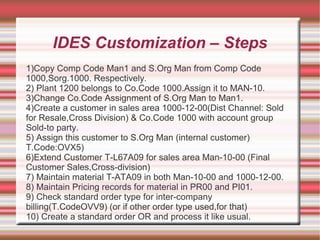
IDES Customization – Steps
1)Copy Comp Code Man1 and S.Org Man from Comp Code
1000,Sorg.1000. Respectively.
2) Plant 1200 belongs to Co.Code 1000.Assign it to MAN-10.
3)Change Co.Code Assignment of S.Org Man to Man1.
4)Create a customer in sales area 1000-12-00(Dist Channel: Sold
for Resale,Cross Division) & Co.Code 1000 with account group
Sold-to party.
5) Assign this customer to S.Org Man (internal customer)
T.Code:OVX5)
6)Extend Customer T-L67A09 for sales area Man-10-00 (Final
Customer Sales,Cross-division)
7) Maintain material T-ATA09 in both Man-10-00 and 1000-12-00.
8) Maintain Pricing records for material in PR00 and PI01.
9) Check standard order type for inter-company
billing(T.CodeOVV9) (or if other order type used,for that)
10) Create a standard order OR and process it like usual.
Conclusion
Other variations to this process which can be
configured in the system are cross-company
stock transfer,internal credit memo,internal
returns,order related cross company sales and
order related third party inter company process.
Conclusion
Other variations to this process which can be
configured in the system are cross-company
stock transfer,internal credit memo,internal
returns,order related cross company sales and
order related third party inter company process.

Inter Company Billing in SAP -Basics

  • 1.
    Inter company SalesProcess in SAP Definition, Concept and Configuration- Using an IDES Example
  • 2.
    Definition  An Inter-companysales process involves delivery to a customer from a delivering plant which is not assigned to the company code to which the Sales Area of the ordering customer belongs.  The two company codes involved in the transaction belong to the same transaction.  This process is different from the inter- company stock transfer in the sense that inter-company stock transfer does not involve any external customer.
  • 3.
    Scenario – IDES Customer T-L67A09 orders material T- AtA09 from sales area MAN-10-00 belonging to company code MAN1.  The Goods are delivered to the customer by delivering plant 1200 belonging to the company code 1000.  Company code MAN1 bills the customer and the company code 1000 in turn bills the sales organization MAN. The later is known as Inter-company billing.
  • 4.
    Some Basics  Twotypes of billing documents are generated in the process viz F2 (Delivery related Invoice) and IV (Inter-Company Delivery Related Invoice ) which are issued to the customer and the sales organization which takes the order respectively.  Internal Customer – The sales organization which takes the order acts as an internal customer to the IV billing company code. Hence,a complete sold-to party account group customer is created for the ordering Sales Org. This customer is assigned to the company code of the delivering plant, via sales area.
  • 5.
    Continued..  In standardsystem (automatic generation of billing documents) customer invoice(F2) has to be generated first. Only after F2 creation the inter-company billing document (IV)is updated in the billing index. Although manually it is possible to create IV before F2 using T-code VF01.  Output type RD04 is configured for billing type IV which carries out automatic posting to the vendor account representing the delivering company code.
  • 6.
    Accounts effected Invoice tocustomer : Dr A/R Cr Sales PGI at delivering plant : Dr COGS Cr Inventory Inter-company Billing at delivering plant : Dr A/R inter-company Cr Sales Payment at Selling Company Code : Dr A/P inter company Cr COGS inter company
  • 7.
    Pricing Conditions  Thecustomer is charged normally using standard pricing condition PR00 by the sales organization of the customer.  The sales organization of the delivering plant bills the internal customer i.e the sales org taking the order using either of : 1)PI01 Inter-company Price: Fixed amount/material 2)PI02 Inter-company % : Percent of net invoice amount  Inter-company pricing has a requirement 22(Inter- company) in order to get activated.  In the sales order theses conditions are marked as statistical i.e. they don't affect the pricing to the customer. Although they are effective for internal pricing.
  • 8.
    IDES Customization –Steps 1)Copy Comp Code Man1 and S.Org Man from Comp Code 1000,Sorg.1000. Respectively. 2) Plant 1200 belongs to Co.Code 1000.Assign it to MAN-10. 3)Change Co.Code Assignment of S.Org Man to Man1. 4)Create a customer in sales area 1000-12-00(Dist Channel: Sold for Resale,Cross Division) & Co.Code 1000 with account group Sold-to party. 5) Assign this customer to S.Org Man (internal customer) T.Code:OVX5) 6)Extend Customer T-L67A09 for sales area Man-10-00 (Final Customer Sales,Cross-division) 7) Maintain material T-ATA09 in both Man-10-00 and 1000-12-00. 8) Maintain Pricing records for material in PR00 and PI01. 9) Check standard order type for inter-company billing(T.CodeOVV9) (or if other order type used,for that) 10) Create a standard order OR and process it like usual.
  • 9.
    Conclusion Other variations tothis process which can be configured in the system are cross-company stock transfer,internal credit memo,internal returns,order related cross company sales and order related third party inter company process.
  • 10.
    Conclusion Other variations tothis process which can be configured in the system are cross-company stock transfer,internal credit memo,internal returns,order related cross company sales and order related third party inter company process.