







Real-world Reinforcement Learning
Max Pagels, Machine Learning Partner
@maxpagels
www.linkedin.com/in/maxpagels
Job: Fourkind
Education: BSc, MSc comp. sci, University of Helsinki
Background: CS researcher, full-stack dev, front-end dev,
data scientist
Interests: Immediate-reward RL, ML reductions,
incremental/online learning, generative design
Some industries: maritime, insurance, ecommerce, gaming,
telecommunications, transportation, media, education,
logistics
What is reinforcement learning?
What is reinforcement
learning?
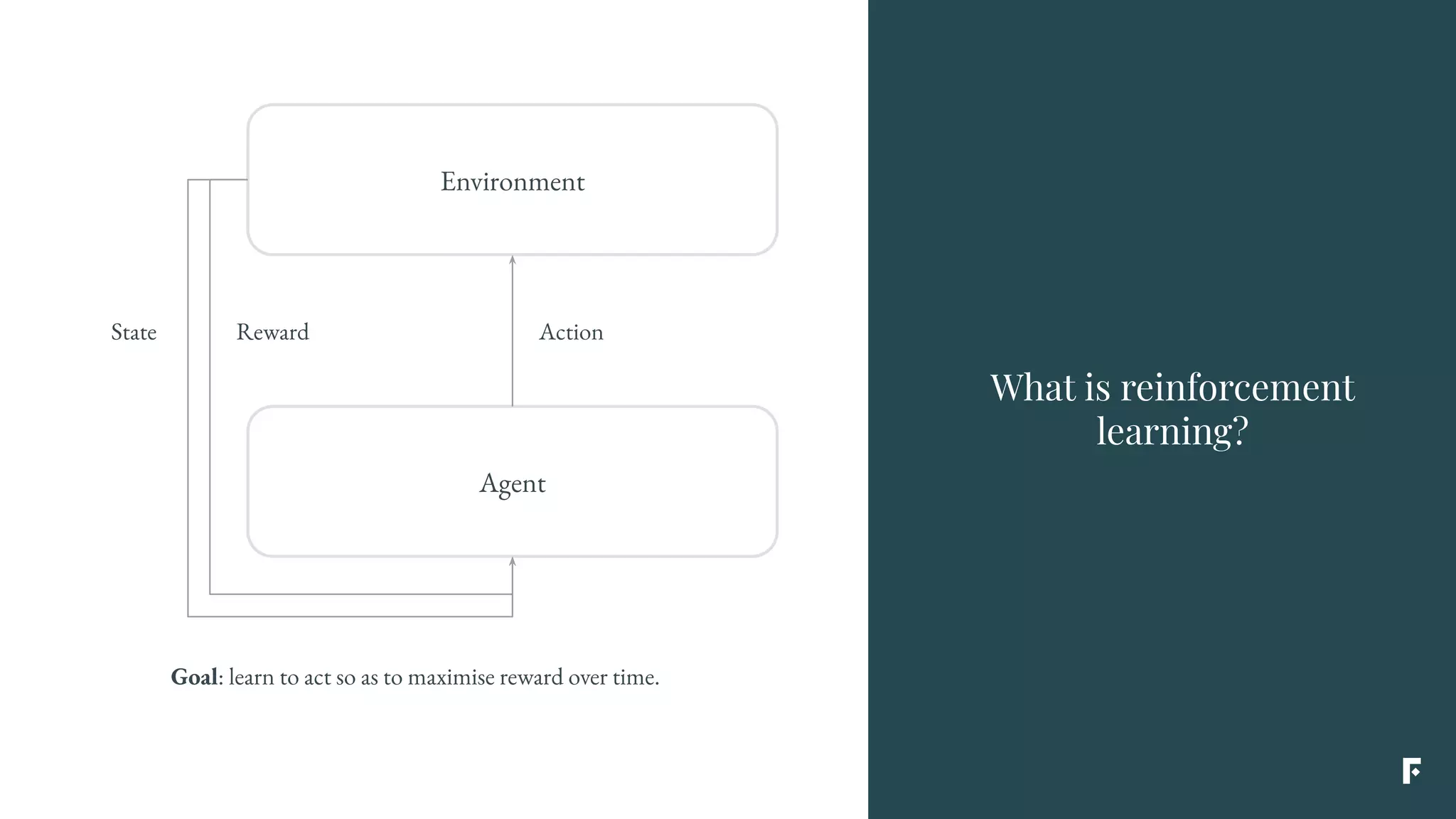
In a reinforcement learning setting, one takes actions in an
environment & receives rewards. The ultimate goal is to
maximise rewards over time.
Environment
Agent
Goal: learn to act so as to maximise reward over time.
ActionReward
What is reinforcement
learning?
State
What is reinforcement
learning?
A good real-world analogy is teaching your dog a new
command. If the dog correctly performs (acts) the command
you (the environment) gave, he or she is given a treat (a
reward). Over time, you dog will learn to act as commanded
in order to maximise reward over time.
What is reinforcement
learning?
Reinforcement learning isn’t entirely dissimilar from the
notion of classical conditioning or Pavlovian response:
“Classical conditioning (also known as Pavlovian or
respondent conditioning) refers to a learning procedure in
which a biologically potent stimulus (e.g. food) is paired with
a previously neutral stimulus (e.g. a bell). It also refers to the
learning process that results from this pairing, through which
the neutral stimulus comes to elicit a response (e.g. salivation)
that is usually similar to the one elicited by the potent
stimulus.”
Classical conditioning,
https://en.wikipedia.org/wiki/Classical_conditioning
What is reinforcement
learning?
In the beginning, a reinforcement learning agent knows
nothing about the world. It must explore different options to
learn what works and what doesn’t.
What is reinforcement
learning?
In addition, an agent must also exploit its knowledge in order
to actually maximise rewards over time.
What is reinforcement
learning?
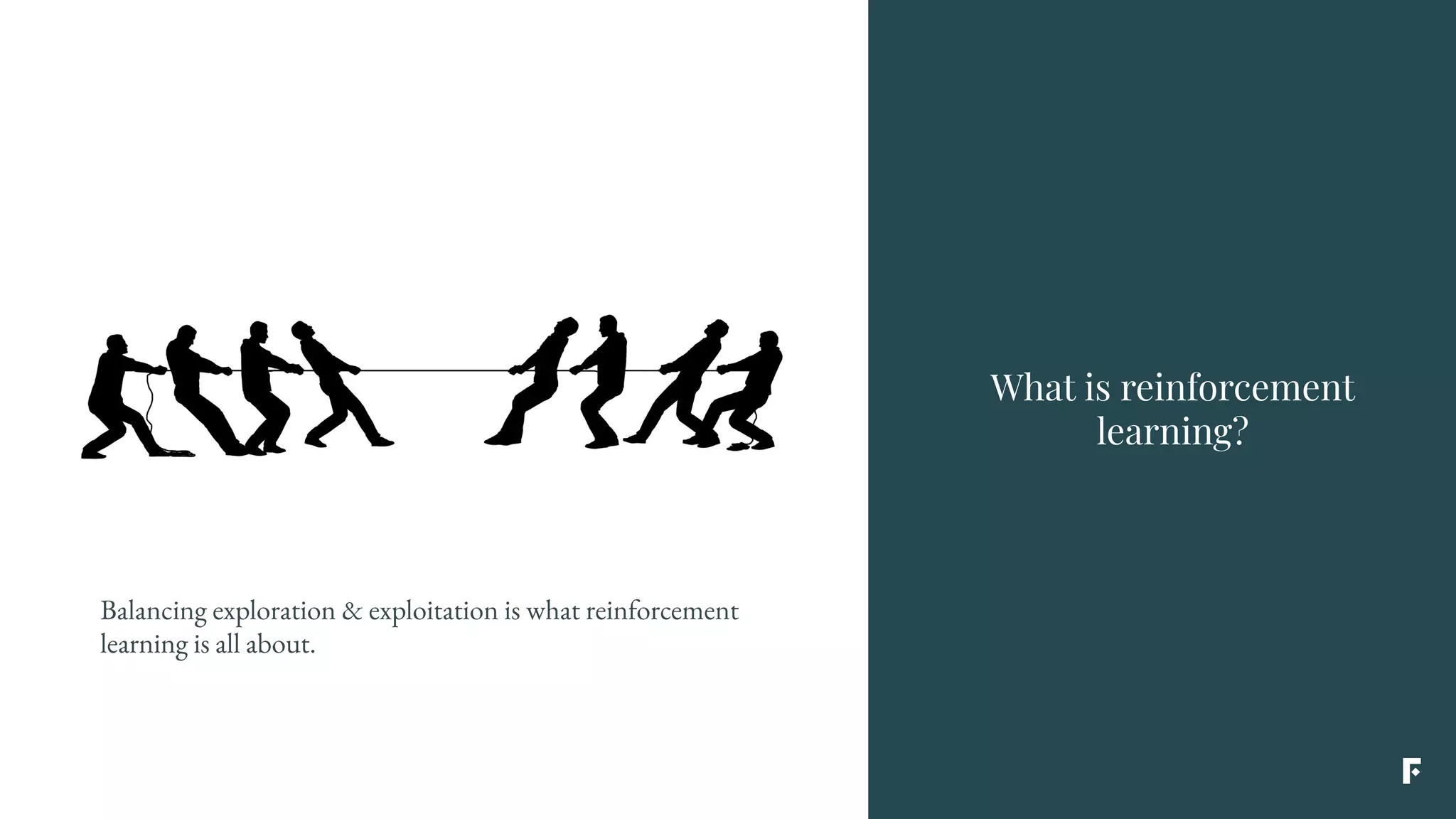
Balancing exploration & exploitation is what reinforcement
learning is all about.
What is reinforcement
learning?
We’ll get back to the details later. Before that, let’s think about
why you might want to use reinforcement learning, and how
to do it in a way that actually works in the real world.
The case for using reinforcement
learning
The case for using
reinforcement learning
Intentionally provocative statement: you can’t really call
machine learning systems intelligent unless they are
reinforcement systems.
Let’s dissect this through some observations.
The case for using
reinforcement learning
Observation #1: any system that doesn’t use machine
learning generates data that is ultimately based on human
expertise.
The case for using
reinforcement learning
Observation #2: any supervised machine learning system that
uses such data is effectively learning from data generated by
human expertise.
The case for using
reinforcement learning
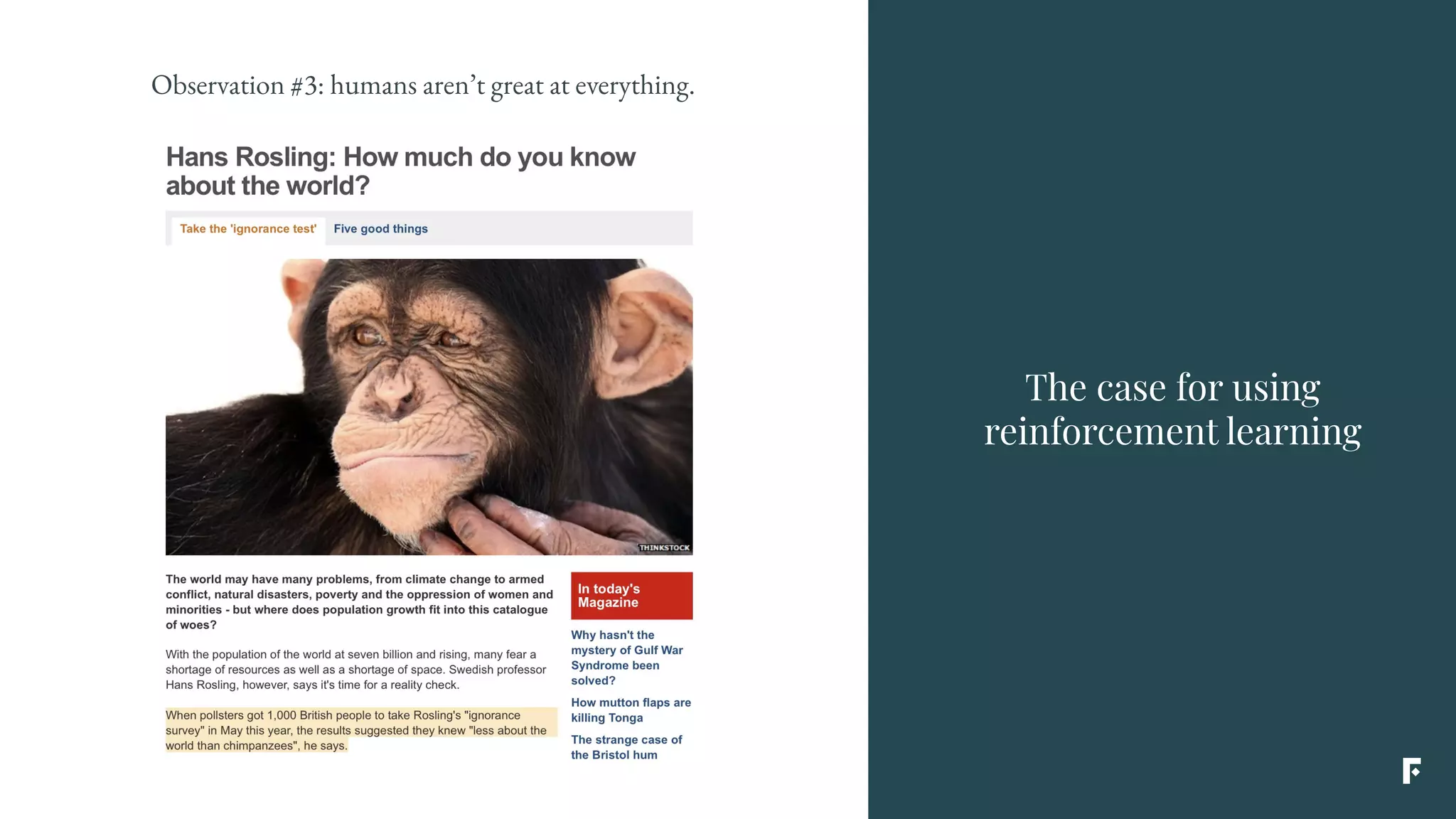
Observation #3: humans aren’t great at everything.
The case for using
reinforcement learning
Observation #4: deploying a supervised learning system itself
generates data from a new distribution. However, it still has
its roots in human expertise.
The case for using
reinforcement learning
Is this type of source information really the way to go? Is it
really the correct signal?
The case for using
reinforcement learning
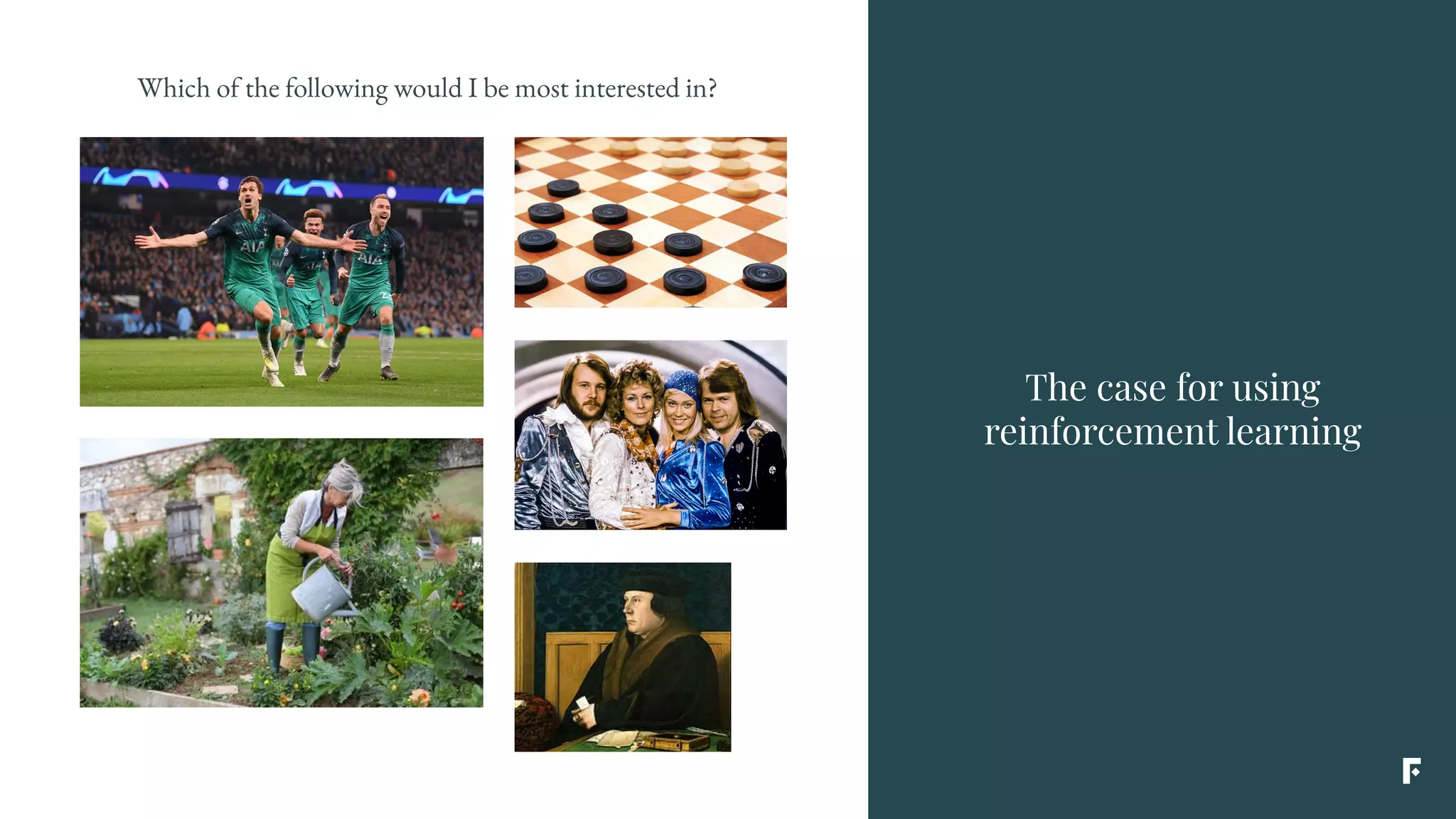
I don’t think so. Let me elaborate with an example.
The case for using
reinforcement learning
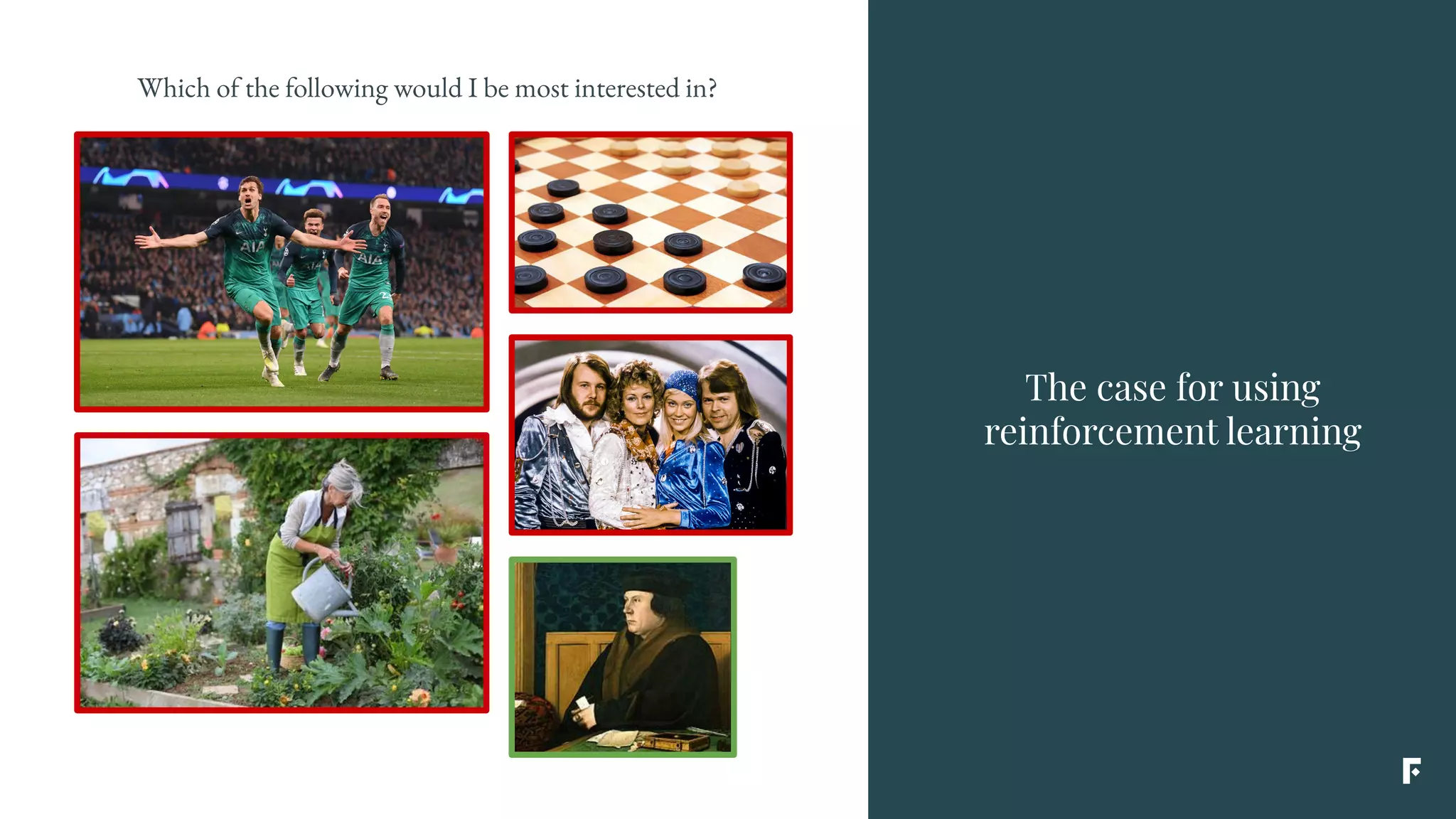
Which of the following would I be most interested in?
The case for using
reinforcement learning
Which of the following would I be most interested in?
The case for using
reinforcement learning
Personal opinion: the only way to uncover the correct signal is
to assume nothing, try out different things (explore), and
learn to act optimally (exploit) based on environmental
feedback. It’s causal by nature. Everything else is a hack*.
* supervised learning can be a massively useful, perhaps even glorious,
hack, but it is still a hack.
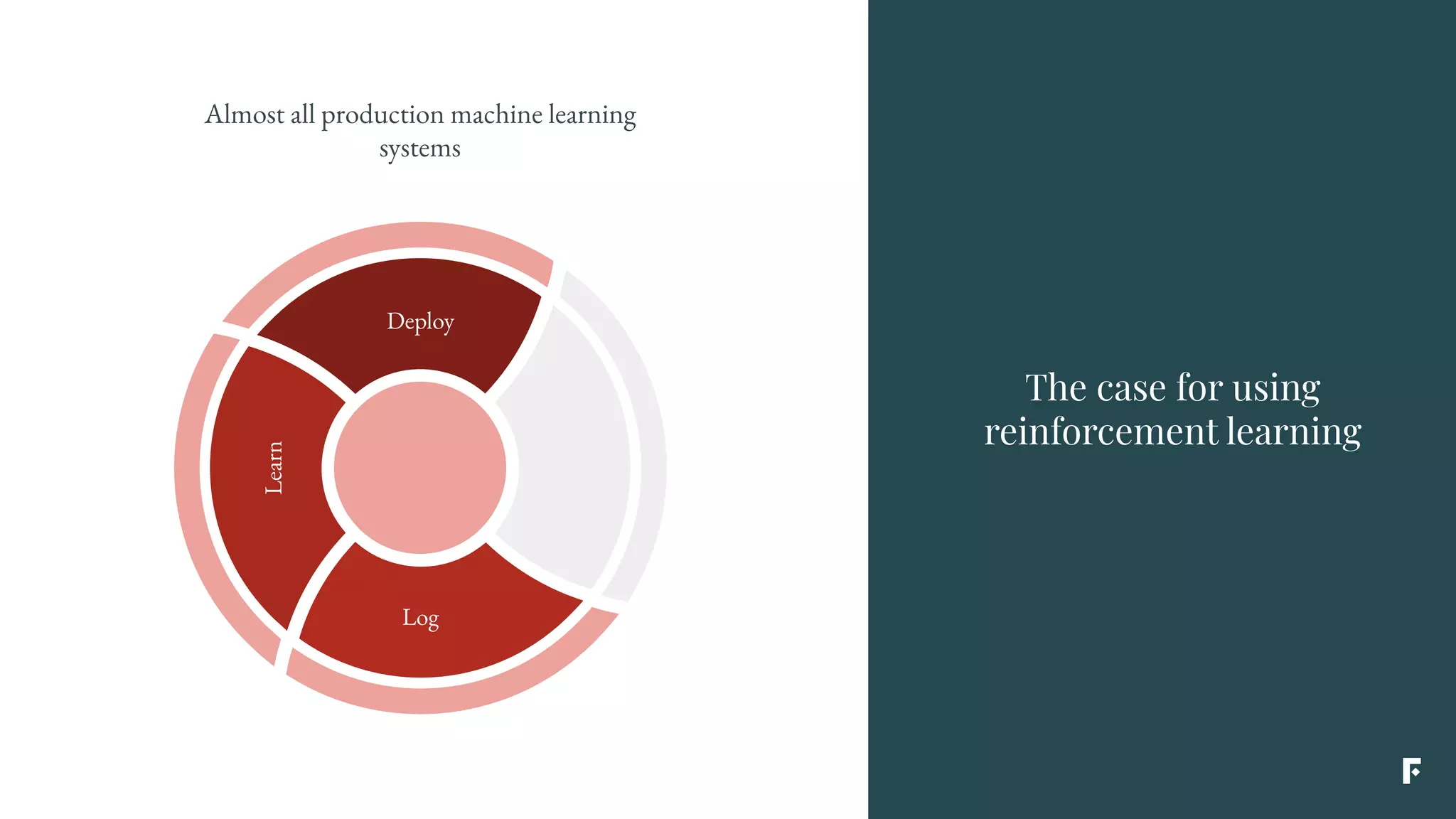
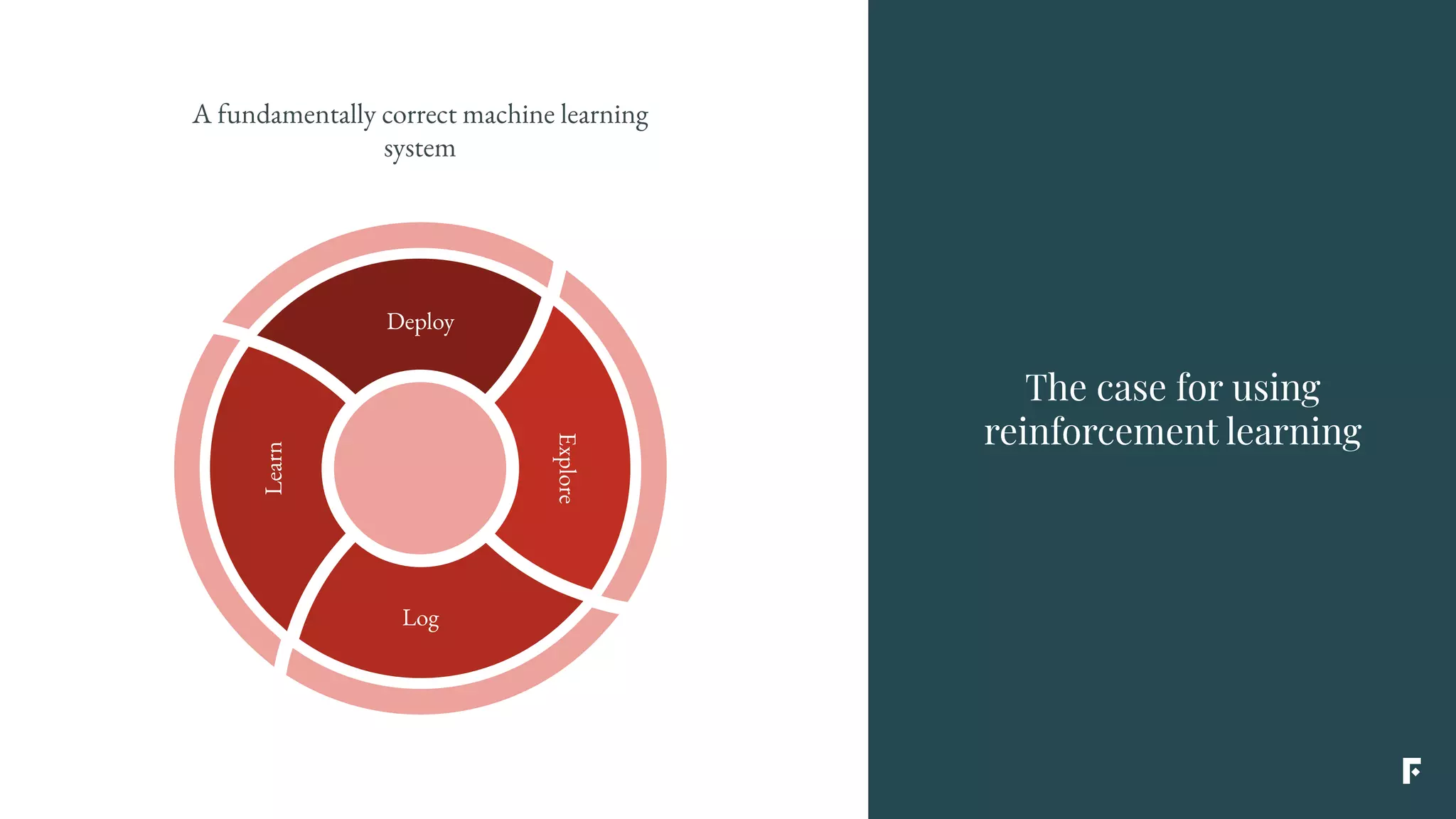
Learn
Log
Deploy
Almost all production machine learning
systems
The case for using
reinforcement learning
A fundamentally correct machine learning
system
Learn
Log
Explore
Deploy
The case for using
reinforcement learning
The case for using
reinforcement learning
If you agree with this train of thought, it begs a question: why
don’t we use more reinforcement learning?
The problem with reinforcement learning
The problem with
reinforcement learning
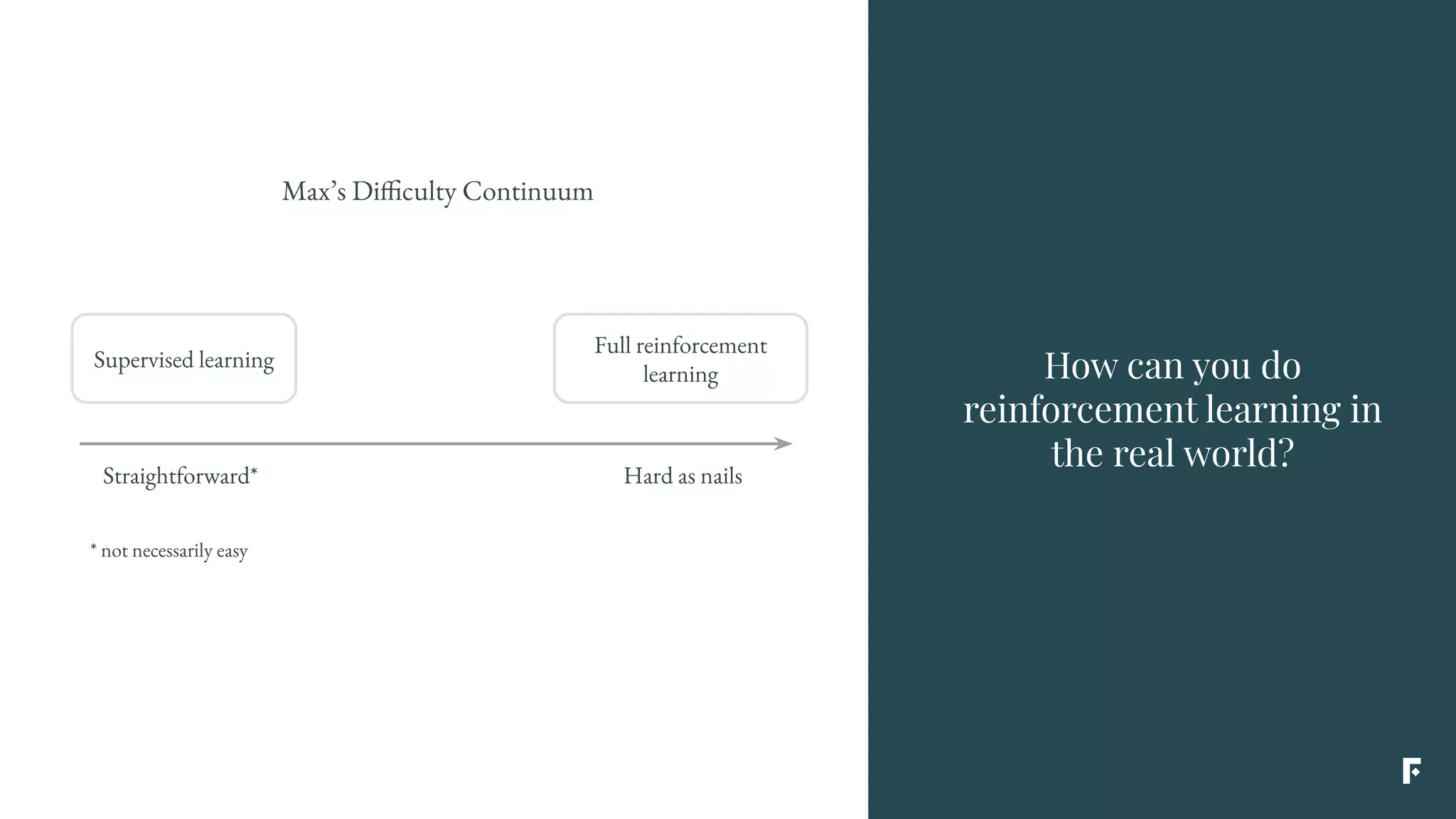
Put bluntly: it’s very difficult.
The problem with
reinforcement learning
Supervised learning
Full reinforcement
learning
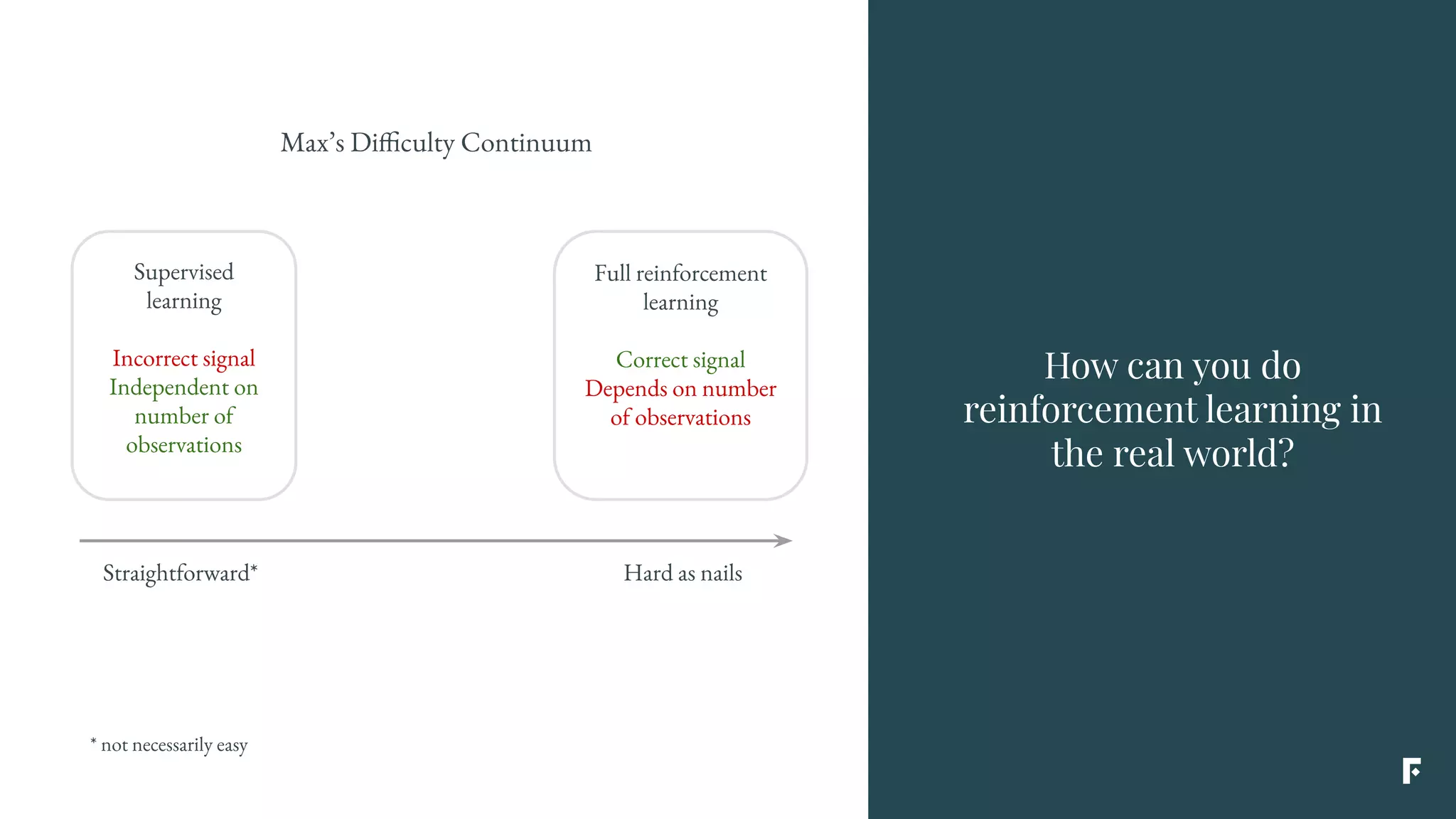
Max’s Difficulty Continuum
* not necessarily easy
Straightforward* Hard as nails
The problem with
reinforcement learning
Why is reinforcement learning so difficult to do?
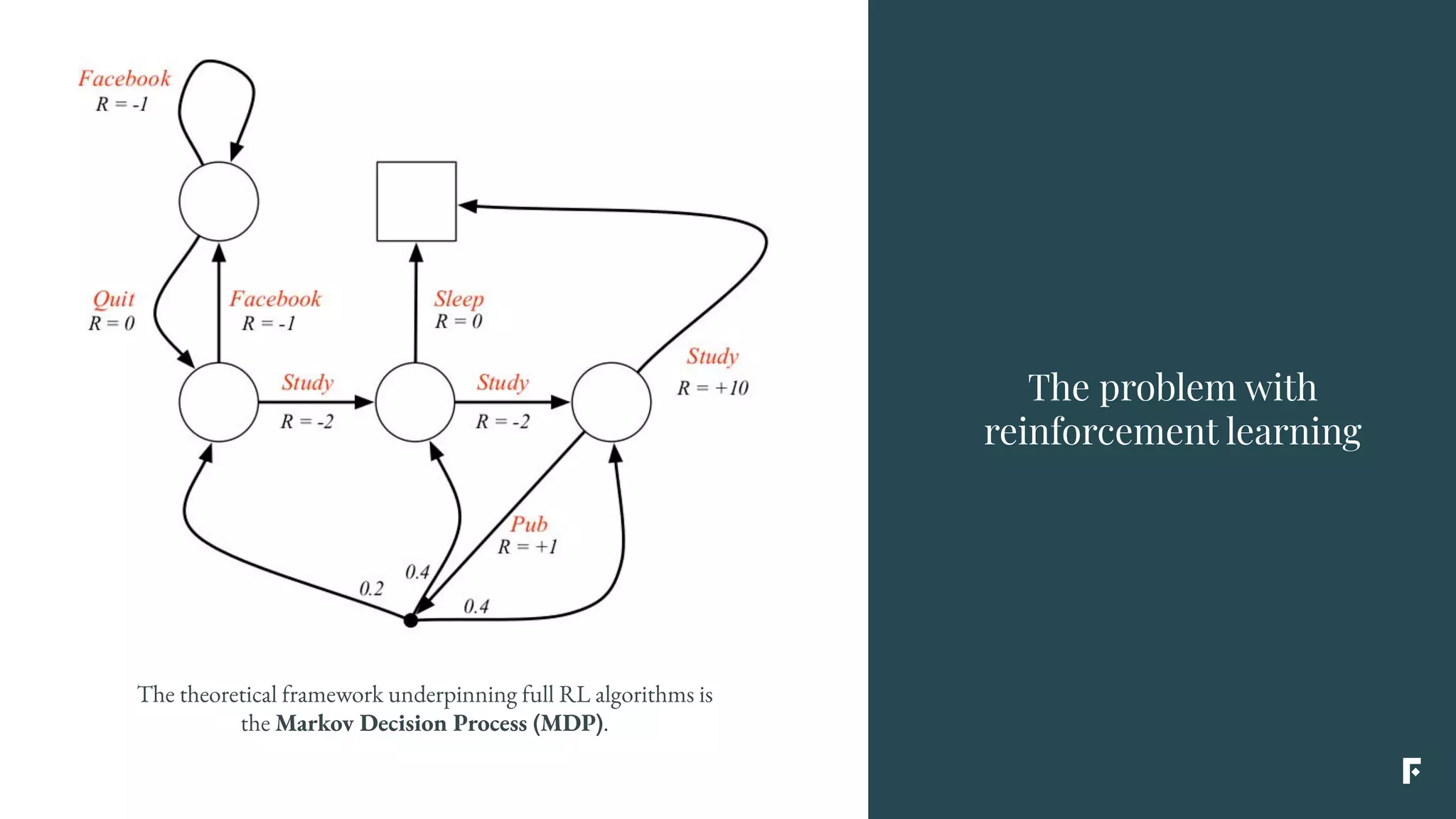
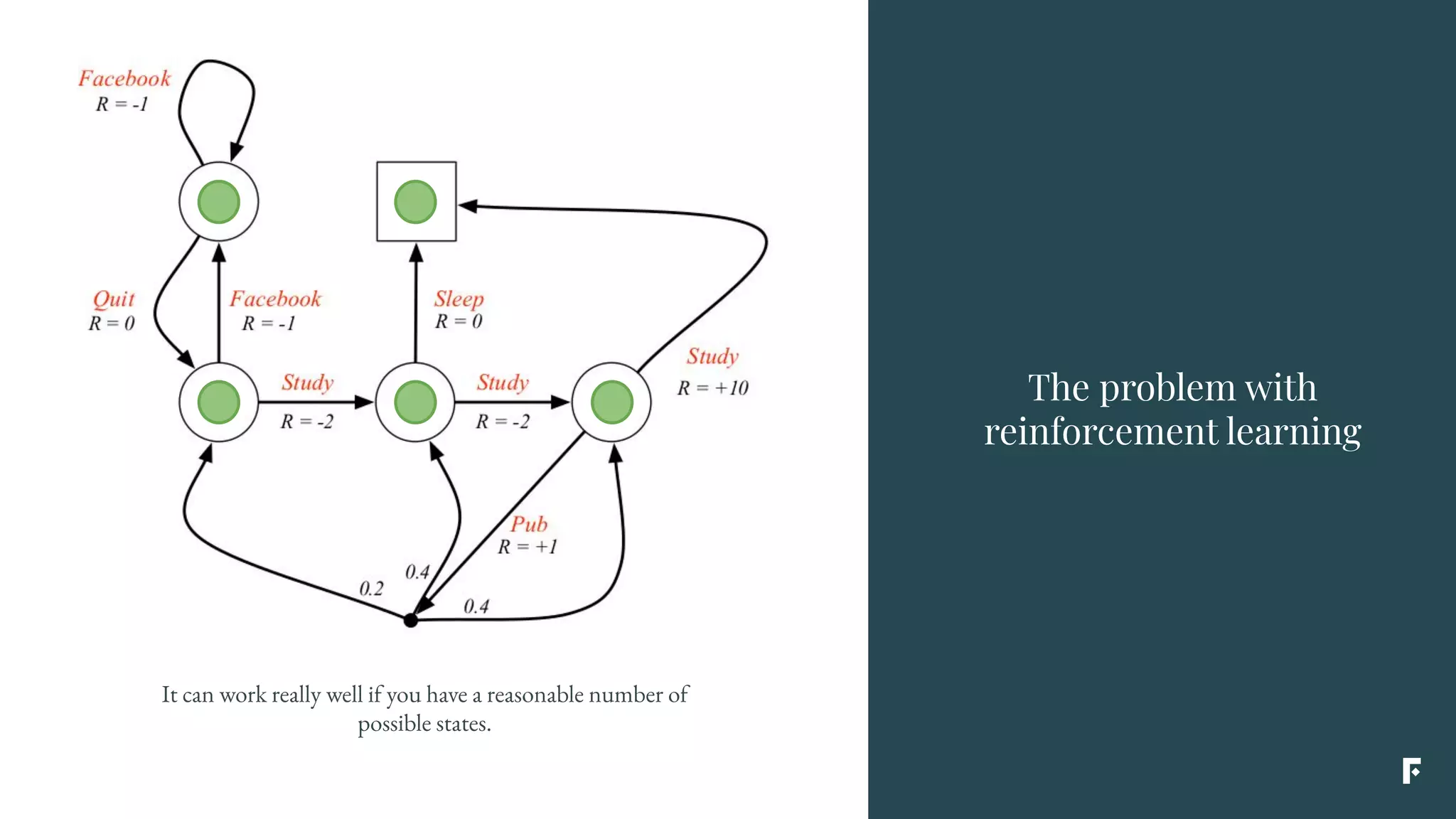
The theoretical framework underpinning full RL algorithms is
the Markov Decision Process (MDP).
The problem with
reinforcement learning
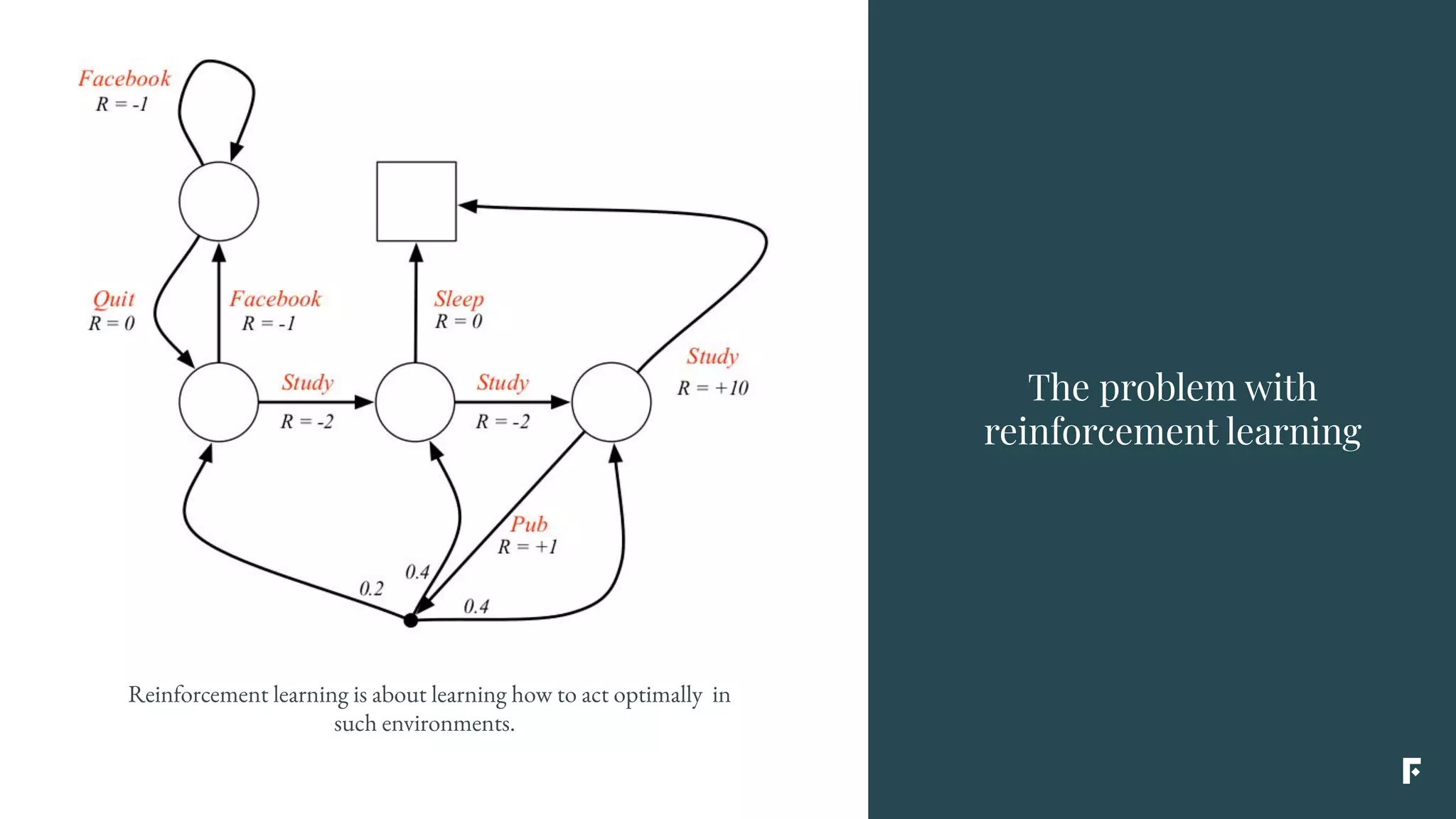
Reinforcement learning is about learning how to act optimally in
such environments.
The problem with
reinforcement learning
It can work really well if you have a reasonable number of
possible states.
The problem with
reinforcement learning
The problem with
reinforcement learning
Unfortunately, for many real-world problems, we have an
insane amount of possible states.
The problem with
reinforcement learning
An insane state space requires an insane amount of training
data to learn a good agent.
The problem with
reinforcement learning
For real-world problems, there usually isn’t an insane amount
of data on tap.
The problem with
reinforcement learning
The standard way to deal with this is to build an
environment simulator, that generates an endless supply of
states & rewards.
This works in constrained, fully digital settings like games.
But for loads of real-world problems, you literally can’t build
a simulator.
The case for using
reinforcement learning
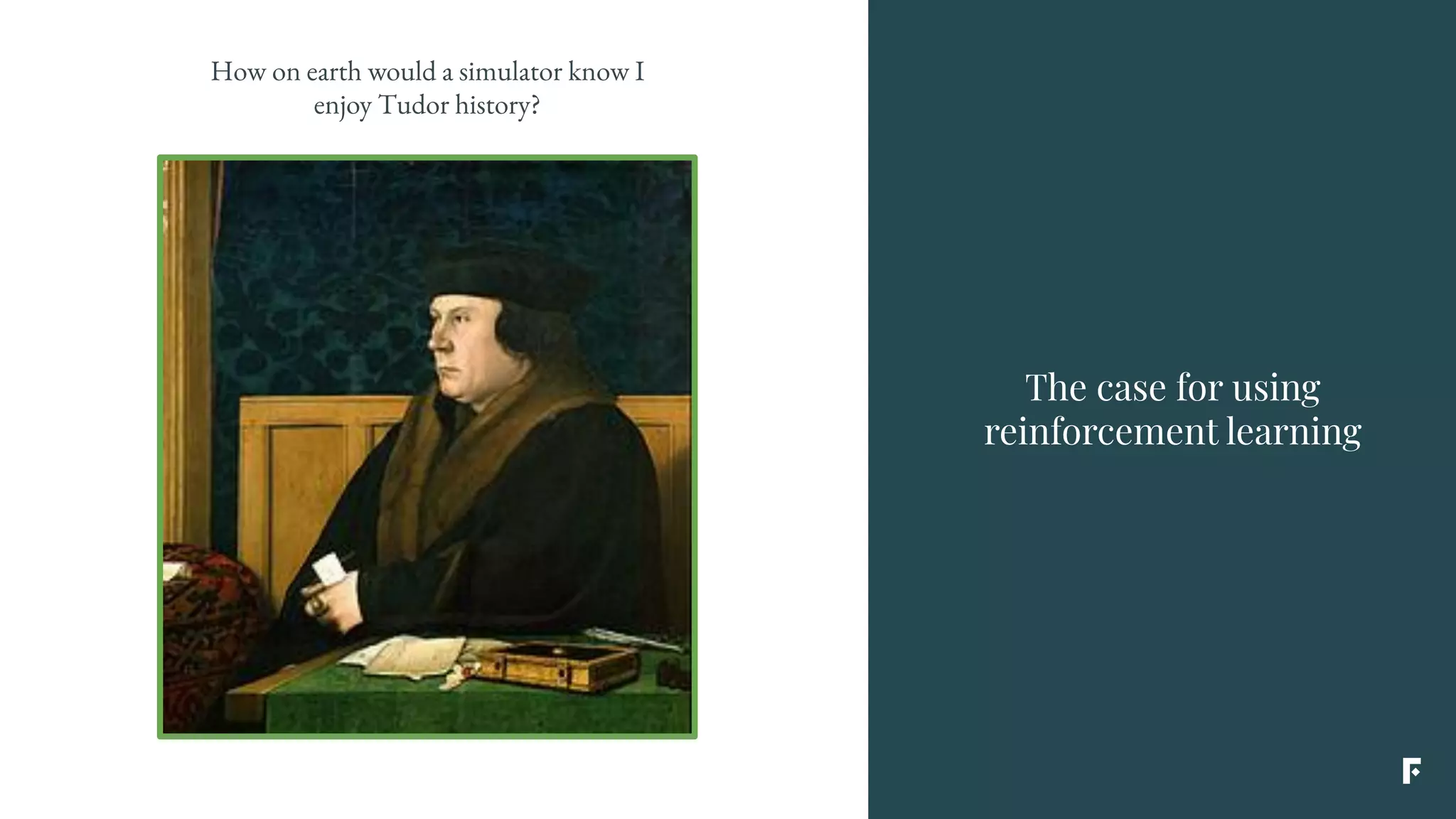
How on earth would a simulator know I
enjoy Tudor history?
The case for using
reinforcement learning
It can’t.
The problem with
reinforcement learning
That’s not the only problem.
The problem with
reinforcement learning
In a full reinforcement learning setting, rewards can arrive
immediately, or sometime in the future.
The problem with
reinforcement learning
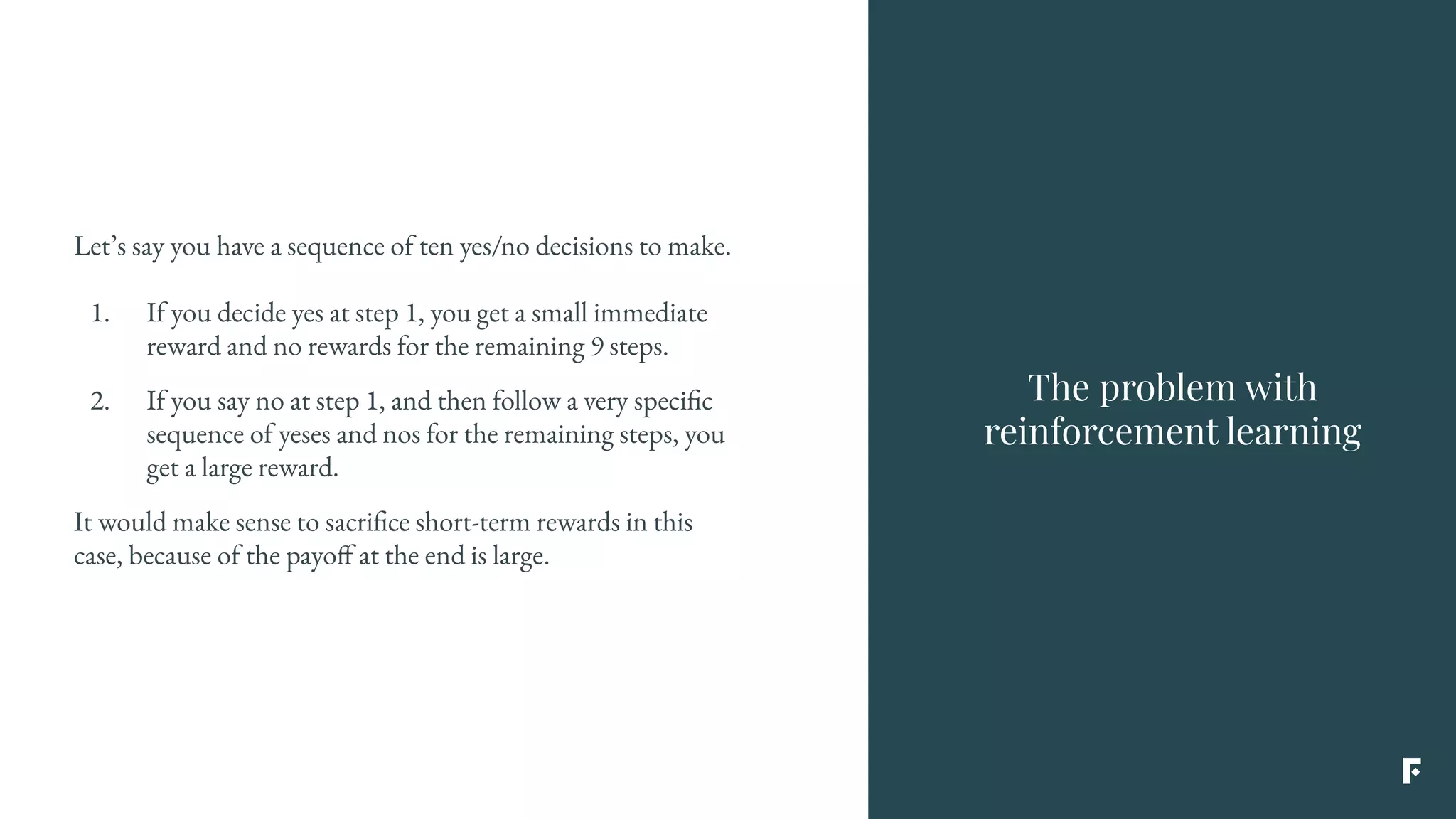
Let’s say you have a sequence of ten yes/no decisions to make.
1. If you decide yes at step 1, you get a small immediate
reward and no rewards for the remaining 9 steps.
2. If you say no at step 1, and then follow a very specific
sequence of yeses and nos for the remaining steps, you
get a large reward.
It would make sense to sacrifice short-term rewards in this
case, because of the payoff at the end is large.
The problem with
reinforcement learning
Consequence: you need to be able to learn to assign (partial)
rewards to actions that possibly happened a long time ago.
This is known as the credit assignment problem. Solving
this problem means full RL algorithms necessarily depend
on the number of observations, exacerbating the sample
complexity issue even more.
The problem with
reinforcement learning
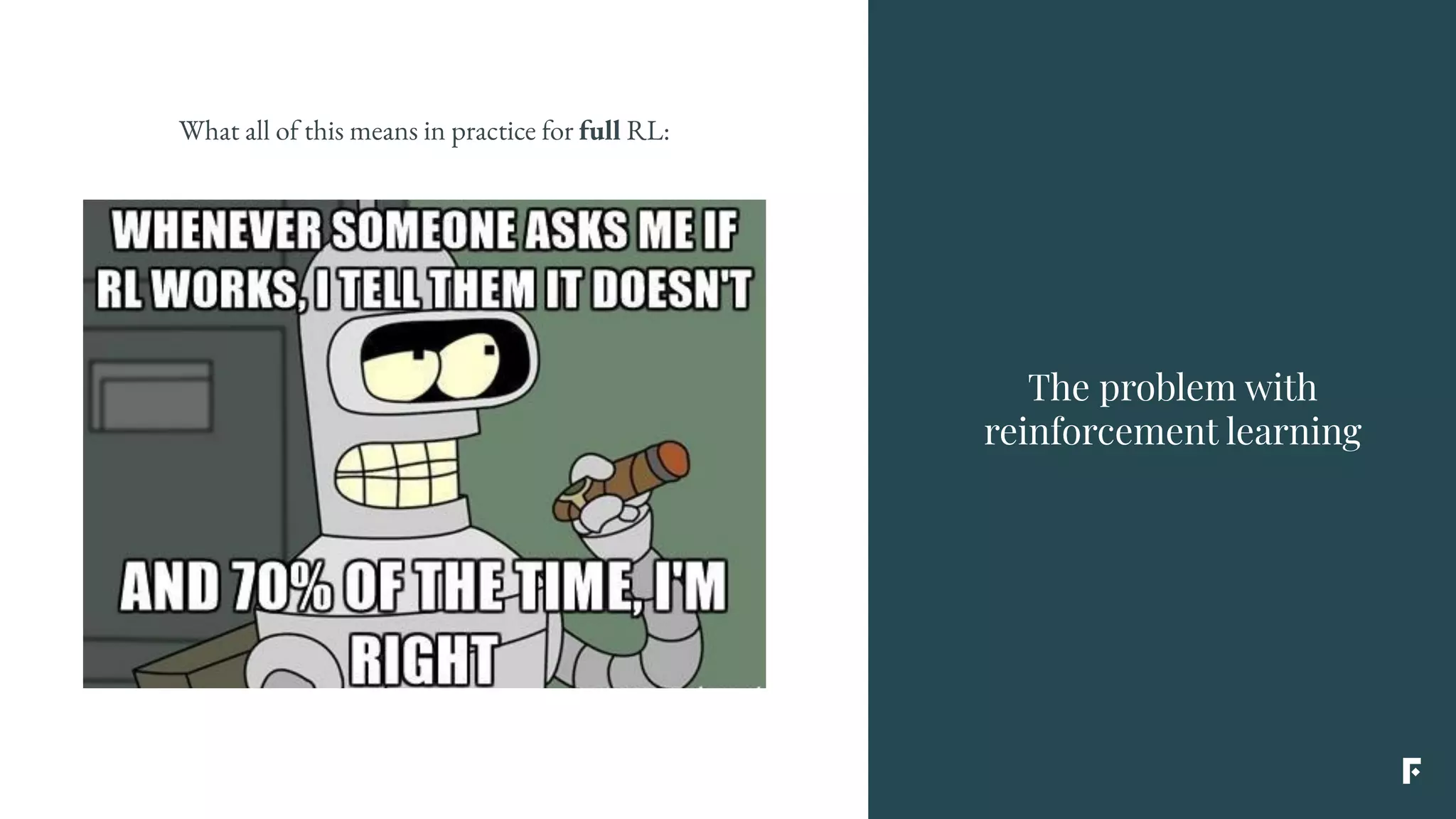
What all of this means in practice for full RL:
The problem with
reinforcement learning
Despite all the issues, RL is still much too promising to
give up on. If we solve RL in real-world settings, we stand to
advance the state of the art significantly.
The problem with
reinforcement learning
So how to we do it? Currently, via a set of clever tricks and
simplifications. We aren’t yet able to solve all real-world RL
problems, but you’d be surprised what we can solve today.
How can you do reinforcement learning
in the real world?
How can you do
reinforcement learning in
the real world?
Currently: via some simplifications.
Let’s look at the Difficulty Continuum again, and add some
pros & cons.
Supervised learning
Full reinforcement
learning
Max’s Difficulty Continuum
* not necessarily easy
Straightforward* Hard as nails
How can you do
reinforcement learning in
the real world?
Straightforward* Hard as nails
Supervised
learning
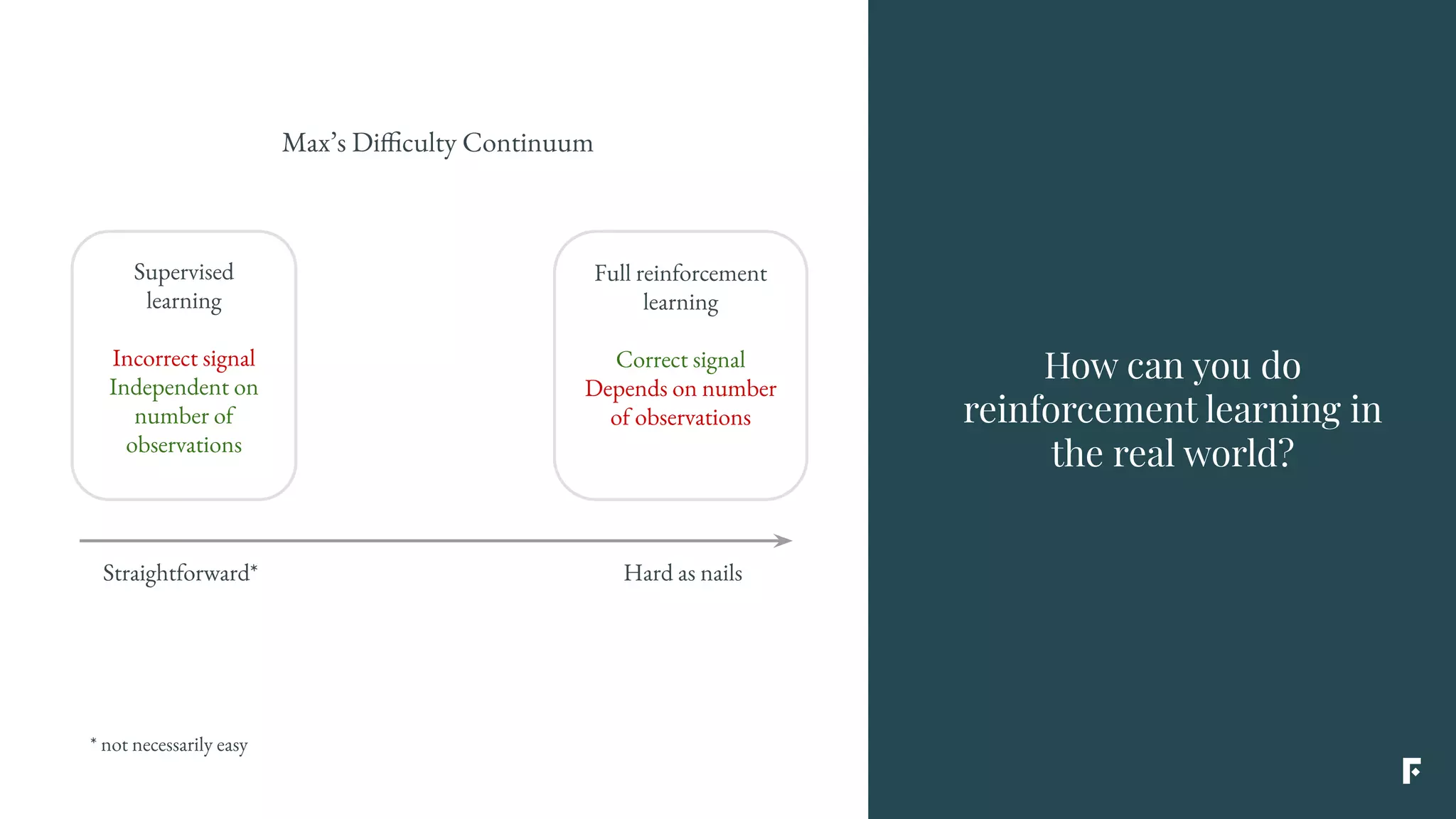
Incorrect signal
Independent on
number of
observations
Full reinforcement
learning
Correct signal
Depends on number
of observations
Max’s Difficulty Continuum
* not necessarily easy
How can you do
reinforcement learning in
the real world?
If we can find a way to get rid of the dependence on sample
size, yet preserve the correctness of signal as well as possible,
we are on to something.
But can we?
How can you do
reinforcement learning in
the real world?
Yes. By making some simple yet critical modifications to
the full RL problem, we can make reinforcement learning
agents capable of solving a huge amount of real-world
problems. Not all problems, but a significant portion.
How can you do
reinforcement learning in
the real world?
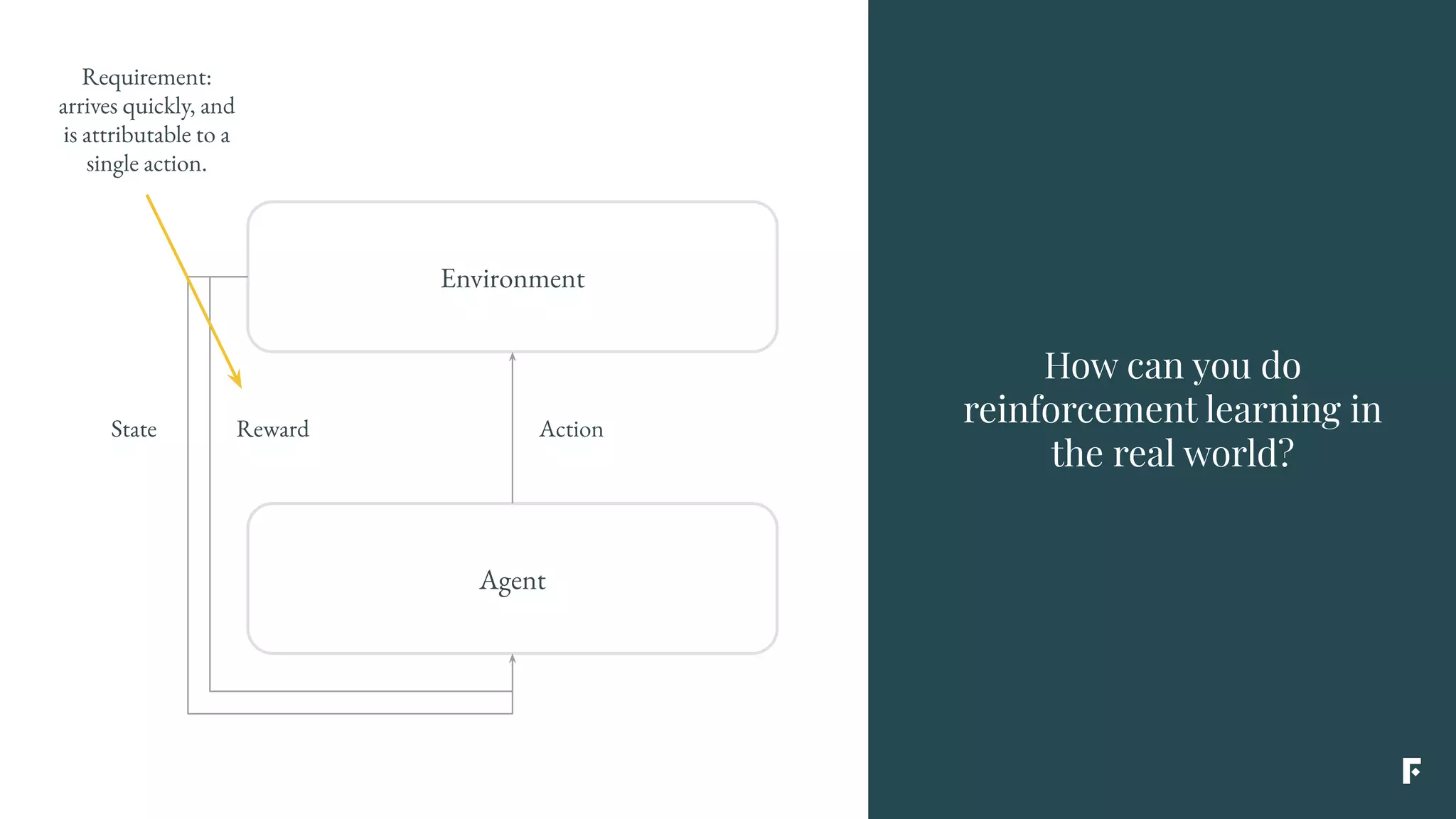
Simplification #1: we are going to require that the reward for
an action is revealed (almost) immediately and, more
importantly, that is is attributable only to the previous action.
How can you do
reinforcement learning in
the real world?
Environment
Agent
ActionRewardState
Requirement:
arrives quickly, and
is attributable to a
single action.
How can you do
reinforcement learning in
the real world?
Q: Isn’t the immediate reward requirement a problem?
A: It depends. Though tricky, there is a huge class of
problems for which you can find short-term proxy rewards
that align well with long-term rewards. This is especially true
in online applications.
How can you do
reinforcement learning in
the real world?
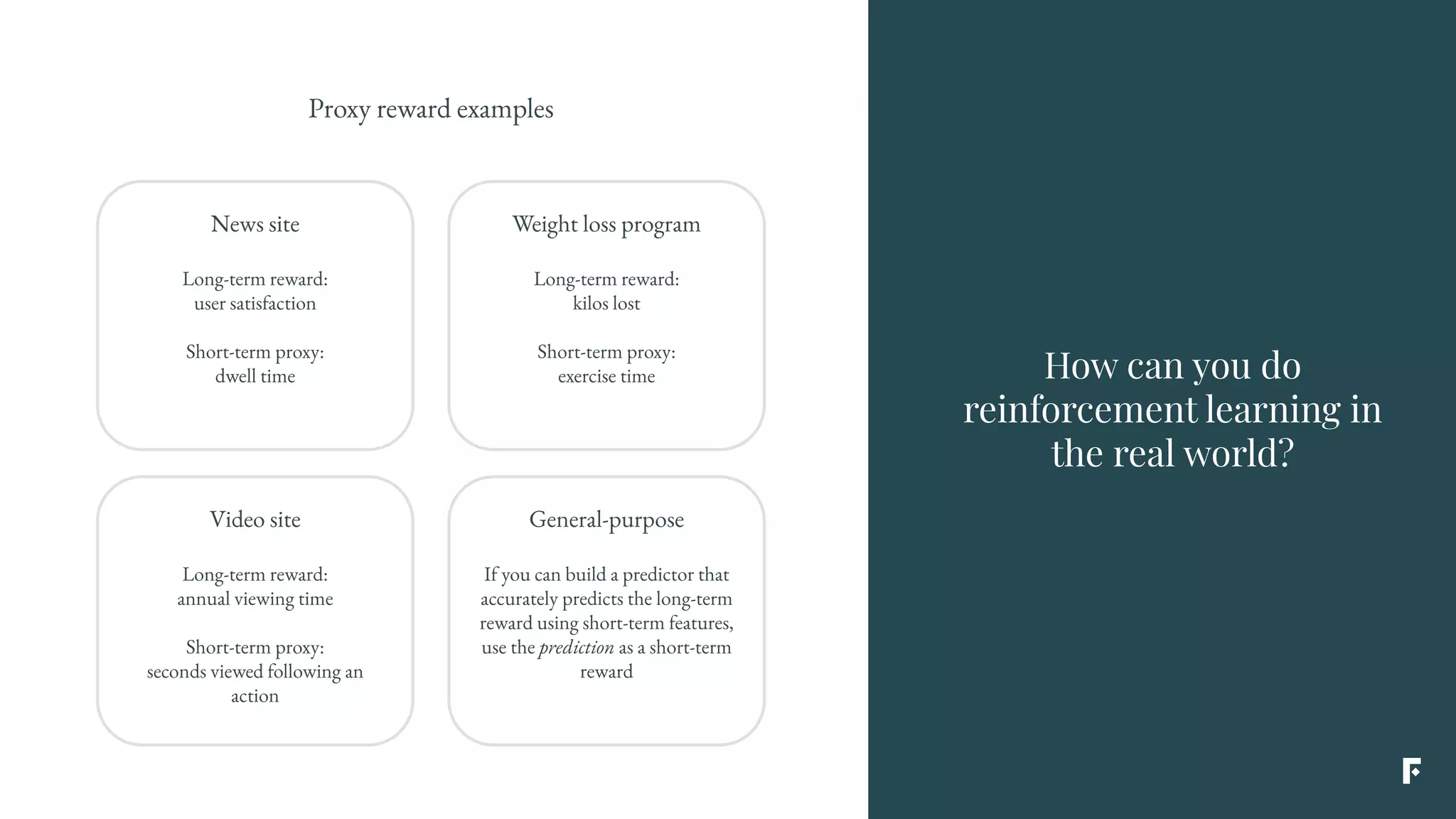
Proxy reward examples
News site
Long-term reward:
user satisfaction
Short-term proxy:
dwell time
Weight loss program
Long-term reward:
kilos lost
Short-term proxy:
exercise time
Video site
Long-term reward:
annual viewing time
Short-term proxy:
seconds viewed following an
action
General-purpose
If you can build a predictor that
accurately predicts the long-term
reward using short-term features,
use the prediction as a short-term
reward
How can you do
reinforcement learning in
the real world?
Simplification #2: we are going to require that possible states
do not depend on previous actions we took.
How can you do
reinforcement learning in
the real world?
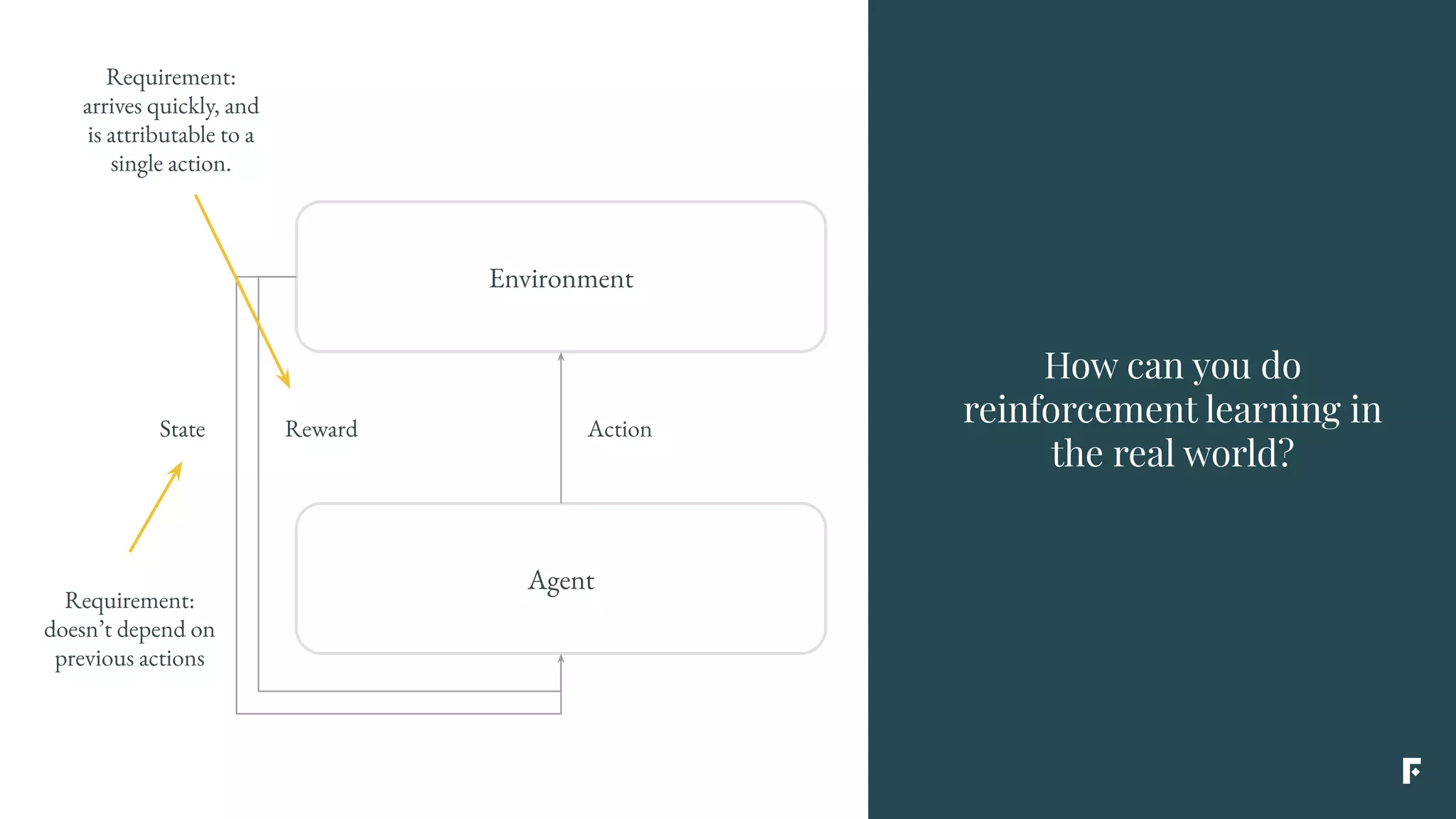
Environment
Agent
ActionRewardState
Requirement:
arrives quickly, and
is attributable to a
single action.
Requirement:
doesn’t depend on
previous actions
How can you do
reinforcement learning in
the real world?
Given these simplifications, we have what is known as
immediate-reward reinforcement learning, or contextual
bandits as it’s more commonly known.
How can you do
reinforcement learning in
the real world?
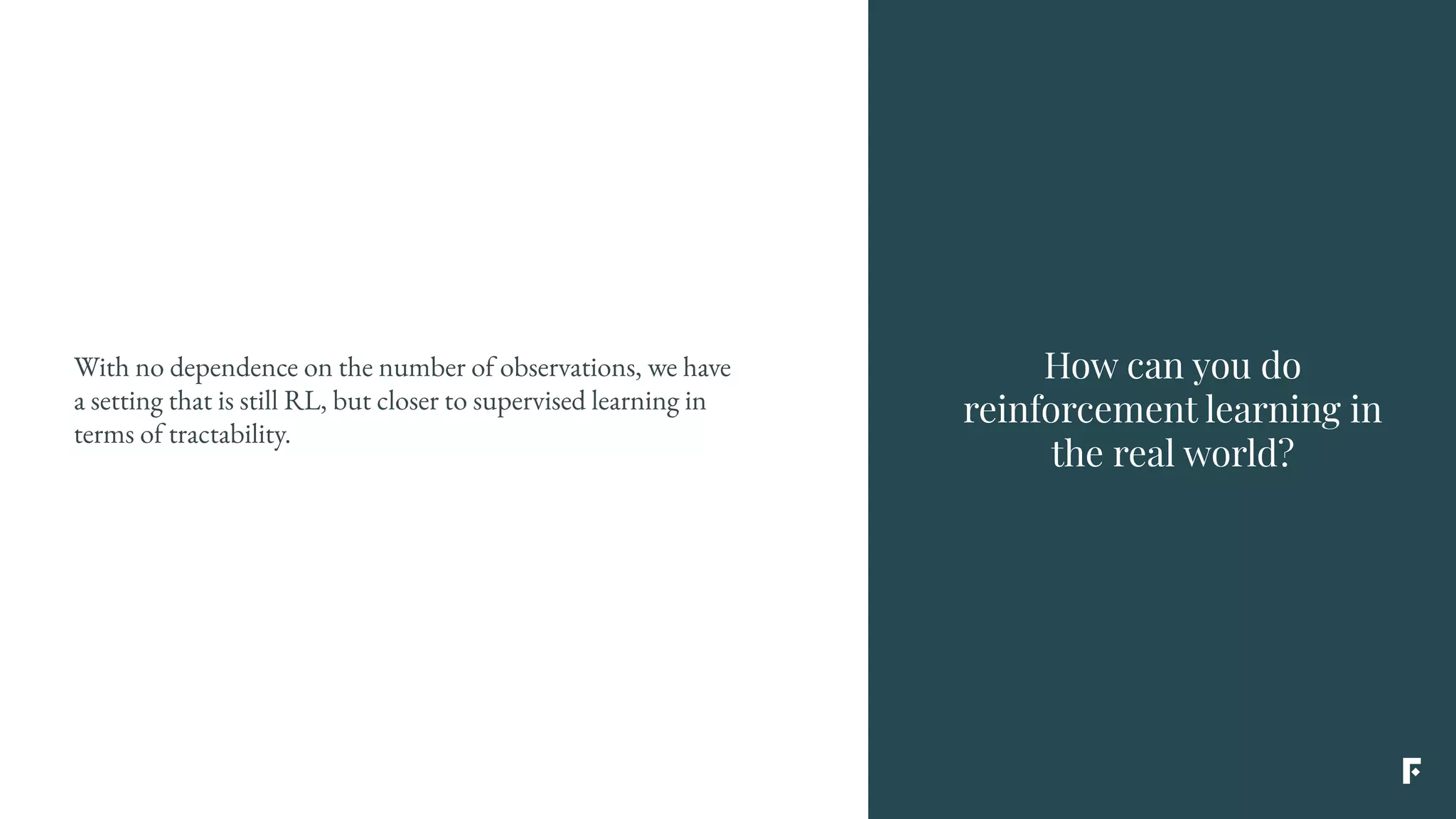
With no dependence on the number of observations, we have
a setting that is still RL, but closer to supervised learning in
terms of tractability.
How can you do
reinforcement learning in
the real world?
Straightforward* Hard as nails
Supervised
learning
Incorrect signal
Independent on
number of
observations
Full reinforcement
learning
Correct signal
Depends on number
of observations
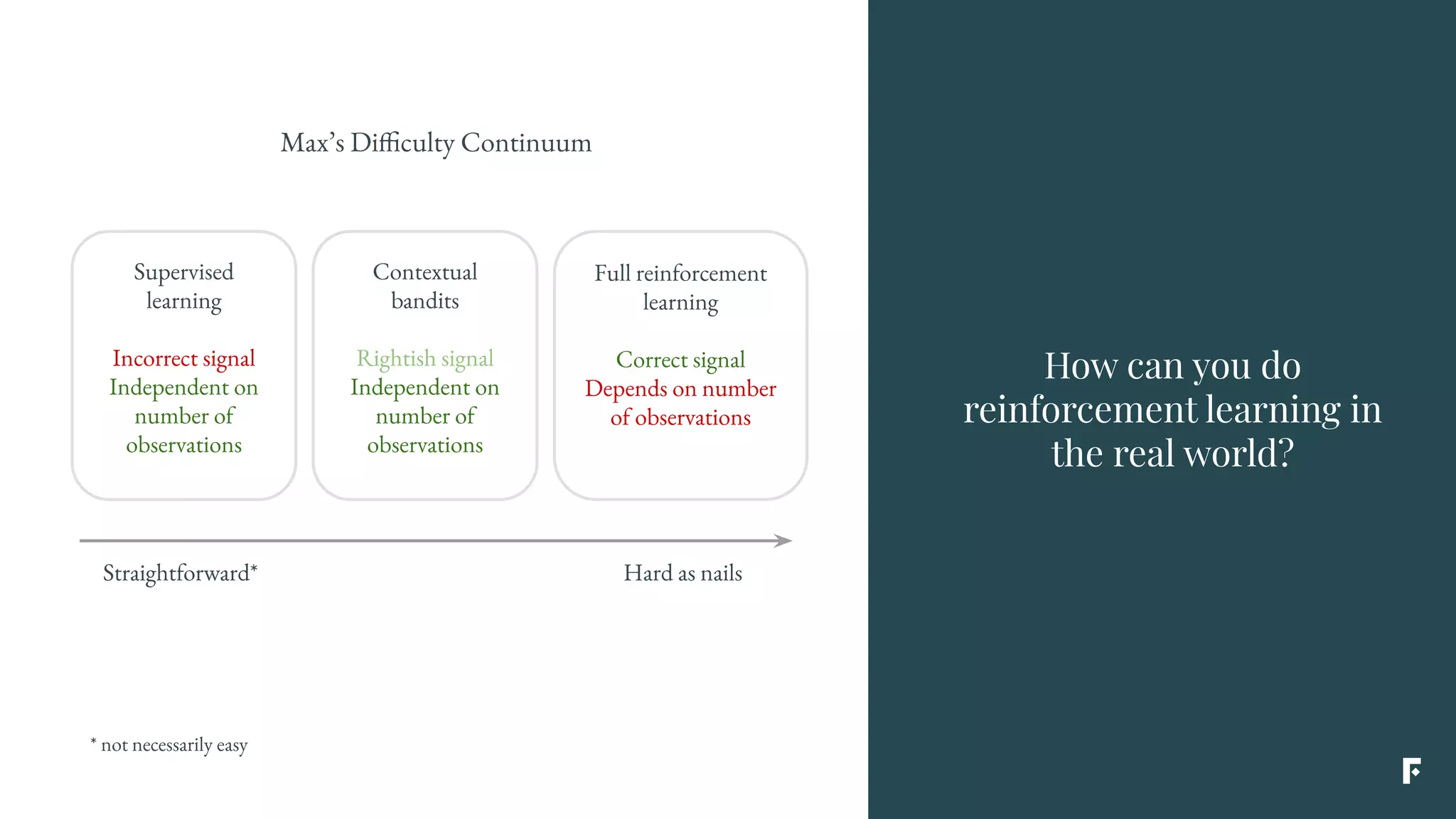
Max’s Difficulty Continuum
* not necessarily easy
How can you do
reinforcement learning in
the real world?
Straightforward* Hard as nails
Supervised
learning
Incorrect signal
Independent on
number of
observations
Full reinforcement
learning
Correct signal
Depends on number
of observations
Max’s Difficulty Continuum
* not necessarily easy
Contextual
bandits
Rightish signal
Independent on
number of
observations
How can you do
reinforcement learning in
the real world?
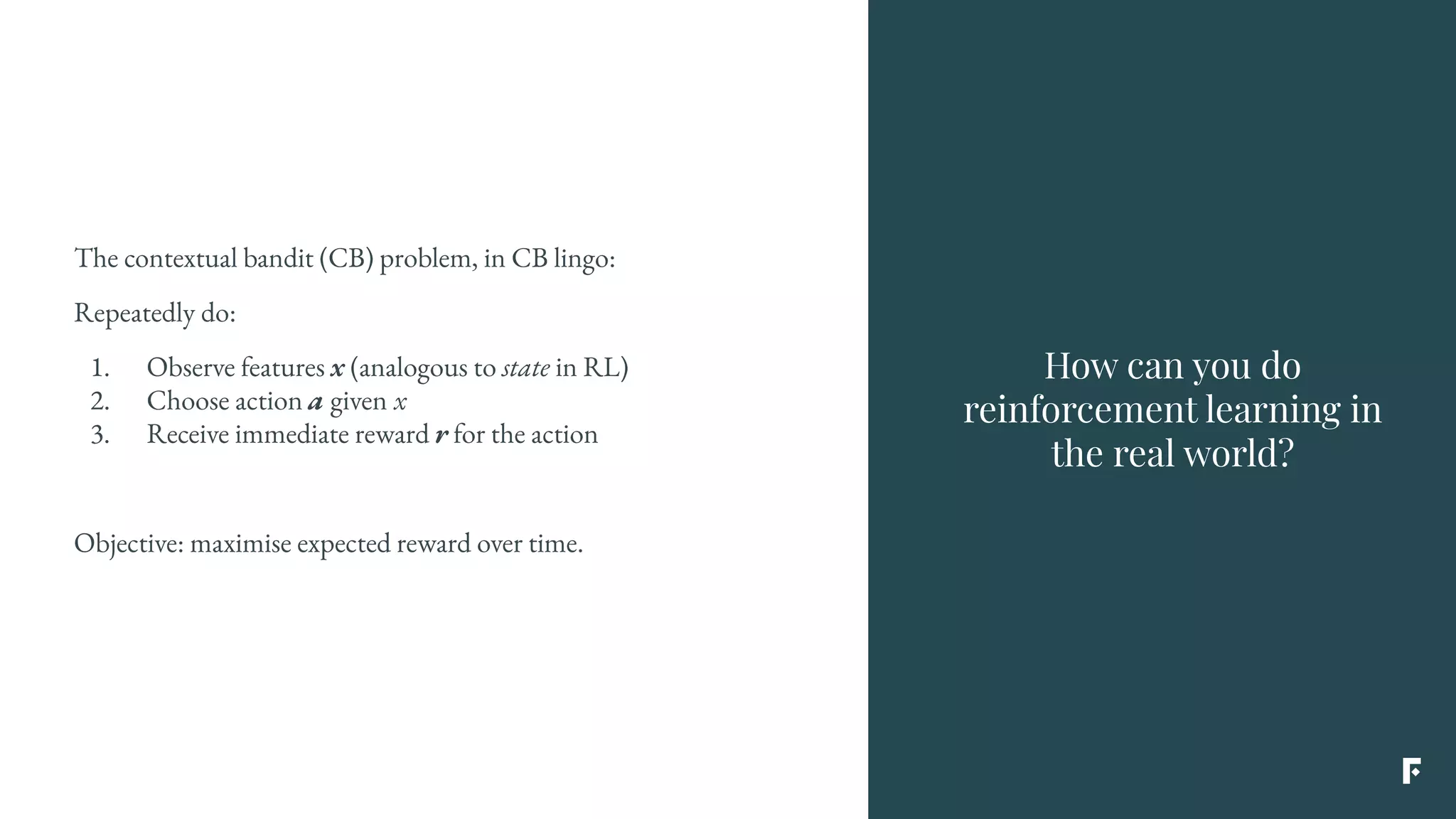
The contextual bandit (CB) problem, in CB lingo:
Repeatedly do:
1. Observe features x (analogous to state in RL)
2. Choose action a given x
3. Receive immediate reward r for the action
Objective: maximise expected reward over time.
How can you do
reinforcement learning in
the real world?
Given the simplifications, contextual bandit problems are
solveable using much less data than full RL problems. This
makes CBs an excellent candidate for solving real-world
problems.
How can you do
reinforcement learning in
the real world?
Next question: how might we go about solving a contextual
bandit problem?
How can you do
reinforcement learning in
the real world?
Let’s take a break: 20 minutes
Next question: how might we go about solving a contextual
bandit problem?
How can you do
reinforcement learning in
the real world?
One possible solution: ML reductions
One possible solution: ML
reductions
There are two approaches to solving a machine learning
problem:
1. Design new algorithms
2. Figure out how to reuse existing algorithms
The subfield of machine learning reductions focuses on 2).
It’s one of my favourite ML topics.
One possible solution: ML
reductions
General approach: reduce your original data distribution into
something that can be solved by an existing, simpler
algorithm. Solve and rollup the solution to solve your original
problem.
One possible solution: ML
reductions
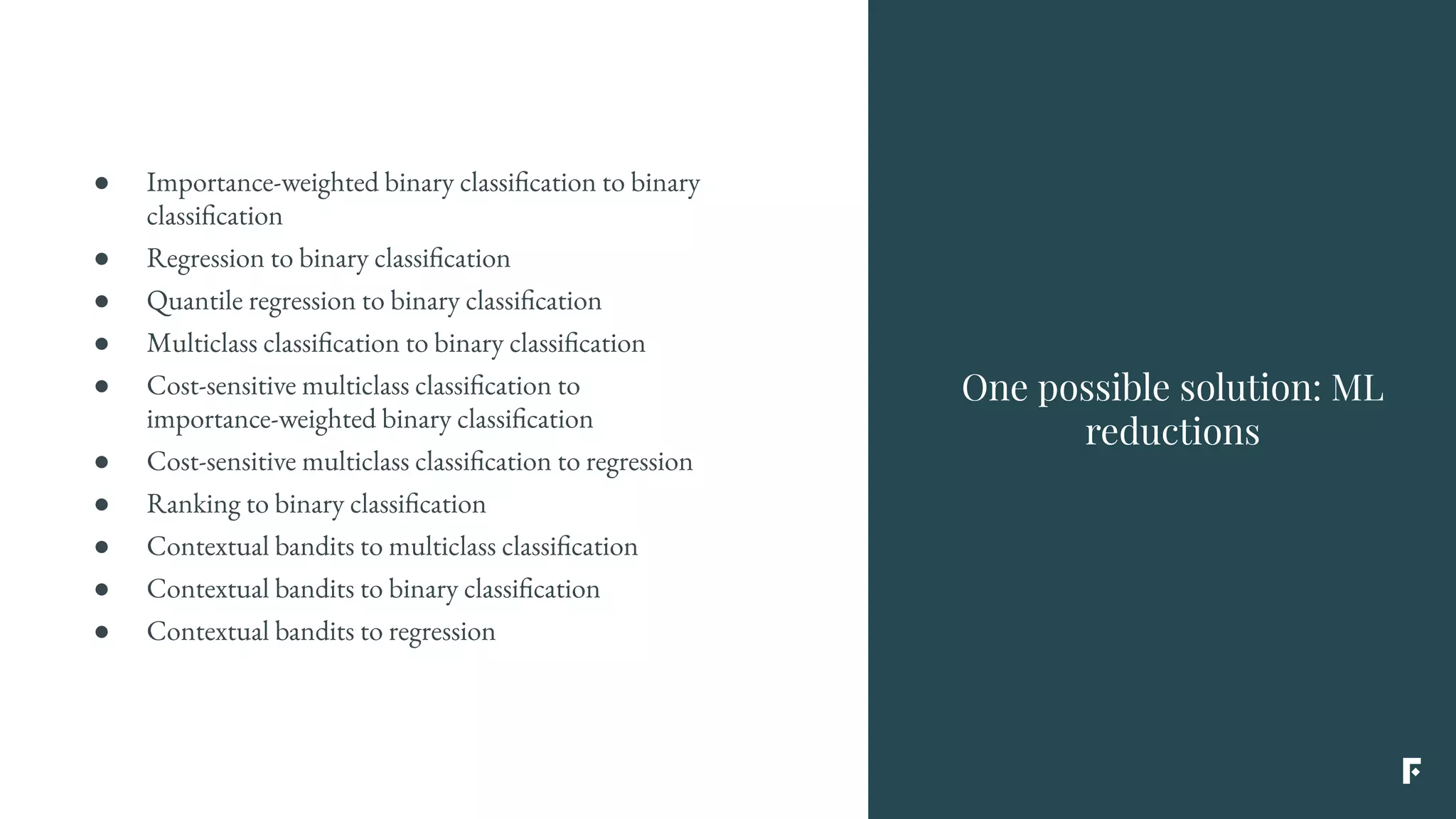
Some of these may be hard to believe, but using either a single
reduction or a stack of reductions, you can reduce at least the
following:
One possible solution: ML
reductions
● Importance-weighted binary classification to binary
classification
● Regression to binary classification
● Quantile regression to binary classification
● Multiclass classification to binary classification
● Cost-sensitive multiclass classification to
importance-weighted binary classification
● Cost-sensitive multiclass classification to regression
● Ranking to binary classification
● Contextual bandits to multiclass classification
● Contextual bandits to binary classification
● Contextual bandits to regression
One possible solution: ML
reductions
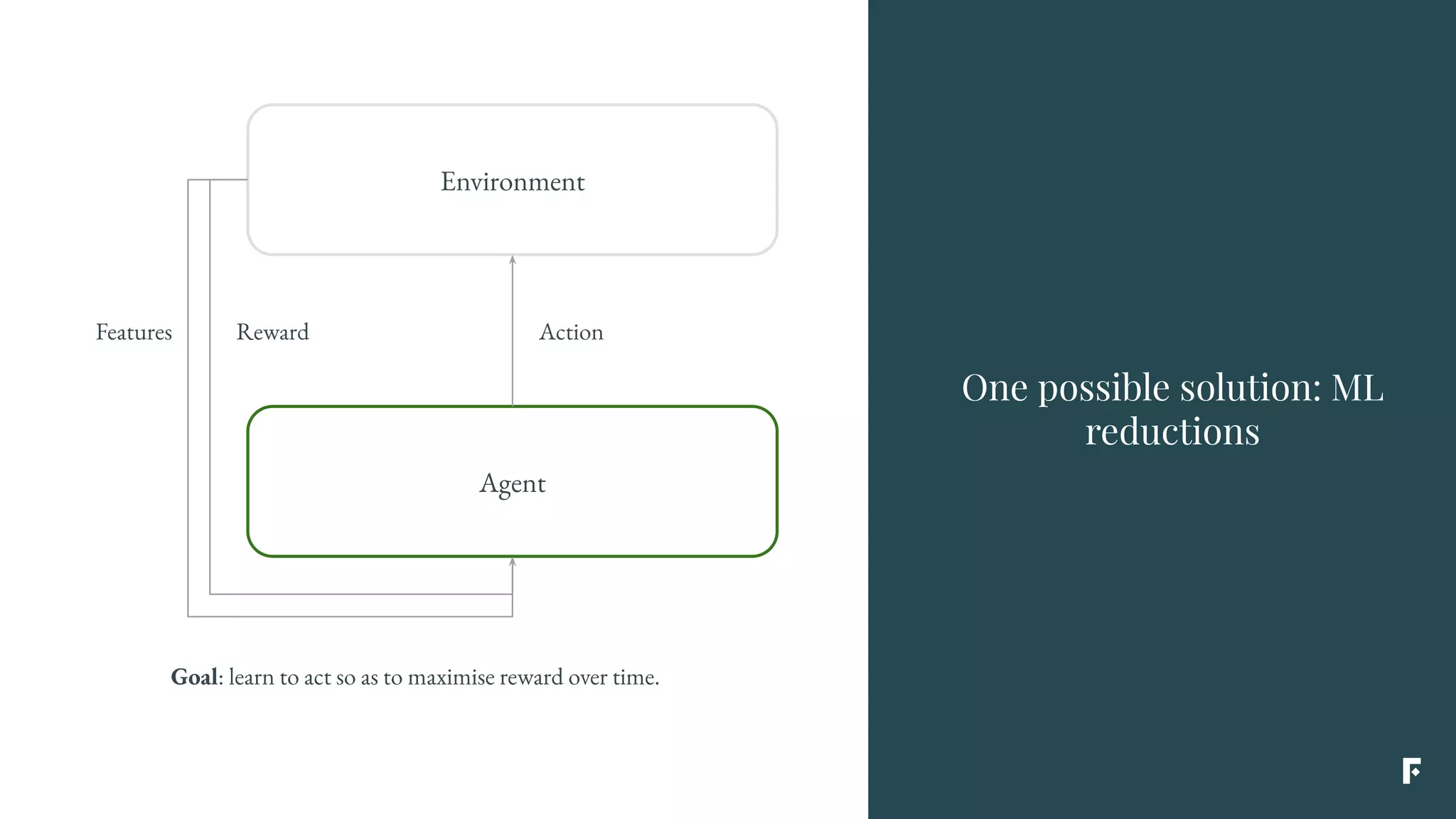
Putting our ML reductionist hat on, let’s take a closer look at
the agent part of the contextual bandit process.
Environment
Agent
Goal: learn to act so as to maximise reward over time.
ActionRewardFeatures
One possible solution: ML
reductions
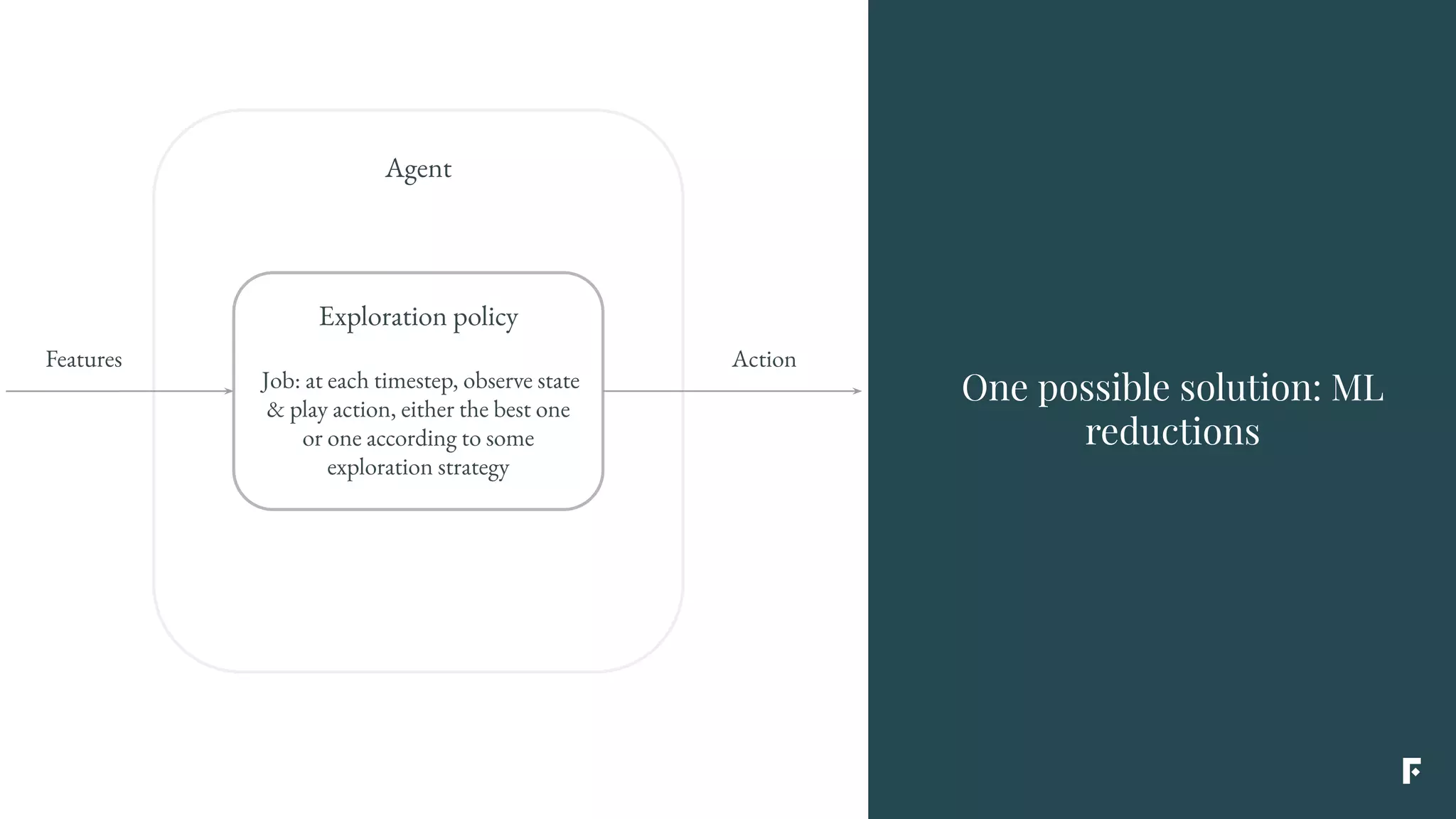
Agent
Exploration policy
Job: at each timestep, observe state
& play action, either the best one
or one according to some
exploration strategy
Features Action
One possible solution: ML
reductions
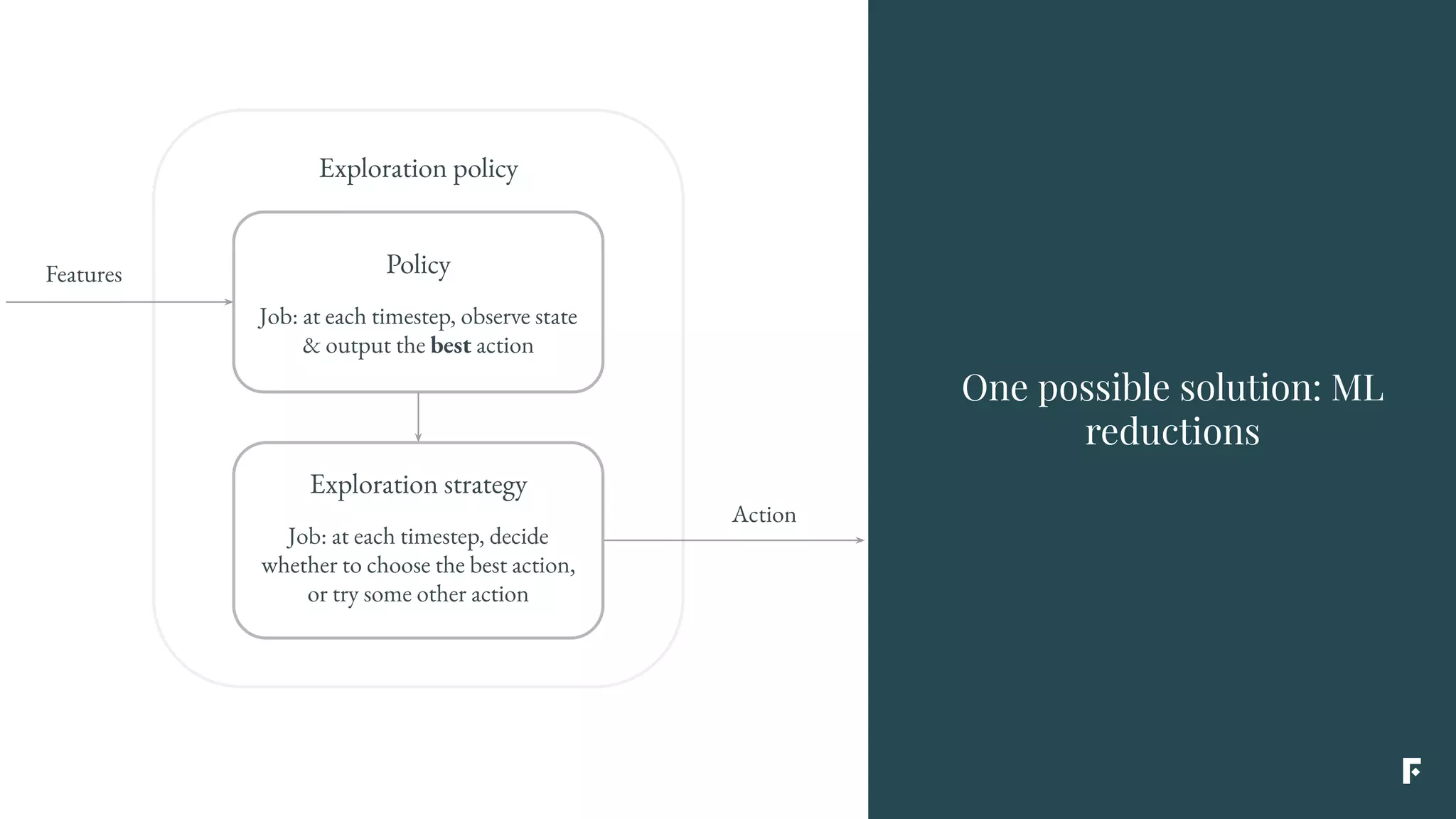
Exploration policy
Policy
Job: at each timestep, observe state
& output the best action
Features
Action
Exploration strategy
Job: at each timestep, decide
whether to choose the best action,
or try some other action
One possible solution: ML
reductions
You could argue finding the best way to explore is basically
what RL is all about. It’s such a broad topic that we’ll skip it*
in this talk, and focus on the policy itself.
*give me a shout after the talk if this is something you’d like to learn
more about.
One possible solution: ML
reductions
A policy is a learned function that takes a state as input and
outputs a prediction of the best action.
Replace “state” with “features” and “action” with “class” and
you get:
….a learned function that takes a features as input and
outputs a prediction of the best class.
Another way to think about this: a policy is a classifier that
acts.
One possible solution: ML
reductions
*Puts reductionist hat on*: all of this sounds an awful lot like
supervised learning.
One possible solution: ML
reductions
Supervised learning assumes a full information setting, so we
can’t use it directly. The bad, and beautiful, thing about
reinforcement learning is that you never get to see rewards
for actions you didn’t take.
One possible solution: ML
reductions
However, it is possible to fill in “fake” reward information in
such a way that you get a dataset without missing
observations.
One possible solution: ML
reductions
This doesn’t seem possible, but it is (we’ll learn one technique
later on). And this is massively exciting, because it means we
can solve the policy part of contextual bandits with any
supervised learning classifier.
One possible solution: ML
reductions
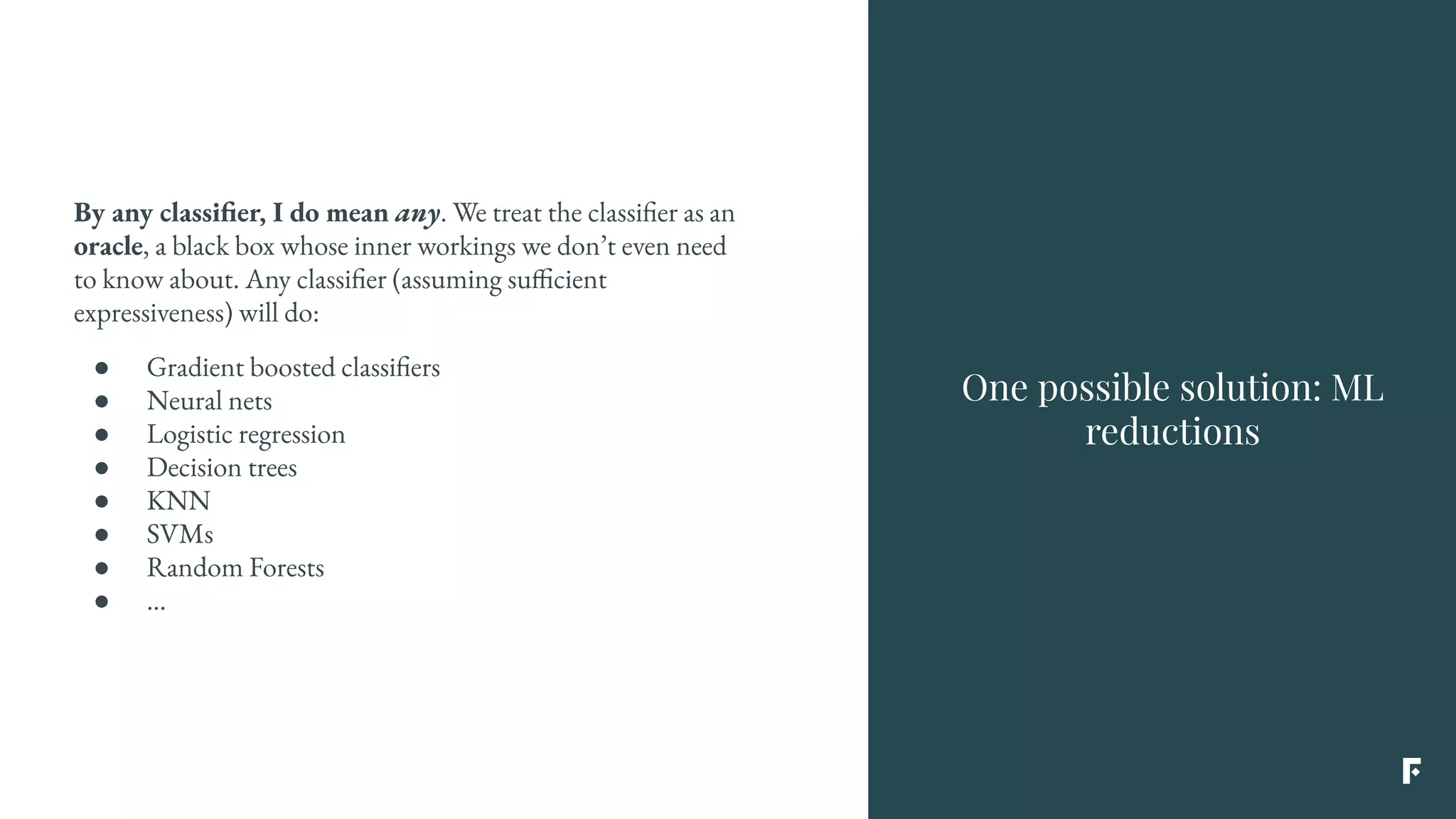
By any classifier, I do mean any. We treat the classifier as an
oracle, a black box whose inner workings we don’t even need
to know about. Any classifier (assuming sufficient
expressiveness) will do:
● Gradient boosted classifiers
● Neural nets
● Logistic regression
● Decision trees
● KNN
● SVMs
● Random Forests
● ...
One possible solution: ML
reductions
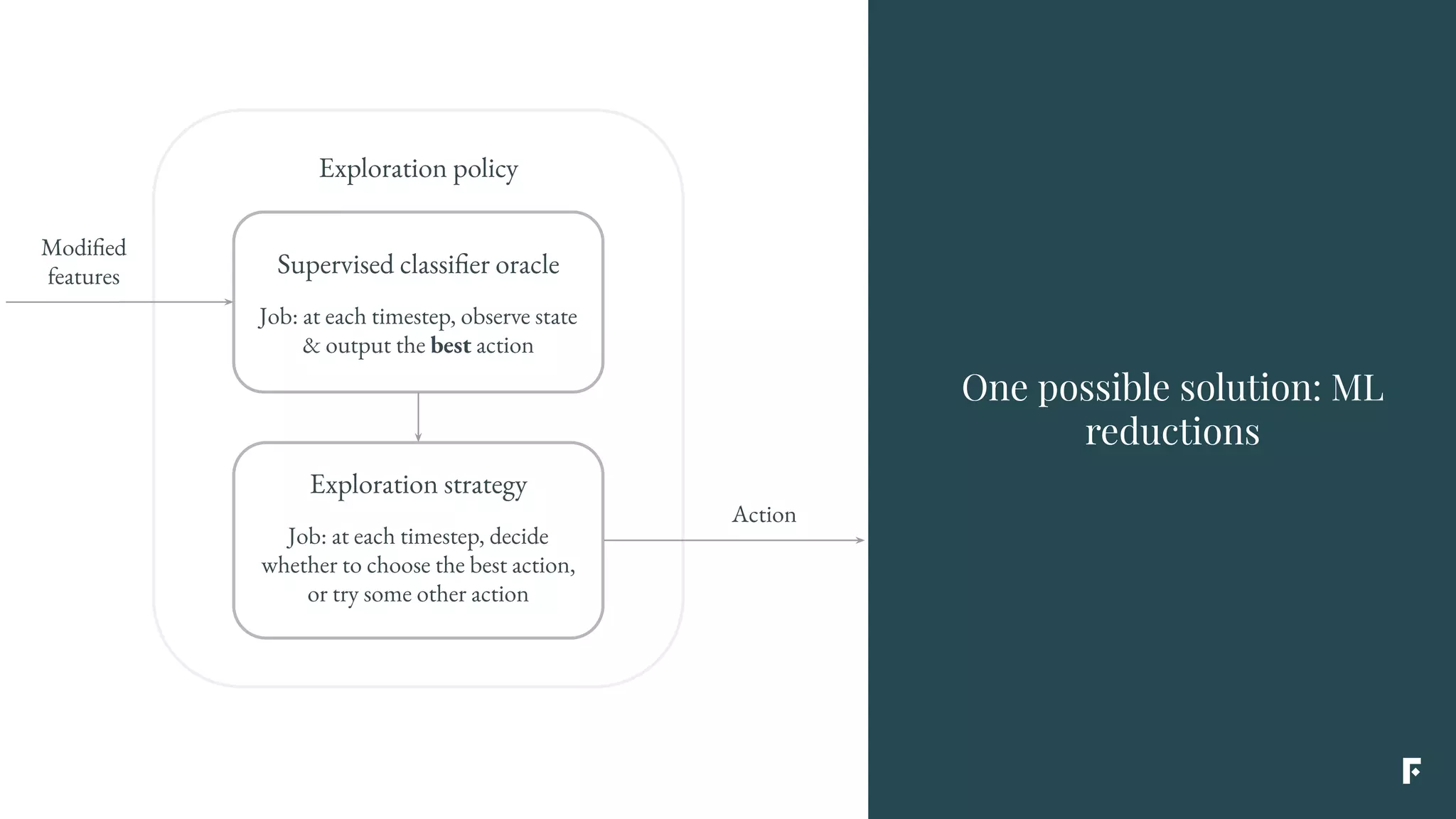
Exploration policy
Supervised classifier oracle
Job: at each timestep, observe state
& output the best action
Modified
features
Action
Exploration strategy
Job: at each timestep, decide
whether to choose the best action,
or try some other action
One possible solution: ML
reductions
Exciting conclusion: we can reduce contextual bandits to
supervised learning + exploration, and solve the learning part
using an oracle learner.
But how do we deal with the partial information problem
inherent to all RL?
One possible solution: ML
reductions
Contextual bandits & the partial
information problem
The reinforcement learning setting, including the contextual
bandit setting, suffers from some severe selection bias,
because we never get to see rewards from actions we
never see.
It makes evaluating the goodness of a policy less than
straightforward. Let’s look at an example.
Contextual bandits & the
partial information problem
Let’s pretend we’ve collected data (also known as experience)
from a contextual bandit agent that chooses between 4
actions (e.g. news articles) according to some exploration
policy π.
Contextual bandits & the
partial information problem
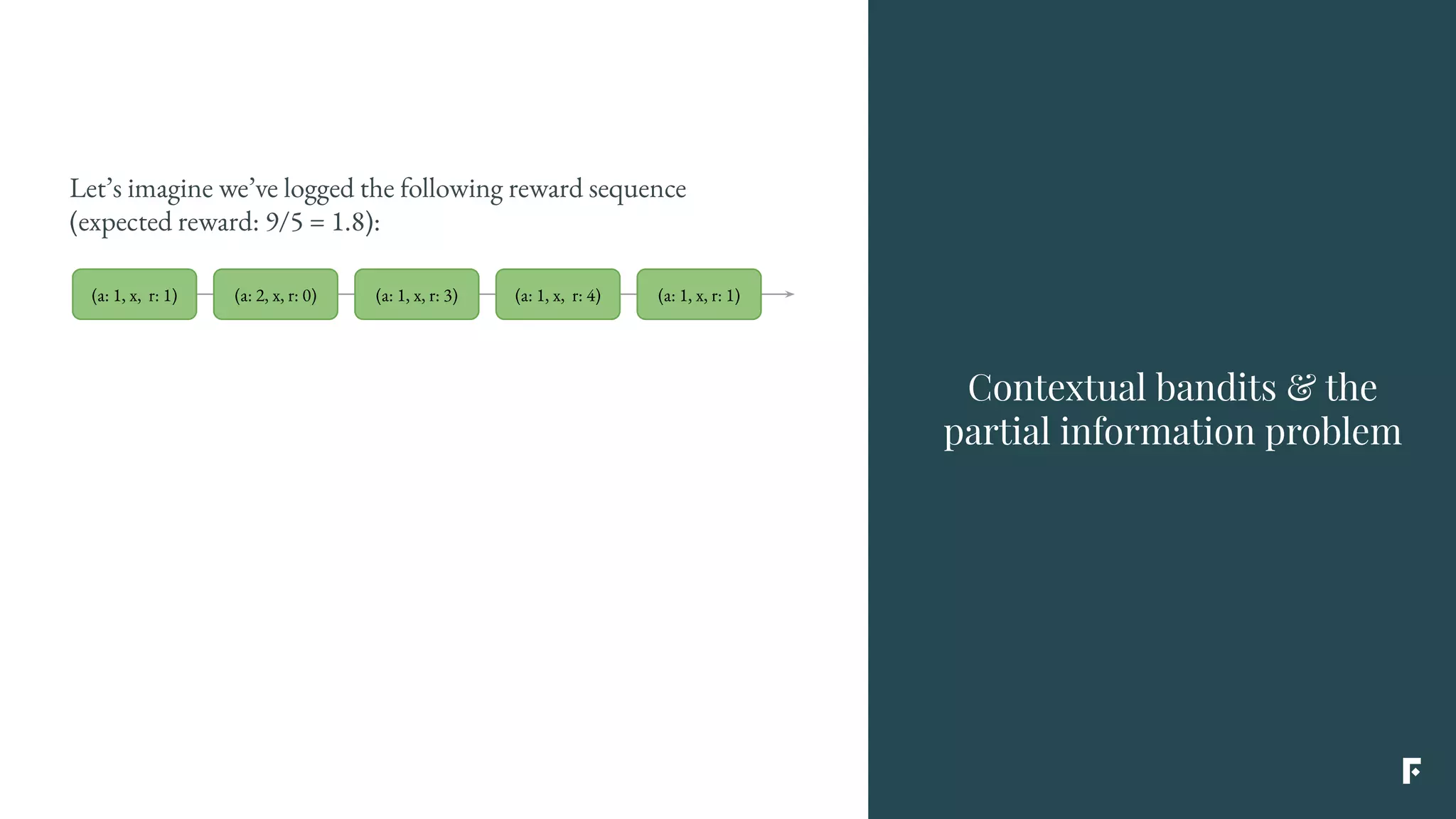
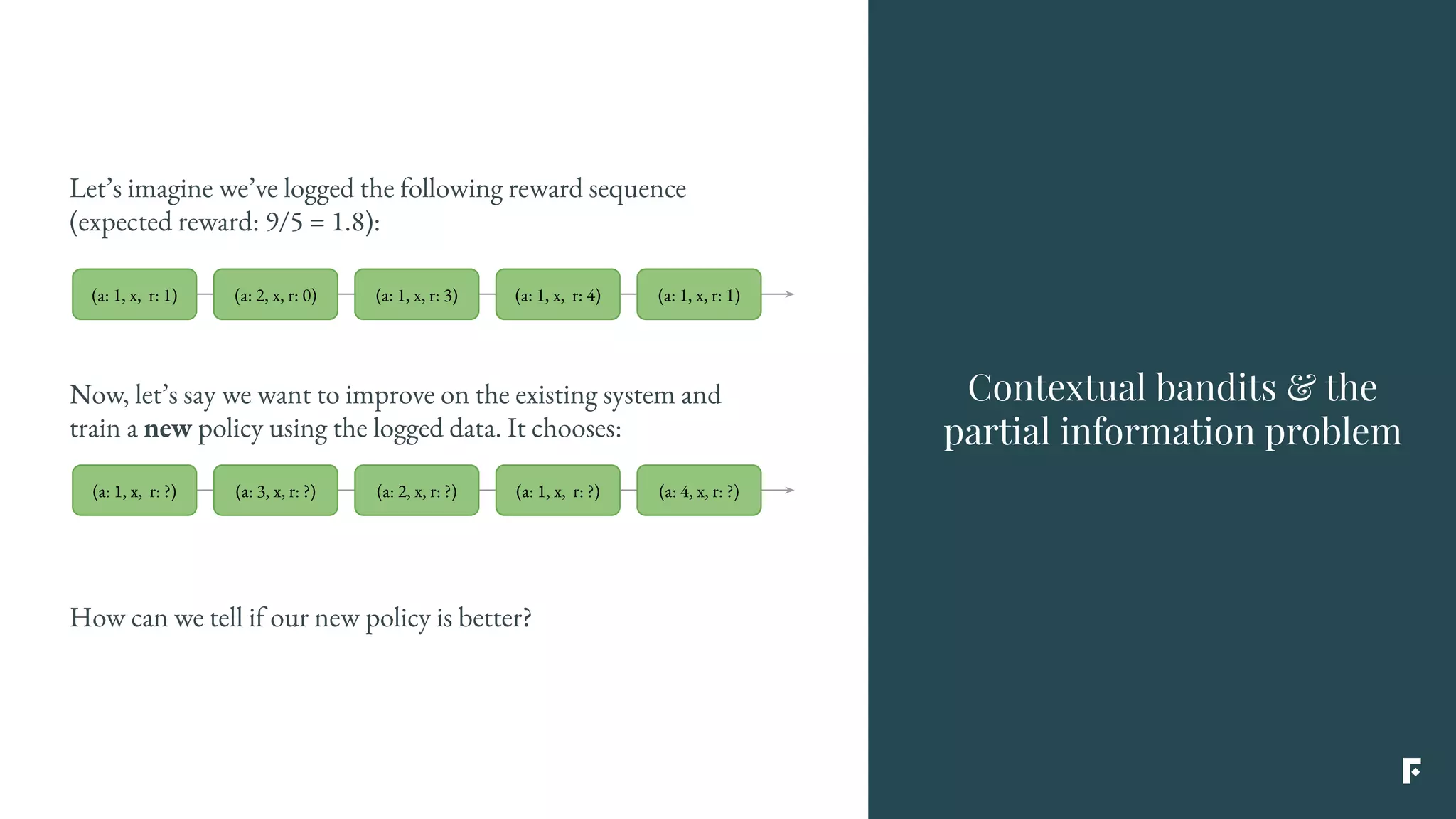
Let’s imagine we’ve logged the following reward sequence
(expected reward: 9/5 = 1.8):
Contextual bandits & the
partial information problem
(a: 1, x, r: 1) (a: 2, x, r: 0) (a: 1, x, r: 3) (a: 1, x, r: 4) (a: 1, x, r: 1)
Contextual bandits & the
partial information problem
(a: 1, x, r: 1) (a: 2, x, r: 0) (a: 1, x, r: 3) (a: 1, x, r: 4) (a: 1, x, r: 1)
Now, let’s say we want to improve on the existing system and
train a new policy using the logged data. It chooses:
(a: 1, x, r: ?) (a: 3, x, r: ?) (a: 2, x, r: ?) (a: 1, x, r: ?) (a: 4, x, r: ?)
How can we tell if our new policy is better?
Let’s imagine we’ve logged the following reward sequence
(expected reward: 9/5 = 1.8):
Contextual bandits & the
partial information problem
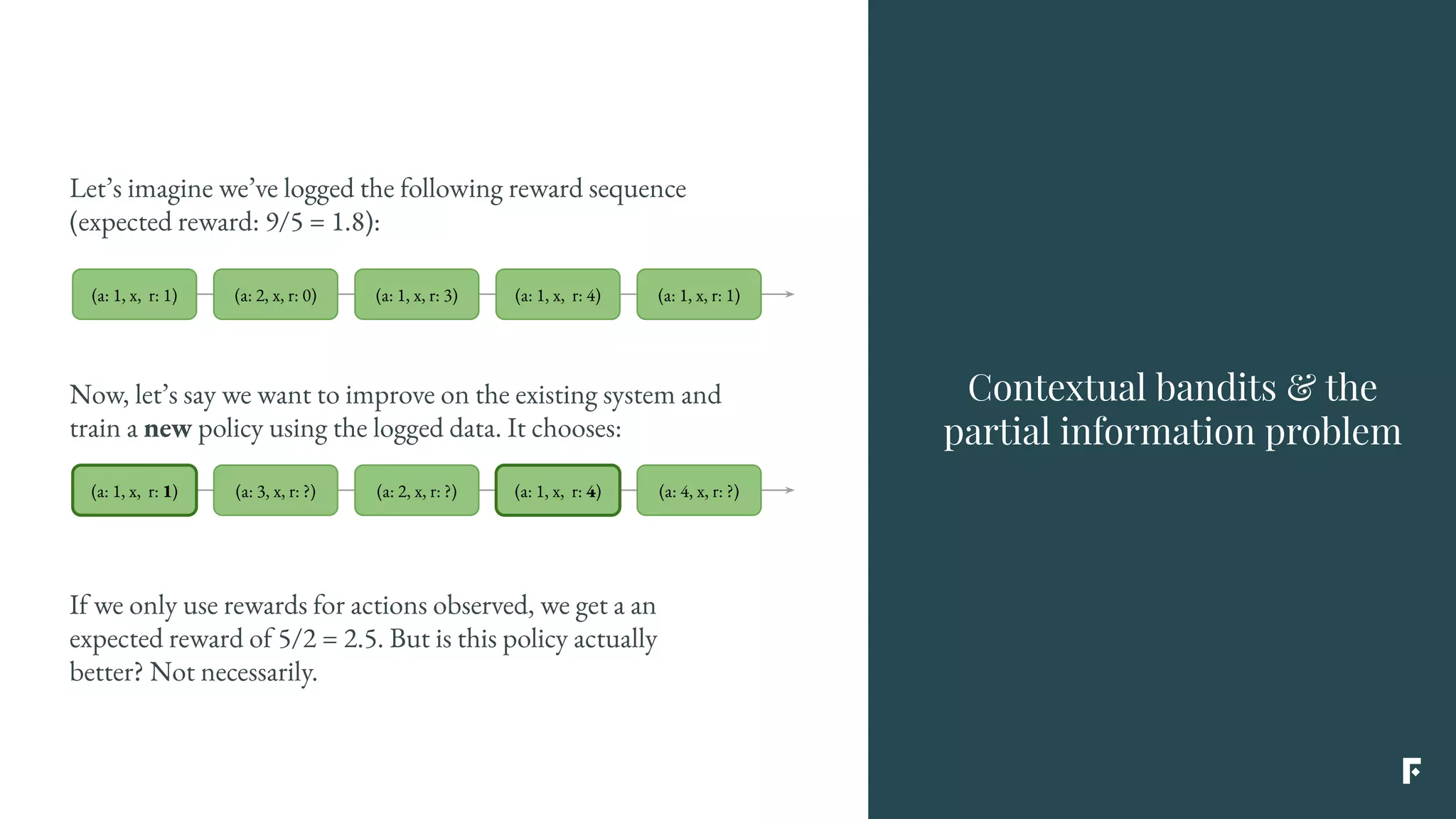
Now, let’s say we want to improve on the existing system and
train a new policy using the logged data. It chooses:
(a: 1, x, r: 1) (a: 3, x, r: ?) (a: 2, x, r: ?) (a: 1, x, r: 4) (a: 4, x, r: ?)
If we only use rewards for actions observed, we get a an
expected reward of 5/2 = 2.5. But is this policy actually
better? Not necessarily.
(a: 1, x, r: 1) (a: 2, x, r: 0) (a: 1, x, r: 3) (a: 1, x, r: 4) (a: 1, x, r: 1)
Let’s imagine we’ve logged the following reward sequence
(expected reward: 9/5 = 1.8):
Contextual bandits & the
partial information problem
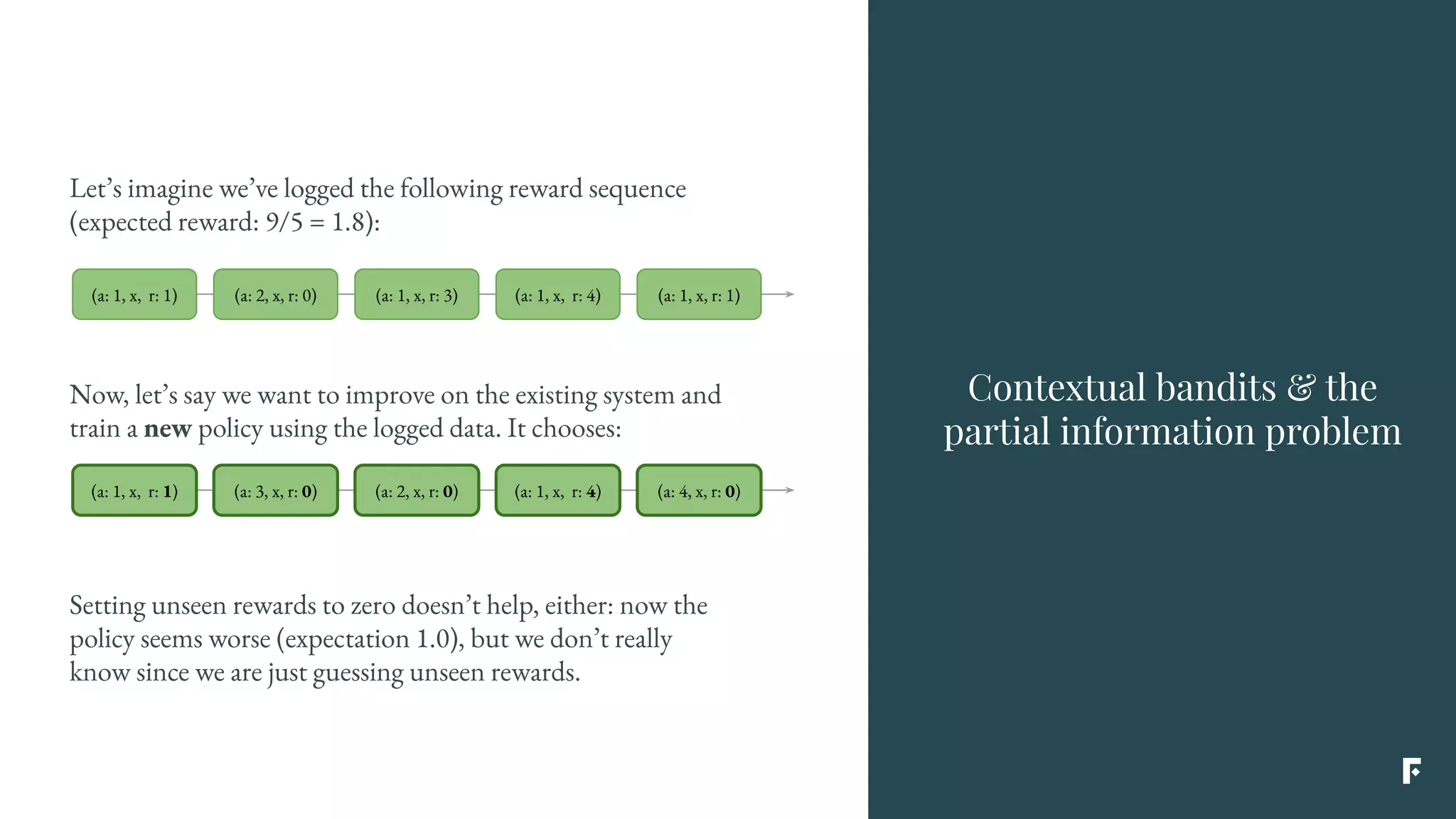
Now, let’s say we want to improve on the existing system and
train a new policy using the logged data. It chooses:
(a: 1, x, r: 1) (a: 3, x, r: 0) (a: 2, x, r: 0) (a: 1, x, r: 4) (a: 4, x, r: 0)
Setting unseen rewards to zero doesn’t help, either: now the
policy seems worse (expectation 1.0), but we don’t really
know since we are just guessing unseen rewards.
(a: 1, x, r: 1) (a: 2, x, r: 0) (a: 1, x, r: 3) (a: 1, x, r: 4) (a: 1, x, r: 1)
Let’s imagine we’ve logged the following reward sequence
(expected reward: 9/5 = 1.8):
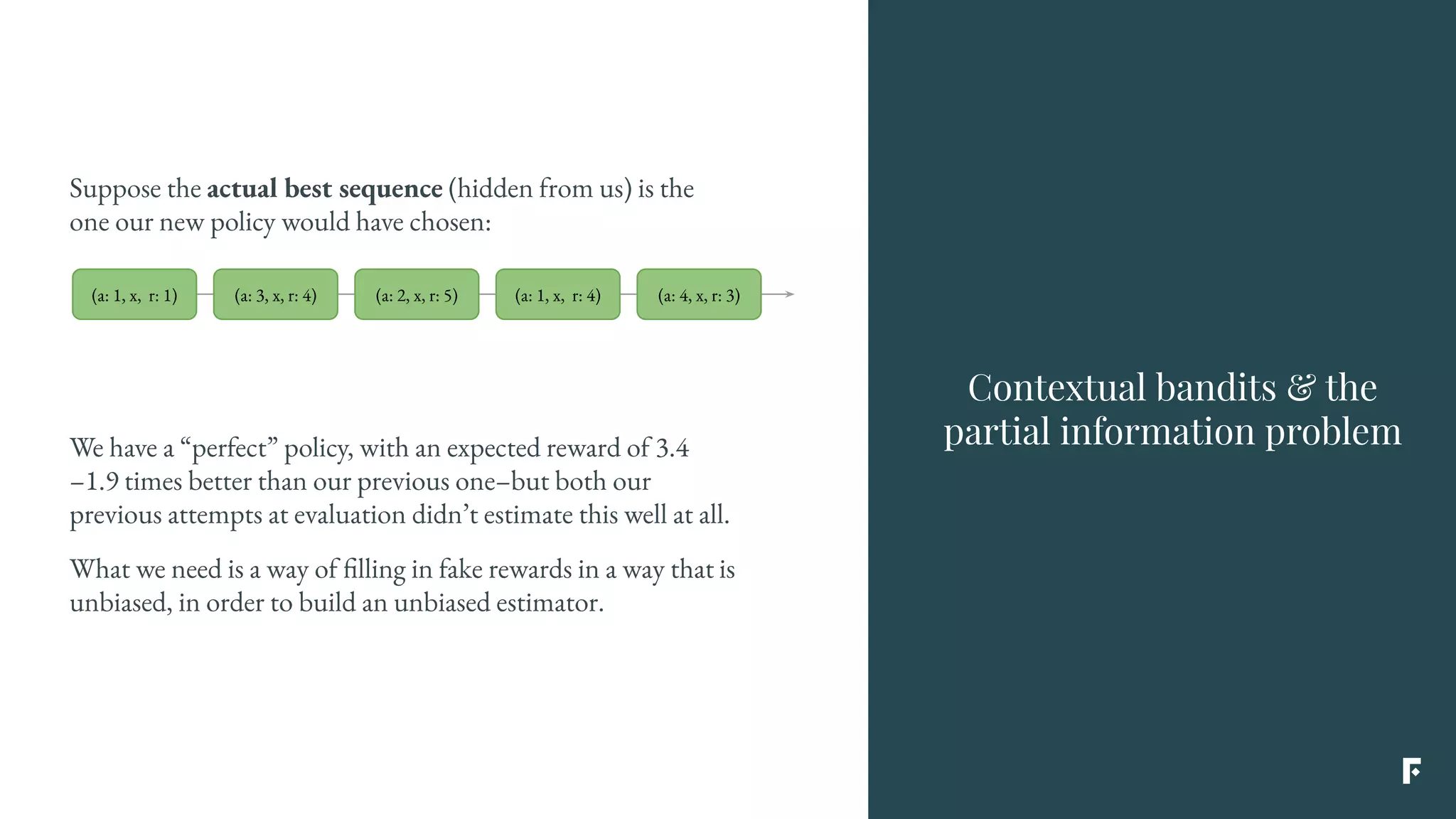
Suppose the actual best sequence (hidden from us) is the
one our new policy would have chosen:
Contextual bandits & the
partial information problemWe have a “perfect” policy, with an expected reward of 3.4
–1.9 times better than our previous one–but both our
previous attempts at evaluation didn’t estimate this well at all.
What we need is a way of filling in fake rewards in a way that is
unbiased, in order to build an unbiased estimator.
(a: 1, x, r: 1) (a: 3, x, r: 4) (a: 2, x, r: 5) (a: 1, x, r: 4) (a: 4, x, r: 3)
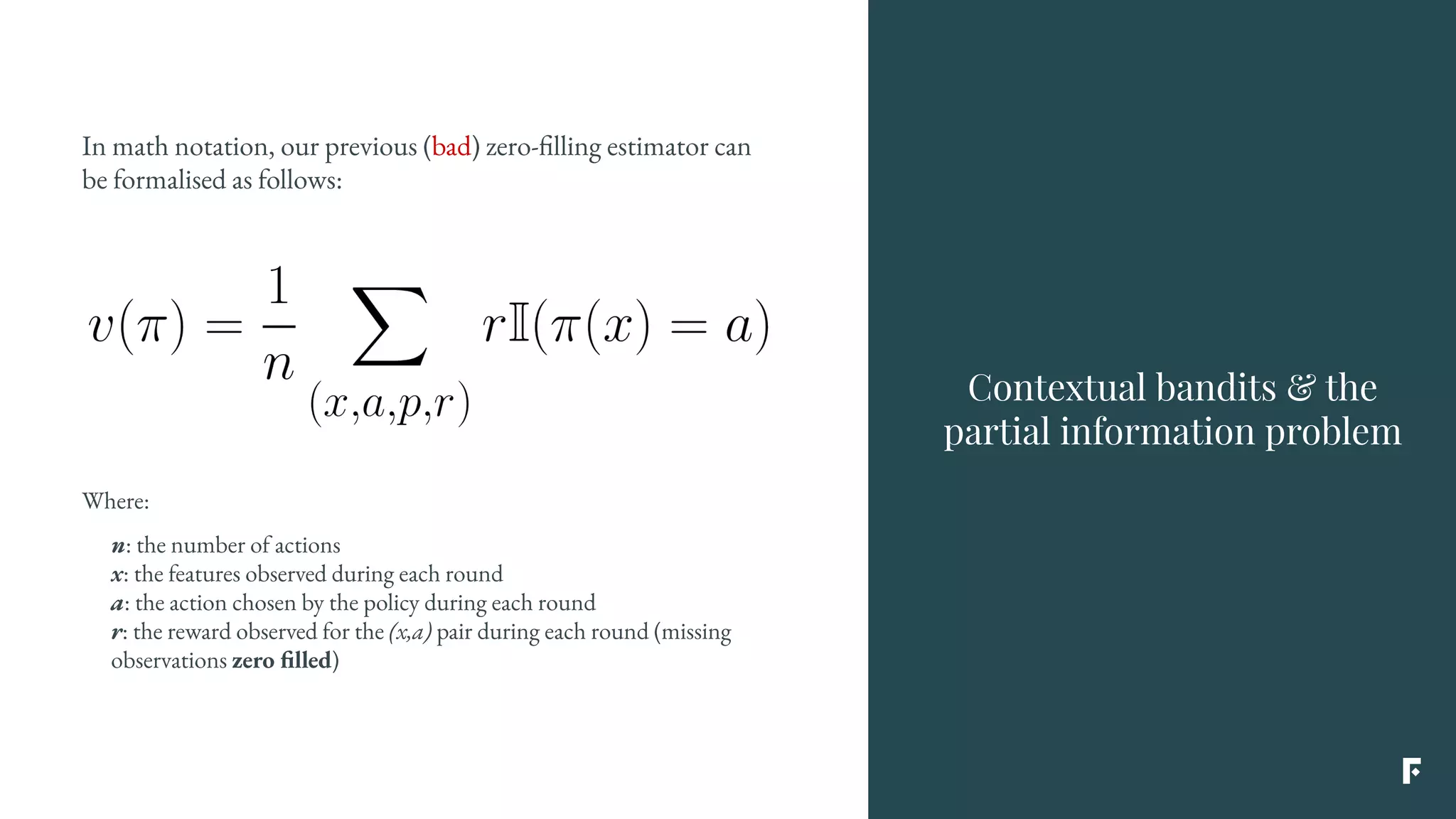
In math notation, our previous (bad) zero-filling estimator can
be formalised as follows:
Contextual bandits & the
partial information problem
Where:
n: the number of actions
x: the features observed during each round
a: the action chosen by the policy during each round
r: the reward observed for the (x,a) pair during each round (missing
observations zero filled)
In order to overcome these bias issues, we are going to leverage
one piece of information that we can collect but haven’t used
yet: action probabilities (the probability of choosing a
particular arm at a given timestep).
Since a contextual bandit policy both explores and exploits, at
any given time step, there’s some probability a given action
will be chosen.
So, in addition to features x, action a, and observed reward r
at each timestep, we also have p, the probability the action
was chosen, giving us an (x,a,p,r) quad.
Contextual bandits & the
partial information problem
Let’s tweak our bad estimator. If our new policy disagrees with
the logged action at any given time, we fill in a zero reward as
before.
Contextual bandits & the
partial information problem
However, if our new policy agrees, we take the observed reward
and inversely weigh it by the probability it was chosen in
our logged data. This estimator is know as IPS (inverse
propensity scoring, a.k.a. inverse probability weighting).
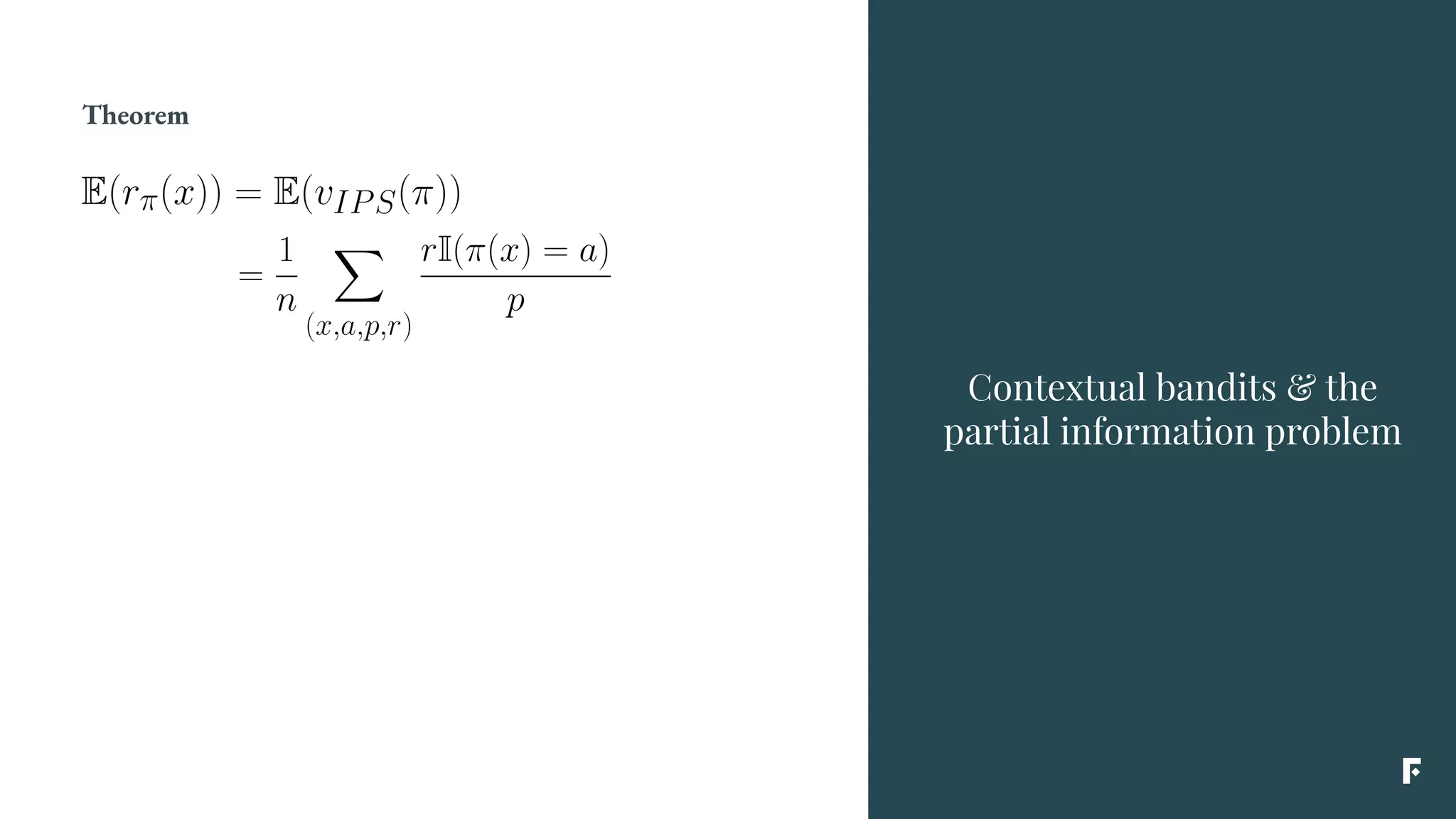
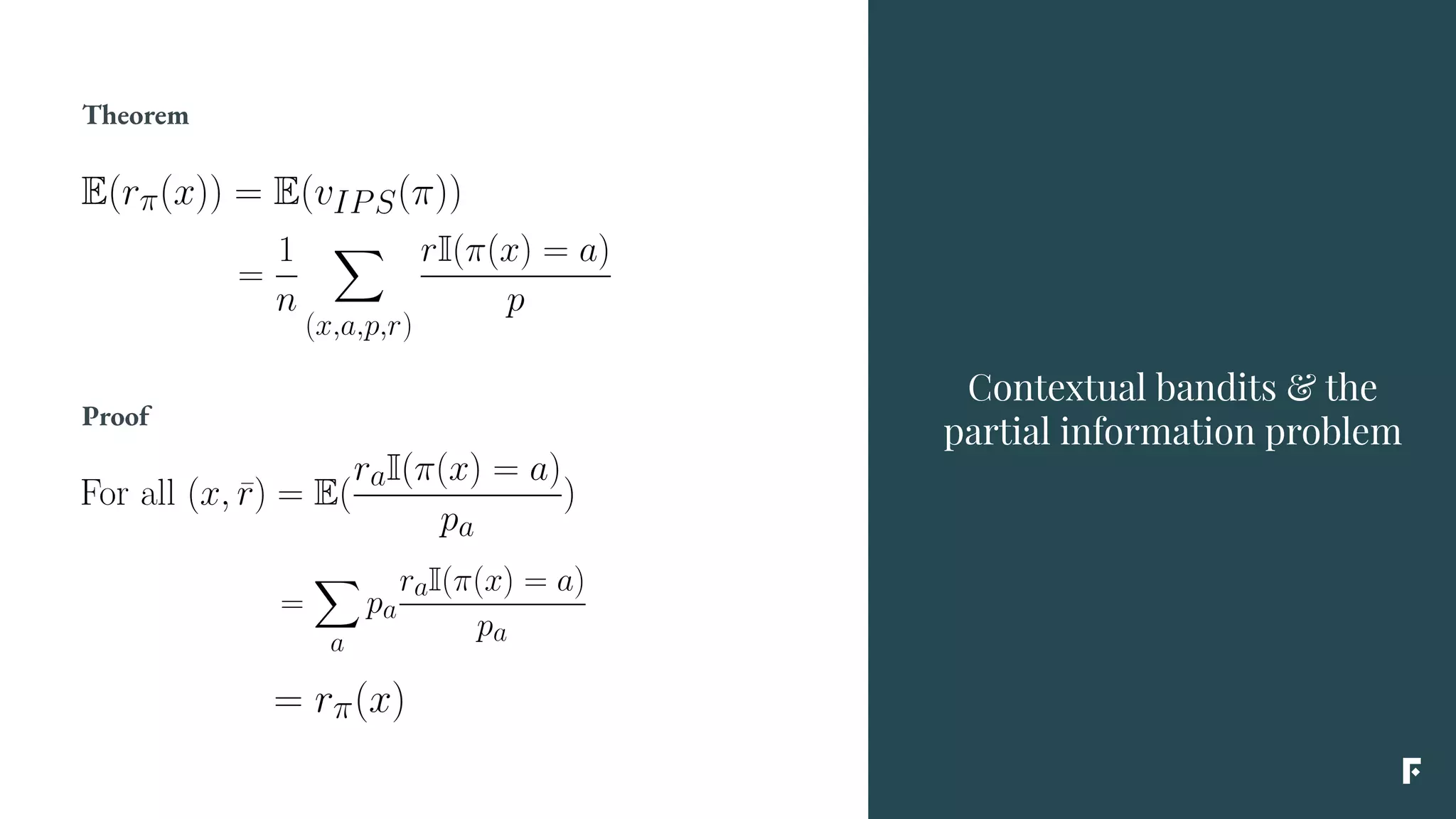
It is possible to show that an IPS estimator provides an
unbiased estimate of the reward. In fact, the proof is so short
that we can do it now.
Contextual bandits & the
partial information problem
Theorem
Contextual bandits & the
partial information problem
Theorem
Contextual bandits & the
partial information problem
Proof
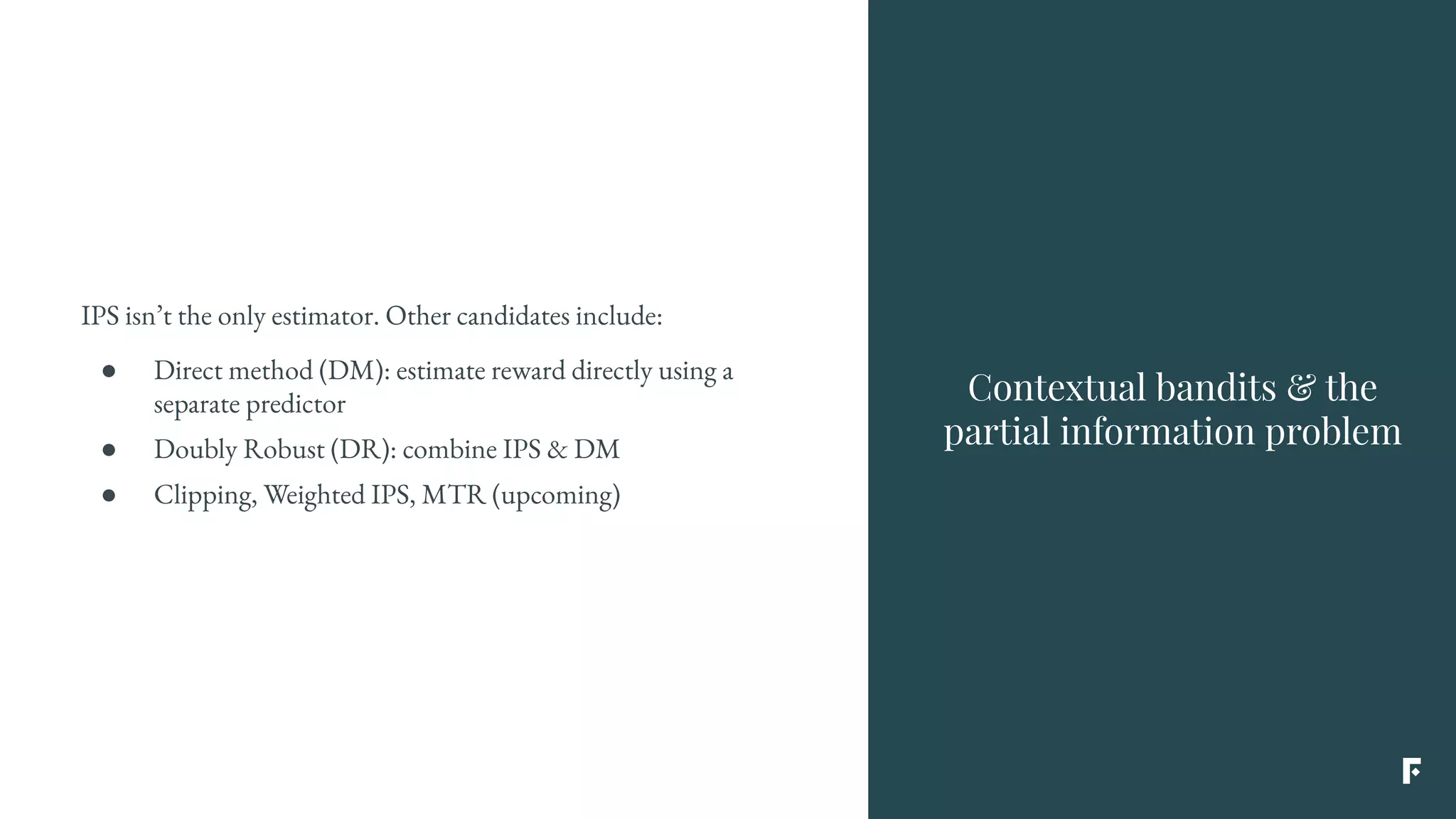
IPS isn’t the only estimator. Other candidates include:
● Direct method (DM): estimate reward directly using a
separate predictor
● Doubly Robust (DR): combine IPS & DM
● Clipping, Weighted IPS, MTR (upcoming)
Contextual bandits & the
partial information problem
What does all this mean? We’ll get to the most interesting bit
shortly, but first, let’s return to the problem of actually
implementing a contextual bandit.
Oracle learners
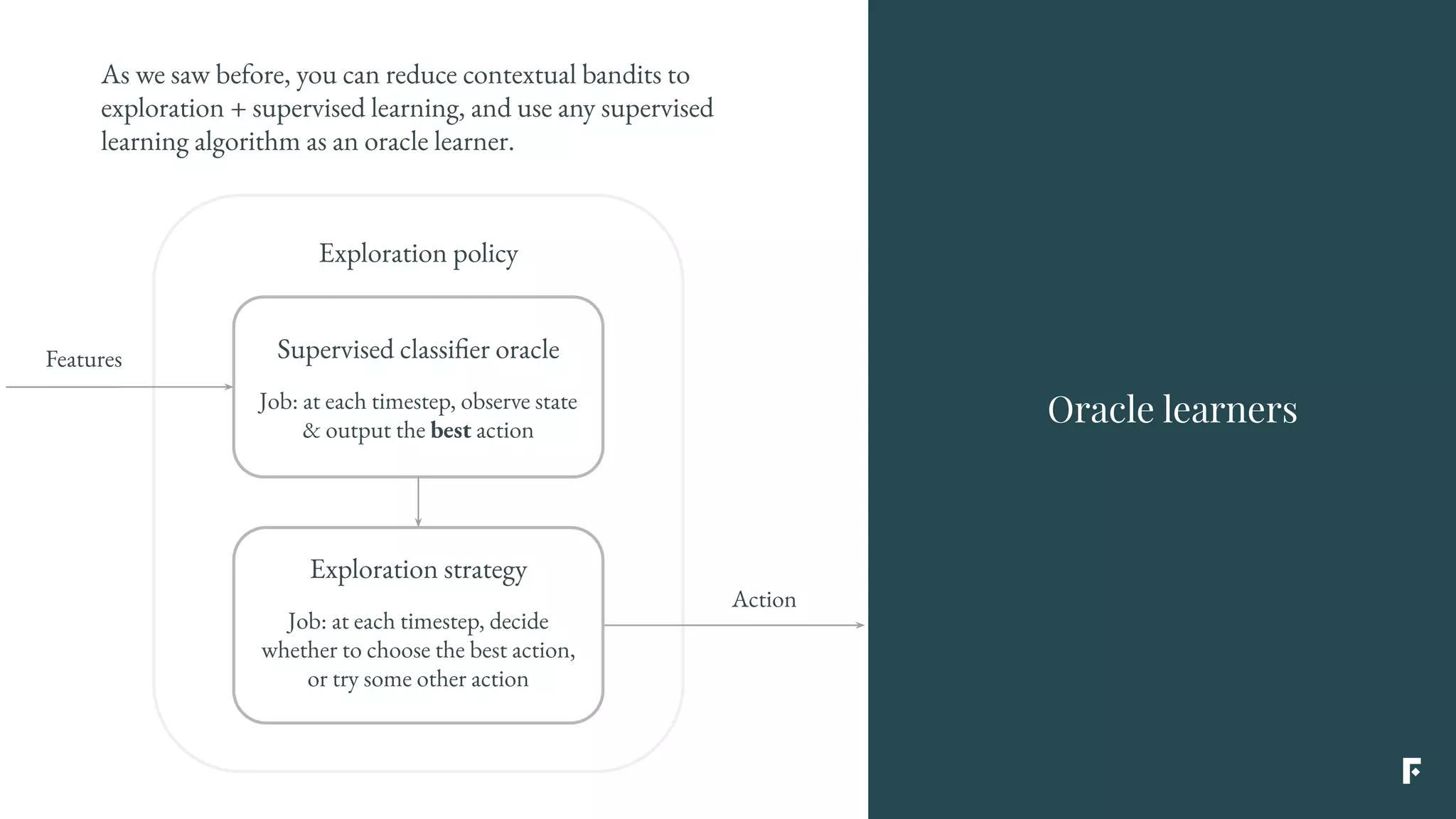
As we saw before, you can reduce contextual bandits to
exploration + supervised learning, and use any supervised
learning algorithm as an oracle learner.
Oracle learners
Exploration policy
Supervised classifier oracle
Job: at each timestep, observe state
& output the best action
Action
Exploration strategy
Job: at each timestep, decide
whether to choose the best action,
or try some other action
Features
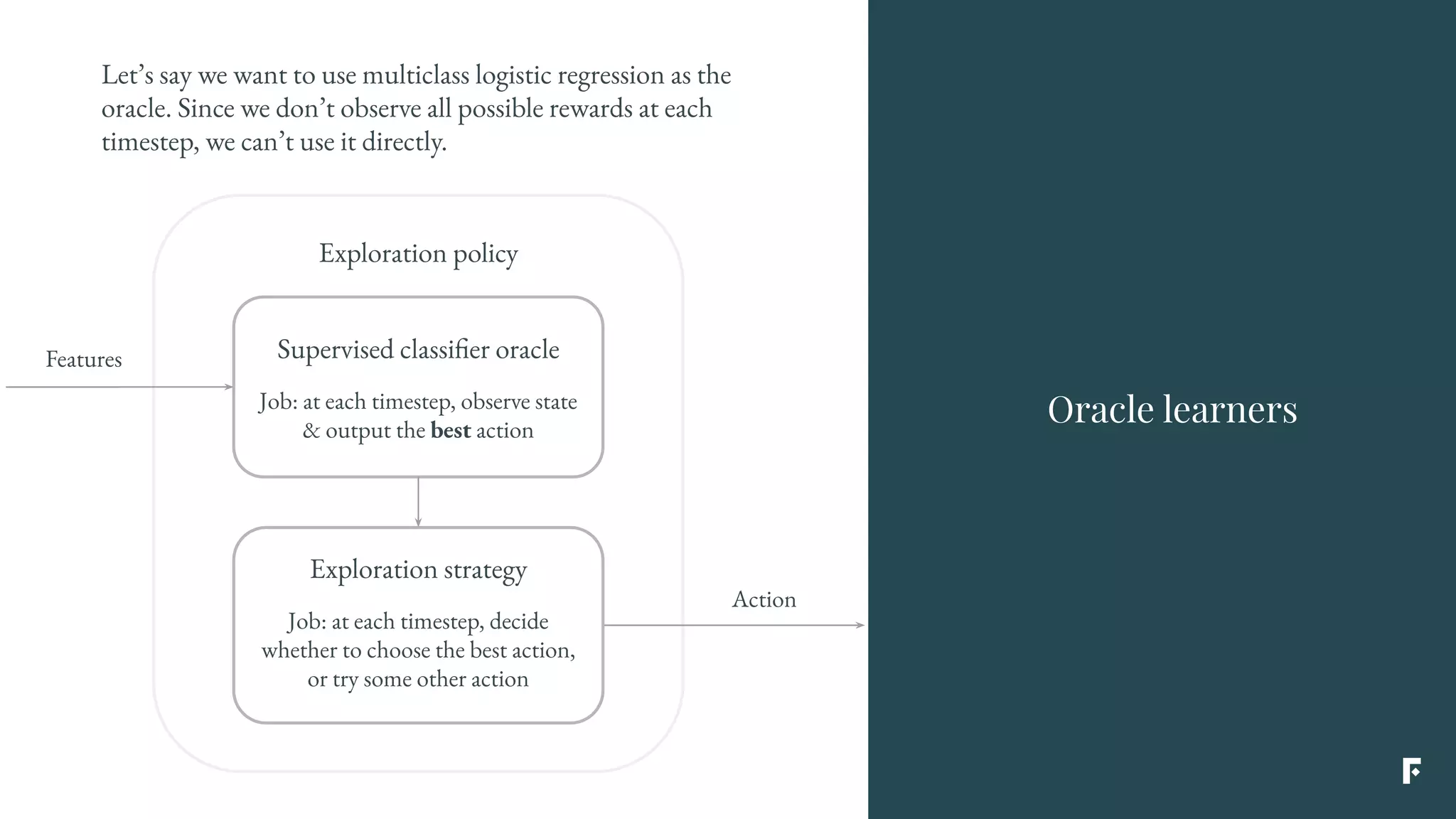
Let’s say we want to use multiclass logistic regression as the
oracle. Since we don’t observe all possible rewards at each
timestep, we can’t use it directly.
Oracle learners
Exploration policy
Supervised classifier oracle
Job: at each timestep, observe state
& output the best action
Features
Action
Exploration strategy
Job: at each timestep, decide
whether to choose the best action,
or try some other action
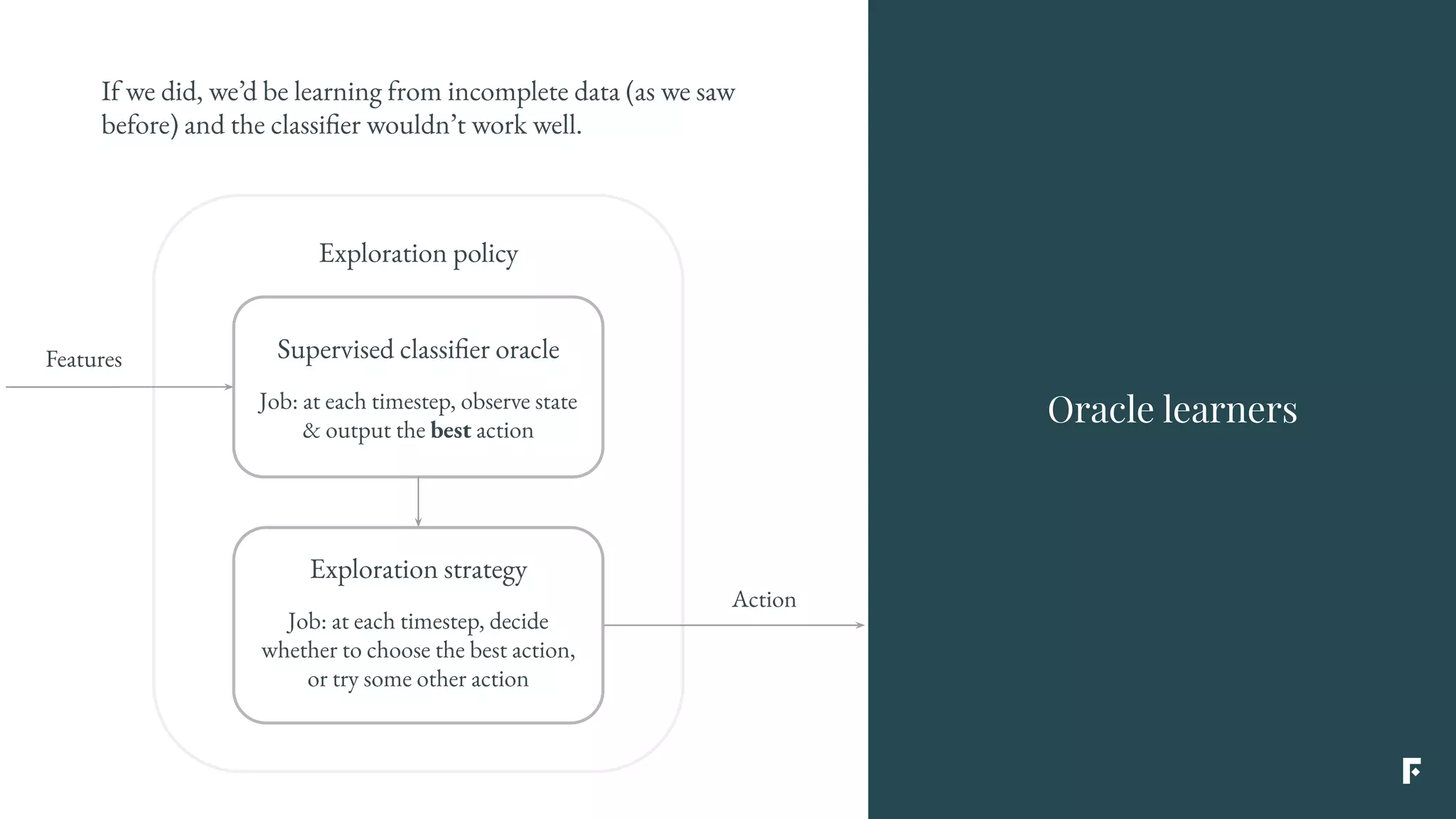
If we did, we’d be learning from incomplete data (as we saw
before) and the classifier wouldn’t work well.
Oracle learners
Exploration policy
Supervised classifier oracle
Job: at each timestep, observe state
& output the best action
Features
Action
Exploration strategy
Job: at each timestep, decide
whether to choose the best action,
or try some other action
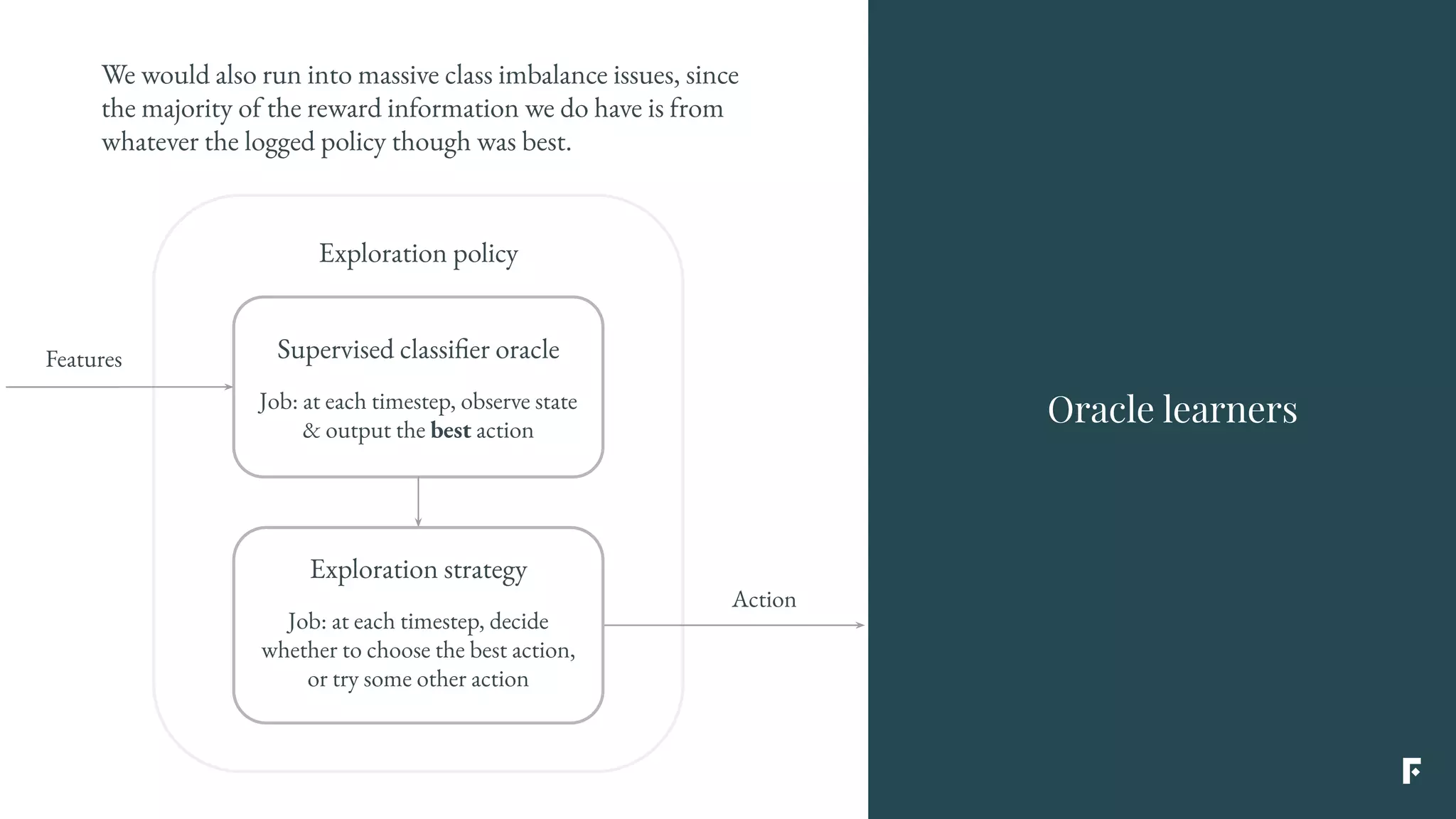
We would also run into massive class imbalance issues, since
the majority of the reward information we do have is from
whatever the logged policy though was best.
Oracle learners
Exploration policy
Supervised classifier oracle
Job: at each timestep, observe state
& output the best action
Features
Action
Exploration strategy
Job: at each timestep, decide
whether to choose the best action,
or try some other action
Let’s fiddle around with the data to make it compatible with
oracle classification algorithms.
Oracle learners
Exploration policy
Supervised classifier oracle
Job: at each timestep, observe state
& output the best action
Modified
features
Action
Exploration strategy
Job: at each timestep, decide
whether to choose the best action,
or try some other action
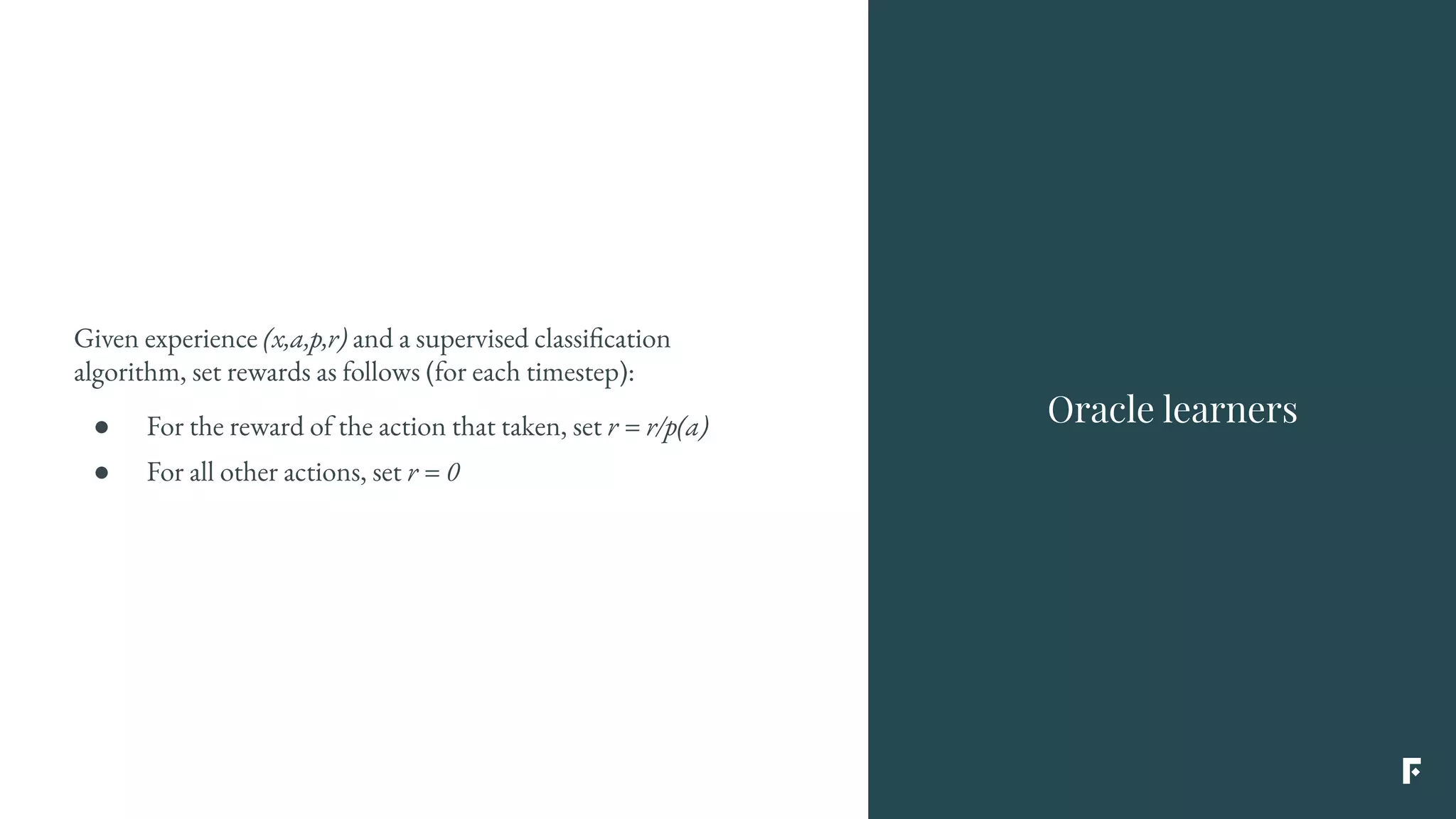
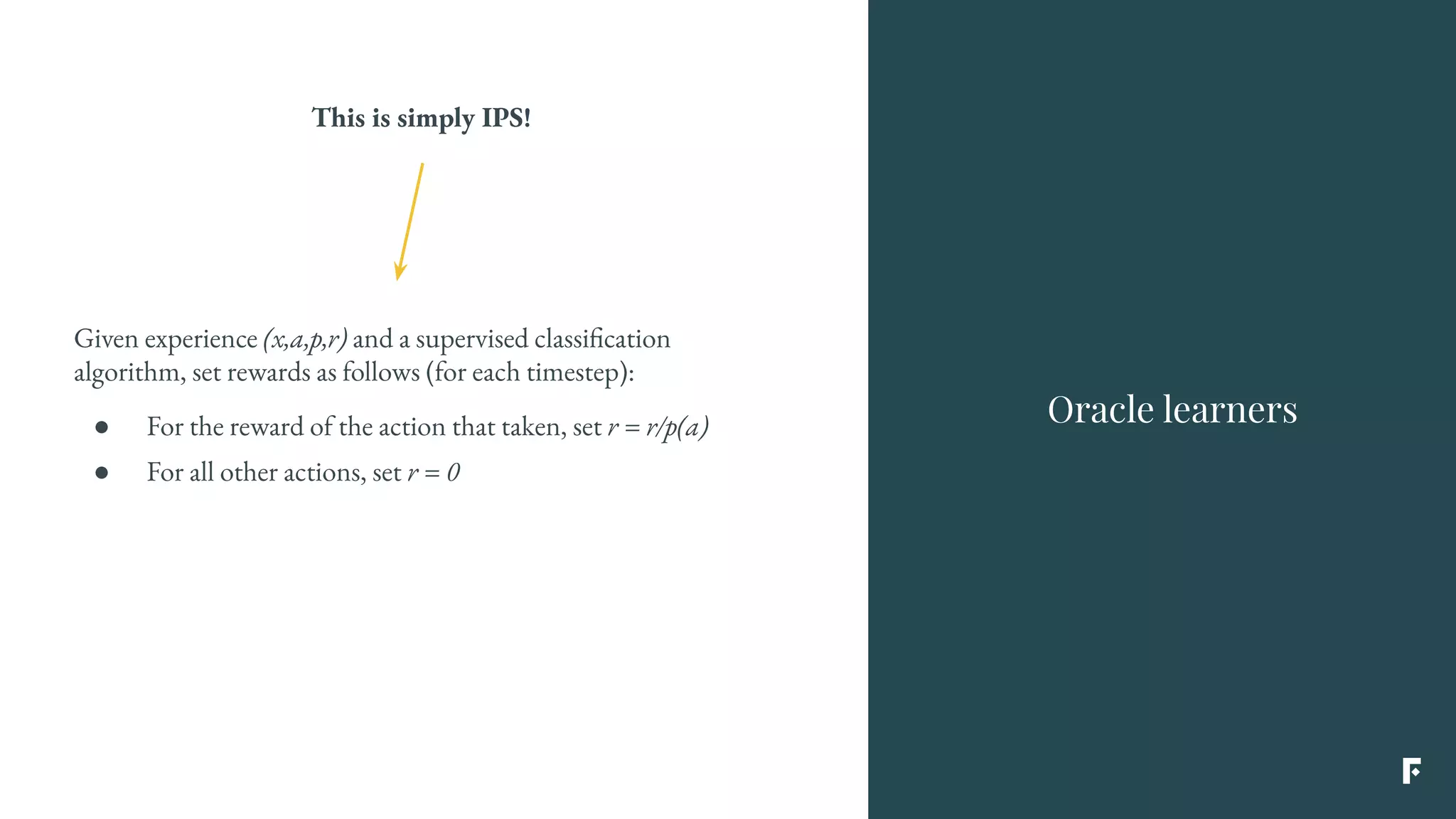
Given experience (x,a,p,r) and a supervised classification
algorithm, set rewards as follows (for each timestep):
● For the reward of the action that taken, set r = r/p(a)
● For all other actions, set r = 0
Oracle learners
Given experience (x,a,p,r) and a supervised classification
algorithm, set rewards as follows (for each timestep):
● For the reward of the action that taken, set r = r/p(a)
● For all other actions, set r = 0
This is simply IPS!
Oracle learners
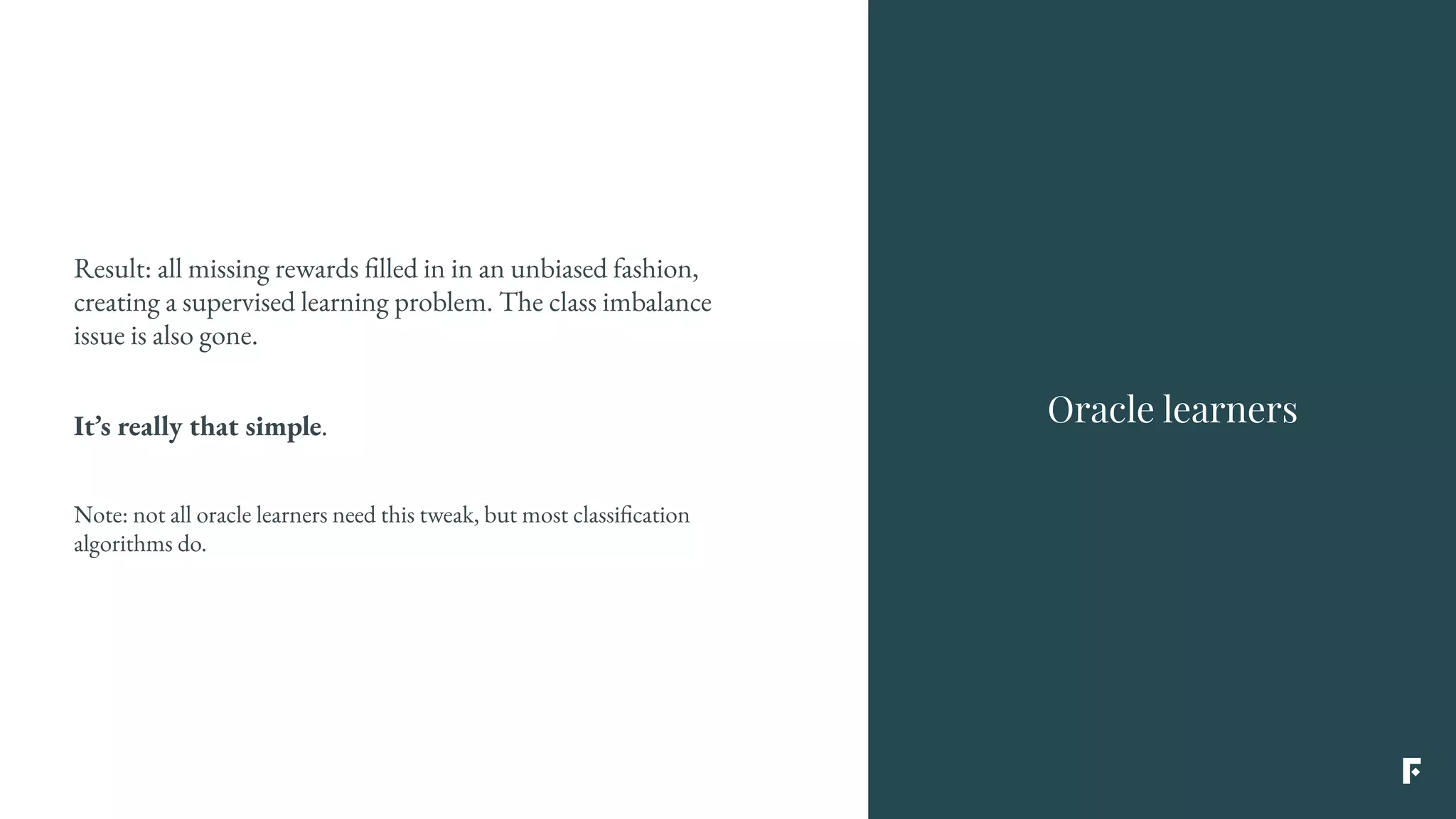
Result: all missing rewards filled in in an unbiased fashion,
creating a supervised learning problem. The class imbalance
issue is also gone.
It’s really that simple.
Note: not all oracle learners need this tweak, but most classification
algorithms do.
Oracle learners
Up next: the last, and most interesting bit of this talk. Oracle learners
Policy evaluation
Using an unbiased estimator to fill in missing rewards allows
us to solve contextual bandits with oracle learners. That’s
neat, but not the best part.
Policy evaluation
We never explicitly mentioned what assumptions we have to
place on our logged quads (x,a,r,p) must have in order for us
to estimate rewards in an unbiased fashion.
Policy evaluation
Answer: apart from assumptions related to the contextual
bandit setting itself, pretty much nothing. Policy evaluation
We can take any logged experience of the form (x,a,r,p) and
evaluate a new policy offline, just like we do in supervised
learning.
Policy evaluation
What if the experience was generated by 10 different policies,
each deployed after the other?
Doesn’t matter.
Policy evaluation
What if the experience was generated by a policy using an
entirely different learning algorithm (e.g. gradient boosting vs.
logistic regression)?
Doesn’t matter.
Policy evaluation
What if the experience was generated by a policy just
randomly exploring, possibly without any machine learning at
all?
Doesn’t matter.
Policy evaluation
Regardless of the policy that generated our experience, we can
use it for training a new policy and evaluating it offline. We
can run hundreds of experiments a day, testing new
hyperparameters, exploration options, learning algorithms,
features etc.
And we can do this without using a simulator, using real
world data collected from real users.
Policy evaluation
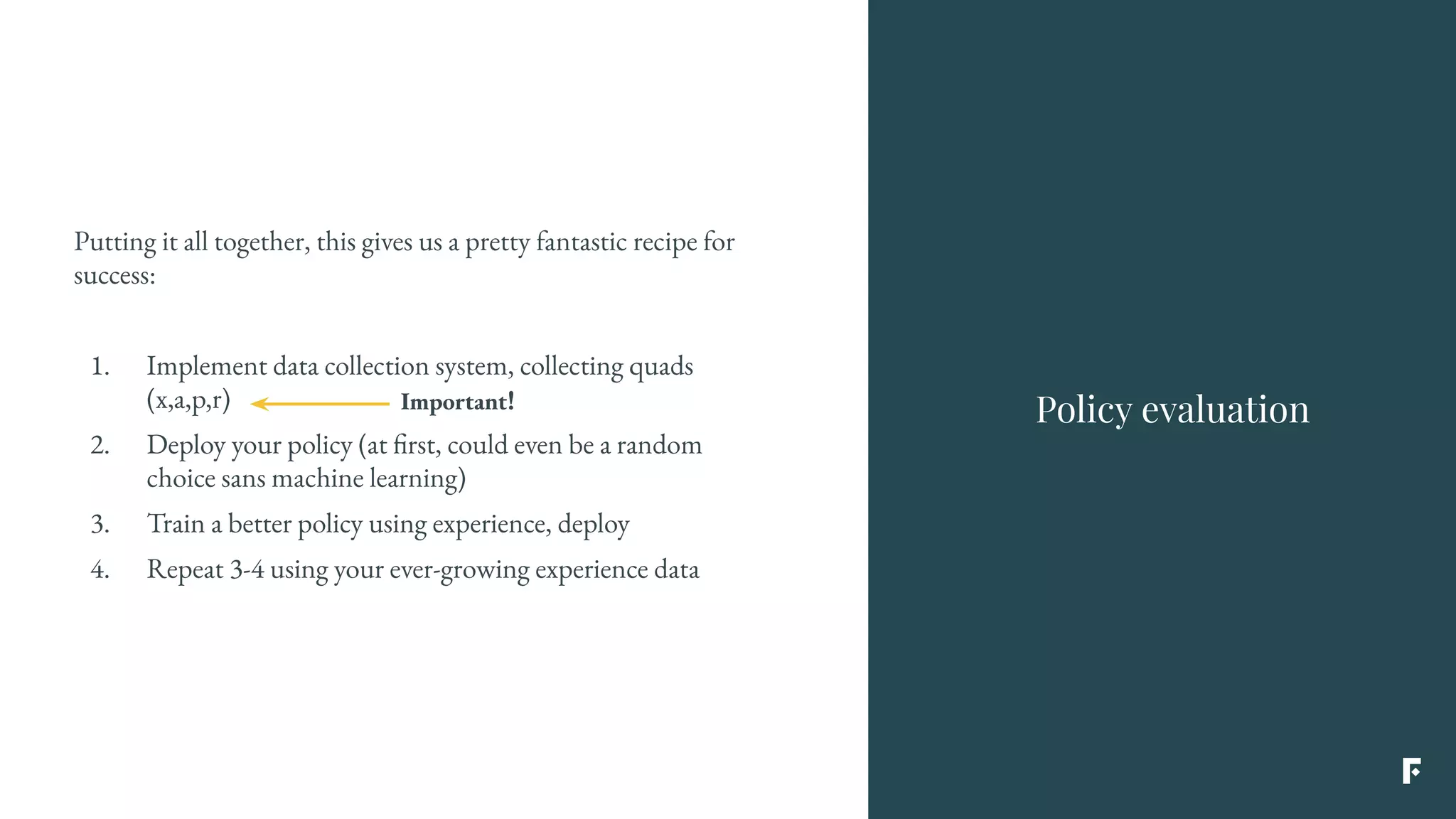
Putting it all together, this gives us a pretty fantastic recipe for
success:
1. Implement data collection system, collecting quads
(x,a,p,r)
2. Deploy your policy (at first, could even be a random
choice sans machine learning)
3. Train a better policy using experience, deploy
4. Repeat 3-4 using your ever-growing experience data
Policy evaluation
Putting it all together, this gives us a pretty fantastic recipe for
success:
1. Implement data collection system, collecting quads
(x,a,p,r)
2. Deploy your policy (at first, could even be a random
choice sans machine learning)
3. Train a better policy using experience, deploy
4. Repeat 3-4 using your ever-growing experience data
Policy evaluationImportant!
Summary
Let’s recap some of the key takeaways from this talk. Summary
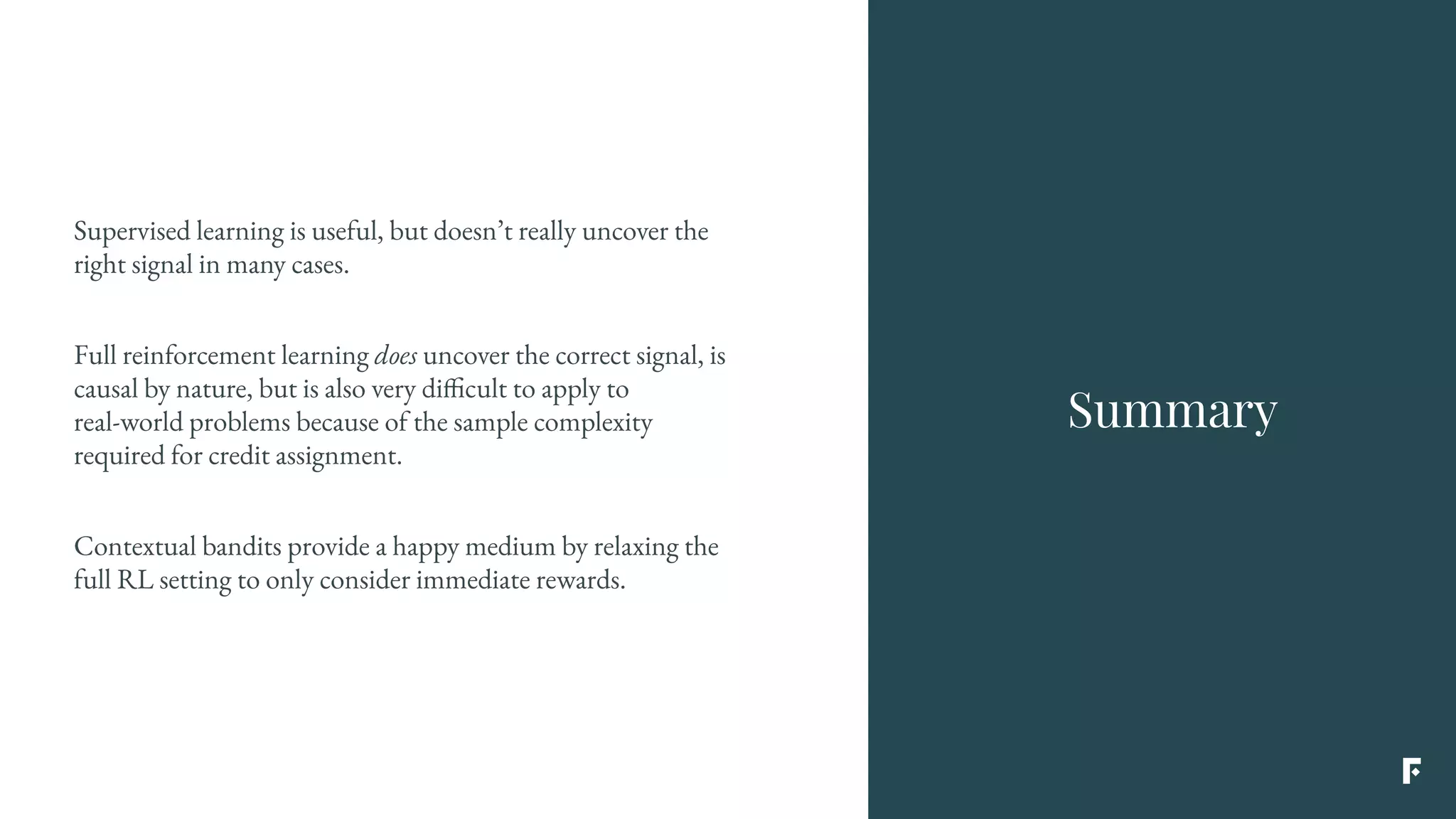
Supervised learning is useful, but doesn’t really uncover the
right signal in many cases.
Full reinforcement learning does uncover the correct signal, is
causal by nature, but is also very difficult to apply to
real-world problems because of the sample complexity
required for credit assignment.
Contextual bandits provide a happy medium by relaxing the
full RL setting to only consider immediate rewards.
Summary
Summary
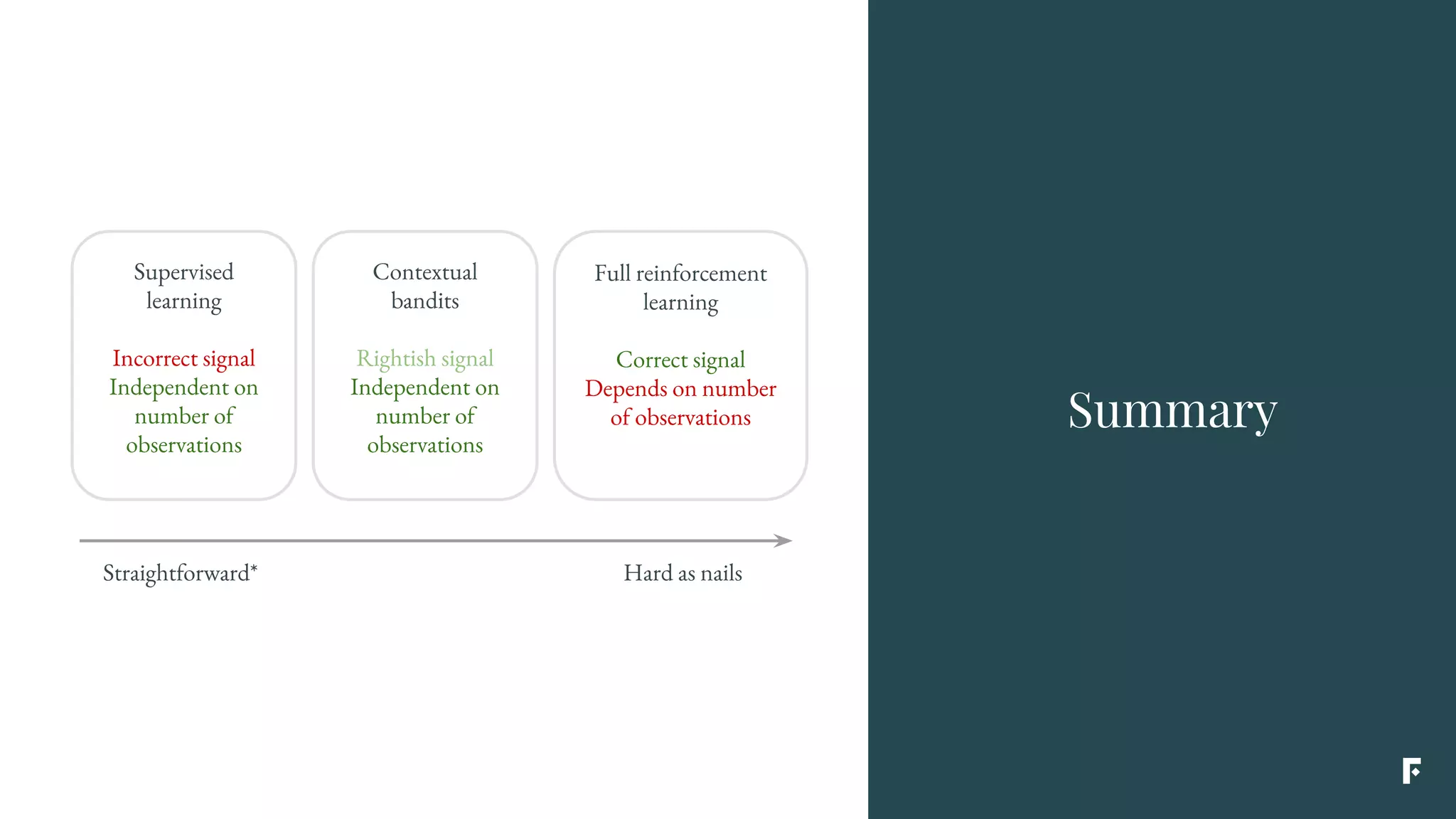
Straightforward* Hard as nails
Supervised
learning
Incorrect signal
Independent on
number of
observations
Full reinforcement
learning
Correct signal
Depends on number
of observations
Contextual
bandits
Rightish signal
Independent on
number of
observations
Contextual bandits can be reduced to exploration +
supervised learning, allowing us to take advantage of
ready-made, state-of-the-art learning algorithms.
Contextual bandit policies can be evaluated offline, using
experience quads (x,a,p,r) generated by any previous policy.
A properly implemented contextual bandit learning system is
a self-improving loop: better policies generate more reward,
and provide more data for improving further.
Contextual bandits allow you to solve a host of real-world
problems, using real data instead of simulation, in a causal
manner.
Summary
If you have a problem where it is possible to explore, and a desire
to make a machine learning system capable of uncovering new
things, consider immediate-reward RL.
Thank you! Questions?
max.pagels@fourkind.com
www.fourkind.com
@fourkindnow

Real-world Reinforcement Learning

  • 1.
    Real-world Reinforcement Learning MaxPagels, Machine Learning Partner @maxpagels www.linkedin.com/in/maxpagels
  • 2.
    Job: Fourkind Education: BSc,MSc comp. sci, University of Helsinki Background: CS researcher, full-stack dev, front-end dev, data scientist Interests: Immediate-reward RL, ML reductions, incremental/online learning, generative design Some industries: maritime, insurance, ecommerce, gaming, telecommunications, transportation, media, education, logistics
  • 3.
  • 4.
    What is reinforcement learning? Ina reinforcement learning setting, one takes actions in an environment & receives rewards. The ultimate goal is to maximise rewards over time.
  • 5.
    Environment Agent Goal: learn toact so as to maximise reward over time. ActionReward What is reinforcement learning? State
  • 6.
    What is reinforcement learning? Agood real-world analogy is teaching your dog a new command. If the dog correctly performs (acts) the command you (the environment) gave, he or she is given a treat (a reward). Over time, you dog will learn to act as commanded in order to maximise reward over time.
  • 7.
    What is reinforcement learning? Reinforcementlearning isn’t entirely dissimilar from the notion of classical conditioning or Pavlovian response: “Classical conditioning (also known as Pavlovian or respondent conditioning) refers to a learning procedure in which a biologically potent stimulus (e.g. food) is paired with a previously neutral stimulus (e.g. a bell). It also refers to the learning process that results from this pairing, through which the neutral stimulus comes to elicit a response (e.g. salivation) that is usually similar to the one elicited by the potent stimulus.” Classical conditioning, https://en.wikipedia.org/wiki/Classical_conditioning
  • 8.
    What is reinforcement learning? Inthe beginning, a reinforcement learning agent knows nothing about the world. It must explore different options to learn what works and what doesn’t.
  • 9.
    What is reinforcement learning? Inaddition, an agent must also exploit its knowledge in order to actually maximise rewards over time.
  • 10.
    What is reinforcement learning? Balancingexploration & exploitation is what reinforcement learning is all about.
  • 11.
    What is reinforcement learning? We’llget back to the details later. Before that, let’s think about why you might want to use reinforcement learning, and how to do it in a way that actually works in the real world.
  • 12.
    The case forusing reinforcement learning
  • 13.
    The case forusing reinforcement learning Intentionally provocative statement: you can’t really call machine learning systems intelligent unless they are reinforcement systems. Let’s dissect this through some observations.
  • 14.
    The case forusing reinforcement learning Observation #1: any system that doesn’t use machine learning generates data that is ultimately based on human expertise.
  • 15.
    The case forusing reinforcement learning Observation #2: any supervised machine learning system that uses such data is effectively learning from data generated by human expertise.
  • 16.
    The case forusing reinforcement learning Observation #3: humans aren’t great at everything.
  • 17.
    The case forusing reinforcement learning Observation #4: deploying a supervised learning system itself generates data from a new distribution. However, it still has its roots in human expertise.
  • 18.
    The case forusing reinforcement learning Is this type of source information really the way to go? Is it really the correct signal?
  • 19.
    The case forusing reinforcement learning I don’t think so. Let me elaborate with an example.
  • 20.
    The case forusing reinforcement learning Which of the following would I be most interested in?
  • 21.
    The case forusing reinforcement learning Which of the following would I be most interested in?
  • 22.
    The case forusing reinforcement learning Personal opinion: the only way to uncover the correct signal is to assume nothing, try out different things (explore), and learn to act optimally (exploit) based on environmental feedback. It’s causal by nature. Everything else is a hack*. * supervised learning can be a massively useful, perhaps even glorious, hack, but it is still a hack.
  • 23.
    Learn Log Deploy Almost all productionmachine learning systems The case for using reinforcement learning
  • 24.
    A fundamentally correctmachine learning system Learn Log Explore Deploy The case for using reinforcement learning
  • 25.
    The case forusing reinforcement learning If you agree with this train of thought, it begs a question: why don’t we use more reinforcement learning?
  • 26.
    The problem withreinforcement learning
  • 27.
    The problem with reinforcementlearning Put bluntly: it’s very difficult.
  • 28.
    The problem with reinforcementlearning Supervised learning Full reinforcement learning Max’s Difficulty Continuum * not necessarily easy Straightforward* Hard as nails
  • 29.
    The problem with reinforcementlearning Why is reinforcement learning so difficult to do?
  • 30.
    The theoretical frameworkunderpinning full RL algorithms is the Markov Decision Process (MDP). The problem with reinforcement learning
  • 31.
    Reinforcement learning isabout learning how to act optimally in such environments. The problem with reinforcement learning
  • 32.
    It can workreally well if you have a reasonable number of possible states. The problem with reinforcement learning
  • 33.
    The problem with reinforcementlearning Unfortunately, for many real-world problems, we have an insane amount of possible states.
  • 34.
    The problem with reinforcementlearning An insane state space requires an insane amount of training data to learn a good agent.
  • 35.
    The problem with reinforcementlearning For real-world problems, there usually isn’t an insane amount of data on tap.
  • 36.
    The problem with reinforcementlearning The standard way to deal with this is to build an environment simulator, that generates an endless supply of states & rewards. This works in constrained, fully digital settings like games. But for loads of real-world problems, you literally can’t build a simulator.
  • 37.
    The case forusing reinforcement learning How on earth would a simulator know I enjoy Tudor history?
  • 38.
    The case forusing reinforcement learning It can’t.
  • 39.
    The problem with reinforcementlearning That’s not the only problem.
  • 40.
    The problem with reinforcementlearning In a full reinforcement learning setting, rewards can arrive immediately, or sometime in the future.
  • 41.
    The problem with reinforcementlearning Let’s say you have a sequence of ten yes/no decisions to make. 1. If you decide yes at step 1, you get a small immediate reward and no rewards for the remaining 9 steps. 2. If you say no at step 1, and then follow a very specific sequence of yeses and nos for the remaining steps, you get a large reward. It would make sense to sacrifice short-term rewards in this case, because of the payoff at the end is large.
  • 42.
    The problem with reinforcementlearning Consequence: you need to be able to learn to assign (partial) rewards to actions that possibly happened a long time ago. This is known as the credit assignment problem. Solving this problem means full RL algorithms necessarily depend on the number of observations, exacerbating the sample complexity issue even more.
  • 43.
    The problem with reinforcementlearning What all of this means in practice for full RL:
  • 44.
    The problem with reinforcementlearning Despite all the issues, RL is still much too promising to give up on. If we solve RL in real-world settings, we stand to advance the state of the art significantly.
  • 45.
    The problem with reinforcementlearning So how to we do it? Currently, via a set of clever tricks and simplifications. We aren’t yet able to solve all real-world RL problems, but you’d be surprised what we can solve today.
  • 46.
    How can youdo reinforcement learning in the real world?
  • 47.
    How can youdo reinforcement learning in the real world? Currently: via some simplifications. Let’s look at the Difficulty Continuum again, and add some pros & cons.
  • 48.
    Supervised learning Full reinforcement learning Max’sDifficulty Continuum * not necessarily easy Straightforward* Hard as nails How can you do reinforcement learning in the real world?
  • 49.
    Straightforward* Hard asnails Supervised learning Incorrect signal Independent on number of observations Full reinforcement learning Correct signal Depends on number of observations Max’s Difficulty Continuum * not necessarily easy How can you do reinforcement learning in the real world?
  • 50.
    If we canfind a way to get rid of the dependence on sample size, yet preserve the correctness of signal as well as possible, we are on to something. But can we? How can you do reinforcement learning in the real world?
  • 51.
    Yes. By makingsome simple yet critical modifications to the full RL problem, we can make reinforcement learning agents capable of solving a huge amount of real-world problems. Not all problems, but a significant portion. How can you do reinforcement learning in the real world?
  • 52.
    Simplification #1: weare going to require that the reward for an action is revealed (almost) immediately and, more importantly, that is is attributable only to the previous action. How can you do reinforcement learning in the real world?
  • 53.
    Environment Agent ActionRewardState Requirement: arrives quickly, and isattributable to a single action. How can you do reinforcement learning in the real world?
  • 54.
    Q: Isn’t theimmediate reward requirement a problem? A: It depends. Though tricky, there is a huge class of problems for which you can find short-term proxy rewards that align well with long-term rewards. This is especially true in online applications. How can you do reinforcement learning in the real world?
  • 55.
    Proxy reward examples Newssite Long-term reward: user satisfaction Short-term proxy: dwell time Weight loss program Long-term reward: kilos lost Short-term proxy: exercise time Video site Long-term reward: annual viewing time Short-term proxy: seconds viewed following an action General-purpose If you can build a predictor that accurately predicts the long-term reward using short-term features, use the prediction as a short-term reward How can you do reinforcement learning in the real world?
  • 56.
    Simplification #2: weare going to require that possible states do not depend on previous actions we took. How can you do reinforcement learning in the real world?
  • 57.
    Environment Agent ActionRewardState Requirement: arrives quickly, and isattributable to a single action. Requirement: doesn’t depend on previous actions How can you do reinforcement learning in the real world?
  • 58.
    Given these simplifications,we have what is known as immediate-reward reinforcement learning, or contextual bandits as it’s more commonly known. How can you do reinforcement learning in the real world?
  • 59.
    With no dependenceon the number of observations, we have a setting that is still RL, but closer to supervised learning in terms of tractability. How can you do reinforcement learning in the real world?
  • 60.
    Straightforward* Hard asnails Supervised learning Incorrect signal Independent on number of observations Full reinforcement learning Correct signal Depends on number of observations Max’s Difficulty Continuum * not necessarily easy How can you do reinforcement learning in the real world?
  • 61.
    Straightforward* Hard asnails Supervised learning Incorrect signal Independent on number of observations Full reinforcement learning Correct signal Depends on number of observations Max’s Difficulty Continuum * not necessarily easy Contextual bandits Rightish signal Independent on number of observations How can you do reinforcement learning in the real world?
  • 62.
    The contextual bandit(CB) problem, in CB lingo: Repeatedly do: 1. Observe features x (analogous to state in RL) 2. Choose action a given x 3. Receive immediate reward r for the action Objective: maximise expected reward over time. How can you do reinforcement learning in the real world?
  • 63.
    Given the simplifications,contextual bandit problems are solveable using much less data than full RL problems. This makes CBs an excellent candidate for solving real-world problems. How can you do reinforcement learning in the real world?
  • 64.
    Next question: howmight we go about solving a contextual bandit problem? How can you do reinforcement learning in the real world?
  • 65.
    Let’s take abreak: 20 minutes
  • 66.
    Next question: howmight we go about solving a contextual bandit problem? How can you do reinforcement learning in the real world?
  • 67.
  • 68.
    One possible solution:ML reductions There are two approaches to solving a machine learning problem: 1. Design new algorithms 2. Figure out how to reuse existing algorithms The subfield of machine learning reductions focuses on 2). It’s one of my favourite ML topics.
  • 69.
    One possible solution:ML reductions General approach: reduce your original data distribution into something that can be solved by an existing, simpler algorithm. Solve and rollup the solution to solve your original problem.
  • 70.
    One possible solution:ML reductions Some of these may be hard to believe, but using either a single reduction or a stack of reductions, you can reduce at least the following:
  • 71.
    One possible solution:ML reductions ● Importance-weighted binary classification to binary classification ● Regression to binary classification ● Quantile regression to binary classification ● Multiclass classification to binary classification ● Cost-sensitive multiclass classification to importance-weighted binary classification ● Cost-sensitive multiclass classification to regression ● Ranking to binary classification ● Contextual bandits to multiclass classification ● Contextual bandits to binary classification ● Contextual bandits to regression
  • 72.
    One possible solution:ML reductions Putting our ML reductionist hat on, let’s take a closer look at the agent part of the contextual bandit process.
  • 73.
    Environment Agent Goal: learn toact so as to maximise reward over time. ActionRewardFeatures One possible solution: ML reductions
  • 74.
    Agent Exploration policy Job: ateach timestep, observe state & play action, either the best one or one according to some exploration strategy Features Action One possible solution: ML reductions
  • 75.
    Exploration policy Policy Job: ateach timestep, observe state & output the best action Features Action Exploration strategy Job: at each timestep, decide whether to choose the best action, or try some other action One possible solution: ML reductions
  • 76.
    You could arguefinding the best way to explore is basically what RL is all about. It’s such a broad topic that we’ll skip it* in this talk, and focus on the policy itself. *give me a shout after the talk if this is something you’d like to learn more about. One possible solution: ML reductions
  • 77.
    A policy isa learned function that takes a state as input and outputs a prediction of the best action. Replace “state” with “features” and “action” with “class” and you get: ….a learned function that takes a features as input and outputs a prediction of the best class. Another way to think about this: a policy is a classifier that acts. One possible solution: ML reductions
  • 78.
    *Puts reductionist haton*: all of this sounds an awful lot like supervised learning. One possible solution: ML reductions
  • 79.
    Supervised learning assumesa full information setting, so we can’t use it directly. The bad, and beautiful, thing about reinforcement learning is that you never get to see rewards for actions you didn’t take. One possible solution: ML reductions
  • 80.
    However, it ispossible to fill in “fake” reward information in such a way that you get a dataset without missing observations. One possible solution: ML reductions
  • 81.
    This doesn’t seempossible, but it is (we’ll learn one technique later on). And this is massively exciting, because it means we can solve the policy part of contextual bandits with any supervised learning classifier. One possible solution: ML reductions
  • 82.
    By any classifier,I do mean any. We treat the classifier as an oracle, a black box whose inner workings we don’t even need to know about. Any classifier (assuming sufficient expressiveness) will do: ● Gradient boosted classifiers ● Neural nets ● Logistic regression ● Decision trees ● KNN ● SVMs ● Random Forests ● ... One possible solution: ML reductions
  • 83.
    Exploration policy Supervised classifieroracle Job: at each timestep, observe state & output the best action Modified features Action Exploration strategy Job: at each timestep, decide whether to choose the best action, or try some other action One possible solution: ML reductions
  • 84.
    Exciting conclusion: wecan reduce contextual bandits to supervised learning + exploration, and solve the learning part using an oracle learner. But how do we deal with the partial information problem inherent to all RL? One possible solution: ML reductions
  • 85.
    Contextual bandits &the partial information problem
  • 86.
    The reinforcement learningsetting, including the contextual bandit setting, suffers from some severe selection bias, because we never get to see rewards from actions we never see. It makes evaluating the goodness of a policy less than straightforward. Let’s look at an example. Contextual bandits & the partial information problem
  • 87.
    Let’s pretend we’vecollected data (also known as experience) from a contextual bandit agent that chooses between 4 actions (e.g. news articles) according to some exploration policy π. Contextual bandits & the partial information problem
  • 88.
    Let’s imagine we’velogged the following reward sequence (expected reward: 9/5 = 1.8): Contextual bandits & the partial information problem (a: 1, x, r: 1) (a: 2, x, r: 0) (a: 1, x, r: 3) (a: 1, x, r: 4) (a: 1, x, r: 1)
  • 89.
    Contextual bandits &the partial information problem (a: 1, x, r: 1) (a: 2, x, r: 0) (a: 1, x, r: 3) (a: 1, x, r: 4) (a: 1, x, r: 1) Now, let’s say we want to improve on the existing system and train a new policy using the logged data. It chooses: (a: 1, x, r: ?) (a: 3, x, r: ?) (a: 2, x, r: ?) (a: 1, x, r: ?) (a: 4, x, r: ?) How can we tell if our new policy is better? Let’s imagine we’ve logged the following reward sequence (expected reward: 9/5 = 1.8):
  • 90.
    Contextual bandits &the partial information problem Now, let’s say we want to improve on the existing system and train a new policy using the logged data. It chooses: (a: 1, x, r: 1) (a: 3, x, r: ?) (a: 2, x, r: ?) (a: 1, x, r: 4) (a: 4, x, r: ?) If we only use rewards for actions observed, we get a an expected reward of 5/2 = 2.5. But is this policy actually better? Not necessarily. (a: 1, x, r: 1) (a: 2, x, r: 0) (a: 1, x, r: 3) (a: 1, x, r: 4) (a: 1, x, r: 1) Let’s imagine we’ve logged the following reward sequence (expected reward: 9/5 = 1.8):
  • 91.
    Contextual bandits &the partial information problem Now, let’s say we want to improve on the existing system and train a new policy using the logged data. It chooses: (a: 1, x, r: 1) (a: 3, x, r: 0) (a: 2, x, r: 0) (a: 1, x, r: 4) (a: 4, x, r: 0) Setting unseen rewards to zero doesn’t help, either: now the policy seems worse (expectation 1.0), but we don’t really know since we are just guessing unseen rewards. (a: 1, x, r: 1) (a: 2, x, r: 0) (a: 1, x, r: 3) (a: 1, x, r: 4) (a: 1, x, r: 1) Let’s imagine we’ve logged the following reward sequence (expected reward: 9/5 = 1.8):
  • 92.
    Suppose the actualbest sequence (hidden from us) is the one our new policy would have chosen: Contextual bandits & the partial information problemWe have a “perfect” policy, with an expected reward of 3.4 –1.9 times better than our previous one–but both our previous attempts at evaluation didn’t estimate this well at all. What we need is a way of filling in fake rewards in a way that is unbiased, in order to build an unbiased estimator. (a: 1, x, r: 1) (a: 3, x, r: 4) (a: 2, x, r: 5) (a: 1, x, r: 4) (a: 4, x, r: 3)
  • 93.
    In math notation,our previous (bad) zero-filling estimator can be formalised as follows: Contextual bandits & the partial information problem Where: n: the number of actions x: the features observed during each round a: the action chosen by the policy during each round r: the reward observed for the (x,a) pair during each round (missing observations zero filled)
  • 94.
    In order toovercome these bias issues, we are going to leverage one piece of information that we can collect but haven’t used yet: action probabilities (the probability of choosing a particular arm at a given timestep). Since a contextual bandit policy both explores and exploits, at any given time step, there’s some probability a given action will be chosen. So, in addition to features x, action a, and observed reward r at each timestep, we also have p, the probability the action was chosen, giving us an (x,a,p,r) quad. Contextual bandits & the partial information problem
  • 95.
    Let’s tweak ourbad estimator. If our new policy disagrees with the logged action at any given time, we fill in a zero reward as before. Contextual bandits & the partial information problem However, if our new policy agrees, we take the observed reward and inversely weigh it by the probability it was chosen in our logged data. This estimator is know as IPS (inverse propensity scoring, a.k.a. inverse probability weighting).
  • 96.
    It is possibleto show that an IPS estimator provides an unbiased estimate of the reward. In fact, the proof is so short that we can do it now. Contextual bandits & the partial information problem
  • 97.
    Theorem Contextual bandits &the partial information problem
  • 98.
    Theorem Contextual bandits &the partial information problem Proof
  • 99.
    IPS isn’t theonly estimator. Other candidates include: ● Direct method (DM): estimate reward directly using a separate predictor ● Doubly Robust (DR): combine IPS & DM ● Clipping, Weighted IPS, MTR (upcoming) Contextual bandits & the partial information problem
  • 100.
    What does allthis mean? We’ll get to the most interesting bit shortly, but first, let’s return to the problem of actually implementing a contextual bandit. Oracle learners
  • 101.
    As we sawbefore, you can reduce contextual bandits to exploration + supervised learning, and use any supervised learning algorithm as an oracle learner. Oracle learners Exploration policy Supervised classifier oracle Job: at each timestep, observe state & output the best action Action Exploration strategy Job: at each timestep, decide whether to choose the best action, or try some other action Features
  • 102.
    Let’s say wewant to use multiclass logistic regression as the oracle. Since we don’t observe all possible rewards at each timestep, we can’t use it directly. Oracle learners Exploration policy Supervised classifier oracle Job: at each timestep, observe state & output the best action Features Action Exploration strategy Job: at each timestep, decide whether to choose the best action, or try some other action
  • 103.
    If we did,we’d be learning from incomplete data (as we saw before) and the classifier wouldn’t work well. Oracle learners Exploration policy Supervised classifier oracle Job: at each timestep, observe state & output the best action Features Action Exploration strategy Job: at each timestep, decide whether to choose the best action, or try some other action
  • 104.
    We would alsorun into massive class imbalance issues, since the majority of the reward information we do have is from whatever the logged policy though was best. Oracle learners Exploration policy Supervised classifier oracle Job: at each timestep, observe state & output the best action Features Action Exploration strategy Job: at each timestep, decide whether to choose the best action, or try some other action
  • 105.
    Let’s fiddle aroundwith the data to make it compatible with oracle classification algorithms. Oracle learners Exploration policy Supervised classifier oracle Job: at each timestep, observe state & output the best action Modified features Action Exploration strategy Job: at each timestep, decide whether to choose the best action, or try some other action
  • 106.
    Given experience (x,a,p,r)and a supervised classification algorithm, set rewards as follows (for each timestep): ● For the reward of the action that taken, set r = r/p(a) ● For all other actions, set r = 0 Oracle learners
  • 107.
    Given experience (x,a,p,r)and a supervised classification algorithm, set rewards as follows (for each timestep): ● For the reward of the action that taken, set r = r/p(a) ● For all other actions, set r = 0 This is simply IPS! Oracle learners
  • 108.
    Result: all missingrewards filled in in an unbiased fashion, creating a supervised learning problem. The class imbalance issue is also gone. It’s really that simple. Note: not all oracle learners need this tweak, but most classification algorithms do. Oracle learners
  • 109.
    Up next: thelast, and most interesting bit of this talk. Oracle learners
  • 110.
  • 111.
    Using an unbiasedestimator to fill in missing rewards allows us to solve contextual bandits with oracle learners. That’s neat, but not the best part. Policy evaluation
  • 112.
    We never explicitlymentioned what assumptions we have to place on our logged quads (x,a,r,p) must have in order for us to estimate rewards in an unbiased fashion. Policy evaluation
  • 113.
    Answer: apart fromassumptions related to the contextual bandit setting itself, pretty much nothing. Policy evaluation
  • 114.
    We can takeany logged experience of the form (x,a,r,p) and evaluate a new policy offline, just like we do in supervised learning. Policy evaluation
  • 115.
    What if theexperience was generated by 10 different policies, each deployed after the other? Doesn’t matter. Policy evaluation
  • 116.
    What if theexperience was generated by a policy using an entirely different learning algorithm (e.g. gradient boosting vs. logistic regression)? Doesn’t matter. Policy evaluation
  • 117.
    What if theexperience was generated by a policy just randomly exploring, possibly without any machine learning at all? Doesn’t matter. Policy evaluation
  • 118.
    Regardless of thepolicy that generated our experience, we can use it for training a new policy and evaluating it offline. We can run hundreds of experiments a day, testing new hyperparameters, exploration options, learning algorithms, features etc. And we can do this without using a simulator, using real world data collected from real users. Policy evaluation
  • 119.
    Putting it alltogether, this gives us a pretty fantastic recipe for success: 1. Implement data collection system, collecting quads (x,a,p,r) 2. Deploy your policy (at first, could even be a random choice sans machine learning) 3. Train a better policy using experience, deploy 4. Repeat 3-4 using your ever-growing experience data Policy evaluation
  • 120.
    Putting it alltogether, this gives us a pretty fantastic recipe for success: 1. Implement data collection system, collecting quads (x,a,p,r) 2. Deploy your policy (at first, could even be a random choice sans machine learning) 3. Train a better policy using experience, deploy 4. Repeat 3-4 using your ever-growing experience data Policy evaluationImportant!
  • 121.
  • 122.
    Let’s recap someof the key takeaways from this talk. Summary
  • 123.
    Supervised learning isuseful, but doesn’t really uncover the right signal in many cases. Full reinforcement learning does uncover the correct signal, is causal by nature, but is also very difficult to apply to real-world problems because of the sample complexity required for credit assignment. Contextual bandits provide a happy medium by relaxing the full RL setting to only consider immediate rewards. Summary
  • 124.
    Summary Straightforward* Hard asnails Supervised learning Incorrect signal Independent on number of observations Full reinforcement learning Correct signal Depends on number of observations Contextual bandits Rightish signal Independent on number of observations
  • 125.
    Contextual bandits canbe reduced to exploration + supervised learning, allowing us to take advantage of ready-made, state-of-the-art learning algorithms. Contextual bandit policies can be evaluated offline, using experience quads (x,a,p,r) generated by any previous policy. A properly implemented contextual bandit learning system is a self-improving loop: better policies generate more reward, and provide more data for improving further. Contextual bandits allow you to solve a host of real-world problems, using real data instead of simulation, in a causal manner. Summary
  • 126.
    If you havea problem where it is possible to explore, and a desire to make a machine learning system capable of uncovering new things, consider immediate-reward RL.
  • 127.