www.technogroovy.com , 07500347448 ,07533940322
Definition:

Alternate definition:
“A robot is a one-armed, blind idiot with limited memory
and which cannot speak, see, or hear.”

www.technogroovy.com , 07500347448 ,
07533940322
Ideal Tasks

Tasks which are:
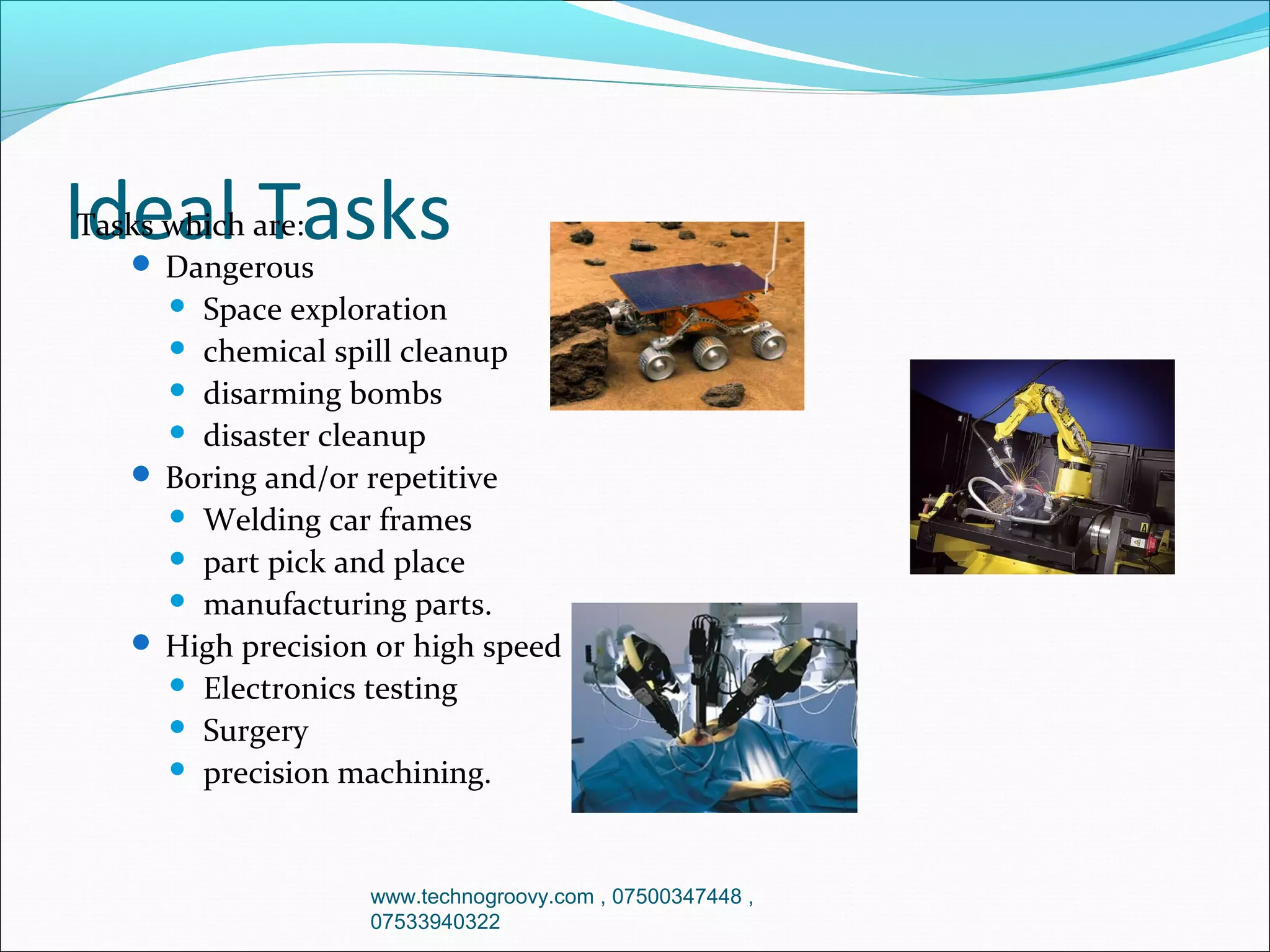
 Dangerous
 Space exploration
 chemical spill cleanup
 disarming bombs
 disaster cleanup
 Boring and/or repetitive
 Welding car frames
 part pick and place
 manufacturing parts.
 High precision or high speed
 Electronics testing
 Surgery
 precision machining.

www.technogroovy.com , 07500347448 ,
07533940322
Automation vs. robots
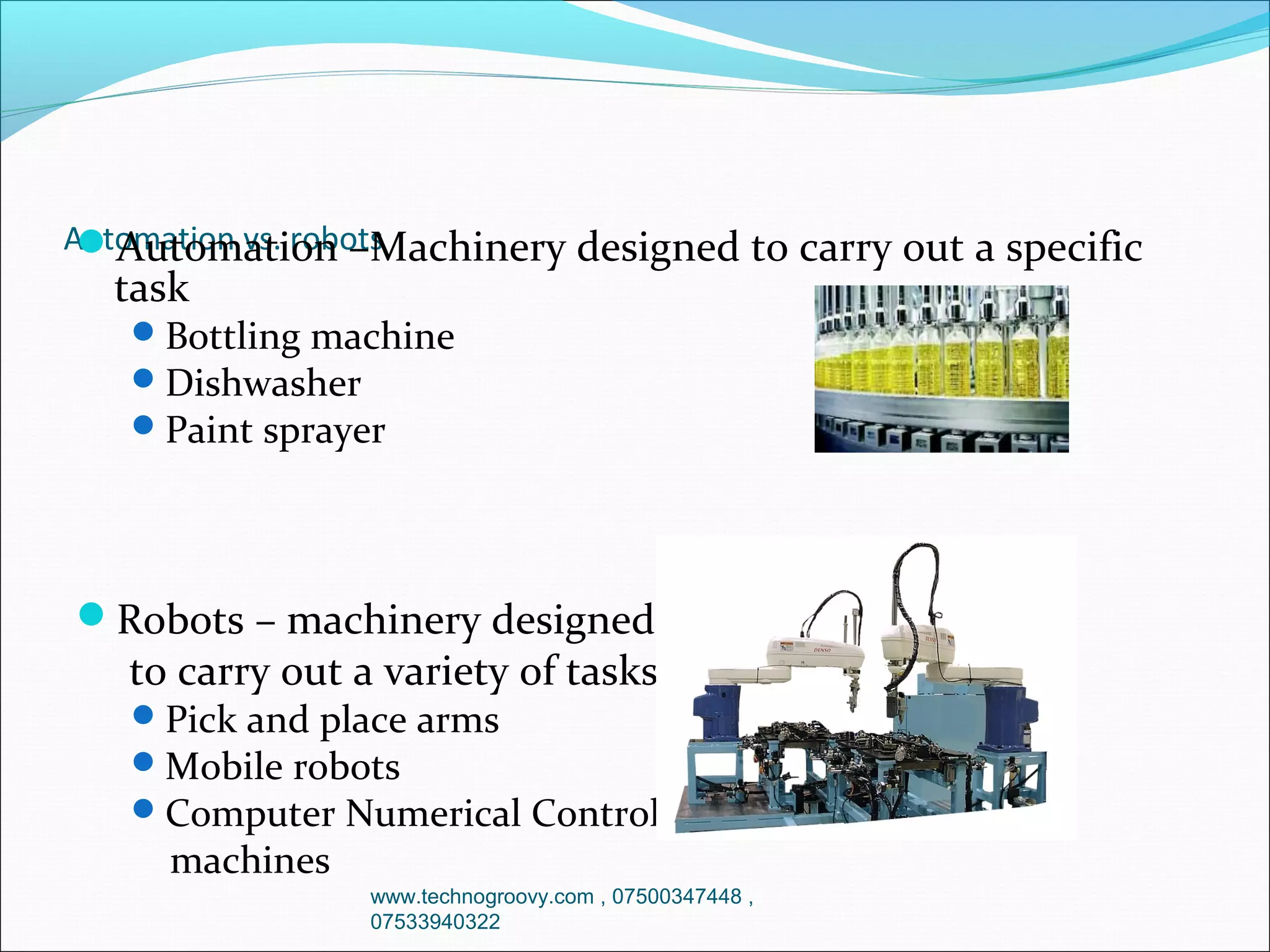
Automation –Machinery designed

task

to carry out a specific

 Bottling machine
 Dishwasher
 Paint sprayer

Robots – machinery designed

to carry out a variety of tasks

 Pick and place arms
 Mobile robots
 Computer Numerical Control

machines

www.technogroovy.com , 07500347448 ,
07533940322
Types of robots
Pick and place
Moves items between points

Continuous path control
Moves along a programmable path

Sensory
Employs sensors for feedback

www.technogroovy.com , 07500347448 ,
07533940322
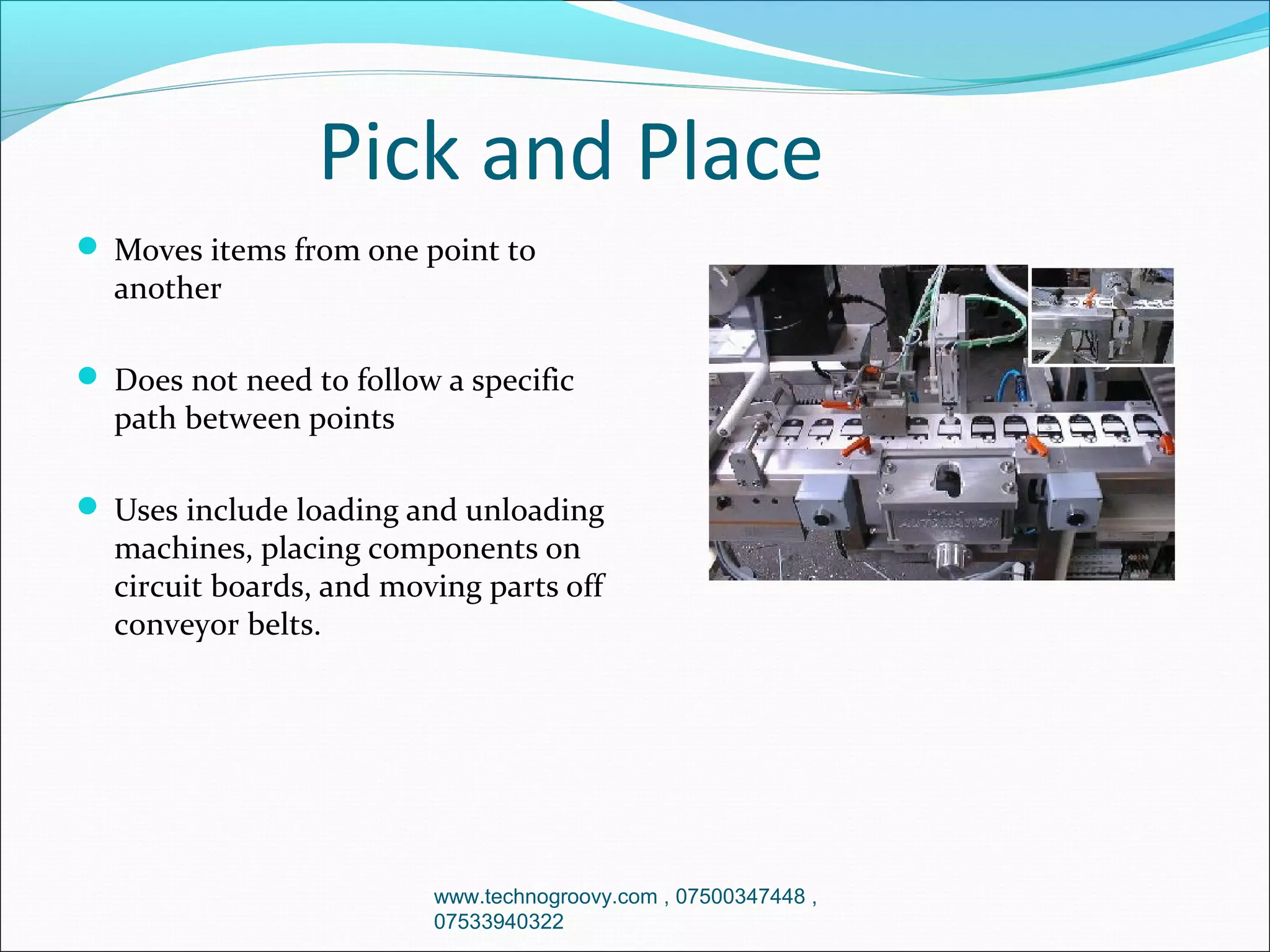
Pick and Place
 Moves items from one point to

another

 Does not need to follow a specific

path between points

 Uses include loading and unloading

machines, placing components on
circuit boards, and moving parts off
conveyor belts.

www.technogroovy.com , 07500347448 ,
07533940322
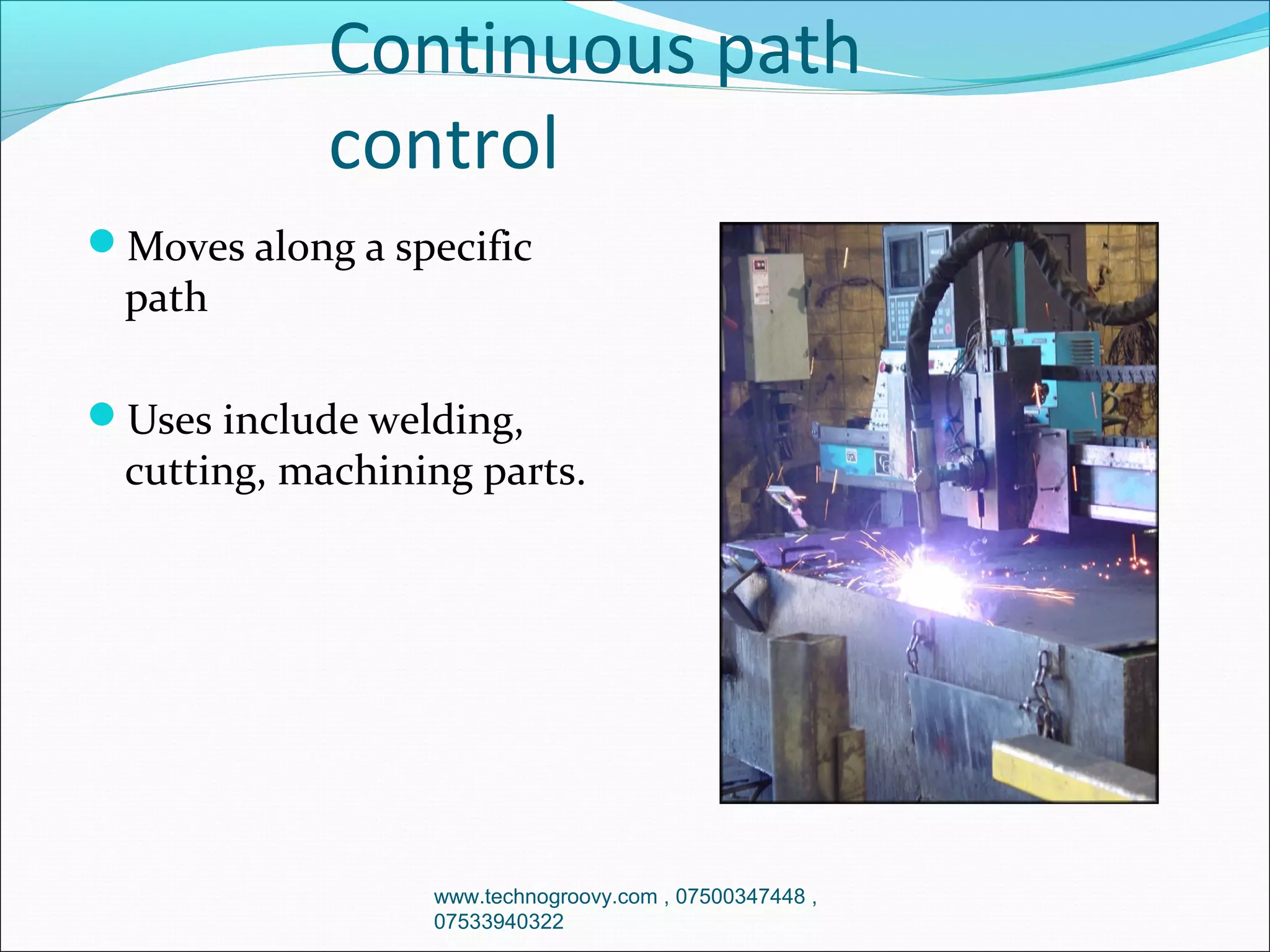
Continuous path
control
Moves along a specific

path

Uses include welding,

cutting, machining parts.

www.technogroovy.com , 07500347448 ,
07533940322
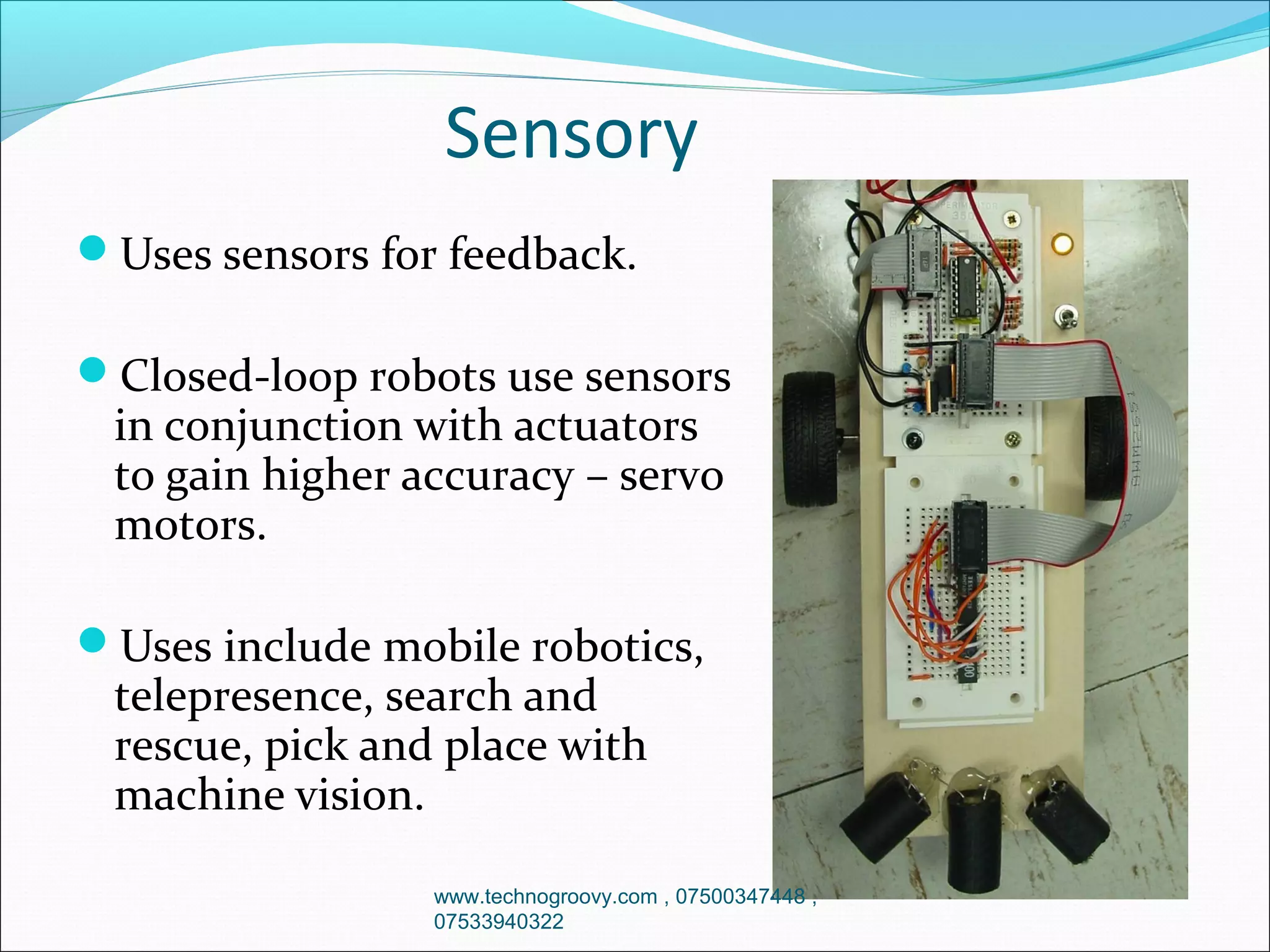
Sensory
Uses sensors for feedback.
Closed-loop robots use sensors

in conjunction with actuators
to gain higher accuracy – servo
motors.

Uses include mobile robotics,

telepresence, search and
rescue, pick and place with
machine vision.

www.technogroovy.com , 07500347448 ,
07533940322
Measures of
performance

 Working volume
 The space within which the robot operates.
 Larger volume costs more but can increase the capabilities
of a robot
 Speed and acceleration
 Faster speed often reduces resolution or increases cost
 Varies depending on position, load.
 Speed can be limited by the task the robot performs
(welding, cutting)
 Resolution
 Often a speed tradeoff
 The smallest step the robot can take
www.technogroovy.com , 07500347448 ,
07533940322
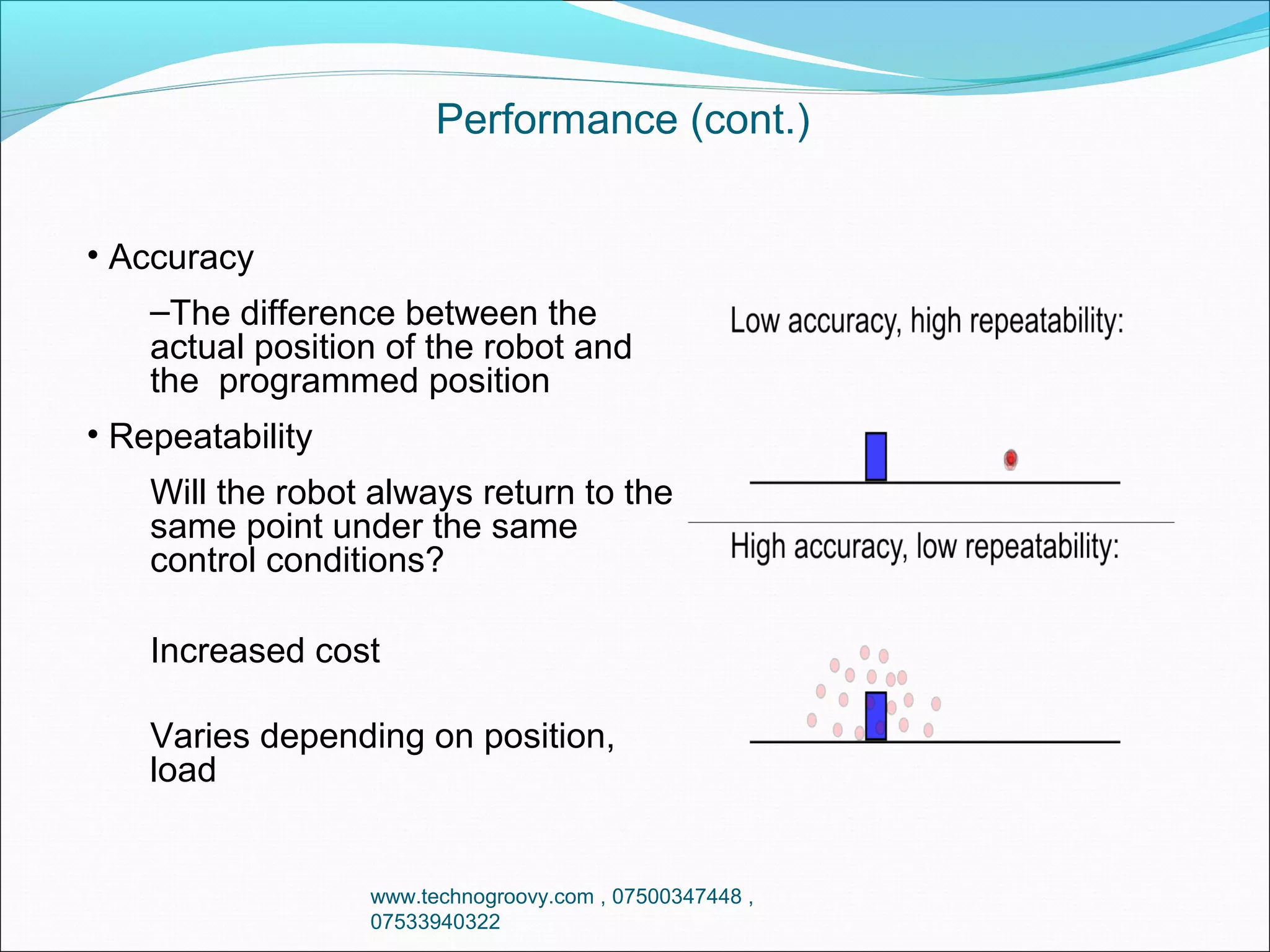
Performance (cont.)
• Accuracy
–The difference between the
actual position of the robot and
the programmed position
• Repeatability
Will the robot always return to the
same point under the same
control conditions?
Increased cost
Varies depending on position,
load

www.technogroovy.com , 07500347448 ,
07533940322
Control
•Open loop, i.e., no feedback, deterministic
•Closed loop, i.e., feedback, maybe a sense of
touch and/or vision

www.technogroovy.com , 07500347448 ,
07533940322
Kinematics and dynamics
Degrees of freedom—number of independent
motions

Translation--3 independent directions
Rotation-- 3 independent axes
2D motion = 3 degrees of freedom: 2 translation, 1

rotation
3D motion = 6 degrees of freedom: 3 translation, 3
rotation

www.technogroovy.com , 07500347448 ,
07533940322
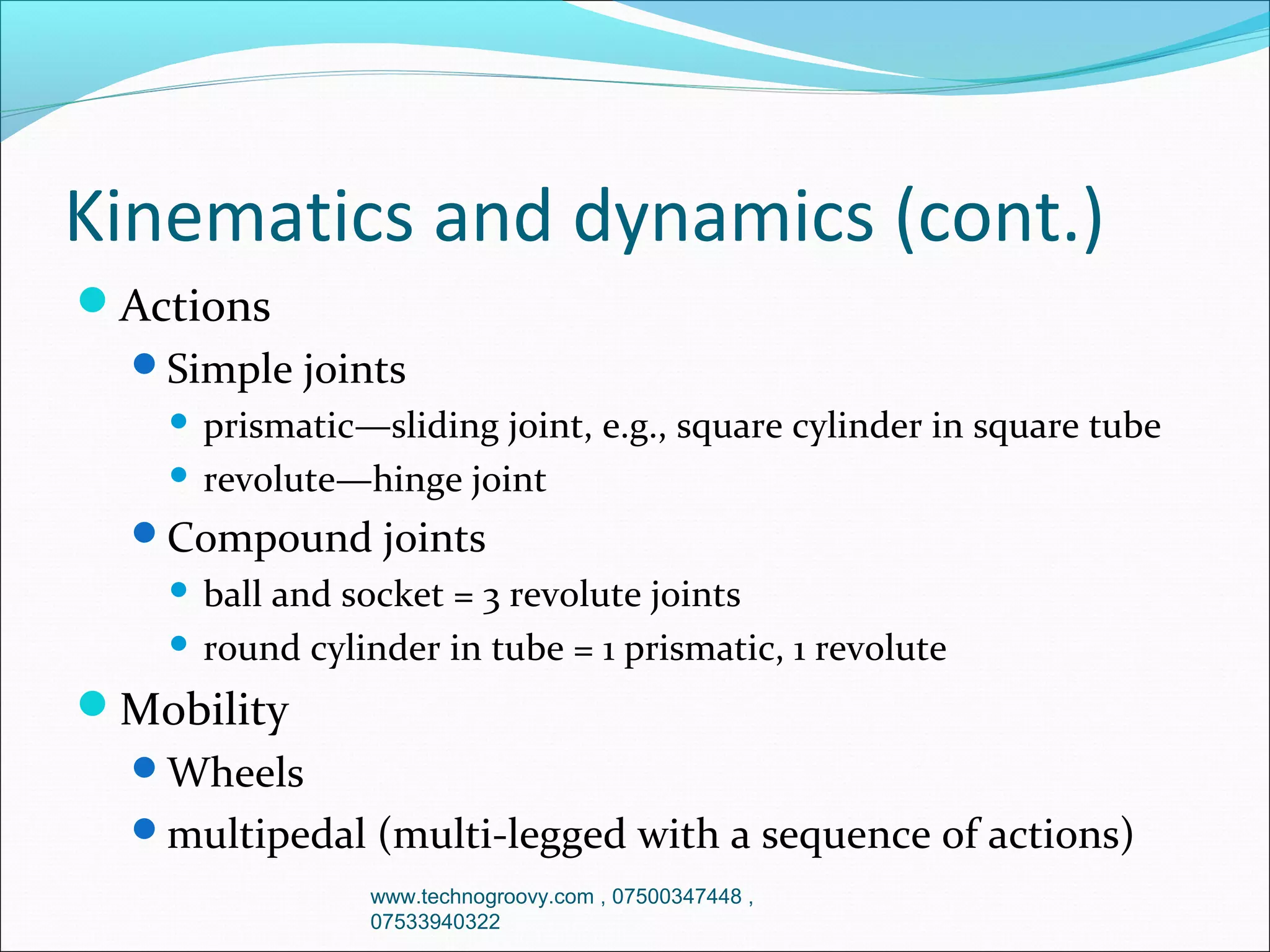
Kinematics and dynamics (cont.)
Actions
Simple joints

prismatic—sliding joint, e.g., square cylinder in square tube
 revolute—hinge joint


Compound joints

ball and socket = 3 revolute joints
 round cylinder in tube = 1 prismatic, 1 revolute


Mobility
Wheels
multipedal (multi-legged with a sequence of actions)
www.technogroovy.com , 07500347448 ,
07533940322
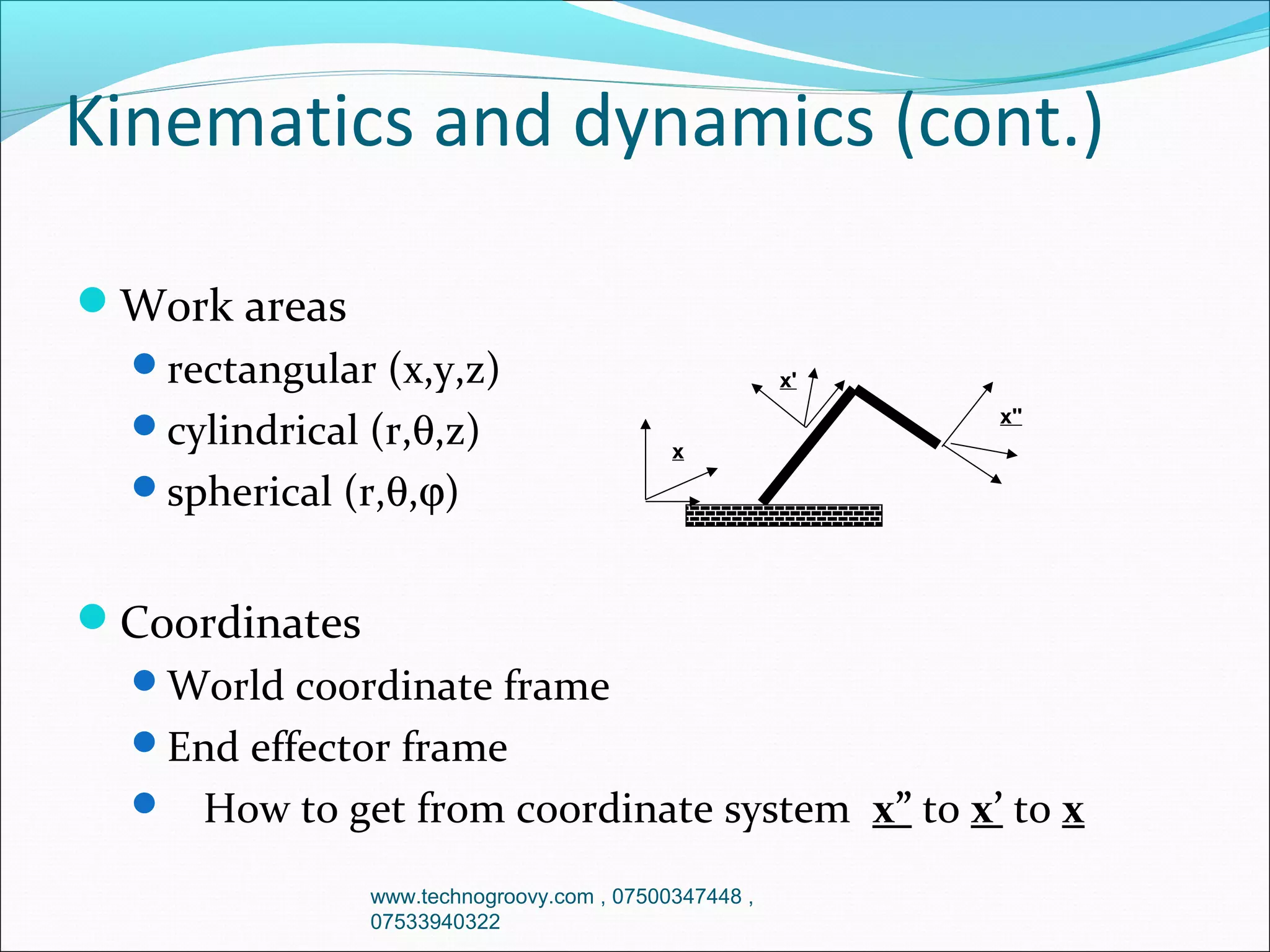
Kinematics and dynamics (cont.)
Work areas
rectangular (x,y,z)
cylindrical (r,θ,z)

x'
x''
x

spherical (r,θ,ϕ)

Coordinates
World coordinate frame
End effector frame


How to get from coordinate system x” to x’ to x
www.technogroovy.com , 07500347448 ,
07533940322
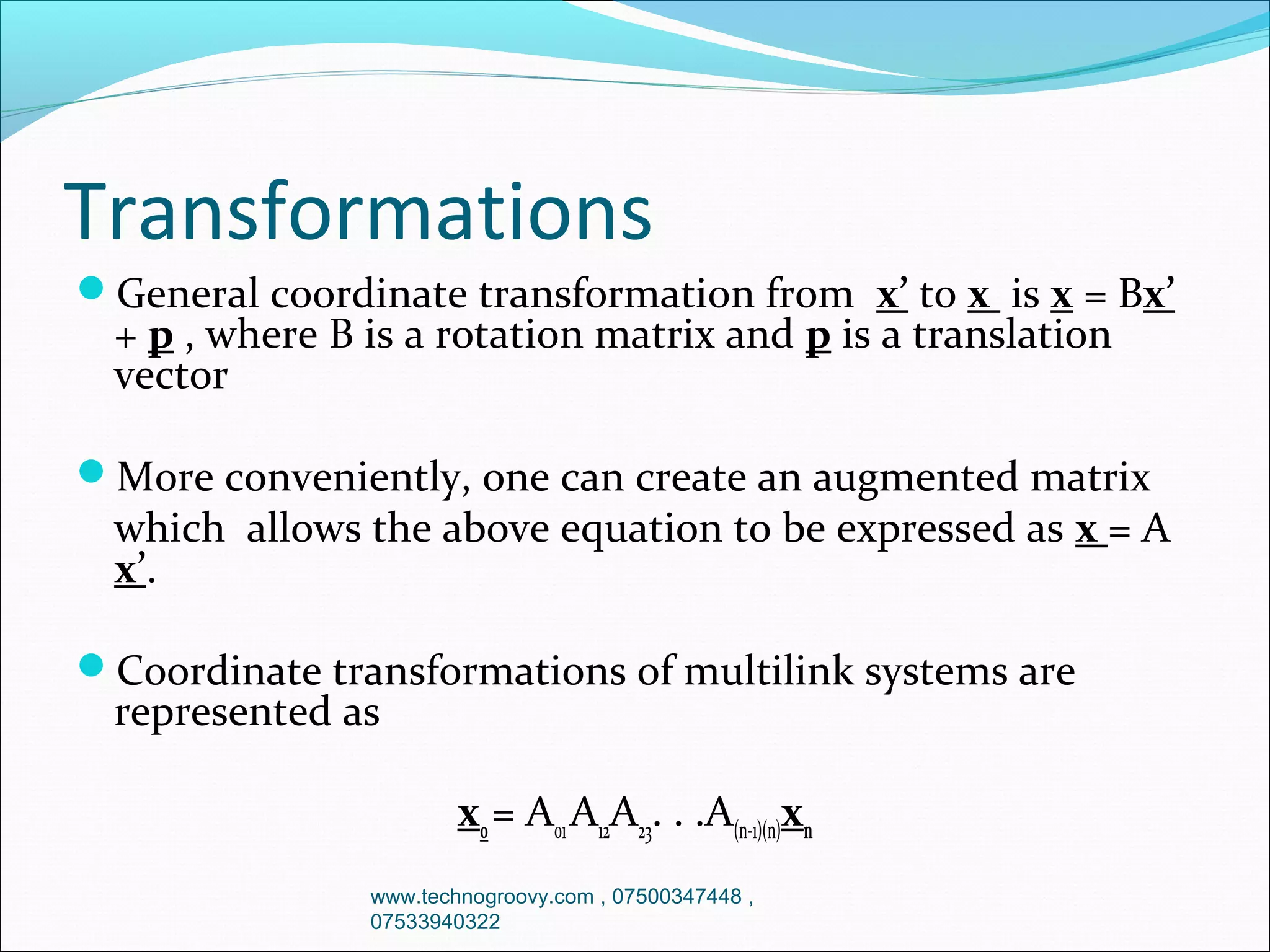
Transformations
General coordinate transformation from x’ to x is x = Bx’

+ p , where B is a rotation matrix and p is a translation
vector

More conveniently, one can create an augmented matrix

which allows the above equation to be expressed as x = A
x’.

Coordinate transformations of multilink systems are

represented as

x0 = A01 A12A23. . .A(n-1)(n)xn
www.technogroovy.com , 07500347448 ,
07533940322
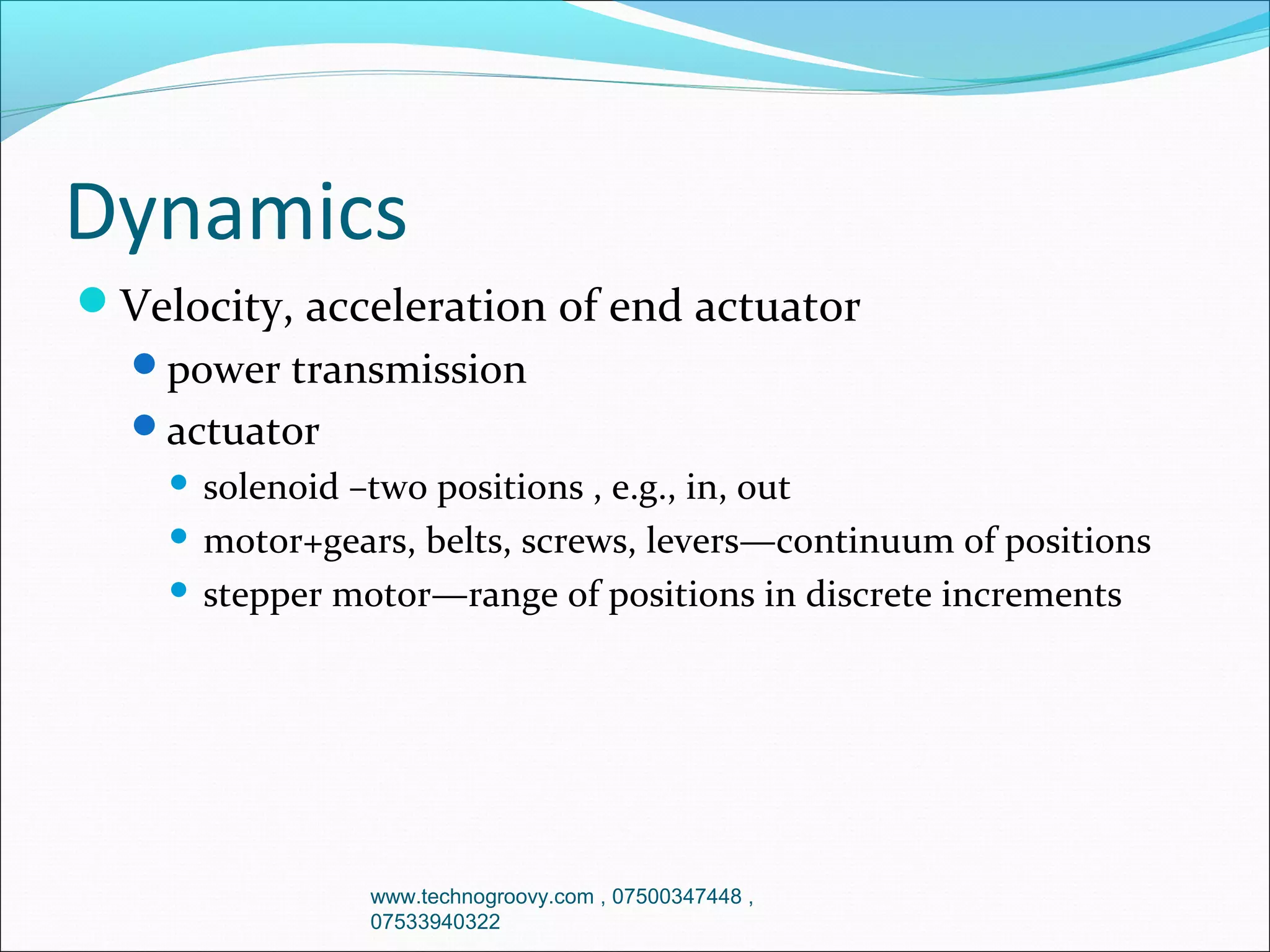
Dynamics
Velocity, acceleration of end actuator
power transmission
actuator

solenoid –two positions , e.g., in, out
 motor+gears, belts, screws, levers—continuum of positions
 stepper motor—range of positions in discrete increments


www.technogroovy.com , 07500347448 ,
07533940322
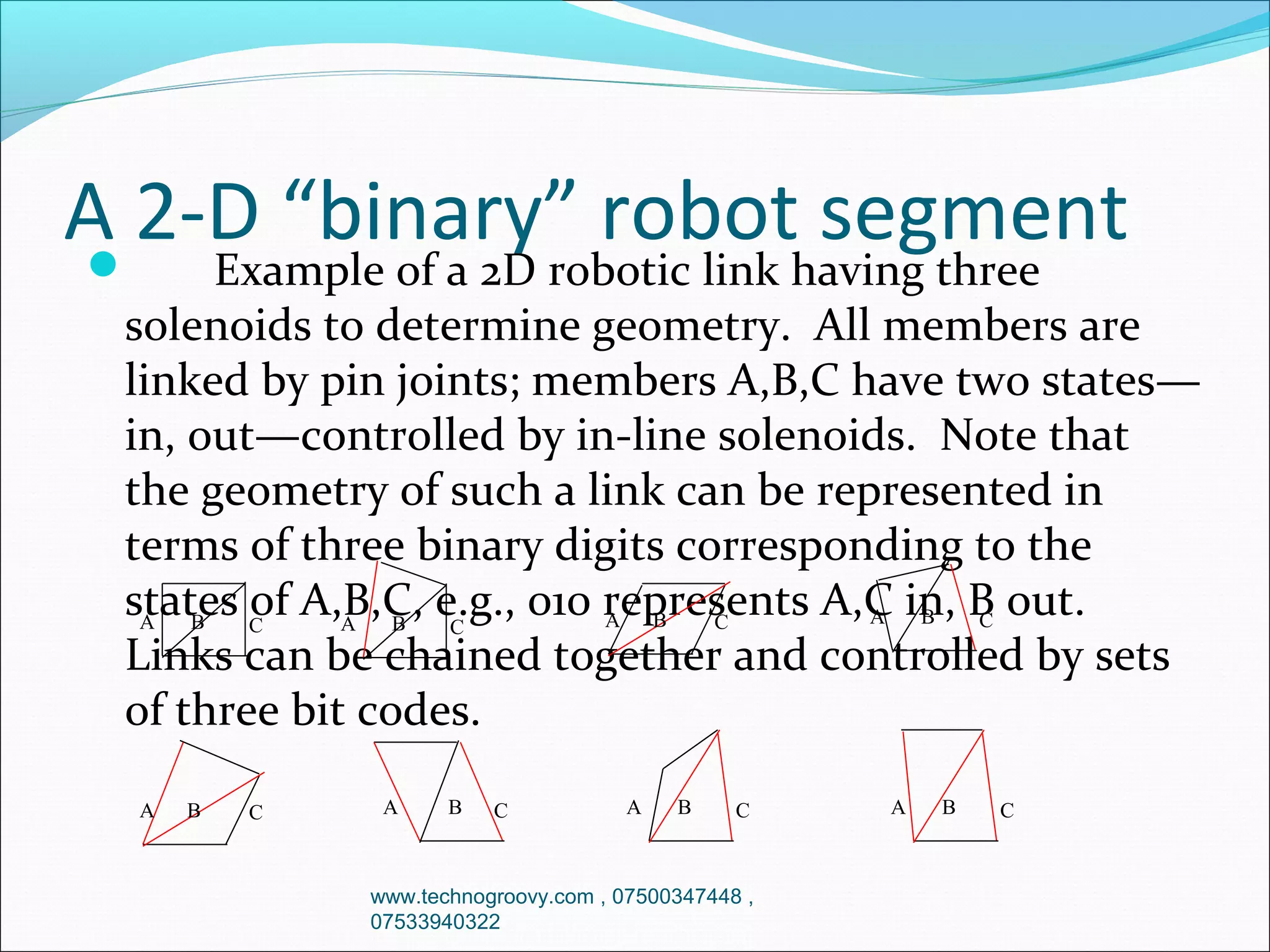
A 2-D “binary” robot segment


Example of a 2D robotic link having three
solenoids to determine geometry. All members are
linked by pin joints; members A,B,C have two states—
in, out—controlled by in-line solenoids. Note that
the geometry of such a link can be represented in
terms of three binary digits corresponding to the
states C A,B,C, e.g., 010 represents A,C in, B out.
of A B C
A
B
B
A
C
A
B
C
Links can be chained together and controlled by sets
of three bit codes.
A

B

C

A

B

C

A

B

C

www.technogroovy.com , 07500347448 ,
07533940322

A

B

C
Problems
Joint play, compounded through N joints
Accelerating masses produce vibration, elastic

deformations in links

Torques, stresses transmitted depending on end

actuator loads

www.technogroovy.com , 07500347448 ,
07533940322
Control and programming
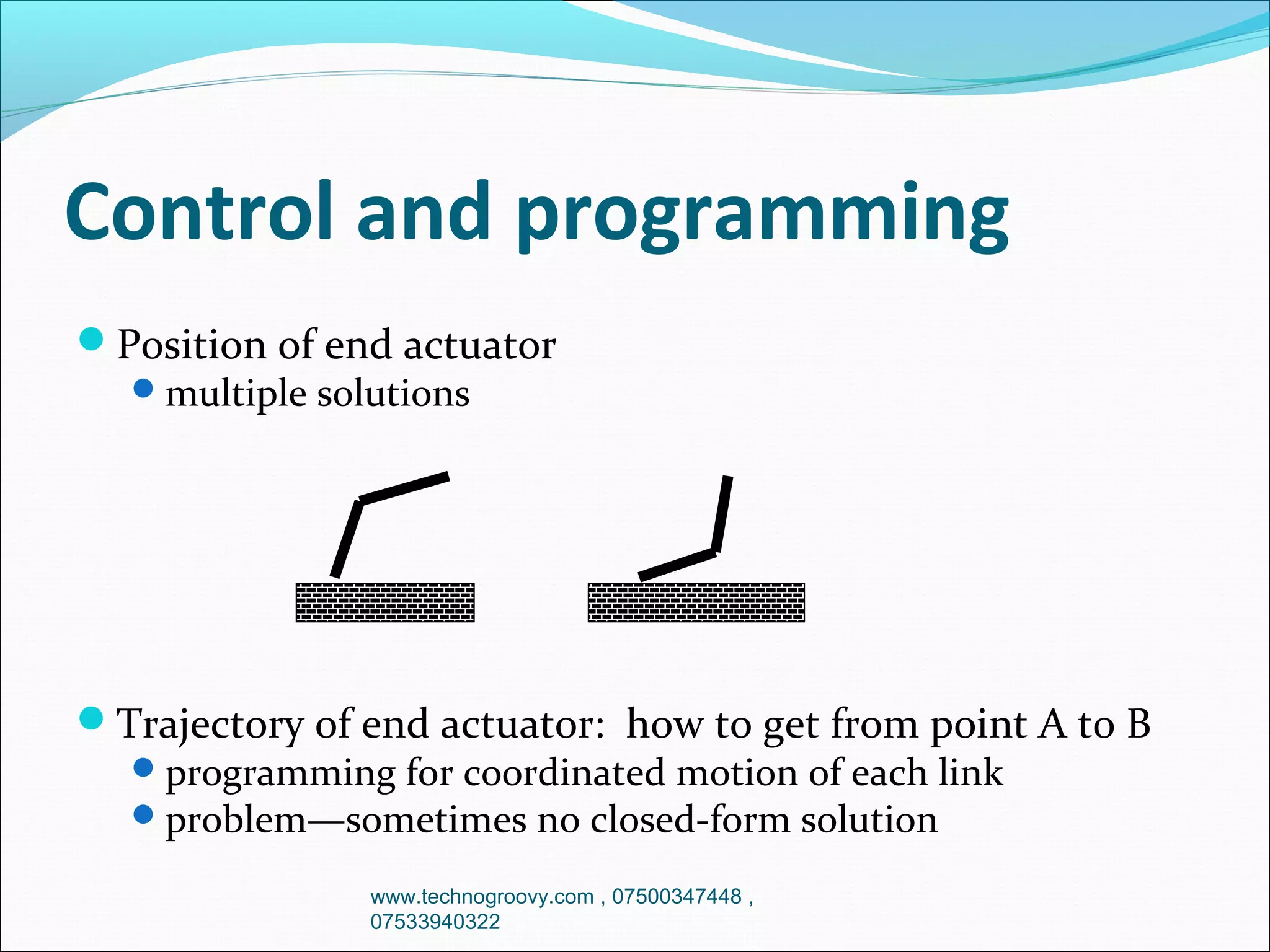
Position of end actuator
 multiple solutions

Trajectory of end actuator: how to get from point A to B
 programming for coordinated motion of each link
 problem—sometimes no closed-form solution
www.technogroovy.com , 07500347448 ,
07533940322
Control and programming (cont.)
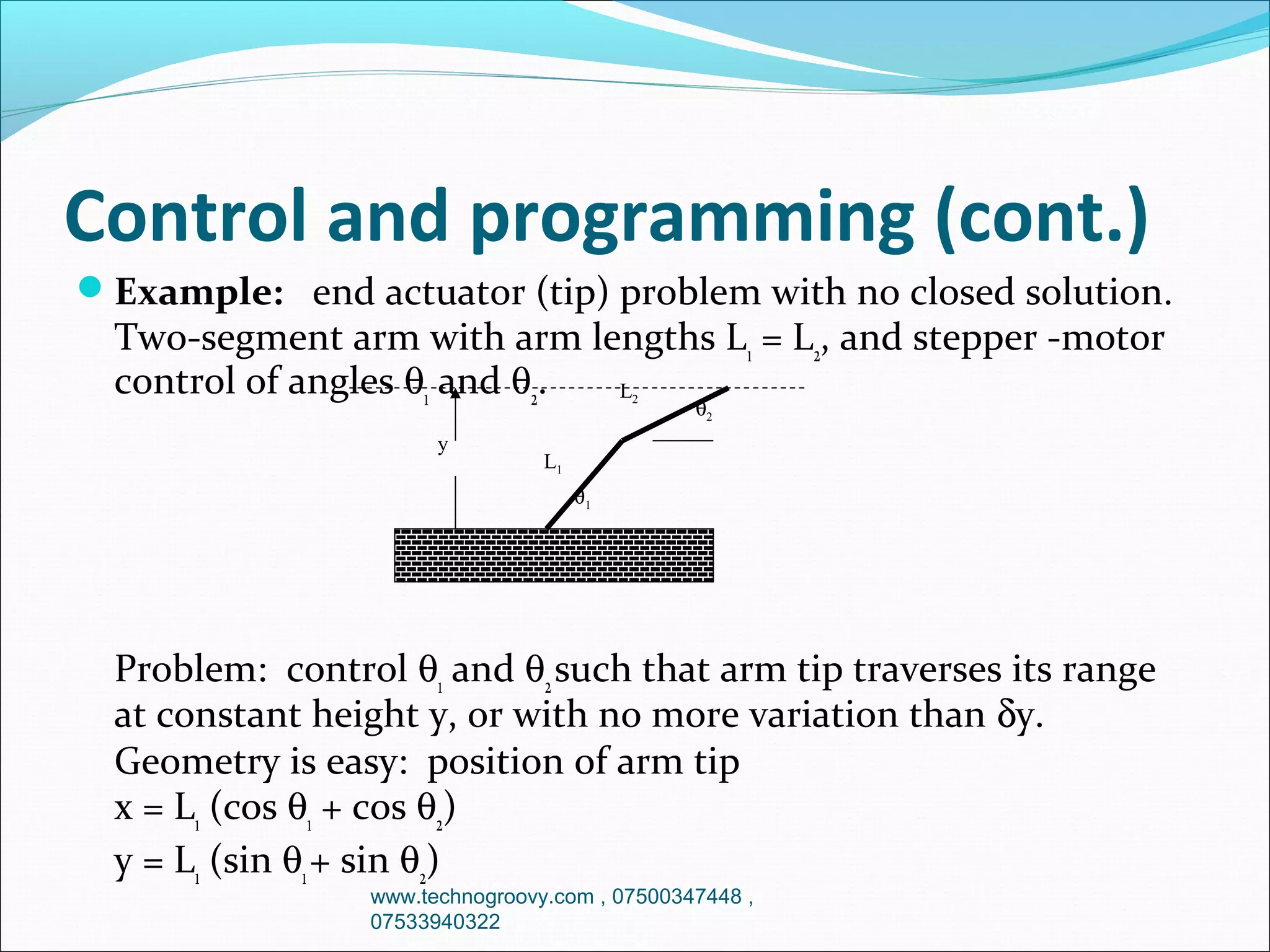
Example: end actuator (tip) problem with no closed solution.

Two-segment arm with arm lengths L1 = L2, and stepper -motor
control of angles θ1 and θ2.
L
2

y

θ2

L1
θ1

Problem: control θ1 and θ2 such that arm tip traverses its range
at constant height y, or with no more variation than δy.
Geometry is easy: position of arm tip
x = L1 (cos θ1 + cos θ2)
y = L1 (sin θ1 + sin θ2)
www.technogroovy.com , 07500347448 ,
07533940322
Control and programming (cont.)
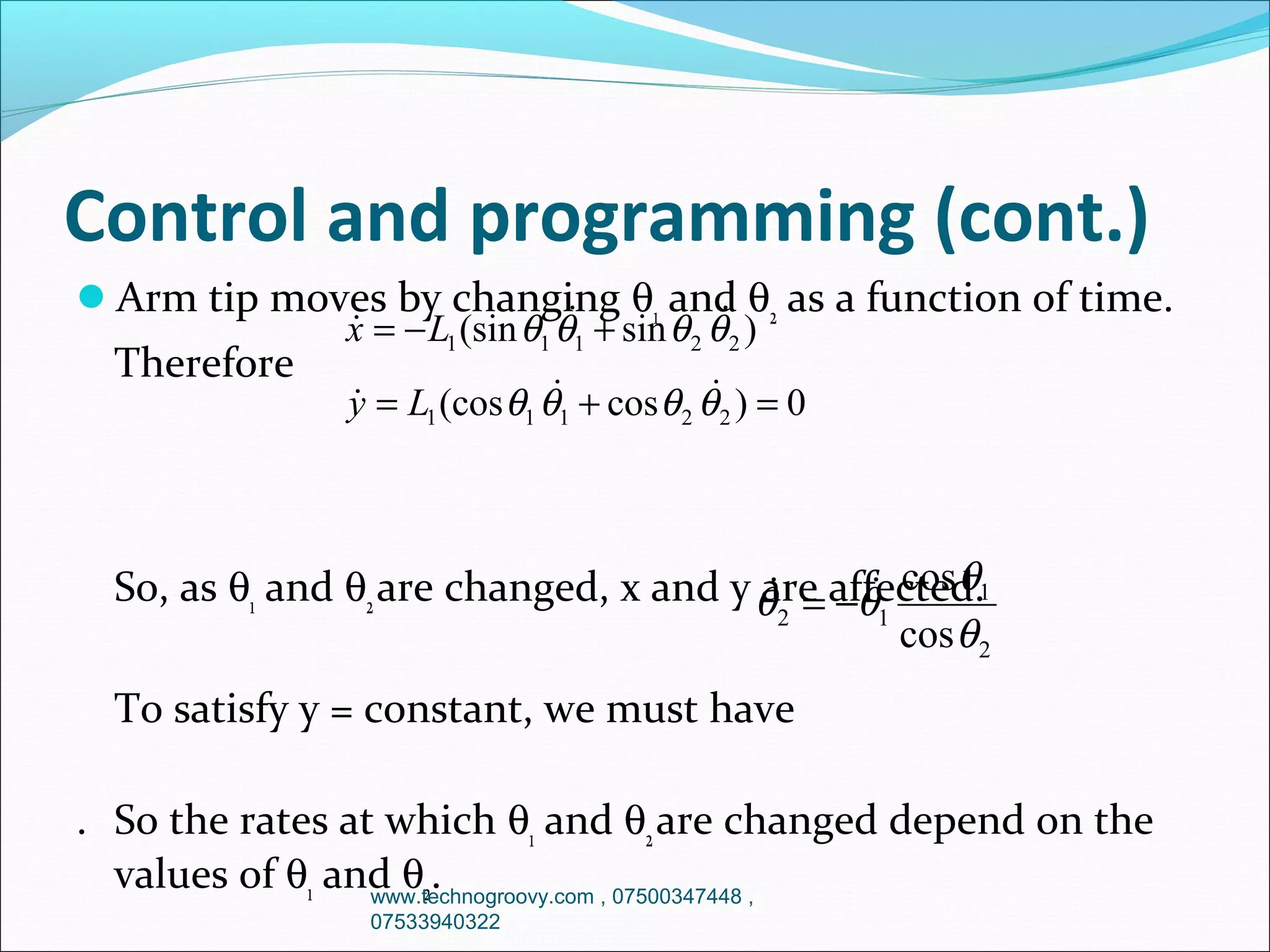
Arm tip moves by changing θ1 and θ2 as a function of time.



x = − L1 (sin θ1 θ1 + sin θ 2 θ 2 )

Therefore




y = L1 (cos θ1 θ1 + cos θ 2 θ 2 ) = 0

So, as θ1 and θ2 are changed, x and y θ = affected.1
are −θ cos θ


2
1
cos θ 2
To satisfy y = constant, we must have
. So the rates at which θ1 and θ2 are changed depend on the
values of θ1 and θ2.
www.technogroovy.com , 07500347448 ,
07533940322
Control and programming (cont.)
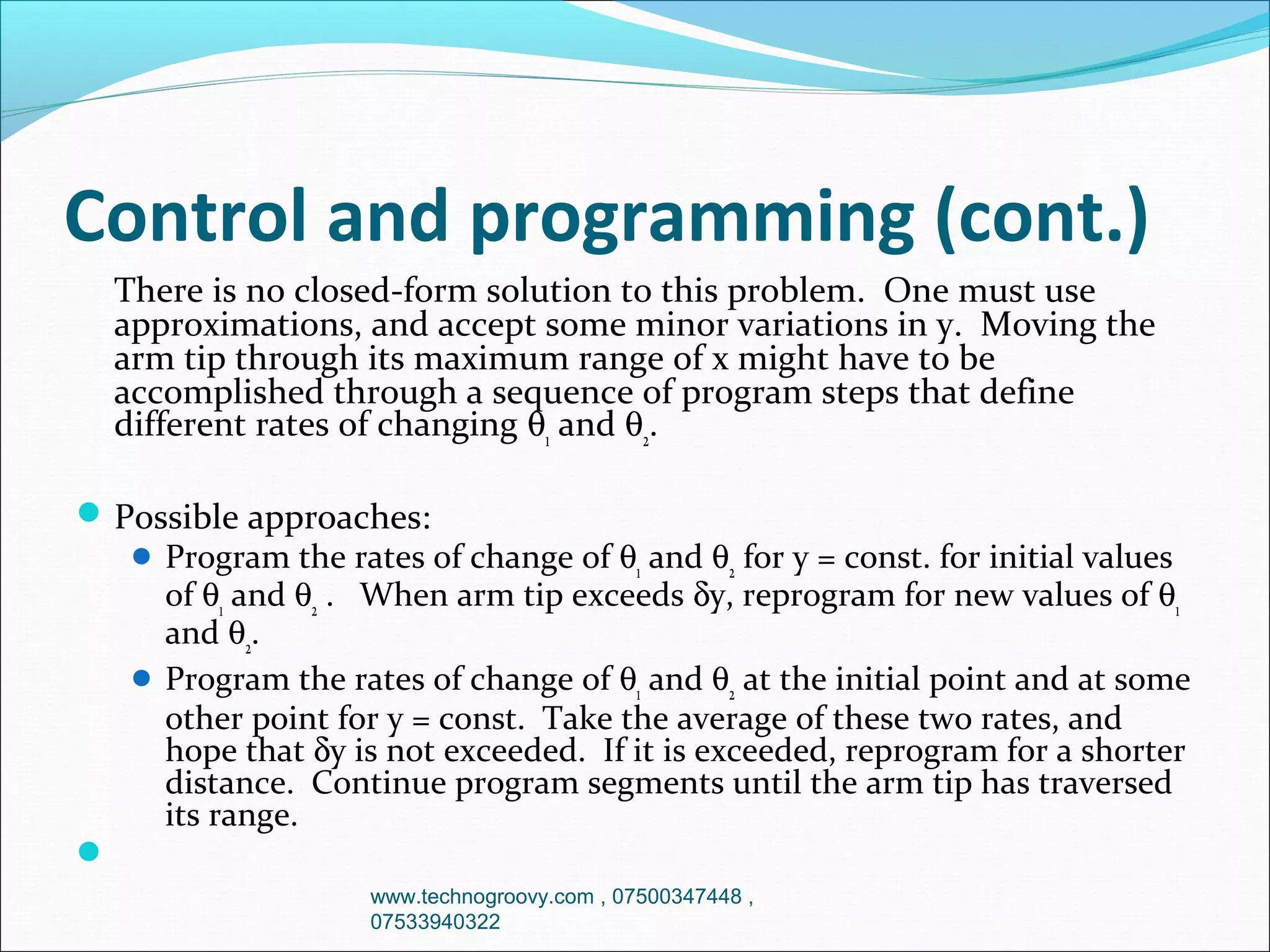
There is no closed-form solution to this problem. One must use
approximations, and accept some minor variations in y. Moving the
arm tip through its maximum range of x might have to be
accomplished through a sequence of program steps that define
different rates of changing θ1 and θ2.
 Possible approaches:
 Program the rates of change of θ1 and θ2 for y = const. for initial values
of θ1 and θ2 . When arm tip exceeds δy, reprogram for new values of θ1
and θ2.
 Program the rates of change of θ1 and θ2 at the initial point and at some
other point for y = const. Take the average of these two rates, and
hope that δy is not exceeded. If it is exceeded, reprogram for a shorter
distance. Continue program segments until the arm tip has traversed
its range.

www.technogroovy.com , 07500347448 ,
07533940322
Control and programming (cont.)
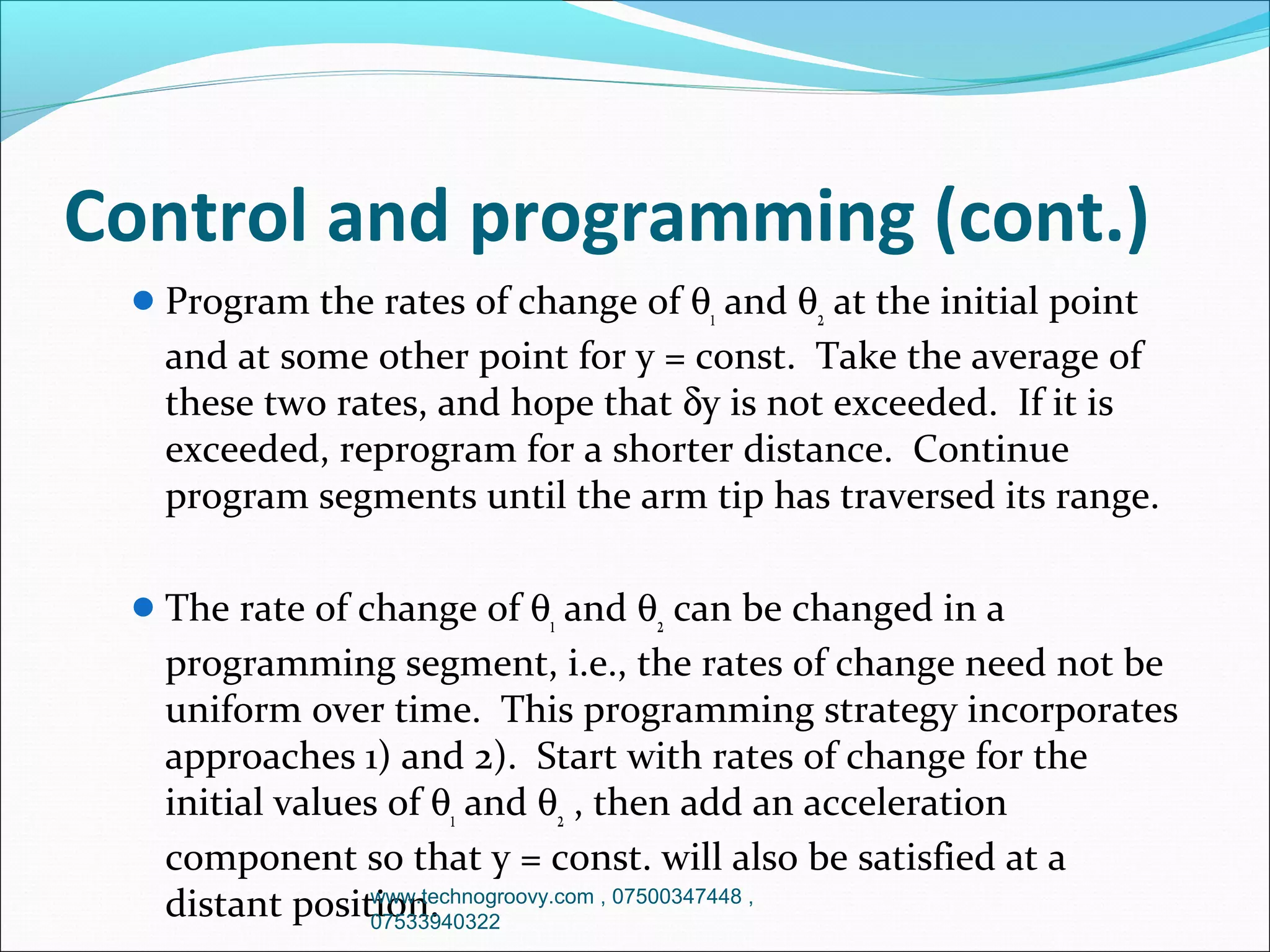
 Program the rates of change of θ1 and θ2 at the initial point

and at some other point for y = const. Take the average of
these two rates, and hope that δy is not exceeded. If it is
exceeded, reprogram for a shorter distance. Continue
program segments until the arm tip has traversed its range.
 The rate of change of θ1 and θ2 can be changed in a

programming segment, i.e., the rates of change need not be
uniform over time. This programming strategy incorporates
approaches 1) and 2). Start with rates of change for the
initial values of θ1 and θ2 , then add an acceleration
component so that y = const. will also be satisfied at a
www.technogroovy.com , 07500347448 ,
distant position.
07533940322
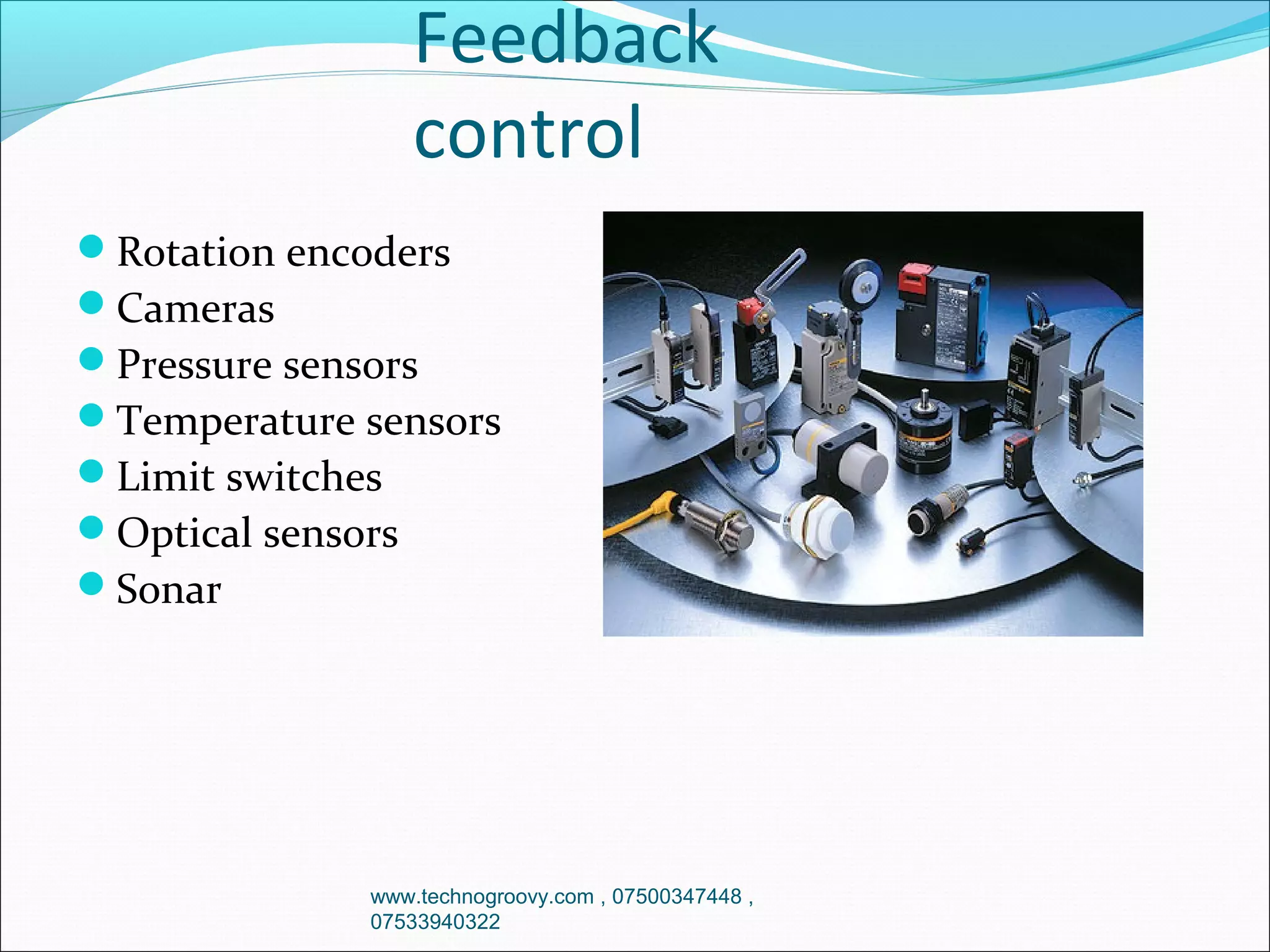
Feedback
control
Rotation encoders
Cameras
Pressure sensors
Temperature sensors
Limit switches
Optical sensors
Sonar

www.technogroovy.com , 07500347448 ,
07533940322
New directions

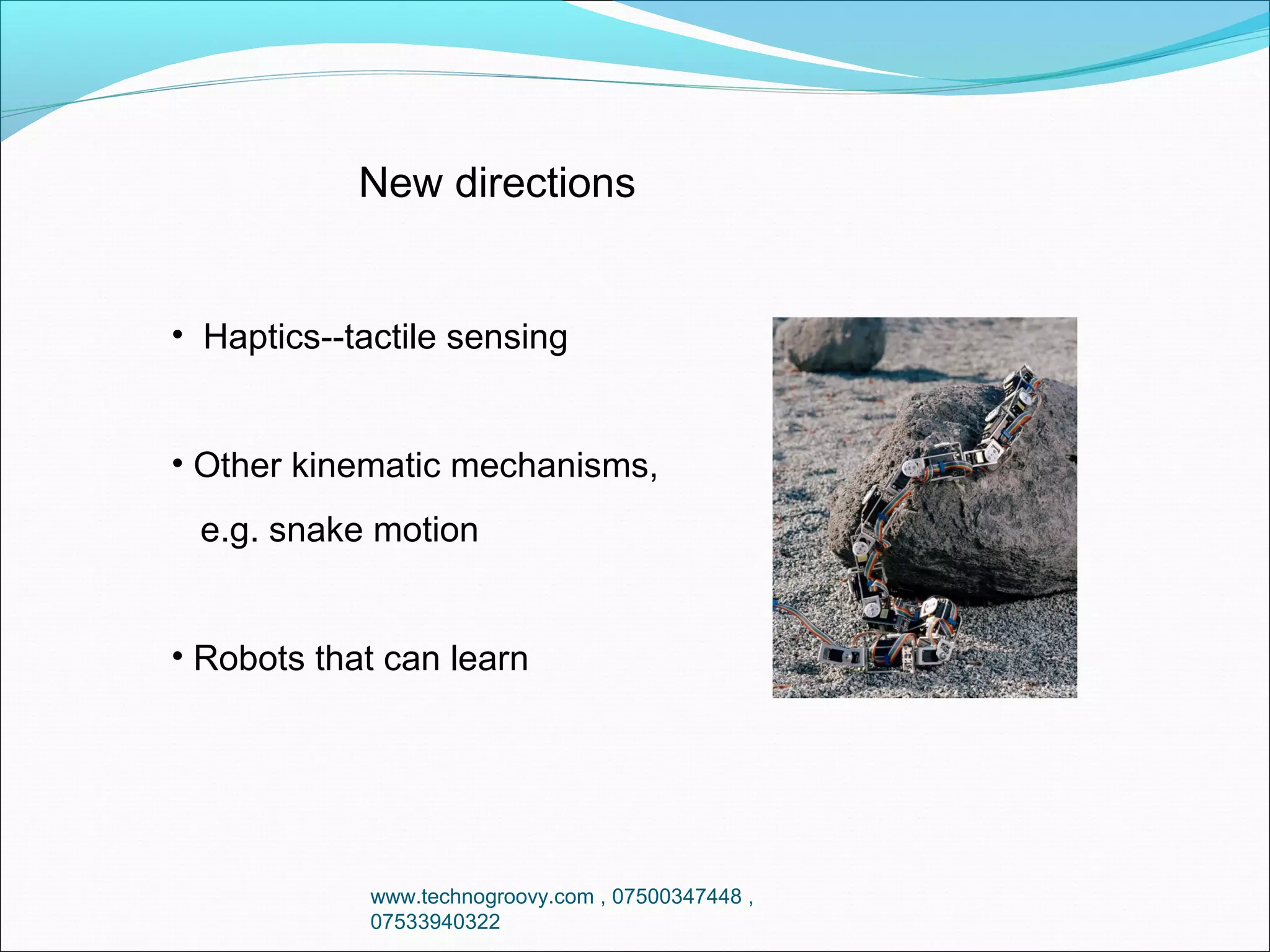
• Haptics--tactile sensing
• Other kinematic mechanisms,
e.g. snake motion
• Robots that can learn

www.technogroovy.com , 07500347448 ,
07533940322
Thank You
Techogroovy Systems India Pvt Ltd
Embedded Systems & Robotics Projects Based Training
www.technogroovy.com
Mail : technogroovy@gmail.com
Cell- +91-7500347448 ,
+91-7533940322

www.technogroovy.com , 07500347448 ,
07533940322

Readymade Projects,Buy Projects,Corporate Training,Projects Assistance

  • 1.
  • 2.
    Definition: Alternate definition: “A robotis a one-armed, blind idiot with limited memory and which cannot speak, see, or hear.” www.technogroovy.com , 07500347448 , 07533940322
  • 3.
    Ideal Tasks Tasks whichare:  Dangerous  Space exploration  chemical spill cleanup  disarming bombs  disaster cleanup  Boring and/or repetitive  Welding car frames  part pick and place  manufacturing parts.  High precision or high speed  Electronics testing  Surgery  precision machining. www.technogroovy.com , 07500347448 , 07533940322
  • 4.
    Automation vs. robots Automation–Machinery designed task to carry out a specific  Bottling machine  Dishwasher  Paint sprayer Robots – machinery designed to carry out a variety of tasks  Pick and place arms  Mobile robots  Computer Numerical Control machines www.technogroovy.com , 07500347448 , 07533940322
  • 5.
    Types of robots Pickand place Moves items between points Continuous path control Moves along a programmable path Sensory Employs sensors for feedback www.technogroovy.com , 07500347448 , 07533940322
  • 6.
    Pick and Place Moves items from one point to another  Does not need to follow a specific path between points  Uses include loading and unloading machines, placing components on circuit boards, and moving parts off conveyor belts. www.technogroovy.com , 07500347448 , 07533940322
  • 7.
    Continuous path control Moves alonga specific path Uses include welding, cutting, machining parts. www.technogroovy.com , 07500347448 , 07533940322
  • 8.
    Sensory Uses sensors forfeedback. Closed-loop robots use sensors in conjunction with actuators to gain higher accuracy – servo motors. Uses include mobile robotics, telepresence, search and rescue, pick and place with machine vision. www.technogroovy.com , 07500347448 , 07533940322
  • 9.
    Measures of performance  Workingvolume  The space within which the robot operates.  Larger volume costs more but can increase the capabilities of a robot  Speed and acceleration  Faster speed often reduces resolution or increases cost  Varies depending on position, load.  Speed can be limited by the task the robot performs (welding, cutting)  Resolution  Often a speed tradeoff  The smallest step the robot can take www.technogroovy.com , 07500347448 , 07533940322
  • 10.
    Performance (cont.) • Accuracy –Thedifference between the actual position of the robot and the programmed position • Repeatability Will the robot always return to the same point under the same control conditions? Increased cost Varies depending on position, load www.technogroovy.com , 07500347448 , 07533940322
  • 11.
    Control •Open loop, i.e.,no feedback, deterministic •Closed loop, i.e., feedback, maybe a sense of touch and/or vision www.technogroovy.com , 07500347448 , 07533940322
  • 12.
    Kinematics and dynamics Degreesof freedom—number of independent motions Translation--3 independent directions Rotation-- 3 independent axes 2D motion = 3 degrees of freedom: 2 translation, 1 rotation 3D motion = 6 degrees of freedom: 3 translation, 3 rotation www.technogroovy.com , 07500347448 , 07533940322
  • 13.
    Kinematics and dynamics(cont.) Actions Simple joints prismatic—sliding joint, e.g., square cylinder in square tube  revolute—hinge joint  Compound joints ball and socket = 3 revolute joints  round cylinder in tube = 1 prismatic, 1 revolute  Mobility Wheels multipedal (multi-legged with a sequence of actions) www.technogroovy.com , 07500347448 , 07533940322
  • 14.
    Kinematics and dynamics(cont.) Work areas rectangular (x,y,z) cylindrical (r,θ,z) x' x'' x spherical (r,θ,ϕ) Coordinates World coordinate frame End effector frame  How to get from coordinate system x” to x’ to x www.technogroovy.com , 07500347448 , 07533940322
  • 15.
    Transformations General coordinate transformationfrom x’ to x is x = Bx’ + p , where B is a rotation matrix and p is a translation vector More conveniently, one can create an augmented matrix which allows the above equation to be expressed as x = A x’. Coordinate transformations of multilink systems are represented as x0 = A01 A12A23. . .A(n-1)(n)xn www.technogroovy.com , 07500347448 , 07533940322
  • 16.
    Dynamics Velocity, acceleration ofend actuator power transmission actuator solenoid –two positions , e.g., in, out  motor+gears, belts, screws, levers—continuum of positions  stepper motor—range of positions in discrete increments  www.technogroovy.com , 07500347448 , 07533940322
  • 17.
    A 2-D “binary”robot segment  Example of a 2D robotic link having three solenoids to determine geometry. All members are linked by pin joints; members A,B,C have two states— in, out—controlled by in-line solenoids. Note that the geometry of such a link can be represented in terms of three binary digits corresponding to the states C A,B,C, e.g., 010 represents A,C in, B out. of A B C A B B A C A B C Links can be chained together and controlled by sets of three bit codes. A B C A B C A B C www.technogroovy.com , 07500347448 , 07533940322 A B C
  • 18.
    Problems Joint play, compoundedthrough N joints Accelerating masses produce vibration, elastic deformations in links Torques, stresses transmitted depending on end actuator loads www.technogroovy.com , 07500347448 , 07533940322
  • 19.
    Control and programming Positionof end actuator  multiple solutions Trajectory of end actuator: how to get from point A to B  programming for coordinated motion of each link  problem—sometimes no closed-form solution www.technogroovy.com , 07500347448 , 07533940322
  • 20.
    Control and programming(cont.) Example: end actuator (tip) problem with no closed solution. Two-segment arm with arm lengths L1 = L2, and stepper -motor control of angles θ1 and θ2. L 2 y θ2 L1 θ1 Problem: control θ1 and θ2 such that arm tip traverses its range at constant height y, or with no more variation than δy. Geometry is easy: position of arm tip x = L1 (cos θ1 + cos θ2) y = L1 (sin θ1 + sin θ2) www.technogroovy.com , 07500347448 , 07533940322
  • 21.
    Control and programming(cont.) Arm tip moves by changing θ1 and θ2 as a function of time.    x = − L1 (sin θ1 θ1 + sin θ 2 θ 2 ) Therefore    y = L1 (cos θ1 θ1 + cos θ 2 θ 2 ) = 0 So, as θ1 and θ2 are changed, x and y θ = affected.1 are −θ cos θ   2 1 cos θ 2 To satisfy y = constant, we must have . So the rates at which θ1 and θ2 are changed depend on the values of θ1 and θ2. www.technogroovy.com , 07500347448 , 07533940322
  • 22.
    Control and programming(cont.) There is no closed-form solution to this problem. One must use approximations, and accept some minor variations in y. Moving the arm tip through its maximum range of x might have to be accomplished through a sequence of program steps that define different rates of changing θ1 and θ2.  Possible approaches:  Program the rates of change of θ1 and θ2 for y = const. for initial values of θ1 and θ2 . When arm tip exceeds δy, reprogram for new values of θ1 and θ2.  Program the rates of change of θ1 and θ2 at the initial point and at some other point for y = const. Take the average of these two rates, and hope that δy is not exceeded. If it is exceeded, reprogram for a shorter distance. Continue program segments until the arm tip has traversed its range.  www.technogroovy.com , 07500347448 , 07533940322
  • 23.
    Control and programming(cont.)  Program the rates of change of θ1 and θ2 at the initial point and at some other point for y = const. Take the average of these two rates, and hope that δy is not exceeded. If it is exceeded, reprogram for a shorter distance. Continue program segments until the arm tip has traversed its range.  The rate of change of θ1 and θ2 can be changed in a programming segment, i.e., the rates of change need not be uniform over time. This programming strategy incorporates approaches 1) and 2). Start with rates of change for the initial values of θ1 and θ2 , then add an acceleration component so that y = const. will also be satisfied at a www.technogroovy.com , 07500347448 , distant position. 07533940322
  • 24.
    Feedback control Rotation encoders Cameras Pressure sensors Temperaturesensors Limit switches Optical sensors Sonar www.technogroovy.com , 07500347448 , 07533940322
  • 25.
    New directions • Haptics--tactilesensing • Other kinematic mechanisms, e.g. snake motion • Robots that can learn www.technogroovy.com , 07500347448 , 07533940322
  • 26.
    Thank You Techogroovy SystemsIndia Pvt Ltd Embedded Systems & Robotics Projects Based Training www.technogroovy.com Mail : technogroovy@gmail.com Cell- +91-7500347448 , +91-7533940322 www.technogroovy.com , 07500347448 , 07533940322