Reading Strategies
Workshop
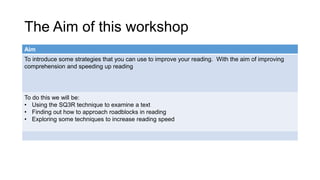
The Aim of this workshop
Aim
To introduce some strategies that you can use to improve your reading. With the aim of improving
comprehension and speeding up reading
To do this we will be:
• Using the SQ3R technique to examine a text
• Finding out how to approach roadblocks in reading
• Exploring some techniques to increase reading speed
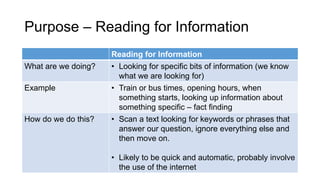
Purpose – Reading for Information
Reading for Information
What are we doing? • Looking for specific bits of information (we know
what we are looking for)
Example • Train or bus times, opening hours, when
something starts, looking up information about
something specific – fact finding
How do we do this? • Scan a text looking for keywords or phrases that
answer our question, ignore everything else and
then move on.
• Likely to be quick and automatic, probably involve
the use of the internet
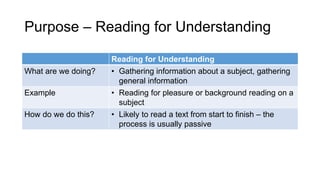
Purpose – Reading for Understanding
Reading for Understanding
What are we doing? • Gathering information about a subject, gathering
general information
Example • Reading for pleasure or background reading on a
subject
How do we do this? • Likely to read a text from start to finish – the
process is usually passive
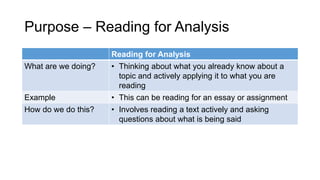
Purpose – Reading for Analysis
Reading for Analysis
What are we doing? • Thinking about what you already know about a
topic and actively applying it to what you are
reading
Example • This can be reading for an essay or assignment
How do we do this? • Involves reading a text actively and asking
questions about what is being said
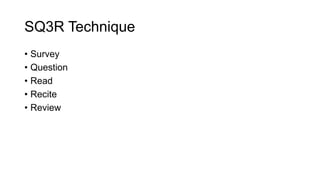
SQ3R Technique
• Survey
• Question
• Read
• Recite
• Review
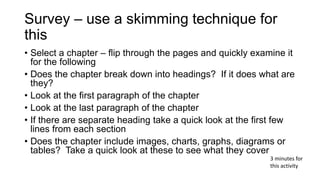
Survey – use a skimming technique for
this
• Select a chapter – flip through the pages and quickly examine it
for the following
• Does the chapter break down into headings? If it does what are
they?
• Look at the first paragraph of the chapter
• Look at the last paragraph of the chapter
• If there are separate heading take a quick look at the first few
lines from each section
• Does the chapter include images, charts, graphs, diagrams or
tables? Take a quick look at these to see what they cover
3 minutes for
this activity
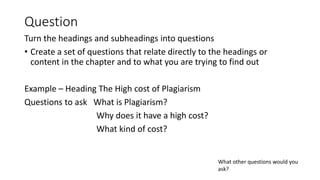
Question
Turn the headings and subheadings into questions
• Create a set of questions that relate directly to the headings or
content in the chapter and to what you are trying to find out
Example – Heading The High cost of Plagiarism
Questions to ask What is Plagiarism?
Why does it have a high cost?
What kind of cost?
What other questions would you
ask?
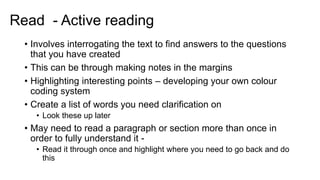
Read - Active reading
• Involves interrogating the text to find answers to the questions
that you have created
• This can be through making notes in the margins
• Highlighting interesting points – developing your own colour
coding system
• Create a list of words you need clarification on
• Look these up later
• May need to read a paragraph or section more than once in
order to fully understand it -
• Read it through once and highlight where you need to go back and do
this
Keep questioning as you read
• What is the author’s position?
• Who isn’t included – what is missing from the text?
• What is being demonstrated?
• Do more questions come to mind as you read the text?
Activity – Talking to the text
In pairs
• one person reads aloud for 60 seconds
• The other person will say what is going on in their mind while
the other reads
• Swap over and repeat
Roadblocks to understanding – what can
make things difficult
• Language
• Sentence length and complexity
• Conceptual difficulty
• Idea density
• Relevance
Clarifying – 5 step process
Fix-it steps
• Ignore the unclear part and read on
• Reread the unclear part again more carefully
• Reread the sentence before the unclear part – does this help
at all
• Try to connect the unclear part to something you already know
about the subject
• Get help from elsewhere – this can be peers, academics, or
other books and articles
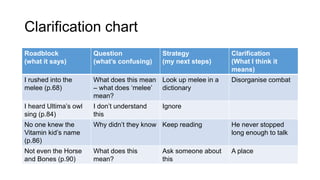
Clarification chart
Roadblock
(what it says)
Question
(what’s confusing)
Strategy
(my next steps)
Clarification
(What I think it
means)
I rushed into the
melee (p.68)
What does this mean
– what does ‘melee’
mean?
Look up melee in a
dictionary
Disorganise combat
I heard Ultima’s owl
sing (p.84)
I don’t understand
this
Ignore
No one knew the
Vitamin kid’s name
(p.86)
Why didn’t they know Keep reading He never stopped
long enough to talk
Not even the Horse
and Bones (p.90)
What does this
mean?
Ask someone about
this
A place
Recite – check your understanding
• Once you have read check you can answer the question that
you set – if you haven’t then go back and check the answers
• Test yourself on what you have read
• Check your understanding
• Can you summarise what you have read in 25 words?
• Draw a mind-map?
• Ask further questions?
Review
• Once you have checked your notes and the information that you
found review this without referring to the text.
• Recall your questions and see if you can answer them without
looking at the information that you have found
• If you can’t remember the answer go back and find it
• Test yourself again
• Review how the notes that you have made fit in with other material
you have (the wider picture)
• Is the material you have read significant?
• What are the implications of what you have read?
• Has it raised additional questions?
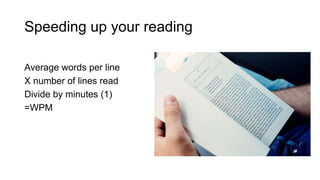
Speeding up your reading
Average words per line
X number of lines read
Divide by minutes (1)
=WPM
What makes reading slow
• Unfamiliar material
• Internal distraction
• External distraction
• Irregular Eye movement -the eyes are focussing on bits all over
the place
• Limited eye span
Reading Time
• Clear starting and stopping times
• Short sessions
• Take breaks
• Find your best time for reading
• Create associations with reading
• Consider where you are reading
(place)
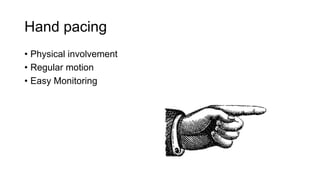
Hand pacing
• Physical involvement
• Regular motion
• Easy Monitoring
“Phrase reading”
• Based on developing eye span
• Rather than reading one word at a time the eyes take in two,
three or four words at a time
• Practice using the online tool Speeder
• http://www.spreeder.com
Practice using drills
• Comfortable speed (80-100% comprehension)
• Double speed (40-50% comprehension)
• Triple speed (0% comprehension)
• 1 minute comfortable speed
Speeding up your reading
Average words per line
X number of lines read
Divide by minutes (1)
=WPM
Questions?

Reading strategies

  • 1.
  • 2.
    The Aim ofthis workshop Aim To introduce some strategies that you can use to improve your reading. With the aim of improving comprehension and speeding up reading To do this we will be: • Using the SQ3R technique to examine a text • Finding out how to approach roadblocks in reading • Exploring some techniques to increase reading speed
  • 3.
    Purpose – Readingfor Information Reading for Information What are we doing? • Looking for specific bits of information (we know what we are looking for) Example • Train or bus times, opening hours, when something starts, looking up information about something specific – fact finding How do we do this? • Scan a text looking for keywords or phrases that answer our question, ignore everything else and then move on. • Likely to be quick and automatic, probably involve the use of the internet
  • 4.
    Purpose – Readingfor Understanding Reading for Understanding What are we doing? • Gathering information about a subject, gathering general information Example • Reading for pleasure or background reading on a subject How do we do this? • Likely to read a text from start to finish – the process is usually passive
  • 5.
    Purpose – Readingfor Analysis Reading for Analysis What are we doing? • Thinking about what you already know about a topic and actively applying it to what you are reading Example • This can be reading for an essay or assignment How do we do this? • Involves reading a text actively and asking questions about what is being said
  • 6.
    SQ3R Technique • Survey •Question • Read • Recite • Review
  • 7.
    Survey – usea skimming technique for this • Select a chapter – flip through the pages and quickly examine it for the following • Does the chapter break down into headings? If it does what are they? • Look at the first paragraph of the chapter • Look at the last paragraph of the chapter • If there are separate heading take a quick look at the first few lines from each section • Does the chapter include images, charts, graphs, diagrams or tables? Take a quick look at these to see what they cover 3 minutes for this activity
  • 8.
    Question Turn the headingsand subheadings into questions • Create a set of questions that relate directly to the headings or content in the chapter and to what you are trying to find out Example – Heading The High cost of Plagiarism Questions to ask What is Plagiarism? Why does it have a high cost? What kind of cost? What other questions would you ask?
  • 9.
    Read - Activereading • Involves interrogating the text to find answers to the questions that you have created • This can be through making notes in the margins • Highlighting interesting points – developing your own colour coding system • Create a list of words you need clarification on • Look these up later • May need to read a paragraph or section more than once in order to fully understand it - • Read it through once and highlight where you need to go back and do this
  • 10.
    Keep questioning asyou read • What is the author’s position? • Who isn’t included – what is missing from the text? • What is being demonstrated? • Do more questions come to mind as you read the text?
  • 11.
    Activity – Talkingto the text In pairs • one person reads aloud for 60 seconds • The other person will say what is going on in their mind while the other reads • Swap over and repeat
  • 12.
    Roadblocks to understanding– what can make things difficult • Language • Sentence length and complexity • Conceptual difficulty • Idea density • Relevance
  • 13.
    Clarifying – 5step process Fix-it steps • Ignore the unclear part and read on • Reread the unclear part again more carefully • Reread the sentence before the unclear part – does this help at all • Try to connect the unclear part to something you already know about the subject • Get help from elsewhere – this can be peers, academics, or other books and articles
  • 14.
    Clarification chart Roadblock (what itsays) Question (what’s confusing) Strategy (my next steps) Clarification (What I think it means) I rushed into the melee (p.68) What does this mean – what does ‘melee’ mean? Look up melee in a dictionary Disorganise combat I heard Ultima’s owl sing (p.84) I don’t understand this Ignore No one knew the Vitamin kid’s name (p.86) Why didn’t they know Keep reading He never stopped long enough to talk Not even the Horse and Bones (p.90) What does this mean? Ask someone about this A place
  • 15.
    Recite – checkyour understanding • Once you have read check you can answer the question that you set – if you haven’t then go back and check the answers • Test yourself on what you have read • Check your understanding • Can you summarise what you have read in 25 words? • Draw a mind-map? • Ask further questions?
  • 16.
    Review • Once youhave checked your notes and the information that you found review this without referring to the text. • Recall your questions and see if you can answer them without looking at the information that you have found • If you can’t remember the answer go back and find it • Test yourself again • Review how the notes that you have made fit in with other material you have (the wider picture) • Is the material you have read significant? • What are the implications of what you have read? • Has it raised additional questions?
  • 17.
    Speeding up yourreading Average words per line X number of lines read Divide by minutes (1) =WPM
  • 18.
    What makes readingslow • Unfamiliar material • Internal distraction • External distraction • Irregular Eye movement -the eyes are focussing on bits all over the place • Limited eye span
  • 19.
    Reading Time • Clearstarting and stopping times • Short sessions • Take breaks • Find your best time for reading • Create associations with reading • Consider where you are reading (place)
  • 20.
    Hand pacing • Physicalinvolvement • Regular motion • Easy Monitoring
  • 21.
    “Phrase reading” • Basedon developing eye span • Rather than reading one word at a time the eyes take in two, three or four words at a time • Practice using the online tool Speeder • http://www.spreeder.com
  • 22.
    Practice using drills •Comfortable speed (80-100% comprehension) • Double speed (40-50% comprehension) • Triple speed (0% comprehension) • 1 minute comfortable speed
  • 23.
    Speeding up yourreading Average words per line X number of lines read Divide by minutes (1) =WPM
  • 24.

Editor's Notes

  • #4 Reading for information Likely to be looking for something specific – we all do this as a matter of course in our daily lives. Eg. I want to know what events the SU are putting on. Most likely to involve searching and using the internet as a first place to look nowadays Automatic in nature – we just do it and want to be rewarded with results How we do this, scan text looking for keywords or phrases that answer our question and ignore everything else.
  • #5 Reading for understanding is about gathering information about a subject – often in the form of general or background information on a subject, can also be about reading for pleasure (fiction reading) To do this we are more likely to read a text or chapter from start to finish – the process is passive, in that we are not questioning or responding to what the writer is stating
  • #6 Reading for analysis is about approaching a text from the point of view of what you already know about a subject and asking questions The point of view might be that you know nothing or that you have some background information – it might be that you have had a lecture on the subject and that is your starting point. This type of reading involves thinking about what you do or don’t know before you start reading and actively engaging with the text Questions to ask include What do I already know What is the author’s position Who isn’t included – what is missing from the text What is being demonstrated In this session we are focussing on Reading for analysis
  • #7 The technique that we are going to use in this workshop is the SQ3R technique Originally developed in the 40s to help military trainees absorb training faster and more effectively Research has shown that by using it 22% read faster 10% comprehend more 80% retain more It is made up of the following areas Survey Question Read Recite Review
  • #8 Each student will have a book available to survey - ask students to select a chapter from the book The first step in the SQ3R technique is to survey the material that you are going to read, to do this use a skimming technique A skimming technique will enable to you to quickly assess what a chapter or a whole book is about. (hand out skimming and scanning This involves looking at skimming the chapter Does the chapter have headings? What are they Look at the first paragraph Look at the last paragraph Can you predict two things that you might get from the chapter
  • #9 Two elements to questioning, before you start to read The first is around questioning the validity of what you are reading based on your initial survey – how it relates to what you need to find out for your assignment Questions to ask are around what is in it for me – what am I going to get out of reading this material in depth Go back to your assignment question – after doing the initial survey think about how does what I am reading fit in with what I need to find out, if it doesn’t then disregard it, move on to the next work. Am I likely to find out what I need from this piece of work? Is what I am reading going to help me with my assignment The second element of questioning is to create questions that relate directly to the material that you have scanned. So, going back to the material that you have just surveyed, can you create one question around the material.
  • #10 The next stage is to go into reading and making notes on the material For this you need to read and interrogate the text in detail – this is an active process You have your set of questions, now you are applying them to the text to find the answers
  • #12 This exercise is based on asking questions of the text and thinking about what you need to come back to- what questions you have Get into pairs One person will read for 60 seconds the other listen and say what they are thinking about what is being read After 60 seconds we will swap over so the other person has a go. Hand out on phantom limbs.
  • #13 Language – different disciplines have different types of language and their own words that need to be understood – if we are new or unfamiliar with the language of a discipline then this can make the text seem difficult. A strategy for this is to create your own glossary of terms – maybe buy a cheap a-z notebook, add terms to that, look the word up and provide a definition Sentence length and complexity – Long sentences can be harder to understand than shorter sentences as they often contain too much information to take in – tip – break down into chunks Short sentences can also be problematic as they can lack words to link material together and help it make sense. Conceptual difficulty – sometimes ideas can seem abstract, especially if what you are reading requires you to have prior knowledge and understanding of a subject – this gets easier as your understanding of a subject grows. A strategy to help with this is to investigate other texts and see if they present material in a more digestible way. Alternatively break down into chunks, continue to ask questions Idea density – you might feel overwhelmed by the number of ideas in a text – this might be especially true of text books Relevance – if something appears to be relevant we are likely to be more comfortable with it and feel motivated to continue reading
  • #14 Clarifying – 5 step process Ignore the unclear part and read on, does further reading make the idea clearer – is the idea important? Reread the unclear part more carefully, may also need to chunk the text into manageable sections if it is too long or difficult
  • #15 To help manage the clarification process you could keep a clarification chart as you read a text – this enables you to track areas that you require clarification on and then solve these after you have read what you are reading.
  • #17 Can be done a few days later
  • #18 Find your comfortable reading speed Set timer for one minute Read for one minute Find out average number of words per line (number of words added together divided by number of lines) X this result by number of line read Divide by number of minutes reading Will arrive at your WPM Average is 250 WPM – or between 150-400 WPM Will vary between situation, reader, type of material, difficulty of the material
  • #19 Some things that can make reading slow include Unfamiliar material – and we have touched on this earlier and how to approach it. But to recap we are talking about Lack of understanding or familiarity with a subject or discipline – unfamiliar material, it’s new and we have to integrate it into our existing picture or schema of the subject. It will raise questions that we need to assimilate and find answers to and we may have to double check vocabulary etc, this can add to the processing time and slow us down. Distractions – internal, I’m hungry, cold, uncomfortable and external, you see something out of the window that interests you, your phone rings etc Distractions are things that are within our control and we will talk about this in a minute Eye movement – the eyes are a muscle that can be developed to help us read faster and we will look at this shortly
  • #20 Good practice around reading time begins with finding the best hours for you – when do you find reading easiest Often it is fitted in around everything else and thought of as an add on, but you need to schedule time into your programme of study and find the time that is going to be most effective for you. It is best not to stick reading around the edges of other study, identify a good time especially for active reading Maybe plan a schedule Block you reading based on realistic time before you start to get distracted – this can be between 30 minutes to an hour before you start to get distracted and lose concentration Have a break at the end of your preferred length of time Create associations around reading so that your brain learns that it will be involved in reading for an hour or so. As humans our brains love to learn associations and links Find a comfortable place, free from too many distractions - find your special place in the library or at home? You want to find somewhere free from things that you will want to get involved in Music can help some people or, white noise – use the White noise creator (on your list of useful links) to screen out external noise -and create a noise that you can learn to associate specifically with reading Other things that are important include light and comfort
  • #21 Based on physical principles that the eyes will follow the hand, can help you to speed up your reading Eyes will follow the finger or pencil as you run it along the text – you are training your eyes to follow and making it easier to read eyes will follow the pointer Creates a connection between the brain and what you are reading – making your reading visible and also creating a rhythm Test it out
  • #22 Phrase reading is based on increasing your eye span This is the amount that your eyes take in at once. If you look at a page of text, divide the page into columns and imagine you have three or four dots on the page, each dot at the centre of your column, the aim is to train your eyes to focus on the words around these dots It requires practice Can use online tool Sp
  • #23 Like anything, getting your reading speed up requires practice, one way is to use drills This can look something like Read for 1 minute at comfortable speed Read for 30 seconds at double speed using hand pacing or ‘phase reading’ Read for 20 seconds at triple speed Return to original speed for one minute – test out – did you get faster Drill practice has benefit of warming up the eyes – as the triple speed deprives us of information it can make us more keen to get it – we get there faster Gets us out of our comfort zone and stretching ourselves
  • #24 Find your comfortable reading speed Set timer for one minute Read for one minute Find out average number of words per line (number of words added together divided by number of lines) X this result by number of line read Divide by number of minutes reading Will arrive at your WPM Average is 250 WPM – or between 150-400 WPM Will vary between situation, reader, type of material, difficulty of the material