Critical Assignment #1
Learning Strategies for 6th grade nonfiction text
By: Hollie Miller
When Could We Use Reading Strategies?
Reading Strategies can be used before, during,
and after reading.
When these strategies are used students can
better comprehend text, understand vocabulary,
and the text can become more meaningful.
Before Reading strategies
• Prior Knowledge Map
• Vocabulary Preview
• K W L chart
• Make Predictions
• THIEVES
Prior Knowledge Map
• Students will make a prior knowledge map by
making a circle in the middle with 4 smaller
circles around it.
• In the 1 middle circle students will write the
name of the text or topic.
• In the 4 outer circles students will write in
what they know about that topic.
Vocabulary Preview
• The students will go through the text to see if
there are any unknown or confusing words.
• Students will write them down and come back
to them after they read to write in the
definition.
• Doing a vocabulary preview can help students
to recognize and identify the words right away
when they are reading.
KWL Chart
• This is chart that has a K, W, and L section.
• The K stands for know and the students will fill
this section in before they read.
• The W stands for what you want to know and
the students would also fill this is before they
read.
Make Predictions
• After reading the title and skimming the
passage the students would then make
predictions.
• These predictions can be done in small groups
or one by one.
THIEVES
• T – title (look at the Title)
• H - Headings (find and understand headings)
• I – Introduction (skim the intro)
• E - Every First Sentence (read every first sentence)
• V - Visuals and Vocab (find pictures or vocab words)
• E - End of Text (read or skim the end of the text)
• S - Summarize Thinking (now what do you think it will
be about)
During Reading Strategies
• Mark up Text
• Table Talk
• Visualizing
• Questioning
• Making Connections
Mark Up Text
• This is something students can do while they are
reading. Students can use highlighters, pencils, and/or
sticky notes to make marks in the text when they see
something important.
For example:
• Dates
• Times
• Unknown words
• Important words/sentences
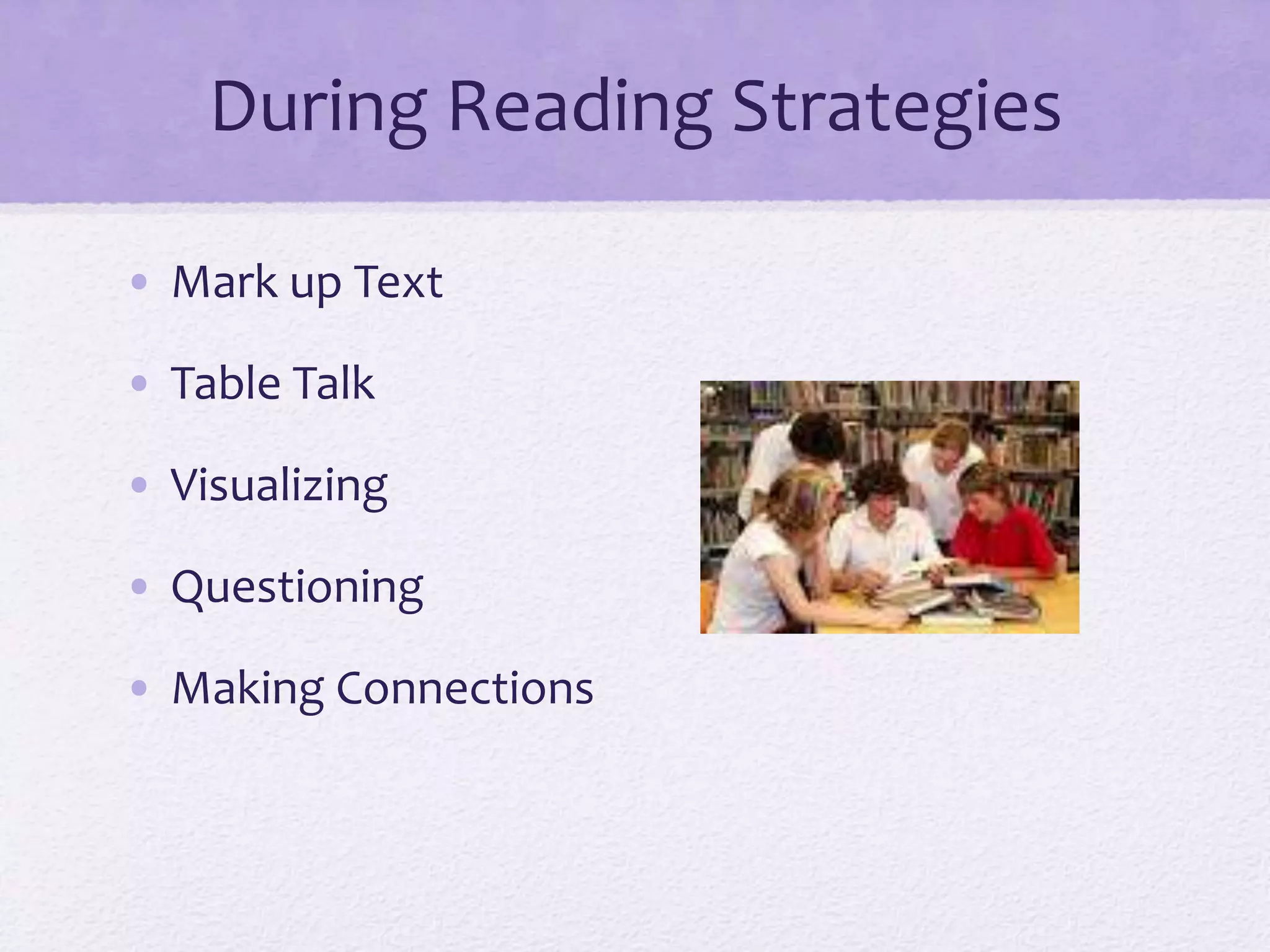
Table Talk
• In the middle of reading you can stop the
students and let them chat with the other
table members and talk about what they read
so far.
• Walk around to make sure students are
sharing out loud and make sure they are on
the right track.
Visualizing
• During reading you can ask your students what
the material is about so far and have them all
close their eyes and visual that in their heads.
• Having a mental picture really helps them to
understand and remember really important
details.
Questioning
• During read their might be some unknown
phrases or sentences that your students come
across.
• At this time students can write down their
questions on a piece of paper or ask the
teacher.
• Making a note right away is crucial so the
student does not forget.
Making Connections
• While reading students should constantly be
making connections with the text.
• Students make connections by thinking about
these 3 questions….
-Have I seen this before?
-Have I read about this before?
-Have I been there before?
After reading Strategies
• Exit slip
• Summarizing
• Graphic Organizers
• QAR
• Review
Exit Slip
• Exit slips are useful in many different ways.
• The teacher can put a variety of questions on
them that they feel they should know after the
reading.
• This helps the student to reflect on their
reading and helps the teacher to see who is
struggling with reading comprehension.
Summarizing
• This can be done at the end of reading.
• Summarizing is when students talk about the
main idea or important details from the text or
passage.
• Summarizing can be done in many different
ways. You can have students summarize in
groups, pairs, or one on one.
Graphic Organizers
• Graphic organizers are used all the time and
can be very beneficial to students after they
read.
• Students can use these to write in the main
idea, details or authors point of view.
• This is a great way to assess your students and
make sure they are understanding the
material.
QAR
• This is a strategy used after reading that helps students to
understand what kind out question is being asked.
• This can be used in small groups or whole class settings.
The four types of QAR’s:
• Right there Questions
• Think and Search Questions
• Author and You Questions
• On my own
Review
• After reading it is important to have a review
and let the students share facts and opinions
about what they read.
• You can complete a review by asking questions
or having a group conversation about the
book.
• Reviews help students to reflect and revisit the
material.
References
• Bursuck, William D., and Mary Damer. Reading Instruction for Students Who Are at Risk or Have
Disabilities. Boston: Pearson/Allyn and Bacon, 2007. Print
• https://en.wikipedia.org/wiki/Bibliophilia#/media/File:Book_lover.jpg
• http://thumbs.dreamstime.com/z/smiling-student-open-book-thinking-21365118.jpg
• http://www.google.com/url?q=http://dearrichblog.blogspot.com/2014/08/can-i-record-books-
for-my-students.html&sa=U&ved=0ahUKEwiRpbD-v-
vLAhUCHx4KHVADBZYQwW4IFjAA&sig2=AsHEzLSTzi9vOxXVHGixuQ&usg=AFQjCNHQ0Ekpii6
WHMrkftHe52EDh-EkrQ
• http://www.google.com/url?q=http://www.datemplate.com/post_blank-web-
diagram_615146/&sa=U&ved=0ahUKEwjrteaKw-
vLAhWG1h4KHRIdCZ8QwW4IFjAA&sig2=xYxkFculW53FPx1DZo63jQ&usg=AFQjCNG03q4Q1RfI
cVfiXAxw9tpICu0jDw
• http://www.hollyclark.org/wp-content/uploads/2015/04/Screen-Shot-2015-04-30-at-3.20.29-
PM.png

Reading Strategies CA#1

  • 1.
    Critical Assignment #1 LearningStrategies for 6th grade nonfiction text By: Hollie Miller
  • 2.
    When Could WeUse Reading Strategies? Reading Strategies can be used before, during, and after reading. When these strategies are used students can better comprehend text, understand vocabulary, and the text can become more meaningful.
  • 3.
    Before Reading strategies •Prior Knowledge Map • Vocabulary Preview • K W L chart • Make Predictions • THIEVES
  • 4.
    Prior Knowledge Map •Students will make a prior knowledge map by making a circle in the middle with 4 smaller circles around it. • In the 1 middle circle students will write the name of the text or topic. • In the 4 outer circles students will write in what they know about that topic.
  • 5.
    Vocabulary Preview • Thestudents will go through the text to see if there are any unknown or confusing words. • Students will write them down and come back to them after they read to write in the definition. • Doing a vocabulary preview can help students to recognize and identify the words right away when they are reading.
  • 6.
    KWL Chart • Thisis chart that has a K, W, and L section. • The K stands for know and the students will fill this section in before they read. • The W stands for what you want to know and the students would also fill this is before they read.
  • 7.
    Make Predictions • Afterreading the title and skimming the passage the students would then make predictions. • These predictions can be done in small groups or one by one.
  • 8.
    THIEVES • T –title (look at the Title) • H - Headings (find and understand headings) • I – Introduction (skim the intro) • E - Every First Sentence (read every first sentence) • V - Visuals and Vocab (find pictures or vocab words) • E - End of Text (read or skim the end of the text) • S - Summarize Thinking (now what do you think it will be about)
  • 9.
    During Reading Strategies •Mark up Text • Table Talk • Visualizing • Questioning • Making Connections
  • 10.
    Mark Up Text •This is something students can do while they are reading. Students can use highlighters, pencils, and/or sticky notes to make marks in the text when they see something important. For example: • Dates • Times • Unknown words • Important words/sentences
  • 11.
    Table Talk • Inthe middle of reading you can stop the students and let them chat with the other table members and talk about what they read so far. • Walk around to make sure students are sharing out loud and make sure they are on the right track.
  • 12.
    Visualizing • During readingyou can ask your students what the material is about so far and have them all close their eyes and visual that in their heads. • Having a mental picture really helps them to understand and remember really important details.
  • 13.
    Questioning • During readtheir might be some unknown phrases or sentences that your students come across. • At this time students can write down their questions on a piece of paper or ask the teacher. • Making a note right away is crucial so the student does not forget.
  • 14.
    Making Connections • Whilereading students should constantly be making connections with the text. • Students make connections by thinking about these 3 questions…. -Have I seen this before? -Have I read about this before? -Have I been there before?
  • 15.
    After reading Strategies •Exit slip • Summarizing • Graphic Organizers • QAR • Review
  • 16.
    Exit Slip • Exitslips are useful in many different ways. • The teacher can put a variety of questions on them that they feel they should know after the reading. • This helps the student to reflect on their reading and helps the teacher to see who is struggling with reading comprehension.
  • 17.
    Summarizing • This canbe done at the end of reading. • Summarizing is when students talk about the main idea or important details from the text or passage. • Summarizing can be done in many different ways. You can have students summarize in groups, pairs, or one on one.
  • 18.
    Graphic Organizers • Graphicorganizers are used all the time and can be very beneficial to students after they read. • Students can use these to write in the main idea, details or authors point of view. • This is a great way to assess your students and make sure they are understanding the material.
  • 19.
    QAR • This isa strategy used after reading that helps students to understand what kind out question is being asked. • This can be used in small groups or whole class settings. The four types of QAR’s: • Right there Questions • Think and Search Questions • Author and You Questions • On my own
  • 20.
    Review • After readingit is important to have a review and let the students share facts and opinions about what they read. • You can complete a review by asking questions or having a group conversation about the book. • Reviews help students to reflect and revisit the material.
  • 21.
    References • Bursuck, WilliamD., and Mary Damer. Reading Instruction for Students Who Are at Risk or Have Disabilities. Boston: Pearson/Allyn and Bacon, 2007. Print • https://en.wikipedia.org/wiki/Bibliophilia#/media/File:Book_lover.jpg • http://thumbs.dreamstime.com/z/smiling-student-open-book-thinking-21365118.jpg • http://www.google.com/url?q=http://dearrichblog.blogspot.com/2014/08/can-i-record-books- for-my-students.html&sa=U&ved=0ahUKEwiRpbD-v- vLAhUCHx4KHVADBZYQwW4IFjAA&sig2=AsHEzLSTzi9vOxXVHGixuQ&usg=AFQjCNHQ0Ekpii6 WHMrkftHe52EDh-EkrQ • http://www.google.com/url?q=http://www.datemplate.com/post_blank-web- diagram_615146/&sa=U&ved=0ahUKEwjrteaKw- vLAhWG1h4KHRIdCZ8QwW4IFjAA&sig2=xYxkFculW53FPx1DZo63jQ&usg=AFQjCNG03q4Q1RfI cVfiXAxw9tpICu0jDw • http://www.hollyclark.org/wp-content/uploads/2015/04/Screen-Shot-2015-04-30-at-3.20.29- PM.png