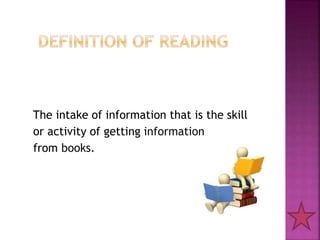
The intake of information that is the skill
or activity of getting information
from books.
 decode, decipher, and identify the words in
print.
 Articulate, speak, and pronounce the words
in print.
 Understand, interpret, and sense the
meaning of the words/texts in print.
There are four types of reading :
 Oral
 Silent
 Intensive
 linguistic
 content
 Extensive
 skimming
 scanning
 Oral:
A technique for improving word identification
skills.
 Silent:
Silent reading is reading without pronouncing
words out loud. It is reading to oneself.
 Intensive:
Intensive Reading (IR) occurs when the
learner is focused on the language rather
than the text.
 linguistic:
A process in which human beings are
involved.
 CONTENT:
Content is something that provides
information to the viewer (or)
reader etc.
 EXTENSIVE:
Extensive reading is an approach to
language teaching in which learners read a
lot of easy material.
 Skimming:
Rapid reading of focusing on the title,
headings ,topic sentences, sign posts to get
the main idea.
 Scanning:
Rapid reading assisted by key words to locate
specific pieces of info.
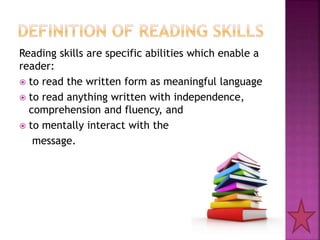
Reading skills are specific abilities which enable a
reader:
 to read the written form as meaningful language
 to read anything written with independence,
comprehension and fluency, and
 to mentally interact with the
message.
There are three steps to improve reading skills:
 Preparing for reading.
 Implementing the basics of reading
improvement.
 Advancing your reading skills.
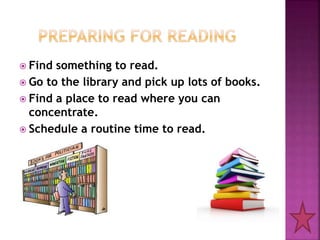
 Find something to read.
 Go to the library and pick up lots of books.
 Find a place to read where you can
concentrate.
 Schedule a routine time to read.
 Begin your reading by looking at the pictures, or
listening to the music to get a feel for what you are
going to be reading about.
 Start with titles, names, or other larger print items
that you may know or ever thought about.
 Read the page carefully.
 Sound out each letter as best you
can and you will notice they form
some sort of word.
 Read as much as you are able.
 Reread the material.
 Use context clues to find out a word's
meaning.
 Memorize a text.
urvey the text:: Critically look at all
 Headings, Pictures (maps, charts, or
graphs),Summaries
uestioning: Turn all of the headings into questions.
 Write out questions and speculate answers before
reading.
ead: Focus on answering your questions as you
read.
 Write down the real answers to your questions.
 These make great self-quiz questions before tests.
ecall: Without looking at your book or notes, sketch, in
your own words, the main points of the reading.
 This forces you to THINK!
eview: Using your book & notes, see how well you did.
 Note the things you stated incorrectly or forgot.
Reading skills
Reading skills

Reading skills

  • 2.
    The intake ofinformation that is the skill or activity of getting information from books.
  • 3.
     decode, decipher,and identify the words in print.  Articulate, speak, and pronounce the words in print.  Understand, interpret, and sense the meaning of the words/texts in print.
  • 4.
    There are fourtypes of reading :  Oral  Silent  Intensive  linguistic  content  Extensive  skimming  scanning
  • 5.
     Oral: A techniquefor improving word identification skills.  Silent: Silent reading is reading without pronouncing words out loud. It is reading to oneself.
  • 6.
     Intensive: Intensive Reading(IR) occurs when the learner is focused on the language rather than the text.  linguistic: A process in which human beings are involved.  CONTENT: Content is something that provides information to the viewer (or) reader etc.
  • 7.
     EXTENSIVE: Extensive readingis an approach to language teaching in which learners read a lot of easy material.  Skimming: Rapid reading of focusing on the title, headings ,topic sentences, sign posts to get the main idea.  Scanning: Rapid reading assisted by key words to locate specific pieces of info.
  • 8.
    Reading skills arespecific abilities which enable a reader:  to read the written form as meaningful language  to read anything written with independence, comprehension and fluency, and  to mentally interact with the message.
  • 10.
    There are threesteps to improve reading skills:  Preparing for reading.  Implementing the basics of reading improvement.  Advancing your reading skills.
  • 11.
     Find somethingto read.  Go to the library and pick up lots of books.  Find a place to read where you can concentrate.  Schedule a routine time to read.
  • 12.
     Begin yourreading by looking at the pictures, or listening to the music to get a feel for what you are going to be reading about.  Start with titles, names, or other larger print items that you may know or ever thought about.  Read the page carefully.  Sound out each letter as best you can and you will notice they form some sort of word.
  • 13.
     Read asmuch as you are able.  Reread the material.  Use context clues to find out a word's meaning.  Memorize a text.
  • 14.
    urvey the text::Critically look at all  Headings, Pictures (maps, charts, or graphs),Summaries uestioning: Turn all of the headings into questions.  Write out questions and speculate answers before reading. ead: Focus on answering your questions as you read.  Write down the real answers to your questions.  These make great self-quiz questions before tests. ecall: Without looking at your book or notes, sketch, in your own words, the main points of the reading.  This forces you to THINK! eview: Using your book & notes, see how well you did.  Note the things you stated incorrectly or forgot.