WHAT BENEFITS WE GET
IN THE
SUB-SKILLS OF READING?
Is it helpful?
•Come’ ontry reading this to find out!
Come’ on try reading this
to find out!
Benefits
of the
SUB-SKILLS
of reading
Helps reader
to:
Associate and recognize the printed
script which include:
Association – association between the
sounds of the spoken words/sentences
and the visual symbols.
Recognition – for effective reading it
requires the instant recognition of
words/phrases.
Become independent reader:
Reading is not merely understanding the
text but making sense of what reading
is.
To know when and how to use
dictionary, an index, a table of contents
and so on.
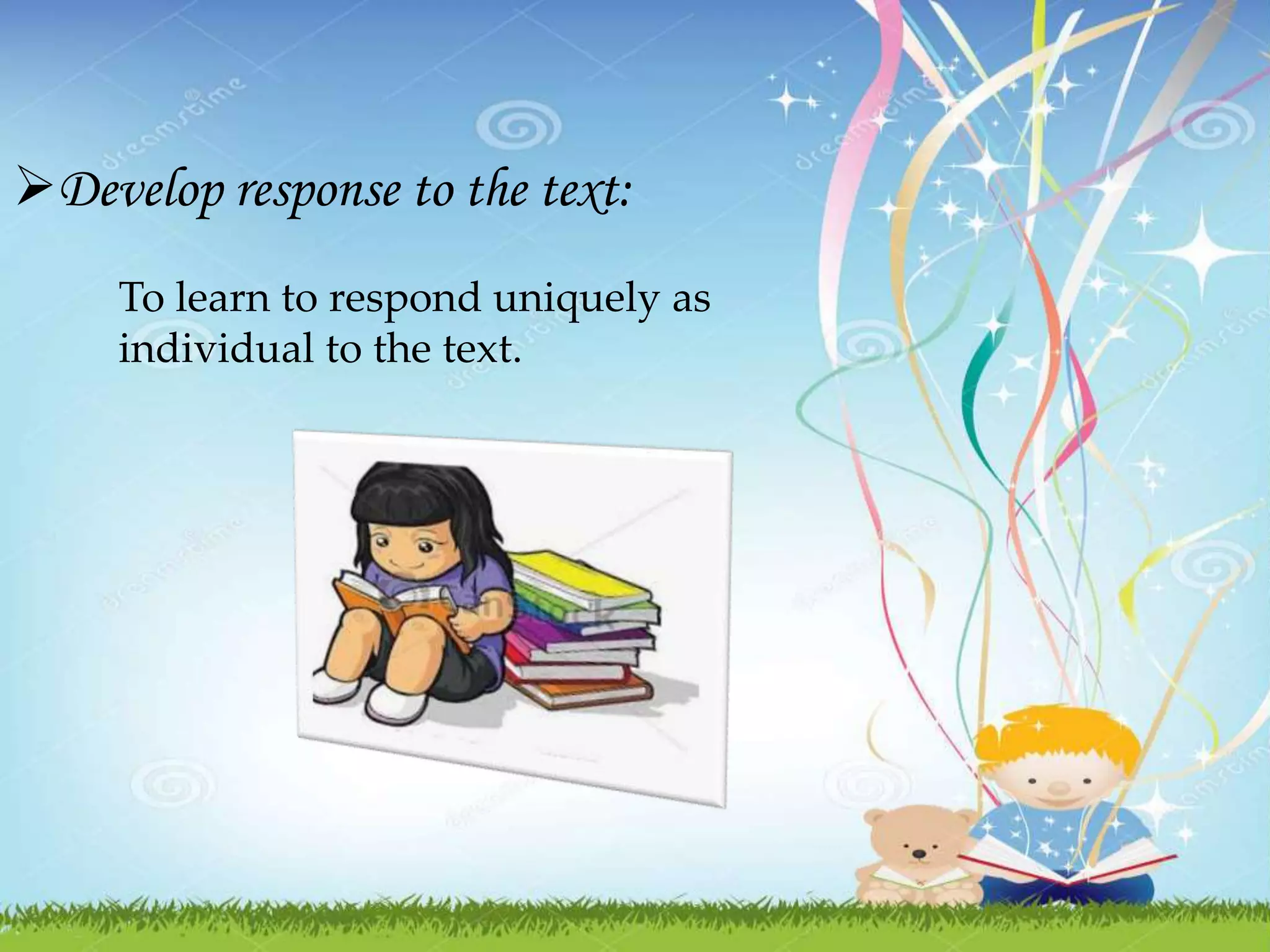
Develop response to the text:
To learn to respond uniquely as
individual to the text.
Read with adequate understanding:
Does not have to understand
everything in a text.
Read at appropriate speed:
Every reading material requires an
exact/right time to finish reading it. So,
you don’t have to rush yourself to
finish reading a book which is hard for
you to understand the contents it.
Read silently:
Reading a loud plays a very small part in our
life when we get older. So, to practice reading
silently is very beneficial to our part. It prepares
us for our future.
Professionals read silently to
think fast and not to disturb
others.
Develop some strategies and attitudes of
skilled reader:
Improving motivation;
Increasing awareness of different
reading purposes;
Developing different reading strategies:
Skimming – a rapid reading
technique. It is widely used to
gain quick information from the
text by passing over it quickly.
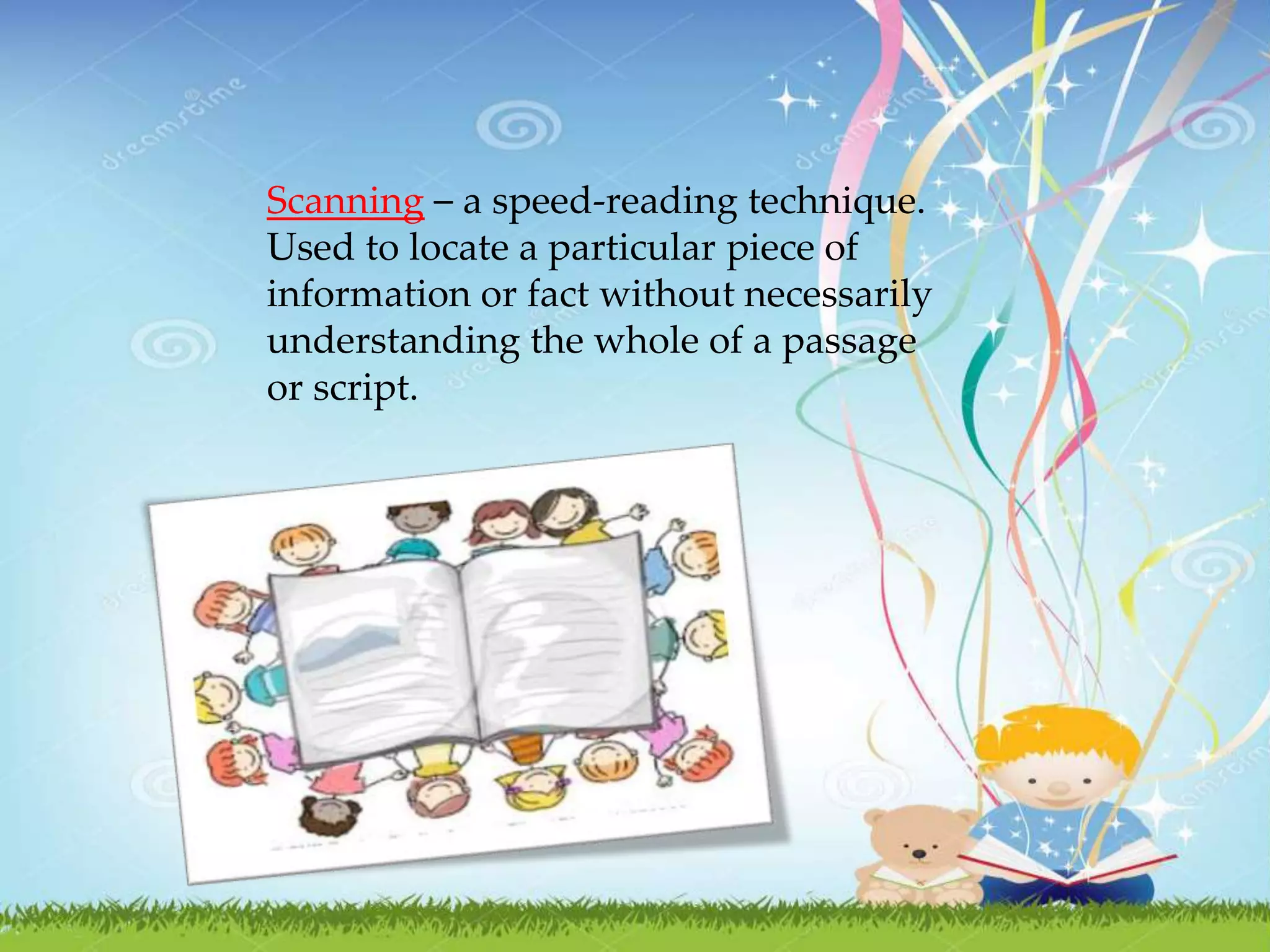
Scanning – a speed-reading technique.
Used to locate a particular piece of
information or fact without necessarily
understanding the whole of a passage
or script.
What reading stands for?
R– reason for
E– everyone to
A– act
D– dutifully
I– indicating
N– numerous
G– gain
I think of life as a good
book.
The further you get into
it,
the more it begins to
make sense.–Harold Kushner
Prepared by:
JESSIBEL A. DENSING

Sub-skills of Reading

  • 1.
    WHAT BENEFITS WEGET IN THE SUB-SKILLS OF READING? Is it helpful? •Come’ ontry reading this to find out! Come’ on try reading this to find out!
  • 2.
  • 3.
    Helps reader to: Associate andrecognize the printed script which include: Association – association between the sounds of the spoken words/sentences and the visual symbols.
  • 4.
    Recognition – foreffective reading it requires the instant recognition of words/phrases. Become independent reader: Reading is not merely understanding the text but making sense of what reading is. To know when and how to use dictionary, an index, a table of contents and so on.
  • 5.
    Develop response tothe text: To learn to respond uniquely as individual to the text.
  • 6.
    Read with adequateunderstanding: Does not have to understand everything in a text. Read at appropriate speed: Every reading material requires an exact/right time to finish reading it. So, you don’t have to rush yourself to finish reading a book which is hard for you to understand the contents it.
  • 7.
    Read silently: Reading aloud plays a very small part in our life when we get older. So, to practice reading silently is very beneficial to our part. It prepares us for our future. Professionals read silently to think fast and not to disturb others.
  • 8.
    Develop some strategiesand attitudes of skilled reader: Improving motivation; Increasing awareness of different reading purposes; Developing different reading strategies: Skimming – a rapid reading technique. It is widely used to gain quick information from the text by passing over it quickly.
  • 9.
    Scanning – aspeed-reading technique. Used to locate a particular piece of information or fact without necessarily understanding the whole of a passage or script.
  • 10.
    What reading standsfor? R– reason for E– everyone to A– act D– dutifully I– indicating N– numerous G– gain
  • 11.
    I think oflife as a good book. The further you get into it, the more it begins to make sense.–Harold Kushner
  • 12.