

READING SKILLS
 Reading is a passive or recognition skill
like listening comprehension.
 Writing and speaking are active or
production skills.
 Hence, listening and reading are known
as skills of comprehension.
 Speaking and writing are skills of
expression.
nandkishore sarap
READING COMPREHENSION
SKILLS
 Comprehension is a twin process
 It requires understanding of what is
read/presented, and
 reproduction of what is comprehended.
nandkishore sarap
READING COMPREHENSION
SKILLS
 Reading comprehension requires an
ability to understand the meaning of
what is written (what has been read),
and
 the intelligence to express it clearly.
nandkishore sarap
Reading an active skill
 Though reading is a passive skill, a
good reader is active during the process
of reading.
 Reading can be called as an active
process as it involves comprehension,
guesswork, production, imagination and
reproduction.
nandkishore sarap
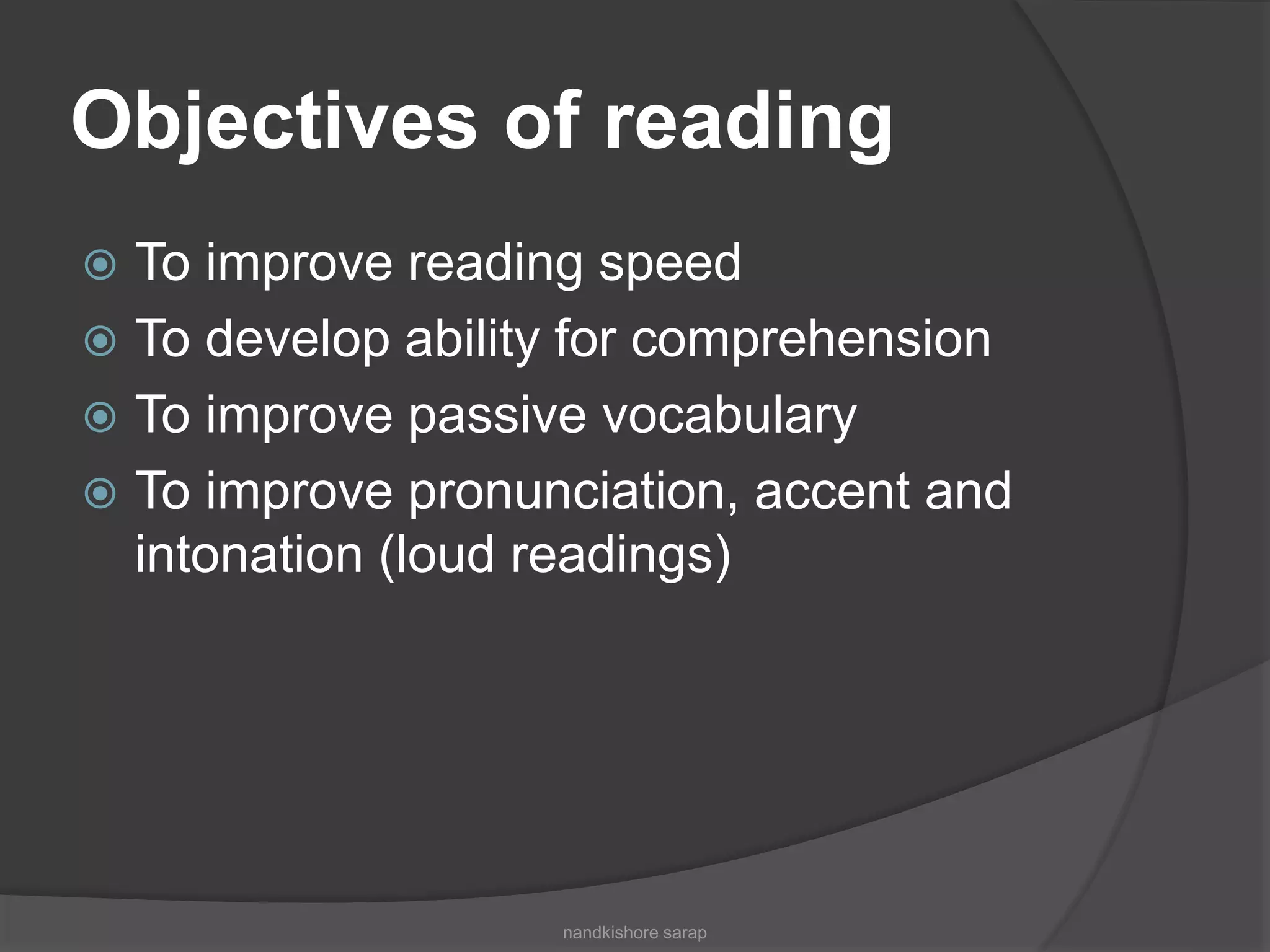
Objectives of reading
 To improve reading speed
 To develop ability for comprehension
 To improve passive vocabulary
 To improve pronunciation, accent and
intonation (loud readings)
nandkishore sarap
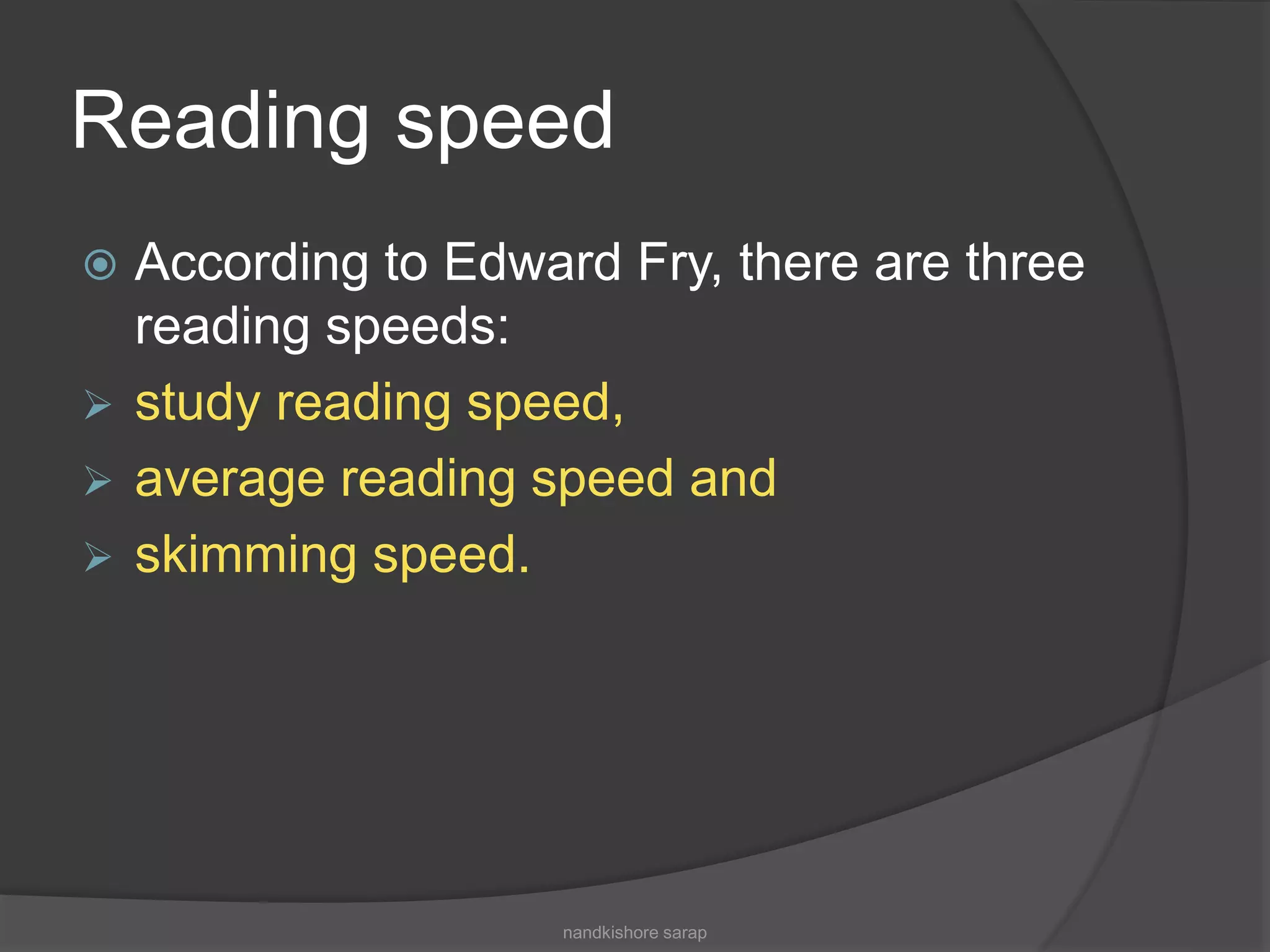
Reading speed
 According to Edward Fry, there are three
reading speeds:
 study reading speed,
 average reading speed and
 skimming speed.
nandkishore sarap
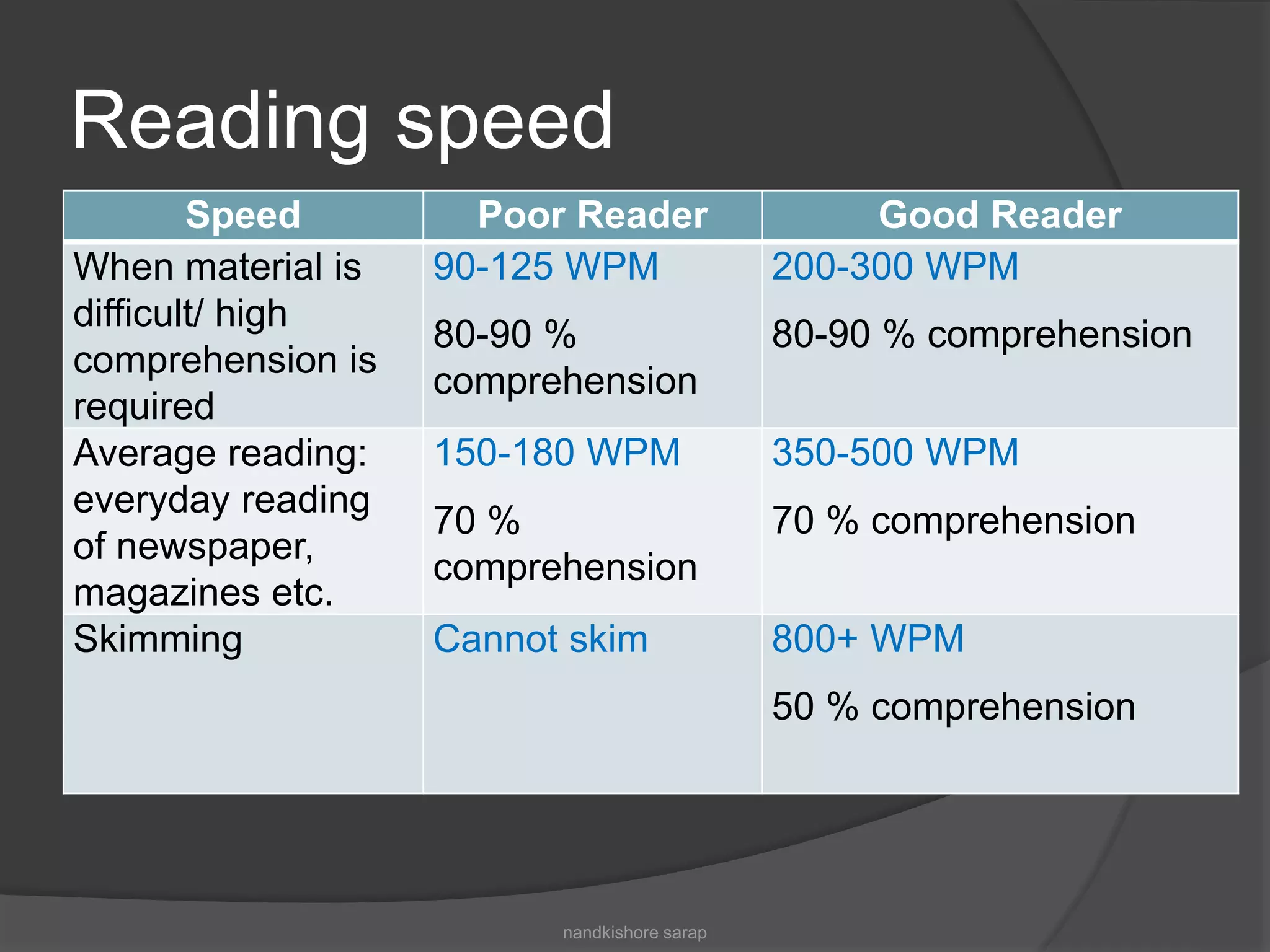
Reading speed
Speed Poor Reader Good Reader
When material is
difficult/ high
comprehension is
required
90-125 WPM
80-90 %
comprehension
200-300 WPM
80-90 % comprehension
Average reading:
everyday reading
of newspaper,
magazines etc.
150-180 WPM
70 %
comprehension
350-500 WPM
70 % comprehension
Skimming Cannot skim 800+ WPM
50 % comprehension
nandkishore sarap
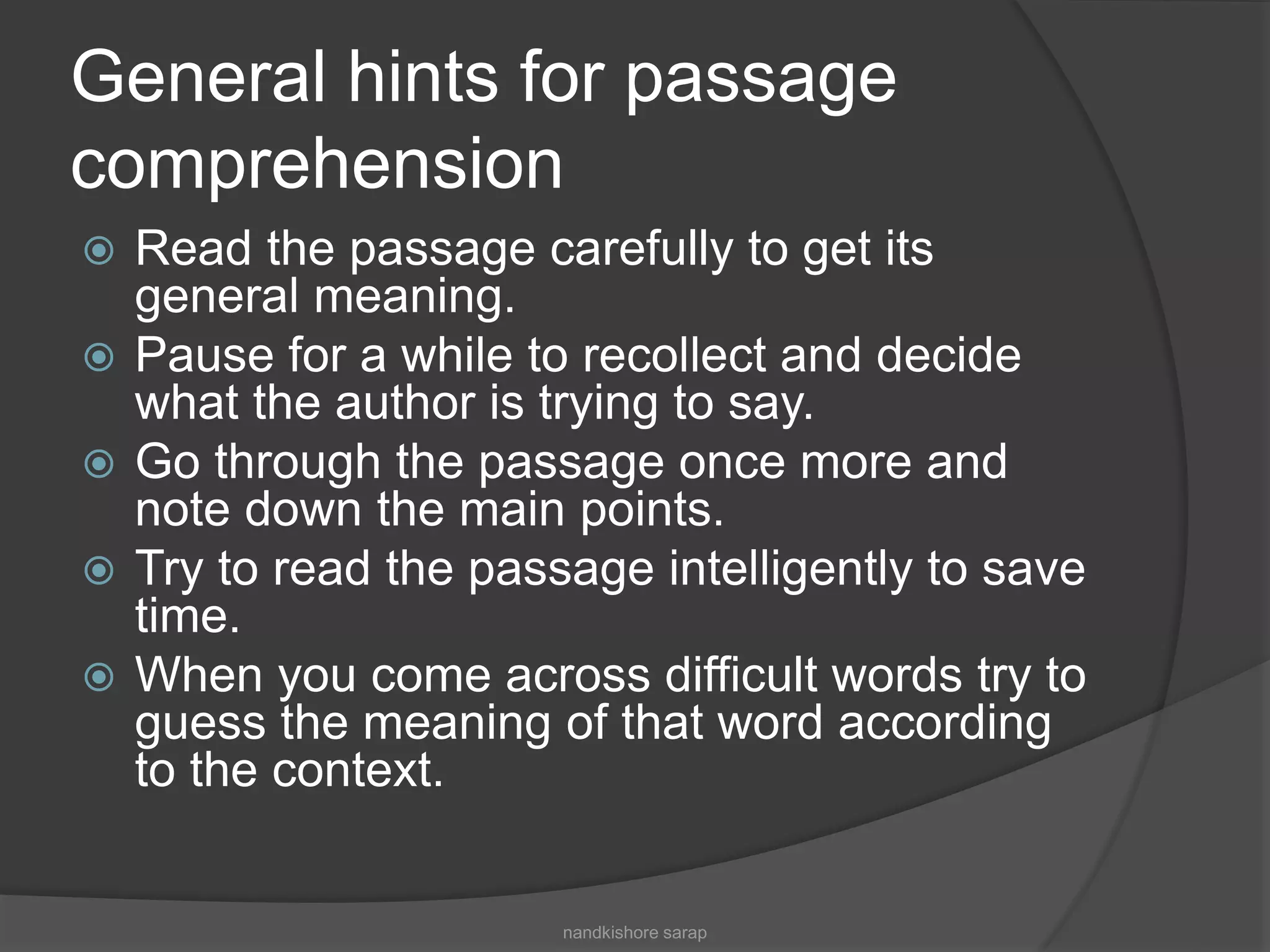
General hints for passage
comprehension
 Read the passage carefully to get its
general meaning.
 Pause for a while to recollect and decide
what the author is trying to say.
 Go through the passage once more and
note down the main points.
 Try to read the passage intelligently to save
time.
 When you come across difficult words try to
guess the meaning of that word according
to the context.
nandkishore sarap
Locating specific information
(scanning)
 The technique of scanning is helpful to
locate specific information.
 A reader has to scan the given passage
to identify required information and need
not understand the rest of the passage.
nandkishore sarap
Understanding meaning of
words, phrases and sentences
 It needs vast vocabulary.
 Sometimes, the meaning of difficult word
or phrase or expression from the context
in which it is used.
nandkishore sarap
Understanding meaning of
words, phrases and sentences
 In some cases
 a reader should be familiar with foreign
names (people/places etc.),
 the terminology of a particular field
 the sentence structures used in various
disciplines and professions.
nandkishore sarap
Understanding the logical
relationship between sentences
 The sentences in a text are interrelated.
 For understanding the text we must
know the relation between the
sentences.
nandkishore sarap
Assignment
1. Measure your reading speeds for
various purposes as given in the table.
2. Read different passages separately for:
a. locating specific information
b. understanding meanings of words,
phrases and sentences
c. understanding logical relationship
between sentences
nandkishore sarap
nandkishore sarap

Reading skills pract

  • 2.
    READING SKILLS  Readingis a passive or recognition skill like listening comprehension.  Writing and speaking are active or production skills.  Hence, listening and reading are known as skills of comprehension.  Speaking and writing are skills of expression. nandkishore sarap
  • 3.
    READING COMPREHENSION SKILLS  Comprehensionis a twin process  It requires understanding of what is read/presented, and  reproduction of what is comprehended. nandkishore sarap
  • 4.
    READING COMPREHENSION SKILLS  Readingcomprehension requires an ability to understand the meaning of what is written (what has been read), and  the intelligence to express it clearly. nandkishore sarap
  • 5.
    Reading an activeskill  Though reading is a passive skill, a good reader is active during the process of reading.  Reading can be called as an active process as it involves comprehension, guesswork, production, imagination and reproduction. nandkishore sarap
  • 6.
    Objectives of reading To improve reading speed  To develop ability for comprehension  To improve passive vocabulary  To improve pronunciation, accent and intonation (loud readings) nandkishore sarap
  • 7.
    Reading speed  Accordingto Edward Fry, there are three reading speeds:  study reading speed,  average reading speed and  skimming speed. nandkishore sarap
  • 8.
    Reading speed Speed PoorReader Good Reader When material is difficult/ high comprehension is required 90-125 WPM 80-90 % comprehension 200-300 WPM 80-90 % comprehension Average reading: everyday reading of newspaper, magazines etc. 150-180 WPM 70 % comprehension 350-500 WPM 70 % comprehension Skimming Cannot skim 800+ WPM 50 % comprehension nandkishore sarap
  • 9.
    General hints forpassage comprehension  Read the passage carefully to get its general meaning.  Pause for a while to recollect and decide what the author is trying to say.  Go through the passage once more and note down the main points.  Try to read the passage intelligently to save time.  When you come across difficult words try to guess the meaning of that word according to the context. nandkishore sarap
  • 10.
    Locating specific information (scanning) The technique of scanning is helpful to locate specific information.  A reader has to scan the given passage to identify required information and need not understand the rest of the passage. nandkishore sarap
  • 11.
    Understanding meaning of words,phrases and sentences  It needs vast vocabulary.  Sometimes, the meaning of difficult word or phrase or expression from the context in which it is used. nandkishore sarap
  • 12.
    Understanding meaning of words,phrases and sentences  In some cases  a reader should be familiar with foreign names (people/places etc.),  the terminology of a particular field  the sentence structures used in various disciplines and professions. nandkishore sarap
  • 13.
    Understanding the logical relationshipbetween sentences  The sentences in a text are interrelated.  For understanding the text we must know the relation between the sentences. nandkishore sarap
  • 14.
    Assignment 1. Measure yourreading speeds for various purposes as given in the table. 2. Read different passages separately for: a. locating specific information b. understanding meanings of words, phrases and sentences c. understanding logical relationship between sentences nandkishore sarap
  • 15.