READING MODEL
Reading 
Model 
Key Features Main Proponents 
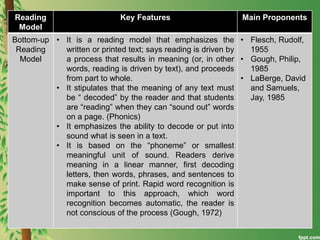
Bottom-up 
Reading 
Model 
• It is a reading model that emphasizes the 
written or printed text; says reading is driven by 
a process that results in meaning (or, in other 
words, reading is driven by text), and proceeds 
from part to whole. 
• It stipulates that the meaning of any text must 
be “ decoded” by the reader and that students 
are “reading” when they can “sound out” words 
on a page. (Phonics) 
• It emphasizes the ability to decode or put into 
sound what is seen in a text. 
• It is based on the “phoneme” or smallest 
meaningful unit of sound. Readers derive 
meaning in a linear manner, first decoding 
letters, then words, phrases, and sentences to 
make sense of print. Rapid word recognition is 
important to this approach, which word 
recognition becomes automatic, the reader is 
not conscious of the process (Gough, 1972) 
• Flesch, Rudolf, 
1955 
• Gough, Philip, 
1985 
• LaBerge, David 
and Samuels, 
Jay, 1985
Reading 
Model 
Key Features Main Proponents 
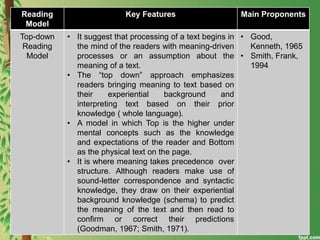
Top-down 
Reading 
Model 
• It suggest that processing of a text begins in 
the mind of the readers with meaning-driven 
processes or an assumption about the 
meaning of a text. 
• The “top down” approach emphasizes 
readers bringing meaning to text based on 
their experiential background and 
interpreting text based on their prior 
knowledge ( whole language). 
• A model in which Top is the higher under 
mental concepts such as the knowledge 
and expectations of the reader and Bottom 
as the physical text on the page. 
• It is where meaning takes precedence over 
structure. Although readers make use of 
sound-letter correspondence and syntactic 
knowledge, they draw on their experiential 
background knowledge (schema) to predict 
the meaning of the text and then read to 
confirm or correct their predictions 
(Goodman, 1967; Smith, 1971). 
• Good, 
Kenneth, 1965 
• Smith, Frank, 
1994
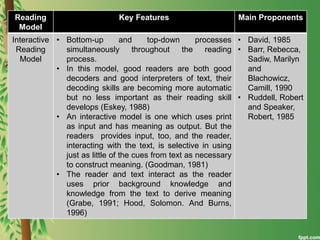
Reading 
Model 
Key Features Main Proponents 
Interactive 
Reading 
Model 
• Bottom-up and top-down processes 
simultaneously throughout the reading 
process. 
• In this model, good readers are both good 
decoders and good interpreters of text, their 
decoding skills are becoming more automatic 
but no less important as their reading skill 
develops (Eskey, 1988) 
• An interactive model is one which uses print 
as input and has meaning as output. But the 
readers provides input, too, and the reader, 
interacting with the text, is selective in using 
just as little of the cues from text as necessary 
to construct meaning. (Goodman, 1981) 
• The reader and text interact as the reader 
uses prior background knowledge and 
knowledge from the text to derive meaning 
(Grabe, 1991; Hood, Solomon. And Burns, 
1996) 
• David, 1985 
• Barr, Rebecca, 
Sadiw, Marilyn 
and 
Blachowicz, 
Camill, 1990 
• Ruddell, Robert 
and Speaker, 
Robert, 1985

Reading model

  • 1.
  • 2.
    Reading Model KeyFeatures Main Proponents Bottom-up Reading Model • It is a reading model that emphasizes the written or printed text; says reading is driven by a process that results in meaning (or, in other words, reading is driven by text), and proceeds from part to whole. • It stipulates that the meaning of any text must be “ decoded” by the reader and that students are “reading” when they can “sound out” words on a page. (Phonics) • It emphasizes the ability to decode or put into sound what is seen in a text. • It is based on the “phoneme” or smallest meaningful unit of sound. Readers derive meaning in a linear manner, first decoding letters, then words, phrases, and sentences to make sense of print. Rapid word recognition is important to this approach, which word recognition becomes automatic, the reader is not conscious of the process (Gough, 1972) • Flesch, Rudolf, 1955 • Gough, Philip, 1985 • LaBerge, David and Samuels, Jay, 1985
  • 3.
    Reading Model KeyFeatures Main Proponents Top-down Reading Model • It suggest that processing of a text begins in the mind of the readers with meaning-driven processes or an assumption about the meaning of a text. • The “top down” approach emphasizes readers bringing meaning to text based on their experiential background and interpreting text based on their prior knowledge ( whole language). • A model in which Top is the higher under mental concepts such as the knowledge and expectations of the reader and Bottom as the physical text on the page. • It is where meaning takes precedence over structure. Although readers make use of sound-letter correspondence and syntactic knowledge, they draw on their experiential background knowledge (schema) to predict the meaning of the text and then read to confirm or correct their predictions (Goodman, 1967; Smith, 1971). • Good, Kenneth, 1965 • Smith, Frank, 1994
  • 4.
    Reading Model KeyFeatures Main Proponents Interactive Reading Model • Bottom-up and top-down processes simultaneously throughout the reading process. • In this model, good readers are both good decoders and good interpreters of text, their decoding skills are becoming more automatic but no less important as their reading skill develops (Eskey, 1988) • An interactive model is one which uses print as input and has meaning as output. But the readers provides input, too, and the reader, interacting with the text, is selective in using just as little of the cues from text as necessary to construct meaning. (Goodman, 1981) • The reader and text interact as the reader uses prior background knowledge and knowledge from the text to derive meaning (Grabe, 1991; Hood, Solomon. And Burns, 1996) • David, 1985 • Barr, Rebecca, Sadiw, Marilyn and Blachowicz, Camill, 1990 • Ruddell, Robert and Speaker, Robert, 1985