Does the Project Manager Stand a
            Chance?

            Peter Langley
Value Management Specific Interest Group

        peter.langley@hotmail.co.uk
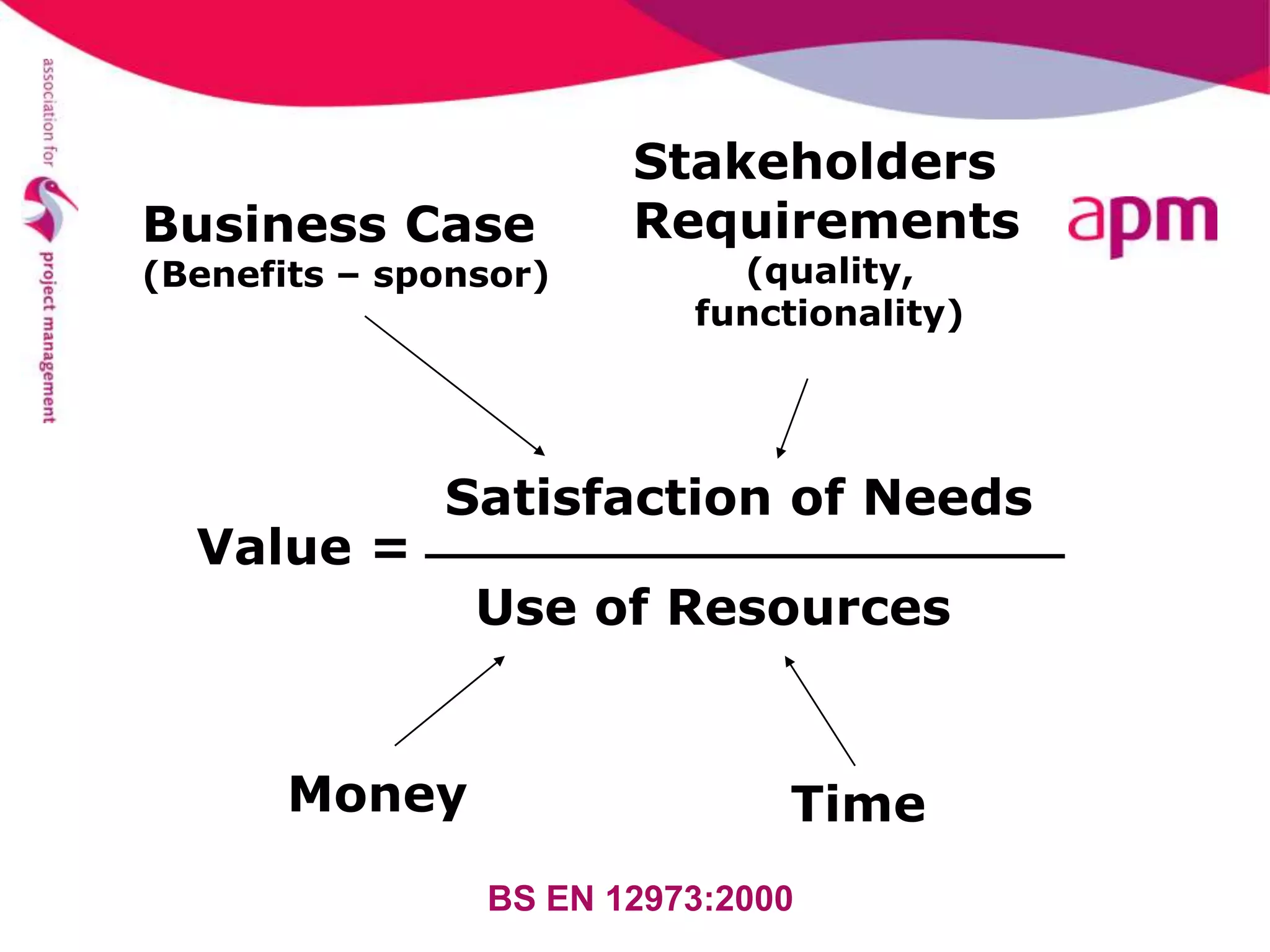
Stakeholders
Business Case          Requirements
(Benefits – sponsor)        (quality,
                          functionality)


              Satisfaction of Needs
  Value =
                Use of Resources


       Money                   Time
                BS EN 12973:2000
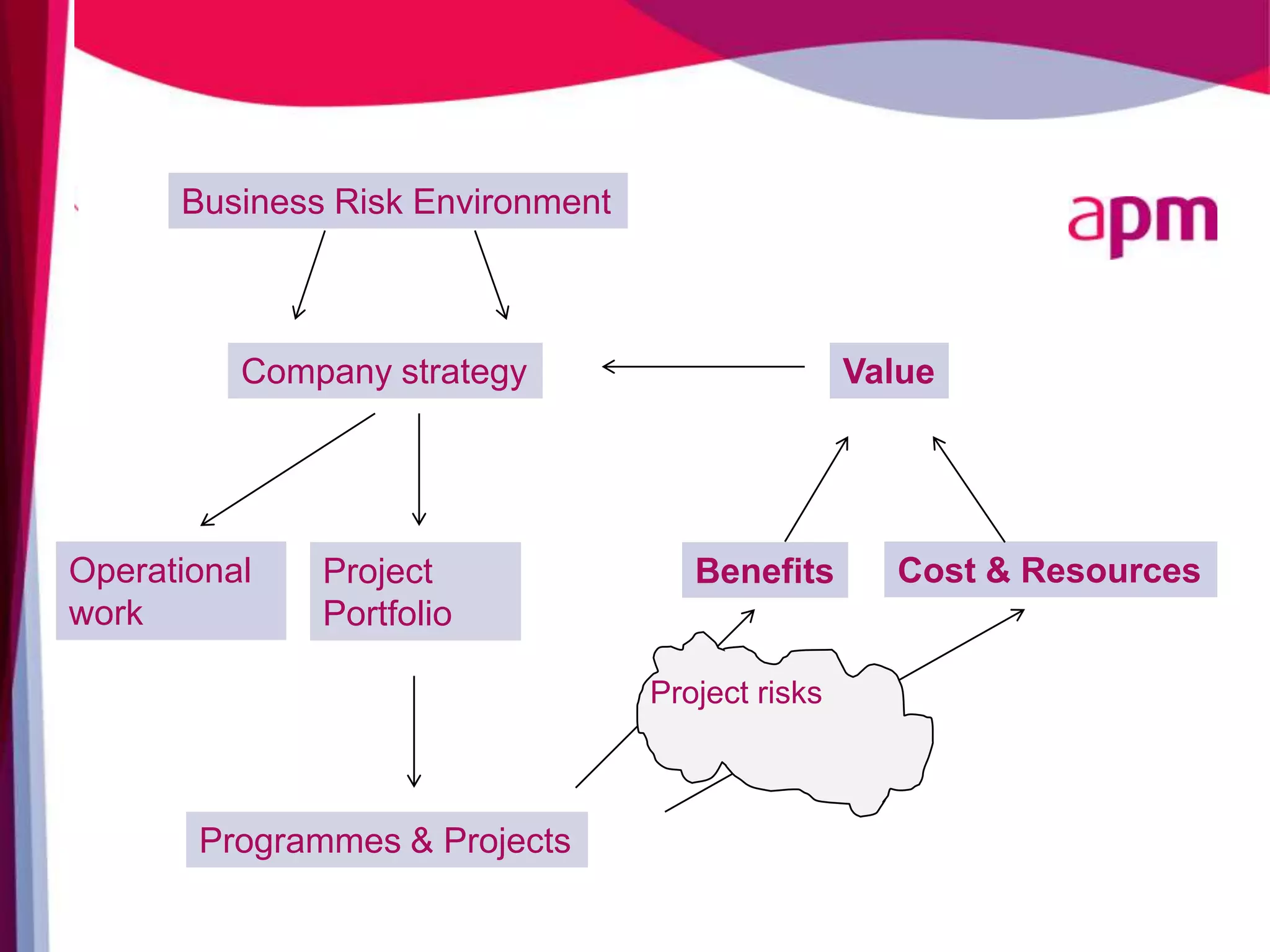
Business Risk Environment


          Company strategy                        Value


Operational   Project                Benefits       Cost & Resources
work          Portfolio

                                  Project risks


       Programmes & Projects
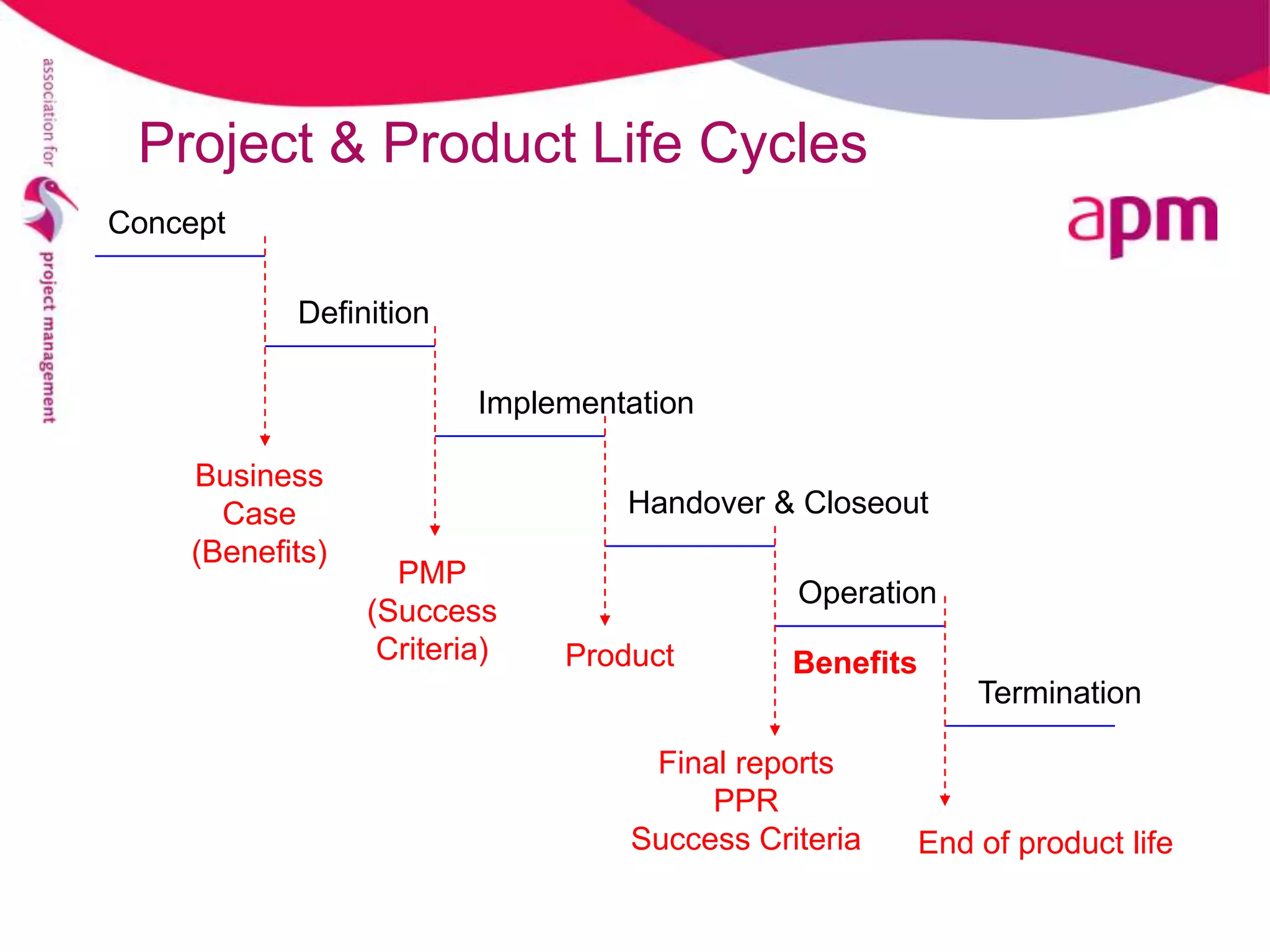
Project & Product Life Cycles
Concept

           Definition

                         Implementation

    Business
      Case                        Handover & Closeout
    (Benefits)
                   PMP
                                             Operation
                 (Success
                  Criteria)   Product        Benefits
                                                            Termination

                                   Final reports
                                       PPR
                                  Success Criteria      End of product life
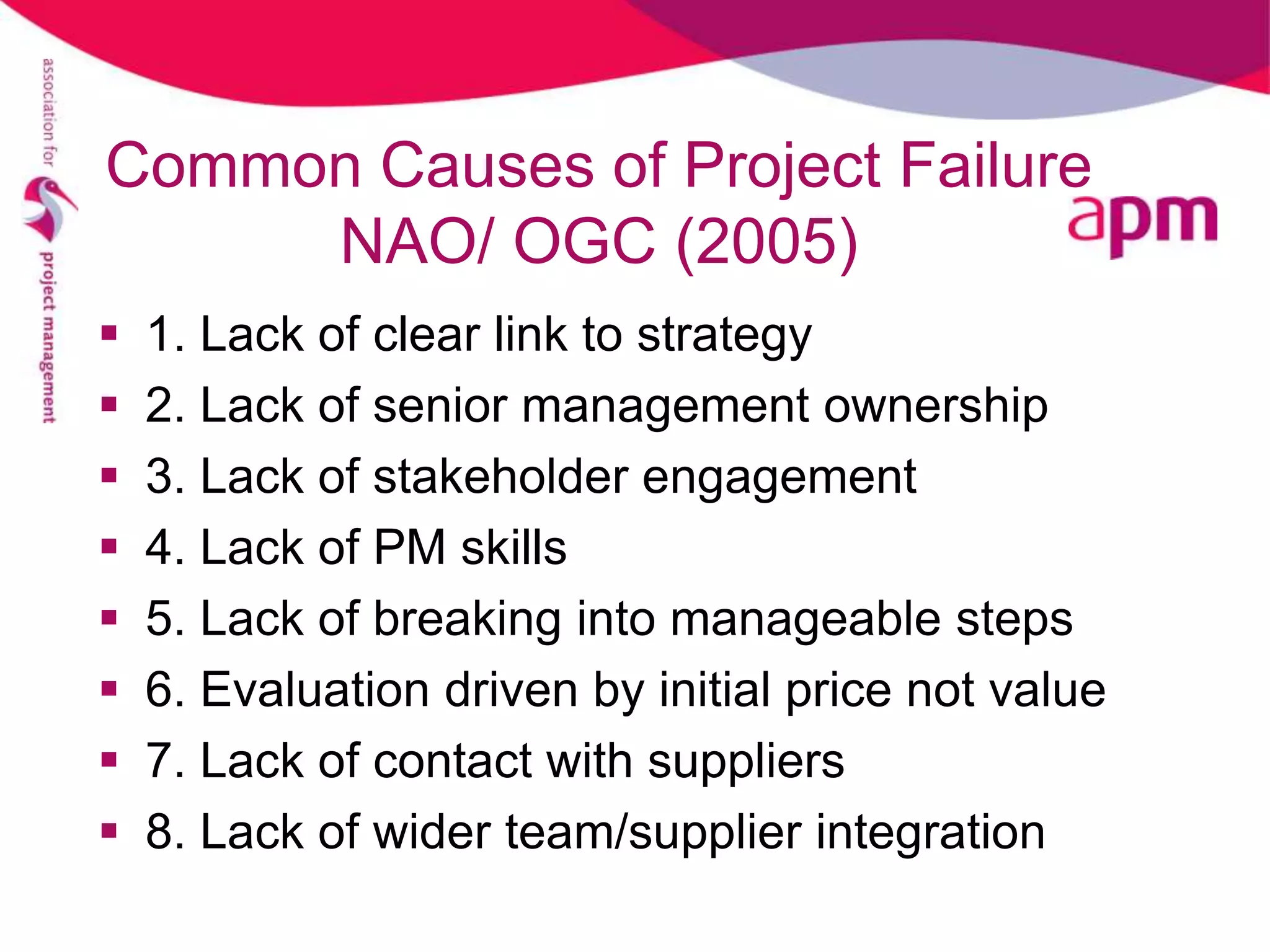
Common Causes of Project Failure
     NAO/ OGC (2005)
   1. Lack of clear link to strategy
   2. Lack of senior management ownership
   3. Lack of stakeholder engagement
   4. Lack of PM skills
   5. Lack of breaking into manageable steps
   6. Evaluation driven by initial price not value
   7. Lack of contact with suppliers
   8. Lack of wider team/supplier integration
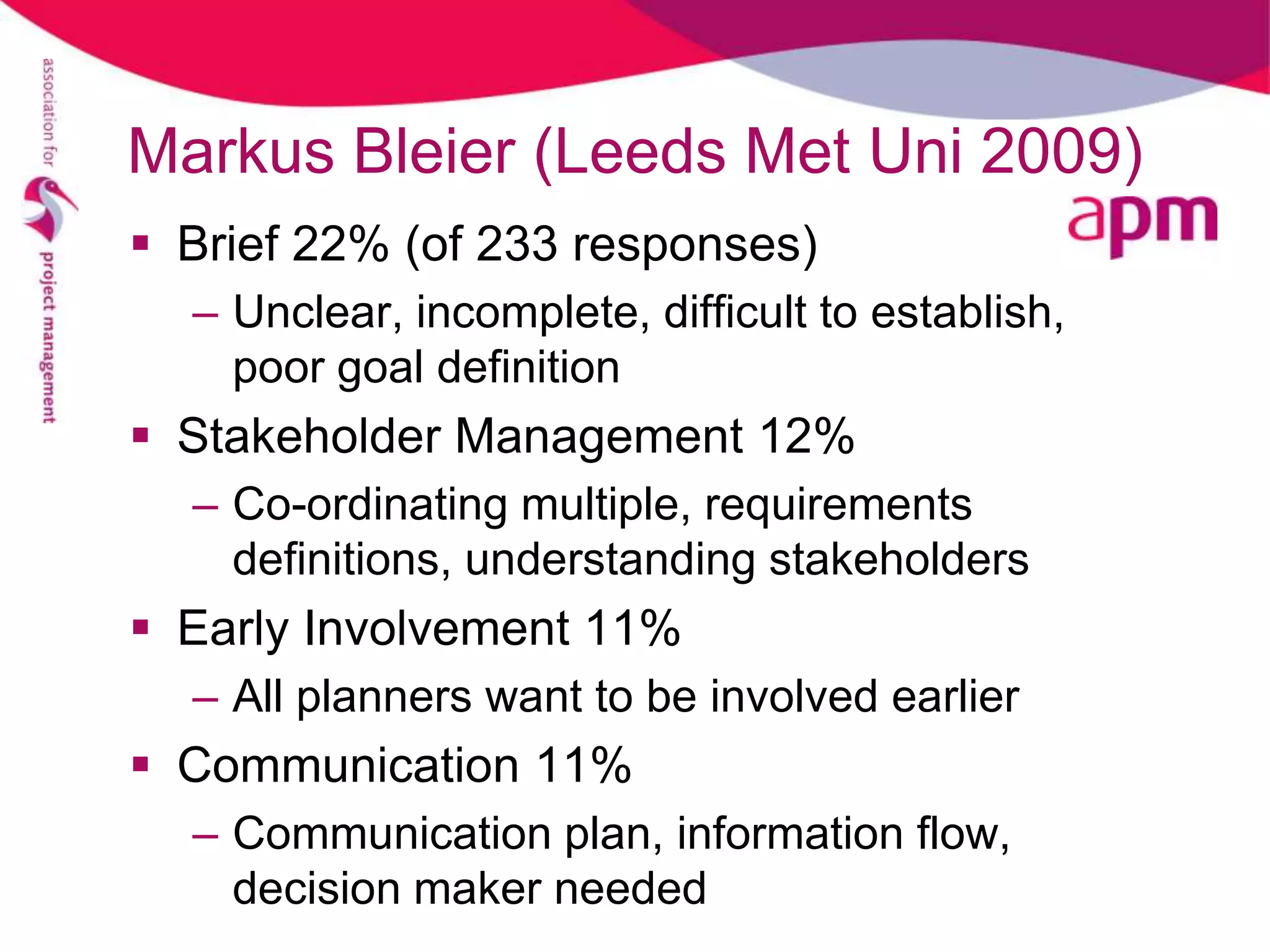
Markus Bleier (Leeds Met Uni 2009)
 Brief 22% (of 233 responses)
  – Unclear, incomplete, difficult to establish,
    poor goal definition
 Stakeholder Management 12%
  – Co-ordinating multiple, requirements
    definitions, understanding stakeholders
 Early Involvement 11%
  – All planners want to be involved earlier
 Communication 11%
  – Communication plan, information flow,
    decision maker needed
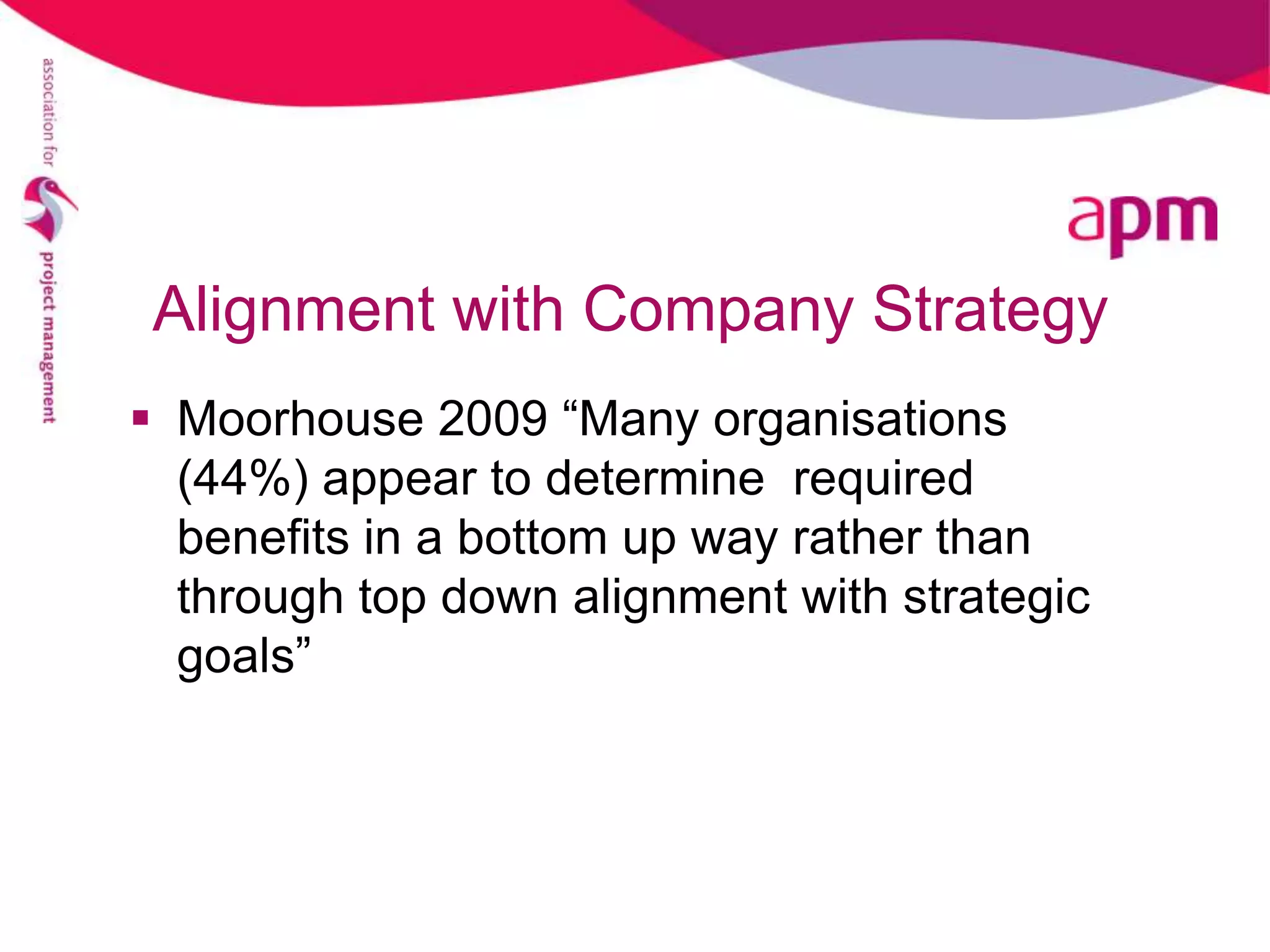
Alignment with Company Strategy
 Moorhouse 2009 “Many organisations
  (44%) appear to determine required
  benefits in a bottom up way rather than
  through top down alignment with strategic
  goals”
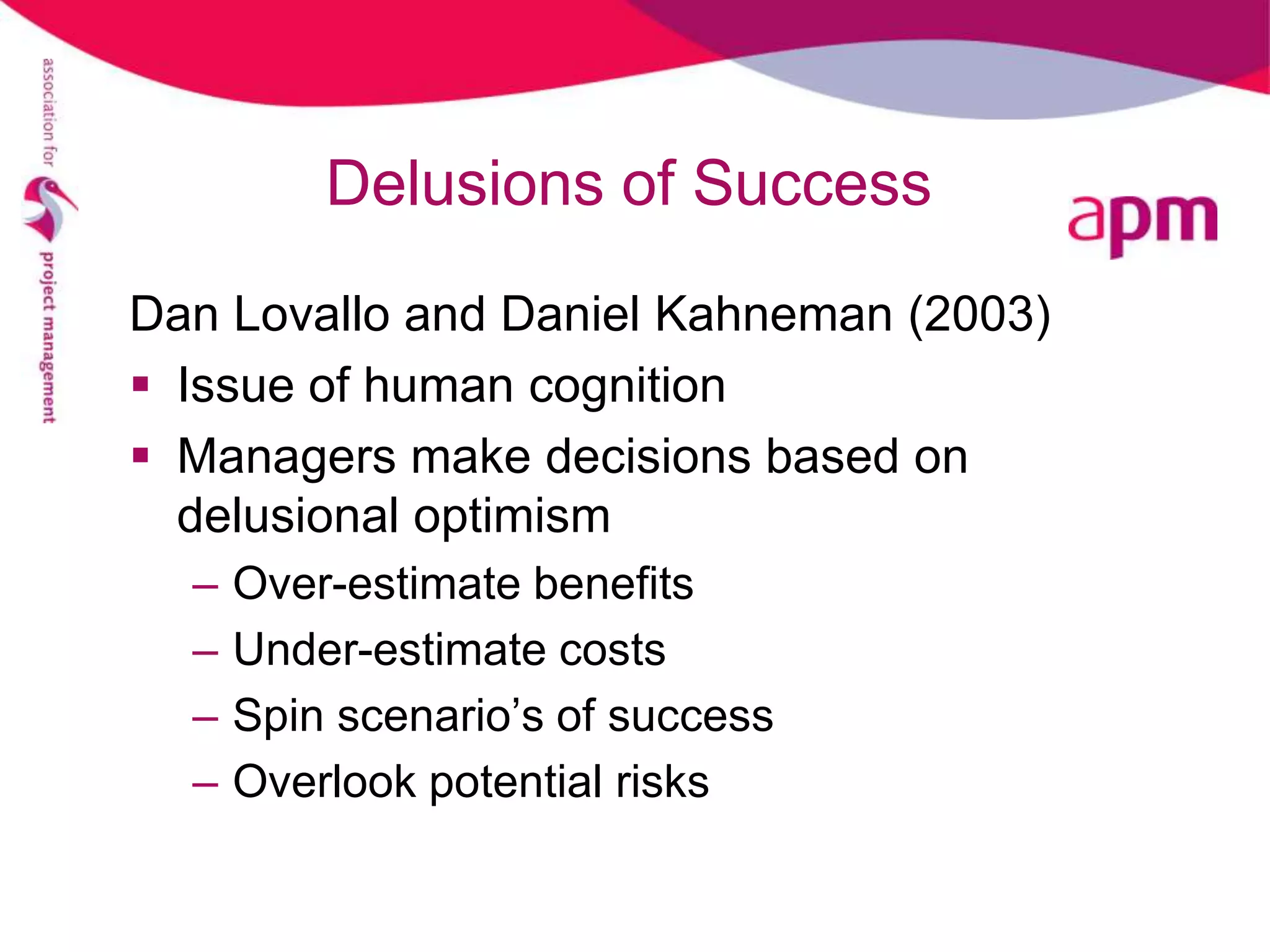
Delusions of Success
Dan Lovallo and Daniel Kahneman (2003)
 Issue of human cognition
 Managers make decisions based on
  delusional optimism
  –   Over-estimate benefits
  –   Under-estimate costs
  –   Spin scenario’s of success
  –   Overlook potential risks
Conspiracy of Optimism
 Royal United Services Institute (2007)

“A conspiracy of optimism exists between MoD
and industry, each having a propensity, in
many cases knowingly, to strike agreements
that are so optimistic as to be unsustainable in
terms of cost, timescale or performance.”
Portsmouth City Council
 Paul Summers (PMT Jan 2013)
  – Many projects failing TCQ
  – Little consideration of benefits
  – Business cases are purely financial
    appraisals
  – Early haste leads to a lack of clarity, vague
    specifications and over optimistic time
    forecasts
Obsession with TCQ
    “The fundamental reason for beginning a
       programme is to realise benefits”
                   Office of Government Commerce (OGC)


“There is little corporate pressure being applied
 on benefits realisation – the focus remains on
   delivery to a fixed cost irrespective of the
                     outcome”
Public sector Board level quote in Moorhouse / Financial Times 2009 survey “The
                       Benefits of Organisational Change”
Benefits Un-realisation
 “The project focus is on creating the business
  case to get the budget approved, then emphasis
  is on delivery on time and to budget”
 “Benefits identification is treated as a mechanism
  to get funding, but there is no effort in the
  realisation of these benefits”
 “Many gateway reviewers don’t understand
  benefits so this is an area that is glossed over”
          Active Benefits Realisation Survey – Steve Jenner 2009
Benefits and Business Case

 Moorhouse 2009 – “Only 20% of
  respondents believe their organisations
  succeed in consistently delivering the
  planned benefits of change.”
 Standish Chaos report 2009 – “24% of
  projects were cancelled prior to completion
  or delivered and never used.”
Problems with Business Cases
 Moorhouse 2009 “Business cases are
  normally used but only as a paper
  exercise, they have very little substance.
  Dashboards are skewed to demonstrate
  success rather than used to drive
  improvement” Executive, Telecoms
Why do Business Cases go
            wrong?
 OGC 2009 “Over half of SRO’s are in their first
  SRO role… Lack of relevant experience,
  combined with regular turnover adds unnecessary
  risk…”
 Moorhouse 2009 “Half of SRO’s surveyed do not
  have clarity around their programme governance
  accountabilities, delegated authorities and
  responsibilities.”
  “Only 10% of SRO’s feel business cases &
benefits realisation are adequately understood….”
Political Dimension
 Jenner 2009 “projects are started in response
  to a political commitment so the task becomes
  one of finding sufficient benefits to justify the
  chosen solution”
   – “Benefits Fraud”
 “Benefits .. seem to be plucked from the air”
 Flyvbjerg 2009 “… perverse incentives that
  encourage promoters to underestimate costs
  and overestimate benefits …” “Survival of the
  Unfittest”
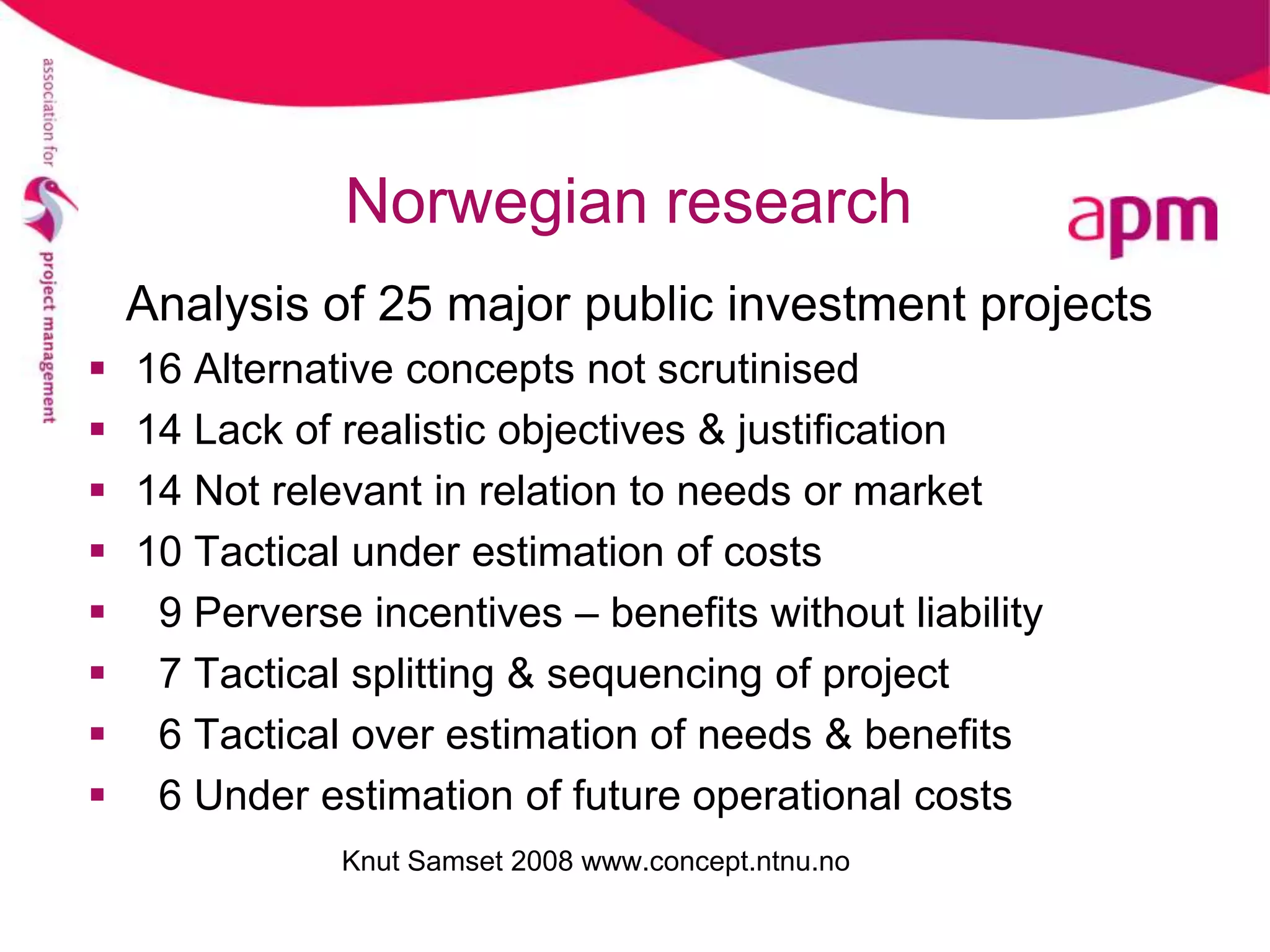
Norwegian research
    Analysis of 25 major public investment projects
   16 Alternative concepts not scrutinised
   14 Lack of realistic objectives & justification
   14 Not relevant in relation to needs or market
   10 Tactical under estimation of costs
    9 Perverse incentives – benefits without liability
    7 Tactical splitting & sequencing of project
    6 Tactical over estimation of needs & benefits
    6 Under estimation of future operational costs
               Knut Samset 2008 www.concept.ntnu.no
Your Turn!!
 What are your experiences in the early
  phases of a project?

 Do you have any ideas for a way forward?

 Do you have any proposals for research
  subjects?
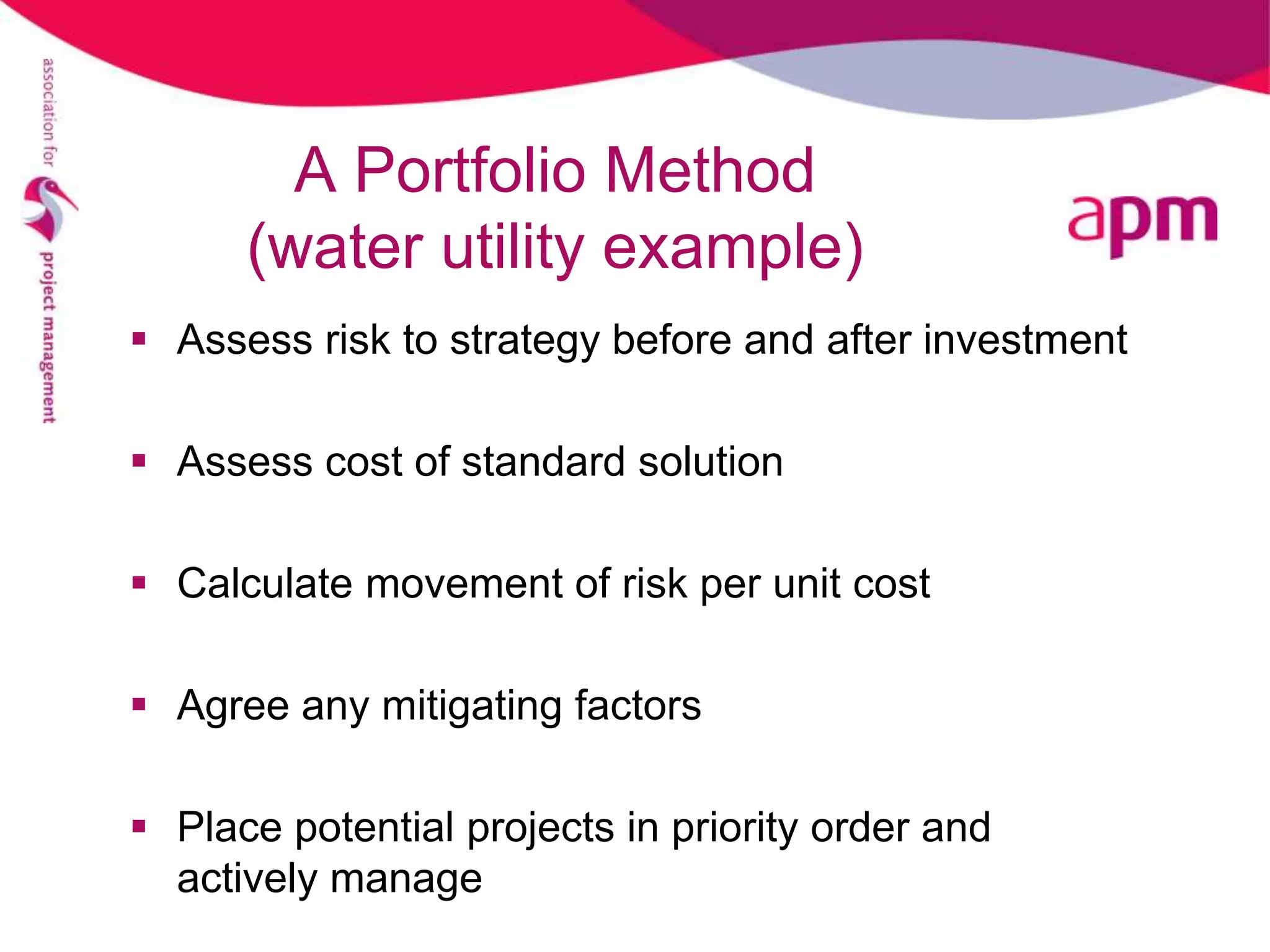
A Portfolio Method
      (water utility example)
 Assess risk to strategy before and after investment

 Assess cost of standard solution

 Calculate movement of risk per unit cost

 Agree any mitigating factors

 Place potential projects in priority order and
  actively manage
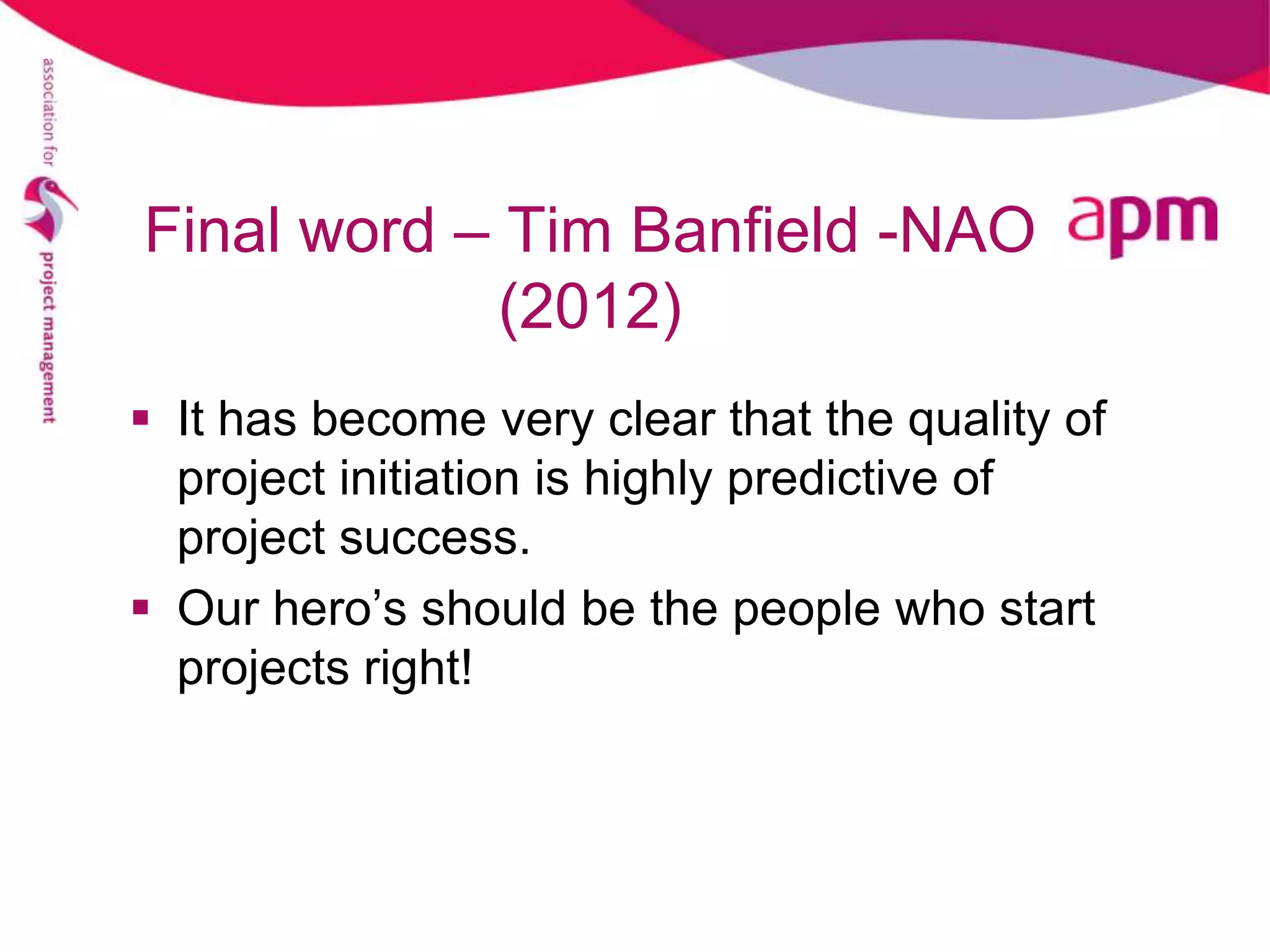
Final word – Tim Banfield -NAO
            (2012)
 It has become very clear that the quality of
  project initiation is highly predictive of
  project success.
 Our hero’s should be the people who start
  projects right!
Thank you


Any Questions or Comments?
Next Steps - Ideas so far
 Research into Concept phase of projects to prove
  case for action
 Encourage better use of Value, Risk and Benefits
  Management at all levels in business within
  context of good governance
 Joint SIG events (e.g. governance, benefits, programme, risk)
 Engaging corporate members of APM
 Organisational maturity models to provide
  evidence of performance

Does the project manager stand a chance?

  • 1.
    Does the ProjectManager Stand a Chance? Peter Langley Value Management Specific Interest Group peter.langley@hotmail.co.uk
  • 2.
    Stakeholders Business Case Requirements (Benefits – sponsor) (quality, functionality) Satisfaction of Needs Value = Use of Resources Money Time BS EN 12973:2000
  • 3.
    Business Risk Environment Company strategy Value Operational Project Benefits Cost & Resources work Portfolio Project risks Programmes & Projects
  • 4.
    Project & ProductLife Cycles Concept Definition Implementation Business Case Handover & Closeout (Benefits) PMP Operation (Success Criteria) Product Benefits Termination Final reports PPR Success Criteria End of product life
  • 5.
    Common Causes ofProject Failure NAO/ OGC (2005)  1. Lack of clear link to strategy  2. Lack of senior management ownership  3. Lack of stakeholder engagement  4. Lack of PM skills  5. Lack of breaking into manageable steps  6. Evaluation driven by initial price not value  7. Lack of contact with suppliers  8. Lack of wider team/supplier integration
  • 6.
    Markus Bleier (LeedsMet Uni 2009)  Brief 22% (of 233 responses) – Unclear, incomplete, difficult to establish, poor goal definition  Stakeholder Management 12% – Co-ordinating multiple, requirements definitions, understanding stakeholders  Early Involvement 11% – All planners want to be involved earlier  Communication 11% – Communication plan, information flow, decision maker needed
  • 7.
    Alignment with CompanyStrategy  Moorhouse 2009 “Many organisations (44%) appear to determine required benefits in a bottom up way rather than through top down alignment with strategic goals”
  • 8.
    Delusions of Success DanLovallo and Daniel Kahneman (2003)  Issue of human cognition  Managers make decisions based on delusional optimism – Over-estimate benefits – Under-estimate costs – Spin scenario’s of success – Overlook potential risks
  • 9.
    Conspiracy of Optimism Royal United Services Institute (2007) “A conspiracy of optimism exists between MoD and industry, each having a propensity, in many cases knowingly, to strike agreements that are so optimistic as to be unsustainable in terms of cost, timescale or performance.”
  • 10.
    Portsmouth City Council Paul Summers (PMT Jan 2013) – Many projects failing TCQ – Little consideration of benefits – Business cases are purely financial appraisals – Early haste leads to a lack of clarity, vague specifications and over optimistic time forecasts
  • 11.
    Obsession with TCQ “The fundamental reason for beginning a programme is to realise benefits” Office of Government Commerce (OGC) “There is little corporate pressure being applied on benefits realisation – the focus remains on delivery to a fixed cost irrespective of the outcome” Public sector Board level quote in Moorhouse / Financial Times 2009 survey “The Benefits of Organisational Change”
  • 12.
    Benefits Un-realisation  “Theproject focus is on creating the business case to get the budget approved, then emphasis is on delivery on time and to budget”  “Benefits identification is treated as a mechanism to get funding, but there is no effort in the realisation of these benefits”  “Many gateway reviewers don’t understand benefits so this is an area that is glossed over” Active Benefits Realisation Survey – Steve Jenner 2009
  • 13.
    Benefits and BusinessCase  Moorhouse 2009 – “Only 20% of respondents believe their organisations succeed in consistently delivering the planned benefits of change.”  Standish Chaos report 2009 – “24% of projects were cancelled prior to completion or delivered and never used.”
  • 14.
    Problems with BusinessCases  Moorhouse 2009 “Business cases are normally used but only as a paper exercise, they have very little substance. Dashboards are skewed to demonstrate success rather than used to drive improvement” Executive, Telecoms
  • 15.
    Why do BusinessCases go wrong?  OGC 2009 “Over half of SRO’s are in their first SRO role… Lack of relevant experience, combined with regular turnover adds unnecessary risk…”  Moorhouse 2009 “Half of SRO’s surveyed do not have clarity around their programme governance accountabilities, delegated authorities and responsibilities.” “Only 10% of SRO’s feel business cases & benefits realisation are adequately understood….”
  • 16.
    Political Dimension  Jenner2009 “projects are started in response to a political commitment so the task becomes one of finding sufficient benefits to justify the chosen solution” – “Benefits Fraud”  “Benefits .. seem to be plucked from the air”  Flyvbjerg 2009 “… perverse incentives that encourage promoters to underestimate costs and overestimate benefits …” “Survival of the Unfittest”
  • 17.
    Norwegian research Analysis of 25 major public investment projects  16 Alternative concepts not scrutinised  14 Lack of realistic objectives & justification  14 Not relevant in relation to needs or market  10 Tactical under estimation of costs  9 Perverse incentives – benefits without liability  7 Tactical splitting & sequencing of project  6 Tactical over estimation of needs & benefits  6 Under estimation of future operational costs Knut Samset 2008 www.concept.ntnu.no
  • 18.
    Your Turn!!  Whatare your experiences in the early phases of a project?  Do you have any ideas for a way forward?  Do you have any proposals for research subjects?
  • 19.
    A Portfolio Method (water utility example)  Assess risk to strategy before and after investment  Assess cost of standard solution  Calculate movement of risk per unit cost  Agree any mitigating factors  Place potential projects in priority order and actively manage
  • 20.
    Final word –Tim Banfield -NAO (2012)  It has become very clear that the quality of project initiation is highly predictive of project success.  Our hero’s should be the people who start projects right!
  • 21.
  • 22.
    Next Steps -Ideas so far  Research into Concept phase of projects to prove case for action  Encourage better use of Value, Risk and Benefits Management at all levels in business within context of good governance  Joint SIG events (e.g. governance, benefits, programme, risk)  Engaging corporate members of APM  Organisational maturity models to provide evidence of performance