Procurement, Leading and Managing Project Teams
Session 2
Project Strategy, including, context, the
business case, success
definition and the project management plan.
Module:
Summary of Lecture 1
• Definition of project management and
its basic aspects
• Project management history
• Project Management Body of
Knowledge
• Project Life Cycle
Warm-up Activity
• What does the term “project
strategy" mean to you?
• Why do you think it is important
to have a clear and defined
project strategy?
• Think of an example of project
strategy.
Learning Objective
Understand the comprehensive Project Management history, body of knowledge and project life
cycle.
By the end of the session, you will be able to:
• Define the meaning and steps of a project strategy.
• Understanding of the business case.
• Understand the criteria which define a project success.
• Definition of the project management steps.
• Understanding how strategy fits into project management.
01 Introduction to Project Strategy
A project strategy is your plan and tools to
complete a project. Great project strategies
align with the mission and goals of the company.
Project strategies typically include the goals for
a project and a strategy to meet them.
''
" Projectmanager.com
What is a project strategy?
Context
• Definition and importance of project strategy
• Strategic context of projects
• Key components of project strategy
Definition of Project Strategy
• Project strategy focuses the project on the desired strategic
results.
• It is an overachieving set of guidelines to be used by the
project in making decisions and taking action in alignment with
corporate, business, marketing, and operational strategies.
• Project Strategy can be defined as “The project perspective,
direction, and guidelines on what to do and how to do it, to
achieve the highest competitive advantage and the best value
from the project.” (Shenhar, Poli & Lechler, 2001).
Importance of project strategy
• Projects must be managed strategically.
• Projects must be more than just tactical or operational.
Corporations need to take advantage of the enormous
opportunities that projects represent.
• Project Strategy provides an umbrella or framework that
can be used to dynamically guide project actions and
decision making as the project environment change.
• Importance in aligning with organizational goals.
Strategic Context of Projects
• How projects fit into the broader strategic goals of an
organization.
• Role of projects in achieving competitive advantage.
Project alignment
• Project alignment is when the project being planned and
executed fits with the larger strategic goals of the
organization running the project.
• The project should always provide business results that
align with the organization.
• This creates value for the organization and makes it more
competitive in the marketplace.
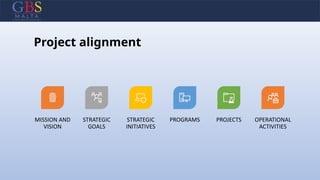
Project alignment
MISSION AND
VISION
STRATEGIC
GOALS
STRATEGIC
INITIATIVES
PROGRAMS PROJECTS OPERATIONAL
ACTIVITIES
Role of projects in achieving competitive advantage
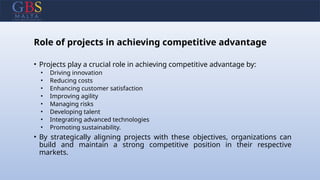
• Projects play a crucial role in achieving competitive advantage by:
• Driving innovation
• Reducing costs
• Enhancing customer satisfaction
• Improving agility
• Managing risks
• Developing talent
• Integrating advanced technologies
• Promoting sustainability.
• By strategically aligning projects with these objectives, organizations can
build and maintain a strong competitive position in their respective
markets.
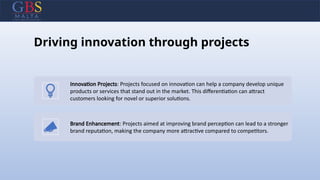
Driving innovation through projects
Innovation Projects: Projects focused on innovation can help a company develop unique
products or services that stand out in the market. This differentiation can attract
customers looking for novel or superior solutions.
Brand Enhancement: Projects aimed at improving brand perception can lead to a stronger
brand reputation, making the company more attractive compared to competitors.
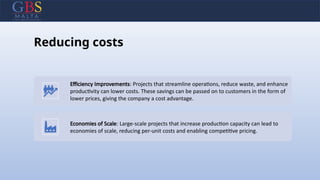
Reducing costs
Efficiency Improvements: Projects that streamline operations, reduce waste, and enhance
productivity can lower costs. These savings can be passed on to customers in the form of
lower prices, giving the company a cost advantage.
Economies of Scale: Large-scale projects that increase production capacity can lead to
economies of scale, reducing per-unit costs and enabling competitive pricing.
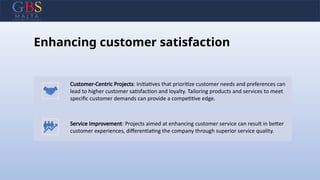
Enhancing customer satisfaction
Customer-Centric Projects: Initiatives that prioritize customer needs and preferences can
lead to higher customer satisfaction and loyalty. Tailoring products and services to meet
specific customer demands can provide a competitive edge.
Service Improvement: Projects aimed at enhancing customer service can result in better
customer experiences, differentiating the company through superior service quality.
Improving agility and responsiveness
Market Adaptation: Projects that enable quick adaptation to market changes or new
trends can keep the company ahead of competitors. This could involve adopting new
technologies or entering emerging markets rapidly.
Flexibility: Projects that increase organizational flexibility allow the company to respond
swiftly to customer needs and market shifts, maintaining a competitive advantage.
Managing risks
Proactive Risk Projects: Identifying and managing risks through dedicated projects can
protect the company from potential threats, ensuring stability and continuity.
Crisis Management: Projects that prepare the company for crises (e.g., disaster recovery
plans) can ensure the company remains operational and competitive even in adverse
conditions.
Developing talents
Skill Enhancement Projects: Investing in employee training and development projects can
lead to a more skilled and capable workforce. This can drive innovation and operational
excellence.
Employee Engagement: Projects that foster a positive work environment and employee
engagement can reduce turnover and attract top talent, contributing to sustained
competitive advantage.
Technology integration
Digital Transformation Projects: Embracing new technologies through dedicated projects
can streamline operations, enhance customer experiences, and open up new business
opportunities.
Automation and AI: Projects that implement automation and artificial intelligence can
improve efficiency, reduce costs, and provide data-driven insights, giving the company a
technological edge over competitors.
Sustainability and CSR
Sustainability Projects: Initiatives focused on sustainability can enhance the company’s
reputation and appeal to environmentally conscious consumers. Sustainable practices can
also lead to long-term cost savings.
Corporate Social Responsibility (CSR): Projects that address social and environmental
issues can build goodwill and brand loyalty, setting the company apart as a responsible
and ethical player in the market.
Key Components of Project Strategy
VISION AND MISSION
ALIGNMENT
STRATEGIC OBJECTIVES RESOURCE ALLOCATION
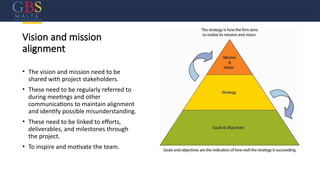
Vision and mission
alignment
• The vision and mission need to be
shared with project stakeholders.
• These need to be regularly referred to
during meetings and other
communications to maintain alignment
and identify possible misunderstanding.
• These need to be linked to efforts,
deliverables, and milestones through
the project.
• To inspire and motivate the team.
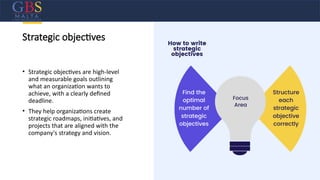
Strategic objectives
• Strategic objectives are high-level
and measurable goals outlining
what an organization wants to
achieve, with a clearly defined
deadline.
• They help organizations create
strategic roadmaps, initiatives, and
projects that are aligned with the
company's strategy and vision.
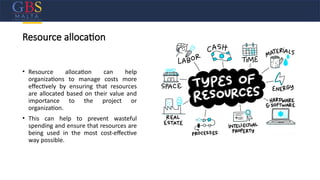
Resource allocation
• Resource allocation can help
organizations to manage costs more
effectively by ensuring that resources
are allocated based on their value and
importance to the project or
organization.
• This can help to prevent wasteful
spending and ensure that resources are
being used in the most cost-effective
way possible.
The business environment
External Factors Internal Factors
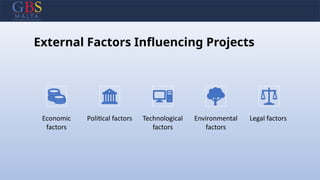
External Factors Influencing Projects
Economic
factors
Political factors Technological
factors
Environmental
factors
Legal factors
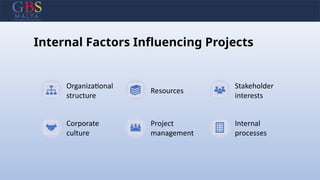
Internal Factors Influencing Projects
Organizational
structure
Resources
Stakeholder
interests
Corporate
culture
Project
management
Internal
processes
Questions?
02 The business case
Understanding the business case
• Definition and purpose
• Components of a business case
What is a business case?
• A business case is a document or argument that outlines the
justification for initiating a project or task.
• It is used to convince decision-makers of the merits of a proposed
project or investment.
• A business case helps ensure that resources are used effectively and
that the proposed project aligns with the organization's strategic goals.
• It serves as a key tool for decision-making, providing a structured
approach to evaluating the merits and feasibility of a project before
committing significant time and resources.
https://www.youtube.com/watch?v=v7m_g1WLYg4
Importance in justifying project
investment
• The importance of a business case in justifying project
investment lies in its ability to provide a comprehensive,
structured, and objective evaluation of a proposed project.
• A business case is essential for justifying project investment
because it ensures that decisions are based on
comprehensive analysis, aligns projects with strategic goals,
optimizes resource allocation, manages risks, promotes
accountability, measures performance, gains stakeholder
support, and provides financial justification.
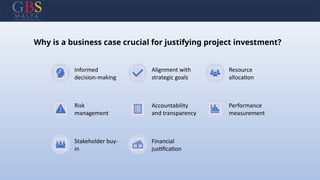
Why is a business case crucial for justifying project investment?
Informed
decision-making
Alignment with
strategic goals
Resource
allocation
Risk
management
Accountability
and transparency
Performance
measurement
Stakeholder buy-
in
Financial
justification
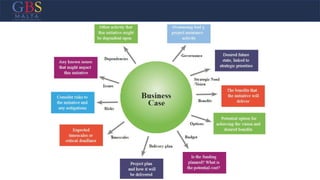
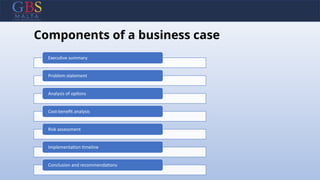
Components of a business case
Executive summary
Problem statement
Analysis of options
Cost-benefit analysis
Risk assessment
Implementation timeline
Conclusion and recommendations
Executive summary
A BRIEF OVERVIEW OF THE BUSINESS CASE. HIGHLIGHTS THE KEY POINTS, INCLUDING THE
PROBLEM, PROPOSED SOLUTION, BENEFITS,
AND RECOMMENDATIONS.
Problem statement
CLEARLY DEFINES THE PROBLEM OR
OPPORTUNITY THE PROJECT AIMS TO
ADDRESS.
EXPLAINS THE CURRENT SITUATION AND WHY
IT NEEDS TO CHANGE.
Objectives
LISTS THE SPECIFIC, MEASURABLE GOALS
THAT THE PROJECT AIMS TO ACHIEVE.
ENSURES ALIGNMENT WITH THE
ORGANIZATION’S STRATEGIC OBJECTIVES.
Options analysis
DESCRIBES VARIOUS POTENTIAL
SOLUTIONS OR APPROACHES.
EVALUATES EACH OPTION AGAINST
CRITERIA SUCH AS FEASIBILITY, COST,
BENEFITS, AND RISKS.
RECOMMENDS THE BEST OPTION
WITH JUSTIFICATION.
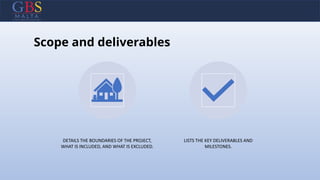
Scope and deliverables
DETAILS THE BOUNDARIES OF THE PROJECT,
WHAT IS INCLUDED, AND WHAT IS EXCLUDED.
LISTS THE KEY DELIVERABLES AND
MILESTONES.
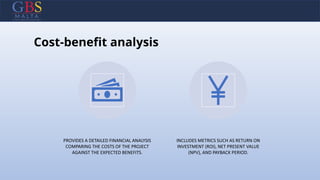
Cost-benefit analysis
PROVIDES A DETAILED FINANCIAL ANALYSIS
COMPARING THE COSTS OF THE PROJECT
AGAINST THE EXPECTED BENEFITS.
INCLUDES METRICS SUCH AS RETURN ON
INVESTMENT (ROI), NET PRESENT VALUE
(NPV), AND PAYBACK PERIOD.
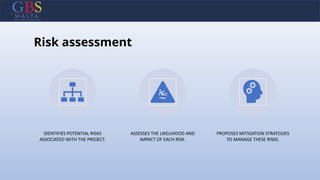
Risk assessment
IDENTIFIES POTENTIAL RISKS
ASSOCIATED WITH THE PROJECT.
ASSESSES THE LIKELIHOOD AND
IMPACT OF EACH RISK.
PROPOSES MITIGATION STRATEGIES
TO MANAGE THESE RISKS.
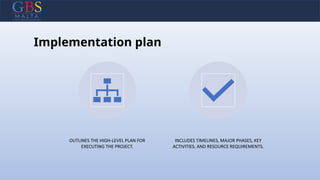
Implementation plan
OUTLINES THE HIGH-LEVEL PLAN FOR
EXECUTING THE PROJECT.
INCLUDES TIMELINES, MAJOR PHASES, KEY
ACTIVITIES, AND RESOURCE REQUIREMENTS.
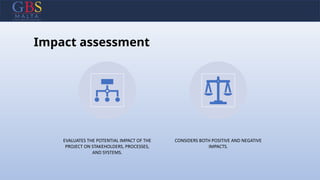
Impact assessment
EVALUATES THE POTENTIAL IMPACT OF THE
PROJECT ON STAKEHOLDERS, PROCESSES,
AND SYSTEMS.
CONSIDERS BOTH POSITIVE AND NEGATIVE
IMPACTS.
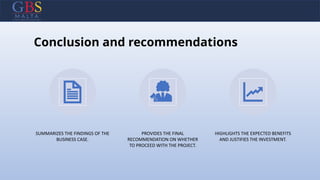
Conclusion and recommendations
SUMMARIZES THE FINDINGS OF THE
BUSINESS CASE.
PROVIDES THE FINAL
RECOMMENDATION ON WHETHER
TO PROCEED WITH THE PROJECT.
HIGHLIGHTS THE EXPECTED BENEFITS
AND JUSTIFIES THE INVESTMENT.
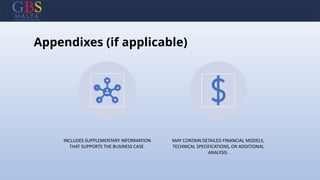
Appendixes (if applicable)
INCLUDES SUPPLEMENTARY INFORMATION
THAT SUPPORTS THE BUSINESS CASE.
MAY CONTAIN DETAILED FINANCIAL MODELS,
TECHNICAL SPECIFICATIONS, OR ADDITIONAL
ANALYSIS.
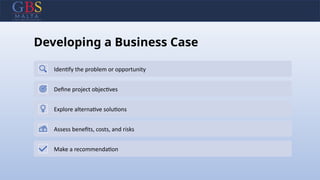
Developing a Business Case
Identify the problem or opportunity
Define project objectives
Explore alternative solutions
Assess benefits, costs, and risks
Make a recommendation
How to write a business case
• https://www.youtube.com/watch?v=UQP5MmCAQ3Y
• https://www.youtube.com/watch?v=0VElRnTKxzA
Question?
Mini Workshop
Developing a business case
Group work – 30 minutes
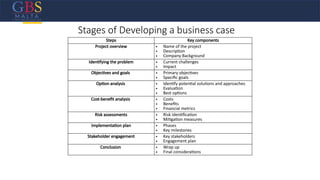
Stages of Developing a business case
Steps Key components
Project overview • Name of the project
• Description
• Company Background
Identifying the problem • Current challenges
• Impact
Objectives and goals • Primary objectives
• Specific goals
Option analysis • Identify potential solutions and approaches
• Evaluation
• Best options
Cost-benefit analysis • Costs
• Benefits
• Financial metrics
Risk assessments • Risk identification
• Mitigation measures
Implementation plan • Phases
• Key milestones
Stakeholder engagement • Key stakeholders
• Engagement plan
Conclusion • Wrap up
• Final considerations
03 Defining Project Success
SUCCESS CRITERIA MEASURING AND REPORTING
SUCCESS
Defining Project Success
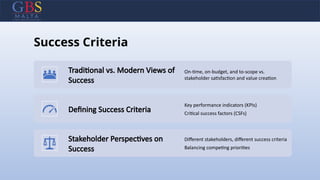
Success Criteria
Traditional vs. Modern Views of
Success
On-time, on-budget, and to-scope vs.
stakeholder satisfaction and value creation
Defining Success Criteria
Key performance indicators (KPIs)
Critical success factors (CSFs)
Stakeholder Perspectives on
Success
Different stakeholders, different success criteria
Balancing competing priorities
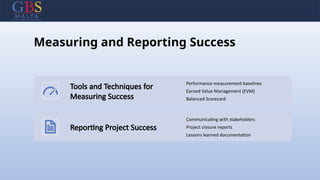
Measuring and Reporting Success
Tools and Techniques for
Measuring Success
Performance measurement baselines
Earned Value Management (EVM)
Balanced Scorecard
Reporting Project Success
Communicating with stakeholders
Project closure reports
Lessons learned documentation
Questions?
04 The Project Management
Plan
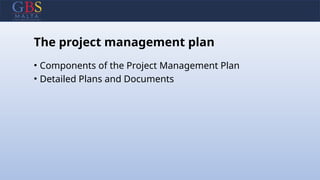
The project management plan
• Components of the Project Management Plan
• Detailed Plans and Documents
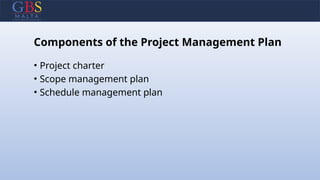
Components of the Project Management Plan
• Project charter
• Scope management plan
• Schedule management plan
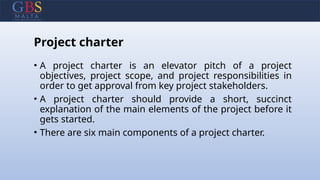
Project charter
• A project charter is an elevator pitch of a project
objectives, project scope, and project responsibilities in
order to get approval from key project stakeholders.
• A project charter should provide a short, succinct
explanation of the main elements of the project before it
gets started.
• There are six main components of a project charter.
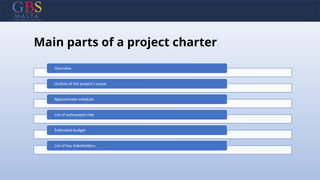
Main parts of a project charter
Overview
Outline of the project's scope
Approximate schedule
List of anticipated risks
Estimated budget
List of key stakeholders.
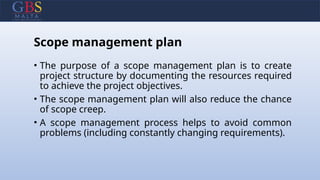
Scope management plan
• The purpose of a scope management plan is to create
project structure by documenting the resources required
to achieve the project objectives.
• The scope management plan will also reduce the chance
of scope creep.
• A scope management process helps to avoid common
problems (including constantly changing requirements).
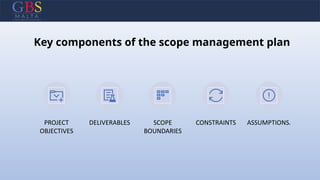
Key components of the scope management plan
PROJECT
OBJECTIVES
DELIVERABLES SCOPE
BOUNDARIES
CONSTRAINTS ASSUMPTIONS.
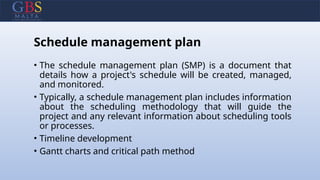
Schedule management plan
• The schedule management plan (SMP) is a document that
details how a project's schedule will be created, managed,
and monitored.
• Typically, a schedule management plan includes information
about the scheduling methodology that will guide the
project and any relevant information about scheduling tools
or processes.
• Timeline development
• Gantt charts and critical path method
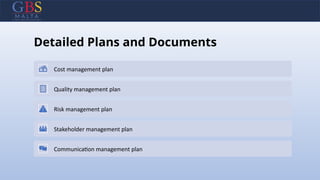
Detailed Plans and Documents
Cost management plan
Quality management plan
Risk management plan
Stakeholder management plan
Communication management plan
05 Integrating Strategy into
Project Management
Purpose
• Strategic Alignment
• Continuous improvement and adaptation
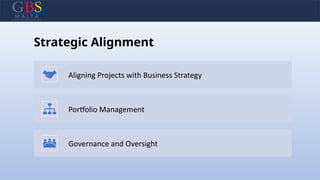
Strategic Alignment
Aligning Projects with Business Strategy
Portfolio Management
Governance and Oversight
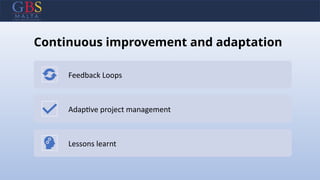
Continuous improvement and adaptation
Feedback Loops
Adaptive project management
Lessons learnt
Questions
Case study
• PROJECT MANAGEMENT AND ITS STRATEGIES IN GLOBAL
ORGANISATION: CASE STUDY
• Novartis Global IT
• Work group: 30 minutes
• Class group discussion
• Each group has to read and discuss the case study paper
• Provide an overview of the company and project approaches
• How does this company align strategy to project management?
• Definition of Project strategy and its importance for proper Project management
• Context of the project strategy (including alignment with organizational goals and
stakeholders' expectations.
• The business case.
• Project success definition.
• Project management plan.
Key Takeaways
• Shenhar, A. J., & Dvir, D. (2007). Reinventing Project Management: The
Diamond Approach to Successful Growth and Innovation. Harvard
Business Review Press.
• Turner, R. (2009). The Handbook of Project-Based Management:
Leading Strategic Change in Organizations. McGraw-Hill Professional.
• Ward, J., & Daniel, E. (2012). Benefits Management: How to Increase
the Business Value of Your IT Projects. John Wiley & Sons.
• Emmerich, F. (2016). Project Business Case: Second Edition. BPB
Publications.
• Kerzner, H. (2018). Project Management Best Practices: Achieving
Global Excellence. John Wiley & Sons.
References
• Pinto, J. K., & Slevin, D. P. (1988). Critical Success Factors Across the
Project Life Cycle. Project Management Institute.
• Project Management Institute. (2021). A Guide to the Project
Management Body of Knowledge (PMBOK® Guide) (7th ed.). Project
Management Institute.
• Wysocki, R. K. (2019). Effective Project Management: Traditional,
Agile, Extreme. John Wiley & Sons.
• Association for Project Management (2020) The APM Body of
knowledge, association for Project Management.
• Bhargove, A. (2018, February). Project procurement: a real-world
guide for procurement skills. Project Management Institute.
References
Questions?
Workshop
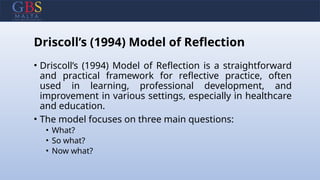
Driscoll's (1994) Model of Reflection
Driscoll’s (1994) Model of Reflection
• Driscoll’s (1994) Model of Reflection is a straightforward
and practical framework for reflective practice, often
used in learning, professional development, and
improvement in various settings, especially in healthcare
and education.
• The model focuses on three main questions:
• What?
• So what?
• Now what?
Explanation of the 3 main questions
• What? - Describing the situation.
• So what? - Analyzing the meaning and significance of the
situation.
• Now what? - Considering future actions and learning
based on reflection.
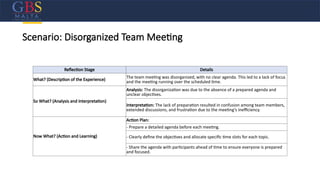
Scenario: Disorganized Team Meeting
Reflection Stage Details
What? (Description of the Experience) The team meeting was disorganized, with no clear agenda. This led to a lack of focus
and the meeting running over the scheduled time.
So What? (Analysis and Interpretation)
Analysis: The disorganization was due to the absence of a prepared agenda and
unclear objectives.
Interpretation: The lack of preparation resulted in confusion among team members,
extended discussions, and frustration due to the meeting’s inefficiency.
Now What? (Action and Learning)
Action Plan:
- Prepare a detailed agenda before each meeting.
- Clearly define the objectives and allocate specific time slots for each topic.
- Share the agenda with participants ahead of time to ensure everyone is prepared
and focused.
Individual Reflection Exercise
• Each participant writes a reflective piece based on a
recent experience using Driscoll’s model.
• Sharing of reflections.
Reflection log as part of the assessment
• For this part of your assessment, you are required to write a reflective learning log
based on the teaching and learning sessions for the module.
• During the teaching and learning sessions for this module, you will have the
opportunity to reflect on your learning through interactions and discussions with
other students and teaching staff.
• Your reflection should be grounded in Driscoll's (1994) Model of Reflection,
integrating the "what," "so what," and "now what" aspects of the experience into
your analysis.
• At the end of each of the teaching sessions, you should reflect on your learning and
write this down in the learning log. Once the teaching for the module has finished
you should write an evaluative self-reflection addressing overall learning and areas
of Procurement, Leading and Managing Project Teams that you would like to learn
more about and how you would go about researching these areas.
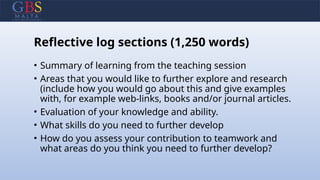
Reflective log sections (1,250 words)
• Summary of learning from the teaching session
• Areas that you would like to further explore and research
(include how you would go about this and give examples
with, for example web-links, books and/or journal articles.
• Evaluation of your knowledge and ability.
• What skills do you need to further develop
• How do you assess your contribution to teamwork and
what areas do you think you need to further develop?
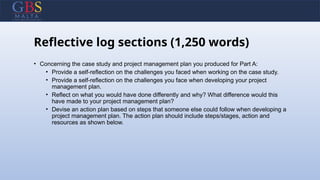
Reflective log sections (1,250 words)
• Concerning the case study and project management plan you produced for Part A:
• Provide a self-reflection on the challenges you faced when working on the case study.
• Provide a self-reflection on the challenges you face when developing your project
management plan.
• Reflect on what you would have done differently and why? What difference would this
have made to your project management plan?
• Devise an action plan based on steps that someone else could follow when developing a
project management plan. The action plan should include steps/stages, action and
resources as shown below.
Steps/Stages Action Resources
Step/Stage 1
Step/Stage 2
Step/Stage 3
Step/Stage 4 etc.
Final remarks
• NB: For this part of the assessment, you will be using Microsoft OneNote as a note-taking software. Please, bring your laptop
to class so you can work on this assessment during the workshops. Once you complete the assessment, download the
OneNote entries in PDF and upload as a PDF file on Turnitin.
• Export notes from OneNote as a PDF
1. On the page you want to export, choose File > Export.
2. Under Export Current, choose what you want to export.
3. Choose PDF (*pdf) > Export.
4. In the Save as dialog box, choose where you want to save your file.
5. Give the file a name, and choose Save.
• Please keep in mind the GBS Academic Misconduct Policy when writing your assessment. You should take care to ensure
that the work presented is your own and that it fully acknowledges the work and opinions of others. It is also your
responsibility to ensure that you do not undertake any form of cheating (plagiarism) or attempt to gain unfair advantage in any
other way. You are required to confirm this via a declaration at submission. Remember that the use of AI content generation
software is an academic misconduct, and it will be penalized.
Questions?

Session 2 - Project Strategy and Project Management Plan (3).pptx

  • 1.
    Procurement, Leading andManaging Project Teams Session 2 Project Strategy, including, context, the business case, success definition and the project management plan. Module:
  • 2.
    Summary of Lecture1 • Definition of project management and its basic aspects • Project management history • Project Management Body of Knowledge • Project Life Cycle
  • 3.
    Warm-up Activity • Whatdoes the term “project strategy" mean to you? • Why do you think it is important to have a clear and defined project strategy? • Think of an example of project strategy.
  • 4.
    Learning Objective Understand thecomprehensive Project Management history, body of knowledge and project life cycle. By the end of the session, you will be able to: • Define the meaning and steps of a project strategy. • Understanding of the business case. • Understand the criteria which define a project success. • Definition of the project management steps. • Understanding how strategy fits into project management.
  • 5.
    01 Introduction toProject Strategy
  • 6.
    A project strategyis your plan and tools to complete a project. Great project strategies align with the mission and goals of the company. Project strategies typically include the goals for a project and a strategy to meet them. '' " Projectmanager.com What is a project strategy?
  • 7.
    Context • Definition andimportance of project strategy • Strategic context of projects • Key components of project strategy
  • 8.
    Definition of ProjectStrategy • Project strategy focuses the project on the desired strategic results. • It is an overachieving set of guidelines to be used by the project in making decisions and taking action in alignment with corporate, business, marketing, and operational strategies. • Project Strategy can be defined as “The project perspective, direction, and guidelines on what to do and how to do it, to achieve the highest competitive advantage and the best value from the project.” (Shenhar, Poli & Lechler, 2001).
  • 9.
    Importance of projectstrategy • Projects must be managed strategically. • Projects must be more than just tactical or operational. Corporations need to take advantage of the enormous opportunities that projects represent. • Project Strategy provides an umbrella or framework that can be used to dynamically guide project actions and decision making as the project environment change. • Importance in aligning with organizational goals.
  • 10.
    Strategic Context ofProjects • How projects fit into the broader strategic goals of an organization. • Role of projects in achieving competitive advantage.
  • 11.
    Project alignment • Projectalignment is when the project being planned and executed fits with the larger strategic goals of the organization running the project. • The project should always provide business results that align with the organization. • This creates value for the organization and makes it more competitive in the marketplace.
  • 12.
  • 13.
    Role of projectsin achieving competitive advantage • Projects play a crucial role in achieving competitive advantage by: • Driving innovation • Reducing costs • Enhancing customer satisfaction • Improving agility • Managing risks • Developing talent • Integrating advanced technologies • Promoting sustainability. • By strategically aligning projects with these objectives, organizations can build and maintain a strong competitive position in their respective markets.
  • 14.
    Driving innovation throughprojects Innovation Projects: Projects focused on innovation can help a company develop unique products or services that stand out in the market. This differentiation can attract customers looking for novel or superior solutions. Brand Enhancement: Projects aimed at improving brand perception can lead to a stronger brand reputation, making the company more attractive compared to competitors.
  • 15.
    Reducing costs Efficiency Improvements:Projects that streamline operations, reduce waste, and enhance productivity can lower costs. These savings can be passed on to customers in the form of lower prices, giving the company a cost advantage. Economies of Scale: Large-scale projects that increase production capacity can lead to economies of scale, reducing per-unit costs and enabling competitive pricing.
  • 16.
    Enhancing customer satisfaction Customer-CentricProjects: Initiatives that prioritize customer needs and preferences can lead to higher customer satisfaction and loyalty. Tailoring products and services to meet specific customer demands can provide a competitive edge. Service Improvement: Projects aimed at enhancing customer service can result in better customer experiences, differentiating the company through superior service quality.
  • 17.
    Improving agility andresponsiveness Market Adaptation: Projects that enable quick adaptation to market changes or new trends can keep the company ahead of competitors. This could involve adopting new technologies or entering emerging markets rapidly. Flexibility: Projects that increase organizational flexibility allow the company to respond swiftly to customer needs and market shifts, maintaining a competitive advantage.
  • 18.
    Managing risks Proactive RiskProjects: Identifying and managing risks through dedicated projects can protect the company from potential threats, ensuring stability and continuity. Crisis Management: Projects that prepare the company for crises (e.g., disaster recovery plans) can ensure the company remains operational and competitive even in adverse conditions.
  • 19.
    Developing talents Skill EnhancementProjects: Investing in employee training and development projects can lead to a more skilled and capable workforce. This can drive innovation and operational excellence. Employee Engagement: Projects that foster a positive work environment and employee engagement can reduce turnover and attract top talent, contributing to sustained competitive advantage.
  • 20.
    Technology integration Digital TransformationProjects: Embracing new technologies through dedicated projects can streamline operations, enhance customer experiences, and open up new business opportunities. Automation and AI: Projects that implement automation and artificial intelligence can improve efficiency, reduce costs, and provide data-driven insights, giving the company a technological edge over competitors.
  • 21.
    Sustainability and CSR SustainabilityProjects: Initiatives focused on sustainability can enhance the company’s reputation and appeal to environmentally conscious consumers. Sustainable practices can also lead to long-term cost savings. Corporate Social Responsibility (CSR): Projects that address social and environmental issues can build goodwill and brand loyalty, setting the company apart as a responsible and ethical player in the market.
  • 22.
    Key Components ofProject Strategy VISION AND MISSION ALIGNMENT STRATEGIC OBJECTIVES RESOURCE ALLOCATION
  • 23.
    Vision and mission alignment •The vision and mission need to be shared with project stakeholders. • These need to be regularly referred to during meetings and other communications to maintain alignment and identify possible misunderstanding. • These need to be linked to efforts, deliverables, and milestones through the project. • To inspire and motivate the team.
  • 24.
    Strategic objectives • Strategicobjectives are high-level and measurable goals outlining what an organization wants to achieve, with a clearly defined deadline. • They help organizations create strategic roadmaps, initiatives, and projects that are aligned with the company's strategy and vision.
  • 25.
    Resource allocation • Resourceallocation can help organizations to manage costs more effectively by ensuring that resources are allocated based on their value and importance to the project or organization. • This can help to prevent wasteful spending and ensure that resources are being used in the most cost-effective way possible.
  • 26.
    The business environment ExternalFactors Internal Factors
  • 27.
    External Factors InfluencingProjects Economic factors Political factors Technological factors Environmental factors Legal factors
  • 28.
    Internal Factors InfluencingProjects Organizational structure Resources Stakeholder interests Corporate culture Project management Internal processes
  • 29.
  • 30.
  • 32.
    Understanding the businesscase • Definition and purpose • Components of a business case
  • 33.
    What is abusiness case? • A business case is a document or argument that outlines the justification for initiating a project or task. • It is used to convince decision-makers of the merits of a proposed project or investment. • A business case helps ensure that resources are used effectively and that the proposed project aligns with the organization's strategic goals. • It serves as a key tool for decision-making, providing a structured approach to evaluating the merits and feasibility of a project before committing significant time and resources. https://www.youtube.com/watch?v=v7m_g1WLYg4
  • 34.
    Importance in justifyingproject investment • The importance of a business case in justifying project investment lies in its ability to provide a comprehensive, structured, and objective evaluation of a proposed project. • A business case is essential for justifying project investment because it ensures that decisions are based on comprehensive analysis, aligns projects with strategic goals, optimizes resource allocation, manages risks, promotes accountability, measures performance, gains stakeholder support, and provides financial justification.
  • 35.
    Why is abusiness case crucial for justifying project investment? Informed decision-making Alignment with strategic goals Resource allocation Risk management Accountability and transparency Performance measurement Stakeholder buy- in Financial justification
  • 36.
    Components of abusiness case Executive summary Problem statement Analysis of options Cost-benefit analysis Risk assessment Implementation timeline Conclusion and recommendations
  • 37.
    Executive summary A BRIEFOVERVIEW OF THE BUSINESS CASE. HIGHLIGHTS THE KEY POINTS, INCLUDING THE PROBLEM, PROPOSED SOLUTION, BENEFITS, AND RECOMMENDATIONS.
  • 38.
    Problem statement CLEARLY DEFINESTHE PROBLEM OR OPPORTUNITY THE PROJECT AIMS TO ADDRESS. EXPLAINS THE CURRENT SITUATION AND WHY IT NEEDS TO CHANGE.
  • 39.
    Objectives LISTS THE SPECIFIC,MEASURABLE GOALS THAT THE PROJECT AIMS TO ACHIEVE. ENSURES ALIGNMENT WITH THE ORGANIZATION’S STRATEGIC OBJECTIVES.
  • 40.
    Options analysis DESCRIBES VARIOUSPOTENTIAL SOLUTIONS OR APPROACHES. EVALUATES EACH OPTION AGAINST CRITERIA SUCH AS FEASIBILITY, COST, BENEFITS, AND RISKS. RECOMMENDS THE BEST OPTION WITH JUSTIFICATION.
  • 41.
    Scope and deliverables DETAILSTHE BOUNDARIES OF THE PROJECT, WHAT IS INCLUDED, AND WHAT IS EXCLUDED. LISTS THE KEY DELIVERABLES AND MILESTONES.
  • 42.
    Cost-benefit analysis PROVIDES ADETAILED FINANCIAL ANALYSIS COMPARING THE COSTS OF THE PROJECT AGAINST THE EXPECTED BENEFITS. INCLUDES METRICS SUCH AS RETURN ON INVESTMENT (ROI), NET PRESENT VALUE (NPV), AND PAYBACK PERIOD.
  • 43.
    Risk assessment IDENTIFIES POTENTIALRISKS ASSOCIATED WITH THE PROJECT. ASSESSES THE LIKELIHOOD AND IMPACT OF EACH RISK. PROPOSES MITIGATION STRATEGIES TO MANAGE THESE RISKS.
  • 44.
    Implementation plan OUTLINES THEHIGH-LEVEL PLAN FOR EXECUTING THE PROJECT. INCLUDES TIMELINES, MAJOR PHASES, KEY ACTIVITIES, AND RESOURCE REQUIREMENTS.
  • 45.
    Impact assessment EVALUATES THEPOTENTIAL IMPACT OF THE PROJECT ON STAKEHOLDERS, PROCESSES, AND SYSTEMS. CONSIDERS BOTH POSITIVE AND NEGATIVE IMPACTS.
  • 46.
    Conclusion and recommendations SUMMARIZESTHE FINDINGS OF THE BUSINESS CASE. PROVIDES THE FINAL RECOMMENDATION ON WHETHER TO PROCEED WITH THE PROJECT. HIGHLIGHTS THE EXPECTED BENEFITS AND JUSTIFIES THE INVESTMENT.
  • 47.
    Appendixes (if applicable) INCLUDESSUPPLEMENTARY INFORMATION THAT SUPPORTS THE BUSINESS CASE. MAY CONTAIN DETAILED FINANCIAL MODELS, TECHNICAL SPECIFICATIONS, OR ADDITIONAL ANALYSIS.
  • 48.
    Developing a BusinessCase Identify the problem or opportunity Define project objectives Explore alternative solutions Assess benefits, costs, and risks Make a recommendation
  • 49.
    How to writea business case • https://www.youtube.com/watch?v=UQP5MmCAQ3Y • https://www.youtube.com/watch?v=0VElRnTKxzA
  • 50.
  • 51.
    Mini Workshop Developing abusiness case Group work – 30 minutes
  • 52.
    Stages of Developinga business case Steps Key components Project overview • Name of the project • Description • Company Background Identifying the problem • Current challenges • Impact Objectives and goals • Primary objectives • Specific goals Option analysis • Identify potential solutions and approaches • Evaluation • Best options Cost-benefit analysis • Costs • Benefits • Financial metrics Risk assessments • Risk identification • Mitigation measures Implementation plan • Phases • Key milestones Stakeholder engagement • Key stakeholders • Engagement plan Conclusion • Wrap up • Final considerations
  • 53.
  • 54.
    SUCCESS CRITERIA MEASURINGAND REPORTING SUCCESS Defining Project Success
  • 55.
    Success Criteria Traditional vs.Modern Views of Success On-time, on-budget, and to-scope vs. stakeholder satisfaction and value creation Defining Success Criteria Key performance indicators (KPIs) Critical success factors (CSFs) Stakeholder Perspectives on Success Different stakeholders, different success criteria Balancing competing priorities
  • 56.
    Measuring and ReportingSuccess Tools and Techniques for Measuring Success Performance measurement baselines Earned Value Management (EVM) Balanced Scorecard Reporting Project Success Communicating with stakeholders Project closure reports Lessons learned documentation
  • 57.
  • 58.
    04 The ProjectManagement Plan
  • 59.
    The project managementplan • Components of the Project Management Plan • Detailed Plans and Documents
  • 60.
    Components of theProject Management Plan • Project charter • Scope management plan • Schedule management plan
  • 61.
    Project charter • Aproject charter is an elevator pitch of a project objectives, project scope, and project responsibilities in order to get approval from key project stakeholders. • A project charter should provide a short, succinct explanation of the main elements of the project before it gets started. • There are six main components of a project charter.
  • 62.
    Main parts ofa project charter Overview Outline of the project's scope Approximate schedule List of anticipated risks Estimated budget List of key stakeholders.
  • 63.
    Scope management plan •The purpose of a scope management plan is to create project structure by documenting the resources required to achieve the project objectives. • The scope management plan will also reduce the chance of scope creep. • A scope management process helps to avoid common problems (including constantly changing requirements).
  • 64.
    Key components ofthe scope management plan PROJECT OBJECTIVES DELIVERABLES SCOPE BOUNDARIES CONSTRAINTS ASSUMPTIONS.
  • 65.
    Schedule management plan •The schedule management plan (SMP) is a document that details how a project's schedule will be created, managed, and monitored. • Typically, a schedule management plan includes information about the scheduling methodology that will guide the project and any relevant information about scheduling tools or processes. • Timeline development • Gantt charts and critical path method
  • 66.
    Detailed Plans andDocuments Cost management plan Quality management plan Risk management plan Stakeholder management plan Communication management plan
  • 67.
    05 Integrating Strategyinto Project Management
  • 68.
    Purpose • Strategic Alignment •Continuous improvement and adaptation
  • 69.
    Strategic Alignment Aligning Projectswith Business Strategy Portfolio Management Governance and Oversight
  • 70.
    Continuous improvement andadaptation Feedback Loops Adaptive project management Lessons learnt
  • 71.
  • 72.
    Case study • PROJECTMANAGEMENT AND ITS STRATEGIES IN GLOBAL ORGANISATION: CASE STUDY • Novartis Global IT • Work group: 30 minutes • Class group discussion • Each group has to read and discuss the case study paper • Provide an overview of the company and project approaches • How does this company align strategy to project management?
  • 73.
    • Definition ofProject strategy and its importance for proper Project management • Context of the project strategy (including alignment with organizational goals and stakeholders' expectations. • The business case. • Project success definition. • Project management plan. Key Takeaways
  • 74.
    • Shenhar, A.J., & Dvir, D. (2007). Reinventing Project Management: The Diamond Approach to Successful Growth and Innovation. Harvard Business Review Press. • Turner, R. (2009). The Handbook of Project-Based Management: Leading Strategic Change in Organizations. McGraw-Hill Professional. • Ward, J., & Daniel, E. (2012). Benefits Management: How to Increase the Business Value of Your IT Projects. John Wiley & Sons. • Emmerich, F. (2016). Project Business Case: Second Edition. BPB Publications. • Kerzner, H. (2018). Project Management Best Practices: Achieving Global Excellence. John Wiley & Sons. References
  • 75.
    • Pinto, J.K., & Slevin, D. P. (1988). Critical Success Factors Across the Project Life Cycle. Project Management Institute. • Project Management Institute. (2021). A Guide to the Project Management Body of Knowledge (PMBOK® Guide) (7th ed.). Project Management Institute. • Wysocki, R. K. (2019). Effective Project Management: Traditional, Agile, Extreme. John Wiley & Sons. • Association for Project Management (2020) The APM Body of knowledge, association for Project Management. • Bhargove, A. (2018, February). Project procurement: a real-world guide for procurement skills. Project Management Institute. References
  • 76.
  • 77.
  • 78.
    Driscoll’s (1994) Modelof Reflection • Driscoll’s (1994) Model of Reflection is a straightforward and practical framework for reflective practice, often used in learning, professional development, and improvement in various settings, especially in healthcare and education. • The model focuses on three main questions: • What? • So what? • Now what?
  • 79.
    Explanation of the3 main questions • What? - Describing the situation. • So what? - Analyzing the meaning and significance of the situation. • Now what? - Considering future actions and learning based on reflection.
  • 80.
    Scenario: Disorganized TeamMeeting Reflection Stage Details What? (Description of the Experience) The team meeting was disorganized, with no clear agenda. This led to a lack of focus and the meeting running over the scheduled time. So What? (Analysis and Interpretation) Analysis: The disorganization was due to the absence of a prepared agenda and unclear objectives. Interpretation: The lack of preparation resulted in confusion among team members, extended discussions, and frustration due to the meeting’s inefficiency. Now What? (Action and Learning) Action Plan: - Prepare a detailed agenda before each meeting. - Clearly define the objectives and allocate specific time slots for each topic. - Share the agenda with participants ahead of time to ensure everyone is prepared and focused.
  • 81.
    Individual Reflection Exercise •Each participant writes a reflective piece based on a recent experience using Driscoll’s model. • Sharing of reflections.
  • 82.
    Reflection log aspart of the assessment • For this part of your assessment, you are required to write a reflective learning log based on the teaching and learning sessions for the module. • During the teaching and learning sessions for this module, you will have the opportunity to reflect on your learning through interactions and discussions with other students and teaching staff. • Your reflection should be grounded in Driscoll's (1994) Model of Reflection, integrating the "what," "so what," and "now what" aspects of the experience into your analysis. • At the end of each of the teaching sessions, you should reflect on your learning and write this down in the learning log. Once the teaching for the module has finished you should write an evaluative self-reflection addressing overall learning and areas of Procurement, Leading and Managing Project Teams that you would like to learn more about and how you would go about researching these areas.
  • 83.
    Reflective log sections(1,250 words) • Summary of learning from the teaching session • Areas that you would like to further explore and research (include how you would go about this and give examples with, for example web-links, books and/or journal articles. • Evaluation of your knowledge and ability. • What skills do you need to further develop • How do you assess your contribution to teamwork and what areas do you think you need to further develop?
  • 84.
    Reflective log sections(1,250 words) • Concerning the case study and project management plan you produced for Part A: • Provide a self-reflection on the challenges you faced when working on the case study. • Provide a self-reflection on the challenges you face when developing your project management plan. • Reflect on what you would have done differently and why? What difference would this have made to your project management plan? • Devise an action plan based on steps that someone else could follow when developing a project management plan. The action plan should include steps/stages, action and resources as shown below.
  • 85.
    Steps/Stages Action Resources Step/Stage1 Step/Stage 2 Step/Stage 3 Step/Stage 4 etc.
  • 86.
    Final remarks • NB:For this part of the assessment, you will be using Microsoft OneNote as a note-taking software. Please, bring your laptop to class so you can work on this assessment during the workshops. Once you complete the assessment, download the OneNote entries in PDF and upload as a PDF file on Turnitin. • Export notes from OneNote as a PDF 1. On the page you want to export, choose File > Export. 2. Under Export Current, choose what you want to export. 3. Choose PDF (*pdf) > Export. 4. In the Save as dialog box, choose where you want to save your file. 5. Give the file a name, and choose Save. • Please keep in mind the GBS Academic Misconduct Policy when writing your assessment. You should take care to ensure that the work presented is your own and that it fully acknowledges the work and opinions of others. It is also your responsibility to ensure that you do not undertake any form of cheating (plagiarism) or attempt to gain unfair advantage in any other way. You are required to confirm this via a declaration at submission. Remember that the use of AI content generation software is an academic misconduct, and it will be penalized.
  • 87.

Editor's Notes

  • #2 Summary of Lecture 1 Estimated time: 5-10 minutes ​ Before starting the second lecture of the PM module, let’s summarize briefly what we have discussed during our previous lecture. Open space for any question/clarification re topics treated during lecture 1.
  • #3 Warm up activity Estimated time: 5-10 minutes ​ Let’s start our session with a brief warm-up activity. Take a moment to reflect on the following questions: What does the term “project strategy" mean to you? Why do you think it is important to have a clear and defined project strategy? Think of an example of project strategy. Feel free to jot down your thoughts. We'll discuss your ideas as we progress through the session. Take a moment for reflection and discuss with your classmates, and when you're ready, we'll continue. ​
  • #4 ​ Let's outline what we aim to achieve in today's session. By the end of this session, you will have a solid basic aspects of project management as an introduction to the topic. Here are our objectives for today: Define the meaning and steps of a project strategy. Understanding of the business case, Understand the criteria which define a project success. Definition of a project management steps. Understanding how strategy fits into project management.
  • #6 Definition of project strategy:  Let's begin by defining what we mean by ‘Project Strategy’ Projectmanager.com definition: A project strategy is your plan and tools to complete a project. Great project strategies align with the mission and goals of the company. Project strategies typically include the goals for a project and a strategy to meet them.
  • #8 Poli, Michael & Shenhar, Aaron. (2003). Project Strategy: The Key to Project Success. 231 - 235. 10.1109/PICMET.2003.1222799. A. J. Shenhar, M. Poli and T. Lechler (2001) “A New Framework for Strategic ProjectManagement”, Pergamon, Management of Technology: The Key to Prosperity in the ThirdMillennium, PICMET - Ninth International Conference on Management Technology, ThousandOaks, CA. (PDF) Project Strategy: The Key to Project Success. Available from: https://www.researchgate.net/publication/4029624_Project_Strategy_The_Key_to_Project_Success [accessed Jun 03 2024].
  • #12 Projects fit into the broader strategic goals of an organization by being part of a structured hierarchy where strategic vision drives the selection and execution of portfolios, programs, and individual projects. This alignment ensures that all efforts are directed towards achieving the long-term objectives of the organization.
  • #27 Economic Factors Market trends Economic cycles Funding availability Inflation rates Political Factors Government policies Regulatory environment Political stability Taxation policies Social Factors Cultural attitudes Demographics Public opinion Social trends Technological Factors Technological advancements Innovation rates Infrastructure changes Cybersecurity threats Environmental Factors Climate change Natural disasters Environmental regulations Sustainability practices Legal Factors Compliance requirements Legal constraints Intellectual property rights Contractual obligations
  • #28 Organizational Structure Hierarchical vs. flat structures Departmental collaboration Decision-making processes Resources Availability of skilled personnel Financial resources Equipment and technology Time constraints Stakeholder Influence Support from management Team dynamics Stakeholder expectations Communication channels Corporate Culture Organizational values Work environment Employee morale Innovation culture Project Management Leadership styles Project management methodologies Risk management practices Quality control mechanisms Internal Processes Workflow efficiency Standard operating procedures Internal policies Process improvement initiatives
  • #35 Informed Decision-Making: A business case provides decision-makers with detailed information about the project, including its objectives, costs, benefits, risks, and potential impacts. This enables them to make informed decisions based on a thorough analysis rather than intuition or incomplete data. Alignment with Strategic Goals: By clearly articulating how the project aligns with the organization’s strategic objectives, a business case helps ensure that resources are allocated to initiatives that support the overall direction and priorities of the organization. Resource Allocation: Organizations have limited resources, including time, money, and personnel. A business case helps justify the allocation of these resources to the proposed project by demonstrating its potential value and return on investment compared to other possible initiatives. Risk Management: A comprehensive business case includes a risk assessment, identifying potential risks and proposing mitigation strategies. This proactive approach to risk management helps minimize the likelihood of project failure and ensures that stakeholders are aware of potential challenges. Accountability and Transparency: Creating a business case involves documenting the rationale for the project, including expected outcomes and assumptions. This promotes accountability and transparency, as stakeholders can review and evaluate the justification for the project before approving it. Performance Measurement: A business case establishes clear objectives and success criteria for the project. This provides a basis for measuring project performance and assessing whether it delivers the anticipated benefits, thereby facilitating post-implementation reviews and continuous improvement. Stakeholder Buy-In: A well-constructed business case helps gain the support of key stakeholders by clearly communicating the value and benefits of the project. This buy-in is essential for securing the necessary resources and cooperation required for successful project implementation. Financial Justification: Through cost-benefit analysis, ROI calculations, and other financial metrics, a business case provides a quantifiable justification for the investment. This financial rigor is crucial for convincing budget holders and financial decision-makers of the project's viability.
  • #51 Discuss and work in groups Identify a company of your choose Identify a potential project that would be potentially beneficial for the company Prepare a short business case based on the steps identified in the next slide.
  • #57 Group Activity Estimated time: 10-15 minutes Complete the activity using Porters Five-Forces model. Handout provided.
  • #69 Aligning Projects with Business Strategy Ensuring project goals support strategic objectives Portfolio Management Managing multiple projects for strategic alignment Governance and Oversight Role of project governance in strategic alignment
  • #70 Feedback Loops Incorporating feedback into project strategy Adaptive Project Management Responding to changes in strategy and environment Lessons Learned Using past projects to inform future strategy
  • #72 Divide class into groups Each group has to read and discuss the case study paper Provide an overview of the company and project approaches How does this company align strategy to project management?
  • #74 References:​ Estimated time: 1 minutes​ ​ Explain that the links are the reference for the content in the slides ​ Advance to the next slide​
  • #75 References:​ Estimated time: 1 minutes​ ​ Explain that the links are the reference for the content in the slides ​ Advance to the next slide​