Project Initiation Document

 A Primer for Portfolio Management
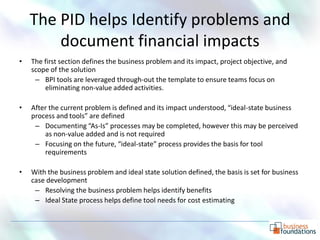
The PID helps Identify problems and
        document financial impacts
•   The first section defines the business problem and its impact, project objective, and
    scope of the solution
     – BPI tools are leveraged through-out the template to ensure teams focus on
        eliminating non-value added activities.

•   After the current problem is defined and its impact understood, “ideal-state business
    process and tools” are defined
     – Documenting “As-Is” processes may be completed, however this may be perceived
        as non-value added and is not required
     – Focusing on the future, “ideal-state” process provides the basis for tool
        requirements

•   With the business problem and ideal state solution defined, the basis is set for business
    case development
     – Resolving the business problem helps identify benefits
     – Ideal State process helps define tool needs for cost estimating


                                                                                            p. 2
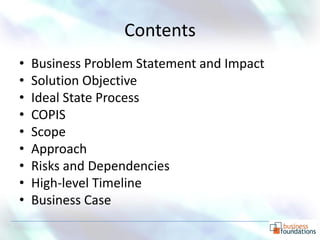
Contents
•   Business Problem Statement and Impact
•   Solution Objective
•   Ideal State Process
•   COPIS
•   Scope
•   Approach
•   Risks and Dependencies
•   High-level Timeline
•   Business Case
                                            p. 3
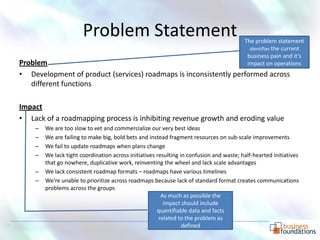
Problem Statement                                                 The problem statement
                                                                                           identifies the current
                                                                                          business pain and it’s
Problem                                                                                   impact on operations
• Development of product (services) roadmaps is inconsistently performed across
   different functions

Impact
• Lack of a roadmapping process is inhibiting revenue growth and eroding value
    –   We are too slow to vet and commercialize our very best ideas
    –   We are failing to make big, bold bets and instead fragment resources on sub-scale improvements
    –   We fail to update roadmaps when plans change
    –   We lack tight coordination across initiatives resulting in confusion and waste; half-hearted initiatives
        that go nowhere, duplicative work, reinventing the wheel and lack scale advantages
    –   We lack consistent roadmap formats – roadmaps have various timelines
    –   We’re unable to prioritize across roadmaps because lack of standard format creates communications
        problems across the groups
                                                        As much as possible the
                                                         impact should include
                                                      quantifiable data and facts
                                                       related to the problem as
                                                                 defined
                                                                                                             p. 4
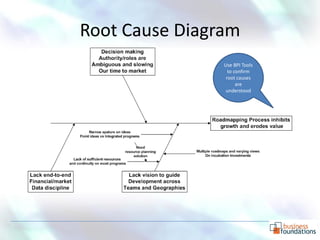
Root Cause Diagram
                Use BPI Tools
                  to confirm
                 root causes
                      are
                 understood


                                p. 5
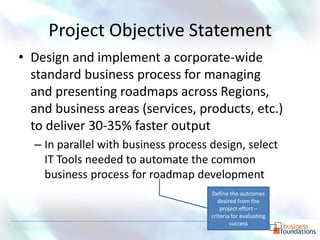
Project Objective Statement
• Design and implement a corporate-wide
  standard business process for managing
  and presenting roadmaps across Regions,
  and business areas (services, products, etc.)
  to deliver 30-35% faster output
  – In parallel with business process design, select
    IT Tools needed to automate the common
    business process for roadmap development
                                      Define the outcomes
                                         desired from the
                                          project effort –
                                      criteria for evaluating
                                              success
                                                                p. 6
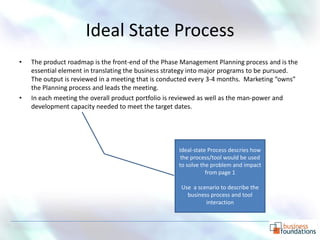
Ideal State Process
•   The product roadmap is the front-end of the Phase Management Planning process and is the
    essential element in translating the business strategy into major programs to be pursued.
    The output is reviewed in a meeting that is conducted every 3-4 months. Marketing “owns”
    the Planning process and leads the meeting.
•   In each meeting the overall product portfolio is reviewed as well as the man-power and
    development capacity needed to meet the target dates.


                                                     Ideal-state Process descries how
                                                      the process/tool would be used
                                                     to solve the problem and impact
                                                                from page 1

                                                      Use a scenario to describe the
                                                        business process and tool
                                                               interaction


                                                                                           p. 7
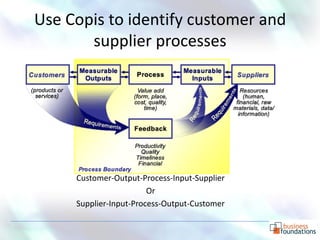
Use Copis to identify customer and
       supplier processes


     Customer-Output-Process-Input-Supplier
                        Or
     Supplier-Input-Process-Output-Customer
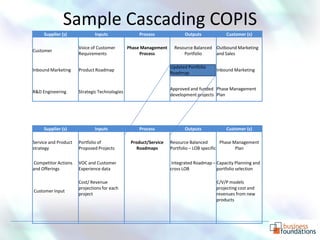
Sample Cascading COPIS
     Supplier (s)             Inputs               Process               Outputs            Customer (s)

                      Voice of Customer        Phase Management     Resource Balanced Outbound Marketing
Customer
                      Requirements                  Process             Portfolio     and Sales

                                                                  Updated Portfolio
Inbound Marketing     Product Roadmap                                                   Inbound Marketing
                                                                  Roadmap


                                                                  Approved and funded Phase Management
R&D Engineering       Strategic Technologies
                                                                  development projects Plan


     Supplier (s)             Inputs               Process               Outputs            Customer (s)

Service and Product   Portfolio of              Product/Service   Resource Balanced        Phase Management
strategy              Proposed Projects            Roadmaps       Portfolio – LOB specific        Plan


Competitor Actions    VOC and Customer                             Integrated Roadmap – Capacity Planning and
and Offerings         Experience data                             cross LOB             portfolio selection

                      Cost/ Revenue                                                     C/V/P models
                      projections for each                                              projecting cost and
Customer Input
                      project                                                           revenues from new
                                                                                        products


                                                                                                                p. 9
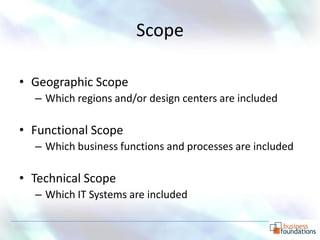
Scope

• Geographic Scope
  – Which regions and/or design centers are included

• Functional Scope
  – Which business functions and processes are included

• Technical Scope
  – Which IT Systems are included

                                                       p. 10
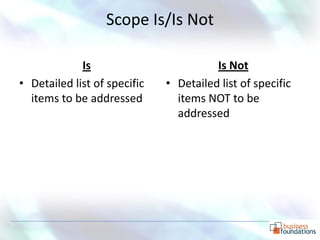
Scope Is/Is Not

             Is                         Is Not
• Detailed list of specific   • Detailed list of specific
  items to be addressed         items NOT to be
                                addressed


                                                        p. 11
Solution Approach
•   Define business process and requirements
•   Evaluate current processes and tools
•   Review and confirm VS fit with requirements
•   Finalize Cost/Benefit/ROI model
•   Pilot Solution in one area
•   Refine implementation plan to align with IT
    Implementation of VS and roll-out

                                              p. 12
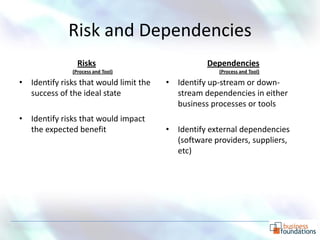
Risk and Dependencies
                 Risks                             Dependencies
               (Process and Tool)                     (Process and Tool)

• Identify risks that would limit the   • Identify up-stream or down-
  success of the ideal state              stream dependencies in either
                                          business processes or tools
• Identify risks that would impact
  the expected benefit                  • Identify external dependencies
                                          (software providers, suppliers,
                                          etc)


                                                                           p. 13
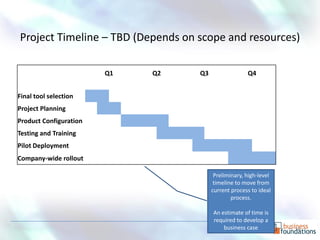
Project Timeline – TBD (Depends on scope and resources)

                        Q1   Q2    Q3                 Q4


Final tool selection
Project Planning
Product Configuration
Testing and Training
Pilot Deployment
Company-wide rollout

                                         Preliminary, high-level
                                         timeline to move from
                                        current process to ideal
                                                process.

                                        An estimate of time is
                                        required to develop a
                                            business case          p. 14
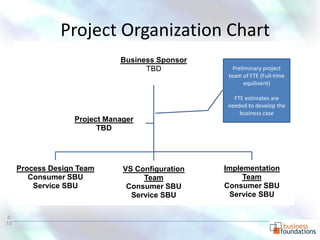
Project Organization Chart
                              Business Sponsor
                                    TBD              Preliminary project
                                                   team of FTE (Full-time
                                                          equilivent)

                                                     FTE estimates are
                                                   needed to develop the
                                                       business case
                   Project Manager
                         TBD


     Process Design Team       VS Configuration   Implementation
        Consumer SBU                Team               Team
         Service SBU            Consumer SBU      Consumer SBU
                                 Service SBU       Service SBU

p.
15
Business Case -   From Excel Business Case Template


• Benefits
   – TBD


• Costs
   – TBD


                                                          p. 16

Project Identification and Initiation Tool Kit

  • 1.
    Project Initiation Document A Primer for Portfolio Management
  • 2.
    The PID helpsIdentify problems and document financial impacts • The first section defines the business problem and its impact, project objective, and scope of the solution – BPI tools are leveraged through-out the template to ensure teams focus on eliminating non-value added activities. • After the current problem is defined and its impact understood, “ideal-state business process and tools” are defined – Documenting “As-Is” processes may be completed, however this may be perceived as non-value added and is not required – Focusing on the future, “ideal-state” process provides the basis for tool requirements • With the business problem and ideal state solution defined, the basis is set for business case development – Resolving the business problem helps identify benefits – Ideal State process helps define tool needs for cost estimating p. 2
  • 3.
    Contents • Business Problem Statement and Impact • Solution Objective • Ideal State Process • COPIS • Scope • Approach • Risks and Dependencies • High-level Timeline • Business Case p. 3
  • 4.
    Problem Statement The problem statement identifies the current business pain and it’s Problem impact on operations • Development of product (services) roadmaps is inconsistently performed across different functions Impact • Lack of a roadmapping process is inhibiting revenue growth and eroding value – We are too slow to vet and commercialize our very best ideas – We are failing to make big, bold bets and instead fragment resources on sub-scale improvements – We fail to update roadmaps when plans change – We lack tight coordination across initiatives resulting in confusion and waste; half-hearted initiatives that go nowhere, duplicative work, reinventing the wheel and lack scale advantages – We lack consistent roadmap formats – roadmaps have various timelines – We’re unable to prioritize across roadmaps because lack of standard format creates communications problems across the groups As much as possible the impact should include quantifiable data and facts related to the problem as defined p. 4
  • 5.
    Root Cause Diagram Use BPI Tools to confirm root causes are understood p. 5
  • 6.
    Project Objective Statement •Design and implement a corporate-wide standard business process for managing and presenting roadmaps across Regions, and business areas (services, products, etc.) to deliver 30-35% faster output – In parallel with business process design, select IT Tools needed to automate the common business process for roadmap development Define the outcomes desired from the project effort – criteria for evaluating success p. 6
  • 7.
    Ideal State Process • The product roadmap is the front-end of the Phase Management Planning process and is the essential element in translating the business strategy into major programs to be pursued. The output is reviewed in a meeting that is conducted every 3-4 months. Marketing “owns” the Planning process and leads the meeting. • In each meeting the overall product portfolio is reviewed as well as the man-power and development capacity needed to meet the target dates. Ideal-state Process descries how the process/tool would be used to solve the problem and impact from page 1 Use a scenario to describe the business process and tool interaction p. 7
  • 8.
    Use Copis toidentify customer and supplier processes Customer-Output-Process-Input-Supplier Or Supplier-Input-Process-Output-Customer
  • 9.
    Sample Cascading COPIS Supplier (s) Inputs Process Outputs Customer (s) Voice of Customer Phase Management Resource Balanced Outbound Marketing Customer Requirements Process Portfolio and Sales Updated Portfolio Inbound Marketing Product Roadmap Inbound Marketing Roadmap Approved and funded Phase Management R&D Engineering Strategic Technologies development projects Plan Supplier (s) Inputs Process Outputs Customer (s) Service and Product Portfolio of Product/Service Resource Balanced Phase Management strategy Proposed Projects Roadmaps Portfolio – LOB specific Plan Competitor Actions VOC and Customer Integrated Roadmap – Capacity Planning and and Offerings Experience data cross LOB portfolio selection Cost/ Revenue C/V/P models projections for each projecting cost and Customer Input project revenues from new products p. 9
  • 10.
    Scope • Geographic Scope – Which regions and/or design centers are included • Functional Scope – Which business functions and processes are included • Technical Scope – Which IT Systems are included p. 10
  • 11.
    Scope Is/Is Not Is Is Not • Detailed list of specific • Detailed list of specific items to be addressed items NOT to be addressed p. 11
  • 12.
    Solution Approach • Define business process and requirements • Evaluate current processes and tools • Review and confirm VS fit with requirements • Finalize Cost/Benefit/ROI model • Pilot Solution in one area • Refine implementation plan to align with IT Implementation of VS and roll-out p. 12
  • 13.
    Risk and Dependencies Risks Dependencies (Process and Tool) (Process and Tool) • Identify risks that would limit the • Identify up-stream or down- success of the ideal state stream dependencies in either business processes or tools • Identify risks that would impact the expected benefit • Identify external dependencies (software providers, suppliers, etc) p. 13
  • 14.
    Project Timeline –TBD (Depends on scope and resources) Q1 Q2 Q3 Q4 Final tool selection Project Planning Product Configuration Testing and Training Pilot Deployment Company-wide rollout Preliminary, high-level timeline to move from current process to ideal process. An estimate of time is required to develop a business case p. 14
  • 15.
    Project Organization Chart Business Sponsor TBD Preliminary project team of FTE (Full-time equilivent) FTE estimates are needed to develop the business case Project Manager TBD Process Design Team VS Configuration Implementation Consumer SBU Team Team Service SBU Consumer SBU Consumer SBU Service SBU Service SBU p. 15
  • 16.
    Business Case - From Excel Business Case Template • Benefits – TBD • Costs – TBD p. 16