

PM
                RO
        ISESPROMI
   SES -MAKING PROMISES
W E C A N K E E P – D A V I D BO T T O M L E Y – S P E C S A V E R S
Promises, Promises
… making promises we can keep

       David Bottomley
      Head of IT Delivery, Specsavers
but IT (sometimes)
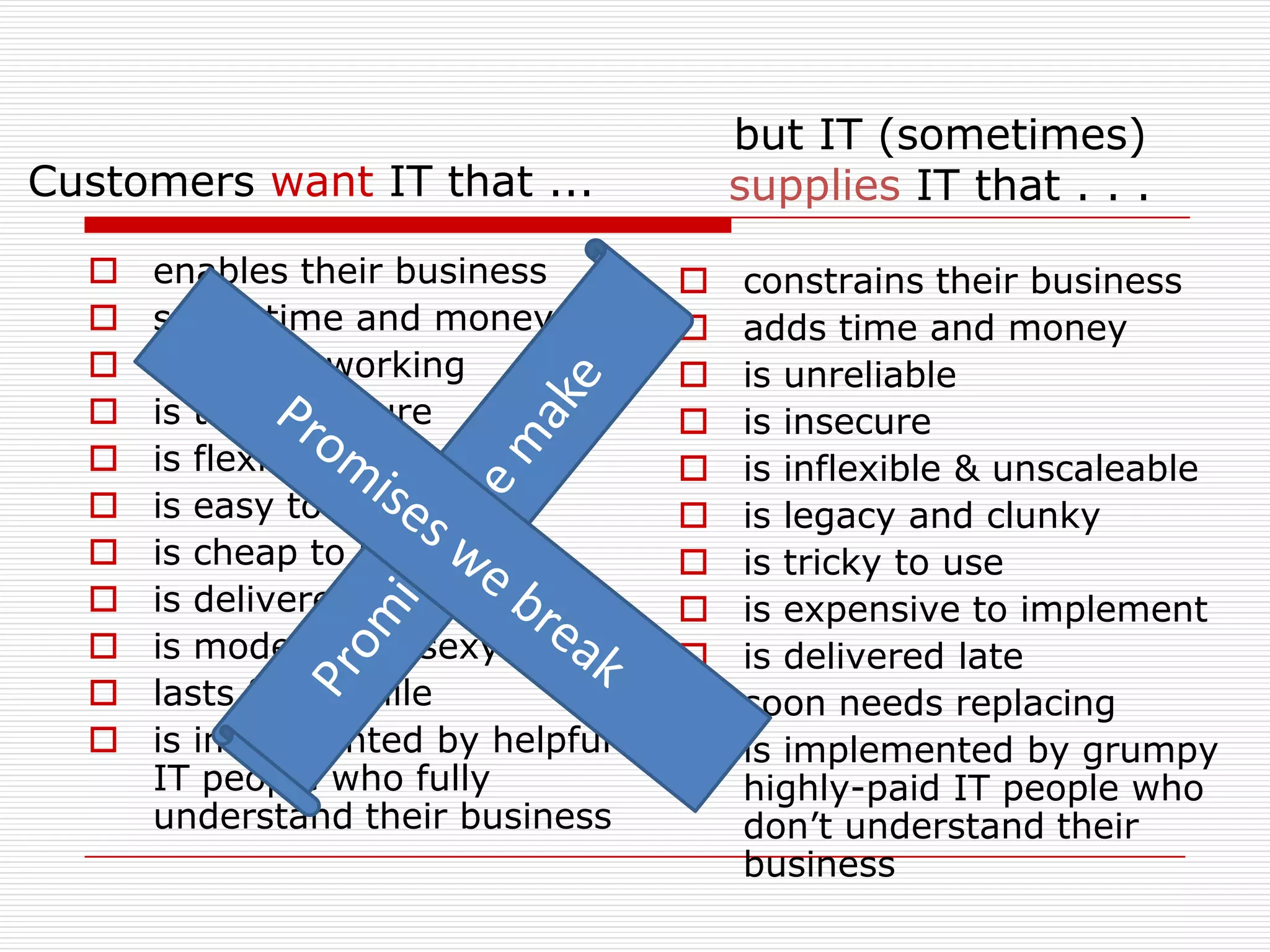
Customers want IT that ...            supplies IT that . . .
     enables their business         constrains their business
     saves time and money           adds time and money
     is always working              is unreliable
     is totally secure              is insecure
     is flexible and scaleable      is inflexible & unscaleable
     is easy to use                 is legacy and clunky
     is cheap to implement          is tricky to use
     is delivered quickly           is expensive to implement
     is modern and sexy             is delivered late
     lasts for a while              soon needs replacing
     is implemented by helpful      is implemented by grumpy
      IT people who fully             highly-paid IT people who
      understand their business       don’t understand their
                                      business
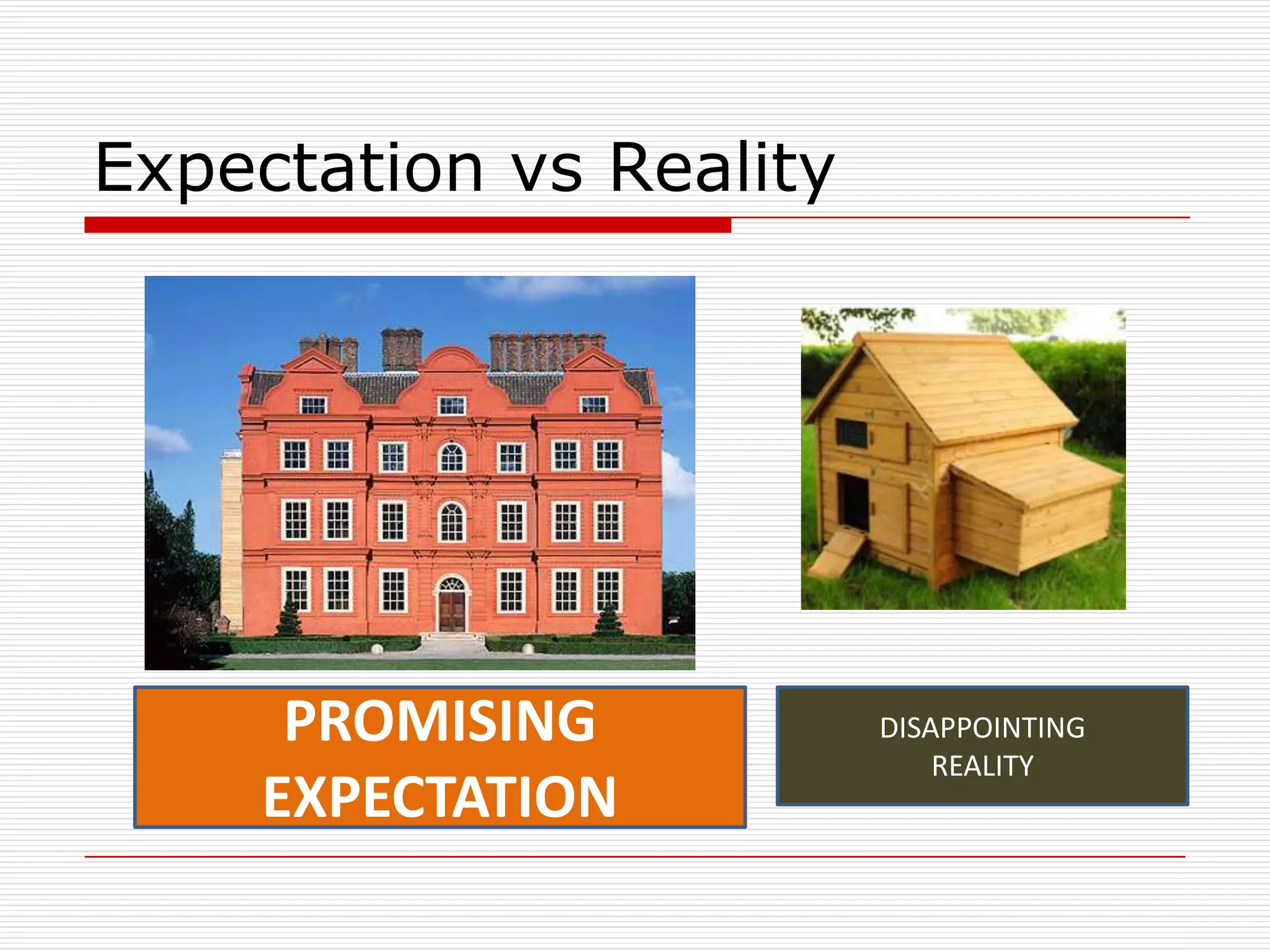
Expectation vs Reality


     PROMISING           DISAPPOINTING
                             REALITY
    EXPECTATION
IT Projects - School Report

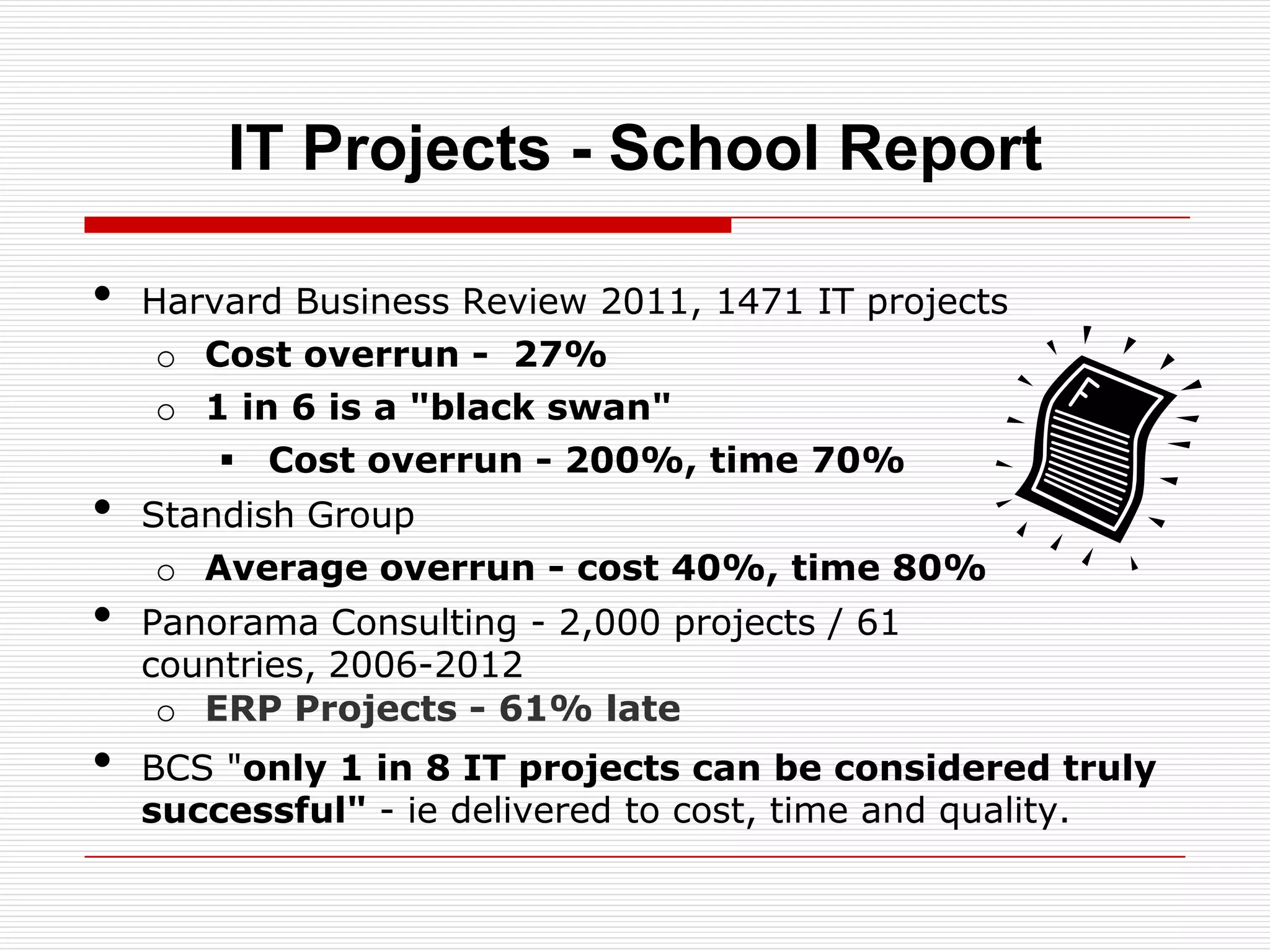
•   Harvard Business Review 2011, 1471 IT projects
     o Cost overrun - 27%
     o 1 in 6 is a "black swan"
         Cost overrun - 200%, time 70%
•   Standish Group
     o Average overrun - cost 40%, time 80%
•   Panorama Consulting - 2,000 projects / 61
    countries, 2006-2012
     o ERP Projects - 61% late
•   BCS "only 1 in 8 IT projects can be considered truly
    successful" - ie delivered to cost, time and quality.
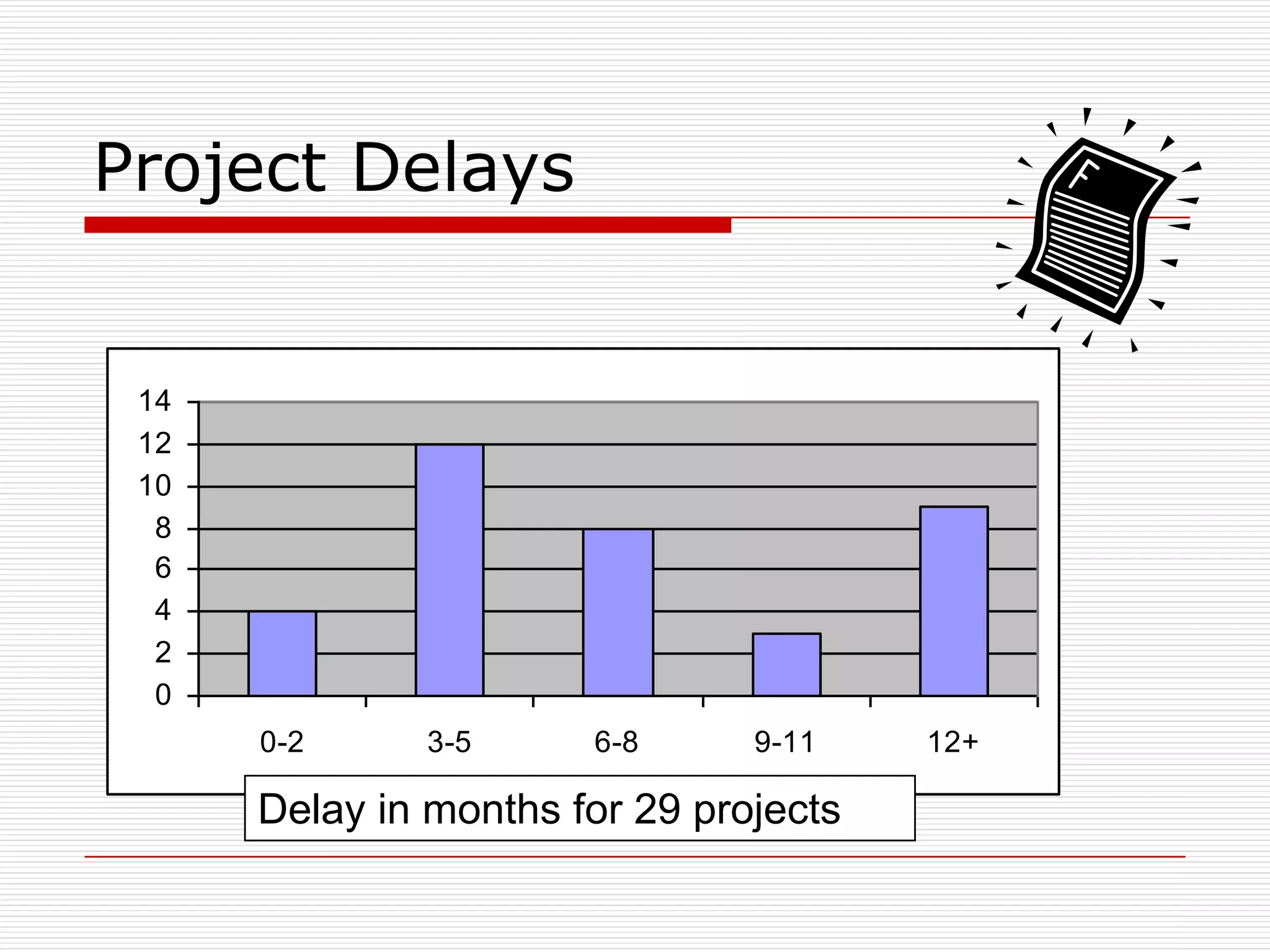
Project Delays


 14
 12
 10
  8
  6
  4
  2
  0
      0-2      3-5     6-8      9-11    12+

      Delay in months for 29 projects
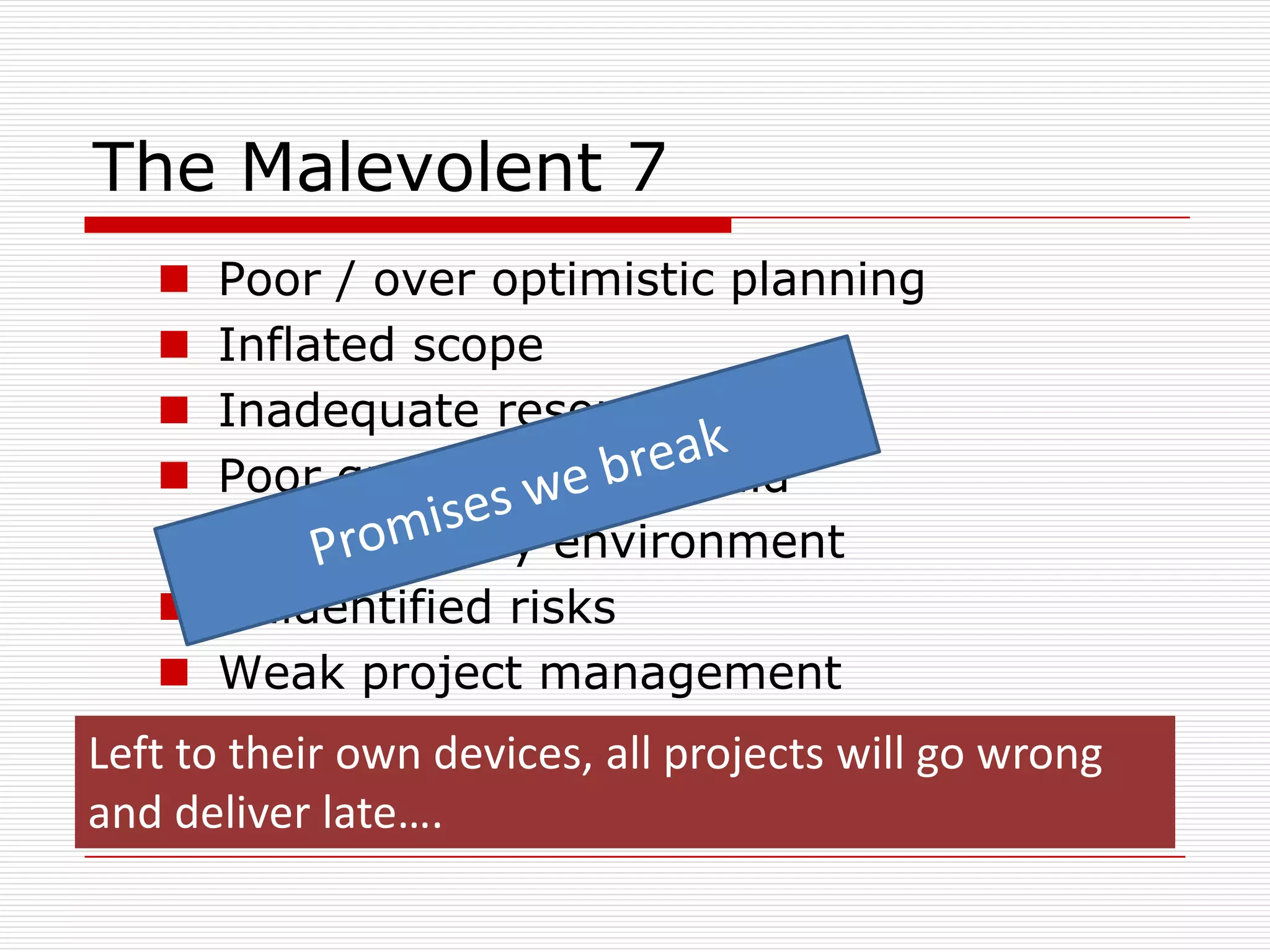
The Malevolent 7
      Poor / over optimistic planning
      Inflated scope
      Inadequate resources
      Poor quality design/build
      Hostile legacy environment
      Unidentified risks
      Weak project management
Left to their own devices, all projects will go wrong
and deliver late….
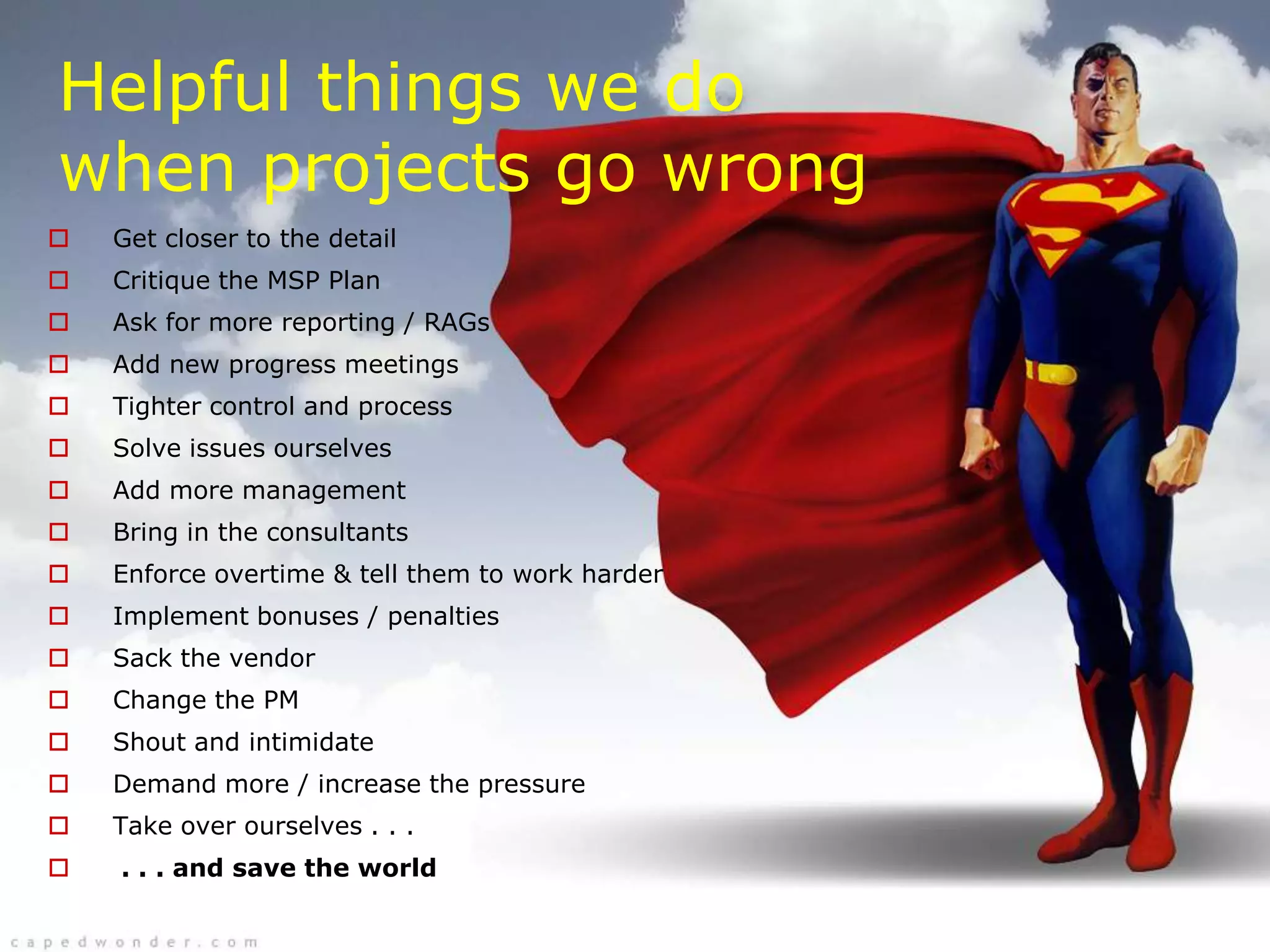
Helpful things we do
when projects go wrong
   Get closer to the detail
   Critique the MSP Plan
   Ask for more reporting / RAGs
   Add new progress meetings
   Tighter control and process
   Solve issues ourselves
   Add more management
   Bring in the consultants
   Enforce overtime & tell them to work harder
   Implement bonuses / penalties
   Sack the vendor
   Change the PM
   Shout and intimidate
   Demand more / increase the pressure
   Take over ourselves . . .
   . . . and save the world
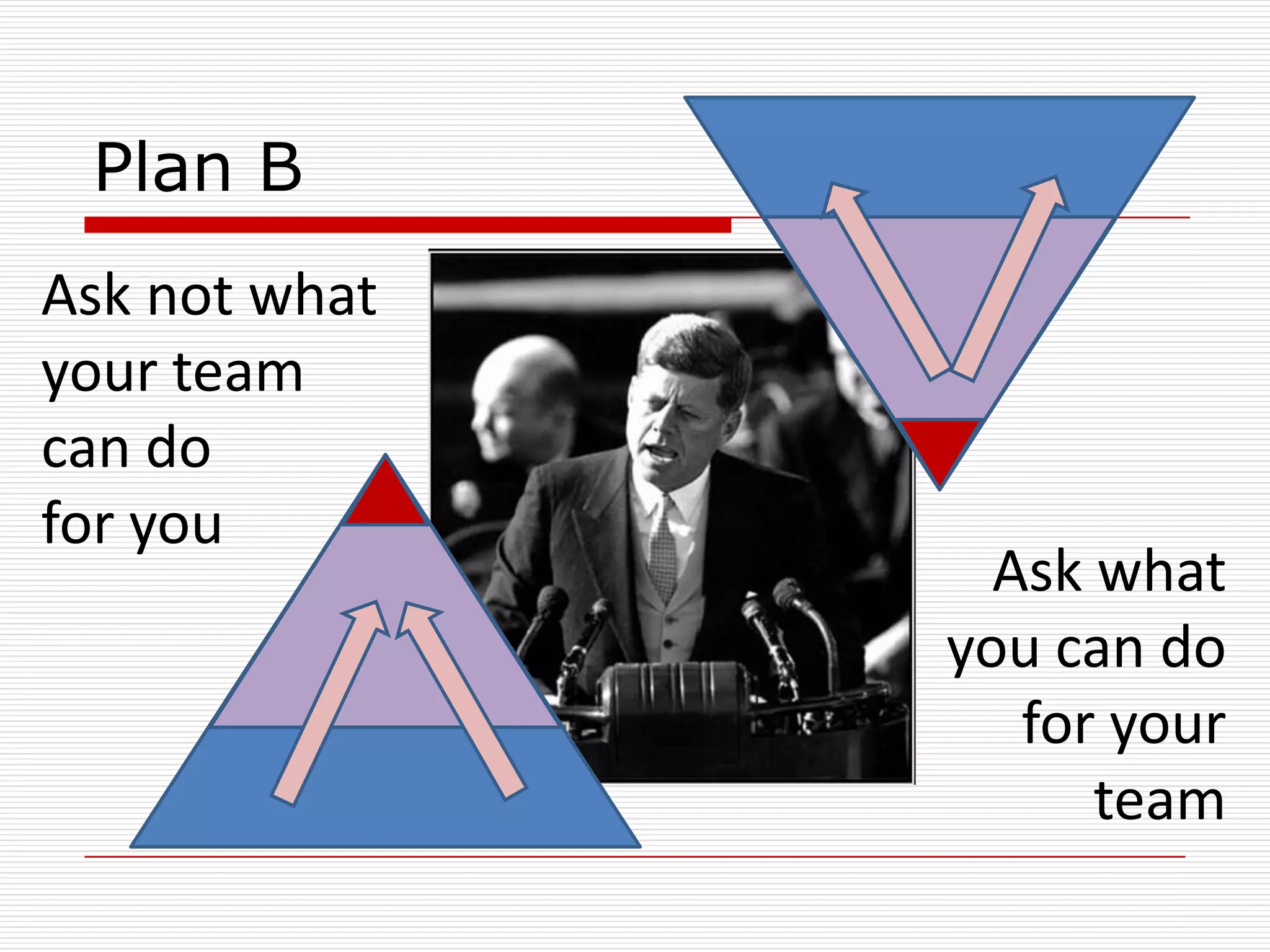
Plan B
Ask not what
your team
can do
for you
                 Ask what
               you can do
                  for your
                     team
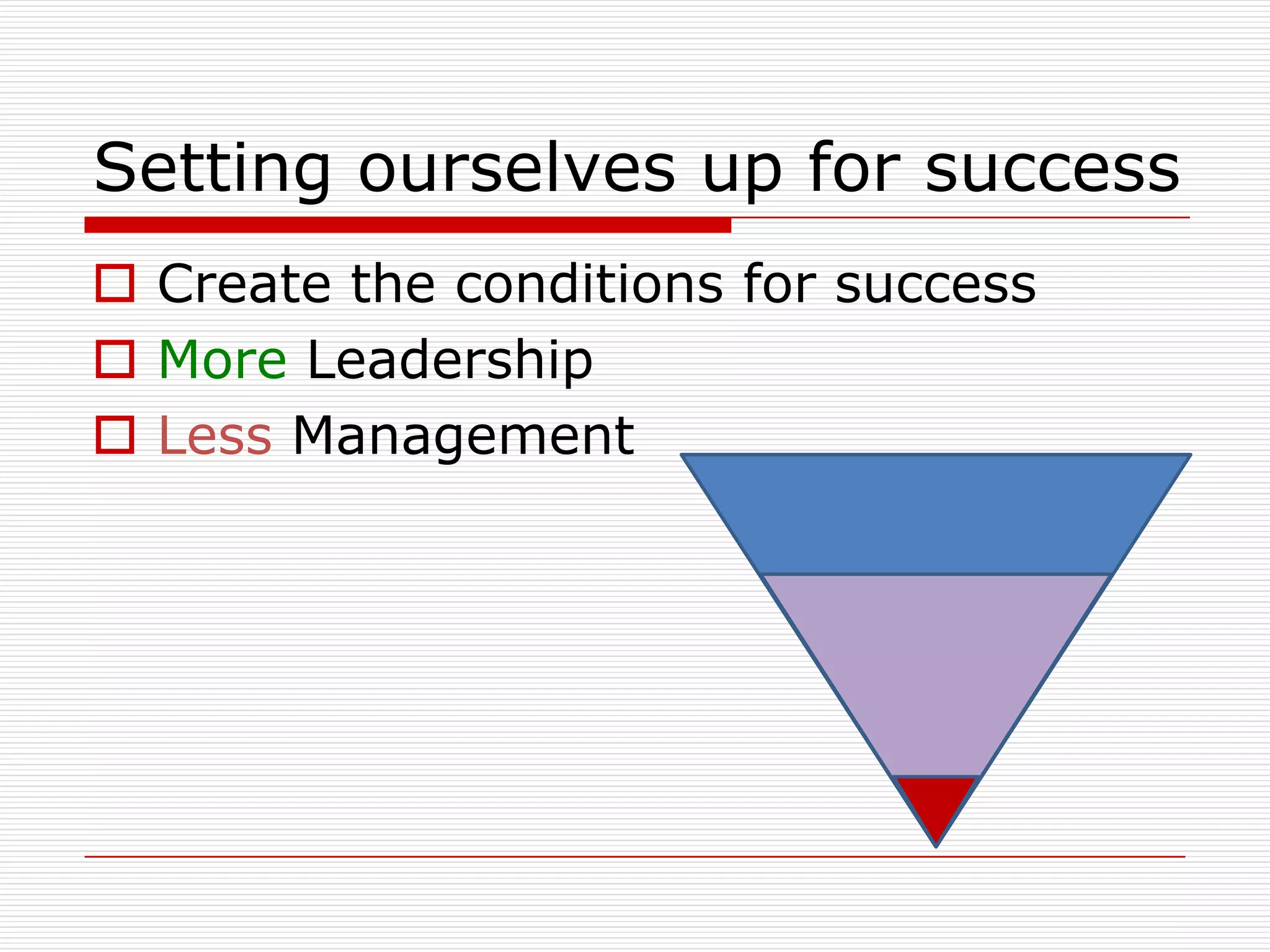
Setting ourselves up for success
 Create the conditions for success
 More Leadership
 Less Management
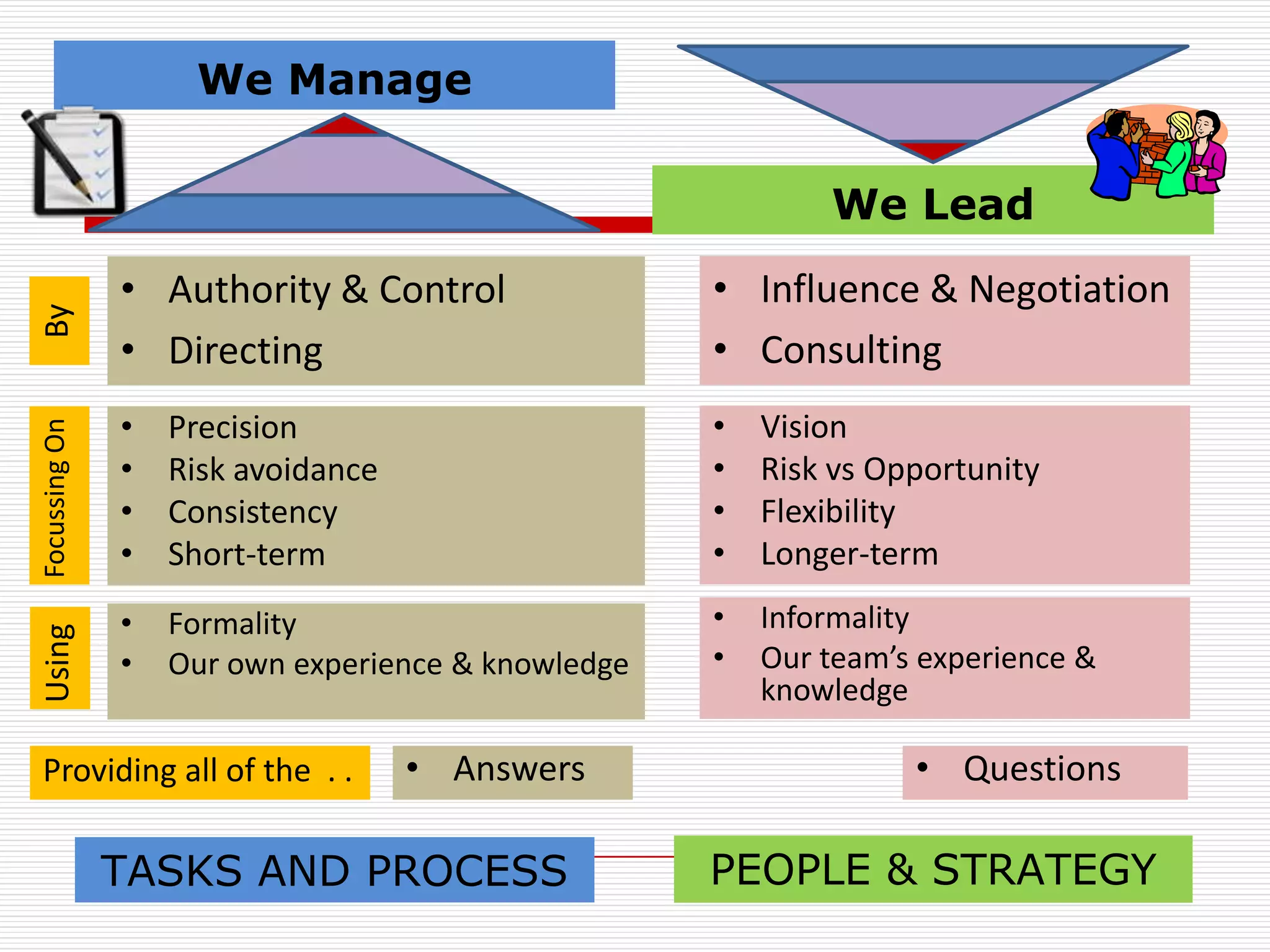
We Manage

                                                            We Lead
               • Authority & Control                • Influence & Negotiation
By


               • Directing                          • Consulting
               •   Precision                        •   Vision
Focussing On


               •   Risk avoidance                   •   Risk vs Opportunity
               •   Consistency                      •   Flexibility
               •   Short-term                       •   Longer-term
               •   Formality                        •   Informality
Using


               •   Our own experience & knowledge   •   Our team’s experience &
                                                        knowledge

Providing all of the . .            • Answers                     • Questions

               TASKS AND PROCESS                    PEOPLE & STRATEGY
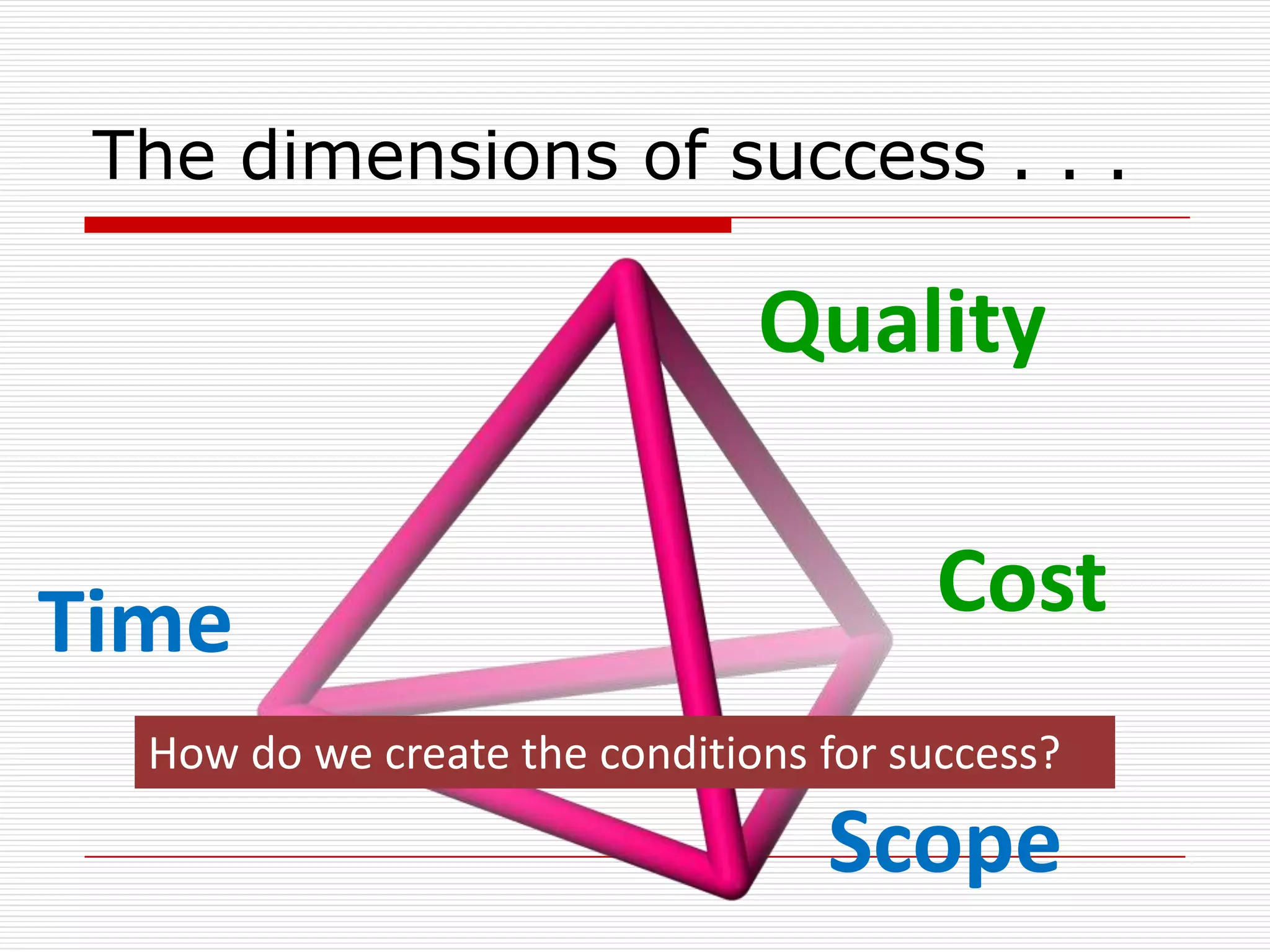
The dimensions of success . . .

                               Quality


Time                                    Cost
  How do we create the conditions for success?

                                  Scope
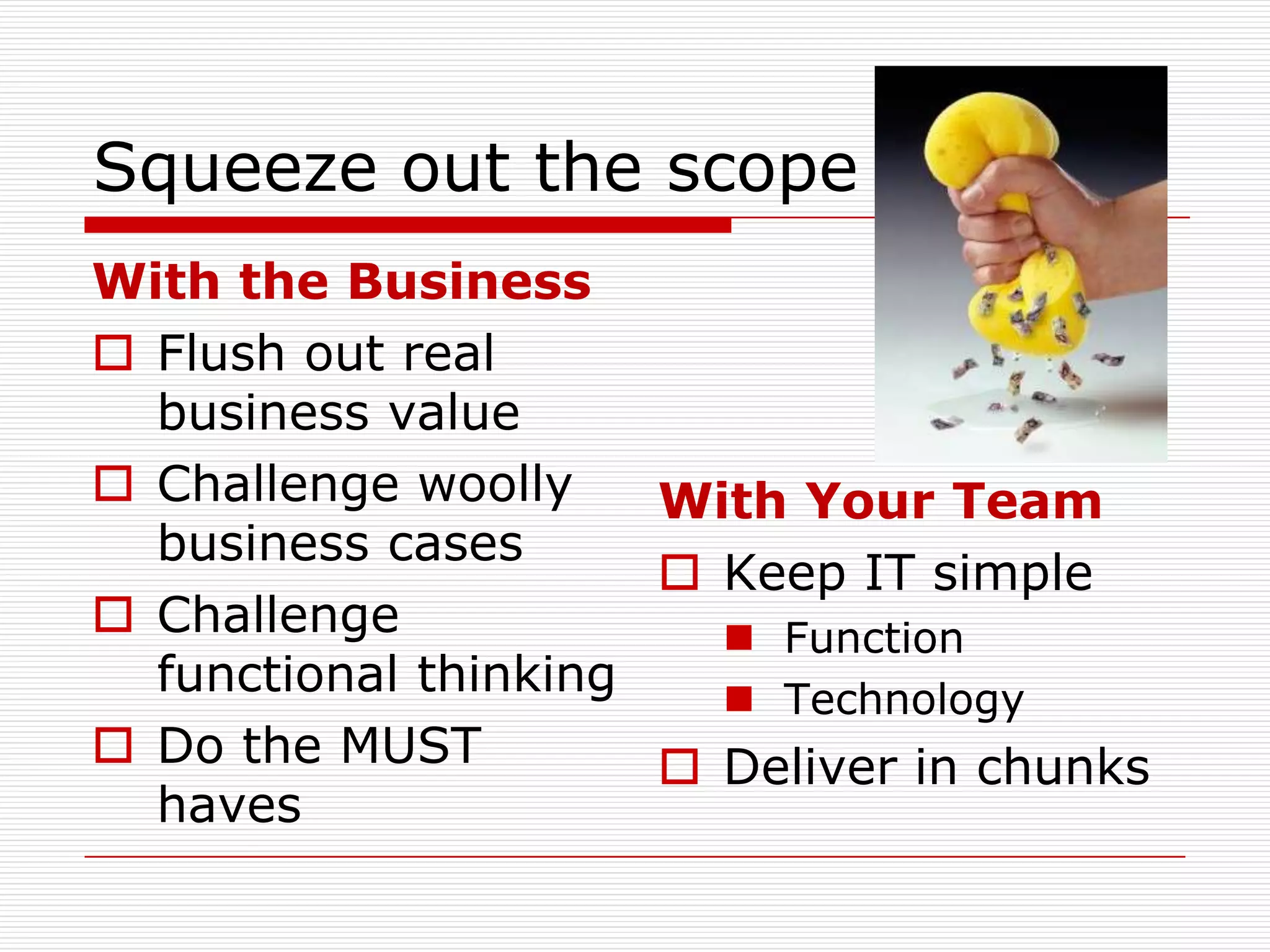
Squeeze out the scope
With the Business
 Flush out real
  business value
 Challenge woolly    With Your Team
  business cases
                       Keep IT simple
 Challenge              Function
  functional thinking    Technology
 Do the MUST          Deliver in chunks
  haves
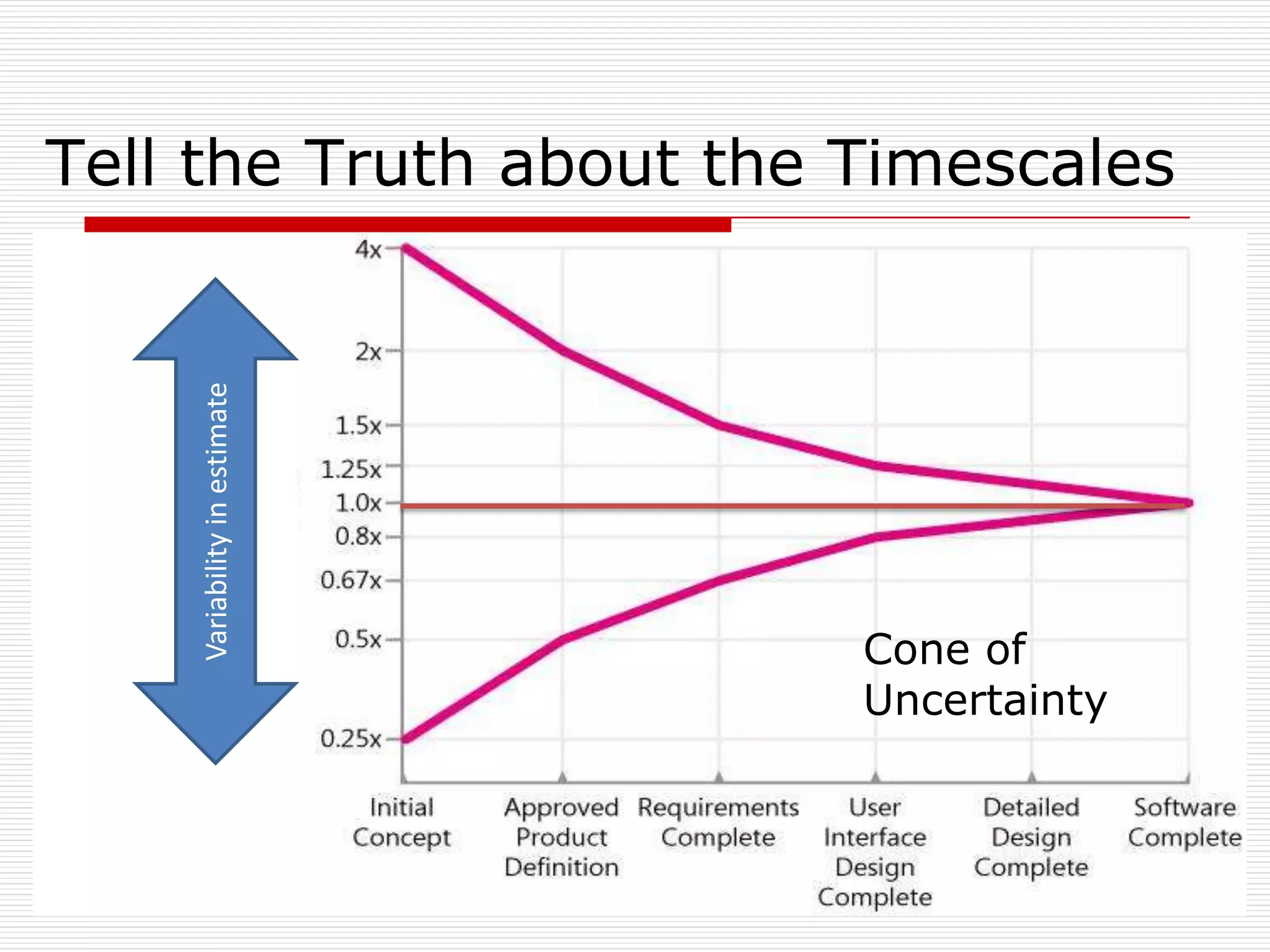
Tell the Truth about the Timescales
 Confidence

                 Variability in estimate


                                                              FS /
                                                      BRD /   LLD
                                                      HLD             Cone of
                                           Initiati
                                           on                         Uncertainty
                                                                     Time
              Conception
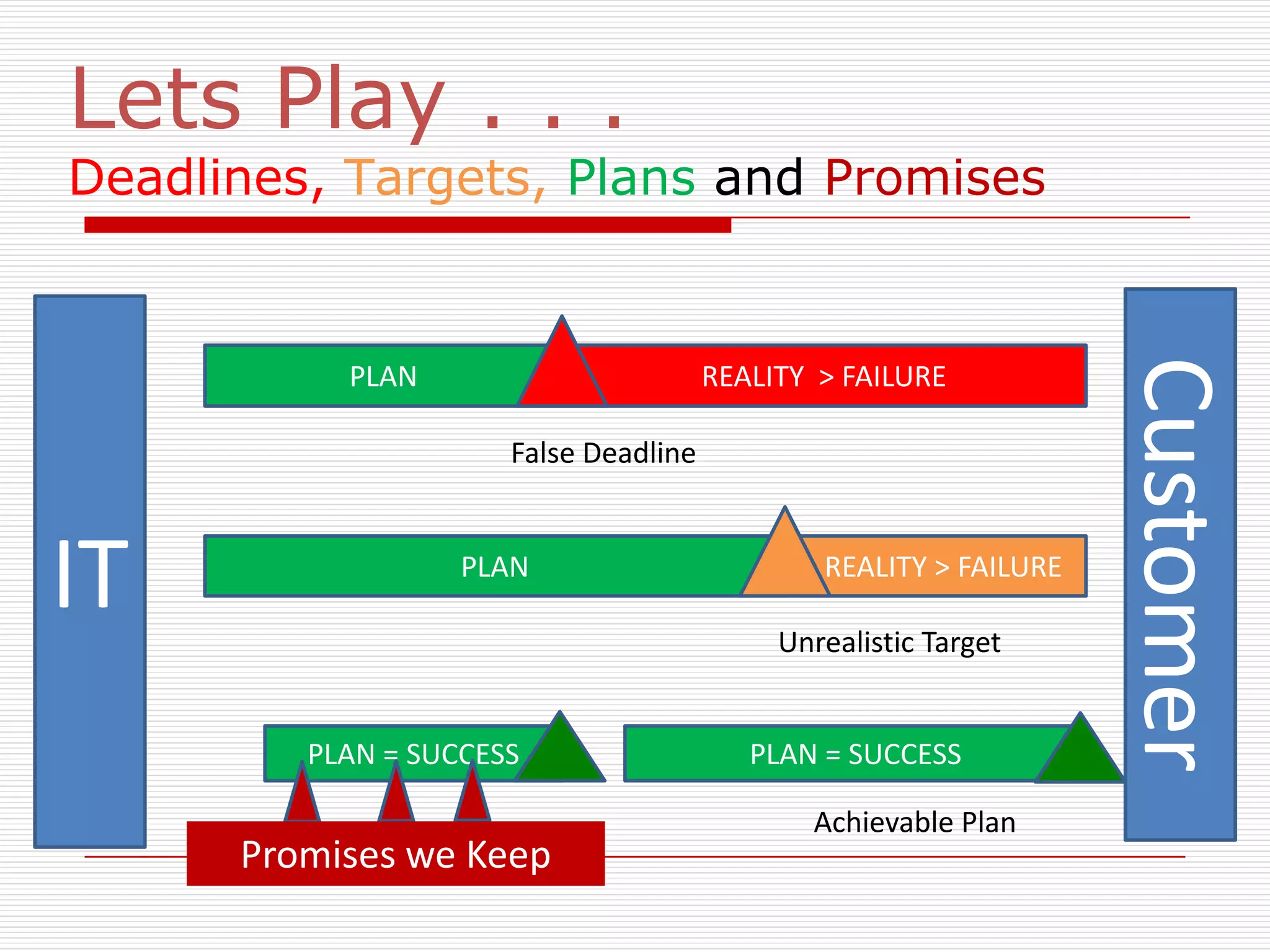
Lets Play . . .
Deadlines, Targets, Plans and Promises


                                                                   Customer
           PLAN                        REALITY > FAILURE

                      False Deadline


IT                 PLAN                        REALITY > FAILURE

                                            Unrealistic Target


         PLAN = SUCCESS                   PLAN = SUCCESS

                                              Achievable Plan
      Promises we Keep
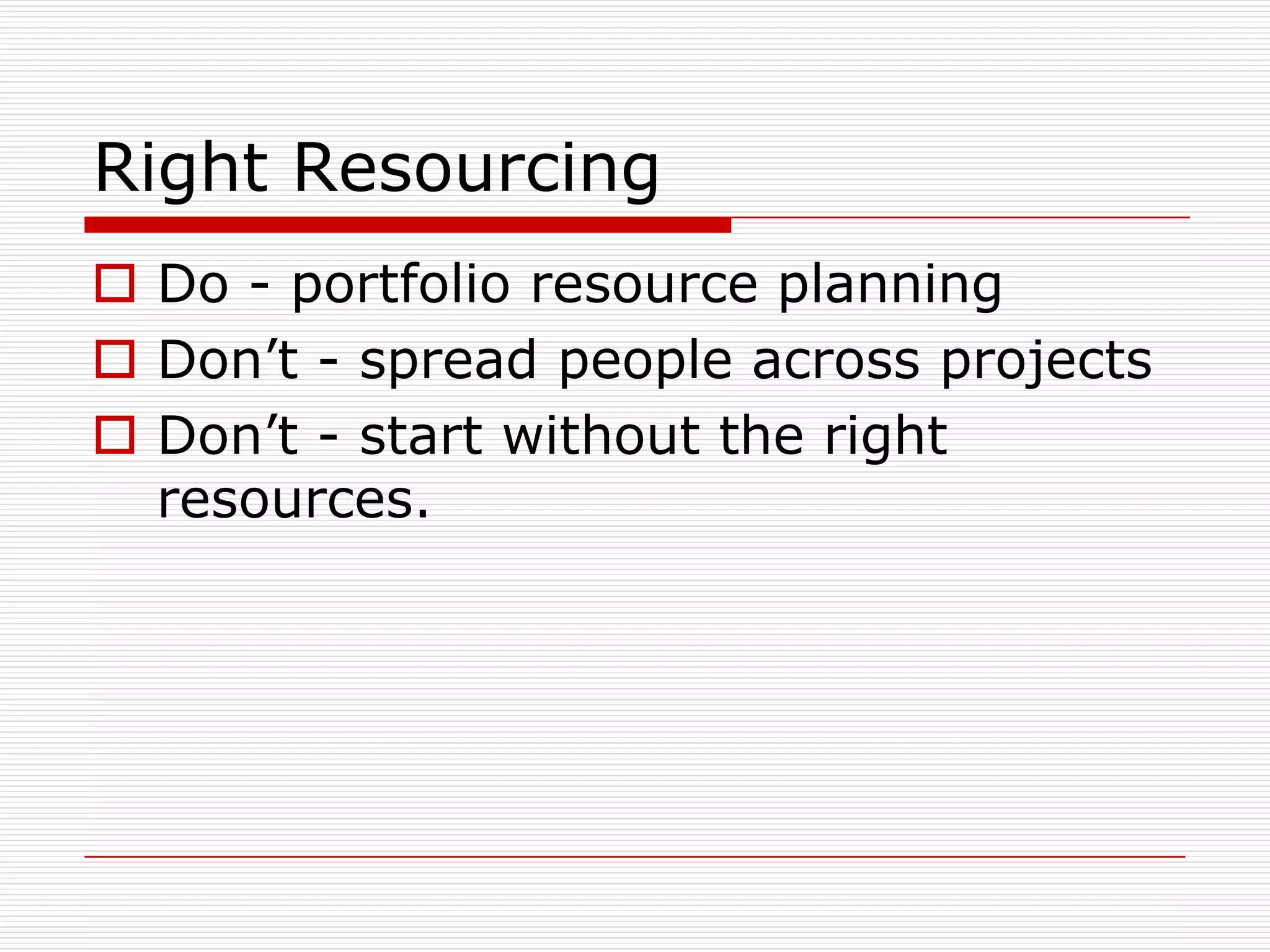
Right Resourcing
 Do - portfolio resource planning
 Don’t - spread people across projects
 Don’t - start without the right
  resources.
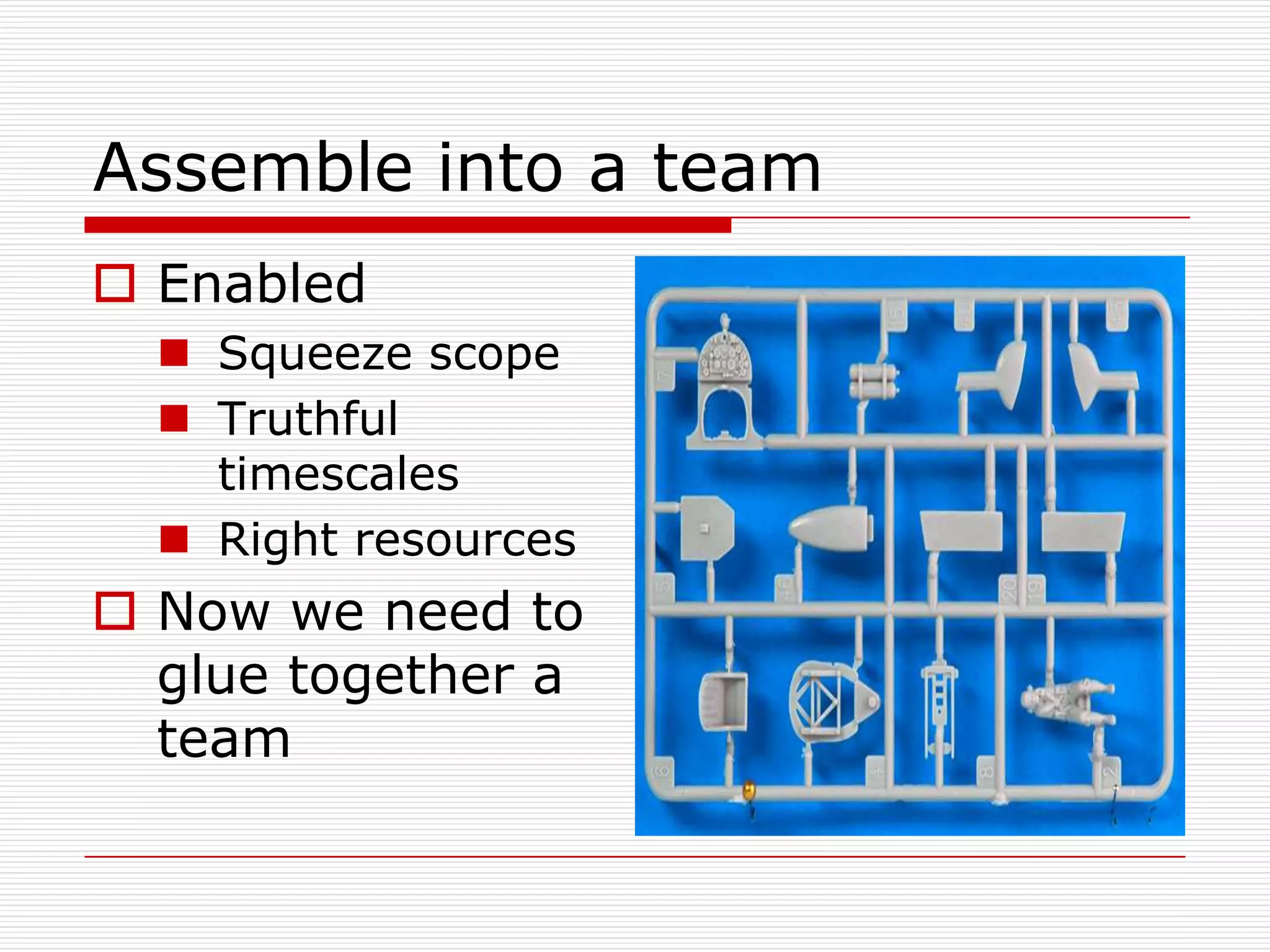
Assemble into a team
 Enabled
   Squeeze scope
   Truthful
    timescales
   Right resources
 Now we need to
  glue together a
  team
High Performing Teams
                Engagement / People
                LOW                      HIGH


                                                          Enablement / Task
         DETACHED                 MOST EFFECTIVE
                                 HIGH PERFORMING
 HIGH


                5%                       49%
                                      (n 50%
                                         = 744)
                                  Specsavers 2010 = 46%
                                  Hay Group norm = 46%


        LEAST EFFECTIVE
         WALKING DEAD             FRUSTRATED
 LOW


               21%
               20%                        25%
             (n = 313)
         Specsavers 2010 = 23%
         Hay Group norm = 27%
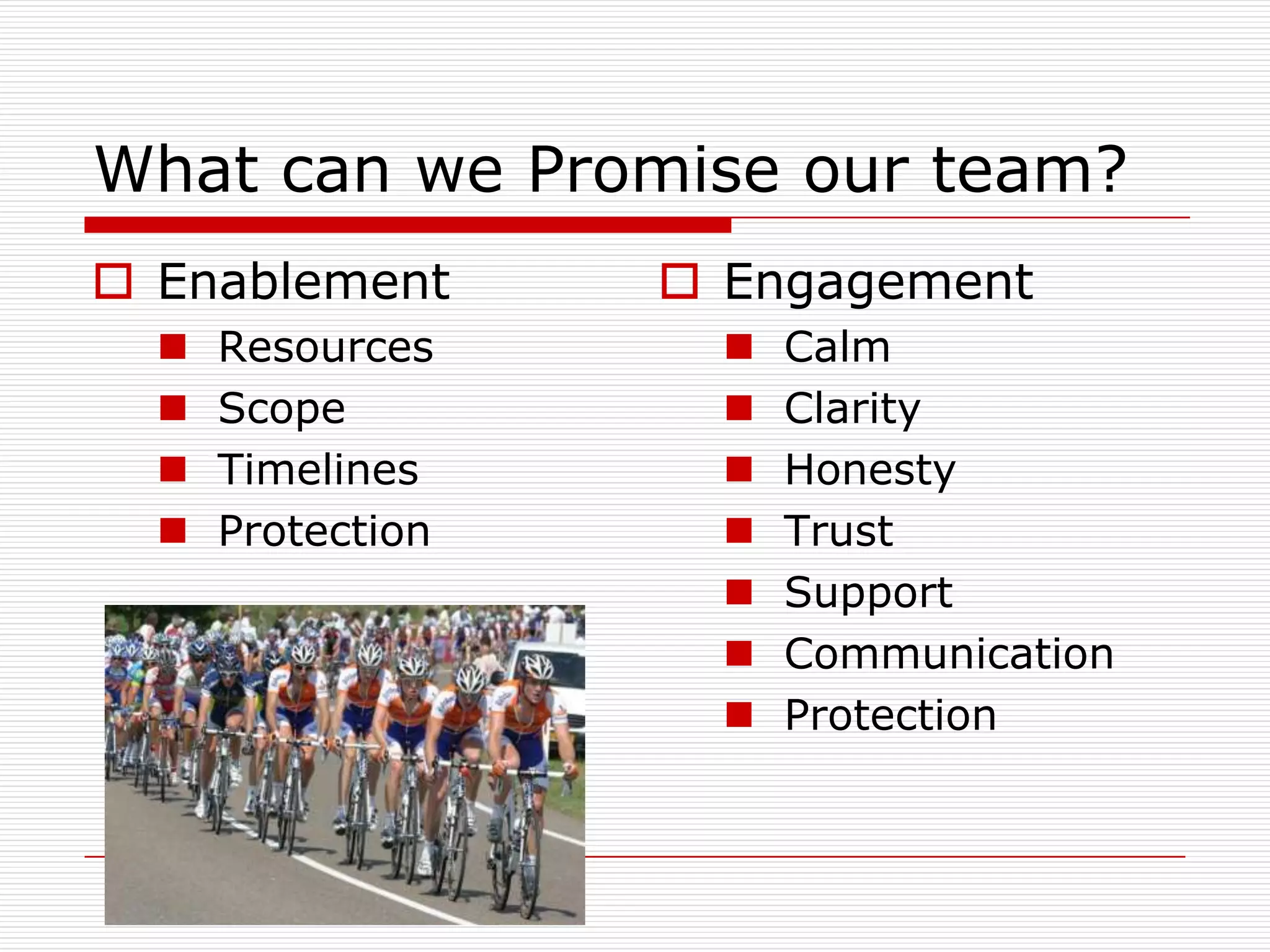
What can we Promise our team?
 Enablement        Engagement
     Resources         Calm
     Scope             Clarity
     Timelines         Honesty
     Protection        Trust
                        Support
                        Communication
                        Protection
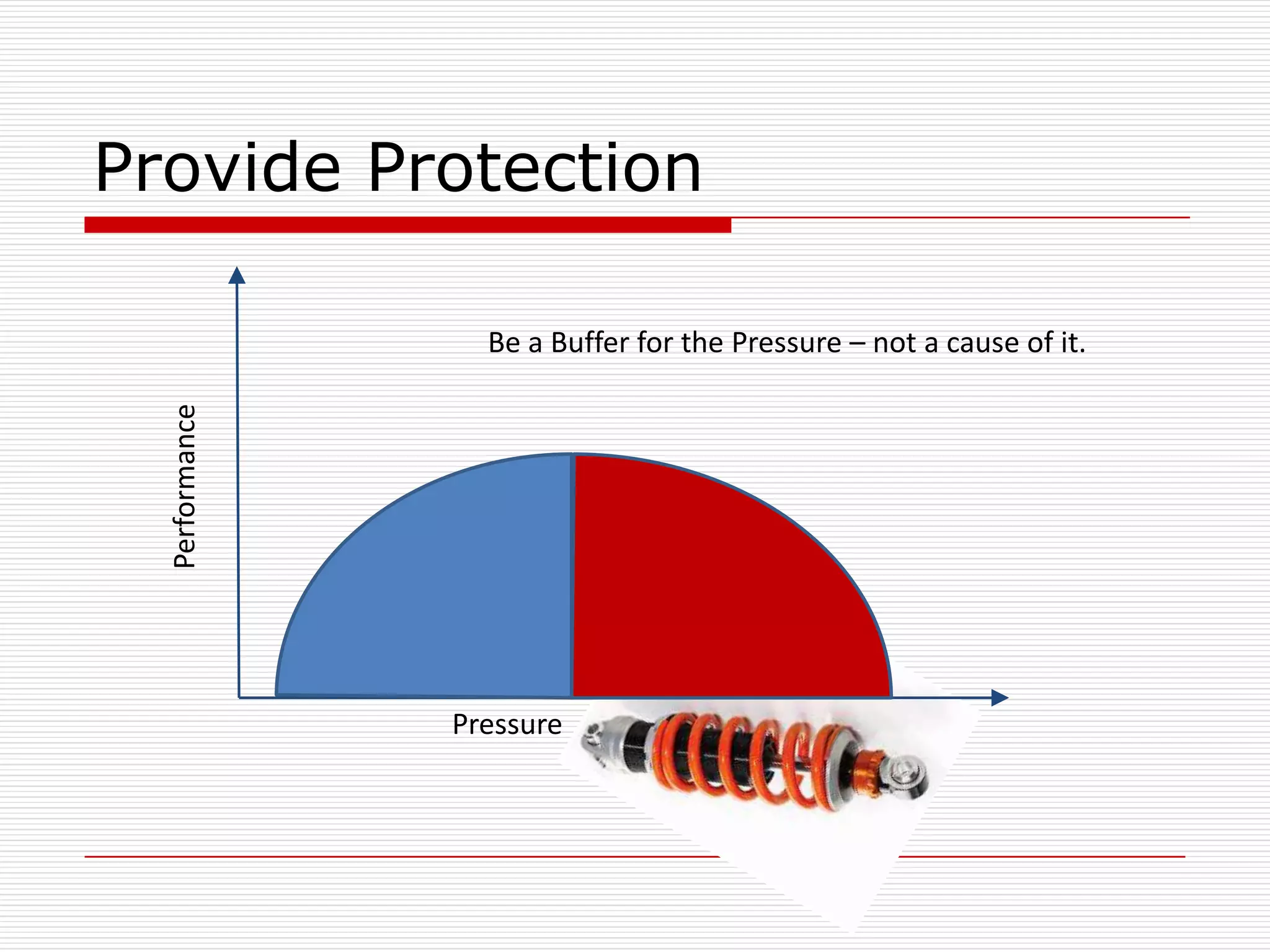
Provide Protection

                  Be a Buffer for the Pressure – not a cause of it.
  Performance


                Pressure
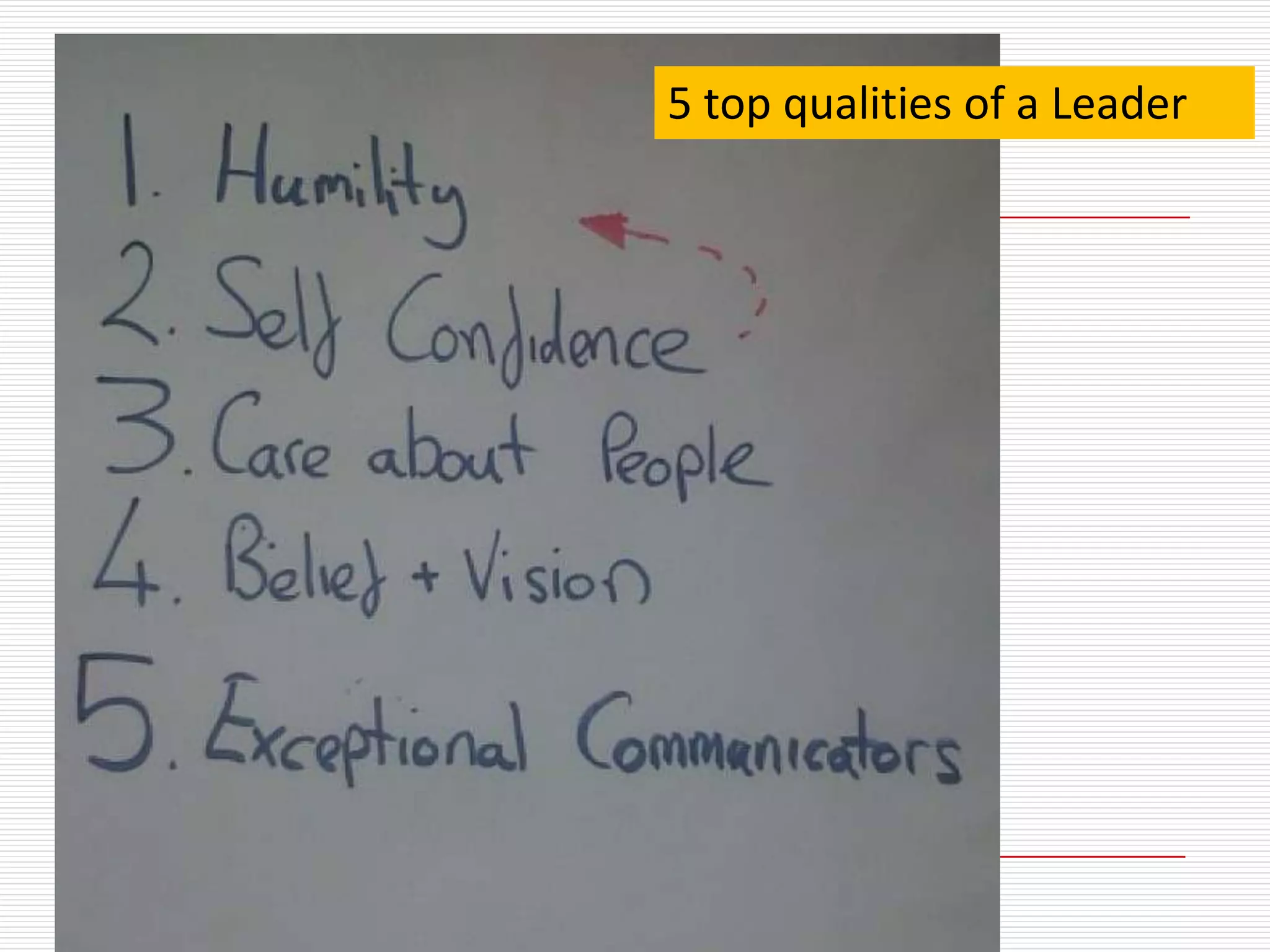
5 top qualities of a Leader
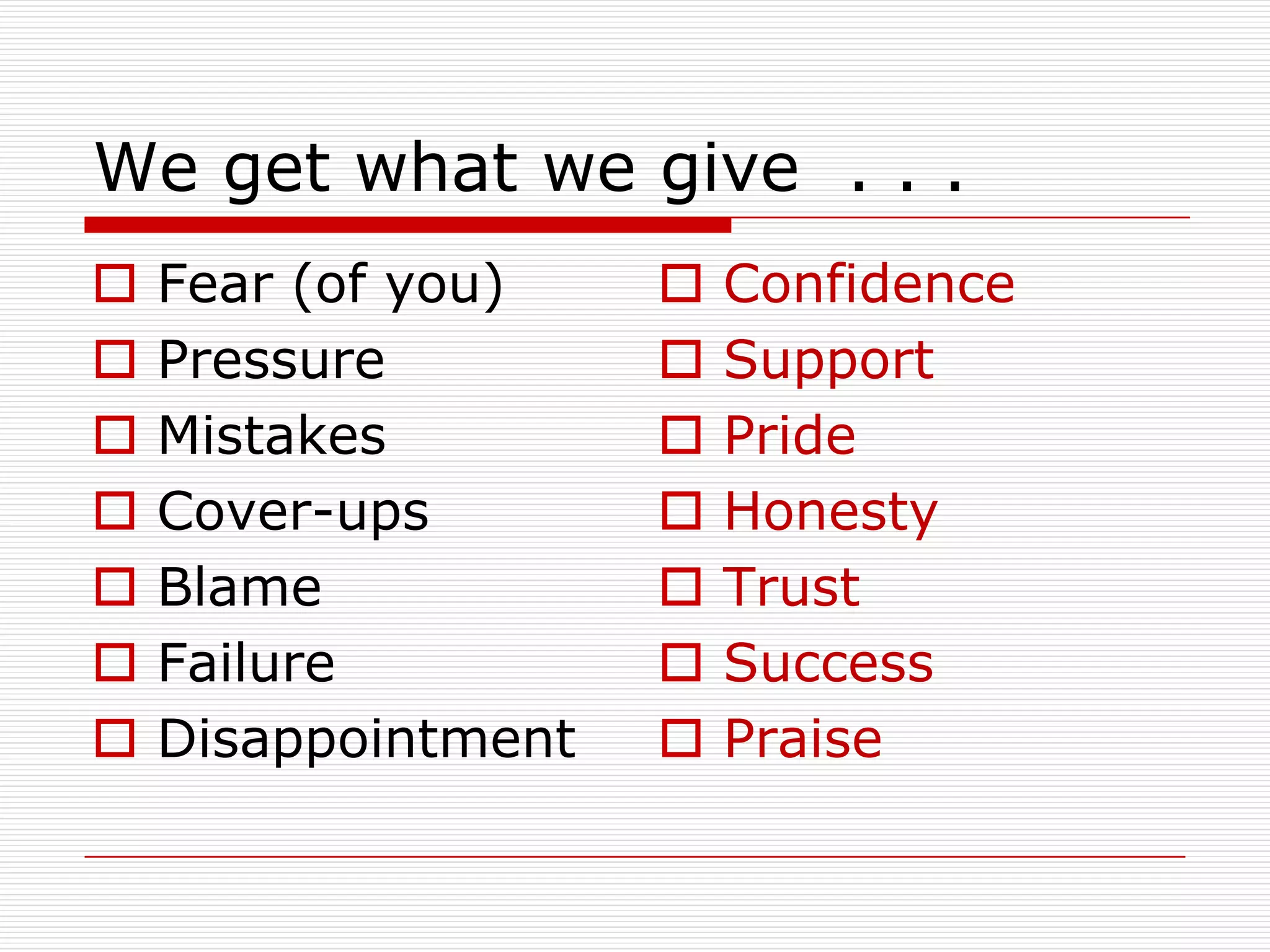
We get what we give . . .
   Fear (of you)       Confidence
   Pressure            Support
   Mistakes            Pride
   Cover-ups           Honesty
   Blame               Trust
   Failure             Success
   Disappointment      Praise
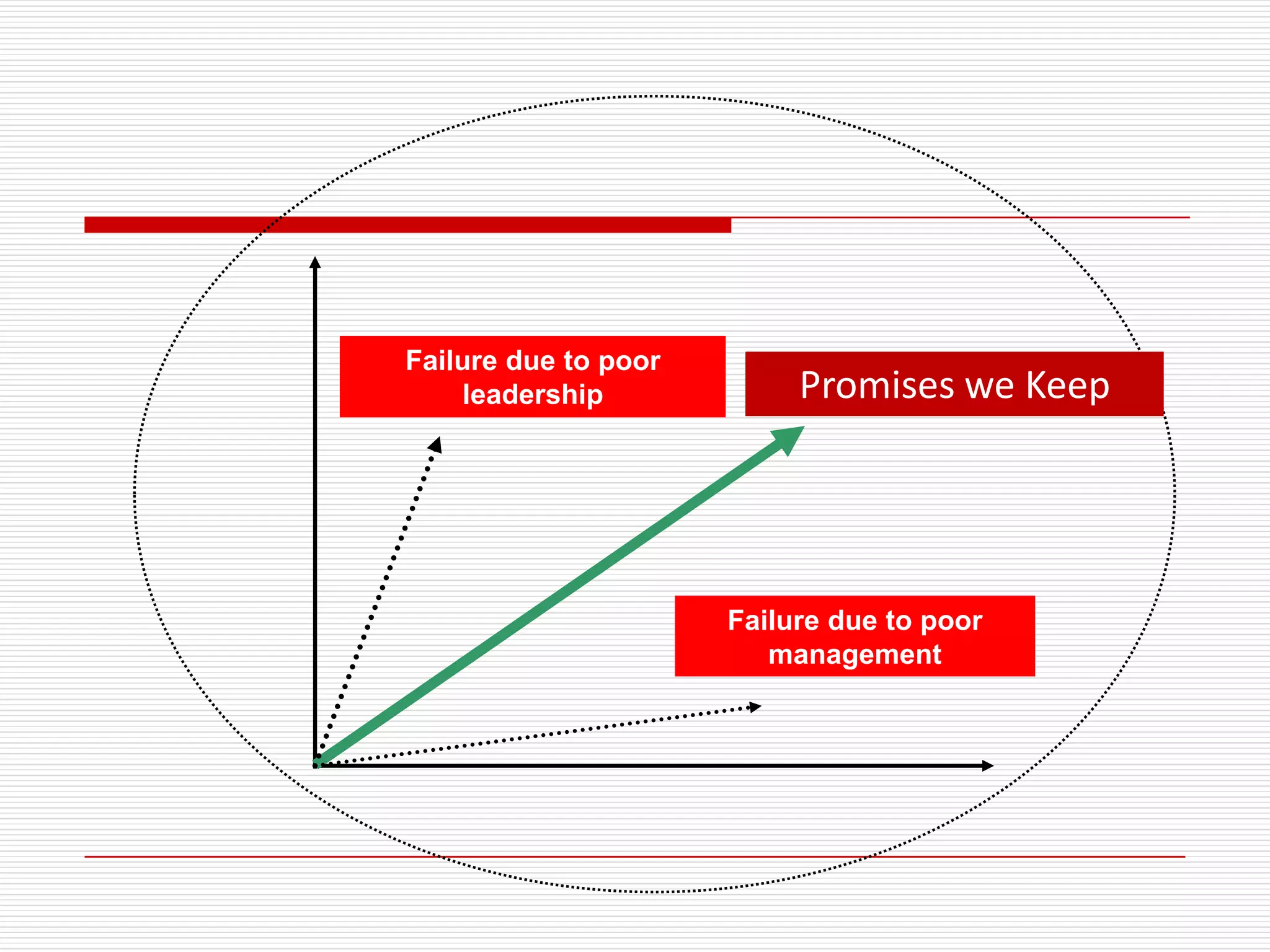
Failure due to poor
     leadership            Promises we Keep
                            Success


                      Failure due to poor
                         management

David Bottomley, Head of IT Delivery at Specsavers - Promises, promises

  • 1.
    PM RO ISESPROMI SES -MAKING PROMISES W E C A N K E E P – D A V I D BO T T O M L E Y – S P E C S A V E R S
  • 3.
    Promises, Promises … makingpromises we can keep David Bottomley Head of IT Delivery, Specsavers
  • 4.
    but IT (sometimes) Customerswant IT that ... supplies IT that . . .  enables their business  constrains their business  saves time and money  adds time and money  is always working  is unreliable  is totally secure  is insecure  is flexible and scaleable  is inflexible & unscaleable  is easy to use  is legacy and clunky  is cheap to implement  is tricky to use  is delivered quickly  is expensive to implement  is modern and sexy  is delivered late  lasts for a while  soon needs replacing  is implemented by helpful  is implemented by grumpy IT people who fully highly-paid IT people who understand their business don’t understand their business
  • 5.
    Expectation vs Reality PROMISING DISAPPOINTING REALITY EXPECTATION
  • 6.
    IT Projects -School Report • Harvard Business Review 2011, 1471 IT projects o Cost overrun - 27% o 1 in 6 is a "black swan"  Cost overrun - 200%, time 70% • Standish Group o Average overrun - cost 40%, time 80% • Panorama Consulting - 2,000 projects / 61 countries, 2006-2012 o ERP Projects - 61% late • BCS "only 1 in 8 IT projects can be considered truly successful" - ie delivered to cost, time and quality.
  • 7.
    Project Delays 14 12 10 8 6 4 2 0 0-2 3-5 6-8 9-11 12+ Delay in months for 29 projects
  • 8.
    The Malevolent 7  Poor / over optimistic planning  Inflated scope  Inadequate resources  Poor quality design/build  Hostile legacy environment  Unidentified risks  Weak project management Left to their own devices, all projects will go wrong and deliver late….
  • 9.
    Helpful things wedo when projects go wrong  Get closer to the detail  Critique the MSP Plan  Ask for more reporting / RAGs  Add new progress meetings  Tighter control and process  Solve issues ourselves  Add more management  Bring in the consultants  Enforce overtime & tell them to work harder  Implement bonuses / penalties  Sack the vendor  Change the PM  Shout and intimidate  Demand more / increase the pressure  Take over ourselves . . .  . . . and save the world
  • 10.
    Plan B Ask notwhat your team can do for you Ask what you can do for your team
  • 11.
    Setting ourselves upfor success  Create the conditions for success  More Leadership  Less Management
  • 12.
    We Manage We Lead • Authority & Control • Influence & Negotiation By • Directing • Consulting • Precision • Vision Focussing On • Risk avoidance • Risk vs Opportunity • Consistency • Flexibility • Short-term • Longer-term • Formality • Informality Using • Our own experience & knowledge • Our team’s experience & knowledge Providing all of the . . • Answers • Questions TASKS AND PROCESS PEOPLE & STRATEGY
  • 13.
    The dimensions ofsuccess . . . Quality Time Cost How do we create the conditions for success? Scope
  • 14.
    Squeeze out thescope With the Business  Flush out real business value  Challenge woolly With Your Team business cases  Keep IT simple  Challenge  Function functional thinking  Technology  Do the MUST  Deliver in chunks haves
  • 15.
    Tell the Truthabout the Timescales Confidence Variability in estimate FS / BRD / LLD HLD Cone of Initiati on Uncertainty Time Conception
  • 16.
    Lets Play .. . Deadlines, Targets, Plans and Promises Customer PLAN REALITY > FAILURE False Deadline IT PLAN REALITY > FAILURE Unrealistic Target PLAN = SUCCESS PLAN = SUCCESS Achievable Plan Promises we Keep
  • 17.
    Right Resourcing  Do- portfolio resource planning  Don’t - spread people across projects  Don’t - start without the right resources.
  • 18.
    Assemble into ateam  Enabled  Squeeze scope  Truthful timescales  Right resources  Now we need to glue together a team
  • 19.
    High Performing Teams Engagement / People LOW HIGH Enablement / Task DETACHED MOST EFFECTIVE HIGH PERFORMING HIGH 5% 49% (n 50% = 744) Specsavers 2010 = 46% Hay Group norm = 46% LEAST EFFECTIVE WALKING DEAD FRUSTRATED LOW 21% 20% 25% (n = 313) Specsavers 2010 = 23% Hay Group norm = 27%
  • 20.
    What can wePromise our team?  Enablement  Engagement  Resources  Calm  Scope  Clarity  Timelines  Honesty  Protection  Trust  Support  Communication  Protection
  • 21.
    Provide Protection Be a Buffer for the Pressure – not a cause of it. Performance Pressure
  • 22.
    5 top qualitiesof a Leader
  • 23.
    We get whatwe give . . .  Fear (of you)  Confidence  Pressure  Support  Mistakes  Pride  Cover-ups  Honesty  Blame  Trust  Failure  Success  Disappointment  Praise
  • 24.
    Failure due topoor leadership Promises we Keep Success Failure due to poor management

Editor's Notes

  • #10 And this is what we doIs this really the answer?
  • #11 JFK – and he got a man on the moon. Explain diagrams.
  • #13 Two things we do –we employ managers to manage – we should focus on leadership.Always answer a question with a question?
  • #14 Our Favourite Tetrahedron. Quality is a given for me – and cheap (includes reliability, security, support, easy to use etc). Cost will be driven scope and timescales. So focus on SCOPE and TIME
  • #15 Critical to coming up with an achievable plan. We blame the customer, but IT can be our own worse enemy – knobs and whistles, wanting features and perfect solutions.
  • #17 Don’t confuse a target with a deadline – there rarely is a fixed deadline – flush this outDon’t confuse a target with a plan. Targets are fine so long as they stay as targets. Make this clear in the languageDon’t confuse a Plan with a promise.Only Promise what you can deliver, deliver it, say you have delivered.Oh – and ensure the start date is the REAL start dateWIN WIN
  • #18 Resources – the main reason projects fail. Some rules here. Portfolio Planning AHEAD
  • #20 Explain
  • #21 Creating the conditions for success. Calm (confidence), Clarity (clear goal and purpose – see the bigger picture) Honesty (breeds honesty), Trust (delegate and demonstrate), Support (brig in the pizzas, fix the issues, defend them), Communication (be accessible)