

Transforming resource
        management
Opening up the profession to the concept of
 p    g p      p                      p
           “DELIVERY”
                                    Andrew Gay
                             4th December, 2008
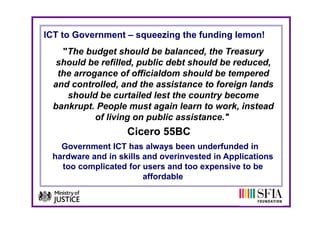
ICT to Government – squeezing the funding lemon!
    "The budget should be balanced, the Treasury
   should be refilled, public debt should be reduced,
             refilled                        reduced
   the arrogance of officialdom should be tempered
  a d co t o ed, a d t e ass sta ce
  and controlled, and the assistance to foreign lands
                                          o e g a ds
     should be curtailed lest the country become
  bankrupt. People must again learn to work, instead
            of living on public assistance."
                   Cicero 55BC
   Government ICT has always been underfunded in
 hardware and in skills and overinvested in Applications
   too complicated for users and too expensive to be
   t        li t d f            dt           i t b
                        affordable
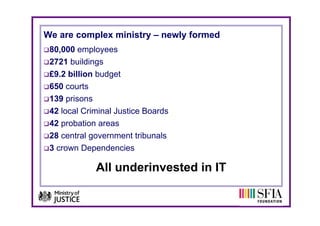
We are complex ministry – newly formed
 80,000 employees
 2721 buildings
 £9.2 billion budget
 650 courts
 139 prisons
 42 local Criminal Justice Boards
 42 probation areas
 28 central government tribunals
            g
 3 crown Dependencies

             All underinvested in IT
                   d i     t di
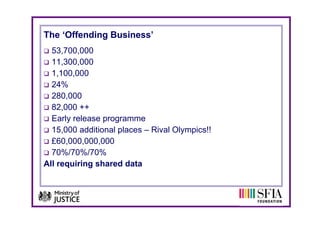
The ‘Offending Business
     Offending Business’
  53,700,000
  11,300,000
  11 300 000
  1,100,000
  24%%
  280,000
  82,000 ++
  Early release programme
  15,000 additional places – Rival Olympics!!
  £60,000,000,000
  £60 000 000 000
  70%/70%/70%
All requiring shared data
Agenda
 The increasing impatience in the industry because of a
 consistent failing to deliver to time and budget.
 The skill in identifying the underlying customer who reaps the
 operating benefit – ‘The Practitioner’.
 The overriding need for more professional and focussed
 project management skills.
 Skill and resource balancing.
 What we are trying to do in the MoJ.
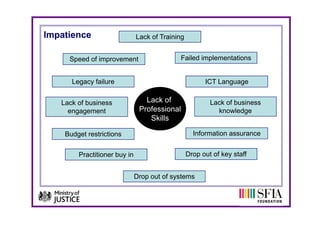
Impatience                    Lack of Training


     Speed of improvement
      p         p                           Failed implementations


      Legacy failure                                   ICT Language


   Lack of business              Lack of                 Lack of business
     engagement                Professional                knowledge
                                  Skills

    Budget restrictions                            Information assurance


        Practitioner buy in                      Drop out of key staff


                              Drop out of systems
Chicago break out session

         The ‘Project from Hell’
           e    oject o     e
   One person’s fruitless crusade against lies,
        deceit, d
        d   it deception and t
                       ti    d treachery.
                                    h

              A project managers story.
                   j t            t


It is all about the people, their skills, their focus, their
           professionalism and their leadership
      AND HOW THEY WORK TOGETHER (EQ)
Why do we have these failures?
 False economies
  o Quality is expensive and hard to get – Most key roles across my
   ICT landscape are self-employed contractors.
  o Of the FTEs >90% earn in the lower quartile of IT income.
                                       q
  o Man marking of the premiership stars by under 12s!
  o Failure to work out poor performers (1.7%).
  o Failure to recognise, train, mentor and develop key talent early..

 Unrecognised shortages and shortfalls in project
 management.
 Poor leadership from businesses.
 Failure to develop a service culture.
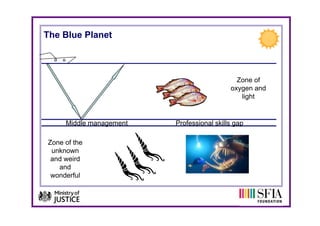
The Blue Planet


                                             Zone of
                                           oxygen and
                                              light


     Middle management   Professional skills gap

Zone of the
 unknown
 and weird
   and
 wonderful
Identifying and improving the customer interface
 ICT has the habit of not identifying the ‘intelligent’ customer.
 The skill is in isolating the user – the ‘practitioner’ – and
                                           practitioner
 identifying the detail of the tasks that make him or her perform
 to a higher level – what makes a difference to their tasks.
 The ICT professional has an obligation to ration functionality
 to the lowest common denominator and resist scope creep.
 This means reducing interfaces and understanding the nature
 of the task by performing that task – in person.
 In practice we do not develop a communication with the
 practitioner and a divide appears – another form of skill gap.
 We need to train our professionals to communicate in
                         p
 common language based on functional requirements.
Project management
 Every procurement, installation, configuration, system
 integration, software/hardware purchase, transformation or
 transition is a project.
 We need to balance resources to deliver what our
 practitioner wants to improve productivity or quality of output.
The Challenge – San Francisco 1998
 In the future business will succeed on the basis of supply
 chain management
  - Strategic Alliances
  - Partnerships/Partnering/outsourcing
  - Differentiation
    Differentiation.
 Partnering in the Service Sector will require delivery of more
 and more for less and less for ever more demanding Clients
                                                      g
 who will expect DELIVERY not EXCUSES.
 Measurable business benefits will be what drives IT – ease
 of access, security and t i i f use will b th main
  f                it  d training for      ill be the    i
 criteria for success.
 To deliver for this future Project Management will be
 the most critical skill of all in IT.
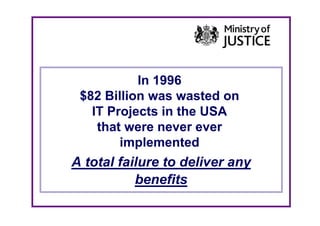
In 1996
 $82 Billion was wasted on
   IT Projects in the USA
    that were never ever
        implemented
        i l        t d
A total failure to deliver any
           benefits
PM is about
getting everyone
 in the team to
     ‘buy in’


                   They must see
                   clear objectives
                     all the time
                      ll th ti
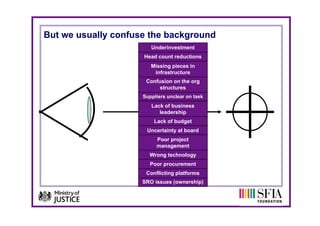
But we usually confuse the background
                        Underinvestment
                     Head count reductions
                        Missing pieces in
                         infrastructure
                      Confusion on the org
                           structures
                     Suppliers unclear on task
                        Lack of business
                           leadership
                         Lack of budget
                      Uncertainty at board
                          Poor project
                          management
                       Wrong technology
                       Poor procurement
                      Conflicting platforms
                     SRO issues (ownership)
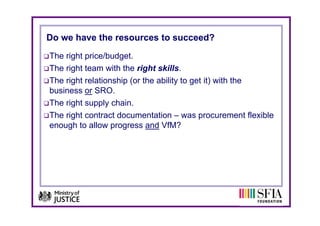
Do we have the resources to succeed?
The right price/budget.
The right team with the right skills.
The right relationship (or the ability to get it) with the
business or SRO
b i          SRO.
The right supply chain.
The i ht
Th right contract documentation – was procurement flexible
              t td           t ti                          t fl ibl
enough to allow progress and VfM?
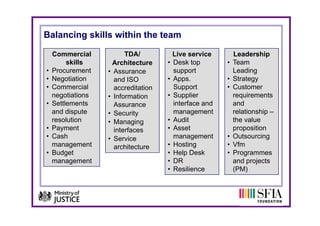
Balancing skills within the team

    Commercial           TDA/            Live service        Leadership
         skills      Architecture    •   Desk top        •   Team
•   Procurement    • Assurance           support             Leading
•   Negotiation      and ISO         •   Apps.           •   Strategy
•   Commercial       accreditation       Support         •   Customer
    negotiations   • Information     •   Supplier            requirements
•   Settlements      Assurance           interface and       and
    and dispute    • Security            management          relationship –
    resolution     • Managing        •   Audit               the value
•   Payment          interfaces      •   Asset               proposition
•   Cash           • Service             management
                                                g        •   Outsourcingg
    management       architecture    •   Hosting         •   Vfm
•   Budget                           •   Help Desk       •   Programmes
    management
          g                          •   DR                  and projects
                                                                  p j
                                     •   Resilience          (PM)
What we are doing now through the MoJ
 Capability building through skill assessment.
 Geared to improving Civil Service capability and reducing
 reliance on expensive contractors – except in key skill areas
 and mainly on fixed contracts on Programme management
 and implementation.
 Reducing contractor numbers by 50% over 12 months and
 saving over £5m per annum
                       annum.
 This is only possible by a systematic approach (SFIA 3 on
 present skills assessment but moving to SFIA 4)
This requires

 The businesses we serve must define needs and demands
 more closely – a ‘Dragons Den’ review.
 A determination not to compromise on p
                            p            poor p
                                              performers.
 A revised pay structure specific to ICT and allowing sensible
 internal promotions.
 Stronger customer interfaces and better communication.
 Much clear focus to requirements when recruiting.
 Should lead to more secondments to and from long term
 supplier partnerships – has been successful in the past.
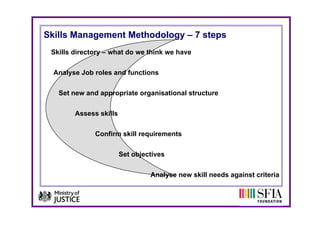
Skills Management Methodology – 7 steps
 Skills directory – what do we think we have

  Analyse Job roles and functions

   Set new and appropriate organisational structure

        Assess skills

              Confirm skill requirements

                        Set objectives

                                 Analyse new skill needs against criteria
Remember
          I think that is an immutable
               law in business that
                 words are words,
         explanations are explanations
             promises are promises
                     - but only
              performance is reality
                      Harold Geneen
            Former chief executive of IT&T 1985


   Achievement of delivery is only possible with
    the right skills and the right motivation and
          with shared goals and objectives
Thank you

Ministry of Justice Transforming Resource Management SFIA

  • 1.
    Transforming resource management Opening up the profession to the concept of p g p p p “DELIVERY” Andrew Gay 4th December, 2008
  • 2.
    ICT to Government– squeezing the funding lemon! "The budget should be balanced, the Treasury should be refilled, public debt should be reduced, refilled reduced the arrogance of officialdom should be tempered a d co t o ed, a d t e ass sta ce and controlled, and the assistance to foreign lands o e g a ds should be curtailed lest the country become bankrupt. People must again learn to work, instead of living on public assistance." Cicero 55BC Government ICT has always been underfunded in hardware and in skills and overinvested in Applications too complicated for users and too expensive to be t li t d f dt i t b affordable
  • 3.
    We are complexministry – newly formed 80,000 employees 2721 buildings £9.2 billion budget 650 courts 139 prisons 42 local Criminal Justice Boards 42 probation areas 28 central government tribunals g 3 crown Dependencies All underinvested in IT d i t di
  • 4.
    The ‘Offending Business Offending Business’ 53,700,000 11,300,000 11 300 000 1,100,000 24%% 280,000 82,000 ++ Early release programme 15,000 additional places – Rival Olympics!! £60,000,000,000 £60 000 000 000 70%/70%/70% All requiring shared data
  • 5.
    Agenda The increasingimpatience in the industry because of a consistent failing to deliver to time and budget. The skill in identifying the underlying customer who reaps the operating benefit – ‘The Practitioner’. The overriding need for more professional and focussed project management skills. Skill and resource balancing. What we are trying to do in the MoJ.
  • 6.
    Impatience Lack of Training Speed of improvement p p Failed implementations Legacy failure ICT Language Lack of business Lack of Lack of business engagement Professional knowledge Skills Budget restrictions Information assurance Practitioner buy in Drop out of key staff Drop out of systems
  • 7.
    Chicago break outsession The ‘Project from Hell’ e oject o e One person’s fruitless crusade against lies, deceit, d d it deception and t ti d treachery. h A project managers story. j t t It is all about the people, their skills, their focus, their professionalism and their leadership AND HOW THEY WORK TOGETHER (EQ)
  • 8.
    Why do wehave these failures? False economies o Quality is expensive and hard to get – Most key roles across my ICT landscape are self-employed contractors. o Of the FTEs >90% earn in the lower quartile of IT income. q o Man marking of the premiership stars by under 12s! o Failure to work out poor performers (1.7%). o Failure to recognise, train, mentor and develop key talent early.. Unrecognised shortages and shortfalls in project management. Poor leadership from businesses. Failure to develop a service culture.
  • 9.
    The Blue Planet Zone of oxygen and light Middle management Professional skills gap Zone of the unknown and weird and wonderful
  • 10.
    Identifying and improvingthe customer interface ICT has the habit of not identifying the ‘intelligent’ customer. The skill is in isolating the user – the ‘practitioner’ – and practitioner identifying the detail of the tasks that make him or her perform to a higher level – what makes a difference to their tasks. The ICT professional has an obligation to ration functionality to the lowest common denominator and resist scope creep. This means reducing interfaces and understanding the nature of the task by performing that task – in person. In practice we do not develop a communication with the practitioner and a divide appears – another form of skill gap. We need to train our professionals to communicate in p common language based on functional requirements.
  • 11.
    Project management Everyprocurement, installation, configuration, system integration, software/hardware purchase, transformation or transition is a project. We need to balance resources to deliver what our practitioner wants to improve productivity or quality of output.
  • 12.
    The Challenge –San Francisco 1998 In the future business will succeed on the basis of supply chain management - Strategic Alliances - Partnerships/Partnering/outsourcing - Differentiation Differentiation. Partnering in the Service Sector will require delivery of more and more for less and less for ever more demanding Clients g who will expect DELIVERY not EXCUSES. Measurable business benefits will be what drives IT – ease of access, security and t i i f use will b th main f it d training for ill be the i criteria for success. To deliver for this future Project Management will be the most critical skill of all in IT.
  • 13.
    In 1996 $82Billion was wasted on IT Projects in the USA that were never ever implemented i l t d A total failure to deliver any benefits
  • 14.
    PM is about gettingeveryone in the team to ‘buy in’ They must see clear objectives all the time ll th ti
  • 15.
    But we usuallyconfuse the background Underinvestment Head count reductions Missing pieces in infrastructure Confusion on the org structures Suppliers unclear on task Lack of business leadership Lack of budget Uncertainty at board Poor project management Wrong technology Poor procurement Conflicting platforms SRO issues (ownership)
  • 16.
    Do we havethe resources to succeed? The right price/budget. The right team with the right skills. The right relationship (or the ability to get it) with the business or SRO b i SRO. The right supply chain. The i ht Th right contract documentation – was procurement flexible t td t ti t fl ibl enough to allow progress and VfM?
  • 17.
    Balancing skills withinthe team Commercial TDA/ Live service Leadership skills Architecture • Desk top • Team • Procurement • Assurance support Leading • Negotiation and ISO • Apps. • Strategy • Commercial accreditation Support • Customer negotiations • Information • Supplier requirements • Settlements Assurance interface and and and dispute • Security management relationship – resolution • Managing • Audit the value • Payment interfaces • Asset proposition • Cash • Service management g • Outsourcingg management architecture • Hosting • Vfm • Budget • Help Desk • Programmes management g • DR and projects p j • Resilience (PM)
  • 18.
    What we aredoing now through the MoJ Capability building through skill assessment. Geared to improving Civil Service capability and reducing reliance on expensive contractors – except in key skill areas and mainly on fixed contracts on Programme management and implementation. Reducing contractor numbers by 50% over 12 months and saving over £5m per annum annum. This is only possible by a systematic approach (SFIA 3 on present skills assessment but moving to SFIA 4)
  • 19.
    This requires Thebusinesses we serve must define needs and demands more closely – a ‘Dragons Den’ review. A determination not to compromise on p p poor p performers. A revised pay structure specific to ICT and allowing sensible internal promotions. Stronger customer interfaces and better communication. Much clear focus to requirements when recruiting. Should lead to more secondments to and from long term supplier partnerships – has been successful in the past.
  • 20.
    Skills Management Methodology– 7 steps Skills directory – what do we think we have Analyse Job roles and functions Set new and appropriate organisational structure Assess skills Confirm skill requirements Set objectives Analyse new skill needs against criteria
  • 21.
    Remember I think that is an immutable law in business that words are words, explanations are explanations promises are promises - but only performance is reality Harold Geneen Former chief executive of IT&T 1985 Achievement of delivery is only possible with the right skills and the right motivation and with shared goals and objectives
  • 22.