Strategies to Develop Reading and Writing Skills:
                 Making Teaching Explicit and Systematic
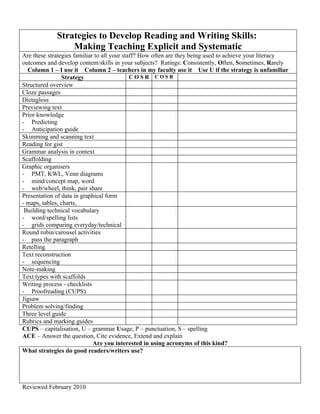
Are these strategies familiar to all your staff? How often are they being used to achieve your literacy
outcomes and develop content/skills in your subjects? Ratings: Consistently, Often, Sometimes, Rarely
  Column 1 – I use it Column 2 – teachers in my faculty use it Use U if the strategy is unfamiliar
                Strategy                     COSR COSR
Structured overview
Cloze passages
Dictagloss
Previewing text
Prior knowledge
- Predicting
- Anticipation guide
Skimming and scanning text
Reading for gist
Grammar analysis in context
Scaffolding
Graphic organisers
- PMT, KWL, Venn diagrams
- mind/concept map, word
- web/wheel, think, pair share
Presentation of data in graphical form
- maps, tables, charts,
 Building technical vocabulary
- word/spelling lists
- grids comparing everyday/technical
Round robin/carousel activities
- pass the paragraph
Retelling
Text reconstruction
- sequencing
Note-making
Text types with scaffolds
Writing process - checklists
- Proofreading (CUPS)
Jigsaw
Problem solving/finding
Three level guide
Rubrics and marking guides
CUPS – capitalisation, U – grammar Usage, P – punctuation, S – spelling
ACE – Answer the question, Cite evidence, Extend and explain
                             Are you interested in using acronyms of this kind?
What strategies do good readers/writers use?


Reviewed February 2010

Strategies Reading

  • 1.
    Strategies to DevelopReading and Writing Skills: Making Teaching Explicit and Systematic Are these strategies familiar to all your staff? How often are they being used to achieve your literacy outcomes and develop content/skills in your subjects? Ratings: Consistently, Often, Sometimes, Rarely Column 1 – I use it Column 2 – teachers in my faculty use it Use U if the strategy is unfamiliar Strategy COSR COSR Structured overview Cloze passages Dictagloss Previewing text Prior knowledge - Predicting - Anticipation guide Skimming and scanning text Reading for gist Grammar analysis in context Scaffolding Graphic organisers - PMT, KWL, Venn diagrams - mind/concept map, word - web/wheel, think, pair share Presentation of data in graphical form - maps, tables, charts, Building technical vocabulary - word/spelling lists - grids comparing everyday/technical Round robin/carousel activities - pass the paragraph Retelling Text reconstruction - sequencing Note-making Text types with scaffolds Writing process - checklists - Proofreading (CUPS) Jigsaw Problem solving/finding Three level guide Rubrics and marking guides CUPS – capitalisation, U – grammar Usage, P – punctuation, S – spelling ACE – Answer the question, Cite evidence, Extend and explain Are you interested in using acronyms of this kind? What strategies do good readers/writers use? Reviewed February 2010