Youth as NSDL Users…and Researchers!
Youth-Centered Design and the NSDL
KIMBERLY LUCAS
EDUCATION DEVELOPMENT CENTER, INC.
Overview
Education Development Center, Inc.
Portfolio of youth media and technology
projects:
 The FunWorks (thefunworks.org)
 Girls Communicating Career Connections (gc3.edc.org)
 Middle School Portal 2: Math and Science Pathways
(msteacher2.org)
 Youth Virtual Learning Experiencs (smartr.edc.org)
 NSDL Youth Resources
Overview of Projects
MSP2 VLEs: SMARTR
 Develop increased STEM
content knowledge in youth
 Increase youth ability to
explore, discover, problem
solve, think critically about
STEM
 Increase youth awareness of
the educational pathways that
lead to STEM careers
 Increased awareness of new
technological
literacies/encourage
productive/responsible use of
technology
NSDL Youth Resources
 Determine what youth and
educators identify and
conceptualize as “high-quality”
online STEM content
 Identify youth intended uses of
this content
 Identify key vocabulary youth
use to find STEM resources
 Provide NSDL collection
owners with a way to identify
and add quality content for
youth
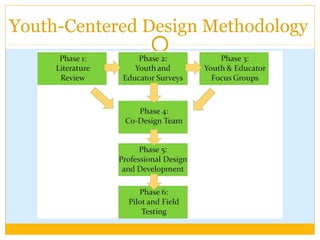
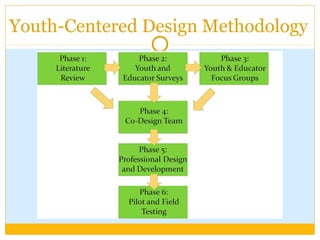
Youth-Centered Design Methodology
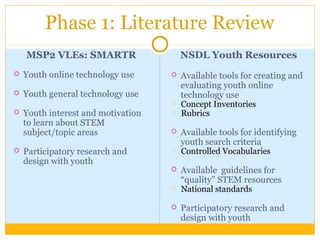
Phase 1: Literature Review
MSP2 VLEs: SMARTR
 Youth online technology use
 Youth general technology use
 Youth interest and motivation
to learn about STEM
subject/topic areas
 Participatory research and
design with youth
NSDL Youth Resources
 Available tools for creating and
evaluating youth online
technology use
 Concept Inventories
 Rubrics
 Available tools for identifying
youth search criteria
 Controlled Vocabularies
 Available guidelines for
“quality” STEM resources
 National standards
 Participatory research and
design with youth
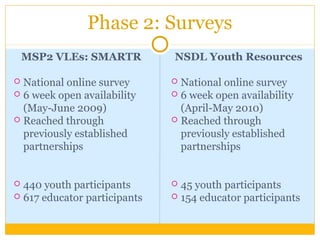
Phase 2: Surveys
MSP2 VLEs: SMARTR
 National online survey
 6 week open availability
(May-June 2009)
 Reached through
previously established
partnerships
 440 youth participants
 617 educator participants
NSDL Youth Resources
 National online survey
 6 week open availability
(April-May 2010)
 Reached through
previously established
partnerships
 45 youth participants
 154 educator participants
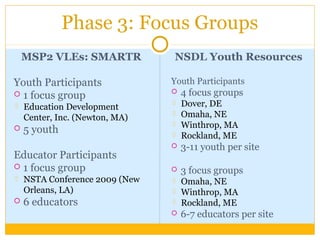
Phase 3: Focus Groups
MSP2 VLEs: SMARTR
Youth Participants
 1 focus group
 Education Development
Center, Inc. (Newton, MA)
 5 youth
Educator Participants
 1 focus group
 NSTA Conference 2009 (New
Orleans, LA)
 6 educators
NSDL Youth Resources
Youth Participants
 4 focus groups
 Dover, DE
 Omaha, NE
 Winthrop, MA
 Rockland, ME
 3-11 youth per site
 3 focus groups
 Omaha, NE
 Winthrop, MA
 Rockland, ME
 6-7 educators per site
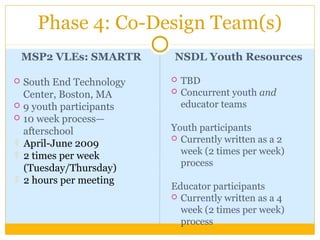
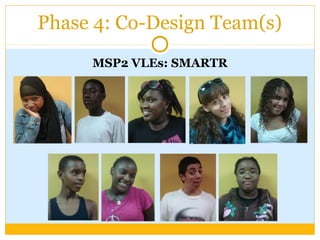
Phase 4: Co-Design Team(s)
MSP2 VLEs: SMARTR
 South End Technology
Center, Boston, MA
 9 youth participants
 10 week process—
afterschool
 April-June 2009
 2 times per week
(Tuesday/Thursday)
 2 hours per meeting
NSDL Youth Resources
 TBD
 Concurrent youth and
educator teams
Youth participants
 Currently written as a 2
week (2 times per week)
process
Educator participants
 Currently written as a 4
week (2 times per week)
process
Phase 4: Co-Design Team(s)
MSP2 VLEs: SMARTR
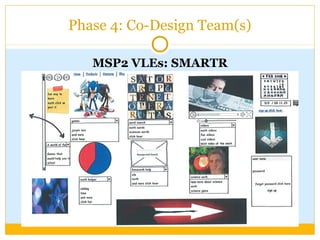
Phase 4: Co-Design Team(s)
MSP2 VLEs: SMARTR
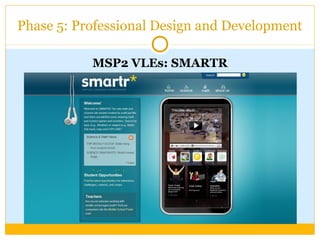
Phase 5: Professional Design and Development
MSP2 VLEs: SMARTR
Phase 6: Pilot and Field Testing
Identify potential partner sites/groups of youth and
educators for pilot/field testing
Create feedback mechanism(s) for testers
Incorporate usage/design feedback into product
Sarita Pillai, PI
spillai@edc.org
Siobhan Bredin, co-PI
sbredin@edc.org
Kimberly Lucas, Research Assistant
klucas@edc.org
Thank You!
KIMBERLY LUCAS AND SIOBHAN BREDIN
EDUCATION DEVELOPMENT CENTER, INC.
NSDL Youth Resources:
Findings and Challenges
Overview
Education Development Center, Inc.
NSDL projects:
 Gender & Science Digital Library (gdsl.org)
 Effective Access Research Project
 The FunWorks (thefunworks.org)
 Girls Communicating Career Connections (gc3.edc.org)
 Middle School Portal 2: Math and Science Pathways
(msteacher2.org)
 Youth Virtual Learning Experiencs (smartr.edc.org)
 NSDL Youth Resources
NSDL Youth Resources
NYR’s goals for youth:
 Determine what youth and educators identify and
conceptualize as “high-quality” online STEM content
 Identify youth intended uses of this content
 Identify key vocabulary youth use to find STEM resources
 Provide NSDL collection owners with a way to identify and
add quality content for youth
NYR products:
 Develop a content-selection rubric for our partners
and other collection owners with a critical need to add
youth-appropriate content to their collections
 Create a controlled vocabulary for the cataloging of
youth resources for the NSDL
Youth-Centered Design Methodology
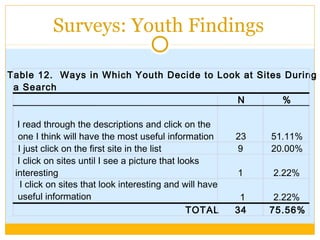
N %
I read through the descriptions and click on the
one I think will have the most useful information 23 51.11%
I just click on the first site in the list 9 20.00%
I click on sites until I see a picture that looks
interesting 1 2.22%
I click on sites that look interesting and will have
useful information 1 2.22%
TOTAL 34 75.56%
Table 12. Ways in Which Youth Decide to Look at Sites During
a Search
Surveys: Youth Findings
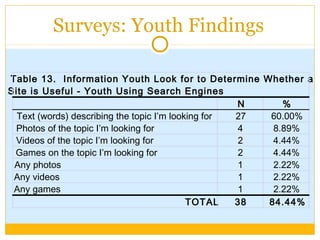
N %
Text (words) describing the topic I’m looking for 27 60.00%
Photos of the topic I’m looking for 4 8.89%
Videos of the topic I’m looking for 2 4.44%
Games on the topic I’m looking for 2 4.44%
Any photos 1 2.22%
Any videos 1 2.22%
Any games 1 2.22%
TOTAL 38 84.44%
Table 13. Information Youth Look for to Determine Whether a
Site is Useful - Youth Using Search Engines
Surveys: Youth Findings
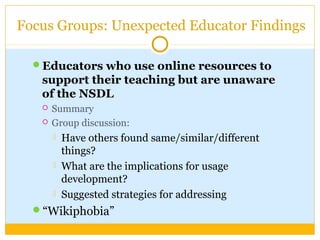
Focus Groups: Unexpected Educator Findings
Educators who use online resources to
support their teaching but are unaware
of the NSDL
 Summary
 Group discussion:
 Have others found same/similar/different
things?
 What are the implications for usage
development?
 Suggested strategies for addressing
“Wikiphobia”
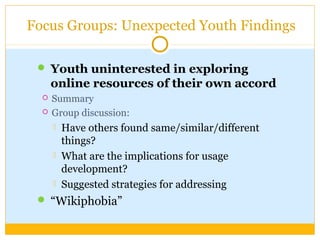
 Youth uninterested in exploring
online resources of their own accord
 Summary
 Group discussion:
 Have others found same/similar/different
things?
 What are the implications for usage
development?
 Suggested strategies for addressing
 “Wikiphobia”
Focus Groups: Unexpected Youth Findings
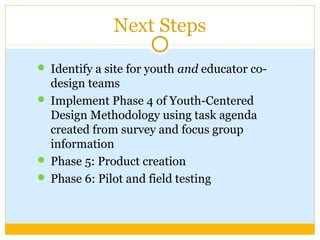
Next Steps
 Identify a site for youth and educator co-
design teams
 Implement Phase 4 of Youth-Centered
Design Methodology using task agenda
created from survey and focus group
information
 Phase 5: Product creation
 Phase 6: Pilot and field testing
Sarita Pillai, PI
spillai@edc.org
Siobhan Bredin, co-PI
sbredin@edc.org
Kimberly Lucas, Research Assistant
klucas@edc.org
Thank You!

Youth-Centered Design and the NSDL

  • 1.
    Youth as NSDLUsers…and Researchers! Youth-Centered Design and the NSDL KIMBERLY LUCAS EDUCATION DEVELOPMENT CENTER, INC.
  • 2.
    Overview Education Development Center,Inc. Portfolio of youth media and technology projects:  The FunWorks (thefunworks.org)  Girls Communicating Career Connections (gc3.edc.org)  Middle School Portal 2: Math and Science Pathways (msteacher2.org)  Youth Virtual Learning Experiencs (smartr.edc.org)  NSDL Youth Resources
  • 3.
    Overview of Projects MSP2VLEs: SMARTR  Develop increased STEM content knowledge in youth  Increase youth ability to explore, discover, problem solve, think critically about STEM  Increase youth awareness of the educational pathways that lead to STEM careers  Increased awareness of new technological literacies/encourage productive/responsible use of technology NSDL Youth Resources  Determine what youth and educators identify and conceptualize as “high-quality” online STEM content  Identify youth intended uses of this content  Identify key vocabulary youth use to find STEM resources  Provide NSDL collection owners with a way to identify and add quality content for youth
  • 4.
  • 5.
    Phase 1: LiteratureReview MSP2 VLEs: SMARTR  Youth online technology use  Youth general technology use  Youth interest and motivation to learn about STEM subject/topic areas  Participatory research and design with youth NSDL Youth Resources  Available tools for creating and evaluating youth online technology use  Concept Inventories  Rubrics  Available tools for identifying youth search criteria  Controlled Vocabularies  Available guidelines for “quality” STEM resources  National standards  Participatory research and design with youth
  • 6.
    Phase 2: Surveys MSP2VLEs: SMARTR  National online survey  6 week open availability (May-June 2009)  Reached through previously established partnerships  440 youth participants  617 educator participants NSDL Youth Resources  National online survey  6 week open availability (April-May 2010)  Reached through previously established partnerships  45 youth participants  154 educator participants
  • 7.
    Phase 3: FocusGroups MSP2 VLEs: SMARTR Youth Participants  1 focus group  Education Development Center, Inc. (Newton, MA)  5 youth Educator Participants  1 focus group  NSTA Conference 2009 (New Orleans, LA)  6 educators NSDL Youth Resources Youth Participants  4 focus groups  Dover, DE  Omaha, NE  Winthrop, MA  Rockland, ME  3-11 youth per site  3 focus groups  Omaha, NE  Winthrop, MA  Rockland, ME  6-7 educators per site
  • 8.
    Phase 4: Co-DesignTeam(s) MSP2 VLEs: SMARTR  South End Technology Center, Boston, MA  9 youth participants  10 week process— afterschool  April-June 2009  2 times per week (Tuesday/Thursday)  2 hours per meeting NSDL Youth Resources  TBD  Concurrent youth and educator teams Youth participants  Currently written as a 2 week (2 times per week) process Educator participants  Currently written as a 4 week (2 times per week) process
  • 9.
    Phase 4: Co-DesignTeam(s) MSP2 VLEs: SMARTR
  • 10.
    Phase 4: Co-DesignTeam(s) MSP2 VLEs: SMARTR
  • 11.
    Phase 5: ProfessionalDesign and Development MSP2 VLEs: SMARTR
  • 12.
    Phase 6: Pilotand Field Testing Identify potential partner sites/groups of youth and educators for pilot/field testing Create feedback mechanism(s) for testers Incorporate usage/design feedback into product
  • 13.
    Sarita Pillai, PI spillai@edc.org SiobhanBredin, co-PI sbredin@edc.org Kimberly Lucas, Research Assistant klucas@edc.org Thank You!
  • 14.
    KIMBERLY LUCAS ANDSIOBHAN BREDIN EDUCATION DEVELOPMENT CENTER, INC. NSDL Youth Resources: Findings and Challenges
  • 15.
    Overview Education Development Center,Inc. NSDL projects:  Gender & Science Digital Library (gdsl.org)  Effective Access Research Project  The FunWorks (thefunworks.org)  Girls Communicating Career Connections (gc3.edc.org)  Middle School Portal 2: Math and Science Pathways (msteacher2.org)  Youth Virtual Learning Experiencs (smartr.edc.org)  NSDL Youth Resources
  • 16.
    NSDL Youth Resources NYR’sgoals for youth:  Determine what youth and educators identify and conceptualize as “high-quality” online STEM content  Identify youth intended uses of this content  Identify key vocabulary youth use to find STEM resources  Provide NSDL collection owners with a way to identify and add quality content for youth NYR products:  Develop a content-selection rubric for our partners and other collection owners with a critical need to add youth-appropriate content to their collections  Create a controlled vocabulary for the cataloging of youth resources for the NSDL
  • 17.
  • 18.
    N % I readthrough the descriptions and click on the one I think will have the most useful information 23 51.11% I just click on the first site in the list 9 20.00% I click on sites until I see a picture that looks interesting 1 2.22% I click on sites that look interesting and will have useful information 1 2.22% TOTAL 34 75.56% Table 12. Ways in Which Youth Decide to Look at Sites During a Search Surveys: Youth Findings
  • 19.
    N % Text (words)describing the topic I’m looking for 27 60.00% Photos of the topic I’m looking for 4 8.89% Videos of the topic I’m looking for 2 4.44% Games on the topic I’m looking for 2 4.44% Any photos 1 2.22% Any videos 1 2.22% Any games 1 2.22% TOTAL 38 84.44% Table 13. Information Youth Look for to Determine Whether a Site is Useful - Youth Using Search Engines Surveys: Youth Findings
  • 20.
    Focus Groups: UnexpectedEducator Findings Educators who use online resources to support their teaching but are unaware of the NSDL  Summary  Group discussion:  Have others found same/similar/different things?  What are the implications for usage development?  Suggested strategies for addressing “Wikiphobia”
  • 21.
     Youth uninterestedin exploring online resources of their own accord  Summary  Group discussion:  Have others found same/similar/different things?  What are the implications for usage development?  Suggested strategies for addressing  “Wikiphobia” Focus Groups: Unexpected Youth Findings
  • 22.
    Next Steps  Identifya site for youth and educator co- design teams  Implement Phase 4 of Youth-Centered Design Methodology using task agenda created from survey and focus group information  Phase 5: Product creation  Phase 6: Pilot and field testing
  • 23.
    Sarita Pillai, PI spillai@edc.org SiobhanBredin, co-PI sbredin@edc.org Kimberly Lucas, Research Assistant klucas@edc.org Thank You!

Editor's Notes

  • #3 EDC – educational research and development non-profit based just outside of boston, ma. Have had several NSDL projects…. The last 3 of these have been youth-focused both in their process and products. Here to today to discuss our process for developing VLE for the MSP2 project In the last 2 NSDL projects and other non-NSDL projects we have worked closely with middle school aged youth in the creation of resources for them. This session will share some of our findings from our participatory design process as well as share some draft designs we are working on the MSP2 VLEs
  • #4 NYR: Focus on the nature of content for youth (i.e., quality, accessibility, interactivity of, learning modalities supported, degree to which a resource fosters discipline-specific thinking/habits of mind, etc.)
  • #6 Research related to project content/topic Recent instruments for data collection with youth Overall provides a context and framework for the planned work with youth, how best to engage them in both the content and design aspects of the project. Our work combines PD + LC-D + CI (a more recent paradigm for working with young learners to create new technologies)
  • #7 Online surveys (what) Our largest source of data: types of websites youth are interested in, their preferences for internet use
  • #8 FGs (how/why) Offer a more detailed and nuanced exploration of how youth find educational information online as well as a greater explanation of visual and layout preferences for online information/websites.
  • #9 Youth co-design team: heart of this process, where project staff and youth work together for several months to craft a series of prototype designs While process is very youth-centric, each of these phases includes data collection and work with educators – just not the focus of this presentation (offering insight into online resources they most often use with youth, websites used in classroom, their perception of website features and content that engages their students, topics that would be most important to cover and why). Consent forms/IRB Partnership with SETC Daily curriculum developed—to ensure that: project moves forward, youth are engaged in using and generating information and ideas, facilitators are engaged in drawing out youth insight Youth as experts Skills build on one another to reach common end goal Final product unveiling
  • #16 EDC – educational research and development non-profit based just outside of boston, ma. Have had several NSDL projects…. The last 3 of these have been youth-focused both in their process and products. Here to today to discuss our process for developing VLE for the MSP2 project