Background notes
             For
    Animal Farm
Pre-Revolution
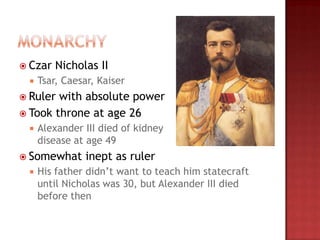
 Czar   Nicholas II
    Tsar, Caesar, Kaiser
 Ruler with absolute power
 Took throne at age 26
    Alexander III died of kidney
     disease at age 49
 Somewhat     inept as ruler
    His father didn‟t want to teach him statecraft
     until Nicholas was 30, but Alexander III died
     before then
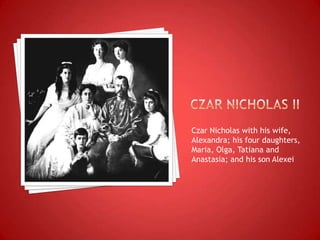
Czar Nicholas with his wife,
Alexandra; his four daughters,
Maria, Olga, Tatiana and
Anastasia; and his son Alexei
 Nicholas
         was
 married, 4 daughters,
 1 son
    Alexei was sickly
     (hemophilia)
        Inherited
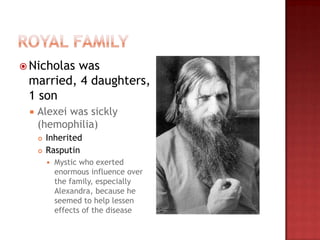
        Rasputin
            Mystic who exerted
             enormous influence over
             the family, especially
             Alexandra, because he
             seemed to help lessen
             effects of the disease
 Widespread    drought       Anti-Semitic
  & famine                     pogroms
 Refusal to agree to         Distrust of
  Constitutional               Rasputin‟s influence
  Monarchy                    Bloody Sunday
 Loss of war with            Bread Riots
  Japan
    Defeat by a non-
     Western power
     brought down prestige
     and authority of the
     regime
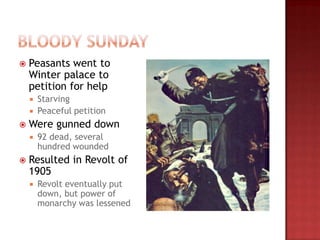
   Peasants went to
    Winter palace to
    petition for help
       Starving
       Peaceful petition
   Were gunned down
       92 dead, several
        hundred wounded
   Resulted in Revolt of
    1905
       Revolt eventually put
        down, but power of
        monarchy was lessened
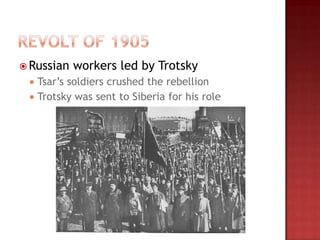
 Russian   workers led by Trotsky
    Tsar‟s soldiers crushed the rebellion
    Trotsky was sent to Siberia for his role
 1917:  WWI caused Tsar/Czar Nicholas II
  to abdicate
 Causes:
  German triumphs, millions killed in WWI
  Nationwide poverty, injustices by czars (Bloody
   Sunday), bread riots, other signs of popular
   hostility
  Spontaneous revolt by workers in Feb., 1917

 Provisional   Interim Govt. : Prince Lvov
 Riots:
    Lenin‟s speech: “The people need peace.
     The people need bread. The people need
     land. And they give you war, hunger, no
     bread…we must fight for the social
     revolution.”
        After the riots, Lvov banned the Bolsheviks (who
         quadrupled in size), sent Lenin into hiding, and
         arrested Trotsky (who was now allied with Lenin)
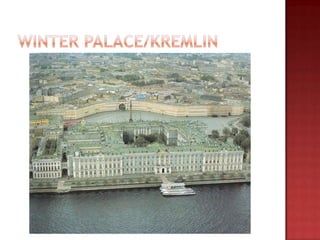
 Troops
       refuse to fight: Bolsheviks take over
 government buildings and the Winter Palace
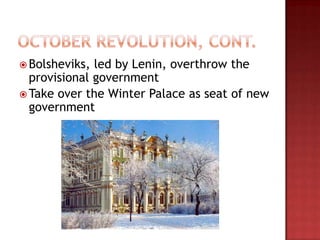
 Bolsheviks, led by Lenin, overthrow the
  provisional government
 Take over the Winter Palace as seat of new
  government
 WW   I caused         Later,
                              Nicholas &
  massive deaths on     family were
  the front, and        executed for
  widespread            treason
  starvation at home       Firing squad and
 Revolution of 1917        bayonets
  forced Nicholas II       Women survived
                            initial bullets
  to abdicate the
                               Diamonds and other
  throne                        jewels sewn in dresses
 Imprisoned by the             protected them
                                Later shot in the head
  revolutionaries           
                                and stabbed with
                                bayonets
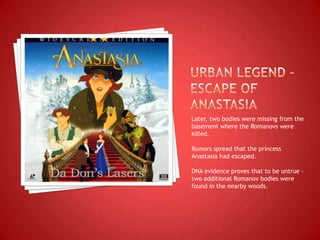
Later, two bodies were missing from the
basement where the Romanovs were
killed.

Rumors spread that the princess
Anastasia had escaped.

DNA evidence proves that to be untrue –
two additional Romanov bodies were
found in the nearby woods.
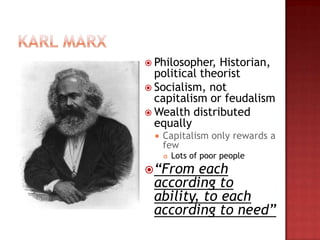
 Philosopher, Historian,
  political theorist
 Socialism, not
  capitalism or feudalism
 Wealth distributed
  equally
    Capitalism only rewards a
     few
        Lots of poor people
 “From  each
 according to
 ability, to each
 according to need”
 Groupof Russians: Meeting in Minsk in
 March 1898, declaring themselves as a
 party
    Russian Social Democratic Workers’ Party:
     Later became the Communist party
        Consisted of nine delegates representing four labor
         unions, a workers‟ newspaper and the Jewish Social
         Democratic Bund
        platform: overthrow of the Romanov rulers
        results of meeting: 8 of the delegates arrested upon
         their return home
    Followed doctrines/teachings of : Karl Marx –
     prophesied the collapse of capitalism and its
     empires
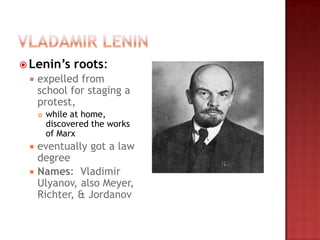
 Lenin’s      roots:
    expelled from
     school for staging a
     protest,
        while at home,
         discovered the works
         of Marx
    eventually got a law
     degree
    Names: Vladimir
     Ulyanov, also Meyer,
     Richter, & Jordanov
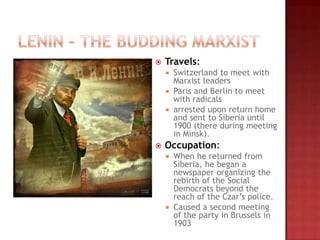
   Travels:
     Switzerland to meet with
      Marxist leaders
     Paris and Berlin to meet
      with radicals
     arrested upon return home
      and sent to Siberia until
      1900 (there during meeting
      in Minsk).
   Occupation:
     When he returned from
      Siberia, he began a
      newspaper organizing the
      rebirth of the Social
      Democrats beyond the
      reach of the Czar‟s police.
     Caused a second meeting
      of the party in Brussels in
      1903
Bolsheviks                      Mensheviks
 After “Bolshoi” – big          Means minority
       Means majority
   Leader: Lenin                  Leader: Trotsky
   Makeup: small, highly          Makeup: take any and
    disciplined, secretive, &       all supporters, find
    vanguard of working             partners, make
    class                           coalitions
   Philosophy:                    Philosophy:
    Government run by               Democratically run
    small dictatorial group         socialism
    of professional
    revolutionaries that
    would tell the
    proletariat (workers)
    what to do
 After
      the Bolsheviks, led by Lenin,
 overthrow the provisional government
  Set up a dictatorship, with secret police
    Lenin is in charge

  Revised economic policy – prosperity for some
   peasants (sold crops & paid taxes)
  Right-hand man: Leon Trotsky
    Military leader, led Stalin‟s Red Army in many

     uprisings & revolutionary battles, including
     the defeat of the “White” army (the nobility)
     in the Civil War
 Premier/Foreign    Minister: Lenin/Trotsky
 Cabinet: Lenin insisted on an all-Bolshevik
  cabinet
 Constituent Assembly: Although Bolsheviks
  won only 25% of the popular vote, and
  moderate socialist groups won 62%, Lenin
  disbanded the Assembly after one meeting and
  banned all parties other than his own, which
  he had renamed the Communist Party.
 Cheka: New police force, authorized to arrest
  and shoot immediately all members of
  counterrevolutionary organizations.
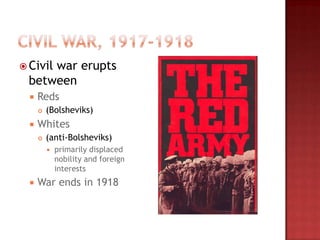
 Civil
     war erupts
 between
     Reds
         (Bolsheviks)
     Whites
         (anti-Bolsheviks)
             primarily displaced
              nobility and foreign
              interests
     War ends in 1918
 Military:
     peace with Germany, but forced separation of
      Poland, Balkans and Ukraine from Russia;
     American, Japanese, British and French troops in
      Russia, various anti-Bolshevik “white” armies
 Economy:       in shambles –
     huge industrial production drops,
     runaway inflation,
     plummeting foreign trade,
     peasant crops requisitioned for the cities,
     widespread famine
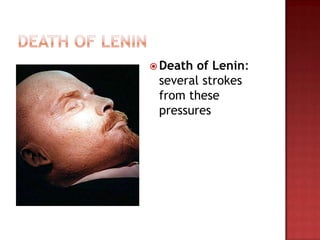
 Deathof Lenin:
 several strokes
 from these
 pressures
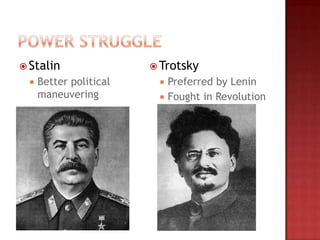
 Stalin                 Trotsky
    Better political       Preferred by Lenin
     maneuvering            Fought in Revolution
Stalin (meaning steel)
 political/military maneuvers:
  armed robberies to replenish Bolshevik
   treasury,
  alliance with two of Lenin‟s top advisors, then
   betrayed them,
  became basically the uncrowned Tsar of the
   Russians (caused Trotsky to flee)
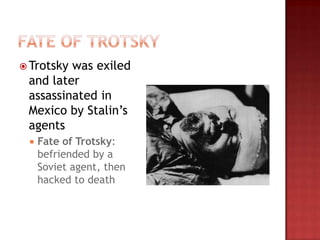
 Trotskywas exiled
 and later
 assassinated in
 Mexico by Stalin‟s
 agents
    Fate of Trotsky:
     befriended by a
     Soviet agent, then
     hacked to death
 Drew  up new constitution,
 Communist party the core of all
  public and state organizations
  (only 10% of population in this elite
   group).
 He held no party congresses and ran
  things by himself
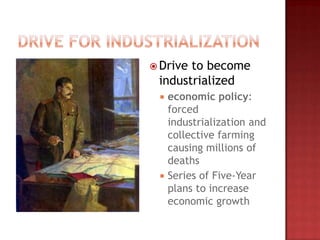
 Driveto become
 industrialized
    economic policy:
     forced
     industrialization and
     collective farming
     causing millions of
     deaths
    Series of Five-Year
     plans to increase
     economic growth
 Forced labor to cities
 Eliminated small farms to create large
  “collectivized farms”
    Produce went to feed those building factories
     and to sell for the financing of those factories
    Many farmers tried to revolt, severely punished –
     killed or sent to Siberia
    Farm production drops, massive famine in Soviet
     Union
        Decisions about farming made by bureaucrats
        Farmers were paid miserably – little incentive to work
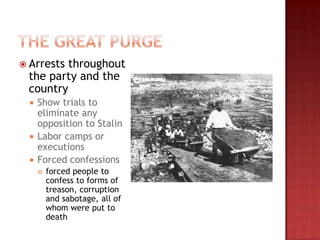
 Arreststhroughout
 the party and the
 country
   Show trials to
    eliminate any
    opposition to Stalin
   Labor camps or
    executions
   Forced confessions
         forced people to
          confess to forms of
          treason, corruption
          and sabotage, all of
          whom were put to
          death
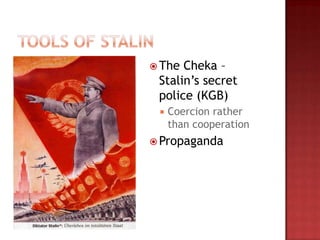
 The Cheka –
 Stalin‟s secret
 police (KGB)
    Coercion rather
     than cooperation
 Propaganda
 Non-Aggression         Pact
    Stalin allied himself with Hitler until Hitler
     invaded Russia in 1941
        the Russians suffer heavy losses beating back the
         Germans (20 million dead)
 Join     the Allies
    fights against the Germans/Japanese
    at the end of the war, meets with Winston
     Churchill & Franklin D. Roosevelt (Yalta
     Conference) to forge a lasting peace treaty and
     carve up Europe
        Note: Makes it hard for Orwell to sell Animal Farm
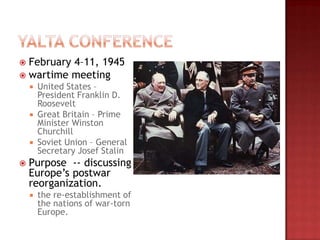
 February 4–11, 1945
 wartime meeting
       United States –
        President Franklin D.
        Roosevelt
       Great Britain – Prime
        Minister Winston
        Churchill
       Soviet Union – General
        Secretary Josef Stalin
   Purpose -- discussing
    Europe‟s postwar
    reorganization.
       the re-establishment of
        the nations of war-torn
        Europe.
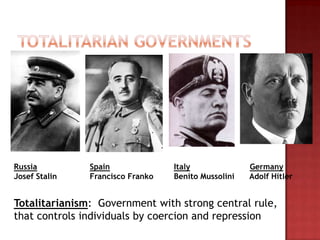
Russia         Spain              Italy              Germany
Josef Stalin   Francisco Franko   Benito Mussolini   Adolf Hitler


Totalitarianism: Government with strong central rule,
that controls individuals by coercion and repression
 Satire
     A literary genre that uses irony, wit, and
      sometimes sarcasm to ridicule people, ideas, or
      practices in an effort to improve society
 Allegory
     A story or tale that has two levels of meaning.
      The first is a surface-level story, with a second,
      and deeper level of meaning, which may be
      moral, political, philosophical, or religious.
         Characters often bear names that indicate the
          qualities or ideas the author wishes to represent.
 Personification
     Giving human characteristics to non-humans
 Utopia
    An ideal place that does not exist in reality
    Term comes from Greek words
        Outopia = “no place”
        Eutopia = “good place”
 Dystopia
    The opposite of utopia
    Horrific places, generally characterized by
     oppressive societies
        Often shown as starting out as attempts to achieve
         utopia
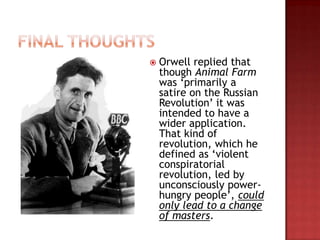
   Orwell replied that
    though Animal Farm
    was „primarily a
    satire on the Russian
    Revolution‟ it was
    intended to have a
    wider application.
    That kind of
    revolution, which he
    defined as „violent
    conspiratorial
    revolution, led by
    unconsciously power-
    hungry people‟, could
    only lead to a change
    of masters.

Russian Revolution

  • 1.
    Background notes For Animal Farm
  • 2.
  • 3.
     Czar Nicholas II  Tsar, Caesar, Kaiser  Ruler with absolute power  Took throne at age 26  Alexander III died of kidney disease at age 49  Somewhat inept as ruler  His father didn‟t want to teach him statecraft until Nicholas was 30, but Alexander III died before then
  • 4.
    Czar Nicholas withhis wife, Alexandra; his four daughters, Maria, Olga, Tatiana and Anastasia; and his son Alexei
  • 5.
     Nicholas was married, 4 daughters, 1 son  Alexei was sickly (hemophilia)  Inherited  Rasputin  Mystic who exerted enormous influence over the family, especially Alexandra, because he seemed to help lessen effects of the disease
  • 6.
     Widespread drought  Anti-Semitic & famine pogroms  Refusal to agree to  Distrust of Constitutional Rasputin‟s influence Monarchy  Bloody Sunday  Loss of war with  Bread Riots Japan  Defeat by a non- Western power brought down prestige and authority of the regime
  • 7.
    Peasants went to Winter palace to petition for help  Starving  Peaceful petition  Were gunned down  92 dead, several hundred wounded  Resulted in Revolt of 1905  Revolt eventually put down, but power of monarchy was lessened
  • 8.
     Russian workers led by Trotsky  Tsar‟s soldiers crushed the rebellion  Trotsky was sent to Siberia for his role
  • 9.
     1917: WWI caused Tsar/Czar Nicholas II to abdicate  Causes:  German triumphs, millions killed in WWI  Nationwide poverty, injustices by czars (Bloody Sunday), bread riots, other signs of popular hostility  Spontaneous revolt by workers in Feb., 1917  Provisional Interim Govt. : Prince Lvov
  • 10.
     Riots:  Lenin‟s speech: “The people need peace. The people need bread. The people need land. And they give you war, hunger, no bread…we must fight for the social revolution.”  After the riots, Lvov banned the Bolsheviks (who quadrupled in size), sent Lenin into hiding, and arrested Trotsky (who was now allied with Lenin)  Troops refuse to fight: Bolsheviks take over government buildings and the Winter Palace
  • 11.
     Bolsheviks, ledby Lenin, overthrow the provisional government  Take over the Winter Palace as seat of new government
  • 13.
     WW I caused  Later, Nicholas & massive deaths on family were the front, and executed for widespread treason starvation at home  Firing squad and  Revolution of 1917 bayonets forced Nicholas II  Women survived initial bullets to abdicate the  Diamonds and other throne jewels sewn in dresses  Imprisoned by the protected them Later shot in the head revolutionaries  and stabbed with bayonets
  • 14.
    Later, two bodieswere missing from the basement where the Romanovs were killed. Rumors spread that the princess Anastasia had escaped. DNA evidence proves that to be untrue – two additional Romanov bodies were found in the nearby woods.
  • 16.
     Philosopher, Historian, political theorist  Socialism, not capitalism or feudalism  Wealth distributed equally  Capitalism only rewards a few  Lots of poor people  “From each according to ability, to each according to need”
  • 17.
     Groupof Russians:Meeting in Minsk in March 1898, declaring themselves as a party  Russian Social Democratic Workers’ Party: Later became the Communist party  Consisted of nine delegates representing four labor unions, a workers‟ newspaper and the Jewish Social Democratic Bund  platform: overthrow of the Romanov rulers  results of meeting: 8 of the delegates arrested upon their return home  Followed doctrines/teachings of : Karl Marx – prophesied the collapse of capitalism and its empires
  • 18.
     Lenin’s roots:  expelled from school for staging a protest,  while at home, discovered the works of Marx  eventually got a law degree  Names: Vladimir Ulyanov, also Meyer, Richter, & Jordanov
  • 19.
    Travels:  Switzerland to meet with Marxist leaders  Paris and Berlin to meet with radicals  arrested upon return home and sent to Siberia until 1900 (there during meeting in Minsk).  Occupation:  When he returned from Siberia, he began a newspaper organizing the rebirth of the Social Democrats beyond the reach of the Czar‟s police.  Caused a second meeting of the party in Brussels in 1903
  • 20.
    Bolsheviks Mensheviks  After “Bolshoi” – big  Means minority  Means majority  Leader: Lenin  Leader: Trotsky  Makeup: small, highly  Makeup: take any and disciplined, secretive, & all supporters, find vanguard of working partners, make class coalitions  Philosophy:  Philosophy: Government run by Democratically run small dictatorial group socialism of professional revolutionaries that would tell the proletariat (workers) what to do
  • 21.
     After the Bolsheviks, led by Lenin, overthrow the provisional government  Set up a dictatorship, with secret police  Lenin is in charge  Revised economic policy – prosperity for some peasants (sold crops & paid taxes)  Right-hand man: Leon Trotsky  Military leader, led Stalin‟s Red Army in many uprisings & revolutionary battles, including the defeat of the “White” army (the nobility) in the Civil War
  • 22.
     Premier/Foreign Minister: Lenin/Trotsky  Cabinet: Lenin insisted on an all-Bolshevik cabinet  Constituent Assembly: Although Bolsheviks won only 25% of the popular vote, and moderate socialist groups won 62%, Lenin disbanded the Assembly after one meeting and banned all parties other than his own, which he had renamed the Communist Party.  Cheka: New police force, authorized to arrest and shoot immediately all members of counterrevolutionary organizations.
  • 23.
     Civil war erupts between  Reds  (Bolsheviks)  Whites  (anti-Bolsheviks)  primarily displaced nobility and foreign interests  War ends in 1918
  • 24.
     Military:  peace with Germany, but forced separation of Poland, Balkans and Ukraine from Russia;  American, Japanese, British and French troops in Russia, various anti-Bolshevik “white” armies  Economy: in shambles –  huge industrial production drops,  runaway inflation,  plummeting foreign trade,  peasant crops requisitioned for the cities,  widespread famine
  • 25.
     Deathof Lenin: several strokes from these pressures
  • 26.
     Stalin  Trotsky  Better political  Preferred by Lenin maneuvering  Fought in Revolution
  • 27.
    Stalin (meaning steel) political/military maneuvers:  armed robberies to replenish Bolshevik treasury,  alliance with two of Lenin‟s top advisors, then betrayed them,  became basically the uncrowned Tsar of the Russians (caused Trotsky to flee)
  • 28.
     Trotskywas exiled and later assassinated in Mexico by Stalin‟s agents  Fate of Trotsky: befriended by a Soviet agent, then hacked to death
  • 29.
     Drew up new constitution,  Communist party the core of all public and state organizations  (only 10% of population in this elite group).  He held no party congresses and ran things by himself
  • 30.
     Driveto become industrialized  economic policy: forced industrialization and collective farming causing millions of deaths  Series of Five-Year plans to increase economic growth
  • 31.
     Forced laborto cities  Eliminated small farms to create large “collectivized farms”  Produce went to feed those building factories and to sell for the financing of those factories  Many farmers tried to revolt, severely punished – killed or sent to Siberia  Farm production drops, massive famine in Soviet Union  Decisions about farming made by bureaucrats  Farmers were paid miserably – little incentive to work
  • 32.
     Arreststhroughout theparty and the country  Show trials to eliminate any opposition to Stalin  Labor camps or executions  Forced confessions  forced people to confess to forms of treason, corruption and sabotage, all of whom were put to death
  • 33.
     The Cheka– Stalin‟s secret police (KGB)  Coercion rather than cooperation  Propaganda
  • 34.
     Non-Aggression Pact  Stalin allied himself with Hitler until Hitler invaded Russia in 1941  the Russians suffer heavy losses beating back the Germans (20 million dead)  Join the Allies  fights against the Germans/Japanese  at the end of the war, meets with Winston Churchill & Franklin D. Roosevelt (Yalta Conference) to forge a lasting peace treaty and carve up Europe  Note: Makes it hard for Orwell to sell Animal Farm
  • 35.
     February 4–11,1945  wartime meeting  United States – President Franklin D. Roosevelt  Great Britain – Prime Minister Winston Churchill  Soviet Union – General Secretary Josef Stalin  Purpose -- discussing Europe‟s postwar reorganization.  the re-establishment of the nations of war-torn Europe.
  • 36.
    Russia Spain Italy Germany Josef Stalin Francisco Franko Benito Mussolini Adolf Hitler Totalitarianism: Government with strong central rule, that controls individuals by coercion and repression
  • 38.
     Satire  A literary genre that uses irony, wit, and sometimes sarcasm to ridicule people, ideas, or practices in an effort to improve society  Allegory  A story or tale that has two levels of meaning. The first is a surface-level story, with a second, and deeper level of meaning, which may be moral, political, philosophical, or religious.  Characters often bear names that indicate the qualities or ideas the author wishes to represent.  Personification  Giving human characteristics to non-humans
  • 39.
     Utopia  An ideal place that does not exist in reality  Term comes from Greek words  Outopia = “no place”  Eutopia = “good place”  Dystopia  The opposite of utopia  Horrific places, generally characterized by oppressive societies  Often shown as starting out as attempts to achieve utopia
  • 40.
    Orwell replied that though Animal Farm was „primarily a satire on the Russian Revolution‟ it was intended to have a wider application. That kind of revolution, which he defined as „violent conspiratorial revolution, led by unconsciously power- hungry people‟, could only lead to a change of masters.