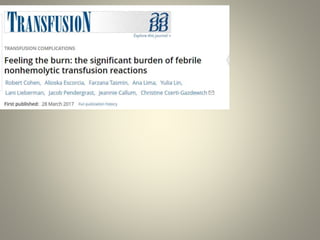


FEBRILE NON HEMOLYTIC
TRANSFUSION REACTION
DR AKSHAYA TOMAR
DEPT OF IMMUNOHEMATOLOGY AND
BLOOD TRANSFUSION
AFMC,PUNE
INTRODUCTION
• Transfusion reactions are a diverse group of adverse events
occuring as a result of transfusion that usually present during
or after transfusion.
• No single alogrithm can encompass all types of events.
DEFINITION
• Temperature increase of at least 1°C with or without chills ,a
cold sensation or discomfort
• Occurrence during or within few hours of transfusion
• Unrelated to hemolysis,sepsis or other known causes of fever
• Most severe reaction – rigors ; temp rise of > 2°C
• Fever usually persist for no more than 8-12 hrs
FNHTR
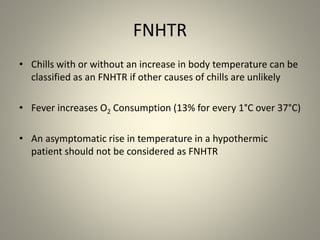
• Chills with or without an increase in body temperature can be
classified as an FNHTR if other causes of chills are unlikely
• Fever increases O2 Consumption (13% for every 1°C over 37°C)
• An asymptomatic rise in temperature in a hypothermic
patient should not be considered as FNHTR
Problem statement
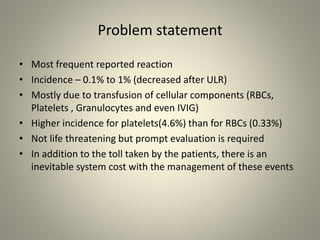
• Most frequent reported reaction
• Incidence – 0.1% to 1% (decreased after ULR)
• Mostly due to transfusion of cellular components (RBCs,
Platelets , Granulocytes and even IVIG)
• Higher incidence for platelets(4.6%) than for RBCs (0.33%)
• Not life threatening but prompt evaluation is required
• In addition to the toll taken by the patients, there is an
inevitable system cost with the management of these events
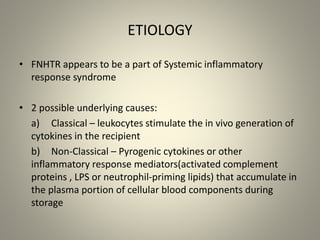
ETIOLOGY
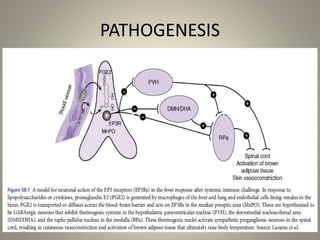
• FNHTR appears to be a part of Systemic inflammatory
response syndrome
• 2 possible underlying causes:
a) Classical – leukocytes stimulate the in vivo generation of
cytokines in the recipient
b) Non-Classical – Pyrogenic cytokines or other
inflammatory response mediators(activated complement
proteins , LPS or neutrophil-priming lipids) that accumulate in
the plasma portion of cellular blood components during
storage
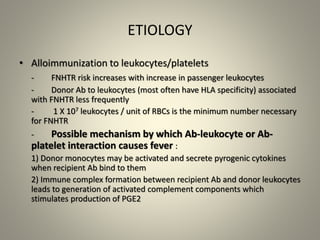
ETIOLOGY
• Alloimmunization to leukocytes/platelets
- FNHTR risk increases with increase in passenger leukocytes
- Donor Ab to leukocytes (most often have HLA specificity) associated
with FNHTR less frequently
- 1 X 10⁷ leukocytes / unit of RBCs is the minimum number necessary
for FNHTR
- Possible mechanism by which Ab-leukocyte or Ab-
platelet interaction causes fever :
1) Donor monocytes may be activated and secrete pyrogenic cytokines
when recipient Ab bind to them
2) Immune complex formation between recipient Ab and donor leukocytes
leads to generation of activated complement components which
stimulates production of PGE2
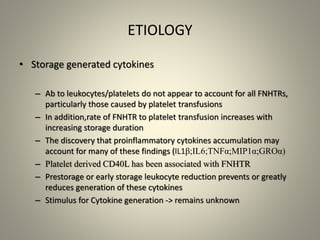
ETIOLOGY
• Storage generated cytokines
– Ab to leukocytes/platelets do not appear to account for all FNHTRs,
particularly those caused by platelet transfusions
– In addition,rate of FNHTR to platelet transfusion increases with
increasing storage duration
– The discovery that proinflammatory cytokines accumulation may
account for many of these findings (IL1β;IL6;TNFα;MIP1α;GROα)
– Platelet derived CD40L has been associated with FNHTR
– Prestorage or early storage leukocyte reduction prevents or greatly
reduces generation of these cytokines
– Stimulus for Cytokine generation -> remains unknown
ETIOLOGY
• RBC units are stored at 2-6°C which has an inhibitory effect on
cellular metabolism, the capacity of passenger leukocytes in
RBC units to synthesize and secrete cytokines is less than
those in platelet concentrate.
• Unless a Gram’s stain and bacterial culture is performed,mild
septic transfusion reactions characterized by only fever and
chills are likely to be classified as FNHTR.
PATHOGENESIS
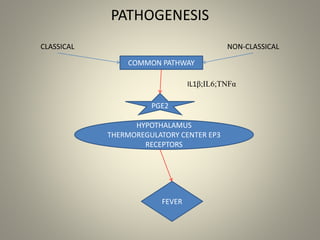
PATHOGENESIS
CLASSICAL NON-CLASSICAL
COMMON PATHWAY
IL1β;IL6;TNFα
HYPOTHALAMUS
THERMOREGULATORY CENTER EP3
RECEPTORS
PGE2
FEVER
DIAGNOSIS
• Vitals monitoring both pre and post transfusion should be
performed,particularly in the first 30-60 min
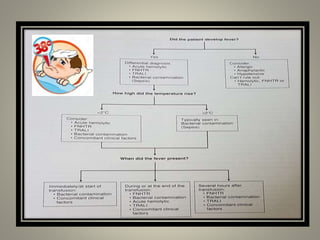
• Rule out other causes of febrile reaction like acute
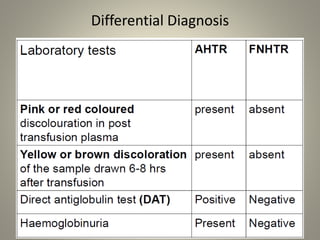
hemolysis/sepsis/TRALI as FNHTR is a diagnosis of exclusion
Differential Diagnosis
• Acute hemolytic reaction
• Bacterial contamination
• TRALI
• Disease / treatment related fever
Differential Diagnosis
Febrile reactions in infants
• Infants are incapable of shivering
• It is not unusual to observe rise in temperature up to 38.5°C
after transfusion
• Temporary refusal to feed , diarrhoea , sudden pallor and cold
skin are other markers of FNHTR
Effect of rate of infusion
• Slower infusion avoids a sudden bolus of bacterial toxins or
cytokines that may provoke an immediate and possibly
massive inflammatory response
Treatment
• Transfusion in progress should be discontinued
• Antipyretics , Acetaminophen(325-500mg) can be
administered – (unsupported , self limiting fever)
• Diphenhyramine (50-100mg) – No role
• Rigors will not respond promptly to antipyretic medications
• Meperidine (25-50mg) administered intravenously for rigors
(contraindicated in renal failure and patients on MAO
inhibitors)
Prevention
• Consider prevention if patient has had more than 2 FNHTR
• Administer paracetamol 1g po 1-3 hours before transfusion
efficacy of premedication has not been established
(advantages: no serious ADR; it doesn’t mask HTR/sepsis)
• Meperidine/Diphenhydramine/Steroids – not indicated
Prevention
• Transfused component should have < 5 X 10⁶ leukocytes/unit
• Using fresh blood and components <7days (<4d for PC)
• Reduce the transfusion rate to 75ml/hr
• Accumulated inflammatory mediators can be removed by
plasma expression
• Keep patient warm
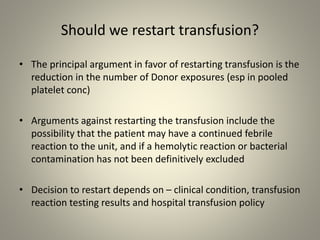
Should we restart transfusion?
• The principal argument in favor of restarting transfusion is the
reduction in the number of Donor exposures (esp in pooled
platelet conc)
• Arguments against restarting the transfusion include the
possibility that the patient may have a continued febrile
reaction to the unit, and if a hemolytic reaction or bacterial
contamination has not been definitively excluded
• Decision to restart depends on – clinical condition, transfusion
reaction testing results and hospital transfusion policy
LEUKOREDUCTION
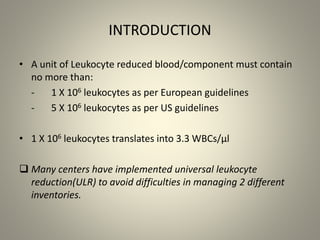
INTRODUCTION
• A unit of Leukocyte reduced blood/component must contain
no more than:
- 1 X 10⁶ leukocytes as per European guidelines
- 5 X 10⁶ leukocytes as per US guidelines
• 1 X 10⁶ leukocytes translates into 3.3 WBCs/µl
 Many centers have implemented universal leukocyte
reduction(ULR) to avoid difficulties in managing 2 different
inventories.
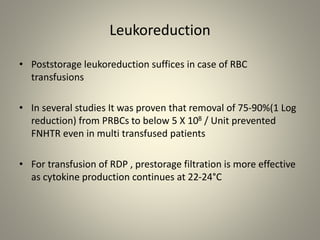
Leukoreduction
• Poststorage leukoreduction suffices in case of RBC
transfusions
• In several studies It was proven that removal of 75-90%(1 Log
reduction) from PRBCs to below 5 X 10⁸ / Unit prevented
FNHTR even in multi transfused patients
• For transfusion of RDP , prestorage filtration is more effective
as cytokine production continues at 22-24°C
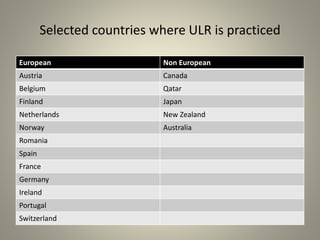
Selected countries where ULR is practiced
European Non European
Austria Canada
Belgium Qatar
Finland Japan
Netherlands New Zealand
Norway Australia
Romania
Spain
France
Germany
Ireland
Portugal
Switzerland
Techniques for Leukoreduction
• Centrifugation and buffy coat removal (1 Log reduction)
• Cell washing(1-2 Log reduction)
• Filtration(3-4 Log reduction)
• Apheresis (3-4 Log reduction)
• Freezing and deglycerolization (2-3 Log reduction)
Clinical Benefits of Leukoreduction
• Clinically proven:
- Reduced frequency and severity of FNHTR
- Reduced risk of Cytomegalovirus transmission
- Reduced risk of HLA- alloimmunization (especially in organ
transplant patients) and platelet refractoriness
- Reduced mortality , infection rates , hospital stay and organ
dysfunction in cardiovascular surgery patients
Clinical Benefits of Leukoreduction
• Likely clinically relevant:
- Reduced infectious risk associated with immunomodulation
- Reduced direct risk of transfusion transmission of bacteria
• Unproven clinically:
- Avoidance of variant Creutzfeldt - Jacob disease (vCJD)
- Avoidance of HTLV I/II , EBV etc.
-Reduced risk of Graft Versus Host Disease (GVHD)
-Reduced risk of Transfusion Associated Acute Lung Injury
(TRALI)
Prestorage Leukoreduction Advantages
• It eliminates the scope of inflammatory cytokine
accumulation  prevention of FNHTR
• Minimizes the risk of HLA alloimunization as it removes intact
leukocytes
• Minimizes the risk of leukotropic virus transmission as
leukocytes disintegrates and release interacellular organisms
after 72 hrs of storage
• It is always easier to perform QC in Lab rather than patient’s
bedside
Cost Effectiveness of Leukoreduction
• In economically poor countries , cost of ULR remains cause of
worry.
• One filter roughly costs around 900 – 1700 INR in India and around
20-40 USD
• An European study estimated cost of prevention of 1 FNHTR is
about 6,916 EUR
• Recent retrospective study in Canada revealed that 1 life was saved
for every 120 patients who received LR blood
• However trend is still in favor of ULR in wealthy countries
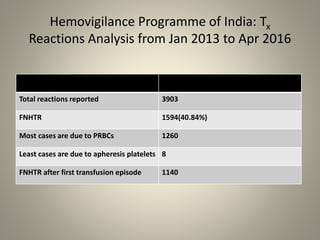
Hemovigilance Programme of India: Tx
Reactions Analysis from Jan 2013 to Apr 2016
Total reactions reported 3903
FNHTR 1594(40.84%)
Most cases are due to PRBCs 1260
Least cases are due to apheresis platelets 8
FNHTR after first transfusion episode 1140
BIBLIOGRAPHY
• Rossi’s principle of Transfusion medicine, 5th edition
• Transfusion Therapy: Clinical Principles and Practice, Mintz ,
3rd edition
• Mollison’s Blood transfusion in clinical practices , 12th edition
THANK YOU

FEBRILE NON HEMOLYTIC TRANSFUSION REACTION

  • 1.
    FEBRILE NON HEMOLYTIC TRANSFUSIONREACTION DR AKSHAYA TOMAR DEPT OF IMMUNOHEMATOLOGY AND BLOOD TRANSFUSION AFMC,PUNE
  • 2.
    INTRODUCTION • Transfusion reactionsare a diverse group of adverse events occuring as a result of transfusion that usually present during or after transfusion. • No single alogrithm can encompass all types of events.
  • 3.
    DEFINITION • Temperature increaseof at least 1°C with or without chills ,a cold sensation or discomfort • Occurrence during or within few hours of transfusion • Unrelated to hemolysis,sepsis or other known causes of fever • Most severe reaction – rigors ; temp rise of > 2°C • Fever usually persist for no more than 8-12 hrs
  • 4.
    FNHTR • Chills withor without an increase in body temperature can be classified as an FNHTR if other causes of chills are unlikely • Fever increases O2 Consumption (13% for every 1°C over 37°C) • An asymptomatic rise in temperature in a hypothermic patient should not be considered as FNHTR
  • 5.
    Problem statement • Mostfrequent reported reaction • Incidence – 0.1% to 1% (decreased after ULR) • Mostly due to transfusion of cellular components (RBCs, Platelets , Granulocytes and even IVIG) • Higher incidence for platelets(4.6%) than for RBCs (0.33%) • Not life threatening but prompt evaluation is required • In addition to the toll taken by the patients, there is an inevitable system cost with the management of these events
  • 7.
    ETIOLOGY • FNHTR appearsto be a part of Systemic inflammatory response syndrome • 2 possible underlying causes: a) Classical – leukocytes stimulate the in vivo generation of cytokines in the recipient b) Non-Classical – Pyrogenic cytokines or other inflammatory response mediators(activated complement proteins , LPS or neutrophil-priming lipids) that accumulate in the plasma portion of cellular blood components during storage
  • 8.
    ETIOLOGY • Alloimmunization toleukocytes/platelets - FNHTR risk increases with increase in passenger leukocytes - Donor Ab to leukocytes (most often have HLA specificity) associated with FNHTR less frequently - 1 X 10⁷ leukocytes / unit of RBCs is the minimum number necessary for FNHTR - Possible mechanism by which Ab-leukocyte or Ab- platelet interaction causes fever : 1) Donor monocytes may be activated and secrete pyrogenic cytokines when recipient Ab bind to them 2) Immune complex formation between recipient Ab and donor leukocytes leads to generation of activated complement components which stimulates production of PGE2
  • 9.
    ETIOLOGY • Storage generatedcytokines – Ab to leukocytes/platelets do not appear to account for all FNHTRs, particularly those caused by platelet transfusions – In addition,rate of FNHTR to platelet transfusion increases with increasing storage duration – The discovery that proinflammatory cytokines accumulation may account for many of these findings (IL1β;IL6;TNFα;MIP1α;GROα) – Platelet derived CD40L has been associated with FNHTR – Prestorage or early storage leukocyte reduction prevents or greatly reduces generation of these cytokines – Stimulus for Cytokine generation -> remains unknown
  • 10.
    ETIOLOGY • RBC unitsare stored at 2-6°C which has an inhibitory effect on cellular metabolism, the capacity of passenger leukocytes in RBC units to synthesize and secrete cytokines is less than those in platelet concentrate. • Unless a Gram’s stain and bacterial culture is performed,mild septic transfusion reactions characterized by only fever and chills are likely to be classified as FNHTR.
  • 11.
  • 12.
  • 13.
    DIAGNOSIS • Vitals monitoringboth pre and post transfusion should be performed,particularly in the first 30-60 min • Rule out other causes of febrile reaction like acute hemolysis/sepsis/TRALI as FNHTR is a diagnosis of exclusion
  • 15.
    Differential Diagnosis • Acutehemolytic reaction • Bacterial contamination • TRALI • Disease / treatment related fever
  • 16.
  • 17.
    Febrile reactions ininfants • Infants are incapable of shivering • It is not unusual to observe rise in temperature up to 38.5°C after transfusion • Temporary refusal to feed , diarrhoea , sudden pallor and cold skin are other markers of FNHTR
  • 18.
    Effect of rateof infusion • Slower infusion avoids a sudden bolus of bacterial toxins or cytokines that may provoke an immediate and possibly massive inflammatory response
  • 19.
    Treatment • Transfusion inprogress should be discontinued • Antipyretics , Acetaminophen(325-500mg) can be administered – (unsupported , self limiting fever) • Diphenhyramine (50-100mg) – No role • Rigors will not respond promptly to antipyretic medications • Meperidine (25-50mg) administered intravenously for rigors (contraindicated in renal failure and patients on MAO inhibitors)
  • 20.
    Prevention • Consider preventionif patient has had more than 2 FNHTR • Administer paracetamol 1g po 1-3 hours before transfusion efficacy of premedication has not been established (advantages: no serious ADR; it doesn’t mask HTR/sepsis) • Meperidine/Diphenhydramine/Steroids – not indicated
  • 21.
    Prevention • Transfused componentshould have < 5 X 10⁶ leukocytes/unit • Using fresh blood and components <7days (<4d for PC) • Reduce the transfusion rate to 75ml/hr • Accumulated inflammatory mediators can be removed by plasma expression • Keep patient warm
  • 22.
    Should we restarttransfusion? • The principal argument in favor of restarting transfusion is the reduction in the number of Donor exposures (esp in pooled platelet conc) • Arguments against restarting the transfusion include the possibility that the patient may have a continued febrile reaction to the unit, and if a hemolytic reaction or bacterial contamination has not been definitively excluded • Decision to restart depends on – clinical condition, transfusion reaction testing results and hospital transfusion policy
  • 23.
  • 24.
    INTRODUCTION • A unitof Leukocyte reduced blood/component must contain no more than: - 1 X 10⁶ leukocytes as per European guidelines - 5 X 10⁶ leukocytes as per US guidelines • 1 X 10⁶ leukocytes translates into 3.3 WBCs/µl  Many centers have implemented universal leukocyte reduction(ULR) to avoid difficulties in managing 2 different inventories.
  • 25.
    Leukoreduction • Poststorage leukoreductionsuffices in case of RBC transfusions • In several studies It was proven that removal of 75-90%(1 Log reduction) from PRBCs to below 5 X 10⁸ / Unit prevented FNHTR even in multi transfused patients • For transfusion of RDP , prestorage filtration is more effective as cytokine production continues at 22-24°C
  • 26.
    Selected countries whereULR is practiced European Non European Austria Canada Belgium Qatar Finland Japan Netherlands New Zealand Norway Australia Romania Spain France Germany Ireland Portugal Switzerland
  • 27.
    Techniques for Leukoreduction •Centrifugation and buffy coat removal (1 Log reduction) • Cell washing(1-2 Log reduction) • Filtration(3-4 Log reduction) • Apheresis (3-4 Log reduction) • Freezing and deglycerolization (2-3 Log reduction)
  • 28.
    Clinical Benefits ofLeukoreduction • Clinically proven: - Reduced frequency and severity of FNHTR - Reduced risk of Cytomegalovirus transmission - Reduced risk of HLA- alloimmunization (especially in organ transplant patients) and platelet refractoriness - Reduced mortality , infection rates , hospital stay and organ dysfunction in cardiovascular surgery patients
  • 29.
    Clinical Benefits ofLeukoreduction • Likely clinically relevant: - Reduced infectious risk associated with immunomodulation - Reduced direct risk of transfusion transmission of bacteria • Unproven clinically: - Avoidance of variant Creutzfeldt - Jacob disease (vCJD) - Avoidance of HTLV I/II , EBV etc. -Reduced risk of Graft Versus Host Disease (GVHD) -Reduced risk of Transfusion Associated Acute Lung Injury (TRALI)
  • 31.
    Prestorage Leukoreduction Advantages •It eliminates the scope of inflammatory cytokine accumulation  prevention of FNHTR • Minimizes the risk of HLA alloimunization as it removes intact leukocytes • Minimizes the risk of leukotropic virus transmission as leukocytes disintegrates and release interacellular organisms after 72 hrs of storage • It is always easier to perform QC in Lab rather than patient’s bedside
  • 32.
    Cost Effectiveness ofLeukoreduction • In economically poor countries , cost of ULR remains cause of worry. • One filter roughly costs around 900 – 1700 INR in India and around 20-40 USD • An European study estimated cost of prevention of 1 FNHTR is about 6,916 EUR • Recent retrospective study in Canada revealed that 1 life was saved for every 120 patients who received LR blood • However trend is still in favor of ULR in wealthy countries
  • 33.
    Hemovigilance Programme ofIndia: Tx Reactions Analysis from Jan 2013 to Apr 2016 Total reactions reported 3903 FNHTR 1594(40.84%) Most cases are due to PRBCs 1260 Least cases are due to apheresis platelets 8 FNHTR after first transfusion episode 1140
  • 34.
    BIBLIOGRAPHY • Rossi’s principleof Transfusion medicine, 5th edition • Transfusion Therapy: Clinical Principles and Practice, Mintz , 3rd edition • Mollison’s Blood transfusion in clinical practices , 12th edition
  • 35.