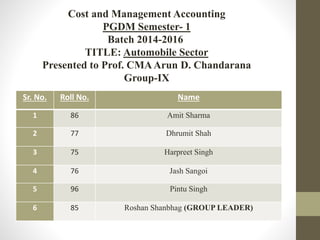
Cost and Management Accounting 
PGDM Semester- 1 
Batch 2014-2016 
TITLE: Automobile Sector 
Presented to Prof. CMA Arun D. Chandarana 
Group-IX 
Sr. No. Roll No. Name 
1 86 Amit Sharma 
2 77 Dhrumit Shah 
3 75 Harpreet Singh 
4 76 Jash Sangoi 
5 96 Pintu Singh 
6 85 Roshan Shanbhag (GROUP LEADER)
INTRODUCTION 
• The Indian automobile sector is one of its most vibrant 
industries. The industry accounts for 22 per cent of the 
country's manufacturing gross domestic product (GDP) 
• The Indian auto market has the potential to dominate the global 
auto industry, provided a conducive environment is created for 
potential innovators to come up with new pilot projects. 
• The next few years are projected to show solid but cautious 
growth due to improved affordability, rising incomes and 
untapped markets
INTRODUCTION (CONTD……) 
MARKET SIZE 
• The automobile industry produced a total of 1,861,849 
vehicles including passenger vehicles, commercial vehicles, 
three-wheelers and two-wheelers in April 2014 as against 
1,687,243 in April 2013, registering a growth of 10.35 percent 
over the corresponding month of 2013. 
• Two-wheeler sales registered growth of 11.67 percent in April 
2014 over April 2013. 
• The cumulative foreign direct investment (FDI) inflows into 
the Indian automobile industry during the period April 2000 - 
May 2014 was recorded at US$ 9,885.21 million, according to 
data published by Department of Industrial Policy and 
Promotion (DIPP).
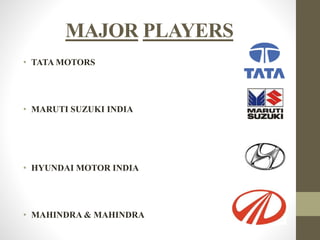
MAJOR PLAYERS 
• TATA MOTORS 
• MARUTI SUZUKI INDIA 
• HYUNDAI MOTOR INDIA 
• MAHINDRA & MAHINDRA
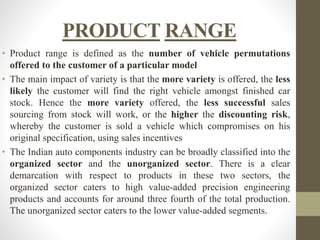
PRODUCT RANGE 
• Product range is defined as the number of vehicle permutations 
offered to the customer of a particular model 
• The main impact of variety is that the more variety is offered, the less 
likely the customer will find the right vehicle amongst finished car 
stock. Hence the more variety offered, the less successful sales 
sourcing from stock will work, or the higher the discounting risk, 
whereby the customer is sold a vehicle which compromises on his 
original specification, using sales incentives 
• The Indian auto components industry can be broadly classified into the 
organized sector and the unorganized sector. There is a clear 
demarcation with respect to products in these two sectors, the 
organized sector caters to high value-added precision engineering 
products and accounts for around three fourth of the total production. 
The unorganized sector caters to the lower value-added segments.
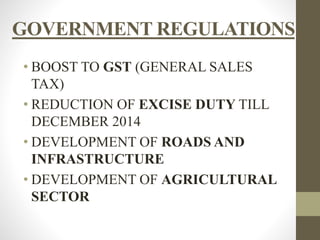
GOVERNMENT REGULATIONS 
• BOOST TO GST (GENERAL SALES 
TAX) 
• REDUCTION OF EXCISE DUTY TILL 
DECEMBER 2014 
• DEVELOPMENT OF ROADS AND 
INFRASTRUCTURE 
• DEVELOPMENT OF AGRICULTURAL 
SECTOR
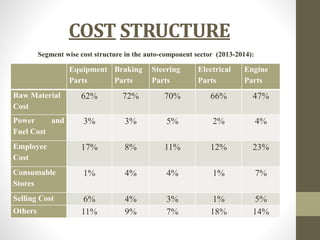
COST STRUCTURE 
Segment wise cost structure in the auto-component sector (2013-2014): 
Equipment 
Parts 
Braking 
Parts 
Steering 
Parts 
Electrical 
Parts 
Engine 
Parts 
Raw Material 
Cost 
62% 72% 70% 66% 47% 
Power and 
Fuel Cost 
3% 3% 5% 2% 4% 
Employee 
Cost 
17% 8% 11% 12% 23% 
Consumable 
Stores 
1% 4% 4% 1% 7% 
Selling Cost 6% 4% 3% 1% 5% 
Others 11% 9% 7% 18% 14%
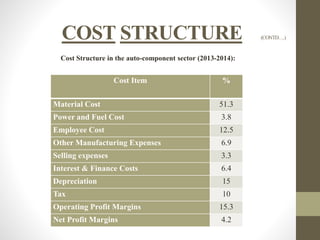
COST STRUCTURE (CONTD….) 
Cost Structure in the auto-component sector (2013-2014): 
Cost Item % 
Material Cost 51.3 
Power and Fuel Cost 3.8 
Employee Cost 12.5 
Other Manufacturing Expenses 6.9 
Selling expenses 3.3 
Interest & Finance Costs 6.4 
Depreciation 15 
Tax 10 
Operating Profit Margins 15.3 
Net Profit Margins 4.2
CONCLUSION 
• Through applying different analysis we come to know about 
the company’s product, government rules & regulations 
and their market positions 
• A fall in interest rates and stable fuel prices are expected to 
create an environment conducive for growth in this industry 
• The Automotive industry is the key driver of any growing 
economy

Costing (Mini) Project on Automobile Industry

  • 1.
    Cost and ManagementAccounting PGDM Semester- 1 Batch 2014-2016 TITLE: Automobile Sector Presented to Prof. CMA Arun D. Chandarana Group-IX Sr. No. Roll No. Name 1 86 Amit Sharma 2 77 Dhrumit Shah 3 75 Harpreet Singh 4 76 Jash Sangoi 5 96 Pintu Singh 6 85 Roshan Shanbhag (GROUP LEADER)
  • 2.
    INTRODUCTION • TheIndian automobile sector is one of its most vibrant industries. The industry accounts for 22 per cent of the country's manufacturing gross domestic product (GDP) • The Indian auto market has the potential to dominate the global auto industry, provided a conducive environment is created for potential innovators to come up with new pilot projects. • The next few years are projected to show solid but cautious growth due to improved affordability, rising incomes and untapped markets
  • 3.
    INTRODUCTION (CONTD……) MARKETSIZE • The automobile industry produced a total of 1,861,849 vehicles including passenger vehicles, commercial vehicles, three-wheelers and two-wheelers in April 2014 as against 1,687,243 in April 2013, registering a growth of 10.35 percent over the corresponding month of 2013. • Two-wheeler sales registered growth of 11.67 percent in April 2014 over April 2013. • The cumulative foreign direct investment (FDI) inflows into the Indian automobile industry during the period April 2000 - May 2014 was recorded at US$ 9,885.21 million, according to data published by Department of Industrial Policy and Promotion (DIPP).
  • 4.
    MAJOR PLAYERS •TATA MOTORS • MARUTI SUZUKI INDIA • HYUNDAI MOTOR INDIA • MAHINDRA & MAHINDRA
  • 5.
    PRODUCT RANGE •Product range is defined as the number of vehicle permutations offered to the customer of a particular model • The main impact of variety is that the more variety is offered, the less likely the customer will find the right vehicle amongst finished car stock. Hence the more variety offered, the less successful sales sourcing from stock will work, or the higher the discounting risk, whereby the customer is sold a vehicle which compromises on his original specification, using sales incentives • The Indian auto components industry can be broadly classified into the organized sector and the unorganized sector. There is a clear demarcation with respect to products in these two sectors, the organized sector caters to high value-added precision engineering products and accounts for around three fourth of the total production. The unorganized sector caters to the lower value-added segments.
  • 6.
    GOVERNMENT REGULATIONS •BOOST TO GST (GENERAL SALES TAX) • REDUCTION OF EXCISE DUTY TILL DECEMBER 2014 • DEVELOPMENT OF ROADS AND INFRASTRUCTURE • DEVELOPMENT OF AGRICULTURAL SECTOR
  • 7.
    COST STRUCTURE Segmentwise cost structure in the auto-component sector (2013-2014): Equipment Parts Braking Parts Steering Parts Electrical Parts Engine Parts Raw Material Cost 62% 72% 70% 66% 47% Power and Fuel Cost 3% 3% 5% 2% 4% Employee Cost 17% 8% 11% 12% 23% Consumable Stores 1% 4% 4% 1% 7% Selling Cost 6% 4% 3% 1% 5% Others 11% 9% 7% 18% 14%
  • 8.
    COST STRUCTURE (CONTD….) Cost Structure in the auto-component sector (2013-2014): Cost Item % Material Cost 51.3 Power and Fuel Cost 3.8 Employee Cost 12.5 Other Manufacturing Expenses 6.9 Selling expenses 3.3 Interest & Finance Costs 6.4 Depreciation 15 Tax 10 Operating Profit Margins 15.3 Net Profit Margins 4.2
  • 9.
    CONCLUSION • Throughapplying different analysis we come to know about the company’s product, government rules & regulations and their market positions • A fall in interest rates and stable fuel prices are expected to create an environment conducive for growth in this industry • The Automotive industry is the key driver of any growing economy