RATIO
ANALYSIS
GROUP 8
GROUP MEMBERS
2
NAME ROLL NO
ANKITA RANE 19106B1012
CHINMAY PANGARKAR 19106A1058
DEEPAK GUPTA 19106B1016
NEHA KADLAK 19106A1032
NIKIT CHINCHGHARE 19106A1029
NIKITA AWATE 19106B1025
PIYUSH PATIL 19106A1027
RAJAT BHAT 19106B1038
SHIVA KOPPERA 19106B1019
SHUBHAM LAHUPACHANG 19106B1059
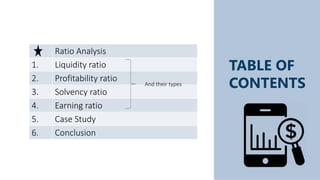
TABLE OF
CONTENTS
Ratio Analysis
1. Liquidity ratio
2. Profitability ratio
3. Solvency ratio
4. Earning ratio
5. Case Study
6. Conclusion
And their types
INTRODUCTION : RATIO ANALYSIS
4
• Ratio analysis is a quantitative method of gaining insight into a company's liquidity, operational
efficiency, and profitability by studying its financial statements such as the balance sheet and
income statement.
• It is the process of determining and interpreting numerical relationship based on financial
statements.
WHY
RATIO
ANALYSIS?
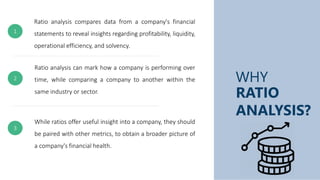
Ratio analysis compares data from a company's financial
statements to reveal insights regarding profitability, liquidity,
operational efficiency, and solvency.
Ratio analysis can mark how a company is performing over
time, while comparing a company to another within the
same industry or sector.
While ratios offer useful insight into a company, they should
be paired with other metrics, to obtain a broader picture of
a company's financial health.
1
3
2
STEPS INVOLVED: RATIO ANALYSIS
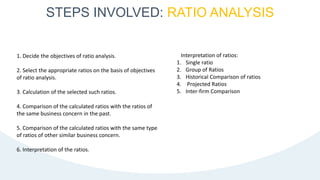
Interpretation of ratios:
1. Single ratio
2. Group of Ratios
3. Historical Comparison of ratios
4. Projected Ratios
5. Inter-firm Comparison
1. Decide the objectives of ratio analysis.
2. Select the appropriate ratios on the basis of objectives
of ratio analysis.
3. Calculation of the selected such ratios.
4. Comparison of the calculated ratios with the ratios of
the same business concern in the past.
5. Comparison of the calculated ratios with the same type
of ratios of other similar business concern.
6. Interpretation of the ratios.
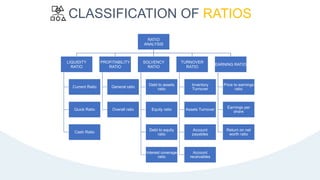
CLASSIFICATION OF RATIOS
7
RATIO
ANALYSIS
LIQUIDITY
RATIO
Current Ratio
Quick Ratio
Cash Ratio
PROFITABILITY
RATIO
General ratio
Overall ratio
SOLVENCY
RATIO
Debt to assets
ratio
Equity ratio
Debt to equity
ratio
Interest coverage
ratio
TURNOVER
RATIO
Inventory
Turnover
Assets Turnover
Account
payables
Account
receivables
EARNING RATIO
Price to earnings
ratio
Earnings per
share
Return on net
worth ratio
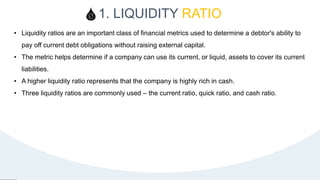
1. LIQUIDITY RATIO
8
• Liquidity ratios are an important class of financial metrics used to determine a debtor's ability to
pay off current debt obligations without raising external capital.
• The metric helps determine if a company can use its current, or liquid, assets to cover its current
liabilities.
• A higher liquidity ratio represents that the company is highly rich in cash.
• Three liquidity ratios are commonly used – the current ratio, quick ratio, and cash ratio.
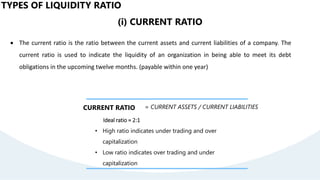
TYPES OF LIQUIDITY RATIO
(i) CURRENT RATIO
 The current ratio is the ratio between the current assets and current liabilities of a company. The
current ratio is used to indicate the liquidity of an organization in being able to meet its debt
obligations in the upcoming twelve months. (payable within one year)
CURRENT RATIO = CURRENT ASSETS / CURRENT LIABILITIES
Ideal ratio = 2:1
• High ratio indicates under trading and over
capitalization
• Low ratio indicates over trading and under
capitalization
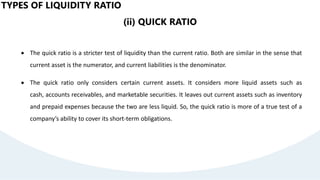
TYPES OF LIQUIDITY RATIO
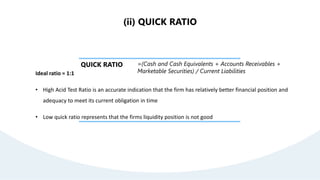
(ii) QUICK RATIO
 The quick ratio is a stricter test of liquidity than the current ratio. Both are similar in the sense that
current asset is the numerator, and current liabilities is the denominator.
 The quick ratio only considers certain current assets. It considers more liquid assets such as
cash, accounts receivables, and marketable securities. It leaves out current assets such as inventory
and prepaid expenses because the two are less liquid. So, the quick ratio is more of a true test of a
company’s ability to cover its short-term obligations.
QUICK RATIO =(Cash and Cash Equivalents + Accounts Receivables +
Marketable Securities) / Current Liabilities
Ideal ratio = 1:1
• High Acid Test Ratio is an accurate indication that the firm has relatively better financial position and
adequacy to meet its current obligation in time
• Low quick ratio represents that the firms liquidity position is not good
(ii) QUICK RATIO
TYPES OF LIQUIDITY RATIO
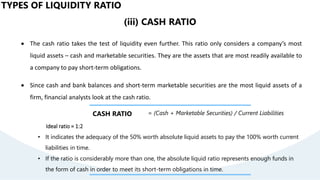
(iii) CASH RATIO
 The cash ratio takes the test of liquidity even further. This ratio only considers a company’s most
liquid assets – cash and marketable securities. They are the assets that are most readily available to
a company to pay short-term obligations.
 Since cash and bank balances and short-term marketable securities are the most liquid assets of a
firm, financial analysts look at the cash ratio.
CASH RATIO = (Cash + Marketable Securities) / Current Liabilities
Ideal ratio = 1:2
• It indicates the adequacy of the 50% worth absolute liquid assets to pay the 100% worth current
liabilities in time.
• If the ratio is considerably more than one, the absolute liquid ratio represents enough funds in
the form of cash in order to meet its short-term obligations in time.
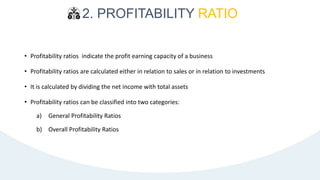
• Profitability ratios indicate the profit earning capacity of a business
• Profitability ratios are calculated either in relation to sales or in relation to investments
• It is calculated by dividing the net income with total assets
• Profitability ratios can be classified into two categories:
a) General Profitability Ratios
b) Overall Profitability Ratios
2. PROFITABILITY RATIO
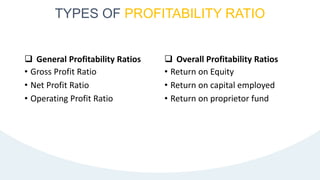
 General Profitability Ratios
• Gross Profit Ratio
• Net Profit Ratio
• Operating Profit Ratio
 Overall Profitability Ratios
• Return on Equity
• Return on capital employed
• Return on proprietor fund
TYPES OF PROFITABILITY RATIO
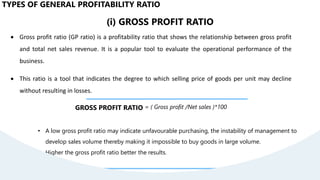
(i) GROSS PROFIT RATIO
 Gross profit ratio (GP ratio) is a profitability ratio that shows the relationship between gross profit
and total net sales revenue. It is a popular tool to evaluate the operational performance of the
business.
 This ratio is a tool that indicates the degree to which selling price of goods per unit may decline
without resulting in losses.
GROSS PROFIT RATIO = ( Gross profit /Net sales )*100
• A low gross profit ratio may indicate unfavourable purchasing, the instability of management to
develop sales volume thereby making it impossible to buy goods in large volume.
• Higher the gross profit ratio better the results.
TYPES OF GENERAL PROFITABILITY RATIO
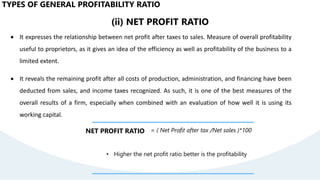
(ii) NET PROFIT RATIO
 It expresses the relationship between net profit after taxes to sales. Measure of overall profitability
useful to proprietors, as it gives an idea of the efficiency as well as profitability of the business to a
limited extent.
 It reveals the remaining profit after all costs of production, administration, and financing have been
deducted from sales, and income taxes recognized. As such, it is one of the best measures of the
overall results of a firm, especially when combined with an evaluation of how well it is using its
working capital.
NET PROFIT RATIO = ( Net Profit after tax /Net sales )*100
• Higher the net profit ratio better is the profitability
TYPES OF GENERAL PROFITABILITY RATIO
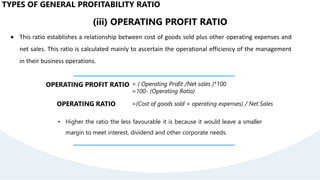
(iii) OPERATING PROFIT RATIO
 This ratio establishes a relationship between cost of goods sold plus other operating expenses and
net sales. This ratio is calculated mainly to ascertain the operational efficiency of the management
in their business operations.
OPERATING PROFIT RATIO = ( Operating Profit /Net sales )*100
=100- (Operating Ratio)
• Higher the ratio the less favourable it is because it would leave a smaller
margin to meet interest, dividend and other corporate needs.
OPERATING RATIO =(Cost of goods sold + operating expenses) / Net Sales
TYPES OF GENERAL PROFITABILITY RATIO
(i) RETURN ON EQUITY
 This ratio establishes the relationship between net profit available to equity shareholders and the
amount of capital invested by them. It is used to compare the performance of company's equity
capital with those of other companies, and thus help the investor in choosing a company with higher
return on equity capital.
RETURN ON EQUITY = ( Net Profit –Preference divided ) /
Equity share capital or Equity shareholder’s fund (paid up)
• Shareholder’s fund= Equity capital +Reserves and surplus-
Accumulated losses
TYPES OF OVERALL PROFITABILITY RATIO
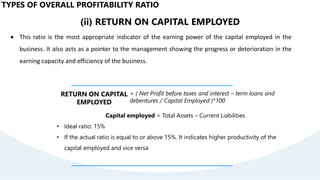
(ii) RETURN ON CAPITAL EMPLOYED
 This ratio is the most appropriate indicator of the earning power of the capital employed in the
business. It also acts as a pointer to the management showing the progress or deterioration in the
earning capacity and efficiency of the business.
RETURN ON CAPITAL
EMPLOYED
= ( Net Profit before taxes and interest – term loans and
debentures / Capital Employed )*100
Capital employed = Total Assets – Current Liabilities
• Ideal ratio: 15%
• If the actual ratio is equal to or above 15%. It indicates higher productivity of the
capital employed and vice versa
TYPES OF OVERALL PROFITABILITY RATIO
(iii) RETURN ON PROPRIETOR’s FUND or
RETURN ON SHAREHOLDER’s INVESTMENT
 Shareholders investment also called return on proprietor’s funds is the ratio of net profit to
proprietor’s funds. It is calculated by the prospective investor in the business to find out whether
the investment would be worth-making in terms of return as compared to the risk involved in the
business.
RETURN ON PROPRIETOR’s
FUND
=( Net Profit after taxes and interest / Proprietors funds)*100
Proprietor’s Funds = Equity share capital + Preference share capital+ Reserves and
surplus - Accumulated losses
• This ratio reveals how well the resources of a firm are being used, higher the ratio, better are
the results.
• The inter firm comparison of this ratio determines whether their investments in the firm are
attractive or not
3. SOLVENCY RATIO
21
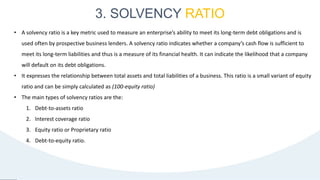
• A solvency ratio is a key metric used to measure an enterprise’s ability to meet its long-term debt obligations and is
used often by prospective business lenders. A solvency ratio indicates whether a company’s cash flow is sufficient to
meet its long-term liabilities and thus is a measure of its financial health. It can indicate the likelihood that a company
will default on its debt obligations.
• It expresses the relationship between total assets and total liabilities of a business. This ratio is a small variant of equity
ratio and can be simply calculated as (100-equity ratio)
• The main types of solvency ratios are the:
1. Debt-to-assets ratio
2. Interest coverage ratio
3. Equity ratio or Proprietary ratio
4. Debt-to-equity ratio.
(i) DEBT to ASSETS RATIO
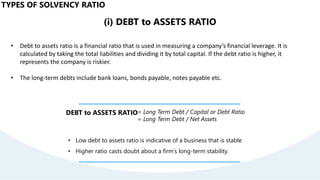
• Debt to assets ratio is a financial ratio that is used in measuring a company’s financial leverage. It is
calculated by taking the total liabilities and dividing it by total capital. If the debt ratio is higher, it
represents the company is riskier.
• The long-term debts include bank loans, bonds payable, notes payable etc.
DEBT to ASSETS RATIO= Long Term Debt / Capital or Debt Ratio
= Long Term Debt / Net Assets
• Low debt to assets ratio is indicative of a business that is stable
• Higher ratio casts doubt about a firm’s long-term stability.
TYPES OF SOLVENCY RATIO
(ii) INTEREST COVERAGE RATIO
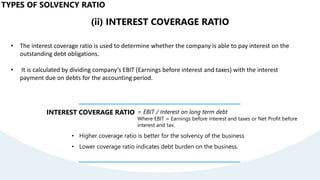
• The interest coverage ratio is used to determine whether the company is able to pay interest on the
outstanding debt obligations.
• It is calculated by dividing company’s EBIT (Earnings before interest and taxes) with the interest
payment due on debts for the accounting period.
INTEREST COVERAGE RATIO = EBIT / Interest on long term debt
Where EBIT = Earnings before interest and taxes or Net Profit before
interest and tax.
• Higher coverage ratio is better for the solvency of the business
• Lower coverage ratio indicates debt burden on the business.
TYPES OF SOLVENCY RATIO
(iii) EQUITY RATIO or PROPRIETARY RATIO
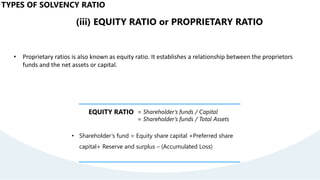
• Proprietary ratios is also known as equity ratio. It establishes a relationship between the proprietors
funds and the net assets or capital.
EQUITY RATIO = Shareholder’s funds / Capital
= Shareholder’s funds / Total Assets
• Shareholder’s fund = Equity share capital +Preferred share
capital+ Reserve and surplus – (Accumulated Loss)
TYPES OF SOLVENCY RATIO
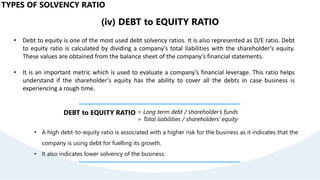
(iv) DEBT to EQUITY RATIO
• Debt to equity is one of the most used debt solvency ratios. It is also represented as D/E ratio. Debt
to equity ratio is calculated by dividing a company’s total liabilities with the shareholder’s equity.
These values are obtained from the balance sheet of the company’s financial statements.
• It is an important metric which is used to evaluate a company’s financial leverage. This ratio helps
understand if the shareholder’s equity has the ability to cover all the debts in case business is
experiencing a rough time.
DEBT to EQUITY RATIO = Long term debt / shareholder’s funds
= Total liabilities / shareholders’ equity
• A high debt-to-equity ratio is associated with a higher risk for the business as it indicates that the
company is using debt for fuelling its growth.
• It also indicates lower solvency of the business.
TYPES OF SOLVENCY RATIO
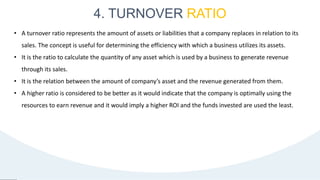
4. TURNOVER RATIO
26
• A turnover ratio represents the amount of assets or liabilities that a company replaces in relation to its
sales. The concept is useful for determining the efficiency with which a business utilizes its assets.
• It is the ratio to calculate the quantity of any asset which is used by a business to generate revenue
through its sales.
• It is the relation between the amount of company’s asset and the revenue generated from them.
• A higher ratio is considered to be better as it would indicate that the company is optimally using the
resources to earn revenue and it would imply a higher ROI and the funds invested are used the least.
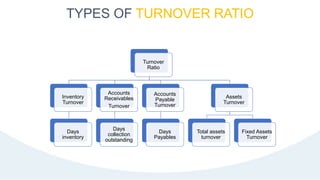
Turnover
Ratio
Inventory
Turnover
Days
inventory
Accounts
Receivables
Turnover
Days
collection
outstanding
Accounts
Payable
Turnover
Days
Payables
Assets
Turnover
Total assets
turnover
Fixed Assets
Turnover
TYPES OF TURNOVER RATIO
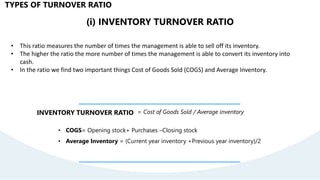
(i) INVENTORY TURNOVER RATIO
• This ratio measures the number of times the management is able to sell off its inventory.
• The higher the ratio the more number of times the management is able to convert its inventory into
cash.
• In the ratio we find two important things Cost of Goods Sold (COGS) and Average Inventory.
INVENTORY TURNOVER RATIO = Cost of Goods Sold / Average inventory
• COGS= Opening stock+ Purchases –Closing stock
• Average Inventory = (Current year inventory +Previous year inventory)/2
TYPES OF TURNOVER RATIO
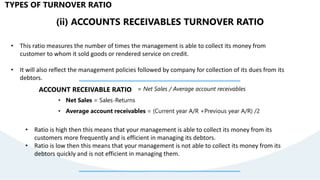
(ii) ACCOUNTS RECEIVABLES TURNOVER RATIO
• This ratio measures the number of times the management is able to collect its money from
customer to whom it sold goods or rendered service on credit.
• It will also reflect the management policies followed by company for collection of its dues from its
debtors.
ACCOUNT RECEIVABLE RATIO = Net Sales / Average account receivables
• Net Sales = Sales-Returns
• Average account receivables = (Current year A/R +Previous year A/R) /2
TYPES OF TURNOVER RATIO
• Ratio is high then this means that your management is able to collect its money from its
customers more frequently and is efficient in managing its debtors.
• Ratio is low then this means that your management is not able to collect its money from its
debtors quickly and is not efficient in managing them.
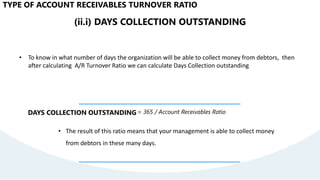
(ii.i) DAYS COLLECTION OUTSTANDING
• To know in what number of days the organization will be able to collect money from debtors, then
after calculating A/R Turnover Ratio we can calculate Days Collection outstanding
DAYS COLLECTION OUTSTANDING= 365 / Account Receivables Ratio
• The result of this ratio means that your management is able to collect money
from debtors in these many days.
TYPE OF ACCOUNT RECEIVABLES TURNOVER RATIO
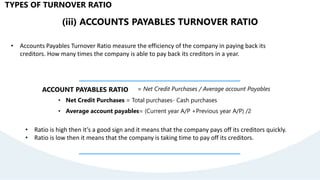
(iii) ACCOUNTS PAYABLES TURNOVER RATIO
• Accounts Payables Turnover Ratio measure the efficiency of the company in paying back its
creditors. How many times the company is able to pay back its creditors in a year.
ACCOUNT PAYABLES RATIO = Net Credit Purchases / Average account Payables
• Net Credit Purchases = Total purchases- Cash purchases
• Average account payables= (Current year A/P +Previous year A/P) /2
TYPES OF TURNOVER RATIO
• Ratio is high then it’s a good sign and it means that the company pays off its creditors quickly.
• Ratio is low then it means that the company is taking time to pay off its creditors.
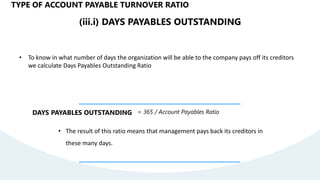
(iii.i) DAYS PAYABLES OUTSTANDING
• To know in what number of days the organization will be able to the company pays off its creditors
we calculate Days Payables Outstanding Ratio
DAYS PAYABLES OUTSTANDING = 365 / Account Payables Ratio
• The result of this ratio means that management pays back its creditors in
these many days.
TYPE OF ACCOUNT PAYABLE TURNOVER RATIO
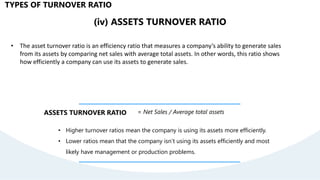
(iv) ASSETS TURNOVER RATIO
• The asset turnover ratio is an efficiency ratio that measures a company’s ability to generate sales
from its assets by comparing net sales with average total assets. In other words, this ratio shows
how efficiently a company can use its assets to generate sales.
ASSETS TURNOVER RATIO = Net Sales / Average total assets
• Higher turnover ratios mean the company is using its assets more efficiently.
• Lower ratios mean that the company isn’t using its assets efficiently and most
likely have management or production problems.
TYPES OF TURNOVER RATIO
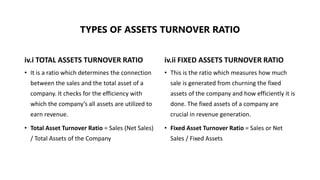
iv.i TOTAL ASSETS TURNOVER RATIO
• It is a ratio which determines the connection
between the sales and the total asset of a
company. It checks for the efficiency with
which the company’s all assets are utilized to
earn revenue.
• Total Asset Turnover Ratio = Sales (Net Sales)
/ Total Assets of the Company
iv.ii FIXED ASSETS TURNOVER RATIO
• This is the ratio which measures how much
sale is generated from churning the fixed
assets of the company and how efficiently it is
done. The fixed assets of a company are
crucial in revenue generation.
• Fixed Asset Turnover Ratio = Sales or Net
Sales / Fixed Assets
TYPES OF ASSETS TURNOVER RATIO
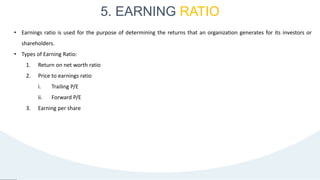
5. EARNING RATIO
35
• Earnings ratio is used for the purpose of determining the returns that an organization generates for its investors or
shareholders.
• Types of Earning Ratio:
1. Return on net worth ratio
2. Price to earnings ratio
i. Trailing P/E
ii. Forward P/E
3. Earning per share
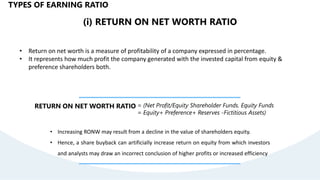
(i) RETURN ON NET WORTH RATIO
• Return on net worth is a measure of profitability of a company expressed in percentage.
• It represents how much profit the company generated with the invested capital from equity &
preference shareholders both.
RETURN ON NET WORTH RATIO = (Net Profit/Equity Shareholder Funds. Equity Funds
= Equity+ Preference+ Reserves -Fictitious Assets)
• Increasing RONW may result from a decline in the value of shareholders equity.
• Hence, a share buyback can artificially increase return on equity from which investors
and analysts may draw an incorrect conclusion of higher profits or increased efficiency
TYPES OF EARNING RATIO
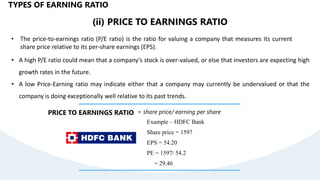
(ii) PRICE TO EARNINGS RATIO
• The price-to-earnings ratio (P/E ratio) is the ratio for valuing a company that measures its current
share price relative to its per-share earnings (EPS).
PRICE TO EARNINGS RATIO = share price/ earning per share
• A high P/E ratio could mean that a company's stock is over-valued, or else that investors are expecting high
growth rates in the future.
• A low Price-Earning ratio may indicate either that a company may currently be undervalued or that the
company is doing exceptionally well relative to its past trends.
TYPES OF EARNING RATIO
Example – HDFC Bank
Share price = 1597
EPS = 54.20
PE = 1597/ 54.2
= 29.46
(i) TRAILING PRICE TO EARNINGS RATIO
• The trailing P/E relies on past performance by dividing the current share price by the total EPS
earnings over the past 12 months.
VERSIONS OF PRICE TO EARNING RATIO
(ii) FORWARD PRICE TO EARNINGS RATIO
• Instead of net income, this uses estimated net earnings over next 12 months. Estimates are typically
derived as the mean of those published by a select group of analysts.
 If the forward P/E ratio is lower than the trailing P/E ratio, it means analysts are expecting
earnings of company to increase
 If the forward P/E is higher than the current P/E ratio, analysts expect a decrease in earnings of
company.
(iii) EARNINGS PER SHARE RATIO
• Earnings Per Share represents the monetary value of the earnings of each shareholder. It is one of
the major components looked at by the analyst while investing in equity markets.
• EPS is typically used by analysts and traders to gauge the financial strength of a company. It is often
considered to be one of the most important variables in determining a stock's value
EARNINGS PER SHARE RATIO = (net income – preferred dividends) / average outstanding
common shares
• A higher EPS means a company is profitable enough to pay out more money to its
shareholders.
• A company with a steadily increasing EPS is considered to be a more reliable
investment than one whose EPS is on the decline or varies substantially
TYPES OF EARNING RATIO
EARNINGS PER SHARE RATIO
Example
XYZ Company
• Net income of Rs. 10 lakh
• Rs. 2 lakh as preferred dividends
and has
• Rs. 4 lakh common share
outstanding
Therefore, the EPS of XYZ Company
= Rs. (10,00,000 – 2,00,000)/
4,00,000
= Rs. 2 per share
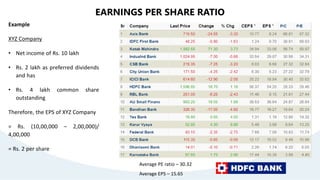
Average PE ratio – 30.32
Average EPS – 15.65
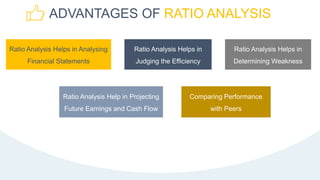
ADVANTAGES OF RATIO ANALYSIS
41
Ratio Analysis Helps in Analysing
Financial Statements
Ratio Analysis Helps in
Judging the Efficiency
Ratio Analysis Helps in
Determining Weakness
Ratio Analysis Help in Projecting
Future Earnings and Cash Flow
Comparing Performance
with Peers
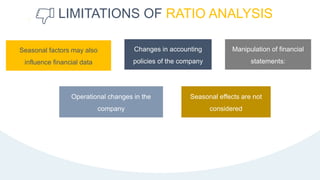
LIMITATIONS OF RATIO ANALYSIS
42
Seasonal factors may also
influence financial data
Changes in accounting
policies of the company
Manipulation of financial
statements:
Operational changes in the
company
Seasonal effects are not
considered
Case Study
ANALYSIS
44
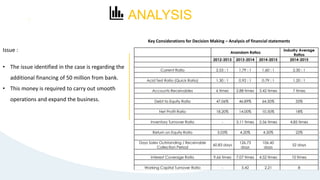
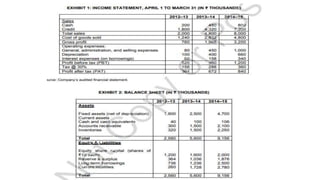
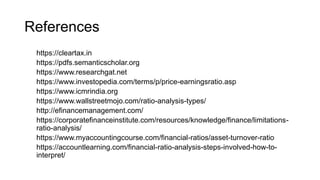
Issue :
• The issue identified in the case is regarding the
additional financing of 50 million from bank.
• This money is required to carry out smooth
operations and expand the business.
Key Considerations for Decision Making – Analysis of financial statements
ANALYSIS
45
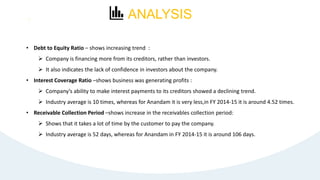
• Debt to Equity Ratio – shows increasing trend :
 Company is financing more from its creditors, rather than investors.
 It also indicates the lack of confidence in investors about the company.
• Interest Coverage Ratio –shows business was generating profits :
 Company’s ability to make interest payments to its creditors showed a declining trend.
 Industry average is 10 times, whereas for Anandam it is very less,in FY 2014-15 it is around 4.52 times.
• Receivable Collection Period –shows increase in the receivables collection period:
 Shows that it takes a lot of time by the customer to pay the company.
 Industry average is 52 days, whereas for Anandam in FY 2014-15 it is around 106 days.
CONCLUSION
• Investors and analysts employ ratio analysis to evaluate the financial health of companies by scrutinizing
past and current financial statements.
• Investors can use ratio analysis easily, and every figure needed to calculate the ratios is found on a
company's financial statements.
• Ratios are comparison points for companies. They evaluate stocks within an industry.
• It is important to understand the variables driving ratios, as management has the flexibility to, alter its
strategy to make its stock and company ratios more attractive.
• Having a good idea of the ratios in each of the four previously mentioned categories will give a
comprehensive view of the company from different angles and will help to spot potential red flags.
References
https://cleartax.in
https://pdfs.semanticscholar.org
https://www.researchgat.net
https://www.investopedia.com/terms/p/price-earningsratio.asp
https://www.icmrindia.org
https://www.wallstreetmojo.com/ratio-analysis-types/
http://efinancemanagement.com/
https://corporatefinanceinstitute.com/resources/knowledge/finance/limitations-
ratio-analysis/
https://www.myaccountingcourse.com/financial-ratios/asset-turnover-ratio
https://accountlearning.com/financial-ratio-analysis-steps-involved-how-to-
interpret/
THANK
YOU

Ratio Analysis

  • 1.
  • 2.
    GROUP MEMBERS 2 NAME ROLLNO ANKITA RANE 19106B1012 CHINMAY PANGARKAR 19106A1058 DEEPAK GUPTA 19106B1016 NEHA KADLAK 19106A1032 NIKIT CHINCHGHARE 19106A1029 NIKITA AWATE 19106B1025 PIYUSH PATIL 19106A1027 RAJAT BHAT 19106B1038 SHIVA KOPPERA 19106B1019 SHUBHAM LAHUPACHANG 19106B1059
  • 3.
    TABLE OF CONTENTS Ratio Analysis 1.Liquidity ratio 2. Profitability ratio 3. Solvency ratio 4. Earning ratio 5. Case Study 6. Conclusion And their types
  • 4.
    INTRODUCTION : RATIOANALYSIS 4 • Ratio analysis is a quantitative method of gaining insight into a company's liquidity, operational efficiency, and profitability by studying its financial statements such as the balance sheet and income statement. • It is the process of determining and interpreting numerical relationship based on financial statements.
  • 5.
    WHY RATIO ANALYSIS? Ratio analysis comparesdata from a company's financial statements to reveal insights regarding profitability, liquidity, operational efficiency, and solvency. Ratio analysis can mark how a company is performing over time, while comparing a company to another within the same industry or sector. While ratios offer useful insight into a company, they should be paired with other metrics, to obtain a broader picture of a company's financial health. 1 3 2
  • 6.
    STEPS INVOLVED: RATIOANALYSIS Interpretation of ratios: 1. Single ratio 2. Group of Ratios 3. Historical Comparison of ratios 4. Projected Ratios 5. Inter-firm Comparison 1. Decide the objectives of ratio analysis. 2. Select the appropriate ratios on the basis of objectives of ratio analysis. 3. Calculation of the selected such ratios. 4. Comparison of the calculated ratios with the ratios of the same business concern in the past. 5. Comparison of the calculated ratios with the same type of ratios of other similar business concern. 6. Interpretation of the ratios.
  • 7.
    CLASSIFICATION OF RATIOS 7 RATIO ANALYSIS LIQUIDITY RATIO CurrentRatio Quick Ratio Cash Ratio PROFITABILITY RATIO General ratio Overall ratio SOLVENCY RATIO Debt to assets ratio Equity ratio Debt to equity ratio Interest coverage ratio TURNOVER RATIO Inventory Turnover Assets Turnover Account payables Account receivables EARNING RATIO Price to earnings ratio Earnings per share Return on net worth ratio
  • 8.
    1. LIQUIDITY RATIO 8 •Liquidity ratios are an important class of financial metrics used to determine a debtor's ability to pay off current debt obligations without raising external capital. • The metric helps determine if a company can use its current, or liquid, assets to cover its current liabilities. • A higher liquidity ratio represents that the company is highly rich in cash. • Three liquidity ratios are commonly used – the current ratio, quick ratio, and cash ratio.
  • 9.
    TYPES OF LIQUIDITYRATIO (i) CURRENT RATIO  The current ratio is the ratio between the current assets and current liabilities of a company. The current ratio is used to indicate the liquidity of an organization in being able to meet its debt obligations in the upcoming twelve months. (payable within one year) CURRENT RATIO = CURRENT ASSETS / CURRENT LIABILITIES Ideal ratio = 2:1 • High ratio indicates under trading and over capitalization • Low ratio indicates over trading and under capitalization
  • 10.
    TYPES OF LIQUIDITYRATIO (ii) QUICK RATIO  The quick ratio is a stricter test of liquidity than the current ratio. Both are similar in the sense that current asset is the numerator, and current liabilities is the denominator.  The quick ratio only considers certain current assets. It considers more liquid assets such as cash, accounts receivables, and marketable securities. It leaves out current assets such as inventory and prepaid expenses because the two are less liquid. So, the quick ratio is more of a true test of a company’s ability to cover its short-term obligations.
  • 11.
    QUICK RATIO =(Cashand Cash Equivalents + Accounts Receivables + Marketable Securities) / Current Liabilities Ideal ratio = 1:1 • High Acid Test Ratio is an accurate indication that the firm has relatively better financial position and adequacy to meet its current obligation in time • Low quick ratio represents that the firms liquidity position is not good (ii) QUICK RATIO
  • 12.
    TYPES OF LIQUIDITYRATIO (iii) CASH RATIO  The cash ratio takes the test of liquidity even further. This ratio only considers a company’s most liquid assets – cash and marketable securities. They are the assets that are most readily available to a company to pay short-term obligations.  Since cash and bank balances and short-term marketable securities are the most liquid assets of a firm, financial analysts look at the cash ratio. CASH RATIO = (Cash + Marketable Securities) / Current Liabilities Ideal ratio = 1:2 • It indicates the adequacy of the 50% worth absolute liquid assets to pay the 100% worth current liabilities in time. • If the ratio is considerably more than one, the absolute liquid ratio represents enough funds in the form of cash in order to meet its short-term obligations in time.
  • 13.
    • Profitability ratiosindicate the profit earning capacity of a business • Profitability ratios are calculated either in relation to sales or in relation to investments • It is calculated by dividing the net income with total assets • Profitability ratios can be classified into two categories: a) General Profitability Ratios b) Overall Profitability Ratios 2. PROFITABILITY RATIO
  • 14.
     General ProfitabilityRatios • Gross Profit Ratio • Net Profit Ratio • Operating Profit Ratio  Overall Profitability Ratios • Return on Equity • Return on capital employed • Return on proprietor fund TYPES OF PROFITABILITY RATIO
  • 15.
    (i) GROSS PROFITRATIO  Gross profit ratio (GP ratio) is a profitability ratio that shows the relationship between gross profit and total net sales revenue. It is a popular tool to evaluate the operational performance of the business.  This ratio is a tool that indicates the degree to which selling price of goods per unit may decline without resulting in losses. GROSS PROFIT RATIO = ( Gross profit /Net sales )*100 • A low gross profit ratio may indicate unfavourable purchasing, the instability of management to develop sales volume thereby making it impossible to buy goods in large volume. • Higher the gross profit ratio better the results. TYPES OF GENERAL PROFITABILITY RATIO
  • 16.
    (ii) NET PROFITRATIO  It expresses the relationship between net profit after taxes to sales. Measure of overall profitability useful to proprietors, as it gives an idea of the efficiency as well as profitability of the business to a limited extent.  It reveals the remaining profit after all costs of production, administration, and financing have been deducted from sales, and income taxes recognized. As such, it is one of the best measures of the overall results of a firm, especially when combined with an evaluation of how well it is using its working capital. NET PROFIT RATIO = ( Net Profit after tax /Net sales )*100 • Higher the net profit ratio better is the profitability TYPES OF GENERAL PROFITABILITY RATIO
  • 17.
    (iii) OPERATING PROFITRATIO  This ratio establishes a relationship between cost of goods sold plus other operating expenses and net sales. This ratio is calculated mainly to ascertain the operational efficiency of the management in their business operations. OPERATING PROFIT RATIO = ( Operating Profit /Net sales )*100 =100- (Operating Ratio) • Higher the ratio the less favourable it is because it would leave a smaller margin to meet interest, dividend and other corporate needs. OPERATING RATIO =(Cost of goods sold + operating expenses) / Net Sales TYPES OF GENERAL PROFITABILITY RATIO
  • 18.
    (i) RETURN ONEQUITY  This ratio establishes the relationship between net profit available to equity shareholders and the amount of capital invested by them. It is used to compare the performance of company's equity capital with those of other companies, and thus help the investor in choosing a company with higher return on equity capital. RETURN ON EQUITY = ( Net Profit –Preference divided ) / Equity share capital or Equity shareholder’s fund (paid up) • Shareholder’s fund= Equity capital +Reserves and surplus- Accumulated losses TYPES OF OVERALL PROFITABILITY RATIO
  • 19.
    (ii) RETURN ONCAPITAL EMPLOYED  This ratio is the most appropriate indicator of the earning power of the capital employed in the business. It also acts as a pointer to the management showing the progress or deterioration in the earning capacity and efficiency of the business. RETURN ON CAPITAL EMPLOYED = ( Net Profit before taxes and interest – term loans and debentures / Capital Employed )*100 Capital employed = Total Assets – Current Liabilities • Ideal ratio: 15% • If the actual ratio is equal to or above 15%. It indicates higher productivity of the capital employed and vice versa TYPES OF OVERALL PROFITABILITY RATIO
  • 20.
    TYPES OF OVERALLPROFITABILITY RATIO (iii) RETURN ON PROPRIETOR’s FUND or RETURN ON SHAREHOLDER’s INVESTMENT  Shareholders investment also called return on proprietor’s funds is the ratio of net profit to proprietor’s funds. It is calculated by the prospective investor in the business to find out whether the investment would be worth-making in terms of return as compared to the risk involved in the business. RETURN ON PROPRIETOR’s FUND =( Net Profit after taxes and interest / Proprietors funds)*100 Proprietor’s Funds = Equity share capital + Preference share capital+ Reserves and surplus - Accumulated losses • This ratio reveals how well the resources of a firm are being used, higher the ratio, better are the results. • The inter firm comparison of this ratio determines whether their investments in the firm are attractive or not
  • 21.
    3. SOLVENCY RATIO 21 •A solvency ratio is a key metric used to measure an enterprise’s ability to meet its long-term debt obligations and is used often by prospective business lenders. A solvency ratio indicates whether a company’s cash flow is sufficient to meet its long-term liabilities and thus is a measure of its financial health. It can indicate the likelihood that a company will default on its debt obligations. • It expresses the relationship between total assets and total liabilities of a business. This ratio is a small variant of equity ratio and can be simply calculated as (100-equity ratio) • The main types of solvency ratios are the: 1. Debt-to-assets ratio 2. Interest coverage ratio 3. Equity ratio or Proprietary ratio 4. Debt-to-equity ratio.
  • 22.
    (i) DEBT toASSETS RATIO • Debt to assets ratio is a financial ratio that is used in measuring a company’s financial leverage. It is calculated by taking the total liabilities and dividing it by total capital. If the debt ratio is higher, it represents the company is riskier. • The long-term debts include bank loans, bonds payable, notes payable etc. DEBT to ASSETS RATIO= Long Term Debt / Capital or Debt Ratio = Long Term Debt / Net Assets • Low debt to assets ratio is indicative of a business that is stable • Higher ratio casts doubt about a firm’s long-term stability. TYPES OF SOLVENCY RATIO
  • 23.
    (ii) INTEREST COVERAGERATIO • The interest coverage ratio is used to determine whether the company is able to pay interest on the outstanding debt obligations. • It is calculated by dividing company’s EBIT (Earnings before interest and taxes) with the interest payment due on debts for the accounting period. INTEREST COVERAGE RATIO = EBIT / Interest on long term debt Where EBIT = Earnings before interest and taxes or Net Profit before interest and tax. • Higher coverage ratio is better for the solvency of the business • Lower coverage ratio indicates debt burden on the business. TYPES OF SOLVENCY RATIO
  • 24.
    (iii) EQUITY RATIOor PROPRIETARY RATIO • Proprietary ratios is also known as equity ratio. It establishes a relationship between the proprietors funds and the net assets or capital. EQUITY RATIO = Shareholder’s funds / Capital = Shareholder’s funds / Total Assets • Shareholder’s fund = Equity share capital +Preferred share capital+ Reserve and surplus – (Accumulated Loss) TYPES OF SOLVENCY RATIO
  • 25.
    (iv) DEBT toEQUITY RATIO • Debt to equity is one of the most used debt solvency ratios. It is also represented as D/E ratio. Debt to equity ratio is calculated by dividing a company’s total liabilities with the shareholder’s equity. These values are obtained from the balance sheet of the company’s financial statements. • It is an important metric which is used to evaluate a company’s financial leverage. This ratio helps understand if the shareholder’s equity has the ability to cover all the debts in case business is experiencing a rough time. DEBT to EQUITY RATIO = Long term debt / shareholder’s funds = Total liabilities / shareholders’ equity • A high debt-to-equity ratio is associated with a higher risk for the business as it indicates that the company is using debt for fuelling its growth. • It also indicates lower solvency of the business. TYPES OF SOLVENCY RATIO
  • 26.
    4. TURNOVER RATIO 26 •A turnover ratio represents the amount of assets or liabilities that a company replaces in relation to its sales. The concept is useful for determining the efficiency with which a business utilizes its assets. • It is the ratio to calculate the quantity of any asset which is used by a business to generate revenue through its sales. • It is the relation between the amount of company’s asset and the revenue generated from them. • A higher ratio is considered to be better as it would indicate that the company is optimally using the resources to earn revenue and it would imply a higher ROI and the funds invested are used the least.
  • 27.
  • 28.
    (i) INVENTORY TURNOVERRATIO • This ratio measures the number of times the management is able to sell off its inventory. • The higher the ratio the more number of times the management is able to convert its inventory into cash. • In the ratio we find two important things Cost of Goods Sold (COGS) and Average Inventory. INVENTORY TURNOVER RATIO = Cost of Goods Sold / Average inventory • COGS= Opening stock+ Purchases –Closing stock • Average Inventory = (Current year inventory +Previous year inventory)/2 TYPES OF TURNOVER RATIO
  • 29.
    (ii) ACCOUNTS RECEIVABLESTURNOVER RATIO • This ratio measures the number of times the management is able to collect its money from customer to whom it sold goods or rendered service on credit. • It will also reflect the management policies followed by company for collection of its dues from its debtors. ACCOUNT RECEIVABLE RATIO = Net Sales / Average account receivables • Net Sales = Sales-Returns • Average account receivables = (Current year A/R +Previous year A/R) /2 TYPES OF TURNOVER RATIO • Ratio is high then this means that your management is able to collect its money from its customers more frequently and is efficient in managing its debtors. • Ratio is low then this means that your management is not able to collect its money from its debtors quickly and is not efficient in managing them.
  • 30.
    (ii.i) DAYS COLLECTIONOUTSTANDING • To know in what number of days the organization will be able to collect money from debtors, then after calculating A/R Turnover Ratio we can calculate Days Collection outstanding DAYS COLLECTION OUTSTANDING= 365 / Account Receivables Ratio • The result of this ratio means that your management is able to collect money from debtors in these many days. TYPE OF ACCOUNT RECEIVABLES TURNOVER RATIO
  • 31.
    (iii) ACCOUNTS PAYABLESTURNOVER RATIO • Accounts Payables Turnover Ratio measure the efficiency of the company in paying back its creditors. How many times the company is able to pay back its creditors in a year. ACCOUNT PAYABLES RATIO = Net Credit Purchases / Average account Payables • Net Credit Purchases = Total purchases- Cash purchases • Average account payables= (Current year A/P +Previous year A/P) /2 TYPES OF TURNOVER RATIO • Ratio is high then it’s a good sign and it means that the company pays off its creditors quickly. • Ratio is low then it means that the company is taking time to pay off its creditors.
  • 32.
    (iii.i) DAYS PAYABLESOUTSTANDING • To know in what number of days the organization will be able to the company pays off its creditors we calculate Days Payables Outstanding Ratio DAYS PAYABLES OUTSTANDING = 365 / Account Payables Ratio • The result of this ratio means that management pays back its creditors in these many days. TYPE OF ACCOUNT PAYABLE TURNOVER RATIO
  • 33.
    (iv) ASSETS TURNOVERRATIO • The asset turnover ratio is an efficiency ratio that measures a company’s ability to generate sales from its assets by comparing net sales with average total assets. In other words, this ratio shows how efficiently a company can use its assets to generate sales. ASSETS TURNOVER RATIO = Net Sales / Average total assets • Higher turnover ratios mean the company is using its assets more efficiently. • Lower ratios mean that the company isn’t using its assets efficiently and most likely have management or production problems. TYPES OF TURNOVER RATIO
  • 34.
    iv.i TOTAL ASSETSTURNOVER RATIO • It is a ratio which determines the connection between the sales and the total asset of a company. It checks for the efficiency with which the company’s all assets are utilized to earn revenue. • Total Asset Turnover Ratio = Sales (Net Sales) / Total Assets of the Company iv.ii FIXED ASSETS TURNOVER RATIO • This is the ratio which measures how much sale is generated from churning the fixed assets of the company and how efficiently it is done. The fixed assets of a company are crucial in revenue generation. • Fixed Asset Turnover Ratio = Sales or Net Sales / Fixed Assets TYPES OF ASSETS TURNOVER RATIO
  • 35.
    5. EARNING RATIO 35 •Earnings ratio is used for the purpose of determining the returns that an organization generates for its investors or shareholders. • Types of Earning Ratio: 1. Return on net worth ratio 2. Price to earnings ratio i. Trailing P/E ii. Forward P/E 3. Earning per share
  • 36.
    (i) RETURN ONNET WORTH RATIO • Return on net worth is a measure of profitability of a company expressed in percentage. • It represents how much profit the company generated with the invested capital from equity & preference shareholders both. RETURN ON NET WORTH RATIO = (Net Profit/Equity Shareholder Funds. Equity Funds = Equity+ Preference+ Reserves -Fictitious Assets) • Increasing RONW may result from a decline in the value of shareholders equity. • Hence, a share buyback can artificially increase return on equity from which investors and analysts may draw an incorrect conclusion of higher profits or increased efficiency TYPES OF EARNING RATIO
  • 37.
    (ii) PRICE TOEARNINGS RATIO • The price-to-earnings ratio (P/E ratio) is the ratio for valuing a company that measures its current share price relative to its per-share earnings (EPS). PRICE TO EARNINGS RATIO = share price/ earning per share • A high P/E ratio could mean that a company's stock is over-valued, or else that investors are expecting high growth rates in the future. • A low Price-Earning ratio may indicate either that a company may currently be undervalued or that the company is doing exceptionally well relative to its past trends. TYPES OF EARNING RATIO Example – HDFC Bank Share price = 1597 EPS = 54.20 PE = 1597/ 54.2 = 29.46
  • 38.
    (i) TRAILING PRICETO EARNINGS RATIO • The trailing P/E relies on past performance by dividing the current share price by the total EPS earnings over the past 12 months. VERSIONS OF PRICE TO EARNING RATIO (ii) FORWARD PRICE TO EARNINGS RATIO • Instead of net income, this uses estimated net earnings over next 12 months. Estimates are typically derived as the mean of those published by a select group of analysts.  If the forward P/E ratio is lower than the trailing P/E ratio, it means analysts are expecting earnings of company to increase  If the forward P/E is higher than the current P/E ratio, analysts expect a decrease in earnings of company.
  • 39.
    (iii) EARNINGS PERSHARE RATIO • Earnings Per Share represents the monetary value of the earnings of each shareholder. It is one of the major components looked at by the analyst while investing in equity markets. • EPS is typically used by analysts and traders to gauge the financial strength of a company. It is often considered to be one of the most important variables in determining a stock's value EARNINGS PER SHARE RATIO = (net income – preferred dividends) / average outstanding common shares • A higher EPS means a company is profitable enough to pay out more money to its shareholders. • A company with a steadily increasing EPS is considered to be a more reliable investment than one whose EPS is on the decline or varies substantially TYPES OF EARNING RATIO
  • 40.
    EARNINGS PER SHARERATIO Example XYZ Company • Net income of Rs. 10 lakh • Rs. 2 lakh as preferred dividends and has • Rs. 4 lakh common share outstanding Therefore, the EPS of XYZ Company = Rs. (10,00,000 – 2,00,000)/ 4,00,000 = Rs. 2 per share Average PE ratio – 30.32 Average EPS – 15.65
  • 41.
    ADVANTAGES OF RATIOANALYSIS 41 Ratio Analysis Helps in Analysing Financial Statements Ratio Analysis Helps in Judging the Efficiency Ratio Analysis Helps in Determining Weakness Ratio Analysis Help in Projecting Future Earnings and Cash Flow Comparing Performance with Peers
  • 42.
    LIMITATIONS OF RATIOANALYSIS 42 Seasonal factors may also influence financial data Changes in accounting policies of the company Manipulation of financial statements: Operational changes in the company Seasonal effects are not considered
  • 43.
  • 44.
    ANALYSIS 44 Issue : • Theissue identified in the case is regarding the additional financing of 50 million from bank. • This money is required to carry out smooth operations and expand the business. Key Considerations for Decision Making – Analysis of financial statements
  • 45.
    ANALYSIS 45 • Debt toEquity Ratio – shows increasing trend :  Company is financing more from its creditors, rather than investors.  It also indicates the lack of confidence in investors about the company. • Interest Coverage Ratio –shows business was generating profits :  Company’s ability to make interest payments to its creditors showed a declining trend.  Industry average is 10 times, whereas for Anandam it is very less,in FY 2014-15 it is around 4.52 times. • Receivable Collection Period –shows increase in the receivables collection period:  Shows that it takes a lot of time by the customer to pay the company.  Industry average is 52 days, whereas for Anandam in FY 2014-15 it is around 106 days.
  • 47.
    CONCLUSION • Investors andanalysts employ ratio analysis to evaluate the financial health of companies by scrutinizing past and current financial statements. • Investors can use ratio analysis easily, and every figure needed to calculate the ratios is found on a company's financial statements. • Ratios are comparison points for companies. They evaluate stocks within an industry. • It is important to understand the variables driving ratios, as management has the flexibility to, alter its strategy to make its stock and company ratios more attractive. • Having a good idea of the ratios in each of the four previously mentioned categories will give a comprehensive view of the company from different angles and will help to spot potential red flags.
  • 48.
  • 49.

Editor's Notes

  • #2 Photo by Nick Hillier on Unsplash
  • #50 Photo by Nick Hillier on Unsplash