Instructions: Use this slide show to consider some key questions about reaction rate graphs Click on the next slide button to see the answers and an explanation about each question Understanding Reaction Rate Graphs
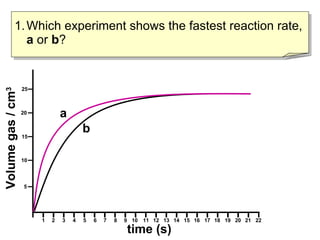
Which experiment shows the fastest reaction rate,  a  or  b ? time (s) Volume gas / cm 3 b a 1 2 3 4 5 6 7 8 9 10 12 13 14 15 16 17 18 19 20 21 22 11 5 10 15 20 25
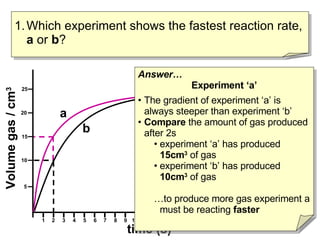
Which experiment shows the fastest reaction rate,  a  or  b ? time (s) Volume gas / cm 3 b a 1 2 3 4 5 6 7 8 9 10 12 13 14 15 16 17 18 19 20 21 22 11 Answer… Experiment ‘a’ The gradient of experiment ‘a’ is always steeper than experiment ‘b’ Compare  the amount of gas produced after 2s experiment ‘a’ has produced  15cm 3  of gas  experiment ‘b’ has produced  10cm 3  of gas … to produce more gas experiment a must be reacting  faster 5 10 15 20 25
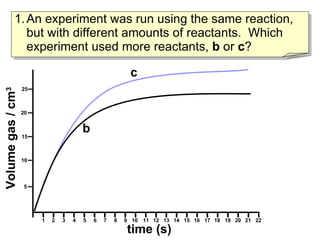
An experiment was run using the same reaction, but with different amounts of reactants.  Which experiment used more reactants,  b  or  c ? time (s) Volume gas / cm 3 b c 1 2 3 4 5 6 7 8 9 10 12 13 14 15 16 17 18 19 20 21 22 11 5 10 15 20 25
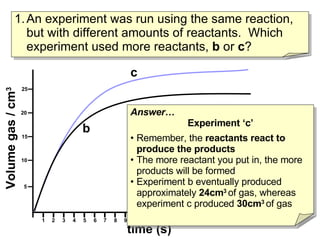
An experiment was run using the same reaction, but with different amounts of reactants.  Which experiment used more reactants,  b  or  c ? time (s) Volume gas / cm 3 b c 1 2 3 4 5 6 7 8 9 10 12 13 14 15 16 17 18 19 20 21 22 11 5 10 15 20 25 Answer… Experiment ‘c’ Remember, the  reactants react to produce the products The more reactant you put in, the more products will be formed Experiment b eventually produced approximately  24cm 3   of gas, whereas experiment c produced  30cm 3   of gas
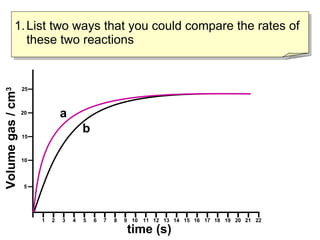
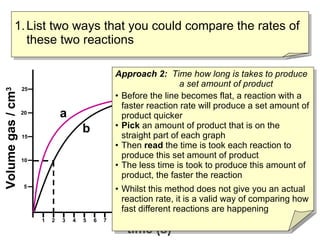
List two ways that you could compare the rates of these two reactions time (s) Volume gas / cm 3 1 2 3 4 5 6 7 8 9 10 12 13 14 15 16 17 18 19 20 21 22 11 5 10 15 20 25 b a
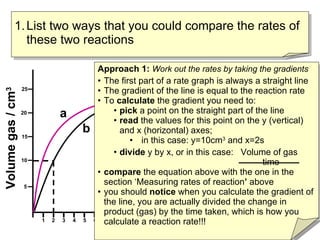
List two ways that you could compare the rates of these two reactions time (s) Volume gas / cm 3 1 2 3 4 5 6 7 8 9 10 12 13 14 15 16 17 18 19 20 21 22 11 5 10 15 20 25 b a Approach 1:  Work out the rates by taking the gradients The first part of a rate graph is always a straight line The gradient of the line is equal to the reaction rate To  calculate  the gradient you need to: pick  a point on the straight part of the line read  the values for this point on the y (vertical) and x (horizontal) axes; in this case: y=10cm 3  and x=2s divide  y by x, or in this case:  Volume of gas     time compare  the equation above with the one in the section ‘Measuring rates of reaction ’  above you should  notice  when you calculate the gradient of the line, you are actually divided the change in product (gas) by the time taken, which is how you calculate a reaction rate!!!
List two ways that you could compare the rates of these two reactions time (s) Volume gas / cm 3 1 2 3 4 5 6 7 8 9 10 12 13 14 15 16 17 18 19 20 21 22 11 5 10 15 20 25 b a Approach 2:  Time how long is takes to produce  a set amount of product Before the line becomes flat, a reaction with a faster reaction rate will produce a set amount of product quicker Pick  an amount of product that is on the straight part of each graph Then  read  the time is took each reaction to produce this set amount of product The less time is took to produce this amount of product, the faster the reaction Whilst this method does not give you an actual reaction rate, it is a valid way of comparing how fast different reactions are happening
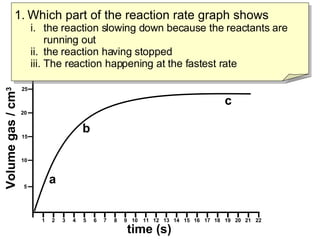
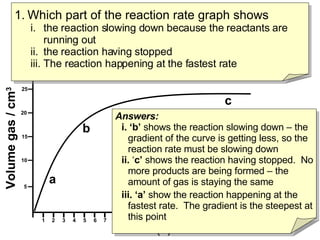
time (s) Volume gas / cm 3 b a 1 2 3 4 5 6 7 8 9 10 12 13 14 15 16 17 18 19 20 21 22 11 5 10 15 20 25 Which part of the reaction rate graph shows the reaction slowing down because the reactants are running out the reaction having stopped The reaction happening at the fastest rate c
time (s) Volume gas / cm 3 b a 1 2 3 4 5 6 7 8 9 10 12 13 14 15 16 17 18 19 20 21 22 11 5 10 15 20 25 c Answers: i. ‘b’  shows the reaction slowing down – the gradient of the curve is getting less, so the reaction rate must be slowing down ii.  ‘ c’  shows the reaction having stopped.  No more products are being formed – the amount of gas is staying the same iii. ‘a’  show the reaction happening at the fastest rate.  The gradient is the steepest at this point Which part of the reaction rate graph shows the reaction slowing down because the reactants are running out the reaction having stopped The reaction happening at the fastest rate

Reaction Rate Graph Tutorial 5

  • 1.
    Instructions: Use thisslide show to consider some key questions about reaction rate graphs Click on the next slide button to see the answers and an explanation about each question Understanding Reaction Rate Graphs
  • 2.
    Which experiment showsthe fastest reaction rate, a or b ? time (s) Volume gas / cm 3 b a 1 2 3 4 5 6 7 8 9 10 12 13 14 15 16 17 18 19 20 21 22 11 5 10 15 20 25
  • 3.
    Which experiment showsthe fastest reaction rate, a or b ? time (s) Volume gas / cm 3 b a 1 2 3 4 5 6 7 8 9 10 12 13 14 15 16 17 18 19 20 21 22 11 Answer… Experiment ‘a’ The gradient of experiment ‘a’ is always steeper than experiment ‘b’ Compare the amount of gas produced after 2s experiment ‘a’ has produced 15cm 3 of gas experiment ‘b’ has produced 10cm 3 of gas … to produce more gas experiment a must be reacting faster 5 10 15 20 25
  • 4.
    An experiment wasrun using the same reaction, but with different amounts of reactants. Which experiment used more reactants, b or c ? time (s) Volume gas / cm 3 b c 1 2 3 4 5 6 7 8 9 10 12 13 14 15 16 17 18 19 20 21 22 11 5 10 15 20 25
  • 5.
    An experiment wasrun using the same reaction, but with different amounts of reactants. Which experiment used more reactants, b or c ? time (s) Volume gas / cm 3 b c 1 2 3 4 5 6 7 8 9 10 12 13 14 15 16 17 18 19 20 21 22 11 5 10 15 20 25 Answer… Experiment ‘c’ Remember, the reactants react to produce the products The more reactant you put in, the more products will be formed Experiment b eventually produced approximately 24cm 3 of gas, whereas experiment c produced 30cm 3 of gas
  • 6.
    List two waysthat you could compare the rates of these two reactions time (s) Volume gas / cm 3 1 2 3 4 5 6 7 8 9 10 12 13 14 15 16 17 18 19 20 21 22 11 5 10 15 20 25 b a
  • 7.
    List two waysthat you could compare the rates of these two reactions time (s) Volume gas / cm 3 1 2 3 4 5 6 7 8 9 10 12 13 14 15 16 17 18 19 20 21 22 11 5 10 15 20 25 b a Approach 1: Work out the rates by taking the gradients The first part of a rate graph is always a straight line The gradient of the line is equal to the reaction rate To calculate the gradient you need to: pick a point on the straight part of the line read the values for this point on the y (vertical) and x (horizontal) axes; in this case: y=10cm 3 and x=2s divide y by x, or in this case: Volume of gas time compare the equation above with the one in the section ‘Measuring rates of reaction ’ above you should notice when you calculate the gradient of the line, you are actually divided the change in product (gas) by the time taken, which is how you calculate a reaction rate!!!
  • 8.
    List two waysthat you could compare the rates of these two reactions time (s) Volume gas / cm 3 1 2 3 4 5 6 7 8 9 10 12 13 14 15 16 17 18 19 20 21 22 11 5 10 15 20 25 b a Approach 2: Time how long is takes to produce a set amount of product Before the line becomes flat, a reaction with a faster reaction rate will produce a set amount of product quicker Pick an amount of product that is on the straight part of each graph Then read the time is took each reaction to produce this set amount of product The less time is took to produce this amount of product, the faster the reaction Whilst this method does not give you an actual reaction rate, it is a valid way of comparing how fast different reactions are happening
  • 9.
    time (s) Volumegas / cm 3 b a 1 2 3 4 5 6 7 8 9 10 12 13 14 15 16 17 18 19 20 21 22 11 5 10 15 20 25 Which part of the reaction rate graph shows the reaction slowing down because the reactants are running out the reaction having stopped The reaction happening at the fastest rate c
  • 10.
    time (s) Volumegas / cm 3 b a 1 2 3 4 5 6 7 8 9 10 12 13 14 15 16 17 18 19 20 21 22 11 5 10 15 20 25 c Answers: i. ‘b’ shows the reaction slowing down – the gradient of the curve is getting less, so the reaction rate must be slowing down ii. ‘ c’ shows the reaction having stopped. No more products are being formed – the amount of gas is staying the same iii. ‘a’ show the reaction happening at the fastest rate. The gradient is the steepest at this point Which part of the reaction rate graph shows the reaction slowing down because the reactants are running out the reaction having stopped The reaction happening at the fastest rate