1
3. Random Variables
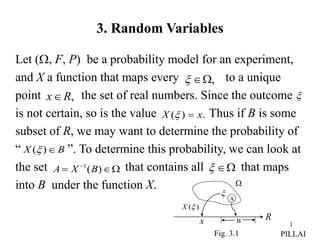
Let (, F, P) be a probability model for an experiment,
and X a function that maps every to a unique
point the set of real numbers. Since the outcome
is not certain, so is the value Thus if B is some
subset of R, we may want to determine the probability of
“ ”. To determine this probability, we can look at
the set that contains all that maps
into B under the function X.
,



,
R
x 
.
)
( x
X 

B
X 
)
(


 
)
(
1
B
X
A 




R
)
(
X
x
A
B
Fig. 3.1 PILLAI
2
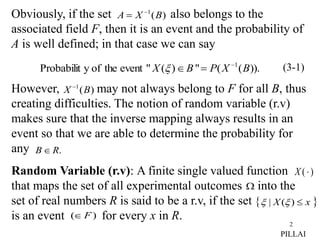
Obviously, if the set also belongs to the
associated field F, then it is an event and the probability of
A is well defined; in that case we can say
However, may not always belong to F for all B, thus
creating difficulties. The notion of random variable (r.v)
makes sure that the inverse mapping always results in an
event so that we are able to determine the probability for
any
Random Variable (r.v): A finite single valued function
that maps the set of all experimental outcomes into the
set of real numbers R is said to be a r.v, if the set
is an event for every x in R.
)
(
1
B
X
A 

)).
(
(
"
)
(
"
event
the
of
y
Probabilit 1
B
X
P
B
X 


 (3-1)
)
(
1
B
X 
.
R
B 
)
( 
X

 
)
(
| x
X 


)
( F

PILLAI
3
Alternatively X is said to be a r.v, if where B
represents semi-definite intervals of the form
and all other sets that can be constructed from these sets by
performing the set operations of union, intersection and
negation any number of times. The Borel collection B of
such subsets of R is the smallest -field of subsets of R that
includes all semi-infinite intervals of the above form. Thus
if X is a r.v, then
is an event for every x. What about
Are they also events ? In fact with since
and are events, is an event and
hence is also an event.
}
{ a
x 


a
b 
   ?
, a
X
b
X
a 


 
b
X 
    }
{ b
X
a
b
X
a
X 





   
a
X
a
X
c



   
)
(
| x
X
x
X 




F
B
X 

)
(
1
}
{ a
X 
(3-2)
PILLAI
4
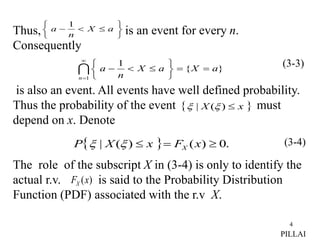
Thus, is an event for every n.
Consequently
is also an event. All events have well defined probability.
Thus the probability of the event must
depend on x. Denote
The role of the subscript X in (3-4) is only to identify the
actual r.v. is said to the Probability Distribution
Function (PDF) associated with the r.v X.









1
a
X
n
a














1
}
{
1
n
a
X
a
X
n
a
 
)
(
| x
X 


  .
0
)
(
)
(
| 

 x
F
x
X
P X

 (3-4)
)
(x
FX
(3-3)
PILLAI
5
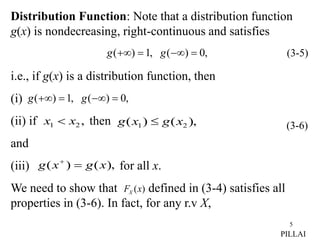
Distribution Function: Note that a distribution function
g(x) is nondecreasing, right-continuous and satisfies
i.e., if g(x) is a distribution function, then
(i)
(ii) if then
and
(iii) for all x.
We need to show that defined in (3-4) satisfies all
properties in (3-6). In fact, for any r.v X,
,
0
)
(
,
1
)
( 


 g
g
,
0
)
(
,
1
)
( 


 g
g
,
2
1 x
x  ),
(
)
( 2
1 x
g
x
g 
),
(
)
( x
g
x
g 

(3-6)
)
(x
FX
(3-5)
PILLAI
6
  1
)
(
)
(
|
)
( 





 P
X
P
FX 

  .
0
)
(
)
(
|
)
( 




 

 P
X
P
FX
(i)
and
(ii) If then the subset
Consequently the event
since implies As a result
implying that the probability distribution function is
nonnegative and monotone nondecreasing.
(iii) Let and consider the event
since
,
2
1 x
x  ).
,
(
)
,
( 2
1 x
x 


   ,
)
(
|
)
(
| 2
1 x
X
x
X 

 



1
)
( x
X 
 .
)
( 2
x
X 

    ),
(
)
(
)
(
)
( 2
2
1
1 x
F
x
X
P
x
X
P
x
F X
X 



 
 (3-9)
 
(3-7)
(3-8)
,
1
2
1 x
x
x
x
x n
n 



  
 .
)
(
| k
k x
X
x
A 

 
 (3-10)
     ,
)
(
)
(
)
( k
k x
X
x
X
x
X
x 




 

 (3-11)
PILLAI
7
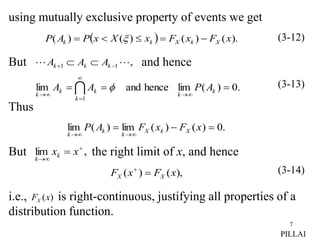
using mutually exclusive property of events we get
But and hence
Thus
But the right limit of x, and hence
i.e., is right-continuous, justifying all properties of a
distribution function.
  ).
(
)
(
)
(
)
( x
F
x
F
x
X
x
P
A
P X
k
X
k
k 



  (3-12)
,
1
1 
 
 
 k
k
k A
A
A
.
0
)
(
lim
hence
and
lim
1









k
k
k
k
k
k
A
P
A
A 
 (3-13)
.
0
)
(
)
(
lim
)
(
lim 






x
F
x
F
A
P X
k
X
k
k
k
),
(
)
( x
F
x
F X
X 

)
(x
FX
(3-14)
,
lim 


 x
xk
k
PILLAI
8
Additional Properties of a PDF
(iv) If for some then
This follows, since implies
is the null set, and for any will be a subset
of the null set.
(v)
We have and since the two events
are mutually exclusive, (16) follows.
(vi)
The events and are mutually
exclusive and their union represents the event
0
)
( 0 
x
FX ,
0
x .
,
0
)
( 0
x
x
x
FX 
 (3-15)
  0
)
(
)
( 0
0 

 x
X
P
x
FX   
0
)
( x
X 

 
)
(
,
0 x
X
x
x 
 
  ).
(
1
)
( x
F
x
X
P X



 (3-16)
    ,
)
(
)
( 



 x
X
x
X 

  .
),
(
)
(
)
( 1
2
1
2
2
1 x
x
x
F
x
F
x
X
x
P X
X 



  (3-17)
}
)
(
{ 2
1 x
X
x 
 
 
)
( 1
x
X 

 .
)
( 2
x
X 

PILLAI
9
(vii)
Let and From (3-17)
or
According to (3-14), the limit of as
from the right always exists and equals However the
left limit value need not equal Thus
need not be continuous from the left. At a discontinuity
point of the distribution, the left and right limits are
different, and from (3-20)
  ).
(
)
(
)
( 


 x
F
x
F
x
X
P X
X
 (3-18)
,
0
,
1 

 

x
x .
2 x
x 
  ),
(
lim
)
(
)
(
lim
0
0













x
F
x
F
x
X
x
P X
X (3-19)
  ).
(
)
(
)
( 


 x
F
x
F
x
X
P X
X
 (3-20)
),
( 0

x
FX )
(x
FX 0
x
x 
).
( 0
x
FX
)
( 0

x
FX ).
( 0
x
FX )
(x
FX
  .
0
)
(
)
(
)
( 0
0
0 


 
x
F
x
F
x
X
P X
X
 (3-21)
PILLAI
10
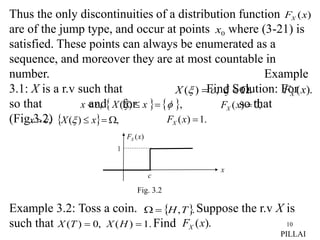
Thus the only discontinuities of a distribution function
are of the jump type, and occur at points where (3-21) is
satisfied. These points can always be enumerated as a
sequence, and moreover they are at most countable in
number. Example
3.1: X is a r.v such that Find Solution: For
so that and for so that
(Fig.3.2)
Example 3.2: Toss a coin. Suppose the r.v X is
such that Find
)
(x
FX
0
x
.
,
)
( 

 
 c
X ).
(x
FX
   ,
)
(
, 
 

 x
X
c
x ,
0
)
( 
x
FX
 .
,T
H


.
1
)
(
,
0
)
( 
 H
X
T
X
)
(x
FX
x
c
1
Fig. 3.2
).
(x
FX
.
1
)
( 
x
FX
  ,
)
(
, 


 x
X
c
x 
PILLAI
11
Solution: For so that
•X is said to be a continuous-type r.v if its distribution
function is continuous. In that case for
all x, and from (3-21) we get
•If is constant except for a finite number of jump
discontinuities(piece-wise constant; step-type), then X is
said to be a discrete-type r.v. If is such a discontinuity
point, then from (3-21)
   ,
)
(
,
0 
 

 x
X
x .
0
)
( 
x
FX
     
    3.3)
(Fig.
.
1
)
(
that
so
,
,
)
(
,
1
,
1
)
(
that
so
,
)
(
,
1
0













x
F
T
H
x
X
x
p
T
P
x
F
T
x
X
x
X
X


  ).
(
)
( 



 i
X
i
X
i
i x
F
x
F
x
X
P
p (3-22)
)
(x
FX
)
(
)
( x
F
x
F X
X 

  .
0

 x
X
P
)
(x
FX
)
(x
FX
x
Fig.3.3
1
q
1
i
x
PILLAI
12
From Fig.3.2, at a point of discontinuity we get
and from Fig.3.3,
Example:3.3 A fair coin is tossed twice, and let the r.v X
represent the number of heads. Find
Solution: In this case and
  .
1
0
1
)
(
)
( 




 
c
F
c
F
c
X
P X
X
  .
0
)
0
(
)
0
(
0 q
q
F
F
X
P X
X 




 
 ,
,
,
, TT
TH
HT
HH


).
(x
FX
.
0
)
(
,
1
)
(
,
1
)
(
,
2
)
( 


 TT
X
TH
X
HT
X
HH
X
 
     
     
  3.4)
(Fig.
.
1
)
(
)
(
,
2
,
4
3
,
,
)
(
,
,
)
(
,
2
1
,
4
1
)
(
)
(
)
(
)
(
,
1
0
,
0
)
(
)
(
,
0


























x
F
x
X
x
TH
HT
TT
P
x
F
TH
HT
TT
x
X
x
T
P
T
P
TT
P
x
F
TT
x
X
x
x
F
x
X
x
X
X
X
X





PILLAI
13
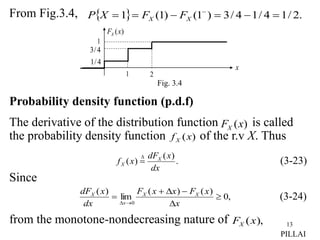
From Fig.3.4,
Probability density function (p.d.f)
The derivative of the distribution function is called
the probability density function of the r.v X. Thus
Since
from the monotone-nondecreasing nature of
  .
2
/
1
4
/
1
4
/
3
)
1
(
)
1
(
1 




 
X
X F
F
X
P
)
(x
FX
)
(x
fX
.
)
(
)
(
dx
x
dF
x
f X
X 
,
0
)
(
)
(
lim
)
(
0







 x
x
F
x
x
F
dx
x
dF X
X
x
X
(3-23)
(3-24)
),
(x
FX
)
(x
FX
x
Fig. 3.4
1
4
/
1
1
4
/
3
2

PILLAI
14
it follows that for all x. will be a
continuous function, if X is a continuous type r.v.
However, if X is a discrete type r.v as in (3-22), then its
p.d.f has the general form (Fig. 3.5)
where represent the jump-discontinuity points in
As Fig. 3.5 shows represents a collection of positive
discrete masses, and it is known as the probability mass
function (p.m.f ) in the discrete case. From (3-23), we
also obtain by integration
Since (3-26) yields
0
)
( 
x
fX )
(x
fX
,
)
(
)
(  

i
i
i
X x
x
p
x
f 
).
(x
FX
(3-25)
.
)
(
)
( du
u
f
x
F
x
x
X  

 (3-26)
,
1
)
( 

X
F
,
1
)
( 




dx
x
fx
(3-27)
i
x
)
(x
fX
x
i
x
i
p
Fig. 3.5
)
(x
fX
PILLAI
15
which justifies its name as the density function. Further,
from (3-26), we also get (Fig. 3.6b)
Thus the area under in the interval represents
the probability in (3-28).
Often, r.vs are referred by their specific density functions -
both in the continuous and discrete cases - and in what
follows we shall list a number of them in each category.
  .
)
(
)
(
)
(
)
(
2
1
1
2
2
1 dx
x
f
x
F
x
F
x
X
x
P
x
x
X
X
X 




  (3-28)
Fig. 3.6
)
(x
fX )
,
( 2
1 x
x
)
(x
fX
(b)
x
1
x 2
x
)
(x
FX
x
1
(a)
1
x 2
x
PILLAI
16
Continuous-type random variables
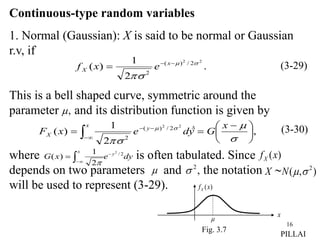
1. Normal (Gaussian): X is said to be normal or Gaussian
r.v, if
This is a bell shaped curve, symmetric around the
parameter and its distribution function is given by
where is often tabulated. Since
depends on two parameters and the notation 
will be used to represent (3-29).
.
2
1
)
(
2
2
2
/
)
(
2





 x
X e
x
f (3-29)
,

,
2
1
)
(
2
2
2
/
)
(
2
 








 


x
y
X
x
G
dy
e
x
F




 (3-30)
dy
e
x
G y
x
2
/
2
2
1
)
( 





)
,
( 2


N
X
)
(x
fX
x

Fig. 3.7

)
(x
fX
 ,
2

PILLAI
17
2. Uniform:  if (Fig. 3.8)
,
),
,
( b
a
b
a
U
X 









otherwise.
0,
,
,
1
)
(
b
x
a
a
b
x
fX
(3.31)
)
(x
fX
x
a b
a
b 
1
Fig. 3.8
3. Exponential:  if (Fig. 3.9)
)
(

X








otherwise.
0,
,
0
,
1
)
(
/
x
e
x
f
x
X

 (3-32)
)
(x
fX
x
Fig. 3.9
PILLAI
18
4. Gamma:  if (Fig. 3.10)
If an integer
5. Beta:  if (Fig. 3.11)
where the Beta function is defined as
)
,
( 

G
X )
0
,
0
( 
 











otherwise.
0,
,
0
,
)
(
)
(
/
1
x
e
x
x
f
x
X




 (3-33)
n

 )!.
1
(
)
( 

 n
n
)
,
( b
a
X  )
0
,
0
( 
 b
a











otherwise.
0,
,
1
0
,
)
1
(
)
,
(
1
)
(
1
1
x
x
x
b
a
x
f
b
a
X  (3-34)
)
,
( b
a






1
0
1
1
.
)
1
(
)
,
( du
u
u
b
a b
a
 (3-35)
x
)
(x
fX
x
Fig. 3.11
1
0
)
(x
fX
Fig. 3.10
PILLAI
19
6. Chi-Square:  if (Fig. 3.12)
Note that is the same as Gamma
7. Rayleigh:  if (Fig. 3.13)
8. Nakagami – m distribution:
),
(
2
n
X 
)
(
2
n
 ).
2
,
2
/
(n








otherwise.
0,
,
0
,
)
(
2
2
2
/
2
x
e
x
x
f
x
X


(3-36)
(3-37)
,
)
( 2

R
X
x
)
(x
fX
Fig. 3.12
)
(x
fX
x
Fig. 3.13
PILLAI










otherwise.
0,
,
0
,
)
2
/
(
2
1
)
(
2
/
1
2
/
2
/
x
e
x
n
x
f
x
n
n
X
2
2 1 /
2
, 0
( ) ( )
0 otherwise
X
m
m mx
m
x e x
f x m
  
   
  
  
 



(3-38)
20
9. Cauchy:  if (Fig. 3.14)
10. Laplace: (Fig. 3.15)
11. Student’s t-distribution with n degrees of freedom (Fig 3.16)
  .
,
1
)
2
/
(
2
/
)
1
(
)
(
2
/
)
1
(
2




















t
n
t
n
n
n
t
f
n
T

,
)
,
( 

C
X
.
,
)
(
/
)
( 2
2







 x
x
x
fX




.
,
2
1
)
( /
|
|





 
x
e
x
f x
X


)
(x
fX
x
Fig. 3.14

(3-41)
(3-40)
(3-39)
x
)
(x
fX
Fig. 3.15
t
( )
T
f t
Fig. 3.16
PILLAI
21
12. Fisher’s F-distribution
/ 2 / 2 / 2 1
( ) / 2
{( )/ 2}
, 0
( ) ( / 2) ( / 2) ( )
0 otherwise
m n m
m n
z
m n m n z
z
f z m n n mz


 


   



(3-42)
PILLAI
22
Discrete-type random variables
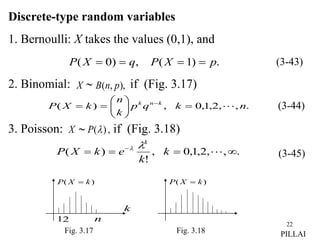
1. Bernoulli: X takes the values (0,1), and
2. Binomial:  if (Fig. 3.17)
3. Poisson:  if (Fig. 3.18)
.
)
1
(
,
)
0
( p
X
P
q
X
P 


 (3-43)
),
,
( p
n
B
X
.
,
,
2
,
1
,
0
,
)
( n
k
q
p
k
n
k
X
P k
n
k











 
(3-44)
,
)
(
P
X
.
,
,
2
,
1
,
0
,
!
)
( 


 

k
k
e
k
X
P
k


(3-45)
k
)
( k
X
P 
Fig. 3.17
12 n
)
( k
X
P 
Fig. 3.18 PILLAI
23
4. Hypergeometric:
5. Geometric:  if
6. Negative Binomial: ~ if
7. Discrete-Uniform:
We conclude this lecture with a general distribution due
PILLAI
(3-49)
(3-48)
(3-47)
.
,
,
2
,
1
,
1
)
( N
k
N
k
X
P 



),
,
( p
r
NB
X
1
( ) , , 1, .
1
r k r
k
P X k p q k r r
r


 
   
 

 
.
1
,
,
,
2
,
1
,
0
,
)
( p
q
k
pq
k
X
P k





 
)
( p
g
X
, max(0, ) min( , )
( )
m N m
k n k
N
n
m n N k m n
P X k
 
 
 
 
   
   
 
 
 
 


   
  (3-46)
24
PILLAI
to Polya that includes both binomial and hypergeometric as
special cases.
Polya’s distribution: A box contains a white balls and b black
balls. A ball is drawn at random, and it is replaced along with
c balls of the same color. If X represents the number of white
balls drawn in n such draws, find the
probability mass function of X.
Solution: Consider the specific sequence of draws where k
white balls are first drawn, followed by n – k black balls. The
probability of drawing k successive white balls is given by
Similarly the probability of drawing k white balls
0, 1, 2, , ,
X n

2 ( 1)
2 ( 1)
W
a a c a c a k c
p
a b a b c a b c a b k c
   

       
(3-50)
25
PILLAI
followed by n – k black balls is given by
Interestingly, pk
in (3-51) also represents the probability of
drawing k white balls and (n – k) black balls in any other
specific order (i.e., The same set of numerator and
denominator terms in (3-51) contribute to all other sequences
as well.) But there are such distinct mutually exclusive
sequences and summing over all of them, we obtain the Polya
distribution (probability of getting k white balls in n draws)
to be
n
k
 
 
 
 
1 1
0 0
( )
( 1)
( 1) ( 1)
.
k w
k n k
i j
b jc
a ic
a b ic a b j k c
b b c b n k c
p p
a b kc a b k c a b n c
  
 


    
   

       
   (3-51)
1 1
0 0
( )
( ) , 0,1,2, , .
k n k
k
i j
n n
k k
b jc
a ic
a b ic a b j k c
P X k p k n
  
   
   
   
     


    
   
 
(3-52)
26
PILLAI
Both binomial distribution as well as the hypergeometric
distribution are special cases of (3-52).
For example if draws are done with replacement, then c = 0
and (3-52) simplifies to the binomial distribution
where
Similarly if the draws are conducted without replacement,
Then c = – 1 in (3-52), and it gives
( ) , 0,1,2, ,
k n k
n
k
P X k p q k n
  
 
 
 
   (3-53)
, 1 .
a b
p q p
a b a b
   
 
( 1)( 2) ( 1) ( 1) ( 1)
( )
( )( 1) ( 1) ( ) ( 1)
n
k
a a a a k b b b n k
P X k
a b a b a b k a b k a b n
 
 
 
 
       
 
          
27
which represents the hypergeometric distribution. Finally
c = +1 gives (replacements are doubled)
we shall refer to (3-55) as Polya’s +1 distribution. the general
Polya distribution in (3-52) has been used to study the spread
of contagious diseases (epidemic modeling).
1 1
1
( 1)! ( 1)! ( 1)! ( 1)!
( )
( 1)! ( 1)! ( 1)! ( 1)!
= .
n
k
a k b n k
k n k
a b n
n
a k a b b n k a b k
P X k
a a b k b a b n
 
 
 
 
   
   
   
   
 
 
 
 
    

  
         
 
       
(3-55)
! !( )! !( )!
( )
!( )! ( )!( )! ( )!( )!
a b
k n k
a b
n
n a a b k b a b n
P X k
k n k a k a b b n k a b k
 
 
 
 
   
   
 
 
 
 


   
  
      
(3-54)
PILLAI

Random variable, distributive function lect3a.ppt

  • 1.
    1 3. Random Variables Let(, F, P) be a probability model for an experiment, and X a function that maps every to a unique point the set of real numbers. Since the outcome is not certain, so is the value Thus if B is some subset of R, we may want to determine the probability of “ ”. To determine this probability, we can look at the set that contains all that maps into B under the function X. ,    , R x  . ) ( x X   B X  ) (     ) ( 1 B X A      R ) ( X x A B Fig. 3.1 PILLAI
  • 2.
    2 Obviously, if theset also belongs to the associated field F, then it is an event and the probability of A is well defined; in that case we can say However, may not always belong to F for all B, thus creating difficulties. The notion of random variable (r.v) makes sure that the inverse mapping always results in an event so that we are able to determine the probability for any Random Variable (r.v): A finite single valued function that maps the set of all experimental outcomes into the set of real numbers R is said to be a r.v, if the set is an event for every x in R. ) ( 1 B X A   )). ( ( " ) ( " event the of y Probabilit 1 B X P B X     (3-1) ) ( 1 B X  . R B  ) (  X    ) ( | x X    ) ( F  PILLAI
  • 3.
    3 Alternatively X issaid to be a r.v, if where B represents semi-definite intervals of the form and all other sets that can be constructed from these sets by performing the set operations of union, intersection and negation any number of times. The Borel collection B of such subsets of R is the smallest -field of subsets of R that includes all semi-infinite intervals of the above form. Thus if X is a r.v, then is an event for every x. What about Are they also events ? In fact with since and are events, is an event and hence is also an event. } { a x    a b     ? , a X b X a      b X      } { b X a b X a X           a X a X c        ) ( | x X x X      F B X   ) ( 1 } { a X  (3-2) PILLAI
  • 4.
    4 Thus, is anevent for every n. Consequently is also an event. All events have well defined probability. Thus the probability of the event must depend on x. Denote The role of the subscript X in (3-4) is only to identify the actual r.v. is said to the Probability Distribution Function (PDF) associated with the r.v X.          1 a X n a               1 } { 1 n a X a X n a   ) ( | x X      . 0 ) ( ) ( |    x F x X P X   (3-4) ) (x FX (3-3) PILLAI
  • 5.
    5 Distribution Function: Notethat a distribution function g(x) is nondecreasing, right-continuous and satisfies i.e., if g(x) is a distribution function, then (i) (ii) if then and (iii) for all x. We need to show that defined in (3-4) satisfies all properties in (3-6). In fact, for any r.v X, , 0 ) ( , 1 ) (     g g , 0 ) ( , 1 ) (     g g , 2 1 x x  ), ( ) ( 2 1 x g x g  ), ( ) ( x g x g   (3-6) ) (x FX (3-5) PILLAI
  • 6.
    6   1 ) ( ) ( | ) (       P X P FX     . 0 ) ( ) ( | ) (          P X P FX (i) and (ii) If then the subset Consequently the event since implies As a result implying that the probability distribution function is nonnegative and monotone nondecreasing. (iii) Let and consider the event since , 2 1 x x  ). , ( ) , ( 2 1 x x       , ) ( | ) ( | 2 1 x X x X        1 ) ( x X   . ) ( 2 x X       ), ( ) ( ) ( ) ( 2 2 1 1 x F x X P x X P x F X X        (3-9)   (3-7) (3-8) , 1 2 1 x x x x x n n         . ) ( | k k x X x A      (3-10)      , ) ( ) ( ) ( k k x X x X x X x          (3-11) PILLAI
  • 7.
    7 using mutually exclusiveproperty of events we get But and hence Thus But the right limit of x, and hence i.e., is right-continuous, justifying all properties of a distribution function.   ). ( ) ( ) ( ) ( x F x F x X x P A P X k X k k       (3-12) , 1 1       k k k A A A . 0 ) ( lim hence and lim 1          k k k k k k A P A A   (3-13) . 0 ) ( ) ( lim ) ( lim        x F x F A P X k X k k k ), ( ) ( x F x F X X   ) (x FX (3-14) , lim     x xk k PILLAI
  • 8.
    8 Additional Properties ofa PDF (iv) If for some then This follows, since implies is the null set, and for any will be a subset of the null set. (v) We have and since the two events are mutually exclusive, (16) follows. (vi) The events and are mutually exclusive and their union represents the event 0 ) ( 0  x FX , 0 x . , 0 ) ( 0 x x x FX   (3-15)   0 ) ( ) ( 0 0    x X P x FX    0 ) ( x X     ) ( , 0 x X x x      ). ( 1 ) ( x F x X P X     (3-16)     , ) ( ) (      x X x X     . ), ( ) ( ) ( 1 2 1 2 2 1 x x x F x F x X x P X X       (3-17) } ) ( { 2 1 x X x      ) ( 1 x X    . ) ( 2 x X   PILLAI
  • 9.
    9 (vii) Let and From(3-17) or According to (3-14), the limit of as from the right always exists and equals However the left limit value need not equal Thus need not be continuous from the left. At a discontinuity point of the distribution, the left and right limits are different, and from (3-20)   ). ( ) ( ) (     x F x F x X P X X  (3-18) , 0 , 1      x x . 2 x x    ), ( lim ) ( ) ( lim 0 0              x F x F x X x P X X (3-19)   ). ( ) ( ) (     x F x F x X P X X  (3-20) ), ( 0  x FX ) (x FX 0 x x  ). ( 0 x FX ) ( 0  x FX ). ( 0 x FX ) (x FX   . 0 ) ( ) ( ) ( 0 0 0      x F x F x X P X X  (3-21) PILLAI
  • 10.
    10 Thus the onlydiscontinuities of a distribution function are of the jump type, and occur at points where (3-21) is satisfied. These points can always be enumerated as a sequence, and moreover they are at most countable in number. Example 3.1: X is a r.v such that Find Solution: For so that and for so that (Fig.3.2) Example 3.2: Toss a coin. Suppose the r.v X is such that Find ) (x FX 0 x . , ) (      c X ). (x FX    , ) ( ,      x X c x , 0 ) (  x FX  . ,T H   . 1 ) ( , 0 ) (   H X T X ) (x FX x c 1 Fig. 3.2 ). (x FX . 1 ) (  x FX   , ) ( ,     x X c x  PILLAI
  • 11.
    11 Solution: For sothat •X is said to be a continuous-type r.v if its distribution function is continuous. In that case for all x, and from (3-21) we get •If is constant except for a finite number of jump discontinuities(piece-wise constant; step-type), then X is said to be a discrete-type r.v. If is such a discontinuity point, then from (3-21)    , ) ( , 0      x X x . 0 ) (  x FX           3.3) (Fig. . 1 ) ( that so , , ) ( , 1 , 1 ) ( that so , ) ( , 1 0              x F T H x X x p T P x F T x X x X X     ). ( ) (      i X i X i i x F x F x X P p (3-22) ) (x FX ) ( ) ( x F x F X X     . 0   x X P ) (x FX ) (x FX x Fig.3.3 1 q 1 i x PILLAI
  • 12.
    12 From Fig.3.2, ata point of discontinuity we get and from Fig.3.3, Example:3.3 A fair coin is tossed twice, and let the r.v X represent the number of heads. Find Solution: In this case and   . 1 0 1 ) ( ) (        c F c F c X P X X   . 0 ) 0 ( ) 0 ( 0 q q F F X P X X         , , , , TT TH HT HH   ). (x FX . 0 ) ( , 1 ) ( , 1 ) ( , 2 ) (     TT X TH X HT X HH X                 3.4) (Fig. . 1 ) ( ) ( , 2 , 4 3 , , ) ( , , ) ( , 2 1 , 4 1 ) ( ) ( ) ( ) ( , 1 0 , 0 ) ( ) ( , 0                           x F x X x TH HT TT P x F TH HT TT x X x T P T P TT P x F TT x X x x F x X x X X X X      PILLAI
  • 13.
    13 From Fig.3.4, Probability densityfunction (p.d.f) The derivative of the distribution function is called the probability density function of the r.v X. Thus Since from the monotone-nondecreasing nature of   . 2 / 1 4 / 1 4 / 3 ) 1 ( ) 1 ( 1        X X F F X P ) (x FX ) (x fX . ) ( ) ( dx x dF x f X X  , 0 ) ( ) ( lim ) ( 0         x x F x x F dx x dF X X x X (3-23) (3-24) ), (x FX ) (x FX x Fig. 3.4 1 4 / 1 1 4 / 3 2  PILLAI
  • 14.
    14 it follows thatfor all x. will be a continuous function, if X is a continuous type r.v. However, if X is a discrete type r.v as in (3-22), then its p.d.f has the general form (Fig. 3.5) where represent the jump-discontinuity points in As Fig. 3.5 shows represents a collection of positive discrete masses, and it is known as the probability mass function (p.m.f ) in the discrete case. From (3-23), we also obtain by integration Since (3-26) yields 0 ) (  x fX ) (x fX , ) ( ) (    i i i X x x p x f  ). (x FX (3-25) . ) ( ) ( du u f x F x x X     (3-26) , 1 ) (   X F , 1 ) (      dx x fx (3-27) i x ) (x fX x i x i p Fig. 3.5 ) (x fX PILLAI
  • 15.
    15 which justifies itsname as the density function. Further, from (3-26), we also get (Fig. 3.6b) Thus the area under in the interval represents the probability in (3-28). Often, r.vs are referred by their specific density functions - both in the continuous and discrete cases - and in what follows we shall list a number of them in each category.   . ) ( ) ( ) ( ) ( 2 1 1 2 2 1 dx x f x F x F x X x P x x X X X        (3-28) Fig. 3.6 ) (x fX ) , ( 2 1 x x ) (x fX (b) x 1 x 2 x ) (x FX x 1 (a) 1 x 2 x PILLAI
  • 16.
    16 Continuous-type random variables 1.Normal (Gaussian): X is said to be normal or Gaussian r.v, if This is a bell shaped curve, symmetric around the parameter and its distribution function is given by where is often tabulated. Since depends on two parameters and the notation  will be used to represent (3-29). . 2 1 ) ( 2 2 2 / ) ( 2       x X e x f (3-29) ,  , 2 1 ) ( 2 2 2 / ) ( 2               x y X x G dy e x F      (3-30) dy e x G y x 2 / 2 2 1 ) (       ) , ( 2   N X ) (x fX x  Fig. 3.7  ) (x fX  , 2  PILLAI
  • 17.
    17 2. Uniform: if (Fig. 3.8) , ), , ( b a b a U X           otherwise. 0, , , 1 ) ( b x a a b x fX (3.31) ) (x fX x a b a b  1 Fig. 3.8 3. Exponential:  if (Fig. 3.9) ) (  X         otherwise. 0, , 0 , 1 ) ( / x e x f x X   (3-32) ) (x fX x Fig. 3.9 PILLAI
  • 18.
    18 4. Gamma: if (Fig. 3.10) If an integer 5. Beta:  if (Fig. 3.11) where the Beta function is defined as ) , (   G X ) 0 , 0 (               otherwise. 0, , 0 , ) ( ) ( / 1 x e x x f x X      (3-33) n   )!. 1 ( ) (    n n ) , ( b a X  ) 0 , 0 (   b a            otherwise. 0, , 1 0 , ) 1 ( ) , ( 1 ) ( 1 1 x x x b a x f b a X  (3-34) ) , ( b a       1 0 1 1 . ) 1 ( ) , ( du u u b a b a  (3-35) x ) (x fX x Fig. 3.11 1 0 ) (x fX Fig. 3.10 PILLAI
  • 19.
    19 6. Chi-Square: if (Fig. 3.12) Note that is the same as Gamma 7. Rayleigh:  if (Fig. 3.13) 8. Nakagami – m distribution: ), ( 2 n X  ) ( 2 n  ). 2 , 2 / (n         otherwise. 0, , 0 , ) ( 2 2 2 / 2 x e x x f x X   (3-36) (3-37) , ) ( 2  R X x ) (x fX Fig. 3.12 ) (x fX x Fig. 3.13 PILLAI           otherwise. 0, , 0 , ) 2 / ( 2 1 ) ( 2 / 1 2 / 2 / x e x n x f x n n X 2 2 1 / 2 , 0 ( ) ( ) 0 otherwise X m m mx m x e x f x m                   (3-38)
  • 20.
    20 9. Cauchy: if (Fig. 3.14) 10. Laplace: (Fig. 3.15) 11. Student’s t-distribution with n degrees of freedom (Fig 3.16)   . , 1 ) 2 / ( 2 / ) 1 ( ) ( 2 / ) 1 ( 2                     t n t n n n t f n T  , ) , (   C X . , ) ( / ) ( 2 2         x x x fX     . , 2 1 ) ( / | |        x e x f x X   ) (x fX x Fig. 3.14  (3-41) (3-40) (3-39) x ) (x fX Fig. 3.15 t ( ) T f t Fig. 3.16 PILLAI
  • 21.
    21 12. Fisher’s F-distribution /2 / 2 / 2 1 ( ) / 2 {( )/ 2} , 0 ( ) ( / 2) ( / 2) ( ) 0 otherwise m n m m n z m n m n z z f z m n n mz              (3-42) PILLAI
  • 22.
    22 Discrete-type random variables 1.Bernoulli: X takes the values (0,1), and 2. Binomial:  if (Fig. 3.17) 3. Poisson:  if (Fig. 3.18) . ) 1 ( , ) 0 ( p X P q X P     (3-43) ), , ( p n B X . , , 2 , 1 , 0 , ) ( n k q p k n k X P k n k              (3-44) , ) ( P X . , , 2 , 1 , 0 , ! ) (       k k e k X P k   (3-45) k ) ( k X P  Fig. 3.17 12 n ) ( k X P  Fig. 3.18 PILLAI
  • 23.
    23 4. Hypergeometric: 5. Geometric: if 6. Negative Binomial: ~ if 7. Discrete-Uniform: We conclude this lecture with a general distribution due PILLAI (3-49) (3-48) (3-47) . , , 2 , 1 , 1 ) ( N k N k X P     ), , ( p r NB X 1 ( ) , , 1, . 1 r k r k P X k p q k r r r              . 1 , , , 2 , 1 , 0 , ) ( p q k pq k X P k        ) ( p g X , max(0, ) min( , ) ( ) m N m k n k N n m n N k m n P X k                                 (3-46)
  • 24.
    24 PILLAI to Polya thatincludes both binomial and hypergeometric as special cases. Polya’s distribution: A box contains a white balls and b black balls. A ball is drawn at random, and it is replaced along with c balls of the same color. If X represents the number of white balls drawn in n such draws, find the probability mass function of X. Solution: Consider the specific sequence of draws where k white balls are first drawn, followed by n – k black balls. The probability of drawing k successive white balls is given by Similarly the probability of drawing k white balls 0, 1, 2, , , X n  2 ( 1) 2 ( 1) W a a c a c a k c p a b a b c a b c a b k c              (3-50)
  • 25.
    25 PILLAI followed by n– k black balls is given by Interestingly, pk in (3-51) also represents the probability of drawing k white balls and (n – k) black balls in any other specific order (i.e., The same set of numerator and denominator terms in (3-51) contribute to all other sequences as well.) But there are such distinct mutually exclusive sequences and summing over all of them, we obtain the Polya distribution (probability of getting k white balls in n draws) to be n k         1 1 0 0 ( ) ( 1) ( 1) ( 1) . k w k n k i j b jc a ic a b ic a b j k c b b c b n k c p p a b kc a b k c a b n c                             (3-51) 1 1 0 0 ( ) ( ) , 0,1,2, , . k n k k i j n n k k b jc a ic a b ic a b j k c P X k p k n                                   (3-52)
  • 26.
    26 PILLAI Both binomial distributionas well as the hypergeometric distribution are special cases of (3-52). For example if draws are done with replacement, then c = 0 and (3-52) simplifies to the binomial distribution where Similarly if the draws are conducted without replacement, Then c = – 1 in (3-52), and it gives ( ) , 0,1,2, , k n k n k P X k p q k n             (3-53) , 1 . a b p q p a b a b       ( 1)( 2) ( 1) ( 1) ( 1) ( ) ( )( 1) ( 1) ( ) ( 1) n k a a a a k b b b n k P X k a b a b a b k a b k a b n                             
  • 27.
    27 which represents thehypergeometric distribution. Finally c = +1 gives (replacements are doubled) we shall refer to (3-55) as Polya’s +1 distribution. the general Polya distribution in (3-52) has been used to study the spread of contagious diseases (epidemic modeling). 1 1 1 ( 1)! ( 1)! ( 1)! ( 1)! ( ) ( 1)! ( 1)! ( 1)! ( 1)! = . n k a k b n k k n k a b n n a k a b b n k a b k P X k a a b k b a b n                                                              (3-55) ! !( )! !( )! ( ) !( )! ( )!( )! ( )!( )! a b k n k a b n n a a b k b a b n P X k k n k a k a b b n k a b k                                         (3-54) PILLAI