4
Continuous Random
Variables and
Probability Distributions
Stat 4570/5570
Material from Devore’s book (Ed 8) – Chapter 4 - and Cengage
2
Continuous r.v.
A random variable X is continuous if possible values
comprise either a single interval on the number line or a
union of disjoint intervals.
Example: If in the study of the ecology of a lake, X, the r.v.
may be depth measurements at randomly chosen
locations.
Then X is a continuous r.v. The range for X is the minimum
depth possible to the maximum depth possible.
3
Continuous r.v.
In principle variables such as height, weight, and
temperature are continuous, in practice the limitations of
our measuring instruments restrict us to a discrete (though
sometimes very finely subdivided) world.
However, continuous models often approximate real-world
situations very well, and continuous mathematics (calculus)
is frequently easier to work with than mathematics of
discrete variables and distributions.
4
Probability Distributions for Continuous Variables
Suppose the variable X of interest is the depth of a lake at
a randomly chosen point on the surface.
Let M = the maximum depth (in meters), so that any
number in the interval [0, M] is a possible value of X.
If we “discretize” X by measuring depth to the nearest
meter, then possible values are nonnegative integers less
than or equal to M.
The resulting discrete distribution of depth can be pictured
using a probability histogram.
5
Probability Distributions for Continuous Variables
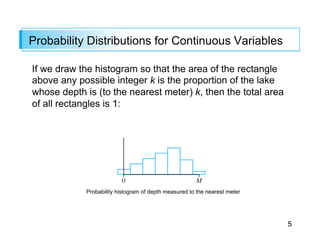
If we draw the histogram so that the area of the rectangle
above any possible integer k is the proportion of the lake
whose depth is (to the nearest meter) k, then the total area
of all rectangles is 1:
Probability histogram of depth measured to the nearest meter
6
Probability Distributions for Continuous Variables
If depth is measured much more accurately, each rectangle
in the resulting probability histogram is much narrower,
though the total area of all rectangles is still 1.
Probability histogram of depth measured to the nearest centimeter
7
Probability Distributions for Continuous Variables
If we continue in this way to measure depth more and more
finely, the resulting sequence of histograms approaches a
smooth curve.
Because for each histogram the total area of all rectangles
equals 1, the total area under the smooth curve is also 1.
A limit of a sequence of discrete histograms
8
Probability Distributions for Continuous Variables
Definition
Let X be a continuous r.v. Then a probability distribution
or probability density function (pdf) of X is a function f(x)
such that for any two numbers a and b with a ≤ b, we have
The probability that X is in the interval [a, b] can be
calculated by integrating the pdf of the r.v. X.
P(a  X  b) =
Z b
a
f(x)dx
9
Probability Distributions for Continuous Variables
The probability that X takes on a value in the interval [a, b]
is the area above this interval and under the graph of the
density function:
P(a ≤ X ≤ b) = the area under the density curve between a and b
10
Probability Distributions for Continuous Variables
For f(x) to be a legitimate pdf, it must satisfy the following
two conditions:
1. f(x) ≥ 0 for all x
2. = area under the entire graph of f(x) = 1
11
Example
Consider the reference line connecting the valve stem on a
tire to the center point.
Let X be the angle measured clockwise to the location of an
imperfection. One possible pdf for X is
12
Example, cont
The pdf is graphed in Figure 4.3.
The pdf and probability from Example 4
Figure 4.3
cont’d
13
Example , cont
Clearly f(x) ≥ 0. How can we show that the area of this pdf
is equal to 1?
How do we calculate P(90 <= X <= 180)?
The probability that the angle of occurrence is within 90° of
the reference line (reference line is at 0 degrees)?
cont’d
14
Probability Distributions for Continuous Variables
Because whenever 0 ≤ a ≤ b ≤ 360 in Example 4.4 and
P(a ≤ X ≤ b) depends only on the width b – a of the interval,
X is said to have a uniform distribution.
Definition
A continuous rv X is said to have a uniform distribution
on the interval [A, B] if the pdf of X is
15
Example
“Time headway” in traffic flow is the elapsed time between
the time that one car finishes passing a fixed point and the
instant that the next car begins to pass that point.
Let X = the time headway for two randomly chosen
consecutive cars on a freeway during a period of heavy
flow.
This pdf of X is essentially the one suggested in “The Statistical Properties of
Freeway Traffic” (Transp. Res., vol. 11: 221–228):
16
Example , cont
The graph of f(x) is given in Figure 4.4; there is no density
associated with headway times less than .5, and headway
density decreases rapidly (exponentially fast) as x
increases from .5.
The density curve for time headway in Example 5
Figure 4.4
cont’d
17
Example
Clearly, f(x) ≥ 0; and
What is the probability that headway time is at most 5
seconds?
cont’d
Z 1
1
f(x)dx =
Z 0.5
1
0 dx +
Z 1
0.5
0.15e 0.15(x 0.5)
dx
= 0.15e0.075
Z 1
0.5
e 0.15x
dx = 1
18
Integrating functions in R
19
The Cumulative Distribution Function
The cumulative distribution function F(x) for a
continuous rv X is defined for every number x by
F(x) = P(X ≤ x) =
For each x, F(x) is the area under the density curve to the
left of x. This is illustrated in Figure 4.5, where F(x)
increases smoothly as x increases.
Figure 4.5
A pdf and associated cdf
20
Example
Let X, the thickness of a certain metal sheet, have a
uniform distribution on [A, B].
The density function is shown in Figure 4.6.
Figure 4.6
The pdf for a uniform distribution
21
Example , cont
For x < A, F(x) = 0, since there is no area under the graph
of the density function to the left of such an x.
For x ≥ B, F(x) = 1, since all the area is accumulated to the
left of such an x. Finally for A ≤ x ≤ B,
cont’d
22
Example , cont
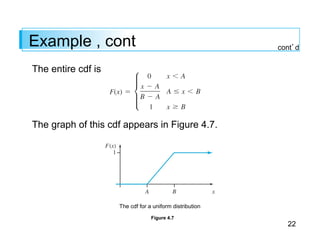
The entire cdf is
The graph of this cdf appears in Figure 4.7.
Figure 4.7
The cdf for a uniform distribution
cont’d
23
Using F(x) to Compute Probabilities
24
Percentiles of a Continuous Distribution
When we say that an individual’s test score was at the 85th
percentile of the population, we mean that 85% of all
population scores were below that score and 15% were
above.
Similarly, the 40th percentile is the score that exceeds 40%
of all scores and is exceeded by 60% of all scores.
25
Percentiles of a Continuous Distribution
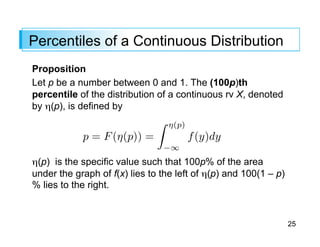
Proposition
Let p be a number between 0 and 1. The (100p)th
percentile of the distribution of a continuous rv X, denoted
by η(p), is defined by
η(p) is the specific value such that 100p% of the area
under the graph of f(x) lies to the left of η(p) and 100(1 – p)
% lies to the right.
p = F(⌘(p)) =
Z ⌘(p)
1
f(y)dy
26
Percentiles of a Continuous Distribution
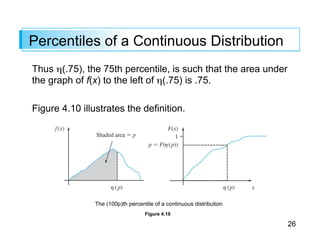
Thus η(.75), the 75th percentile, is such that the area under
the graph of f(x) to the left of η(.75) is .75.
Figure 4.10 illustrates the definition.
Figure 4.10
The (100p)th percentile of a continuous distribution
27
Example 9
The distribution of the amount of gravel (in tons) sold by a
particular construction supply company in a given week is a
continuous rv X with pdf
What is the cdf of sales for any x? How do you use this to
find the probability that X is less than .25? What about the
probability that X is greater than .75? What about
P(.25 < X < .75)?
28
Example 9
The graphs of both f(x) and F(x) appear in Figure 4.11.
Figure 4.11
The pdf and cdf for Example 4.9
cont’d
29
Example 9
How do we find the 40th percentile of this distribution?
How would you find the median of this distribution?
cont’d
30
Percentiles of a Continuous Distribution
Definition
The median of a continuous distribution, denoted by , is
the 50th percentile, so satisfies .5 = F( ) That is, half the
area under the density curve is to the left of and half is to
the right of . The 25th percentile is called the lower
quartile and the 75th percentile is called the upper
quartile.
31
Expected Values
Definition
The expected (or mean) value of a continuous r.v. X with
the pdf f(x) is:
µX = E(X) =
Z 1
1
x · f(x)dx
32
Example, cont
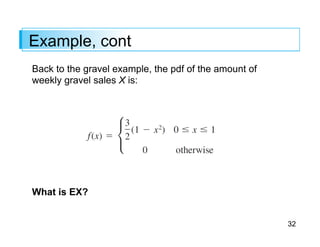
Back to the gravel example, the pdf of the amount of
weekly gravel sales X is:
What is EX?
33
Expected Values of functions of r.v.
If h(X) is a function of X, then
For h(X) = aX + b, a linear function,
µh(X) = E[h(X)] =
Z 1
1
h(x) · f(x) dx
E[h(X)] = E[aX + b] = aE[X] + b
34
Variance
The variance of a continuous random variable X with pdf
f(x) and mean value µ is
The standard deviation (SD) of X is
When h(X) = aX + b,
2
X = V (X) =
Z 1
1
(x µ)2
· f(x) dx
= E[(X E(X))2
]
= E(X2
) E(X)2
X =
p
V (X)
V [h(X)] = V [aX + b] = a2
· 2
X and aX+b = |a| · X
35
Example, cont.
How do we compute the variance for the weekly
gravel sales example?
36
The Normal Distribution
The normal distribution is probably the most important
distribution in all of probability and statistics.
Many populations have distributions that can be fit very
closely by an appropriate normal (or Gaussian, bell) curve.
Examples: height, weight, and other physical
characteristics, scores on various tests, etc.
37
The Normal Distribution
Definition
A continuous r.v. X is said to have a normal distribution
with parameters µ and σ > 0 (or µ and σ 2), if the pdf of X is
• e has approximate value 2.71828
• π has approximate value 3.14159.
f(x; µ, ) =
1
p
2⇡
e (x µ)2
/2 2
where 1 < x < 1
38
The Normal Distribution
The statement that X is normally distributed with
parameters µ and σ2 is often abbreviated X ~ N(µ, σ2).
Clearly f(x; µ, σ) ≥ 0, but a somewhat complicated calculus
argument must be used to verify that f(x; µ, σ) dx = 1.
Similarly, it can be shown that E(X) = µ and V(X) = σ2, so
the parameters are the mean and the standard deviation of
X.
39
The Normal Distribution
Figure below presents graphs of f(x; µ, σ) for several
different (µ, σ) pairs.
Two different normal density curves Visualizing µ and σ for a normal
distribution
40
(z) =
Z z
1
f(y; 0, 1) dy
f(z; 0, 1) =
1
p
2⇡
e z2
/2
where 1 < z < 1
The Standard Normal Distribution
The normal distribution with parameter values µ = 0 and
σ = 1 is called the standard normal distribution.
A r.v. with this distribution is called a standard normal
random variable and is denoted by Z. Its pdf is:
The graph of f(z; 0, 1) is called the standard normal curve.
Its inflection points are at 1 and –1. The cdf of the standard normal is
note we use the special notation Φ(z) for the cdf of Z.
41
The Standard Normal Distribution
• The standard normal distribution rarely occurs naturally.
• Instead, it is a reference distribution from which information about
other normal distributions can be obtained via a simple formula.
• These probabilities can then be found “normal tables”.
• This can also be computed with a single command in R.
42
The Standard Normal Distribution
Figure below illustrates the probabilities tabulated in Table
A.3:
43
Example
P(Z ≤ 1.25) = (1.25), a probability that is tabulated in a
normal table.
What is this probability?
Figure below illustrates this probability:
cont’d
44
Example , cont.
b) P(Z ≥ 1.25) = ?
c) Why does P(Z ≤ –1.25) = P(Z >= 1.25)? What is
(–1.25)?
d) How do we calculate P(–.38 ≤ Z ≤ 1.25)?
cont’d
45
Example
The 99th percentile of the standard normal distribution is
that value of z such that the area under the z curve to the
left of the value is .99
Tables give for fixed z the area under the standard normal
curve to the left of z, whereas now –
we have the area and want the value of z.
This is the “inverse” problem to P(Z ≤ z) = ?
How can the table be used for this?
46
Example
By symmetry, the first percentile is as far below 0 as the
99th is above 0, so equals –2.33 (1% lies below the first
and also above the 99th).
cont’d
47
Percentiles of the Standard Normal Distribution
If p does not appear in a table, what can we do?
What is the 95th percentile of the normal distribution?
48
zα Notation
In statistical inference, we need the z values that give
certain tail areas under the standard normal curve.
There, this notation will be standard:
zα will denote the z value for which α of the area under
the z curve lies to the right of zα.
49
zα Notation for z Critical Values
For example, z.10 captures upper-tail area .10, and z.01
captures upper-tail area .01.
Since α of the area under the z curve lies to the right of zα,
1 – α of the area lies to its left.
Thus zα is the 100(1 – α)th percentile of the standard
normal distribution.
Similarly, what does –zα mean?
50
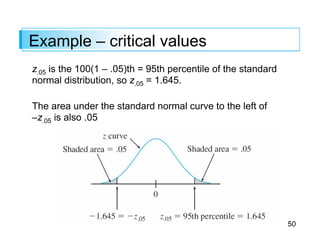
Example – critical values
z.05 is the 100(1 – .05)th = 95th percentile of the standard
normal distribution, so z.05 = 1.645.
The area under the standard normal curve to the left of
–z.05 is also .05
51
Nonstandard Normal Distributions
When X ~ N(µ, σ 2), probabilities involving X are computed
by “standardizing.” The standardized variable is (X – µ)/
σ.
Subtracting µ shifts the mean from µ to zero, and then
dividing by σ scales the variable so that the standard
deviation is 1 rather than σ.
Proposition
If X has a normal distribution with mean µ and standard
deviation σ, then
is distributed standard normal.
52
Nonstandard Normal Distributions
Why do we standardize normal random variables?
Equality of nonstandard and standard normal curve areas
53
Nonstandard Normal Distributions
has a standard normal distribution. Thus
54
THE NORMAL
DISTRIBUTION IN R.
55
Exponential Distribution
56
The Exponential Distributions
The family of exponential distributions provides probability
models that are very widely used in engineering and
science disciplines. Examples?
Definition
X is said to have an exponential distribution with the rate
parameter λ (λ > 0) if the pdf of X is
57
The Exponential Distributions
Integration by parts give the following results:
How would we set up the calculation for EX?
Both the mean and standard deviation of the exponential
distribution equal 1/λ.
CDF:
58
Another important application of the exponential distribution
is to model the distribution of lifetimes, or times to an
event.
A partial reason for the popularity of such applications is
the “memoryless” property of the Exponential
distribution.
The Exponential Distributions
59
The Exponential Distributions
Suppose a light bulb’s lifetime is exponentially distributed
with parameter λ.
Say you turn the light on, and then we leave and come
back after t0 hours to find it still on. What is the probability
that the light bulb will last for at least additional t hours?
In symbols, we are looking for P(X ≥ t + t0 | X ≥ t0).
How would we calculate this?
60
The Chi-Squared Distribution
Definition
Let v be a positive integer. Then a random variable X is
said to have a chi-squared distribution with parameter v if
the pdf of X is the gamma density with α = v/2 and β = 2.
The pdf of a chi-squared rv is thus
The parameter is called the number of degrees of
freedom (df) of X. The symbol χ2 is often used in place of
“chi-squared.”
(4.10)
61
The Weibull Distribution
The Weibull distribution is used similarly to the exponential
distribution to model times to an event, but with an extra
parameter included for flexilibility.
Definition
A random variable X is said to have a Weibull distribution
with parameters α and β (α > 0, β > 0) if the pdf of X is
What is this distribution if alpha = 1?
(4.11)
62
The Weibull Distribution
Both α and β can be varied to obtain a number of different-
looking density curves, as illustrated below.
Weibull density curves
63
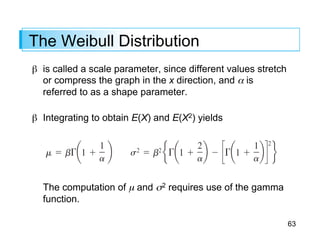
The Weibull Distribution
β is called a scale parameter, since different values stretch
or compress the graph in the x direction, and α is
referred to as a shape parameter.
β Integrating to obtain E(X) and E(X2) yields
The computation of µ and σ2 requires use of the gamma
function.
64
The Beta Distribution
So far, all families of continuous distributions (except for the
uniform distribution) had positive density over an infinite
interval.
The beta distribution provides positive density only for X in
an interval of finite length [A,B].
The standard beta distribution is commonly used to model
variation in the proportion or percentage of a quantity
occurring in different samples. Examples?
65
The Beta Distribution
Definition
A random variable X is said to have a beta distribution
with parameters α, β (both positive), A, and B if the pdf of
X is
The case A = 0, B = 1 gives the standard beta
distribution.
66
The Beta Distribution
Figure below illustrates several standard beta pdf’s.
Standard beta density curves
67
The Beta Distribution
Graphs of the general pdf are similar, except they are
shifted and then stretched or compressed to fit over [A, B].
Unless α and β are integers, integration of the pdf to
calculate probabilities is difficult. Either a table of the
incomplete beta function or appropriate software should be
used.
The mean and variance of X are
68
Example 1
Suppose the pdf of the magnitude X of a dynamic load on a
bridge (in newtons) is
What are F(x), E(X), and Var(X)?
69
Example 1
The graphs of f(x) and F(x) are shown in Figure 4.9.
The pdf and cdf for Example 4.7
cont’d
70
Example 1
What is the probability that the load is between 1 and 1.5?
The probability that the load exceeds 1?
The average load? The median load?
cont’d
71
Example 2
The time that it takes a driver to react to the brake lights on
a decelerating vehicle is critical in helping to avoid rear-end
collisions.
The article “Fast-Rise Brake Lamp as a Collision-
Prevention Device” (Ergonomics, 1993: 391–395) suggests
that reaction time for an in-traffic response to a brake signal
from standard brake lights can be modeled with a normal
distribution having mean value 1.25 sec and standard
deviation of .46 sec.
What is the probability that reaction time is between 1.00
sec and 1.75 sec?

Continuous random variables and probability distribution

  • 1.
    4 Continuous Random Variables and ProbabilityDistributions Stat 4570/5570 Material from Devore’s book (Ed 8) – Chapter 4 - and Cengage
  • 2.
    2 Continuous r.v. A randomvariable X is continuous if possible values comprise either a single interval on the number line or a union of disjoint intervals. Example: If in the study of the ecology of a lake, X, the r.v. may be depth measurements at randomly chosen locations. Then X is a continuous r.v. The range for X is the minimum depth possible to the maximum depth possible.
  • 3.
    3 Continuous r.v. In principlevariables such as height, weight, and temperature are continuous, in practice the limitations of our measuring instruments restrict us to a discrete (though sometimes very finely subdivided) world. However, continuous models often approximate real-world situations very well, and continuous mathematics (calculus) is frequently easier to work with than mathematics of discrete variables and distributions.
  • 4.
    4 Probability Distributions forContinuous Variables Suppose the variable X of interest is the depth of a lake at a randomly chosen point on the surface. Let M = the maximum depth (in meters), so that any number in the interval [0, M] is a possible value of X. If we “discretize” X by measuring depth to the nearest meter, then possible values are nonnegative integers less than or equal to M. The resulting discrete distribution of depth can be pictured using a probability histogram.
  • 5.
    5 Probability Distributions forContinuous Variables If we draw the histogram so that the area of the rectangle above any possible integer k is the proportion of the lake whose depth is (to the nearest meter) k, then the total area of all rectangles is 1: Probability histogram of depth measured to the nearest meter
  • 6.
    6 Probability Distributions forContinuous Variables If depth is measured much more accurately, each rectangle in the resulting probability histogram is much narrower, though the total area of all rectangles is still 1. Probability histogram of depth measured to the nearest centimeter
  • 7.
    7 Probability Distributions forContinuous Variables If we continue in this way to measure depth more and more finely, the resulting sequence of histograms approaches a smooth curve. Because for each histogram the total area of all rectangles equals 1, the total area under the smooth curve is also 1. A limit of a sequence of discrete histograms
  • 8.
    8 Probability Distributions forContinuous Variables Definition Let X be a continuous r.v. Then a probability distribution or probability density function (pdf) of X is a function f(x) such that for any two numbers a and b with a ≤ b, we have The probability that X is in the interval [a, b] can be calculated by integrating the pdf of the r.v. X. P(a  X  b) = Z b a f(x)dx
  • 9.
    9 Probability Distributions forContinuous Variables The probability that X takes on a value in the interval [a, b] is the area above this interval and under the graph of the density function: P(a ≤ X ≤ b) = the area under the density curve between a and b
  • 10.
    10 Probability Distributions forContinuous Variables For f(x) to be a legitimate pdf, it must satisfy the following two conditions: 1. f(x) ≥ 0 for all x 2. = area under the entire graph of f(x) = 1
  • 11.
    11 Example Consider the referenceline connecting the valve stem on a tire to the center point. Let X be the angle measured clockwise to the location of an imperfection. One possible pdf for X is
  • 12.
    12 Example, cont The pdfis graphed in Figure 4.3. The pdf and probability from Example 4 Figure 4.3 cont’d
  • 13.
    13 Example , cont Clearlyf(x) ≥ 0. How can we show that the area of this pdf is equal to 1? How do we calculate P(90 <= X <= 180)? The probability that the angle of occurrence is within 90° of the reference line (reference line is at 0 degrees)? cont’d
  • 14.
    14 Probability Distributions forContinuous Variables Because whenever 0 ≤ a ≤ b ≤ 360 in Example 4.4 and P(a ≤ X ≤ b) depends only on the width b – a of the interval, X is said to have a uniform distribution. Definition A continuous rv X is said to have a uniform distribution on the interval [A, B] if the pdf of X is
  • 15.
    15 Example “Time headway” intraffic flow is the elapsed time between the time that one car finishes passing a fixed point and the instant that the next car begins to pass that point. Let X = the time headway for two randomly chosen consecutive cars on a freeway during a period of heavy flow. This pdf of X is essentially the one suggested in “The Statistical Properties of Freeway Traffic” (Transp. Res., vol. 11: 221–228):
  • 16.
    16 Example , cont Thegraph of f(x) is given in Figure 4.4; there is no density associated with headway times less than .5, and headway density decreases rapidly (exponentially fast) as x increases from .5. The density curve for time headway in Example 5 Figure 4.4 cont’d
  • 17.
    17 Example Clearly, f(x) ≥0; and What is the probability that headway time is at most 5 seconds? cont’d Z 1 1 f(x)dx = Z 0.5 1 0 dx + Z 1 0.5 0.15e 0.15(x 0.5) dx = 0.15e0.075 Z 1 0.5 e 0.15x dx = 1
  • 18.
  • 19.
    19 The Cumulative DistributionFunction The cumulative distribution function F(x) for a continuous rv X is defined for every number x by F(x) = P(X ≤ x) = For each x, F(x) is the area under the density curve to the left of x. This is illustrated in Figure 4.5, where F(x) increases smoothly as x increases. Figure 4.5 A pdf and associated cdf
  • 20.
    20 Example Let X, thethickness of a certain metal sheet, have a uniform distribution on [A, B]. The density function is shown in Figure 4.6. Figure 4.6 The pdf for a uniform distribution
  • 21.
    21 Example , cont Forx < A, F(x) = 0, since there is no area under the graph of the density function to the left of such an x. For x ≥ B, F(x) = 1, since all the area is accumulated to the left of such an x. Finally for A ≤ x ≤ B, cont’d
  • 22.
    22 Example , cont Theentire cdf is The graph of this cdf appears in Figure 4.7. Figure 4.7 The cdf for a uniform distribution cont’d
  • 23.
    23 Using F(x) toCompute Probabilities
  • 24.
    24 Percentiles of aContinuous Distribution When we say that an individual’s test score was at the 85th percentile of the population, we mean that 85% of all population scores were below that score and 15% were above. Similarly, the 40th percentile is the score that exceeds 40% of all scores and is exceeded by 60% of all scores.
  • 25.
    25 Percentiles of aContinuous Distribution Proposition Let p be a number between 0 and 1. The (100p)th percentile of the distribution of a continuous rv X, denoted by η(p), is defined by η(p) is the specific value such that 100p% of the area under the graph of f(x) lies to the left of η(p) and 100(1 – p) % lies to the right. p = F(⌘(p)) = Z ⌘(p) 1 f(y)dy
  • 26.
    26 Percentiles of aContinuous Distribution Thus η(.75), the 75th percentile, is such that the area under the graph of f(x) to the left of η(.75) is .75. Figure 4.10 illustrates the definition. Figure 4.10 The (100p)th percentile of a continuous distribution
  • 27.
    27 Example 9 The distributionof the amount of gravel (in tons) sold by a particular construction supply company in a given week is a continuous rv X with pdf What is the cdf of sales for any x? How do you use this to find the probability that X is less than .25? What about the probability that X is greater than .75? What about P(.25 < X < .75)?
  • 28.
    28 Example 9 The graphsof both f(x) and F(x) appear in Figure 4.11. Figure 4.11 The pdf and cdf for Example 4.9 cont’d
  • 29.
    29 Example 9 How dowe find the 40th percentile of this distribution? How would you find the median of this distribution? cont’d
  • 30.
    30 Percentiles of aContinuous Distribution Definition The median of a continuous distribution, denoted by , is the 50th percentile, so satisfies .5 = F( ) That is, half the area under the density curve is to the left of and half is to the right of . The 25th percentile is called the lower quartile and the 75th percentile is called the upper quartile.
  • 31.
    31 Expected Values Definition The expected(or mean) value of a continuous r.v. X with the pdf f(x) is: µX = E(X) = Z 1 1 x · f(x)dx
  • 32.
    32 Example, cont Back tothe gravel example, the pdf of the amount of weekly gravel sales X is: What is EX?
  • 33.
    33 Expected Values offunctions of r.v. If h(X) is a function of X, then For h(X) = aX + b, a linear function, µh(X) = E[h(X)] = Z 1 1 h(x) · f(x) dx E[h(X)] = E[aX + b] = aE[X] + b
  • 34.
    34 Variance The variance ofa continuous random variable X with pdf f(x) and mean value µ is The standard deviation (SD) of X is When h(X) = aX + b, 2 X = V (X) = Z 1 1 (x µ)2 · f(x) dx = E[(X E(X))2 ] = E(X2 ) E(X)2 X = p V (X) V [h(X)] = V [aX + b] = a2 · 2 X and aX+b = |a| · X
  • 35.
    35 Example, cont. How dowe compute the variance for the weekly gravel sales example?
  • 36.
    36 The Normal Distribution Thenormal distribution is probably the most important distribution in all of probability and statistics. Many populations have distributions that can be fit very closely by an appropriate normal (or Gaussian, bell) curve. Examples: height, weight, and other physical characteristics, scores on various tests, etc.
  • 37.
    37 The Normal Distribution Definition Acontinuous r.v. X is said to have a normal distribution with parameters µ and σ > 0 (or µ and σ 2), if the pdf of X is • e has approximate value 2.71828 • π has approximate value 3.14159. f(x; µ, ) = 1 p 2⇡ e (x µ)2 /2 2 where 1 < x < 1
  • 38.
    38 The Normal Distribution Thestatement that X is normally distributed with parameters µ and σ2 is often abbreviated X ~ N(µ, σ2). Clearly f(x; µ, σ) ≥ 0, but a somewhat complicated calculus argument must be used to verify that f(x; µ, σ) dx = 1. Similarly, it can be shown that E(X) = µ and V(X) = σ2, so the parameters are the mean and the standard deviation of X.
  • 39.
    39 The Normal Distribution Figurebelow presents graphs of f(x; µ, σ) for several different (µ, σ) pairs. Two different normal density curves Visualizing µ and σ for a normal distribution
  • 40.
    40 (z) = Z z 1 f(y;0, 1) dy f(z; 0, 1) = 1 p 2⇡ e z2 /2 where 1 < z < 1 The Standard Normal Distribution The normal distribution with parameter values µ = 0 and σ = 1 is called the standard normal distribution. A r.v. with this distribution is called a standard normal random variable and is denoted by Z. Its pdf is: The graph of f(z; 0, 1) is called the standard normal curve. Its inflection points are at 1 and –1. The cdf of the standard normal is note we use the special notation Φ(z) for the cdf of Z.
  • 41.
    41 The Standard NormalDistribution • The standard normal distribution rarely occurs naturally. • Instead, it is a reference distribution from which information about other normal distributions can be obtained via a simple formula. • These probabilities can then be found “normal tables”. • This can also be computed with a single command in R.
  • 42.
    42 The Standard NormalDistribution Figure below illustrates the probabilities tabulated in Table A.3:
  • 43.
    43 Example P(Z ≤ 1.25)= (1.25), a probability that is tabulated in a normal table. What is this probability? Figure below illustrates this probability: cont’d
  • 44.
    44 Example , cont. b)P(Z ≥ 1.25) = ? c) Why does P(Z ≤ –1.25) = P(Z >= 1.25)? What is (–1.25)? d) How do we calculate P(–.38 ≤ Z ≤ 1.25)? cont’d
  • 45.
    45 Example The 99th percentileof the standard normal distribution is that value of z such that the area under the z curve to the left of the value is .99 Tables give for fixed z the area under the standard normal curve to the left of z, whereas now – we have the area and want the value of z. This is the “inverse” problem to P(Z ≤ z) = ? How can the table be used for this?
  • 46.
    46 Example By symmetry, thefirst percentile is as far below 0 as the 99th is above 0, so equals –2.33 (1% lies below the first and also above the 99th). cont’d
  • 47.
    47 Percentiles of theStandard Normal Distribution If p does not appear in a table, what can we do? What is the 95th percentile of the normal distribution?
  • 48.
    48 zα Notation In statisticalinference, we need the z values that give certain tail areas under the standard normal curve. There, this notation will be standard: zα will denote the z value for which α of the area under the z curve lies to the right of zα.
  • 49.
    49 zα Notation forz Critical Values For example, z.10 captures upper-tail area .10, and z.01 captures upper-tail area .01. Since α of the area under the z curve lies to the right of zα, 1 – α of the area lies to its left. Thus zα is the 100(1 – α)th percentile of the standard normal distribution. Similarly, what does –zα mean?
  • 50.
    50 Example – criticalvalues z.05 is the 100(1 – .05)th = 95th percentile of the standard normal distribution, so z.05 = 1.645. The area under the standard normal curve to the left of –z.05 is also .05
  • 51.
    51 Nonstandard Normal Distributions WhenX ~ N(µ, σ 2), probabilities involving X are computed by “standardizing.” The standardized variable is (X – µ)/ σ. Subtracting µ shifts the mean from µ to zero, and then dividing by σ scales the variable so that the standard deviation is 1 rather than σ. Proposition If X has a normal distribution with mean µ and standard deviation σ, then is distributed standard normal.
  • 52.
    52 Nonstandard Normal Distributions Whydo we standardize normal random variables? Equality of nonstandard and standard normal curve areas
  • 53.
    53 Nonstandard Normal Distributions hasa standard normal distribution. Thus
  • 54.
  • 55.
  • 56.
    56 The Exponential Distributions Thefamily of exponential distributions provides probability models that are very widely used in engineering and science disciplines. Examples? Definition X is said to have an exponential distribution with the rate parameter λ (λ > 0) if the pdf of X is
  • 57.
    57 The Exponential Distributions Integrationby parts give the following results: How would we set up the calculation for EX? Both the mean and standard deviation of the exponential distribution equal 1/λ. CDF:
  • 58.
    58 Another important applicationof the exponential distribution is to model the distribution of lifetimes, or times to an event. A partial reason for the popularity of such applications is the “memoryless” property of the Exponential distribution. The Exponential Distributions
  • 59.
    59 The Exponential Distributions Supposea light bulb’s lifetime is exponentially distributed with parameter λ. Say you turn the light on, and then we leave and come back after t0 hours to find it still on. What is the probability that the light bulb will last for at least additional t hours? In symbols, we are looking for P(X ≥ t + t0 | X ≥ t0). How would we calculate this?
  • 60.
    60 The Chi-Squared Distribution Definition Letv be a positive integer. Then a random variable X is said to have a chi-squared distribution with parameter v if the pdf of X is the gamma density with α = v/2 and β = 2. The pdf of a chi-squared rv is thus The parameter is called the number of degrees of freedom (df) of X. The symbol χ2 is often used in place of “chi-squared.” (4.10)
  • 61.
    61 The Weibull Distribution TheWeibull distribution is used similarly to the exponential distribution to model times to an event, but with an extra parameter included for flexilibility. Definition A random variable X is said to have a Weibull distribution with parameters α and β (α > 0, β > 0) if the pdf of X is What is this distribution if alpha = 1? (4.11)
  • 62.
    62 The Weibull Distribution Bothα and β can be varied to obtain a number of different- looking density curves, as illustrated below. Weibull density curves
  • 63.
    63 The Weibull Distribution βis called a scale parameter, since different values stretch or compress the graph in the x direction, and α is referred to as a shape parameter. β Integrating to obtain E(X) and E(X2) yields The computation of µ and σ2 requires use of the gamma function.
  • 64.
    64 The Beta Distribution Sofar, all families of continuous distributions (except for the uniform distribution) had positive density over an infinite interval. The beta distribution provides positive density only for X in an interval of finite length [A,B]. The standard beta distribution is commonly used to model variation in the proportion or percentage of a quantity occurring in different samples. Examples?
  • 65.
    65 The Beta Distribution Definition Arandom variable X is said to have a beta distribution with parameters α, β (both positive), A, and B if the pdf of X is The case A = 0, B = 1 gives the standard beta distribution.
  • 66.
    66 The Beta Distribution Figurebelow illustrates several standard beta pdf’s. Standard beta density curves
  • 67.
    67 The Beta Distribution Graphsof the general pdf are similar, except they are shifted and then stretched or compressed to fit over [A, B]. Unless α and β are integers, integration of the pdf to calculate probabilities is difficult. Either a table of the incomplete beta function or appropriate software should be used. The mean and variance of X are
  • 68.
    68 Example 1 Suppose thepdf of the magnitude X of a dynamic load on a bridge (in newtons) is What are F(x), E(X), and Var(X)?
  • 69.
    69 Example 1 The graphsof f(x) and F(x) are shown in Figure 4.9. The pdf and cdf for Example 4.7 cont’d
  • 70.
    70 Example 1 What isthe probability that the load is between 1 and 1.5? The probability that the load exceeds 1? The average load? The median load? cont’d
  • 71.
    71 Example 2 The timethat it takes a driver to react to the brake lights on a decelerating vehicle is critical in helping to avoid rear-end collisions. The article “Fast-Rise Brake Lamp as a Collision- Prevention Device” (Ergonomics, 1993: 391–395) suggests that reaction time for an in-traffic response to a brake signal from standard brake lights can be modeled with a normal distribution having mean value 1.25 sec and standard deviation of .46 sec. What is the probability that reaction time is between 1.00 sec and 1.75 sec?