Random Access Memory
Group#1
 Amna Riaz (1001)
 Iqra Aslam (1002)
 Memoona (1003)
 Samina Rani (1004)
 Aneesa Rahman (1005)
BSIT-Mor-3rd Semester
Mr. Inam-ul-Haq
University of Education,Lhr, okara
campus
Presented by: Presented To:
Definition :
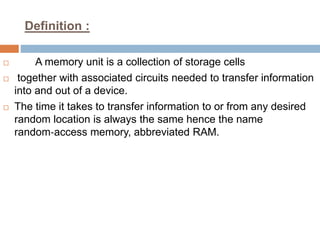
 A memory unit is a collection of storage cells
 together with associated circuits needed to transfer information
into and out of a device.
 The time it takes to transfer information to or from any desired
random location is always the same hence the name
random‐access memory, abbreviated RAM.
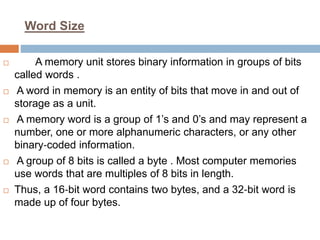
Word Size
 A memory unit stores binary information in groups of bits
called words .
 A word in memory is an entity of bits that move in and out of
storage as a unit.
 A memory word is a group of 1’s and 0’s and may represent a
number, one or more alphanumeric characters, or any other
binary‐coded information.
 A group of 8 bits is called a byte . Most computer memories
use words that are multiples of 8 bits in length.
 Thus, a 16‐bit word contains two bytes, and a 32‐bit word is
made up of four bytes.
Input and output:
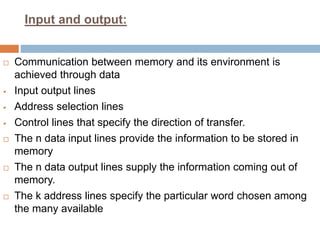
 Communication between memory and its environment is
achieved through data
 Input output lines
 Address selection lines
 Control lines that specify the direction of transfer.
 The n data input lines provide the information to be stored in
memory
 The n data output lines supply the information coming out of
memory.
 The k address lines specify the particular word chosen among
the many available
Internal working:
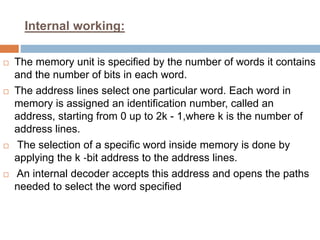
 The memory unit is specified by the number of words it contains
and the number of bits in each word.
 The address lines select one particular word. Each word in
memory is assigned an identification number, called an
address, starting from 0 up to 2k - 1,where k is the number of
address lines.
 The selection of a specific word inside memory is done by
applying the k ‐bit address to the address lines.
 An internal decoder accepts this address and opens the paths
needed to select the word specified
Read and Write Operation:
 The two operations that RAM can perform are the write and
read operations.
 The write signal specifies a transfer‐in operation
 The read signal specifies a transfer‐out operation.
 On accepting one of these control signals, the internal circuits
inside the memory provide the desired operation.
 The memory unit will then take the bits from the input data lines
and store them in the word specified by the address lines.
Cont….
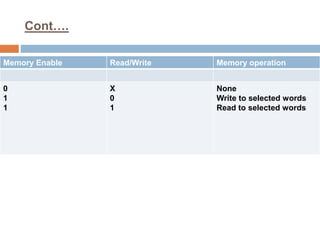
Memory Enable Read/Write Memory operation
0
1
1
X
0
1
None
Write to selected words
Read to selected words
Memory Description in HDL:
 Memory is modeled in the Verilog hardware description
language (HDL) by an array of registers.
 It is declared with a reg keyword, using a two‐dimensional
array.
 The first number in the array specifies the number of bits in a
word (the word length) and the second gives the number of
words in memory.
 For example, a memory of 1,024 words with 16 bits per word
is declared as:
reg [15: 0] memword [0: 1023];
 Examples: reg [3: 0] DataOut;
reg [3: 0] Mem [0: 63];
Types of Memories:
The mode of access of a memory system is determined by the type
of components used.
 Integrated circuit RAM units are available in two operating
modes:
 Static RAM (SRAM) consists essentially of internal latches that
store the binary information. The stored information remains valid
as long as power is applied to the unit.
 Dynamic RAM (DRAM) stores the binary information in the form
of electric charges on capacitors provided inside the chip by
MOS transistors.
 The stored charge on the capacitors tends to discharge with time,
and the capacitors must be periodically recharged by refreshing
the dynamic memory.
 Refreshing is done by cycling through the words every few
milliseconds to restore the decaying charge.
Cont…
 DRAM offers reduced power consumption and larger storage
capacity in a single memory chip.
 SRAM is easier to use and has shorter read and write cycles.
 Memory units that lose stored information when power is
turned off are said to be volatile.
 CMOS integrated circuit RAMs, both static and dynamic, are of
this category, since the binary cells need external power to
maintain the stored information.
 In contrast, a nonvolatile memory, such as magnetic disk,
retains its stored information after the removal of power
 ROM is another nonvolatile memory.
 A nonvolatile memory enables digital computers to store
programs that will be needed again after the computer is
turned on.
Cont…
 Programs and data that cannot be altered are stored in ROM,
while other large programs are maintained on magnetic disks.
 The latter programs are transferred into the computer RAM as
needed.
 Before the power is turned off, the binary information from the
computer RAM is transferred to the disk so that the information
will be retained.
ERROR DETECTION AND CORRECTION:
 The reliability of a memory unit may be improved by employing
error‐detecting and error‐correcting codes.
Parity bit:
 The most common error detection scheme is the parity bit. A
parity bit is generated and stored along with the data word in
memory.
 The parity of the word is checked after reading it from memory.
 The data word is accepted if the parity of the bits read out is
correct.
 If the parity checked results in an inversion, an error is
detected, but it cannot be corrected
Hamming Code:
 One of the most common error‐correcting codes used in RAMs
was devised by R.W. Hamming.
 In the Hamming code, k parity bits are added to an n ‐bit data
word, forming a new word of n + k bits.
 The bit positions are numbered in sequence from 1 to n + k.
 Those positions numbered as a power of 2 are reserved for the
parity bits.
 The remaining bits are the data bits.
 The code can be used with words of any length
Reference:
 Digital Logic Designs (Book)
Written by: Morris Mano
THANKS 

Random Access Memory

  • 1.
    Random Access Memory Group#1 Amna Riaz (1001)  Iqra Aslam (1002)  Memoona (1003)  Samina Rani (1004)  Aneesa Rahman (1005) BSIT-Mor-3rd Semester Mr. Inam-ul-Haq University of Education,Lhr, okara campus Presented by: Presented To:
  • 2.
    Definition :  Amemory unit is a collection of storage cells  together with associated circuits needed to transfer information into and out of a device.  The time it takes to transfer information to or from any desired random location is always the same hence the name random‐access memory, abbreviated RAM.
  • 3.
    Word Size  Amemory unit stores binary information in groups of bits called words .  A word in memory is an entity of bits that move in and out of storage as a unit.  A memory word is a group of 1’s and 0’s and may represent a number, one or more alphanumeric characters, or any other binary‐coded information.  A group of 8 bits is called a byte . Most computer memories use words that are multiples of 8 bits in length.  Thus, a 16‐bit word contains two bytes, and a 32‐bit word is made up of four bytes.
  • 4.
    Input and output: Communication between memory and its environment is achieved through data  Input output lines  Address selection lines  Control lines that specify the direction of transfer.  The n data input lines provide the information to be stored in memory  The n data output lines supply the information coming out of memory.  The k address lines specify the particular word chosen among the many available
  • 5.
    Internal working:  Thememory unit is specified by the number of words it contains and the number of bits in each word.  The address lines select one particular word. Each word in memory is assigned an identification number, called an address, starting from 0 up to 2k - 1,where k is the number of address lines.  The selection of a specific word inside memory is done by applying the k ‐bit address to the address lines.  An internal decoder accepts this address and opens the paths needed to select the word specified
  • 6.
    Read and WriteOperation:  The two operations that RAM can perform are the write and read operations.  The write signal specifies a transfer‐in operation  The read signal specifies a transfer‐out operation.  On accepting one of these control signals, the internal circuits inside the memory provide the desired operation.  The memory unit will then take the bits from the input data lines and store them in the word specified by the address lines.
  • 7.
    Cont…. Memory Enable Read/WriteMemory operation 0 1 1 X 0 1 None Write to selected words Read to selected words
  • 8.
    Memory Description inHDL:  Memory is modeled in the Verilog hardware description language (HDL) by an array of registers.  It is declared with a reg keyword, using a two‐dimensional array.  The first number in the array specifies the number of bits in a word (the word length) and the second gives the number of words in memory.  For example, a memory of 1,024 words with 16 bits per word is declared as: reg [15: 0] memword [0: 1023];  Examples: reg [3: 0] DataOut; reg [3: 0] Mem [0: 63];
  • 9.
    Types of Memories: Themode of access of a memory system is determined by the type of components used.  Integrated circuit RAM units are available in two operating modes:  Static RAM (SRAM) consists essentially of internal latches that store the binary information. The stored information remains valid as long as power is applied to the unit.  Dynamic RAM (DRAM) stores the binary information in the form of electric charges on capacitors provided inside the chip by MOS transistors.  The stored charge on the capacitors tends to discharge with time, and the capacitors must be periodically recharged by refreshing the dynamic memory.  Refreshing is done by cycling through the words every few milliseconds to restore the decaying charge.
  • 10.
    Cont…  DRAM offersreduced power consumption and larger storage capacity in a single memory chip.  SRAM is easier to use and has shorter read and write cycles.  Memory units that lose stored information when power is turned off are said to be volatile.  CMOS integrated circuit RAMs, both static and dynamic, are of this category, since the binary cells need external power to maintain the stored information.  In contrast, a nonvolatile memory, such as magnetic disk, retains its stored information after the removal of power  ROM is another nonvolatile memory.  A nonvolatile memory enables digital computers to store programs that will be needed again after the computer is turned on.
  • 11.
    Cont…  Programs anddata that cannot be altered are stored in ROM, while other large programs are maintained on magnetic disks.  The latter programs are transferred into the computer RAM as needed.  Before the power is turned off, the binary information from the computer RAM is transferred to the disk so that the information will be retained.
  • 12.
    ERROR DETECTION ANDCORRECTION:  The reliability of a memory unit may be improved by employing error‐detecting and error‐correcting codes. Parity bit:  The most common error detection scheme is the parity bit. A parity bit is generated and stored along with the data word in memory.  The parity of the word is checked after reading it from memory.  The data word is accepted if the parity of the bits read out is correct.  If the parity checked results in an inversion, an error is detected, but it cannot be corrected
  • 13.
    Hamming Code:  Oneof the most common error‐correcting codes used in RAMs was devised by R.W. Hamming.  In the Hamming code, k parity bits are added to an n ‐bit data word, forming a new word of n + k bits.  The bit positions are numbered in sequence from 1 to n + k.  Those positions numbered as a power of 2 are reserved for the parity bits.  The remaining bits are the data bits.  The code can be used with words of any length
  • 14.
    Reference:  Digital LogicDesigns (Book) Written by: Morris Mano THANKS 