THE INTERNET ACCESS AND
TRAINING PROGRAM
The Internet Access and Training Program (IATP) is
funded by the United States Agency for International
Development (USAID) and administered by the
International Research and Exchanges Board (IREX)
Mark Skogen, Director for Eurasia
(Azerbaijan, Belarus, Georgia, Kazakhstan,
Kyrgyzstan, Moldova, Tajikistan,
Turkmenistan, Ukraine & Uzbekistan)
INTERNET IN EURASIA
 Government intervention to support and
hinder
 Between .5 and 30% of the population (no
reliable statistics) use Internet regularly
 Limited local-language content
 Limited, poor-quality access outside
capitals
 Lacking skills
Citizens and government not taking
advantage of Internet’s potential
IATP CENTERS
10 countries
100 centers
8,000 websites
700,000 visitors/year
IATP CENTERS
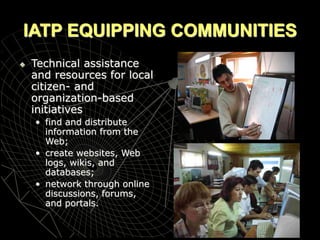
IATP EQUIPPING COMMUNITIES
 Technical assistance
and resources for local
citizen- and
organization-based
initiatives
• find and distribute
information from the
Web;
• create websites, Web
logs, wikis, and
databases;
• network through online
discussions, forums,
and portals.
IATP TARGET AUDIENCES
IATP serves everyone,
but gives priority to:
 Civil society activists,
government employees,
journalists, doctors,
farmers, librarians,
teachers, students and
others interested in using
Information Technology to
improve society and their
ability to succeed in it;
 Often these are
constituents of USAID-
funded programs
Courses (number of hours)
 Computer basics (5)
 Word (2)
 Excel (2)
 Web design (12)
 PowerPoint (4)
 Internet search (2)
 E-mail (2)
 Online forums (2-10)
TAILOR-MADE TRAININGS
Tailored modules:
 Advanced Internet for
Journalists
 Computer
Technologies for
Government Officials
 Internet for Teachers
 IT for Hearing
impaired
 Internet for NGOs
 Forum creation and
administration
Web design (results-oriented)
 Need text typed
 Photos or graphics
 Plan for design
 Someone to maintain and update
site
Professional networking
Electronic presentations
Public finds you online and
discusses topics you choose
Brochures and publications
Store and retrieve
information in
databases
Use electronic documents
Efficient
communication
INCREASING PROFESSIONALISM WITH INFORMATION
AND COMMUNICATION TECHNOLOGIES
You and your
colleagues work more
efficiently
Website for
organization
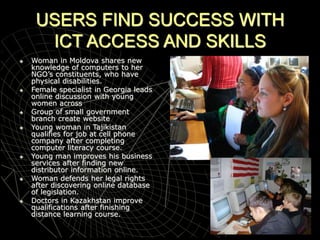
USERS FIND SUCCESS WITH
ICT ACCESS AND SKILLS
 Woman in Moldova shares new
knowledge of computers to her
NGO’s constituents, who have
physical disabilities.
 Female specialist in Georgia leads
online discussion with young
women across
 Group of small government
branch create website
 Young woman in Tajikistan
qualifies for job at cell phone
company after completing
computer literacy course.
 Young man improves his business
services after finding new
distributor information online.
 Woman defends her legal rights
after discovering online database
of legislation.
 Doctors in Kazakhstan improve
qualifications after finishing
distance learning course.
http://turkmenistan.WIKISPACES.com
Online forums
FORUM DISCUSSION
WHEN TO USE WHAT
TECHNOLOGY?
 A government representative requests
money for a computer and webmaster to
create its website.
 Need to arrange a meeting or roundtable,
but no travel budget for it or safety
concerns.
 Want to unite healthcare specialists to
jointly create an online resource.
 Government wants to help farmers, who are
using greenhouses for the first time.
 You work on a youth development project
and need to reach at-risk groups.
 Teacher has created after-school courses for
ninth-graders and wishes to reach a wider
audience with materials;
 Involve maternal healthcare specialists
throughout Iraq to jointly create an online
resource on keeping children healthy.
IATP Eurasia

  • 1.
    THE INTERNET ACCESSAND TRAINING PROGRAM The Internet Access and Training Program (IATP) is funded by the United States Agency for International Development (USAID) and administered by the International Research and Exchanges Board (IREX) Mark Skogen, Director for Eurasia (Azerbaijan, Belarus, Georgia, Kazakhstan, Kyrgyzstan, Moldova, Tajikistan, Turkmenistan, Ukraine & Uzbekistan)
  • 2.
    INTERNET IN EURASIA Government intervention to support and hinder  Between .5 and 30% of the population (no reliable statistics) use Internet regularly  Limited local-language content  Limited, poor-quality access outside capitals  Lacking skills Citizens and government not taking advantage of Internet’s potential
  • 3.
    IATP CENTERS 10 countries 100centers 8,000 websites 700,000 visitors/year IATP CENTERS
  • 4.
    IATP EQUIPPING COMMUNITIES Technical assistance and resources for local citizen- and organization-based initiatives • find and distribute information from the Web; • create websites, Web logs, wikis, and databases; • network through online discussions, forums, and portals.
  • 5.
    IATP TARGET AUDIENCES IATPserves everyone, but gives priority to:  Civil society activists, government employees, journalists, doctors, farmers, librarians, teachers, students and others interested in using Information Technology to improve society and their ability to succeed in it;  Often these are constituents of USAID- funded programs
  • 6.
    Courses (number ofhours)  Computer basics (5)  Word (2)  Excel (2)  Web design (12)  PowerPoint (4)  Internet search (2)  E-mail (2)  Online forums (2-10)
  • 7.
    TAILOR-MADE TRAININGS Tailored modules: Advanced Internet for Journalists  Computer Technologies for Government Officials  Internet for Teachers  IT for Hearing impaired  Internet for NGOs  Forum creation and administration
  • 8.
    Web design (results-oriented) Need text typed  Photos or graphics  Plan for design  Someone to maintain and update site
  • 9.
    Professional networking Electronic presentations Publicfinds you online and discusses topics you choose Brochures and publications Store and retrieve information in databases Use electronic documents Efficient communication INCREASING PROFESSIONALISM WITH INFORMATION AND COMMUNICATION TECHNOLOGIES You and your colleagues work more efficiently Website for organization
  • 10.
    USERS FIND SUCCESSWITH ICT ACCESS AND SKILLS  Woman in Moldova shares new knowledge of computers to her NGO’s constituents, who have physical disabilities.  Female specialist in Georgia leads online discussion with young women across  Group of small government branch create website  Young woman in Tajikistan qualifies for job at cell phone company after completing computer literacy course.  Young man improves his business services after finding new distributor information online.  Woman defends her legal rights after discovering online database of legislation.  Doctors in Kazakhstan improve qualifications after finishing distance learning course.
  • 11.
  • 12.
  • 13.
  • 14.
    WHEN TO USEWHAT TECHNOLOGY?  A government representative requests money for a computer and webmaster to create its website.  Need to arrange a meeting or roundtable, but no travel budget for it or safety concerns.  Want to unite healthcare specialists to jointly create an online resource.  Government wants to help farmers, who are using greenhouses for the first time.  You work on a youth development project and need to reach at-risk groups.  Teacher has created after-school courses for ninth-graders and wishes to reach a wider audience with materials;  Involve maternal healthcare specialists throughout Iraq to jointly create an online resource on keeping children healthy.