Submitted by:
Md. Waresul Islam Shohan
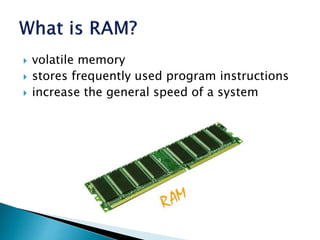
 volatile memory
 stores frequently used program instructions
 increase the general speed of a system
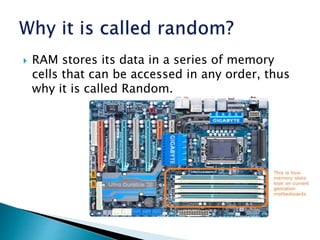
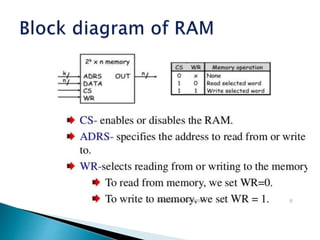
 RAM stores its data in a series of memory
cells that can be accessed in any order, thus
why it is called Random.
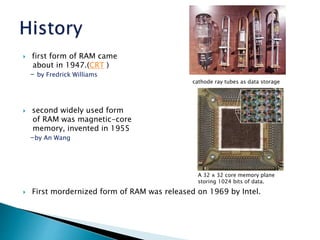
 first form of RAM came
about in 1947.(CRT )
- by Fredrick Williams
 second widely used form
of RAM was magnetic-core
memory, invented in 1955
-by An Wang
 First mordernized form of RAM was released on 1969 by Intel.
A 32 x 32 core memory plane
storing 1024 bits of data.
cathode ray tubes as data storage
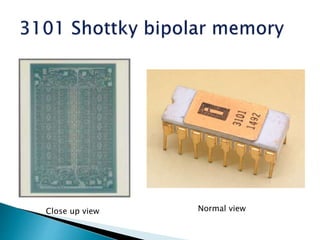
Close up view Normal view
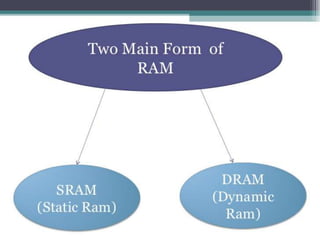
1.Static Random Access Memory (SRAM)
 Doesn’t need refreshing
 Retains contents as long as power applied to
the chip
 Access time around 10 nanoseconds
 Used for cache memory
 Also for date and time settings as powered by
small battery
2. Dynamic Random Access Memory (DRAM)
 Contents are constantly refreshed 1000 times
per second
 Access time 60 – 70 nanoseconds
3.Synchronous Dynamic Random Access
Memory (SDRAM)
 Quicker than DRAM
 Access time less than 60 nanoseconds
4. Direct Rambus Dynamic Random Access
Memory (DRDRAM)
 New type of RAM architecture
 Access time 20 times faster than DRAM
 More expensive
5.Video Random Access memory (VRAM)
 Holds data to be displayed on computer
screen
 Has two data paths allowing READ and WRITE
to occur at the same time
 A graphics card may have its own VRAM chip
on board EXAMPLE: NVDIA
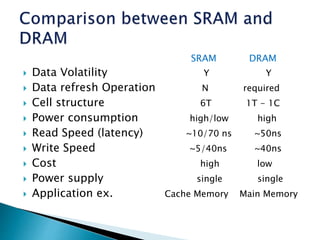
SRAM DRAM
 Data Volatility Y Y
 Data refresh Operation N required
 Cell structure 6T 1T - 1C
 Power consumption high/low high
 Read Speed (latency) ~10/70 ns ~50ns
 Write Speed ~5/40ns ~40ns
 Cost high low
 Power supply single single
 Application ex. Cache Memory Main Memory
Any Question ?

RAM (Random Access Memory)

  • 1.
  • 2.
     volatile memory stores frequently used program instructions  increase the general speed of a system
  • 3.
     RAM storesits data in a series of memory cells that can be accessed in any order, thus why it is called Random.
  • 4.
     first formof RAM came about in 1947.(CRT ) - by Fredrick Williams  second widely used form of RAM was magnetic-core memory, invented in 1955 -by An Wang  First mordernized form of RAM was released on 1969 by Intel. A 32 x 32 core memory plane storing 1024 bits of data. cathode ray tubes as data storage
  • 5.
    Close up viewNormal view
  • 8.
    1.Static Random AccessMemory (SRAM)  Doesn’t need refreshing  Retains contents as long as power applied to the chip  Access time around 10 nanoseconds  Used for cache memory  Also for date and time settings as powered by small battery
  • 9.
    2. Dynamic RandomAccess Memory (DRAM)  Contents are constantly refreshed 1000 times per second  Access time 60 – 70 nanoseconds
  • 10.
    3.Synchronous Dynamic RandomAccess Memory (SDRAM)  Quicker than DRAM  Access time less than 60 nanoseconds 4. Direct Rambus Dynamic Random Access Memory (DRDRAM)  New type of RAM architecture  Access time 20 times faster than DRAM  More expensive
  • 11.
    5.Video Random Accessmemory (VRAM)  Holds data to be displayed on computer screen  Has two data paths allowing READ and WRITE to occur at the same time  A graphics card may have its own VRAM chip on board EXAMPLE: NVDIA
  • 12.
    SRAM DRAM  DataVolatility Y Y  Data refresh Operation N required  Cell structure 6T 1T - 1C  Power consumption high/low high  Read Speed (latency) ~10/70 ns ~50ns  Write Speed ~5/40ns ~40ns  Cost high low  Power supply single single  Application ex. Cache Memory Main Memory
  • 13.