Memory
(Introduction to Read-only memory, read/write memory - SRAM and DRAM)
2
Memory
Memory is required to store:
1. data
2. application programs
3. operating system
3
Memory
Can be broadly classified as:
Random Access Memory (RAM)
or
Read Only Memory (ROM)
4
Random Access Memory (RAM)

Can be written to or read from.
− Read/Write memory

Reading from RAM is non-destructive.

Access time to read from any memory
location is the same.
− As compared to serial access memory.

Volatile
− Information is lost when power is
removed.
5
Random Access Memory (RAM)
6
Random Access Memory (RAM)

Static Random Access Memory (SRAM)
− Based on the Flip-Flop
− Requires a large number of transistors
− Fast

Dynamic Random Access Memory (DRAM)
− Uses a single transistor to store charge
− Requires very few transistors
− Must be periodically refreshed
− Slow(er)
Summary:
1. SRAM is static while DRAM is dynamic.
2. SRAM is faster compared to DRAM.
3. SRAM consumes less power than DRAM.
4. SRAM uses more transistors per bit of memory compared
to DRAM.
5. SRAM is more expensive than DRAM.
6. Cheaper DRAM is used in main memory while SRAM is
commonly used in cache memory
8
Random Access Memory (RAM)
What is typically stored in RAM?
9
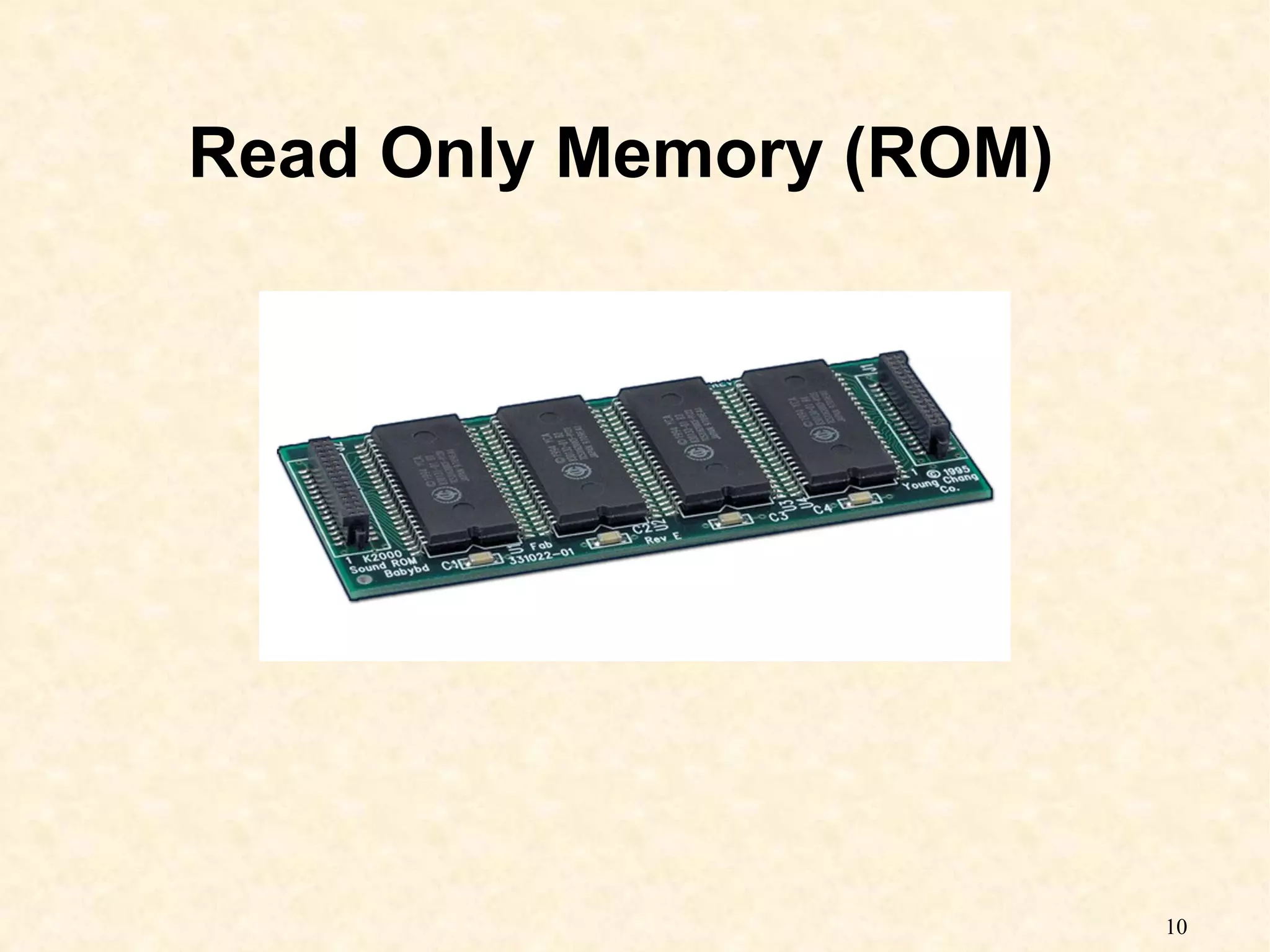
Read Only Memory (ROM)

Can only be read from.

Memory is written (or “programmed”) once

Reading from ROM is non-destructive.

Access time to read from any memory
location is the same.
− As compared to serial access memory.

Non-Volatile
− Information is retained even after power
is removed.
10
Read Only Memory (ROM)
11
Read Only Memory (ROM)

Programmable Read Only Memory (PROM)
− Can be “programmed”

Erasable PROM (EPROM)
− Can be “programmed” and erased

Electrically Erasable PROM (EEPROM)
− Can be erased using an electrical signal

UV Erasable PROM (UVEPROM)
− Can be erased using Ultraviolet light
12
Read Only Memory (ROM)
13
Read Only Memory (ROM)
What is typically stored in ROM?
14
Memory
15
Memory
Random Access Memory
16
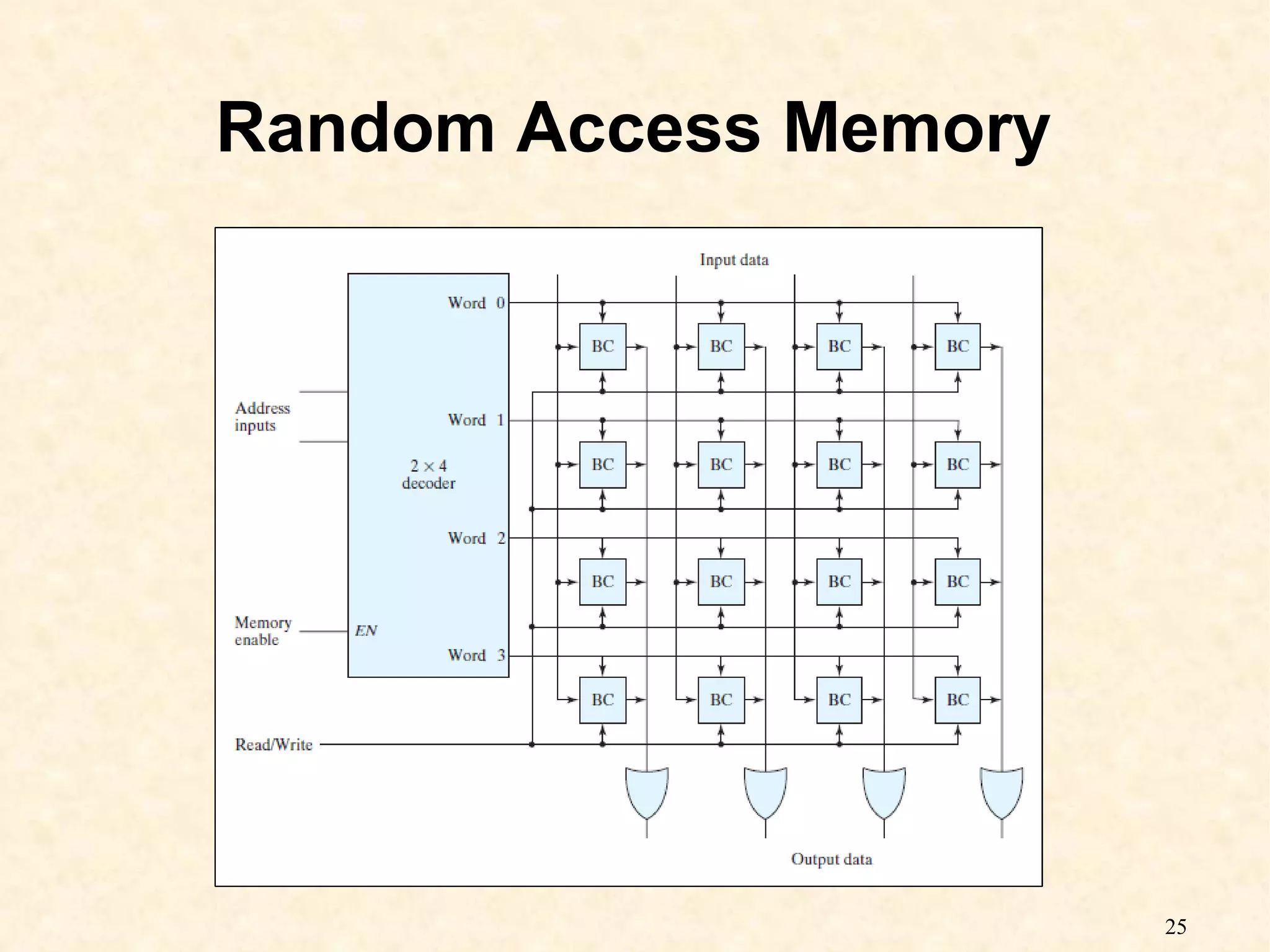
Random Access Memory

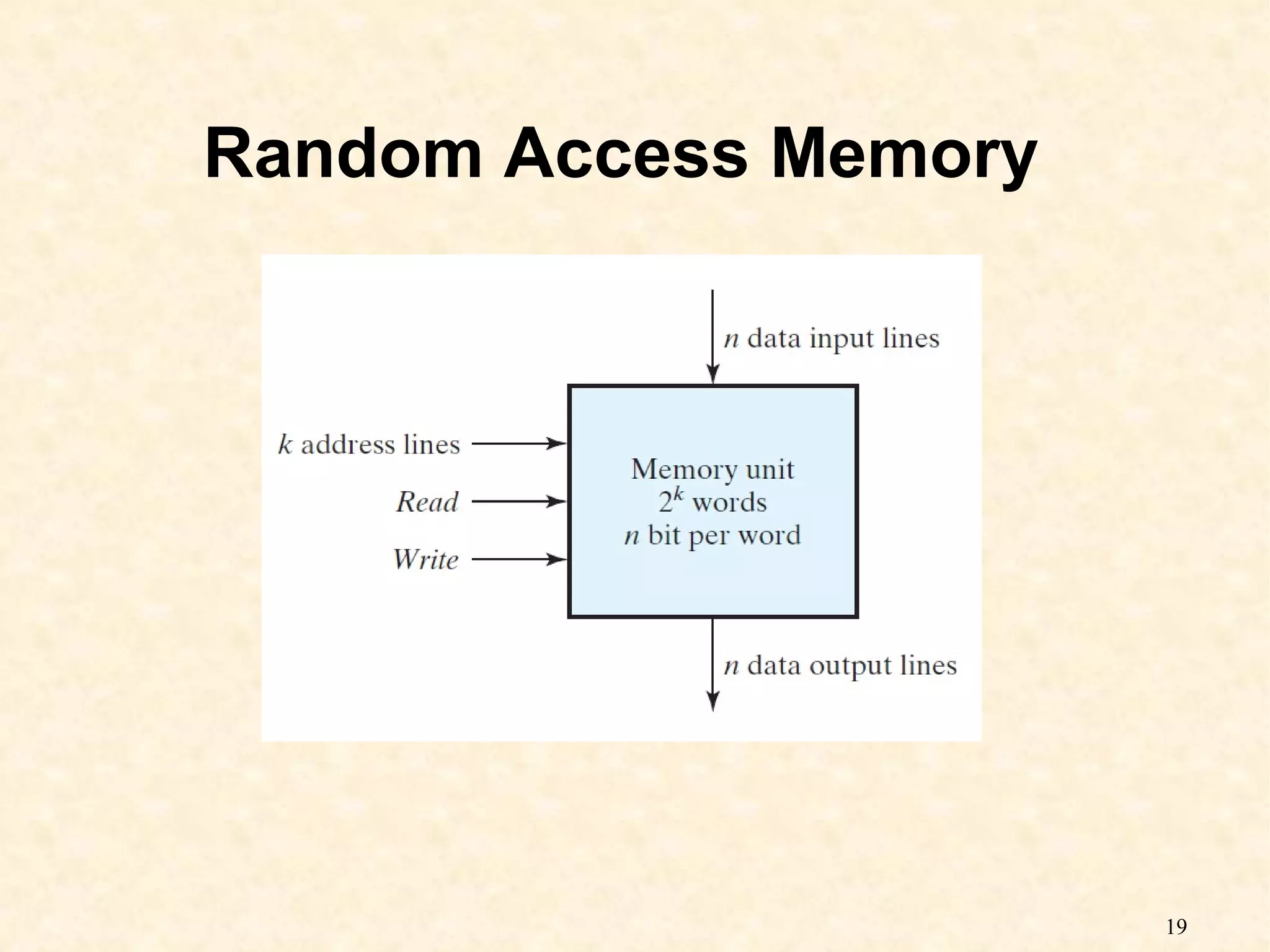
Address
− Location in memory of the binary information
− Must be decoded to select the appropriate
location and read/write the associated data
− k-bit address → 2k
memory locations

Data
− Binary information of interest
− Stored in a specific location in the memory
− Typically organized into words
− Each word has n bits
17
Random Access Memory
address
10-bit address
1024 locations
data
18
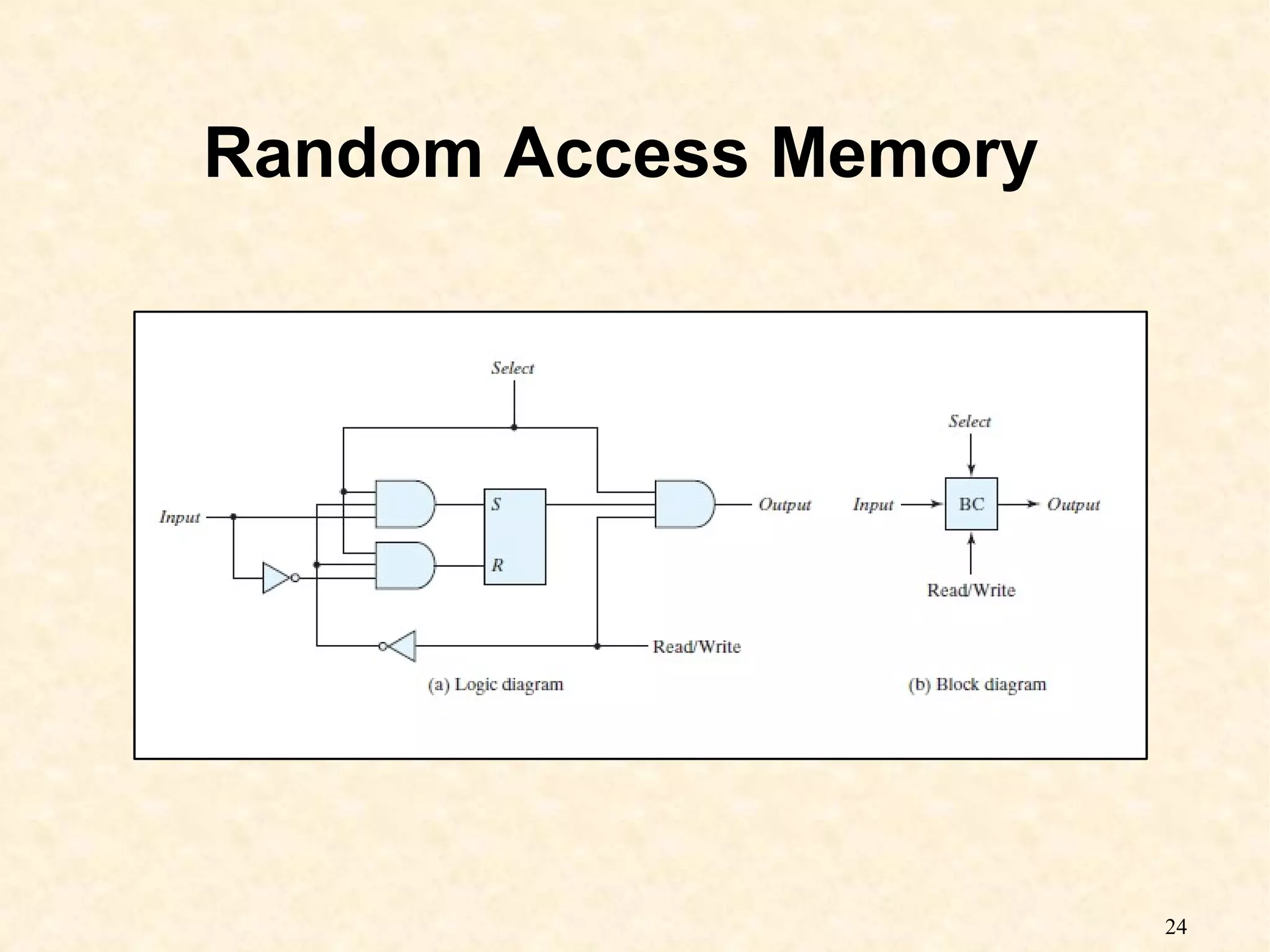
Random Access Memory

Read
− Indicates that the memory is to be read

Write
− Indicates that the memory is to be written
19
Random Access Memory
20
Random Access Memory

Rather than use the Read and Write
signals, most commercially available RAM
chips use Enable and Read/Write'

Enable
− Used to enable the selected RAM chip
− Aka. “chip select”

Read/Write'
− RAM is read when Read/Write' = 1
− RAM is written when Read/Write' = 0
21
Random Access Memory
22
Random Access Memory
Write Cycle
23
Random Access Memory
Read Cycle
24
Random Access Memory
25
Random Access Memory
Terminology used to address memories
1. 1K = 210
2. 1M = 220
3. 1G = 230
Problems
The memory units that follow are specified by the number of words times
the number of bits per word, How many address lines and input-output
data lines are needed in each case?
(a)8K x 16
(b)2G X 8
(c)16M X 32
(d)256K X 64
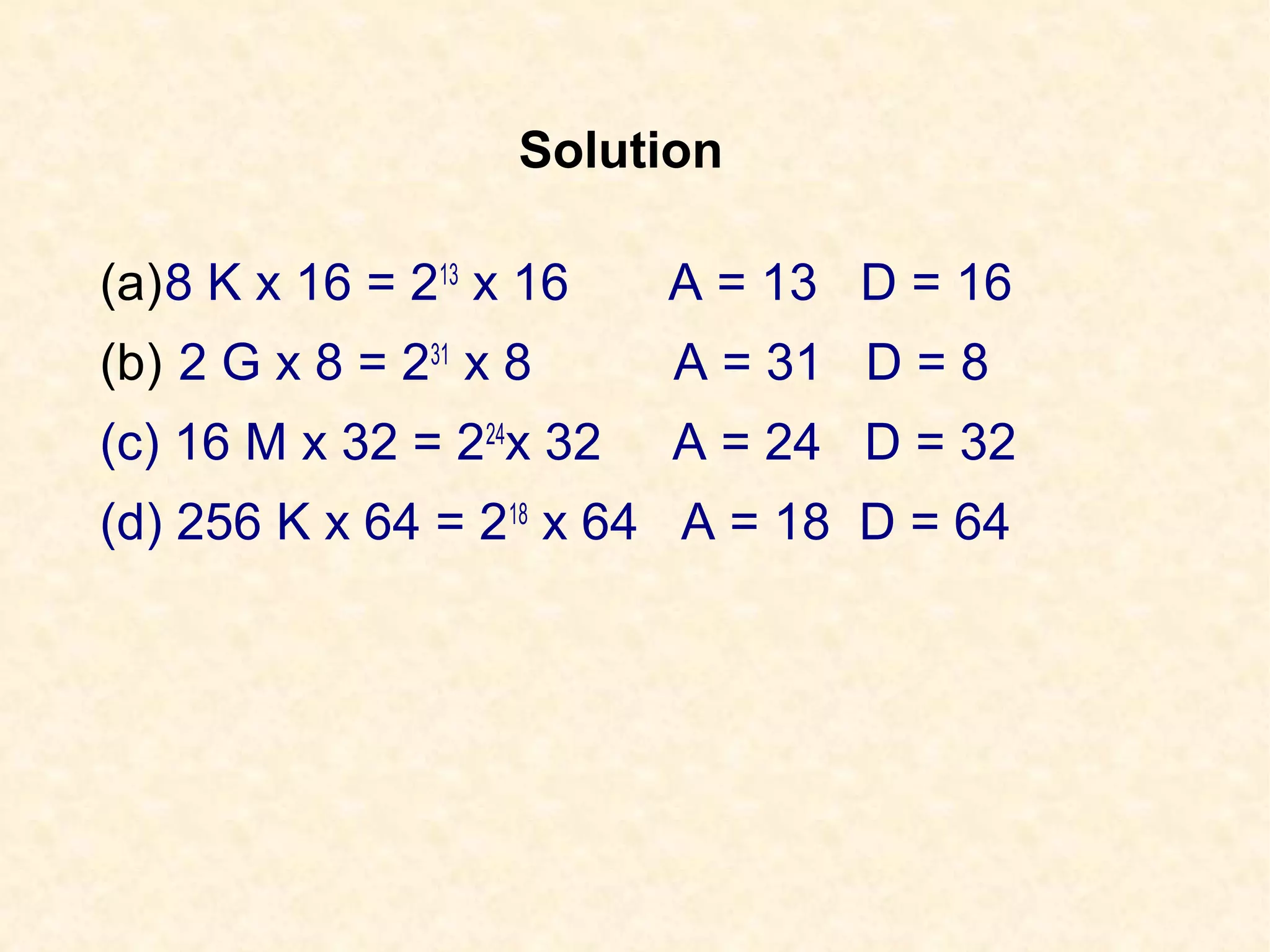
Solution
(a)8 K x 16 = 213
x 16 A = 13 D = 16
(b) 2 G x 8 = 231
x 8 A = 31 D = 8
(c) 16 M x 32 = 224
x 32 A = 24 D = 32
(d) 256 K x 64 = 218
x 64 A = 18 D = 64
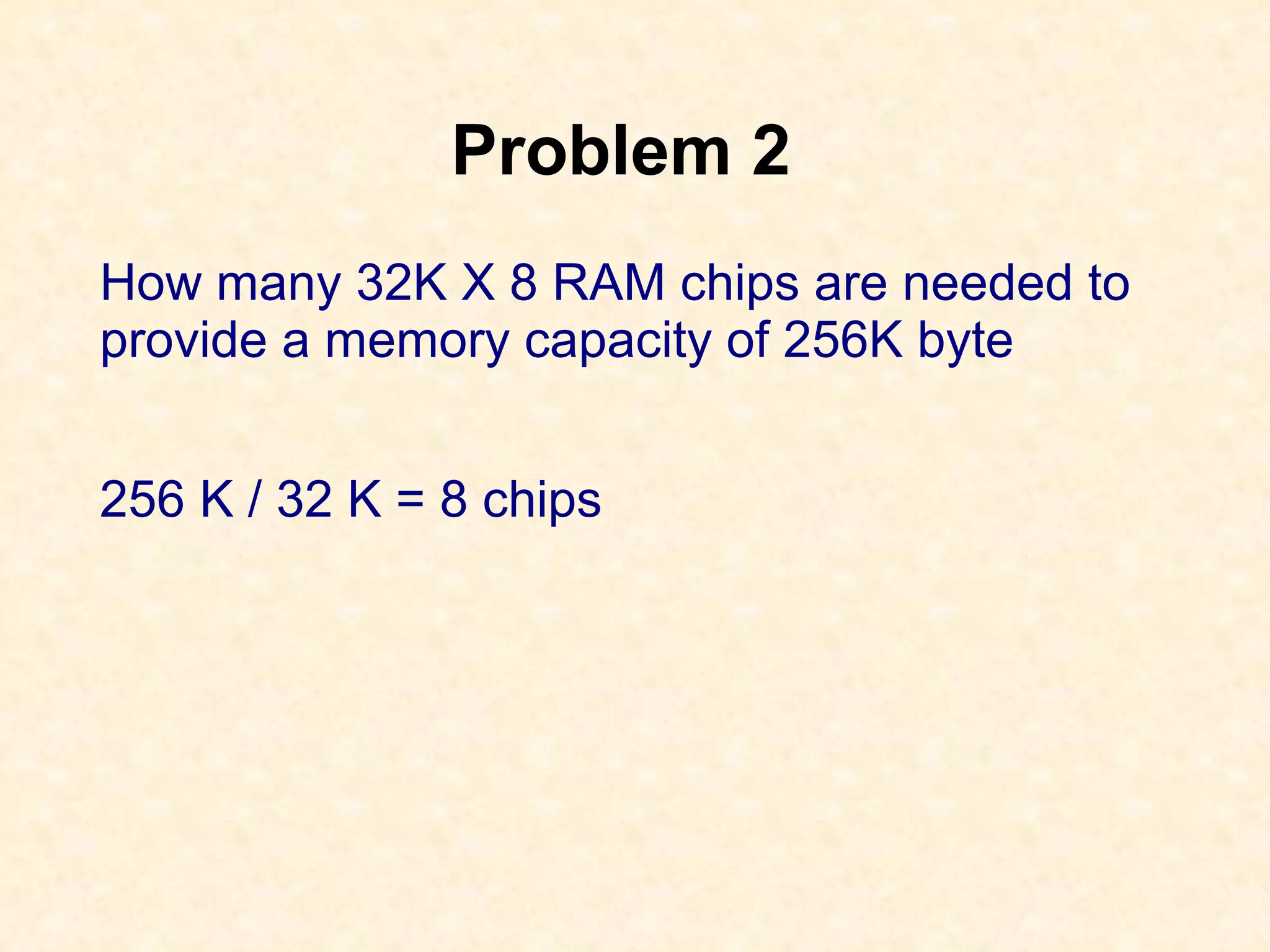
Problem 2
How many 32K X 8 RAM chips are needed to
provide a memory capacity of 256K byte
256 K / 32 K = 8 chips
End of Topic

Memory

  • 1.
    Memory (Introduction to Read-onlymemory, read/write memory - SRAM and DRAM)
  • 2.
    2 Memory Memory is requiredto store: 1. data 2. application programs 3. operating system
  • 3.
    3 Memory Can be broadlyclassified as: Random Access Memory (RAM) or Read Only Memory (ROM)
  • 4.
    4 Random Access Memory(RAM)  Can be written to or read from. − Read/Write memory  Reading from RAM is non-destructive.  Access time to read from any memory location is the same. − As compared to serial access memory.  Volatile − Information is lost when power is removed.
  • 5.
  • 6.
    6 Random Access Memory(RAM)  Static Random Access Memory (SRAM) − Based on the Flip-Flop − Requires a large number of transistors − Fast  Dynamic Random Access Memory (DRAM) − Uses a single transistor to store charge − Requires very few transistors − Must be periodically refreshed − Slow(er)
  • 7.
    Summary: 1. SRAM isstatic while DRAM is dynamic. 2. SRAM is faster compared to DRAM. 3. SRAM consumes less power than DRAM. 4. SRAM uses more transistors per bit of memory compared to DRAM. 5. SRAM is more expensive than DRAM. 6. Cheaper DRAM is used in main memory while SRAM is commonly used in cache memory
  • 8.
    8 Random Access Memory(RAM) What is typically stored in RAM?
  • 9.
    9 Read Only Memory(ROM)  Can only be read from.  Memory is written (or “programmed”) once  Reading from ROM is non-destructive.  Access time to read from any memory location is the same. − As compared to serial access memory.  Non-Volatile − Information is retained even after power is removed.
  • 10.
  • 11.
    11 Read Only Memory(ROM)  Programmable Read Only Memory (PROM) − Can be “programmed”  Erasable PROM (EPROM) − Can be “programmed” and erased  Electrically Erasable PROM (EEPROM) − Can be erased using an electrical signal  UV Erasable PROM (UVEPROM) − Can be erased using Ultraviolet light
  • 12.
  • 13.
    13 Read Only Memory(ROM) What is typically stored in ROM?
  • 14.
  • 15.
  • 16.
    16 Random Access Memory  Address −Location in memory of the binary information − Must be decoded to select the appropriate location and read/write the associated data − k-bit address → 2k memory locations  Data − Binary information of interest − Stored in a specific location in the memory − Typically organized into words − Each word has n bits
  • 17.
    17 Random Access Memory address 10-bitaddress 1024 locations data
  • 18.
    18 Random Access Memory  Read −Indicates that the memory is to be read  Write − Indicates that the memory is to be written
  • 19.
  • 20.
    20 Random Access Memory  Ratherthan use the Read and Write signals, most commercially available RAM chips use Enable and Read/Write'  Enable − Used to enable the selected RAM chip − Aka. “chip select”  Read/Write' − RAM is read when Read/Write' = 1 − RAM is written when Read/Write' = 0
  • 21.
  • 22.
  • 23.
  • 24.
  • 25.
  • 26.
    Terminology used toaddress memories 1. 1K = 210 2. 1M = 220 3. 1G = 230
  • 27.
    Problems The memory unitsthat follow are specified by the number of words times the number of bits per word, How many address lines and input-output data lines are needed in each case? (a)8K x 16 (b)2G X 8 (c)16M X 32 (d)256K X 64
  • 28.
    Solution (a)8 K x16 = 213 x 16 A = 13 D = 16 (b) 2 G x 8 = 231 x 8 A = 31 D = 8 (c) 16 M x 32 = 224 x 32 A = 24 D = 32 (d) 256 K x 64 = 218 x 64 A = 18 D = 64
  • 29.
    Problem 2 How many32K X 8 RAM chips are needed to provide a memory capacity of 256K byte 256 K / 32 K = 8 chips
  • 30.