PRESENT TENSES
 1.To express what is actually happening at the present moment.
                   e.g. The teacher is teaching.
                     The student are learning.
                   2.To express custom or habit
                      e.g. I take tea morning.
                        I exercise everyday.
3.To express what is always and necessarily true[ universal truth].
                  e.g. The sun rises in the East.
                    Honesty is the best policy.
               4. To describe an event of the past.
             e.g. Taj Mahal was built by Shahjahan.
                  5. To express a future action.
       e.g. The school closes next week for Autumn Break.
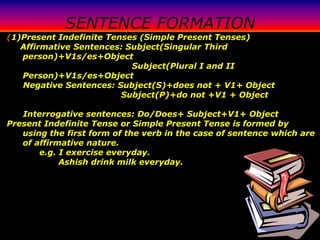
SENTENCE FORMATION
(1)Present Indefinite Tenses (Simple Present Tenses)
   Affirmative Sentences: Subject(Singular Third
   person)+V1s/es+Object
                           Subject(Plural I and II
   Person)+V1s/es+Object
   Negative Sentences: Subject(S)+does not + V1+ Object
                         Subject(P)+do not +V1 + Object

   Interrogative sentences: Do/Does+ Subject+V1+ Object
Present Indefinite Tense or Simple Present Tense is formed by
   using the first form of the verb in the case of sentence which are
   of affirmative nature.
       e.g. I exercise everyday.
            Ashish drink milk everyday.
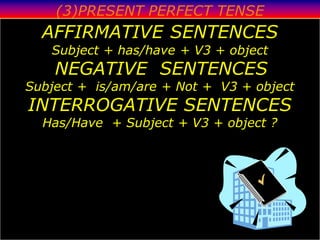
(3)PRESENT PERFECT TENSE
  AFFIRMATIVE SENTENCES
   Subject + has/have + V3 + object
    NEGATIVE SENTENCES
Subject + is/am/are + Not + V3 + object
INTERROGATIVE SENTENCES
  Has/Have + Subject + V3 + object ?
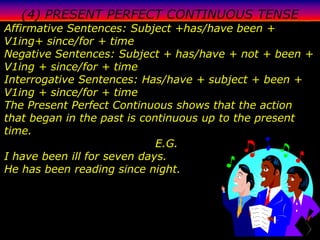
(4) PRESENT PERFECT CONTINUOUS TENSE
Affirmative Sentences: Subject +has/have been +
V1ing+ since/for + time
Negative Sentences: Subject + has/have + not + been +
V1ing + since/for + time
Interrogative Sentences: Has/have + subject + been +
V1ing + since/for + time
The Present Perfect Continuous shows that the action
that began in the past is continuous up to the present
time.
                             E.G.
I have been ill for seven days.
He has been reading since night.
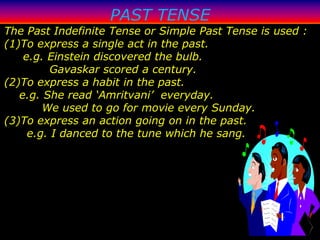
PAST TENSE
The Past Indefinite Tense or Simple Past Tense is used :
(1)To express a single act in the past.
    e.g. Einstein discovered the bulb.
          Gavaskar scored a century.
(2)To express a habit in the past.
   e.g. She read ‘Amritvani’ everyday.
        We used to go for movie every Sunday.
(3)To express an action going on in the past.
     e.g. I danced to the tune which he sang.
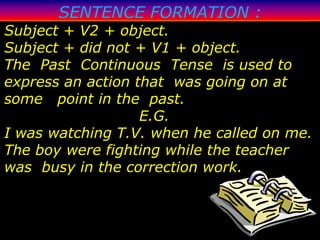
SENTENCE FORMATION :
Subject + V2 + object.
Subject + did not + V1 + object.
The Past Continuous Tense is used to
express an action that was going on at
some point in the past.
                   E.G.
I was watching T.V. when he called on me.
The boy were fighting while the teacher
was busy in the correction work.
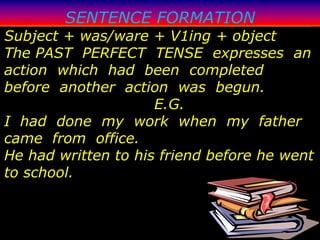
SENTENCE FORMATION
Subject + was/ware + V1ing + object
The PAST PERFECT TENSE expresses an
action which had been completed
before another action was begun.
                     E.G.
I had done my work when my father
came from office.
He had written to his friend before he went
to school.
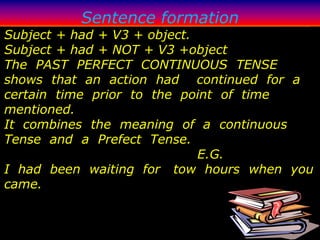
Sentence formation
Subject + had + V3 + object.
Subject + had + NOT + V3 +object
The PAST PERFECT CONTINUOUS TENSE
shows that an action had continued for a
certain time prior to the point of time
mentioned.
It combines the meaning of a continuous
Tense and a Prefect Tense.
                             E.G.
I had been waiting for tow hours when you
came.
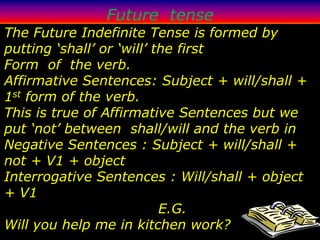
Future tense
The Future Indefinite Tense is formed by
putting ‘shall’ or ‘will’ the first
Form of the verb.
Affirmative Sentences: Subject + will/shall +
1st form of the verb.
This is true of Affirmative Sentences but we
put ‘not’ between shall/will and the verb in
Negative Sentences : Subject + will/shall +
not + V1 + object
Interrogative Sentences : Will/shall + object
+ V1
                           E.G.
Will you help me in kitchen work?
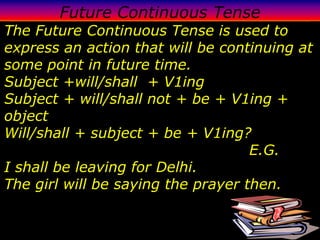
Future Continuous Tense
The Future Continuous Tense is used to
express an action that will be continuing at
some point in future time.
Subject +will/shall + V1ing
Subject + will/shall not + be + V1ing +
object
Will/shall + subject + be + V1ing?
                                    E.G.
I shall be leaving for Delhi.
The girl will be saying the prayer then.
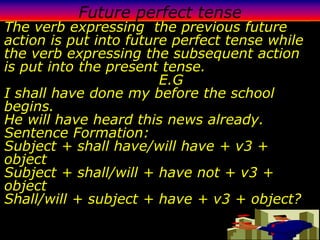
Future perfect tense
The verb expressing the previous future
action is put into future perfect tense while
the verb expressing the subsequent action
is put into the present tense.
                        E.G
I shall have done my before the school
begins.
He will have heard this news already.
Sentence Formation:
Subject + shall have/will have + v3 +
object
Subject + shall/will + have not + v3 +
object
Shall/will + subject + have + v3 + object?
Future perfect continuous tense
The FUTURE PERFEECT CONTINUOUS TENSE
shows an action that will have been going on
at, or before, some point of time in the future ;
as
                      E.G
We will have been living there for two months by
then.
SENTENCE FORMATION:
Subject + shall/will + have been + v1ing +
object
Subject + shall/will + not + have been + v1ing
+ object
Shall/will + subject + have been+ v1ing +
object?

Rahul 8

  • 2.
    PRESENT TENSES 1.Toexpress what is actually happening at the present moment. e.g. The teacher is teaching. The student are learning. 2.To express custom or habit e.g. I take tea morning. I exercise everyday. 3.To express what is always and necessarily true[ universal truth]. e.g. The sun rises in the East. Honesty is the best policy. 4. To describe an event of the past. e.g. Taj Mahal was built by Shahjahan. 5. To express a future action. e.g. The school closes next week for Autumn Break.
  • 3.
    SENTENCE FORMATION (1)Present IndefiniteTenses (Simple Present Tenses) Affirmative Sentences: Subject(Singular Third person)+V1s/es+Object Subject(Plural I and II Person)+V1s/es+Object Negative Sentences: Subject(S)+does not + V1+ Object Subject(P)+do not +V1 + Object Interrogative sentences: Do/Does+ Subject+V1+ Object Present Indefinite Tense or Simple Present Tense is formed by using the first form of the verb in the case of sentence which are of affirmative nature. e.g. I exercise everyday. Ashish drink milk everyday.
  • 4.
    (3)PRESENT PERFECT TENSE AFFIRMATIVE SENTENCES Subject + has/have + V3 + object NEGATIVE SENTENCES Subject + is/am/are + Not + V3 + object INTERROGATIVE SENTENCES Has/Have + Subject + V3 + object ?
  • 5.
    (4) PRESENT PERFECTCONTINUOUS TENSE Affirmative Sentences: Subject +has/have been + V1ing+ since/for + time Negative Sentences: Subject + has/have + not + been + V1ing + since/for + time Interrogative Sentences: Has/have + subject + been + V1ing + since/for + time The Present Perfect Continuous shows that the action that began in the past is continuous up to the present time. E.G. I have been ill for seven days. He has been reading since night.
  • 6.
    PAST TENSE The PastIndefinite Tense or Simple Past Tense is used : (1)To express a single act in the past. e.g. Einstein discovered the bulb. Gavaskar scored a century. (2)To express a habit in the past. e.g. She read ‘Amritvani’ everyday. We used to go for movie every Sunday. (3)To express an action going on in the past. e.g. I danced to the tune which he sang.
  • 7.
    SENTENCE FORMATION : Subject+ V2 + object. Subject + did not + V1 + object. The Past Continuous Tense is used to express an action that was going on at some point in the past. E.G. I was watching T.V. when he called on me. The boy were fighting while the teacher was busy in the correction work.
  • 8.
    SENTENCE FORMATION Subject +was/ware + V1ing + object The PAST PERFECT TENSE expresses an action which had been completed before another action was begun. E.G. I had done my work when my father came from office. He had written to his friend before he went to school.
  • 9.
    Sentence formation Subject +had + V3 + object. Subject + had + NOT + V3 +object The PAST PERFECT CONTINUOUS TENSE shows that an action had continued for a certain time prior to the point of time mentioned. It combines the meaning of a continuous Tense and a Prefect Tense. E.G. I had been waiting for tow hours when you came.
  • 10.
    Future tense The FutureIndefinite Tense is formed by putting ‘shall’ or ‘will’ the first Form of the verb. Affirmative Sentences: Subject + will/shall + 1st form of the verb. This is true of Affirmative Sentences but we put ‘not’ between shall/will and the verb in Negative Sentences : Subject + will/shall + not + V1 + object Interrogative Sentences : Will/shall + object + V1 E.G. Will you help me in kitchen work?
  • 11.
    Future Continuous Tense TheFuture Continuous Tense is used to express an action that will be continuing at some point in future time. Subject +will/shall + V1ing Subject + will/shall not + be + V1ing + object Will/shall + subject + be + V1ing? E.G. I shall be leaving for Delhi. The girl will be saying the prayer then.
  • 12.
    Future perfect tense Theverb expressing the previous future action is put into future perfect tense while the verb expressing the subsequent action is put into the present tense. E.G I shall have done my before the school begins. He will have heard this news already. Sentence Formation: Subject + shall have/will have + v3 + object Subject + shall/will + have not + v3 + object Shall/will + subject + have + v3 + object?
  • 13.
    Future perfect continuoustense The FUTURE PERFEECT CONTINUOUS TENSE shows an action that will have been going on at, or before, some point of time in the future ; as E.G We will have been living there for two months by then. SENTENCE FORMATION: Subject + shall/will + have been + v1ing + object Subject + shall/will + not + have been + v1ing + object Shall/will + subject + have been+ v1ing + object?