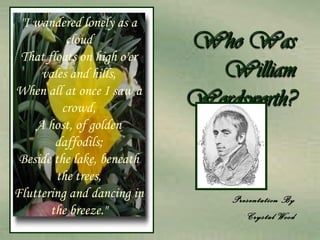
"I wandered lonely as a
          cloud
 That floats on high o'er
     vales and hills,
When all at once I saw a
         crowd,
    A host, of golden
        daffodils;
 Beside the lake, beneath
        the trees,
Fluttering and dancing in   Presentation By
       the breeze."            Crystal Wood
Where It All Began
W illiam Wordsworth
  was born on April
  17, 1770, just
  outside the Lake
  District in the
  quaint market town
  of Cockermouth,
  Cumbria. His
  popularity as a
  poet draws
  thousands of
  tourists to this
  northwestern
  England city every
  year.
The Wordsworth House
 Today, Wordsworth’s
 childhood home is a
 popular tourist
 attraction. The fine
 Georgian home has
 been restored and
 refurnished to its
 original 18 th century
 beauty. Visit
 http://www.wordswort
 hhouse.org.uk/ to take
 an online tour of the
 Wordsworth House.
The Wordsworth House
 Wordsworth refers to his home at Cockermouth in his poem,
  Guilt and Sorrow:
                        XXIV
 "A little croft we owned - a plot of corn,
  A garden stored with peas, and mint, and thyme,
  And flowers for poises, oft on Sunday morn
  Plucked while the church bells rang their earliest chime.
  Can I forget our freaks at shearing time!
  My hen's rich nest through long grass scarce espied;
  The cowslip-gathering in June's dewy prime;
  The swans that with white chests upreared in pride
  Rushing and racing came to meet me at the waterside."
Wordsworth in Nature
    The beautiful landscape of the Lake District inspired
     the young Wordsworth; nature is a common theme
           that can be found in many of his poems.
My heart leaps up when I behold
                     A rainbow in the sky:
The Rainbow      So was it when my life began;
                   So is it now I am a man;
                So be it when I shall grow old,
                         Or let me die!
                The Child is father of the Man;
                  I could wish my days to be
              Bound each to each by natural piety.

                                William Wordsworth
The Wordsworth Household
      William was the second of five children.
   After his mother’s death in 1778, he was sent
   to Hawkshead Grammar School; this is where
    his love for poetry was first established. Five
              years later, his father died.
Wordsworth & the “Common Man”
       In 1790, Wordsworth quit school at St.
    John’s in Cambridge to partake in a walking
     tour of Europe. This experience heightened
      Wordsworth's interest in the life, troubles
     and speech of the "common man,” which is
        another common theme in his works.
Early Works
In 1793, Wordsworth’s first works, An Evening Walk
and Descriptive Sketches, were published but
received little notice.

“Where, bosom'd deep, the shy Winander peeps
  Mid' clust'ring isles, and holly-sprinkl'd steeps;
  Where twilight glens endear my Esthwaite's
  shore,
  And memory of departed pleasures, more.”

                                    From An Evening Walk
“We Were Three Persons With One
Soul.”

    In 1794,
   Wordsworth was
   reunited with his
   sister, Dorothy;
   shortly after, he met another
     poet, Samuel Taylor Coleridge,
     and
   they became close friends.
Lyrical Ballads
Wordsworth and Coleridge saw the poetry of
the Neo-classical period as stale and un-
relatable to the public. The two
Poets initiated the Romantic
era with their collaborative
creation, Lyrical Ballads,
Which contained old themes
and new subjects.
Lyrical Ballads
  Old forms brought       New subjects for
    back to poetry:          poetry:
 The Nursery Rhyme         Children and women
                        Common folks and peasants
  Biblical/Scriptural    Psychological aberrations
                              and altered mental
 The popular ballad                  states
                           Idiocy and madness
                        The nature and purpose of
                                 poetry itself
                                 The Gothic 
Lyrical Ballads
 --From Coleridge’s poem, The Rime of the Ancient Mariner
 “God save thee, ancient Mariner!
 From the fiends, that plague thee thus!—
 Why look'st thou so?—With my crossbow
 I shot the Albatross.”
                                           “For I have learned
                       To look on nature, not as in the hour
             Of thoughtless youth; but hearing oftentimes
                            The still, sad music of humanity,
           Nor harsh nor grating, though of ample power
                                     To chasten and subdue.”
                       --From Wordsworth’s poem, “Tintern Abbey”
Quote from Lyrical Ballads
        "Poetry is the breath and finer
       spirit of all knowledge; it is the
     impassioned expression which is in
       the countenance of all Science.“

                            William Wordsworth
Dove Cottage
 Wordsworth and his
   family called this
   place home from
  1799 to 1807; it is
 another main tourist
     attraction in
       Cumbria.
Mr. and Mrs. Wordsworth
     In 1802,
   Wordsworth
  married Mary
Hutchinson in the
Brompton Church.
   She was the         “She was a Phantom of delight
                      When first she gleamed upon my
inspiration for his                  sight;
poem, “She Was A         A lovely Apparition, sent
   Phantom of           To be a moment's ornament;
                      Her eyes as stars of Twilight fair;
       Delight.”
                       Like Twilight's, too, her dusky
                                     hair;”
Wordsworth in Sorrow
 By 1810, they had                  “… That thought's return
    five children;
  however, two of        Was the worst pang that sorrow ever
   their deaths in                                     bore,
    1812 caused
                            Save one, one only, when I stood
 Wordsworth great                                   forlorn,
 sorrow. His poem,
   “Surprised By       Knowing my heart's best treasure was
  Joy,” reflects his                               no more;
       anguish.
                         That neither present time, nor years
                                                      unborn

                       Could to my sight that heavenly face
                                                   restore.”
Rydal Mount and Beyond
  Shortly after, Wordsworth
                and
  his family settled at Rydal
              Mount
 where he continued to write
 poetry for the remainder of
                his
   life. In 1843, he became
   England’s poet laureate.
 He died on April 23, 1850,
                and
    is buried at St Oswald's
Conclusion
  It was Wordsworth's emotional power, rather than
    his range of intellect, that made him famous and
   influential. He defined poetry as "the spontaneous
 overflow of powerful feelings arising from "emotion
    recollected in tranquility." To him, poetry was an
    overflowing of emotion onto paper backed up by
 the refusal to conform to the “rules” of society. This
      belief, along with his inspirations, allowed his
              talent and emotions to run free.
"Our birth is but a sleep and a forgetting:
  The soul that rises with us, our life's star,
  Hath had elsewhere its setting,
  And cometh from afar.
  Not in entire forgetfulness,
  And not in utter nakedness,
  But trailing clouds of glory, do we come
  From God, who is our home."
Made by : Abhishek tyagi
10 th

William worsworth

  • 1.
    "I wandered lonelyas a cloud That floats on high o'er vales and hills, When all at once I saw a crowd, A host, of golden daffodils; Beside the lake, beneath the trees, Fluttering and dancing in Presentation By the breeze." Crystal Wood
  • 2.
    Where It AllBegan W illiam Wordsworth was born on April 17, 1770, just outside the Lake District in the quaint market town of Cockermouth, Cumbria. His popularity as a poet draws thousands of tourists to this northwestern England city every year.
  • 3.
    The Wordsworth House Today, Wordsworth’s childhood home is a popular tourist attraction. The fine Georgian home has been restored and refurnished to its original 18 th century beauty. Visit http://www.wordswort hhouse.org.uk/ to take an online tour of the Wordsworth House.
  • 4.
    The Wordsworth House Wordsworth refers to his home at Cockermouth in his poem, Guilt and Sorrow: XXIV "A little croft we owned - a plot of corn, A garden stored with peas, and mint, and thyme, And flowers for poises, oft on Sunday morn Plucked while the church bells rang their earliest chime. Can I forget our freaks at shearing time! My hen's rich nest through long grass scarce espied; The cowslip-gathering in June's dewy prime; The swans that with white chests upreared in pride Rushing and racing came to meet me at the waterside."
  • 5.
    Wordsworth in Nature The beautiful landscape of the Lake District inspired the young Wordsworth; nature is a common theme that can be found in many of his poems.
  • 6.
    My heart leapsup when I behold A rainbow in the sky: The Rainbow So was it when my life began; So is it now I am a man; So be it when I shall grow old, Or let me die! The Child is father of the Man; I could wish my days to be Bound each to each by natural piety. William Wordsworth
  • 7.
    The Wordsworth Household William was the second of five children. After his mother’s death in 1778, he was sent to Hawkshead Grammar School; this is where his love for poetry was first established. Five years later, his father died.
  • 8.
    Wordsworth & the“Common Man” In 1790, Wordsworth quit school at St. John’s in Cambridge to partake in a walking tour of Europe. This experience heightened Wordsworth's interest in the life, troubles and speech of the "common man,” which is another common theme in his works.
  • 9.
    Early Works In 1793,Wordsworth’s first works, An Evening Walk and Descriptive Sketches, were published but received little notice. “Where, bosom'd deep, the shy Winander peeps Mid' clust'ring isles, and holly-sprinkl'd steeps; Where twilight glens endear my Esthwaite's shore, And memory of departed pleasures, more.” From An Evening Walk
  • 10.
    “We Were ThreePersons With One Soul.” In 1794, Wordsworth was reunited with his sister, Dorothy; shortly after, he met another poet, Samuel Taylor Coleridge, and they became close friends.
  • 11.
    Lyrical Ballads Wordsworth andColeridge saw the poetry of the Neo-classical period as stale and un- relatable to the public. The two Poets initiated the Romantic era with their collaborative creation, Lyrical Ballads, Which contained old themes and new subjects.
  • 12.
    Lyrical Ballads Old forms brought New subjects for back to poetry: poetry: The Nursery Rhyme  Children and women Common folks and peasants Biblical/Scriptural Psychological aberrations and altered mental The popular ballad states Idiocy and madness The nature and purpose of poetry itself The Gothic 
  • 13.
    Lyrical Ballads --FromColeridge’s poem, The Rime of the Ancient Mariner “God save thee, ancient Mariner! From the fiends, that plague thee thus!— Why look'st thou so?—With my crossbow I shot the Albatross.” “For I have learned To look on nature, not as in the hour Of thoughtless youth; but hearing oftentimes The still, sad music of humanity, Nor harsh nor grating, though of ample power To chasten and subdue.” --From Wordsworth’s poem, “Tintern Abbey”
  • 14.
    Quote from LyricalBallads "Poetry is the breath and finer spirit of all knowledge; it is the impassioned expression which is in the countenance of all Science.“ William Wordsworth
  • 15.
    Dove Cottage Wordsworthand his family called this place home from 1799 to 1807; it is another main tourist attraction in Cumbria.
  • 16.
    Mr. and Mrs.Wordsworth In 1802, Wordsworth married Mary Hutchinson in the Brompton Church. She was the “She was a Phantom of delight When first she gleamed upon my inspiration for his sight; poem, “She Was A A lovely Apparition, sent Phantom of To be a moment's ornament; Her eyes as stars of Twilight fair; Delight.” Like Twilight's, too, her dusky hair;”
  • 17.
    Wordsworth in Sorrow By 1810, they had “… That thought's return five children; however, two of Was the worst pang that sorrow ever their deaths in bore, 1812 caused Save one, one only, when I stood Wordsworth great forlorn, sorrow. His poem, “Surprised By Knowing my heart's best treasure was Joy,” reflects his no more; anguish. That neither present time, nor years unborn Could to my sight that heavenly face restore.”
  • 18.
    Rydal Mount andBeyond Shortly after, Wordsworth and his family settled at Rydal Mount where he continued to write poetry for the remainder of his life. In 1843, he became England’s poet laureate. He died on April 23, 1850, and is buried at St Oswald's
  • 19.
    Conclusion Itwas Wordsworth's emotional power, rather than his range of intellect, that made him famous and influential. He defined poetry as "the spontaneous overflow of powerful feelings arising from "emotion recollected in tranquility." To him, poetry was an overflowing of emotion onto paper backed up by the refusal to conform to the “rules” of society. This belief, along with his inspirations, allowed his talent and emotions to run free.
  • 20.
    "Our birth isbut a sleep and a forgetting: The soul that rises with us, our life's star, Hath had elsewhere its setting, And cometh from afar. Not in entire forgetfulness, And not in utter nakedness, But trailing clouds of glory, do we come From God, who is our home."
  • 21.
    Made by :Abhishek tyagi 10 th