

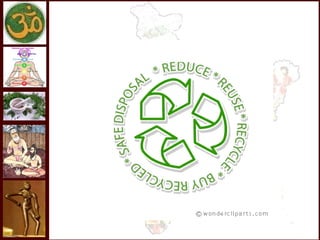





Reuse Keep your world clean and green.
 Save trees,Save the environment!!
Clean city,Green city!!
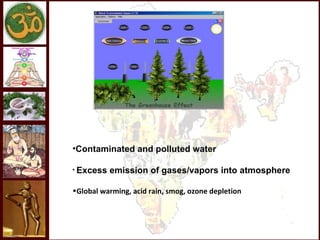
•Contaminated and polluted water

• Excess   emission of gases/vapors into atmosphere

•Global warming, acid rain, smog, ozone depletion
Pollution causes not only physical disabilities but also
psychological and behavioral disorders in people.

         Reduced lung functioning

         Irritation of eyes, nose, mouth and throat

         Asthma attacks

         Respiratory symptoms such as coughing and wheezing


         Increased respiratory disease such as bronchitis

         Reduced energy levels

         Headaches and dizziness

         Disruption of endocrine, reproductive and immune systems

         Neurobehavioral disorders
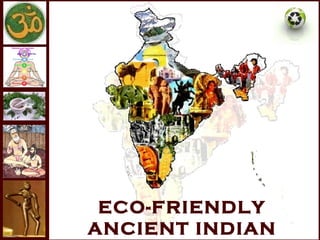
ECO-FRIENDLY
ANCIENT INDIAN
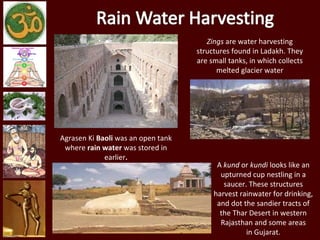
Zings are water harvesting
                                    structures found in Ladakh. They
                                    are small tanks, in which collects
                                          melted glacier water


Agrasen Ki Baoli was an open tank
 where rain water was stored in
             earlier.
                                          A kund or kundi looks like an
                                           upturned cup nestling in a
                                            saucer. These structures
                                         harvest rainwater for drinking,
                                          and dot the sandier tracts of
                                           the Thar Desert in western
                                           Rajasthan and some areas
                                                   in Gujarat.
"It is already becoming clear that a
      chapter which had a Western
 beginning will have to have an Indian
  ending if it is not to end in the self-
destruction of the human race. At this
    supremely dangerous moment in
history, the only way of salvation for
        mankind is the Indian Way.“
      Dr Arnold Toynbee (British Historian, 1889-1975)
These ancient practices not
only protect our environment
but also help the human beings
to lead a happy and disease
free life. These type of prctices
we can adopt now anf make our
 MOTHER EARTH CLEAN AND
BEAUTIFUL PLACE TO
LIVE…….

Ancient practices

  • 2.
    Reuse Keep yourworld clean and green. Save trees,Save the environment!! Clean city,Green city!!
  • 4.
    •Contaminated and pollutedwater • Excess emission of gases/vapors into atmosphere •Global warming, acid rain, smog, ozone depletion
  • 5.
    Pollution causes notonly physical disabilities but also psychological and behavioral disorders in people.          Reduced lung functioning          Irritation of eyes, nose, mouth and throat          Asthma attacks          Respiratory symptoms such as coughing and wheezing          Increased respiratory disease such as bronchitis          Reduced energy levels          Headaches and dizziness          Disruption of endocrine, reproductive and immune systems          Neurobehavioral disorders
  • 6.
  • 14.
    Zings are water harvesting structures found in Ladakh. They are small tanks, in which collects melted glacier water Agrasen Ki Baoli was an open tank where rain water was stored in earlier. A kund or kundi looks like an upturned cup nestling in a saucer. These structures harvest rainwater for drinking, and dot the sandier tracts of the Thar Desert in western Rajasthan and some areas in Gujarat.
  • 15.
    "It is alreadybecoming clear that a chapter which had a Western beginning will have to have an Indian ending if it is not to end in the self- destruction of the human race. At this supremely dangerous moment in history, the only way of salvation for mankind is the Indian Way.“ Dr Arnold Toynbee (British Historian, 1889-1975)
  • 16.
    These ancient practicesnot only protect our environment but also help the human beings to lead a happy and disease free life. These type of prctices we can adopt now anf make our MOTHER EARTH CLEAN AND BEAUTIFUL PLACE TO LIVE…….

Editor's Notes

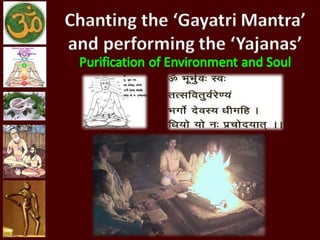
  • #8 Purification of the environment and the inner soul
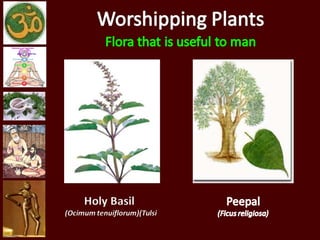
  • #9 Tulsi’s extracts are used in  ayurvedic  remedies for common colds, headaches, stomach disorders, inflammation, heart disease, various forms of poisoning, and malaria. Traditionally, tulsi is taken in many forms: as herbal tea, dried powder, fresh leaf, or mixed with  ghee . Ficus religiosa  is used in traditional medicine for about 50 types of disorders including asthma, diabetes, diarrhea, epilepsy, gastric problems, inflammatory disorders, infectious and sexual disorders. Help of the religion has been taken to discourage people from cutting them. Many other plants and trees which were advantageous were made auspicious e.g. basil plant, myrobalan tree and neem tree etc. A religious instruction was issued to grow the basil plant in the courtyard of the house. People worship it. This plant purifies the surroundings. Taking the leaves of this plant with milk or tea or chewing them as such is advantageous. Basil leaves’ tea cures bad cold in the children. It has many other wonderful medicinal applications.
  • #12 Natural or Vegetable organic dyes have been around in India since ancient times. Their use can be seen in palaces murals and on textiles of India. These vegetable dyes are eco friendly and last longer than most chemical dyes. In dehydration plant extracts coloring liquor from plants, flowers and vegetable peels like pomegranate, onion, mango, plum etc. These materials are then concentrated and converted into powder form. There are around 500 different variety of plants available in India which give color dyes.
  • #13 Indians consume milk on a daily basis, and the cow as a provider of milk, is equated to one's mother (hence the expression Gomäta = mother cow). Traditionally, Indians had cows in every household. They were part of the family, with names and personalities. Just like one would not hurt/eat their pets, the Indians did not hurt the cows and respected them. The cow has a special role in the Hindu mythologies; Kamadhenu is a wish-fulfilling cow. A cow is also depicted as vehicle of several deities The cow was possibly revered because the largely  pastoral  Vedic people and subsequent generations relied heavily on it for  dairy products  and for tilling the fields, and on  cow dung  as a source of fuel,  fertilizer , and  psilocybin mushrooms  which naturally grow out of the animal's own excrement. Universally, Hindus still use cow dung for various purposes; the burning of cow dung creates an insecticide to repel mosquitoes, and ash formed from cow dung is used as a fertilizer. Thus, the cow’s status as a 'caretaker' led to identifying it as an almost maternal figure (hence the term  gau mata ).
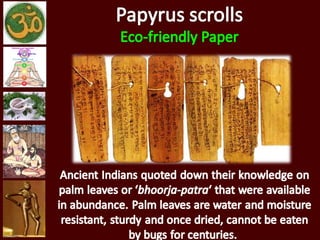
  • #14 Unlike their Western counterparts using papyrus scrolls, ancient Indians quoted down their knowledge on palm leaves or ‘ bhoorja-patra ‘ that were available in abundance in their tropical land. Palm leaves are water and moisture resistant, sturdy and once dried, cannot be eaten by bugs for centuries. Moreover, each plant offers thousands of leaves and each leaf can be cut into tens of ‘pages’, depending on size. In most cases, each page was kept rectangular and measured just few inches in length. Being ultimately thin in their cross-section each book stacked hundreds of pages and hence provided the ancient scholars with plenty of one-spot physical material at hand to textualize their thoughts or knowledge, a rare thing in those times otherwise! Most of the South Asian literature, sacred texts and other compositions between 10th and 13th century AD have been recorded in these palm-leaf books. A peacock feather and black soot from lamps were often used as pen and ink, respectively.
  • #15   It is indeed astonishing to realize that at the dawn of civilisation, the humans understood the significance and importance of water.  Johads  are small earthen check dams that capture and conserve rainwater, improving percolation and groundwater recharge. Starting 1984, the last sixteen years have seen the revival of some 3000  johads  spread across more than 650 villages in Alwar district, Rajasthan. Bhitada village , Jhabua district of Madhya pradesh developed the unique pat system. This system was devised according to the peculiarities of the terrain to divert water from swift-flowing hill streams into irrigation channels called pats. The diversion bunds across the stream are made by piling up stones and then lining them with teak leaves and mud to make them leakproof. The pat channel has to negotiate small nullahs that join the stream off and on, and also sheer cliffs before reaching the fields. These sections invariably get washed away during the monsoons. Stone aqueducts have to be built to span the intervening nullahs. Naada / Bandha   Naada/bandha  are found in the Mewar region of the Thar desert. It is a stone check dam, constructed across a stream or gully, to capture monsoon runoff on a stretch of land. Submerged in water, the land becomes fertile as silt deposits on it and the soil retains substantial amounts of water.. Kunds / Kundis  A  kund  or  kundi  looks like an upturned cup nestling in a saucer. These structures harvest rainwater for drinking, and dot the sandier tracts of the Thar Desert in western Rajasthan and some areas in Gujarat.